Theodore

USS Theodore Roosevelt Arrives In The Middle East, Relieving USS George Washington

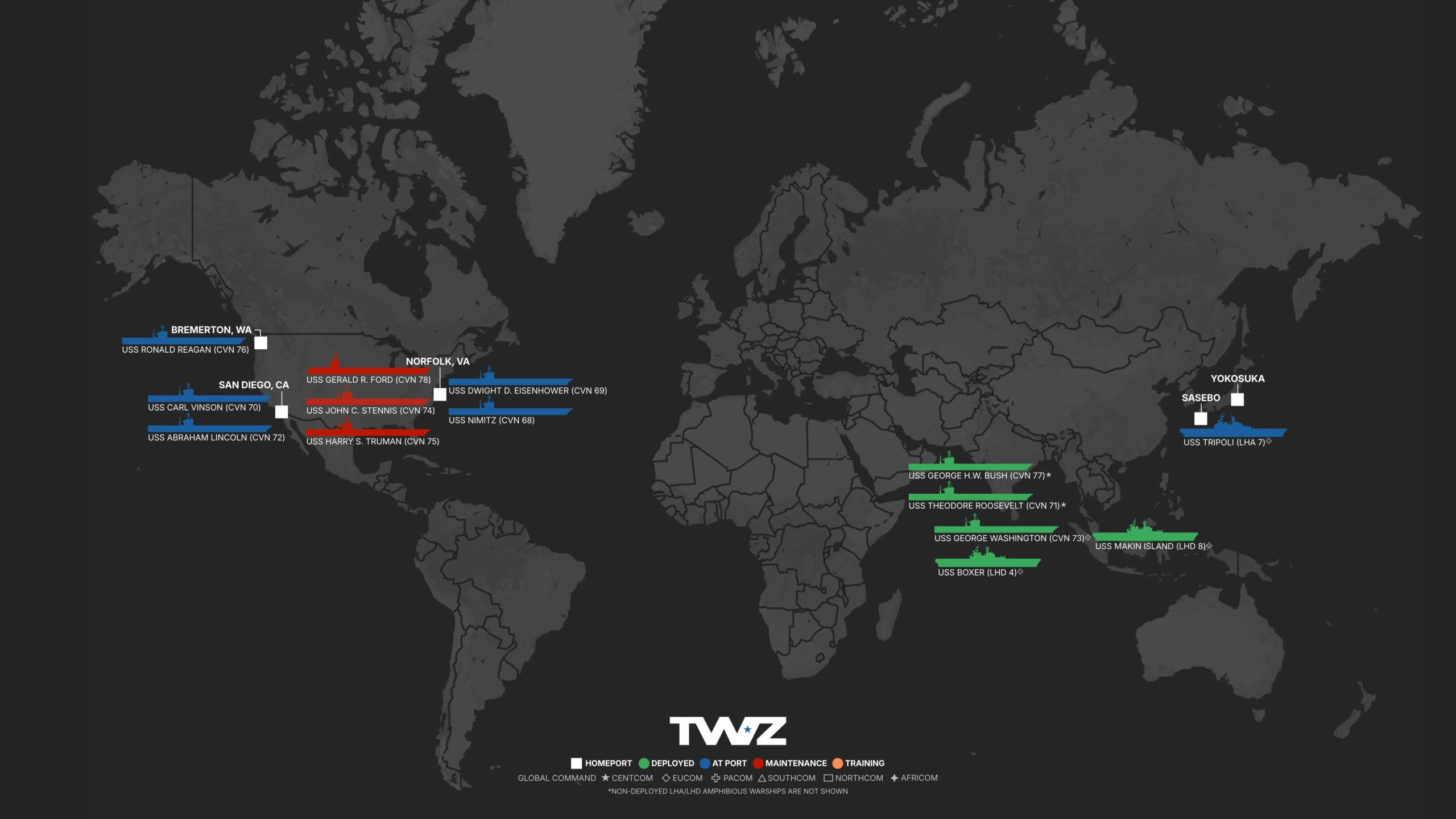
Reinforcements and relief have arrived in the Middle East. USS Theodore Roosevelt chopped into the 5th Fleet-U.S. Central Command (CENTCOM) area of responsibility (AOR) and was pictured sailing alongside USS George Washington in the Arabian Sea this week. With USS George H.W. Bush also on station, Roosevelt’s arrival placed three American aircraft carriers in the Middle East, but the overlap was short-lived, as TWZ anticipated. The George Washington Carrier Strike Group (CSG) has left the region, most recently operating at an undisclosed location off India, and has likely begun the journey back to Yokosuka, Japan. With two carriers remaining in the AOR, U.S. carrier force posture remains unchanged.

Meanwhile, the final elements of the Abraham Lincoln CSG that deployed almost a year ago are finally home after completing historic deployments, amphibious assault ship USS Boxer has moved out of the Middle East while her expected replacement, USS Makin Island, is in Singapore, and the acting secretary of the Navy told senators the service will face five years with nine carriers instead of the legally mandated 11.

Here’s TWZ’s weekly carrier tracker monitoring and visualizing America’s flattop fleet, including deployed CSGs and Amphibious Ready Groups (ARGs), using publicly available open-source information. Check out last week’s report here.

Custom visualization and graphic showing the current position and status of America's 11 aircraft carrier fleet and deployed amphibious assault ships. Created by IAN ELLIS-JONES and TWZ.
Current position and status of America’s aircraft carrier fleet and deployed amphibious assault ships. TWZ/IAN ELLIS-JONES

How Many Aircraft Carriers Are Still In The Middle East?

USS Theodore Roosevelt left Singapore on November 8 after a short stop at Changi Naval Base, transited the Strait of Malacca, and crossed into the CENTCOM AOR on or around November 15. Guided-missile cruiser USS Chosin and guided-missile destroyer USS Decatur accompanied the flattop through the strait, while destroyer USS Paul Hamilton steamed east in the South China Sea. The last element of the strike group, destroyer USS Carl M. Levin, has been disaggregated and operating in the theater since October. It’s unclear if Levin has rejoined the CSG.

During the brief overlap, the three Carrier Air Wings (CVW) in the region combined for 10 squadrons of F/A-18E/F Super Hornets, two squadrons of F-35C Lightning IIs, and three squadrons of EA-18G Growlers. Washington and Roosevelt each embark a squadron of stealthy F-35Cs; the only tactical jets Bush is certified to employ are Super Hornets and Growlers. The one-for-one swap keeps a single squadron of the fifth-generation fighters in theater.

Nimitz-class aircraft carrier USS George Washington (CVN 73) sails alongside Nimitz-class aircraft carrier USS Theodore Roosevelt (CVN 71), Nov. 16, 2026. George Washington is deployed to the U.S. 5th Fleet area of operations to support maritime security and stability in the Middle East. (U.S. Navy photo)
Aircraft carrier USS George Washington sails alongside USS Theodore Roosevelt in the CENTCOM AOR. U.S. Navy photo

Washington left Yokosuka on May 23 for a routine summer patrol in the Western Pacific but was redirected to CENTCOM in August to relieve Lincoln. The carrier is now 181 days into her deployment, roughly double the typical three-month patrol the Sailors aboard expected upon departure. The flattop was last spotted operating in the Indian Ocean (on the U.S. 7th Fleet side) and hosted distinguished visitors including U.S. Ambassador to India Sergio Gor.

Carrier Airwing (CVW) 5 aircraft fly in formation over Nimitz-class aircraft carrier USS George Washington (CVN 73) during an air power demonstration while underway in the Indian Ocean, Nov. 19, 2026. The George Washington Carrier Strike Group is operating in the U.S. 7th Fleet area of operations. George Washington is the U.S. Navy’s premiere forward-deployed aircraft carrier, a long-standing symbol of the United States’ commitment to maintaining a free and open Indo-Pacific, while operating alongside allies and partners across the U.S. Navy’s largest numbered fleet. (U.S. Navy photo by Mass Communication Specialist Seaman Anthony Vilardi)
CVW-5 aircraft fly over USS George Washington during an air power demonstration while in the Indian Ocean. U.S. Navy photo

The blockade of Iranian ports and coastal cities remains in full effect. A U.S. aircraft fired precision munitions and disabled the St. Kitts-flagged cargo ship M/V Huda in the Gulf of Oman on November 7, the fifth vessel disabled since July and the first in nearly a month, and CENTCOM forces have redirected approximately 150 others. Iran resumed attacks on American bases in the region between November 13 and 17, but CENTCOM said the projectiles were intercepted with no resulting damage or casualties. U.S. forces responded Tuesday by striking targets on Qeshm Island.

How Long Will USS George H.W. Bush Be Deployed?

USS George H.W. Bush is staying in theater, for now. She is 234 days into a deployment that began from Norfolk on March 31, and Navy leaders told roughly 500 family members on November 9 at a town hall to plan for a worst-case scenario of 12 months, according to audio obtained by MS NOW. When asked what would bring the strike group home, acting Secretary of the Navy Hung Cao answered, “The criteria is for them to agree to a non-nuclear Iran.”

Two F/A-18E Super Hornets attached to Strike Fighter Squadron (VFA) 103 launch off the flight deck of Nimitz-class aircraft carrier USS George H.W. Bush (CVN 77), Nov. 16, 2026. George H.W. Bush is deployed to the U.S. 5th Fleet area of operations to support maritime security and stability in the Middle East. (U.S. Navy photo)
A pair of Super Hornets launch off the flight deck of USS George H.W. Bush. U.S. Navy photo

Officials told the families the Navy is preparing USS Dwight D. Eisenhower to eventually relieve Bush, which lines up with the early 2027 deployment timeline TWZ first reported in June. A full year would push Bush past the 326-day record set by USS Gerald R. Ford in May. If that timeline plays out, Bush would officially break the record around February 21, 2027.

What Did The Navy’s Acting Secretary Tell Congress About The Carrier Fleet?

Cao testified in front of the Senate Armed Services Committee on Tuesday for his confirmation hearing, and the carrier fleet came up multiple times. He explained that delays tied to the Ford class’s electromagnetic catapults and weapons elevators mean the Navy is facing “five years where we’re going to be down to nine carriers,” two short of the 11 required by law. Sen. Roger Wicker, the committee’s chairman, called President Trump’s demand to return to steam catapults a “non-starter,” as TWZ reported this week.

Cao placed the total battle force at 286 ships and said 17 destroyers are currently supporting the blockade of Iran, and that the development of unmanned surface vessels (USVs) is being accelerated to relieve some of the tasking burden. Sen. Mark Kelly raised reports from families of food shortages aboard Washington and the Boxer ARG, and Cao acknowledged that destroyer USS Gonzalez, most recently operating in the Red Sea, was down to about a week of rations. Sen. Mazie Hirono pressed him on having three strike groups in the Middle East without any coverage in the Pacific.

Acting Navy secretary Hung Cao, President Trump's nominee to lead the U.S. Navy, testified before the Senate Armed Services Committee during his confirmation hearing on November 17, 2026.
Acting Secretary of the Navy Hung Cao testifies before the Senate Armed Services Committee. Photo credit: C-Span

Where Is The Rest Of The American Aircraft Carrier Fleet?

  • On the West Coast, Lincoln is still in San Diego ahead of a homeport shift to Bremerton, Washington, by the end of the year. The last of her escorts arrived back home last week after two historic deployments. Destroyer USS Michael Murphy returned to Pearl Harbor on November 12 after a 346-day cruise and USS Spruance pulled into San Diego a day later after 357 days, which is reportedly the longest destroyer deployment since World War II. USS Ronald Reagan is in Bremerton and USS Carl Vinson is in San Diego.
  • On the East Coast, USS Nimitz returned to Norfolk after a training underway, supporting Carrier Qualifications (CQ) for CVW-1, as well as student naval aviators. She supported 103 sorties, 442 arrested landings, and 152 touch-and-goes, according to the Navy. Eisenhower is also at port in Norfolk.
  • Three carriers remain offline in maintenance. USS John C. Stennis is finishing a Refueling and Complex Overhaul (RCOH), USS Harry S. Truman is at the start of one, and Ford is in a Planned Incremental Availability (PIA) expected to run until March 2027.
  • The future USS John F. Kennedy, back in Norfolk since November 5 after Aircraft Compatibility Testing, is expected to be delivered in spring 2027.
Master-at-Arms 3rd Class Grant Just and Master-at-Arms Seaman Apprentice Kaci Gurley stand crew-serve weapons watch on the starboard catwalk of Nimitz-class aircraft carrier USS Nimitz (CVN 68) as the ship pulls into Naval Station Norfolk after a scheduled underway in the Atlantic Ocean, Nov. 9. 2026. Nimitz is currently homeported in Naval Station Norfolk as flagship of Carrier Strike Group 8. (U.S. Navy photo by Mass Communication Specialist Seaman Apprentice Adam Sytkowski)
Crew aboard USS Nimitz stand weapons watch as the carrier returns to Norfolk, sailing past the future USS John F. Kennedy. U.S. Navy photo

The Big Deck Fleet At A Glance

Overall, three U.S. carriers are deployed, three are working up in various states of readiness, three are in maintenance, one is post-deployment and preparing for an upcoming availability, another is being used primarily for training before deactivation, and the next to be commissioned will be delivered to the fleet in 2027. Two amphibious assault ships are deployed, one is forward-deployed, two are getting ready for future deployments and currently in port, and four are in maintenance.

A custom table showing the status of the American aircraft carrier Fleet as of November 20, 2026. High resolution graphic created by Ian Ellis-Jones and TWZ.

Note: Positions are general approximations. Non-deployed LHA/LHD amphibious warships are not shown on the graphic.

Contact the author: ian@twz.com or @ianellisjones
Ian executes TWZ’s full-spectrum social media strategy, brings his interpretive graphics skills to our editorial team as a Staff Writer and OSINT researcher, and maintains the weekly carrier tracker and newsletter.


Source link

USS Theodore Roosevelt Arrives In Singapore; Last Stop Before Third Strike Group Reaches The Middle East

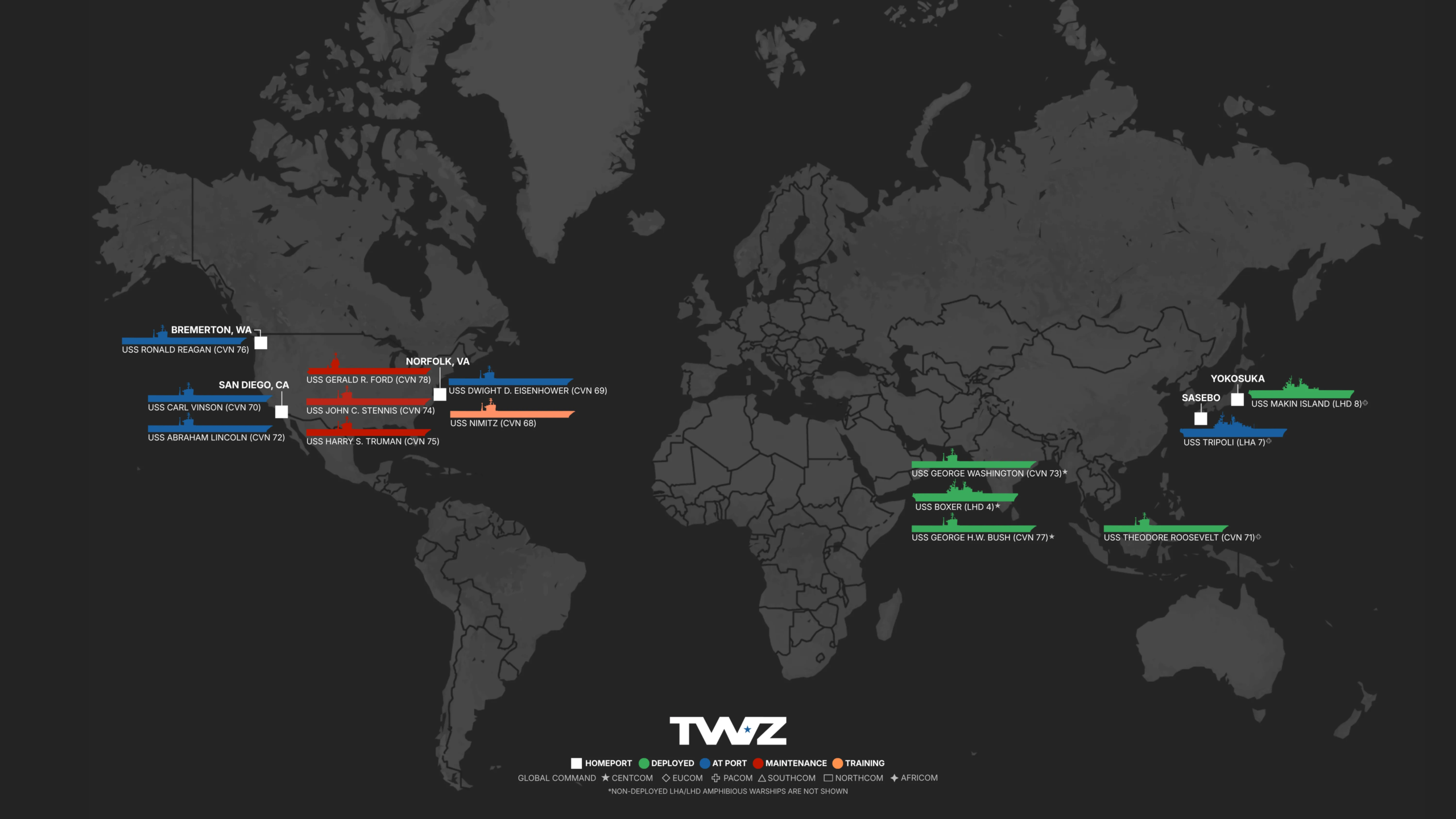
USS Theodore Roosevelt moored at Changi Naval Base in Singapore last night just before midnight Eastern Time, her final stop before continuing on to the Middle East. The Roosevelt Carrier Strike Group (CSG) will join the George H.W. Bush and George Washington CSGs, which are both now prepared, locked, and loaded should the commander in chief follow through on threats to renew military action against Iran after Tuesday’s midterm elections. Roosevelt and the three escorting warships will transit the Strait of Malacca next before heading west toward the U.S. Central Command (CENTCOM) area of responsibility (AOR), a journey that will likely take one to two weeks.

Meanwhile, the U.S. quietly launched strikes on Iran’s Qeshm Island on Monday, according to a report first published by The Wall Street Journal. The U.S. officials cited by The Journal said the strikes were reactive and for defensive purposes, but the paper notes they were the latest in a “series of limited strikes Washington has secretly carried out against the country in recent weeks.” However, it’s possible that CENTCOM began shaping operations to prepare the battlefield if the go order is given. The U.S. military did not announce the strikes publicly, a noteworthy deviation from past operations that were typically disclosed, but U.S. President Donald Trump told Fox on Tuesday it was “just a minor attack” on a recently built “anti-aircraft facility.”

Here’s TWZ’s weekly carrier tracker monitoring and visualizing America’s flattop fleet, including deployed CSGs and Amphibious Ready Groups (ARGs), using publicly available open-source information. Check out last week’s report here.

TWZ’s weekly carrier tracker monitoring and visualizing America’s flattop fleet, including deployed CSGs and Amphibious Ready Groups (ARG), using publicly available open-source information. Created by Ian Ellis-Jones and TWZ.
A high resolution graphic visualizing the status and location of America’s fleet of 11 aircraft carriers. TWZ/IAN ELLIS-JONES

How Fast Can The Theodore Roosevelt CSG Get To The Middle East?

The Theodore Roosevelt CSG completed combined exercise Keen Sword 27, which involved four other allied navies, on October 29. After being topped off by fleet replenishment oiler USNS Tippecanoe the following day, Roosevelt and her three escorts – guided-missile cruiser USS Chosin and guided-missile destroyers USS Paul Hamilton and USS Decatur – entered the South China Sea via the Luzon Strait and steamed southwest toward Singapore. A U.S. official told Axios that the group will spend a few days in Singapore but “won’t reach CENTCOM’s area of responsibility before mid-November.”

A custom TWZ graphic visualizing the transit of aircraft carrier USS Theodore Roosevelt into Changi Naval Base on November 5, 2026. Created by Ian Ellis-Jones and TWZ. Source: MarineTraffic/KPLER  and Reprinted with permission
USS Theodore Roosevelt’s transit on November 5 into Singapore. Source: MarineTraffic/KPLER (Reprinted with permission)

According to MarineTraffic, Roosevelt switched on her Automatic Identification System (AIS) transponder about 100 nautical miles east of Malaysia at 11:25 Eastern Time on November 5, broadcasting a precise position publicly for the first time since departing Yokosuka on October 19. The flattop moored at Berth 3/4 at RSS Singapura–Changi Naval Base approximately 12 hours later, followed by the other three warships over the next few hours.

The next leg of Roosevelt’s transit to the CENTCOM AOR runs north through the narrow Strait of Malacca and west across the vast Indian Ocean. In August, USS George Washington completed the journey from the Strait to the Arabian Sea in just over one week. A few days in port and a roughly 10-day cruise support the reporting of a mid-to-late November arrival.

Nimitz-class aircraft carrier USS Theodore Roosevelt (CVN 71) conducts a replenishment-at-sea with Royal Australian Navy Supply-class replenishment oiler HMAS Stalwart (A304), Nov. 4, 2026. Theodore Roosevelt, flagship of Carrier Strike Group (CSG) 9, is underway conducting routine operations in the U.S. 7th Fleet area of operations, demonstrating the U.S. Navy’s commitment to a free and open Indo Pacific. (U.S. Navy photo)Nimitz-class aircraft carrier USS Theodore Roosevelt (CVN 71) conducts a replenishment-at-sea with Royal Australian Navy Supply-class replenishment oiler HMAS Stalwart (A304), Nov. 4, 2026. Theodore Roosevelt, flagship of Carrier Strike Group (CSG) 9, is underway conducting routine operations in the U.S. 7th Fleet area of operations, demonstrating the U.S. Navy’s commitment to a free and open Indo Pacific. (U.S. Navy photo)
USS Theodore Roosevelt conducts a replenishment-at-sea with Royal Australian Navy oiler HMAS Stalwart in the South China Sea. U.S. Navy photo

Elements of the Makin Island ARG, which is also reportedly bound for the Middle East, were still in Yokosuka, Japan, as of publication. The three-ship amphibious group, packed with more than 2,200 Marines, will likely replace the Boxer ARG, which is approaching eight months deployed and due for relief. The fleet of amphibious warships is stretched thin, with only 31 in the fleet, but Navy and Marine leaders believe at least 40 are required.

Which Carriers Are On Station If The U.S. Launches Post-Midterm Strikes Against Iran?

USS George Washington, with Carrier Air Wing (CVW) 5 embarked, and USS George H.W. Bush, with CVW 7 aboard, are both operating in the Middle East. The composition of both CSGs is fluid as CENTCOM frequently rotates destroyers and cruisers assigned to strike groups with those on independent deployments. Imagery posted on DVIDS, the military’s content-sharing platform, shows Bush launching and recovering F/A-18E/F Super Hornets and EA-18G Growlers on November 4, and Washington conducting a fueling-at-sea evolution alongside fleet replenishment oiler USNS Oscar V. Peterson on November 3.

An EA-18G Growler attached to Electronic Attack Squadron (VAQ) 140 launches from the flight deck of Nimitz-class aircraft carrier USS George H.W. Bush (CVN 77), Nov. 4, 2026. George H.W. Bush is deployed to the U.S. 5th Fleet area of operations to support maritime security and stability in the Middle East. (U.S. Navy photo)
An EA-18G Growler attached to Electronic Attack Squadron (VAQ) 140 launches from USS George H.W. Bush. U.S. Navy photo

Washington left Yokosuka, where she is forward-deployed, 167 days ago on what was expected to be a routine three-month patrol in the Western Pacific. However, the flattop was redirected to the Middle East to relieve the battle-worn USS Abraham Lincoln, leaving the roughly 5,000 Sailors aboard unprepared for an unexpected, and potentially extended, combat deployment. Bush, whose crew knew what their mission was upon departure, has been deployed for 220 days. Neither carrier has broadcast AIS since arriving in theater.

Nimitz-class aircraft carrier USS George Washington (CVN 73) prepares to come alongside Supply-class fast combat support ship USNS Arctic (T-AOE 8) for a replenishment-at-sea evolution, Oct. 31, 2026. George Washington is deployed to the U.S. 5th Fleet area of operations to support maritime security and stability in the Middle East. (U.S. Navy photo)
USS George Washington prepares for a replenishment-at-sea evolution with fast combat support ship USNS Arctic. U.S. Navy photo

An author on the WSJ article referenced above, Shelby Holliday, embarked on Washington in mid-October and provided a firsthand account of life aboard the carrier in a series of must-watch videos on YouTube and Instagram. Sailors spoke candidly about the deployment, and some hinted at what could come next.

Holliday’s interview with the “Gun Boss,” Cmdr. Brian Garcia, showcased AGM-84H/K SLAM-ER (Standoff Land Attack Missile-Expanded Response) air-launched cruise missiles and GBU-31(V)4/B JDAM (Joint Direct Attack Munition) bombs equipped with BLU-109 bunker-buster penetrators. “We’re getting more of these weapons right here, and a couple other items that they feel we’re going to need for whatever the mission set sets forward in the future,” Garcia said. When asked what the magazine room looks like before an escalation, he responded, “This is it right here. This is the preparation that we’re ready for; we don’t need to ramp up because we’re already prepared.”

Where Is The Rest Of The American Aircraft Carrier Fleet?

  • On the West Coast, USS Ronald Reagan returned to her homeport in Bremerton, Washington, on November 3 after departing San Diego the week before. Reagan was completing flight deck certification and carrier qualifications following a lengthy maintenance availability. USS Abraham Lincoln, which will conduct a homeport shift from San Diego to Bremerton by the end of the year ahead of a Drydock Planned Incremental Availability, remains moored at Naval Air Station North Island. Also pierside in San Diego, USS Carl Vinson has not been at sea since completing a 25 days of Tailored Ship’s Training Availability and Final Evaluation Period in September.
  • On the East Coast, USS Dwight D. Eisenhower returned to Naval Station Norfolk yesterday after a one-day underway, according to AIS data. USS Nimitz has been operating at an undisclosed location in the Atlantic Ocean conducting Carrier Air Traffic Control Center certifications with CVW 1, as well as carrier qualifications, since October 27.
  • Three carriers are currently offline in various states of maintenance: USS John C. Stennis, USS Gerald R. Ford, and USS Harry S. Truman. Stennis is at the tail end of a yearslong Refueling and Complex Overhaul (RCOH), while Truman just began an RCOH. Ford began a post-deployment availability in July, and work is expected to be finished by March 2027.
  • The future USS John F. Kennedy, the Navy’s second and newest Gerald R. Ford class supercarrier, returned to Norfolk on November 5 after 13 days at sea conducting Aircraft Compatibility Testing with Super Hornets and Growlers. In mid-October, an F-35C assigned to the Air Test and Evaluation Squadron (VX) 23 made the first arrested landing on and launch from a Ford class. Kennedy, still considered a Pre-Commissioning Unit, is expected to enter the fleet in spring 2027, around the same time Nimitz will begin the process of deactivation.

The Big Deck Fleet At A Glance

Overall, three U.S. carriers are deployed, three are working up in various states of readiness, three are in maintenance, one is post-deployment preparing for an upcoming availability, another is being used primarily for training before deactivation, and the next to be commissioned will be delivered to the fleet in 2027. Two amphibious assault ships are deployed, one is forward-deployed, two are getting ready for upcoming deployments and currently in port, and four are in maintenance.

TWZ’s custom table summarizing the status of America’s fleet of aircraft carriers and amphibious assault ships using publicly available open-source information. Created by Ian Ellis-Jones and TWZ.
The status and location of America’s fleet of 11 aircraft carriers and 9 amphibious assault ships. TWZ/IAN ELLIS-JONES

Note: Positions are general approximations. Non-deployed LHA/LHD amphibious warships are not shown on the graphic.

Contact the author: ian@twz.com or @ianellisjones

Ian executes TWZ’s full-spectrum social media strategy, brings his interpretive graphics skills to our editorial team as a Staff Writer and OSINT researcher, and maintains the weekly carrier tracker and newsletter.


Source link