theaters

Why audiences packed theaters for ‘The Odyssey’

It took an ancient Greek epic to ignite a fire at the box office last weekend, as Christopher Nolan’s adaptation of “The Odyssey” became one of the biggest movie events of the year.

The film, led by Matt Damon as Odysseus, hauled in $123.5 million in the U.S. and Canada on its way to a global total of nearly $264 million — the biggest-ever global opening for one of Nolan’s films.

In many ways, “The Odyssey” is a throwback to old-school Hollywood filmmaking, with Nolan’s use of practical effects and numerous on-location shoots. It’s also a sign that audiences will still pack theaters for the right kind of movie.

The Universal Pictures film also outperformed studio expectations of a $117-million domestic premiere and set a record for the highest-grossing opening weekend for a live-action or R-rated film this year.

“Audiences always want to be thoroughly immersed in the theatrical experience and engulfed by the story and the production, and Christopher Nolan’s ‘The Odyssey’ is a perfect example of that,” Jim Orr, Universal’s president of domestic distribution, said Sunday. “When you have a very substantial opening, and you have those kinds of audience scores, it only points to what should be a remarkable run throughout the summer and into the fall.”

That’s good news for the summer box office, which lately has seen a bit of ebb and flow.

“The Odyssey” now ranks as the third-largest domestic opening of the year, trailing only kid-friendly films such as Walt Disney Co. and Pixar’s “Toy Story 5” and Universal, Illumination and Nintendo’s “The Super Mario Galaxy Movie.” Though family-friendly films have become power players for theaters, the two most recent flicks — Disney’s live-action “Moana” and Universal and Illumination’s “Minions & Monsters” saw softer openings.

After the big weekend for “The Odyssey,” the summer box office is up 7.3% compared with the lackluster 2025 season, according to entertainment data firm Rentrak. More encouraging, the year-to-date domestic box office is now 10.4% higher than for the same period last year.

That’s been helped not only by big blockbusters such as “The Odyssey,” which had a production budget of $200 million to $250 million, but also by the success of smaller-budget films such as A24’s “Backrooms” and Focus Features’ “Obsession.”

The common denominator is the draw of directors who have cultivated strong fan bases. “Obsession” director Curry Barker, 26, and 21-year-old Kane Parsons, who helmed “Backrooms,” have been building their reputation on YouTube among Gen Z audiences, and that loyalty is starting to count for something at the box office.

Nolan, of course, is one of the masters of building a faithful following over more than two decades. Fans started grabbing Imax 70 millimeter tickets for “The Odyssey” when they first went on sale a year ago, and the film ended up driving record presales for the Canadian entertainment tech company, which operates out of Playa Vista.

The film has notched a 95% on aggregator Rotten Tomatoes and an A CinemaScore rating.

“His films have tapped into the cultural zeitgeist,” said Shawn Robbins, director of movie analytics at Fandango and founder of the website Box Office Theory. “That’s what keeps bringing people back. They know they’re going to get a different experience; there’s always going to be a watercooler conversation around his movies, and they’re part of the cultural fabric.”

For “The Odyssey,” part of that conversation was Nolan’s old-school movie magic, including the puppetry, animatronics and robotics he used in scenes with the Cyclops, as well as the real Viking ship that the actors learned to sail.

The film also has driven interest in 70mm screenings from film buffs and casual moviegoers.

Ahead of the premiere of “The Odyssey,” Allen Michaan, owner of Oakland’s Grand Lake Theater, knew the weekend would be very busy for his four-screen movie palace. He is showing the film both in standard digital format and on 70mm film.

You’re reading the Wide Shot

Samantha Masunaga delivers the latest news, analysis and insights on everything from streaming wars to production — and what it all means for the future.

Michaan has made 70mm showings a priority since 1982, when the projector was installed for the release of Steven Spielberg’s “E.T. the Extra-Terrestrial.” He said the theater played that movie for 45 weeks that year. Due to the demand at the time, he installed two more 70mm projectors, making three of his four screens capable of the old-fashioned format.

Demand for the 70mm showings of “The Odyssey” has significantly outperformed their digital screenings, he said.

“We’re thrilled to get any 70mm print because it’s a gift from the filmmaker and the studio,” Michaan said.

Enhanced format screenings for “The Odyssey” made up 53% of the domestic weekend box office, with Imax film and digital revenue accounting for nearly 24%.

Imax 70mm accounted for about 4% of that total, with Imax digital making up the rest. Non-Imax 70mm film screening revenue totaled 3%, while 35mm showings made up 0.3%.

The nearly three-hour epic also marked the first feature film shot entirely on Imax cameras, a feat that required extensive collaboration between Nolan and Imax.

Nolan first told Imax Corp. Chief Executive Rich Gelfond in early 2024 that he was considering making an entire film with Imax cameras and laid out what he’d need for that to happen, including a quieter and lighter camera, a way to make film reloads easier and getting enough trained projectionists.

“It took a fair amount of time and investment” to figure out those challenges, Gelfond said. But by August 2024, the Imax team put together a series of tests to show cinematographer Hoyte van Hoytema. Two months later, Nolan saw the tests and was impressed.

“As filmmakers and studios integrate Imax, we become an increasingly important part of the ecosystem,” Gelfond said. “When a film is released in Imax or shot in Imax, I think it’s a signal to audiences that it’s somewhat special, and the filmmaker is really leaning in in a unique way.”

Times staff writer Cerys Davies contributed to this report.

Stuff We Wrote

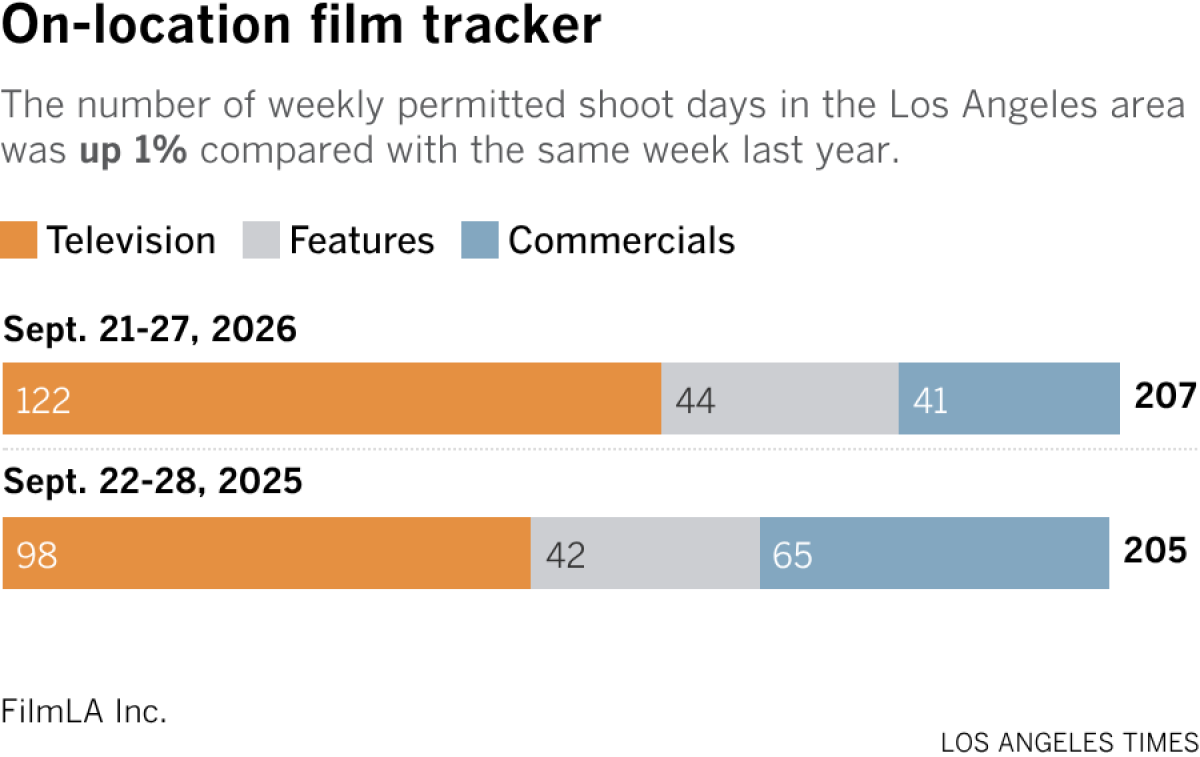
Film shoots

Number of the week

fifty-one billion dollars

Streaming giant Netflix narrowed its 2026 revenue forecast to $51 billion to $51.4 billion from its previous, larger range of $50.7 billion to $51.7 billion in its last Thursday’s second-quarter earnings report, renewing concerns among investors and equity analysts about the Los Gatos-based company’s future growth.

On the Friday morning after the earnings call, Netflix stock slid 13% to $65.08 a share, marking a new 52-week low. Shares eventually closed that day at $68.95.

As my colleague Wendy Lee has reported, investors are growing nervous that in recent months, Netflix’s share of TV viewing time in the U.S. has been decreasing, while YouTube’s share has increased, according to Nielsen data. Investors are concerned that if consumers are watching Netflix less, they’ll cancel their subscriptions, and that will put pressure on the company’s ability to raise prices in the U.S.

Netflix has said its engagement rates are healthy.

What I’m watching

I love a good teen mystery show, especially when it has a bit of a “Veronica Mars” vibe, so I binged Paramount+’s “School Spirits” last weekend.

Where Veronica Mars was solving realistic crimes around her local beach city, “School Spirits” tries to dig into why so many teens have died at (and haunt) a Wisconsin high school. At times, they’re hitting at a lot of different themes and storylines, but I loved the colorful ensemble of ghost characters from different decades, and Jennifer Tilly makes for an incredible villain.

Source link

For ‘Odyssey’ in 70mm, theaters raced to resurrect a nearly lost craft

One year ago, when tickets first went on sale for “The Odyssey” in Imax 70mm, nearly every screening sold out instantly.

The unprecedented ticket mayhem built hype — not just for the film, but for the format. By the time a second round of tickets were made available last month, buyers swarmed with such frenzy that they crashed the AMC Theatres app.

In Los Angeles, home base for cinephiles of every stripe, scoring one of these coveted opening weekend tickets was particularly challenging. Much of the excitement revolved around the fact that “The Odyssey” was the first feature shot entirely on Imax 70mm film, a technical achievement that involved the invention of a new camera.

  • Share via

Want to see The Odyssey in 70mm but couldn’t get tickets? Glendale’s historic The Alex Theatre has you covered.

For 28-year-old Van Nuys resident Chase Stanley, who tried and failed to secure a ticket, that milestone was top of mind.

“Ultimately, I’m just jealous that I’m not included,” he said. “Since it’s the first movie to capture the whole thing in 70mm Imax, it’s my due diligence to see it like that.”

Despite the enthusiasm from moviegoers, film projection has been considered a dying art since most movie theaters worldwide switched to digital projection in the early 2010s.

More than a marketing tactic, the scarcity of tickets for Imax 70mm screenings underscored both the dearth of theaters capable of projecting films in the premium large format — only 41 — and projectionists with the requisite skills.

A number of renowned directors, including “The Odyssey’s” Christopher Nolan, prefer to shoot on film and strongly encourage analog viewing. But because few theaters own the necessary equipment or employ full-time projectionists, coordinating a release as massive as “The Odyssey” is its own arduous journey.

Jimmy Gonzales is Cepheus, Matt Damon is Odysseus and Himesh Patel is Eurylochus in "The Odyssey."

Jimmy Gonzales is Cepheus, left, Matt Damon is Odysseus and Himesh Patel is Eurylochus in “The Odyssey.”

(Melinda Sue Gordon / Universal Pictures)

Venues new and old

There are 25 theaters in the United States showing “The Odyssey” in Imax 70mm, eight of which are located in California. One of L.A.’s favorites is the Universal Cinema AMC at CityWalk Hollywood, where veteran Imax projectionist Taylor Umphenour has worked for the last three years.

On his Instagram page, Umphenour shares “projectionist POV” photos and videos with more than 22,000 followers, giving them a unique glimpse into the projection booth for movies like “Sinners,” “One Battle After Another” and “Project Hail Mary.” His company, Film Leader Co., supervises film restorations and runs technical operations for a smattering of cinema houses across the country.

In addition to his work at CityWalk, Umphenour has been busy for weeks overhauling the projection setup at the historic Alex Theatre in Glendale.

People pass by the historic Art Deco Alex Theatre.

Releases such as “The Odyssey” have renewed interest in film projectionists and specialty theaters, including the historic Alex Theatre.

(Allen J. Schaben / Los Angeles Times)

The 100-year-old venue opened in 1925 as a vaudeville and silent movie house where Walt Disney previewed his animated shorts, but it changed identities many times over the course of its history. Now, Umphenour and his team are working with Miles Williams, the theater’s artistic director, to transform it into a “premier cinema house” in time for “The Odyssey’s” release. It marks the first time the theater has been used for a first-run film release since “Terminator 2: Judgment Day” in 1991.

“What better opportunity to relaunch this venue than to open with Christopher Nolan’s ‘The Odyssey’? That’s why this project is on such a tight turn,” Umphenour said.

His team built an entirely new, massive booth in just three weeks to house sound equipment and projectors capable of running both 35mm and 70mm film. To secure the Alex a last-minute 70mm print of “The Odyssey” — which costs tens of thousands of dollars to manufacture, ship and distribute and runs about four miles long — Umphenour relied on his relationship with distribution executives at Universal.

The Alex will screen the movie in 70mm, which uses the same film stock as Imax 70mm but runs vertically instead of horizontally, making each physical frame roughly three times smaller than its Imax counterpart. Audiences seeking the larger-than-life Imax experience will have to look elsewhere — like CityWalk — but Umphenour believes that analog screenings will still draw a crowd.

“What’s special about these — about running on film, about running 70mm, about handling premium large formats — is that it does remind people how much they love going to the movies,” he said.

“What it’s all about is expanding that sense of scope and horizon, the analog color, that sense of immersion.”

Not a job for ‘popcorn projectionists’

In advance of “The Odyssey’s” release, Imax contracted 130 experienced projectionists and required each to attend an intensive, weeklong training program.

“I’ve said for years that the projectionist is the last performer in a long chain of people that started with an idea,” Umphenour said. “They are the final person to deliver the vision of the filmmakers to the audience, and therefore, one of the most crucial.” Far from simply pressing a button, film projectionists must actively guide a screening, threading and splicing reels and closely monitoring for mechanical issues.

But thanks in large part to the dwindling number of theaters projecting analog film since 2013, finding capable, actively working projectionists for releases like “The Odyssey” can be a struggle.

Sean McKinnon, director of specialty presentations and AV integration at Boston Light and Sound, is in charge of hiring these projectionists for about 60 venues across the country screening “The Odyssey” in 70mm. He did the same for “Oppenheimer” in 2023, which had the longest theatrical window of the year.

“It was pretty challenging finding people for ‘Oppenheimer,’ especially because the film was so amazing, it was in theaters for so long,” he said of the 122-day release. Staffing projectionists for “The Odyssey” has been “definitely easier,” he said, as the “word has gotten out.”

The talent pool McKinnon pulls from includes theater managers, retired projectionists, trainees from specialized college programs and even workers in other professions who take PTO for the occasion.

“We get people from really all walks of life,” he said. “It’s a special event and people want to be a part of it.”

A man operates a projector.

Taylor Umphenour checks the projector’s focus at the historic Alex Theatre in Glendale.

(Allen J. Schaben / Los Angeles Times)

Outside of big cities, the lack of local projectionists also means McKinnon’s company has to fly people to Morrow, Ga., or Valley View, Ohio, for instance, to run the booth for the duration of a film’s run.

Leah Saint Marie, a filmmaker and former projectionist at the Vista Theatre in Los Feliz, attributed the staffing struggle to the experience and knowledge divide between hobbyists and experts.

“Training is pretty easy if you want to be what they call a ‘popcorn projectionist,’” she said. They “can thread the movie and push start, but if there are any mechanical issues, they can’t fix it.”

“I don’t think anybody who’s going to run a 70mm Imax are popcorn projectionists, because it’s very technical,” she added. Each Imax film print of “The Odyssey” is 11 miles long and weighs roughly 600 pounds.

The most recent data from the U.S. Bureau of Labor Statistics estimated that in 2023, there were 2,610 motion picture projectionists employed in the U.S. — an increase from 1,900 in 2022. In 2012, the BLS estimated roughly 8,000 projectionists and predicted the number would decline by 26.5% in the next 10 years — but it ultimately decreased by 76%.

“If you want to maintain expertise in the field, what you want are enough [movie] theaters out there running film that somebody can try their hand at it and get better,” Umphenour said.

Why film matters

Could the overwhelming audience demand for Imax 70mm screenings translate into a resurgence of fully equipped theaters? According to Imax Chief Executive Richard Gelfond, it’s more complicated than that.

“The problem is they haven’t made new Imax film projectors in about 50 years,” Gelfond told Variety on Wednesday. “We build new projectors every day, but film projectors, using this film, it’s not practical. So we’ve got to find them and retrofit them and rebuild them, which is what we did for ‘Odyssey.’ But can all 2,000 of our theaters be film projectors? No. There’s just not that many around.”

That said, Cinemark reportedly installed Imax 70mm projectors at three of its theaters ahead of “The Odyssey’s” release, and there are 11 more theaters projecting “The Odyssey” in Imax 70mm than there were for “Oppenheimer.”

A man loads film into a projector.

Cinema engineer Justin Dennis is working with projectionist and production manager Taylor Umphenour to build a new projection booth capable of running both 35mm and 70mm film at the Alex Theatre.

(Allen J. Schaben / Los Angeles Times)

Saint Marie recalled working as a projectionist in Pennsylvania during the period when most theaters transitioned from film to digital. While training at a new theater, she was surprised to find an old film projector still stored in the booth, and even more surprised to learn it was for Nolan’s sake.

“When he releases a [movie] on film, we have to have the projector. A lot of places around the United States kept their projectors specifically for Nolan,” she said.

Nolan isn’t the only director with an affinity for large format film and analog media. Quentin Tarantino, Paul Thomas Anderson and Ryan Coogler (whose 2025 hit “Sinners” made quite a splash in Imax 70mm) are others associated with what Umphenour dubbed “the 70mm renaissance.”

According to Saint Marie, theaters worldwide transitioned from film to digital projection mainly because the cost of shipping a Digital Cinema Package is much cheaper than shipping a film release print. But the community of skilled laborers and enthusiastic audiences who champion analog projection say it’s worth it.

“I think there’s something to be said about what film gives you as an artistic community, versus what digital gives you is just consuming as a capitalistic society,” Saint Marie said. To McKinnon, it comes down to the “tradition of humans telling a story by flickering light” harking back to prehistoric times.

For Umphenour, the story of “The Odyssey’s” release and all of the 70mm fanfare is one of preservationists triumphing over countless obstacles.

“There are 70mm theaters running this film throughout the world that, frankly, have been kept alive through the deep devotion of people who care about this format,” Umphenour said. “They really do deserve to be celebrated because, like so many things in life, if you don’t have people that care about it, you don’t end up with a thing.”

“The results of all this work are not images projected on screen,” he continued. “It’s a community brought together to hear a story well told, which allows them to create a life memory they get to carry forward for years and years.”

An interior view of the historic Alex Theatre.

Film projection takes center stage at the Alex Theatre.

(Allen J. Schaben / Los Angeles Times)


Source link

Microdrama previews are hitting movie theaters this summer

Before the lights dim and the trailers roll, moviegoers will start to see microdrama ads in movie theaters.

National CineMedia (NCM), the company responsible for the pre-show programming on the big screen, announced a new partnership with AI-native microseries studio aTwist on Wednesday. The company will begin advertising aTwist’s upcoming slate of vertical series in theaters later this summer.

“Movie theaters have always been where people go to lose themselves in storytelling,” Mike Rosen, NCM’s chief revenue officer, said in a statement. “This partnership brings new, exciting content to the pre-show experience, and gives brands the opportunity to speak more authentically to an audience that is naturally drawn to compelling, innovative content.”

The partnership was first reported by the Hollywood Reporter.

The deal will feature brand-sponsored series, previews of aTwist originals and a QR code that will take viewers directly to the aTwist platform.

These advertisements will be integrated into NCM’s regular programming, which spans more than 18,500 screens in over 1,650 theaters nationwide. The advertiser works with major movie chains such as AMC, Cinemark and Regal, across 185 markets. NCM was founded in 2002 and is best known for its “Noovie” preshow hosted by Maria Menounos.

ATwist is set to launch later this summer. The Los Angeles-based company, founded by former Hollywood executives Jana Winograde, Susan Rovner and Lloyd Braun, is entering an increasingly competitive format.

Microdramas, which originated in China, have continued to gain traction in the U.S. Some of the industry’s major players include ReelShort and DramaBox. The short-form content, engineered for a vertical phone screen, has drawn comparisons to a new addictive form of soap opera. The vertical video market is expected to generate around $150 billion in revenue this year, according to media consulting firm Owl & Co.

Brands such as Marc Jacobs and Crocs have already positioned the storytelling format as a way to advertise new products and reach new audiences.

By advertising to moviegoers, aTwist is hoping to distinguish itself among its competitors.

“We built aTwist around the belief that great storytelling should meet audiences wherever they are,” Winograde, aTwist’s chief executive officer, said in a statement.

“There is no better partner than NCM to introduce microseries to moviegoers and bring our storytelling into one of the most immersive entertainment environments.”

Source link

‘Choo Choo Revue’: Bob Baker Marionette Theater’s new show

The Bob Baker Marionette Theater was about to debut its first new production in 45 years, and it was uncertain whether one of the show’s signature new puppets would even work. A pelican, with an oversized bucket-like beak, was in need of last-minute maintenance.

This gangly bird, designed to hop, skip, soar and sing to Clarence Henry’s mid-’50s rhythm and blues hit “Ain’t Got No Home,” was supposed to surprise the audience, as its elongated bill is actually hiding a frog. Getting the pelican-frog duo to perform in unison was a feat of mechanical artistry for the team, not to mention the choreography needed by the puppeteer.

  • Share via

And in the minutes before showtime, director Alex Evans was trying to stay calm. In such moments, he would say later, he only need remind himself of an old adage in the puppet arts.

“Puppets,” he says, “break all the time.”

With that, he was ready to embrace the unknown.

“I always say I love the chaos of live theater,” Evans says. “We got to believe in this thing.”

“Choo Choo Revue,” the latest in a long line of song-and-dance productions, is arriving at a momentous time for the Bob Baker Marionette Theater. Just last month the troupe announced its intent to purchase its venue on Highland Park’s York Boulevard for $5 million, doing so as it was gearing up for performances at the Coachella Valley Music and Arts Festival. The latter went viral, a fact Evans attributes to many of the first week shows of “Choo Choo Revue” selling out.

An organist plays while people file into the premiere of “Choo Choo Revue" at the Bob Baker Marionette Theater.

An organist plays while people file into the premiere of “Choo Choo Revue” at the Bob Baker Marionette Theater.

In many ways, “Choo Choo Revue” is a statement piece. Evans, who also serves as co-executive director with Mary Fagot, wants to place the spotlight on the theater’s current crop of artists, fabricators and collaborators. While the show pays tribute in many ways to the theater’s legendary namesake founder, perhaps most notably in its use of his vintage record collection, it’s time, Evans says, for the Bob Baker Marionette Theater’s next generation to shine.

Evans was instrumental in the decision to shift the team away from the previously announced production of “Arabian Nights,” a project once spearheaded by Baker, who died in 2014. Just ahead of the arrival of the 2020 COVID-19 pandemic, the theater had gone so far as to print an “Arabian Nights” program, and had finished sets and puppets ready to go.

"Choo Choo Revue" is the first new Bob Baker Marionette show since 1981's "Hooray LA!"

“Choo Choo Revue” is the first new Bob Baker Marionette show since 1981’s “Hooray LA!”

During the forced closure, however, the team began to rethink its future. “It was a deep-breath time to do some internal thinking about who we are and what we want to prioritize,” says Evans, who joined the company in 2007 as a volunteer and became a staffer in 2009.

“The first new show in 40 years — us finishing one of Bob’s shows would have been deeply personal and meaningful, but it would have kept the narrative, internally and externally, that this was one person’s vision,” Evans says. “‘Choo Choo’ is the culmination of so many different ideas and people. It was purposefully about opening the floodgates, that Bob Baker could be more than just the person of Bob Baker.”


It wasn’t a sure thing the Bob Baker Marionette Theater would even reach this milestone. For much of the past decade — since about the death of the theater’s patriarch — the narrative surrounding the theater was one of survival.

In 2019, the Bob Baker Marionette Theater needed a lifeline. Forced out of its edge-of-downtown home of more than 55 years, the beloved troupe with its thousands of handcrafted puppets — a saucy black cat in heels, a fish out of water that can’t help but wiggle — ultimately found a new location in a Highland Park theater, where it signed a 10-year lease.

Then came the pandemic, when the theater relied heavily on community fundraising to cover its rent. California, and Hollywood in particular, has a rich puppetry tradition. Bob Baker Marionette Theater likes to refer to itself as the largest ongoing puppet theater in the U.S. The oldest puppet space in the country resides up north in Oakland at amusement park Children’s Fairyland. And in 2020, Bob Baker found it had many fans, asking at one point to raise $365,000 over the course of a year. It did so in four weeks.

1

L Castro twirls a marionette.

2

The audience gives a round of applause after the premiere of “Choo Choo Revue."

3

People stand in line for the premiere of “Choo Choo Revue" at the Bob Baker Marionette Theatre.

1. L Castro twirls a marionette. 2. The audience gives a round of applause after the premiere of “Choo Choo Revue.” 3. People stand in line for the premiere of “Choo Choo Revue” at the Bob Baker Marionette Theatre. (Carlin Stiehl/For The Times)

Children react to marionettes.

Old favorites, including the theater’s famed black cat marionette, make appearances in “Choo Choo Revue.”

But it was the long process of buying its home, namely the belief that it would be in Highland Park to stay, that gave the company the confidence that it could go forward with a new show. The obvious question, of course, is why it took 40 years for a completely fresh Bob Baker experience. Evans gives a long answer, pointing to numerous hurdles, be it the shift in locations, the cost of preserving its historic puppets and collection, as well as just managing priorities.

“It’s not necessarily a financial hurdle,” Evans says, noting “Choo Choo Revue” cost $300,000, with about half of that sum dedicated to the creation of new puppets and scenery.

“I think it was more about priorities,” Evans says. “Like, do we get the staff healthcare first, or do we do a new show first? So we got the staff healthcare. Or do we give the stage better lighting.”


As for how and why the team settled on “Choo Choo Revue” as its first production since 1981’s “Hooray LA!,” Evans says not to overthink it.

“It made me giggle,” he says. “It was a jumping off point to imagination. ‘Choo Choo Revue,’ by name itself, I thought to giggle.”

The show is a fantastical representation of a cross-country train trip, filled with adorable puppet trains.

A meticulously detailed log with windows, for instance, or a car that seems to balance natural, mountainous wonders on its back. They’re colorful playthings, at least until the background scenery starts depicting various locomotive styles. Puppeteers will whisk train cars out into the open, each often housing a fantastical creature — a moose, for instance, who takes a break from knitting to prance around to a rendition of the on-theme traditional blues ditty “Midnight Special.”

Behind it all are tens of thousands of hours of handcrafted proficiency. Each new puppet is a work of art. Take, for instance, a swarm of bats that seemed to glow in the dark (the creatures, created for “Choo Choo Revue,” made their debut during last year’s Halloween season).

A puppeteer holds a pelican puppet.

The Bob Baker Marionette Theater created more than 100 new puppets for “Choo Choo Revue,” including a pelican hiding a frog in its beak.

Or an intricately detailed cicada band. They’re each playing tiny instruments — one a half-open sardine can, another a stringed matchbook. Their wings deserve a close inspection, as the translucent curved fixtures are inspired by stained glass windows. There are trees that ski, and train whistles with big lips and high heels, modeled after harmony group the Andrews Sisters. Wait till the latter toot off their tops, as each of the 100 new puppets is full of surprises.

“We get a bunch of different artists together, and we all brainstorm,” Evans says of the creation process. “Like, ‘Let’s all think for a second about anthropomorphizing trains.’ We did a series of sketches and showed them to each other. I honestly probably have a thousand different fascinating ideas for train movement.”

On opening night, the crowd claps along to the numbers, cheering with delight at each new piece of whimsy that rolls or soars onto the floor-level stage. And as for the showstopping pelican, the frog erupts out of its beak right on cue, a moment that indeed inspires a round of laughter and childlike awe.

As the imaginary train whisks the puppets around the country, the show manages to build anticipation just by making the crowd wonder what comes next. Say, for instance, a fluffy Sasquatch, or a crooner of a moon in pajamas singing an old-timey lullaby to all the little ones seated cross-legged on the floor.

Puppeteer Ginger Duncan twirls a marionette named Comedy.

Puppeteer Ginger Duncan twirls a marionette named Comedy.

Much of “Choo Choo Revue,” like the yawning, serenading moon, is rooted in the music of the past. That was a decision made to ensure the show feels in line with earlier Bob Baker works. Yet Evans says the team is emboldend after Coachella to start tackling more contemporary songs at its Highland Park headquarters. The crowd at the Indio festival, for instance, went wild for the puppets swooning to Ben Platt’s cover of Addison Rae’s hit tune “Diet Pepsi.”

“Honestly, if we had done Coachella last year, it would have pushed ‘Choo Choo’ further,” he says, noting he initially feared pop music could distract. “I didn’t think it could work in a way that wouldn’t throw you out of the show.”

And yet Evans doesn’t want to get ahead of himself. He nearly teared up at the end of the “Choo Choo Revue” premiere, saying the following afternoon that seeing this show come together after multiple years was second only to his 2025 wedding in terms of creating an “overwhelming feeling of pride, love and care.”

“Choo Choo Revue” culminates in a look toward the future. That’s when a sleek, silver, oversized high-speed bullet train arrives on the scene.

It can be read as a metaphor.

While the nonprofit is still seeking donor help — at the premiere, Fagot said the company now has secured $4.7 million toward its $5 million goal of buying the theater and it also hopes to raise an additional $2 million for building upgrades — its future is more secure than it has been at any time over the past decade.

At long last, the Bob Baker Marionette Theater can relax and look toward new horizons.

Evans, for instance, can’t help himself excitedly tease a potential next Bob Baker show. He says twice in the interview that the Olympics are on the troupe’s mind.

“We’ve got two years,” he says. And now the permanent home to house it.


Source link

AMC is bringing a new live concert experience to local movie theaters

Movie theaters are no longer just for watching stories — they’re becoming live entertainment portals. In a pivot toward live music entertainment, AMC is launching a real-time, interactive concert experience across 300 of its locations.

Unlike the static concert films of the past, the new tech allows artists on a remote stage to see, hear, and respond to the theater audience, effectively turning your local cinema into a stadium.

Pop stars Bebe Rexha, Paris Hilton, Kim Petras and Maren Morris are the first headliners for the concert series hitting AMC screens this June. The program moves away from pre-recorded content, opting instead for live broadcasts that allow artists to perform for a national theater audience in real time.

The movie theater chain is partnering with live entertainment company, Arena One, to bring this technology to 89 markets across the country.

“This is a highly immersive, communal experience, combining the energy of a live concert with the scale, comfort, accessibility and affordability unique to AMC,” Adam Aron, the chief executive officer of AMC Entertainment said during an earnings call Tuesday afternoon.

These one-night-only live events are meant to simulate the look and feel of going to a concert in-person — without the often-pricey cost of admission. According to AMC, the prices for these tickets will range from $40 to $75, depending on the artist and the market.

“The next chapter of live shows isn’t about proximity to big venues, it’s about creating visceral, intimate, affordable live connection between artists and fans no matter where they are,” Rohit Kapoor, Arena One’s founder, said in a statement.

“Arena One gives artists a new cinema-native canvas to create live performances, while amplifying the raw energy and shared fandom that makes live shows unforgettable.”

Music has been a hot topic for movie theaters of late as the industry continues to navigate rough waters amid hopes of a durable post-pandemic recovery.

Between box office-topping biopics like “Michael,” documentaries like “EPiC: Elvis Presley in Concert” and concert films like the forthcoming Billie Eilish movie “Hit Me Hard and Soft: The Tour,” movies rooted in music are consistently drawing sizable and enthusiastic theater audiences.

Aron, AMC’s CEO, added, “We believe that this innovation can open an entirely new chapter in live entertainment while driving incremental attendance and revenue across our circuit.”

Source link