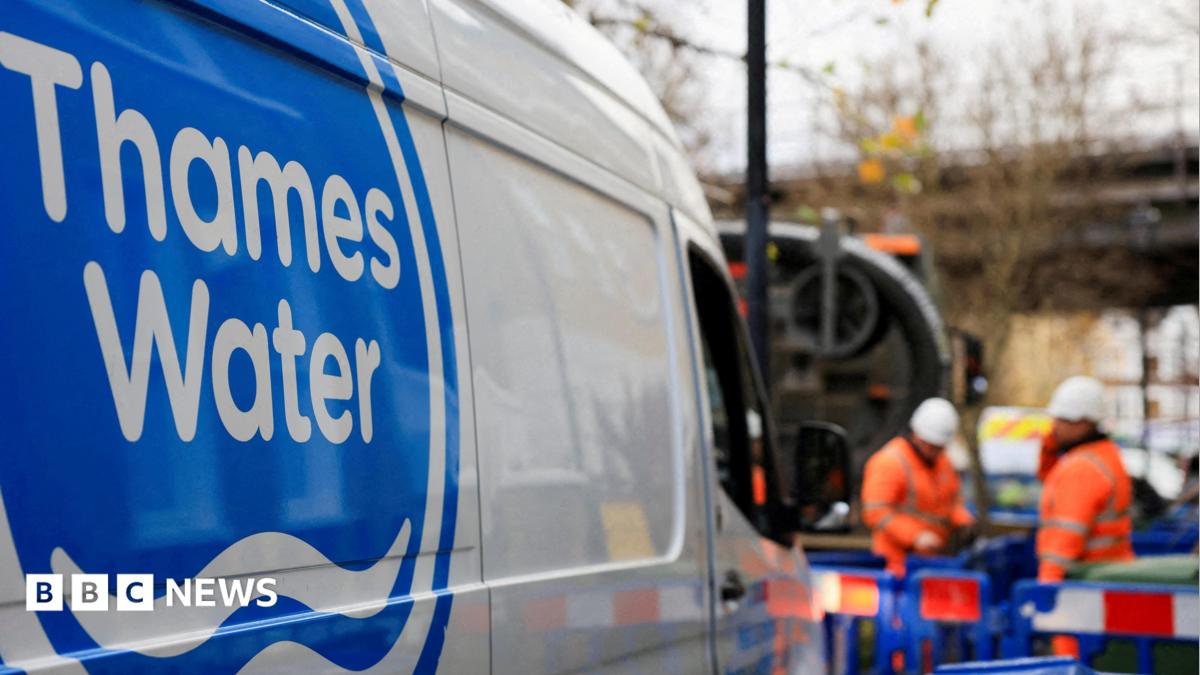
Thames Water paid its finance chief a £1m signing-on fee in July as the company struggles with a mountain of debt and faces temporary nationalisation.
Steve Buck joined the company in April 2025 but it is understood the seven-figure payment was not made until last month after the company had taken legal advice over its contractual obligations.
The existence of the payment, first reported by Sky News,, external was revealed in a letter from the Thames Water chairman to MPs on the Commons Environment, Food and Rural Affairs Committee.
In the letter,, external Sir Adrian Montague said he understood customers would see large payments to senior leaders as “unjust” but argued they were necessary to stop staff leaving.
The letter said: “The majority of the team were brought in recently to fix the problems the company faces and are not responsible for causing those problems.
“These talented and experienced individuals have opportunities for roles outside Thames Water and, in many cases, have been actively approached by other companies.
“These roles would be less in the public gaze, less difficult and more remunerative.”
Sir Adrian described the payment to Buck as a “necessary incentive” and said the money had come from emergency funding provided by Thames Water’s lenders.
He said the company is facing recruitment and retention difficulties and warned the problem would “persist” if it was nationalised or put into special administration.
Alistair Carmichael, Lib Dem MP and chair of the Environment Committee, said: “Money should be going into improving services, not remunerating already well-paid senior executives.
“The government were clear in the early days that they wanted this to stop. It is obvious that they have not succeeded in this. We need to hear now from them about what they intend to do about it.”
The utility company owes roughly £20bn and has been working with creditors and government officials to find a way forward.
Failure to reach a deal could lead to Thames Water being forced into a “special administration regime”, a form of temporary nationalisation intended to keep the business operating until a viable solution can be found.
This would see government-appointed officials temporarily running the company – including funding its operations and upgrading infrastructure as well as dealing with any outstanding debts following a restructuring of the business.
If the company was subsequently sold to a private buyer, the government would be able to recoup some taxpayer cash.
Prime Minister Andy Burnham has previously said he would like to see “greater public control” of key water and energy utilities.
In the past year, Thames Water boss Chris Weston saw his pay increase 14% to £1.63m while other directors received bonuses totalling £4.1m.
Speaking on the BBC Big Boss interview late last month, Weston acknowledged there was anger about Thames Water pay, but argued that the company needed to be able attract “capable people to help turn this company around”.
“If we’re not prepared to pay market rates, then they won’t come to us and they won’t stay with us,” he said.
In a darkened room in Maldon, Essex, a ship’s lantern illuminates the laundry drying on a web of ropes suspended from the ceiling. Between piles of sailing memorabilia, 86-year-old Barry Pearce is flipping through a yellowing logbook, watched by his mongrel, Winkle. It feels more like a ship’s cabin than a terrace house. Pearce is one of a handful of surviving skippers who delivered freight on the Thames by sailing barge, the flat-bottomed trading boats famous for their striking red sails that were endemic to the river’s estuary until the 1960s. He remembers the names of every vessel he worked on – Remercie, Edith May, Colonia.
In the 19th century, the ochre sails of thousands of Thames sailing barges pierced the skyline as the craft carried cargo from the Thames estuary and beyond in and out of London. Their shallow draft allowed them to snake far upriver in as little as a metre of water (bargemen would boast that they could sail anywhere there had been a heavy dew). Their ingenious rig, with sails that could be set and stowed with the help of winches, meant around 150tonnes of cargo could be shifted by just a skipper and mate – often accompanied by a guard dog. This efficiency allowed them to outlive all other commercial sailing vessels, surviving until the 1960s, when Pearce himself took the helm.
Illustration: Guardian Graphics
Today, only about 30 Thames barges are still sailing, either as private homes or leisure cruisers. Two of them – Pudge and Centaur – lie like beached krakens on the oozing mud of Maldon’s Blackwater estuary. Both are owned by the Thames Sailing Barge Trust, a charity run entirely by volunteers, including Pearce. Every summer, both vessels can be hired as private charters for groups of up to 12, or you can book a berth on one of their one- to three-day public sailing cruises. They also offer events such as children’s art days throughout the year.
I’m here on a scorching evening at Hythe quay to spend the weekend exploring the River Blackwater and Essex coast aboard Centaur, a barge built in 1895. Itineraries are flexible and based on passengers’ interests. For us it involves sailing up the Blackwater, a Pimm’s at Tollesbury Marina, and a swim off Shingle Point and wander around West Mersea on Mersea Island. Our motley crew consists of three trainees overseen by skipper Chris Martin, who teaches boatbuilding at vocational training organisation Circles Alternative Education.
Centaur in the Blackwater estuary. Photograph: Chris Bourne
There are also six passengers, ranging in age from 18 to 76, in five cabins, which are basic but comfortable (each has a wash basin). Although I am the only one who is not a competent sailor, Martin makes it clear that helping to handle the barge is optional.
Unwisely, given our 3am departure to catch high tide, I sink several pints with the two youngest members of Pudge’s crew in the Little Ship Club on the quay. A behemothic man wielding a squeezebox sings sea shanties as salty couples slow dance nearby. “I only know of one or two people my age who are into barging, and I find that disturbing,” yells 25-year-old Charlie Francis over strains of Bound for South Australia. “Barging was the lifeblood of the east coast. We should be proud of our heritage and celebrate the communities working to preserve it.”
After a few hours in my bunk, I make it on to deck at 4.15am. The moon is a slice of radish in a lilac sky. We’re bearing away from the wind and, having set the sails, the crew is already on their second round of tea and custard creams.
As dawn paints its peachy palette, Martin turns the great wheel. He points out Blackwater landmarks that only a local would know: the green buoy known as the Doctor, where early 20th-century fishers left spirits for the alcoholics supposedly drying out at Osea Island’s temperance resort; the pub where, as recently as 20 years ago, Martin witnessed a smuggler wordlessly deliver two dripping bags while regulars stared determinedly into their pints; the hulking trawler, Ross Revenge, which is still home to Radio Caroline, the former pirate station – another relic kept alive by volunteers of the Blackwater.
The writer on the deck of the Centaur. Photograph: Laura Lewis/The Guardian
Where the river opens into the silvery sea, the wind picks up and the barge rocks gently against the tide. My eyelids are heavy and the slowness of the whole experience is working its magic on my screen-frazzled brain. Martin calls for the staysail to be unfurled, a 20-minute task that rewards the barge with another knot and a half of speed. “This life is the antithesis of the digital age’s obsession with instant gratification,” he says. “Sailing barges may not be able to teach us much about cargo any more, but they can teach us the value of slowing down, doing things with our hands and spending time in nature.”
As we make our stately, seven-knot progress, 370 sq metres of rust-red canvas billows above and fingers of salt marsh slide by. With so little distraction, the coffee tastes lip-curlingly bitter, the bacon sandwiches as saline as the deep. I settle on a coil of rope to scan the horizon for porpoises, but soon drift into sleep.
A swim from a sandbank near Tollesbury is followed by a meander through West Mersea at golden hour. Clapboard cottages framed by hollyhocks sit beside sailmakers and chandleries converted into trendy cafes. We drop anchor in the Blackwater estuary and beneath a blazing sunset tuck into lasagne on deck. I haven’t felt this present for months. It’s all such a delight I begin to feel concerned about the trust’s future. Sailing barges cost between £30,000 and £100,000 a year to keep afloat. The trip I’m on costs just £220 including meals, while the Trust’s annual membership is only £37.50.
Although the trust offers training in many of the skills needed to maintain the barges, sourcing the timber is becoming increasingly difficult – and expensive. “Centaur’s exterior planking is pitch pine from the Mississippi basin, which is incredibly durable, but has been virtually exhausted,” says Martin. “And so much of the timber trade has been replaced by plastic.”
The trust also offers free training for future skippers, including the mate on our trip, 18-year-old Ben Weldon, the son of a local shipwright. However, it typically takes 2,000 hours – or 10 years – and the dropout rate is high.
While the trust has recently been awarded £28,090 from the National Lottery Heritage Fund to develop a bid for the £4m needed to restore Centaur, it seems wrong that responsibility for keeping this thread of Britain’s maritime story from unravelling rests on so few shoulders. Sailing may be associated with privilege, but we are a seafaring nation and this inheritance belongs to all of us.
Skipper Chris Martin, on the left, on board Centaur. Photograph: Imogen Lepere
On Sunday morning, our last on board, a westerly fills the sails, and the tea-coloured Blackwater wrinkles beneath the bow as we beat our way back towards Maldon. “Lee ho,” Martin calls, showing me how to spin the wheel to help the crew tack. “So far we’ve used less than a gallon of fuel to do 50 miles. Pretty extraordinary, given that a family car does about 30 miles to the gallon.”
When I asked Pearce at the start of the trip why keeping Thames sailing barges afloat is worth the fight, he looked blank, as if such a question had never occurred to him. He showed me a pencil sketch of a barge he had drawn at the age of 15 in Greenwich, left half-finished when his skipper had poked his head through the hatch and invited him below for dinner. Now, more than 70 years later, he bends once more over that drawing as though no time has passed.
Eventually, he half-whispers: “Well, they’re just lovely, ain’t they?” He glances toward the window. Nearby, Centaur waits on the mud for the returning tide.
FANCY a classic sightseeing trip to London? I’ve found the best way to take in the city’s breath-taking skyline.
Us Brits are lucky to have a fantastic capital city which packs in fascinating landmarks, futuristic skyscrapers, and majestic bridges as well as historical 11th century buildings which still stand today.
I found the best way to soak up London’s best sights – and enjoy a fancy meal on the Thames at the same timeCredit: Jenna Stevens
Book a River Thames Lunch Cruise – ON SALE for £38 (was £53)
And if you’re planning a trip to London anytime soon, there’s one sightseeing experience you won’t want to miss.
City Cruises have a range of Thames sightseeing cruises which let you take in the London city skyline from the water from an open-air deck or swanky indoor lounge.
Sign up for the Travel newsletter
Thank you!
You can pick from a classic sightseeing cruise, which starts from only £15 per adult and £10.25 per child, or treat yourself to a Jazz, Elvis tribute or even a Murder Mystery cruise.
Not only is this the most popular experience, but it’s currently on sale – down to £38 a ticket instead of £53. That’s the cheapest lunchtime cruise on the River Thames we could find.
Considering you get a fancy two-course meal, panoramic views of London’s top landmarks like Big Ben and the London Eye, plus expert commentary – this is one hell of a bargain.
The tour starts by stepping onboard at the Tower Millennium Pier, a central spot that’s easy to get to by taking the underground to Tower Hill.
I stepped onboard to find a very spacious cabin, with a sleek downstairs dining area dotted with white tablecloths, plus an upper deck that’s perfect for making use of in sunny weather.
Lots of guests around me were celebrating birthdays or special occasions, dressed up to the nines snapping shots for Instagram or family photos.
And this is certainly the place to take pictures, with flattering golden sunlight pouring in through the windows, plus landmarks like Tower Bridge, The Shard and Big Ben as your backdrop.
I cruised past landmarks like Big Ben and the London Eye on my City Cruises’ lunch tourCredit: Jenna Stevens
Book a River Thames Lunch Cruise – ON SALE for £38 (was £53)
As it turns out, the food onboard was just as impressive as the views.
I only waited around 15 minutes from being seated until my main course arrived – and the presentation of the dish was Masterchef-worthy.
There are two options for your main course: a vegetarian cassoulet with oyster mushrooms and white beans, or a roasted supreme of chicken with fondant potatoes and veg.
I went for the latter, and was blown away by the rich creamy mushroom sauce and the cheesy fondant potato. The decadent dish would have wowed me in a high-end restaurant, let alone on a Thames cruise.
After a short rest came dessert – a baked cheesecake with a gooey white chocolate centre and a heavy drizzle of tart raspberry coulis, plus tea or coffee. Could you picture a more perfect pudding?
With a full belly and warm coffee in hand, there’s nothing left to do but lean back and watch London glide past your window
The route takes you from the pier across to Canary Wharf, where you can admire the futuristic skyline and spot six of the UK’s 10 tallest buildings.
From here you’ll turn back around and head all the way towards Big Ben.
The London Lunch Cruise on the River Thames is City Cruises’ most popular experienceCredit: Jenna StevensThe sunlight pours in the huge windows onboard – perfect for taking picturesCredit: Jenna Stevens
This is when the commentary begins, so you’ll soak up centuries of London history along the way. I recommend heading up to the deck for the best views.
You’ll glide under nine magnificent bridges including Tower Bridge, London Bridge and – my favourite – the Wibbly Wobbly bridge (AKA Milennium Bridge).
You’ll also get up-close with the bright red pillars of the lost 18th century Blackfriars Bridge which jut out from the water.
Plus you’ll cruise under “Ladies’ Bridge” – the unofficial nickname of Waterloo Bridge, which was built largely by women during World War II.
It was fascinating to see historic landmarks nestled in-between glossy modern offices and huge skyscrapers.
One of these impressive slices of history is Cleopatra’s Needle – the oldest structure in London. The obelisk was built in 1450 BC, and made its way over to London from Egypt in 1878.
Finally you’ll pass spots like the Globe Theatre and the London Eye until you reach the Houses of Parliament – stop for a quick selfie – then it’s back to the pier.
Although I live in London, I left feeling like I’d learned so much about my city that I didn’t even before, thanks to the knowledgeable tour guide.
Overall, the lunch cruise was a fantastic way to pack in sightseeing, fascinating history, and a delicious meal into one relaxing experience.
Plus when you step off, you’ve got the Tower of London, Borough Market and more on your doorstep to continue ticking off the best of London.
Click below to browse City Cruises‘ options, starting from £15 for a sightseeing cruise.
The London Lunch Cruise is currently on sale, down to £38 per ticket instead of £53Credit: Jenna Stevens
Browse City Cruises’ experiences – starting at £15 per adult