test

Machado’s Return Is the Real Test of Venezuela’s Political Opening

The real test of Venezuela’s current political moment will not be institutional, but political. It will not lie in the appointment of a new prosecutor, or in any decision taken by a parliament that, by design, reflects the preferences of those in power. It will lie in something far less controllable: the return of María Corina Machado.

For months, there has been talk of normalization, of technocratic adjustment, even of a transition managed from within. It is an appealing idea, but an illusory one. As usual, chavismo does not administer space, it occupies it. The notion that it would suddenly evolve into a system governed by technocratic restraint, even under US pressure, was always more wishful thinking than analysis.

What has changed is not the nature of the system, but our understanding of it. For years, it was assumed that power rested on a rigid internal balance, a kind of tripod between civilian leadership, party machinery, and the military. The uneventful sidelining of Vladimir Padrino López suggests otherwise. Now relegated to an almost theatrical role as Agriculture Minister, he makes appearances at cattle shows in Borsalino hats and Panerai watches. We have long known that chavismo’s superpower is its adaptability. It can reshuffle, absorb shocks, and reallocate power without fracturing, even at its highest levels, and carry on.

That adaptability cuts both ways. It helps explain why Delcy Rodríguez has been able to consolidate authority despite presiding over the country under the tutelage of the “yankee devil”, and despite earlier doubts about her staying power. It also explains why the government has been able to pursue a limited opening without losing control. But it also sets the limits of that opening.

Because the one problem the system has not been able to solve is credibility.

An empty pitch

The effort to attract investment has run into a wall that legal reforms and external signaling cannot easily overcome. Investors are not simply looking for incentives, they are looking for guarantees, that power is legitimate, that rules will be upheld, that today’s opening will not be reversed tomorrow. So far, those guarantees do not exist.

As I have argued before, none of this means that capital will stop flowing into Venezuela altogether. It won’t. There are firms that know how to operate in this environment, firms that have built their business models around political risk rather than in spite of it.

Take Grupo Cisneros, which is moving to secure a $1 billion investment fund aimed at Venezuela’s recovery. Or Chevron, which has doubled down on its presence through a major asset swap with PDVSA, expanding its stake in key projects in the Orinoco Belt.

What is not arriving, at least not yet, is transformational capital, the kind that requires predictability, legal certainty, and a credible political horizon.

These are not naïve entrants. They are actors with long experience navigating the Venezuelan system. Cisneros has remained a player despite fines and suspensions over the years. Chevron, for its part, has effectively become the most important American economic partner of the current government, maintaining operations through multiple political cycles and regulatory frameworks.

But that is precisely the point.

This is not the kind of capital Venezuela needs.

What is arriving, or staying, is adapted capital, capital that knows how to survive volatility, negotiate through informal institutions, and operate without full guarantees. What is not arriving, at least not yet, is transformational capital, the kind that requires predictability, legal certainty, and a credible political horizon.

And that gap cannot be closed through reforms alone. It cannot be legislated into existence, nor negotiated deal by deal. It requires something more fundamental: confidence that power in Venezuela is not entirely discretionary.

The pressure map

The timing of this becomes even more significant in light of Venezuela’s re-engagement with the IMF and the World Bank. After years of isolation, the country is once again being folded back into the international financial system, opening the door to technical assistance, debt restructuring, and eventually, fresh financing. It is the clearest signal yet that normalization, at least at the institutional level, is moving forward.

But this only sharpens the underlying problem.

These institutions can help stabilize accounts, restructure liabilities, and provide liquidity. What they cannot do is manufacture credibility where it does not exist. Their return signals that Venezuela is being treated, once again, as a country with which business can be conducted. It does not guarantee that the rules of that business will hold.

In some ways, Delcy has the easier hand to play. The current arrangement in Venezuela has become useful to Donald Trump in ways that go beyond the country itself. With the Iranian campaign failing to deliver the results he had anticipated, Venezuela has quietly taken on the role of a foreign policy success story, something tangible he can point to, both in terms of energy security and geopolitical leverage.

That utility is not uniform across his coalition. For more isolationist voters in what is often referred to as flyover country, a stable Venezuela that does not require further military involvement, and that contributes to stabilizing US energy prices, is a net positive. 

Detaining Machado, after appearances at CERAWeek and high-level meetings in Europe and Washington, would send a clear and immediate signal to the very actors the government has been trying to court.

Venezuelan crude is already easing pressure on US fuel costs, reinforcing the perception that the current arrangement delivers practical benefits.

But in South Florida, the picture is different. Latino voters, particularly Venezuelans, are already uneasy with the administration’s immigration policies, and are far less inclined to accept stability under a reconfigured chavista leadership as an acceptable endpoint. They are drawn instead to Machado’s message, and increasingly wary of what a prolonged Delcy Rodríguez-led government would mean. For them, the issue is not stability alone, but the absence of a credible electoral horizon.

This creates a tension within Washington’s own political logic. On one hand, there is an incentive to consolidate what appears to be working: restored oil flows, renewed financial channels, and growing international engagement with Caracas. On the other, there remains a constituency that expects something more, a path toward elections, not just normalization.

Machado, in this context, faces a more complex task than it might appear. She is not only trying to pressure the Venezuelan government, she is also trying to persuade a cautious administration that pushing beyond the current equilibrium is worth the risk, that the next step is not to stabilize the system as it is, but to open it further.

And she is doing so with limited institutional backing. Much of the Venezuelan civil society ecosystem aligned with MAGA politics appears more focused on maintaining its own access to the White House than on advancing a coherent strategy for Venezuela itself. That leaves Machado in a familiar position, carrying the burden of political escalation largely on the legs of her own prestige, but now within a much tighter set of constraints.

This is where María Corina Machado reenters the picture, not just as a political actor, but as a structural variable. Her return forces a choice that cannot be deferred. Allow her back into the country, or stop her.

Detaining her, after appearances at CERAWeek and high-level meetings in Europe and Washington, would send a clear and immediate signal to the very actors the government has been trying to court. These are not abstract observers, they are the same executives and investors now being asked to commit capital. Arresting her would not simply be a domestic political decision, it would be read as a statement about the limits of the current opening.

Allowing her to return is not costless either. It risks projecting weakness toward a base that has been conditioned to expect control. It creates space for mobilization, for coordination, for a reactivation of political pressure that the system has worked hard to contain.

But at this stage, that is a more manageable risk.

A constrained confrontation

Chavismo has shown that it can absorb internal contradictions. It can tolerate limited openings while maintaining overall control. What it is less equipped to manage, at least at this point, is a collapse in external credibility at the precise moment it is trying to rebuild it.

This is also not a confrontation between unconstrained actors. Machado is operating within limits of her own. She understands that an uncontrolled escalation could be interpreted in Washington as an attempt to derail a strategy that, for now, tolerates the current arrangement. Her leverage depends not only on mobilization, but on preserving her external legitimacy.

What emerges from this is not a clean confrontation, but a constrained one. Both sides are pushing, but neither is free to push all the way. Machado needs to generate pressure without triggering a rupture that works against her. The government needs to contain that pressure without closing the space in ways that undermine its own economic strategy.

That is what makes her physical presence in the country so consequential. Without it, the reactivation we are beginning to see, student movements regaining traction, party structures reopening, political figures cautiously returning, remains fragmented. With it, that energy has a focal point. 

And that is precisely why her return has become the real test. Not whether the system can produce institutional outcomes aligned with its interests, but whether it can tolerate, and ultimately absorb, the presence of the one actor it does not fully control, without undoing the fragile equilibrium it is trying to build.

Source link

French Open: Carlos Alcaraz says test on wrist injury ‘crucial’ for hopes of defending title

“I’m trying to be very patient. But we are good and just waiting a little bit.

“We have a few tests in the next few days and then we will see how the injury is and what the next steps will be.”

The 22-year-old, who won clay-court titles in Monte Carle, Rome and Roland Garros and reached the final in Barcelona last season, could lose significant ground to Sinner in the rankings because of the injury.

Italian Sinner reclaimed the number one ranking this month after beating Alcaraz in the Monte Carlo final.

Alcaraz said: “I’d rather come back a little later but in great shape than come back early, rushing around, and unwell.

“God willing, I have a very long career ahead of me, many years, and pushing myself too hard at this Roland Garros could seriously harm me in future tournaments.

“Things happen in the professional world. You have to accept them. I need to recover really well if I don’t want it to affect me later on.”

Source link

South Korea: North Korea test launched ballistic missiles into East Sea Sunday

This image, released on March 20, by the North Korean Official News Service (KCNA), shows North Korean leader Kim Jong Un and his daughter, Kim Ju Ae, observing a military exercise involving tanks, drones, and other munitions. File Photo by KCNA/UPI | License Photo

April 19 (UPI) — South Korea’s Defense Ministry said North Korea test launched multiple, short-range ballistic missiles into the East Sea, also known as the Sea of Japan, Sunday morning.

“Detailed specifications are currently under close analysis by South Korean and U.S. intelligence authorities,” officials in Seoul said in a statement, according to ABC News.

“Our military is closely monitoring North Korea’s military activities under a firm combined defense posture and maintains an overwhelming capability and readiness to respond to any provocation.”

The Japan Times said the Defense Ministry of Japan also confirmed the activity.

“North Korea’s series of actions, including the repeated launches of ballistic missiles and other weapons, threaten the peace and security of Japan, the region and the international community,” the ministry said in a statement.

Newsweek said Pyongyang has increased its ballistic missile testing and nuclear weapons development since the conflict between the United States, Israel and Iran began nearly two months ago.

Sunday’s missile launches appear to have come from Sinpho, a coastal city in North Korea where submarines capable of launching such weapons are built.

Sakie Yokota, mother of Megumi Yokota, who was abducted by North Korea, speaks during a rally demanding the immediate return of all abductees in Tokyo on November 3, 2025. Photo by Keizo Mori/UPI | License Photo

Source link

YFQ-44 Fury Fighter Drone Wraps Contested Operations Test That Could Accelerate Its Fielding

  • YFQ-44 Fury drone completes critical test. The U.S. Air Force concluded a key exercise with a YFQ-44 Fury prototype at Edwards Air Force Base to test its deployment in contested environments.
  • Warfighting Acquisition System aims for speed. The exercise tested a framework to accelerate CCA deployment, allowing operators to refine tactics early.
  • Operators used Menace-T system. The system enabled autonomous operations from a simulated forward base, aligning with Agile Combat Employment concepts.
  • CCAs to enhance combat capabilities. The Air Force sees CCAs as vital for extending sensor coverage and adding combat mass in high-end conflicts.

Bottom line: The YFQ-44 Fury drone’s recent test at Edwards Air Force Base marks a significant step in the Air Force’s efforts to rapidly field combat-ready CCAs. This exercise focused on operational integration and logistical challenges, aiming to enhance the Air Force’s capabilities in contested environments.

The U.S. Air Force has concluded what it describes as a “critical exercise” with Anduril’s YFQ-44 Fury ‘fighter drone’ prototype, flown out of the base that is the heart of flight testing, the legendary Edwards Air Force Base, California. The drills involved the Air Force’s Experimental Operations Unit and were intended to demonstrate how CCAs can be deployed and sustained in a contested environment. For the exercise, the YFQ-44A flew from Edwards back to Anduril’s Southern California test site.

As well as the Experimental Operations Unit (EOU), which falls under Air Combat Command (ACC), the exercise involved personnel from Air Force Materiel Command’s (AFMC) 412th Test Wing. This wing is headquartered at Edwards Air Force Base, and the squadrons attached to it are responsible for flight testing of virtually all the aircraft in the Air Force’s inventory.

A YFQ-44A takes off from the runway at Edwards Air Force Base, California, during a Collaborative Combat Aircraft exercise. U.S. Air Force photo by Ariana Ortega Ariana Ortega

Multiple sorties were flown — we have asked Air Combat Command for more details on exactly how many and their scope. The exercise took place last week, according to Anduril’s vice president of autonomous airpower, Mark Shushnar.

The YFQ-44 is one of two designs now being developed as part of the first phase, or Increment 1, of the Air Force’s CCA program. The other is General Atomics’ YFQ-42A Dark Merlin. We have reached out to Edwards to see whether the YFQ-42 was originally expected to take part in the exercise before its recent takeoff accident.

Imagery published by the Air Force shows a YFQ-44A carrying inert AIM-120 Advanced Medium Range Air-to-Air Missiles (AMRAAM) on pylons under the wings, something that we first saw earlier this year, during captive-carry evaluations, as you can read about here. It should be noted that the Fury, at least as it exists now, does not have an internal munitions bay.

MSgt Ricardo Villalva, EOU removes fins
Master Sgt. Ricardo Villalva Jr., with Air Combat Command’s Experimental Operations Unit, performs pre-flight checks on an inert AMRAAM at Edwards Air Force Base, California. U.S. Air Force photo by Ariana Ortega Ariana Ortega

The primary function of the exercise was to explore the practicalities of what the Air Force calls the Warfighting Acquisition System. This framework is intended to speed the delivery of CCAs to operational units by enabling operators to get their hands on the drones earlier in the program. In this way, they can refine tactics and procedures before deliveries to the front line.

ACC has stressed in the past how it wants CCAs to operate seamlessly within the existing command structures and legal frameworks that govern all Air Force weapons systems.

“This experimental operations event was executed by EOU members from start to finish. Every sortie generated and flown was done with a warfighter, not an engineer or test pilot, kicking the tires and controlling the prototypes,” explained Lt. Col. Matthew Jensen, EOU commander. “We are learning by doing, at a speed and risk tolerance accepted by the USAF’s most senior leaders, to ensure CCA is ready to operate and win in the most demanding combat environments.”

A YFQ-44A flies over Edwards Air Force Base, California, during a Collaborative Combat Aircraft exercise. U.S. Air Force photo by Ariana Ortega Ariana Ortega

Above all, the sorties stressed operational and logistical procedures for using CCAs in a contested environment. The issue of logistics is a critical one, including how CCAs will get to the area of operations and how they will be maintained in the field.

According to Shushnar, Anduril’s Menace-T command, control, communications, and compute (C4) solution was used as the main ground element for YFQ-44A flight operations during the exercise. “EOU operators used Menace-T’s ruggedized laptop to upload mission plans, initiate autonomous taxi and takeoff, task the aircraft while in flight, and manage post-flight data ingestion and checks,” he explained. “That enabled the EOU to conduct operations out of a simulated forward operating base, successfully launching, recovering, and turning YFQ-44A without the infrastructure of a large, established base.”

This is entirely in line with the Air Force’s drive toward short-notice and otherwise irregular deployments, often to remote, austere, or otherwise non-traditional locales. Agile Combat Employment (ACE) is the term the service currently uses to describe a set of concepts for distributed and disaggregated operations.

While the warfighters of the EOU were at Edwards to carry out the practical aspects of CCA employment, exploring tactics, techniques, and procedures, the 412th Test Wing, meanwhile, was on hand to gather data from the test events.

“By uniting the distinct test authorities of AFMC and the operational authorities of ACC, officials were able to fast-track the event, enabling groundbreaking, hands-on experimentation by operators at a uniquely early stage of development,” the Air Force explained in a media release.

An earlier photo, in which the Air Force gave us our first look at a YFQ-44 carrying an inert AIM-120 Advanced Medium-Range Air-to-Air Missile (AMRAAM). U.S. Air Force

“The collaboration we saw in this exercise is the cornerstone of our acquisition transformation. By embedding the operators from the EOU with our acquisition professionals, we create a tight feedback loop that lets us trade operational risk with acquisition risk in real-time,” said Col. Timothy Helfrich, portfolio acquisition executive for fighters and advanced aircraft. “This isn’t just a test; it’s a demonstration of how we are adopting a more agile process. An 85 percent solution in the hands of a warfighter today is infinitely better than a 100 percent solution that never arrives.”

The CCA program is viewed as a pathfinder for the Warfighting Acquisition System, and success with this could lead to the same approach being employed to get other systems into operational service much more quickly than in the past.

The Air Force has not yet determined whether it will procure one or both Increment 1 CCA designs at scale. Whichever option it selects is expected to become its first operational “fighter drones,” built to carry live munitions into combat alongside crewed aircraft.

Three examples of the YFQ-42A Dark Merlin. General Atomics

CCAs will also extend the sensor coverage of the crewed fighters they accompany. More broadly, the Air Force views them as a way to add vital combat mass and unlock new tactical options, particularly in high-end conflicts against adversaries like China. Back in late 2024, Brig. Gen. Douglas “Beaker” Wickert, commander of the 412th Test Wing, told TWZ that, “[the-then Secretary of the Air Force Frank Kendall] “has been very clear that we are out of time, that our Air Force has never been older or smaller than it is right now, and that the People’s Liberation Army has been specifically designed to defeat us.”

“The investments we’re making right now in modernization and testing for the USAF are designed for success and aimed at changing Chairman Xi’s calculus about pushing back aggressively against the international rules-based order. What we are doing here and across USAF flight-testing is extremely consequential.”

Since then, Wickert has moved on to become Director of Air, Space and Cyberspace Operations at AFMC, but the test wing’s remit remains the same. Meanwhile, the People’s Liberation Army Air Force has doubled down on its rapid expansion, including many of its own CCA programs.

If all goes to plan, the completion of this recent exercise at Edwards could well be a key milestone in fielding a combat-ready force of CCAs and go some way toward realizing the Air Force’s ambition for a new capability that should extend the reach and the survivability of its crewed aircraft.

Contact the author: thomas@thewarzone.com

Thomas is a defense writer and editor with over 20 years of experience covering military aerospace topics and conflicts. He’s written a number of books, edited many more, and has contributed to many of the world’s leading aviation publications. Before joining The War Zone in 2020, he was the editor of AirForces Monthly.


Source link

Qatari 747-8i Gifted To Trump For Interim Air Force One Is Undergoing Test Flights

  • Qatar’s 747-8i gifted for interim Air Force One use. The U.S. Air Force is testing a lavish 747-8i donated by Qatar to serve as a temporary Air Force One while awaiting delayed VC-25B deliveries.
  • Test flights underway with expected delivery by 2026. The VC-25B Bridge Aircraft has begun test flights and is expected to be delivered to the Presidential Airlift Group by summer 2026.
  • Limited modifications observed on the aircraft. Photos show few changes to the jet’s communication systems, though it includes new aerials and UHF satcom antennas.
  • Defensive capabilities remain uncertain. The aircraft may lack comprehensive defensive systems like EMP hardening and defensive systems, raising questions about its operational use.
  • High conversion costs and limited operational scope. With a conversion cost nearing $400 million, the jet may only be used domestically or in low-threat areas, prompting questions about its necessity.

Bottom line: The U.S. Air Force is testing a Qatari 747-8i as an interim Air Force One due to delays in Boeing’s VC-25B deliveries. While modifications are underway, the jet’s limited defensive capabilities and high conversion costs raise questions about its practicality and operational use.

The U.S. Air Force has begun test flights on an extremely lavish 747-8i Boeing Business Jet (BBJ) that Qatar donated to the U.S. last year for use by President Donald Trump. The jet, now dubbed VC-25B Bridge Aircraft, is set to serve in the Air Force One role while the White House awaits the extremely delayed delivery from Boeing of two fully-outfitted VC-25B Air Force One aircraft 

“I can confirm that the VC-25B Bridge Aircraft has begun flight test,” an Air Force spokesperson told The War Zone Friday afternoon. “We expect the aircraft will be delivered to the Presidential Airlift Group no later than summer 2026.”

Aviation Week was the first to report the news of the test flight.

The Air Force declined to provide additional information about the testing program, including when it began or how many flights have taken place. It also remains unclear when the 747-8i will conduct real VIP missions or if it will receive a new official designation. With questions swirling about the legality and ethics of a president receiving a gift plane, the Pentagon last May took delivery of the aircraft and said it would rapidly undertake the required modifications.

The jet, using the call sign VADER01, was spotted by flight trackers over Texas yesterday. It took off from Majors Field in Greenville, Texas, flew over Tulsa, Oklahoma, Amarillo and Abilene, Texas, before landing back at Majors Field. The airport is home to L3 Technologies, which is modifying the jet. The facility at Greenville is a hub for this exact kind of modification work on the Pentagon’s larger aircraft.

Video and photos taken by aviation photographers show that the aircraft was in a white base livery, though it will reportedly get Trump’s red, dark blue and white paint scheme. The aircraft was delivered from Qatar in its maroon, white and gray striped scheme originally.

In this February 15, 2025 a Qatari Boeing 747 sits on the tarmac of Palm Beach International airport after US President Donald Trump toured the aircraft on February 15, 2025. Donald Trump plans to accept a luxury Boeing jet from the Qatari royal family for use as Air Force One and then continue flying in it after his tenure, despite strict rules on US presidential gifts, media reported May 11, 2025. Calling the plane a "flying palace," ABC News, which first reported the story, said the Boeing 747-8 jumbo jet would possibly be the most expensive gift ever received by the American government. (Photo by ROBERTO SCHMIDT / AFP) (Photo by ROBERTO SCHMIDT/AFP via Getty Images)
The donated Qatari Boeing 747-8i seen on the tarmac of Palm Beach International airport after Trump toured the aircraft on February 15, 2025. (Photo by ROBERTO SCHMIDT/AFP via Getty Images) ROBERTO SCHMIDT

Aviation photographer TT-33 operator was kind enough to share some images with us. The photos were captured as the aircraft was landing at Majors Field yesterday. You can see more of his work here.

(TT-33 operator)
(TT-33 operator)
(TT-33 operator)

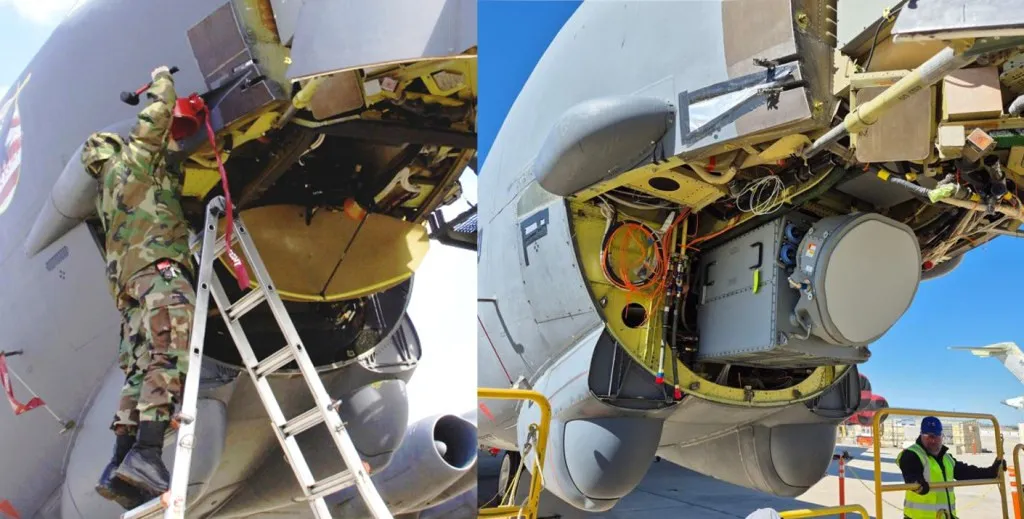
The photos show remarkably few modifications to the VC-25B Bridge Aircraft’s communications system, which already had an extensive broadband satellite communications suite when Qatar handed it over. These additions include a handfuls of new aerials and what appear to be two UHF satcom ‘platter’ antennas.

As TWZ has previously noted, converting any aircraft into one that is secure and safe enough to transport the president is a complex undertaking. The aircraft needs to provide constant, secure communications, including what is needed to order a nuclear strike. Historically, it also needs to be physically hardened both inside and out to withstand myriad threats, from the electromagnetic pulse of a nuclear weapon going off to incoming surface-to-air missiles to enemy intelligence-gathering efforts. To do this requires significant modifications right down to the aircraft’s outer structure.

In this case, it is likely impossible for the jet to receive EMP hardening and, at least based on the limited photos available, we cannot find any clear additions that would indicate the installation of an integrated self defense suite of any kind. The VC-25As are speckled with missile approach warning sensors and many laser countermeasures turrets (DIRCM). They also include the legacy Matador infrared countermeasure system above their jet engines and APU. This is in addition to other defensive features which are less visible and remain closely guarded secrets.

Common Infrared Countermeasures (CIRCM) thumbnail

Common Infrared Countermeasures (CIRCM)


At the very least, this aircraft will have to feature some kind of DIRCM setup to repel shoulder-fired heat-seeking missiles, and modular units are available that can be attached in a canoe to the bottom of the aircraft. These systems, such as Elbit’s C-MUSIC or Northrop Grumman’s Guardian, are in service with foreign VVIP 747s, as well as commercial aircraft, including those flying for Israeli airline El Al. You can read all about these systems here. Still, while they offer far less defensive capacity compared to what is seen under the belly of a VC-25A, they would offer a significant layer of protection.

Northrop Grumman’s Guardian pod is a self-contained DIRCM (includes missile approach and warning sensors and laser pointer) solution for airliner-type aircraft. (Northrop Grumman)

It’s also possible a more elaborate and fully integrated defensive system could be installed in the coming weeks, but it’s hard to imagine this would allow the jet to enter service this summer.

Adding a further layer of complexity to the procurement and fielding process of any new presidential airlift aircraft, there are tight controls around sourcing spares for aircraft with this mission, and specific rules about vetting individual parts to protect against espionage and sabotage. Clearly many practices and requirements had to be relaxed in order to rush this ‘bridge’ aircraft into service.

USAF via FOIA

There are also questions about where this jet could actually fly operationally. Without a fully specialized design meeting all the requirements for the traditional Air Force One mission, it will likely be limited to domestic use or other very low threat areas. Given all that, and its reported conversion price tag approaching $400 million, there are legitimate questions about why it is needed at all.

As we noted earlier in this story, the flight test of this aircraft came as Boeing is far behind in the process of converting two other 747-8is originally built as commercial airliners into new fully customized VC-25B Air Force One aircraft. This led to the emergence of Trump’s idea of procuring an ‘interim’ Air Force One.

On Friday, the Air Force told us that it “is collaborating with Boeing to implement acceleration initiatives and expect the first delivery of the VC-25B in mid-2028.” If this is the case, then this ‘bridge’ aircraft will have served at most around two years until the first full-up VC-25B is delivered.

We have reached out to Boeing for additional details.

The U.S. Air Force has confirmed it is buying two Boeing 747-8 airliners from German flag carrier Lufthansa.
A rendering of a future US Air Force VC-25B Air Force One jet. Boeing

While it is not yet known when the ‘bridge’ VC-25B will actually transport the president, we know there is great pressure to get it doing exactly that from the White House. Judging by its configuration so far, whatever possible appears to have been done to make that happen.

Contact the author: howard@thewarzone.com

Howard is a Senior Staff Writer for The War Zone, and a former Senior Managing Editor for Military Times. Prior to this, he covered military affairs for the Tampa Bay Times as a Senior Writer. Howard’s work has appeared in various publications including Yahoo News, RealClearDefense, and Air Force Times.


Tyler’s passion is the study of military technology, strategy, and foreign policy and he has fostered a dominant voice on those topics in the defense media space. He was the creator of the hugely popular defense site Foxtrot Alpha before developing The War Zone.


Source link