tennessee-based corecivic

DHS buys two California immigrant detention centers for $1.5 billion

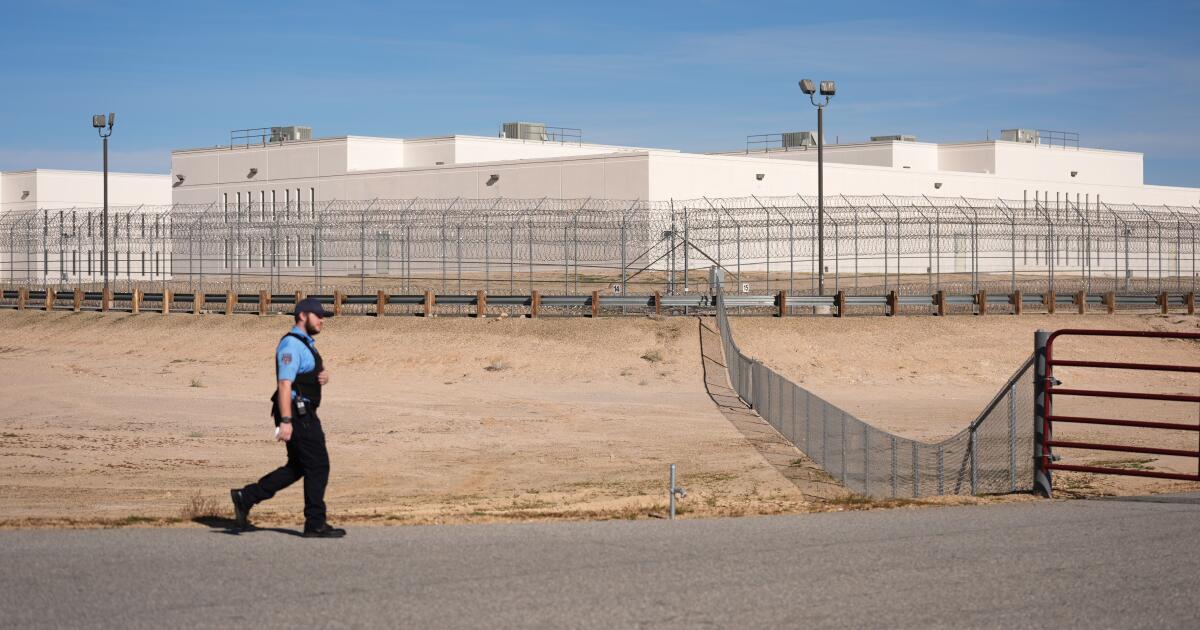
The Department of Homeland Security bought two of the largest immigrant detention facilities in California for $1.5 billion, according to the private prison company that sold them.

The purchase comes as the department — flush with cash after Trump’s One Big Beautiful Bill Act infused the agency with $170 billion — has moved to scale up its capacity to detain immigrants without relying as heavily on private prison corporations.

In announcement Monday, the Tennessee-based CoreCivic said the sale of the 2,560-bed California City Detention Facility and the 1,994-bed Otay Mesa Detention Center in San Diego closed on July 2.

The company said it expects net proceeds of about $1.1 billion after income taxes and transaction expenses.

Ryan Gustin, public affairs director for CoreCivic, said such sales are not uncommon and that “the process was marked with rigor and integrity.” He added that the valuations were established through the federal government’s required appraisal process, using independent appraisers, who determined objective fair market value.

The sale doesn’t immediately change anything at the facilities — CoreCivic expects to continue managing them under existing contracts with U.S. Immigration and Customs Enforcement, according to the company and a filing with the Securities and Exchange Commission.

But the terms of those contracts could be modified given the change in ownership, the filing states. The California City facility contract expires in August 2027 and the Otay Mesa facility contract expires in December 2029, with the option to extend for another five years.

“We are pleased with the sales of these two mission-critical facilities for the Company’s government partner, which demonstrates the value of the Company’s underlying real estate portfolio, while reflecting our role as a long-term, flexible solutions provider to government,” CoreCivic CEO Patrick Swindle said in the announcement.

The Department of Homeland Security did not immediately respond to a request for comment.

During a quarterly earnings call in May, George Zoley, CEO of the GEO Group, another major private prison corporation, said that the company had been in discussions with ICE “regarding the potential sale of multiple facilities.”

Critics of the purchases of detention facilities say the Trump administration is simply looking to avoid state and local oversight by bringing them under federal ownership. That issue was raised during the GEO Group earnings call when a participant later asked why the federal government wants to own the facilities instead of contracting with third parties.

If the facilities are federally owned, Zoley replied, there are “more protections from unwarranted litigation that infringes upon the activities of the ICE processing centers.”

Zoley said federal ownership would bolster the legal defense of the facilities and the argument that “states can only have very limited involvement.”

“There’s been litigation regarding overseeing medical services, food services, general cleanliness, etc.,” Zoley continued. “It’s really unprecedented and I believe it’s fundamentally unconstitutional. As some blue states are considering more active involvement in oversight of facilities, I think the logical solution to much of that is federal ownership of the facilities.”

California tried to kick private detention operators out of the state, but the 2020 law was overturned in the Ninth Circuit Court of Appeals. Since then, state leaders have established oversight mechanisms through laws that allow for monitoring and investigation of detention centers by the California Department of Justice and local health authorities.

Asked to comment about the sale, Sen. Alex Padilla (D-Calif.) said his congressional oversight visits to facilities operated by CoreCivic have shown that immigrants who pose no public safety threat are being held in “unacceptable conditions.”

“Whether these facilities are operated by a private contractor or owned by the federal government, my expectations remain the same,” he said. “I will continue demanding transparency, accountability, and humane conditions that respect the dignity and rights of every person in immigration detention.”

Eight ICE detention facilities now operate in California, with a combined capacity to hold nearly 9,000 people.

The California City and Otay Mesa facilities have both been the subject of lawsuits by detainees alleging detainee mistreatment. CoreCivic calls such allegations unfounded and says it complies with all regulations concerning the treatment of detainees.

In its announcement on Monday, CoreCivic said the company is in discussions with ICE about potentially selling additional detention facilities, though it said those talks are in various stages and it’s unclear whether the sales will go through.

Source link

California immigrant detainees boycott over high commissary prices

Immigrants detained at two federal facilities in California have launched a boycott in protest of increasing and, in their view, burdensome prices at the facilities’ commissaries for items including tampons, coffee and soup.

The Times reviewed a grievance letter and spoke with three detainees who are involved in the boycott at the California City Detention Facility, about 80 miles east of Bakersfield, and at the Golden State Annex in McFarland.

More than 300 detainees are estimated to have signed grievance letters sent recently to facility administrators, according to advocates with the California Collaborative for Immigrant Justice.

Both facilities are operated by private prison corporations — the California City facility by Tennessee-based CoreCivic and the Golden State Annex by Florida-based GEO Group.

The Times has reached out to the Department of Homeland Security, GEO Group and CoreCivic for comment.

Detainees are provided certain essentials, such as food and soap, free of charge, but many also purchase items at commissary stores that are of better quality or otherwise unavailable. Detainees said shampoo and other hygiene items sometimes run out for days and that meals are small or exacerbate diabetes and other health issues.

“The three daily meals that CoreCivic provides at California City Detention Facility are the bare minimum to keep a person alive,” they wrote. “Because of this, charging inflated prices on necessities is considered price gouging and profiteering against vulnerable incarcerated population who have no ability to refuse or shop elsewhere.”

The detainees said an 8 oz. jar of Folgers instant coffee costs $18 at the California City facility, a single instant ramen soup is 75 cents and a box of 40 tampons costs nearly $21.

At Walmart, the same Folgers coffee costs $8.97, Maruchan chicken ramen soup is 50 cents and 40 Tampax tampons are $12.19.

U.S. Immigration and Customs Enforcement detains immigrants for civil purposes. Detention is meant to facilitate removal proceedings but is not meant to be punitive.

Detainees are paid $1 per day under a voluntary work program for cleaning or cooking. Many detainees rely on money from family and friends.

In their grievance letter, the detainees called the markups an unacceptable business practice with no apparent limit. They said they view the situation as an example of captive market exploitation and economic coercion.

The detainees requested a review of commissary pricing by facility leaders, a comparison of prices with prison industry standards, an immediate reduction in prices of essential items and the implementation of reasonable price caps. They also requested an increase in the portions of daily meals, including for meals meeting religious requirements, which they said are particularly small.

In May, the California State Senate passed a bill that would prohibit the excessive markup of products sold at private detention centers, limiting prices to 35% above the vendor cost. Existing California law already limits such markups in state prisons. The bill is now in the Assembly.

Priya Patel, an attorney at the California Collaborative for Immigrant Justice, represents people who have been detained at both facilities. She said that during legal service consultations, commissary pricing frequently comes up.

“The higher the prices get, the higher of an impact the conditions have on people and the more difficult it becomes to fight their cases,” Patel said.

The collaborative is one of the organizations that brought a lawsuit last year alleging inadequate medical care, as well as insufficient clothing, food, water and outdoor recreation time at the California City facility, which can hold more than 2,500 people. The lawsuit remains ongoing; in March, a U.S. district judge in San Francisco appointed an external monitor to ensure the facility provides “constitutionally adequate health care.”

The lawsuit describes multiple commissary-related issues. For example, it says the facility doesn’t provide headphones for tablets, making private phone calls — including privileged calls with attorneys — impossible unless the detainee can afford to purchase headphones from the commissary.

“One detained person has difficulty walking and standing for extended periods of time without shoes that provide arch support,” the complaint says. “He arrived at California City with appropriate shoes to accommodate his mobility disability, which were approved as an accommodation at a prior ICE facility. California City staff confiscated those shoes and instead provided him with plastic, orange sandals.”

“Several weeks after staff confiscated his shoes, he had an appointment with a doctor at California City,” it continues. “The doctor told the him … to buy different shoes from commissary to accommodate his foot condition.”

A contract between CoreCivic and ICE for the California City facility, dated April 1, 2025, says the contractor must provide notice of any price increases and that “any revenues earned in excess of what is required for commissary operations shall be used solely to benefit aliens at the facility.”

Alfredo Parada Calderon, 52, has been detained at the California City facility since September. He said commissary prices were already high before they increased around mid-June.

Parada Calderon said he asked an ICE officer why the prices had increased so much. The officer said he wasn’t aware of the change but that the vendor is Keefe Group, which supplies commissaries at prisons and immigrant detention centers across the country.

Detainees in his dormitory submitted a grievance about commissary prices, Parada Calderon said. The answer was vague.

“They’re blaming it on inflation,” he said.

Parada Calderon said his family sends him about $100 per month to spend on commissary items, which he spends on packets of crackers, coffee, soups, soap, shampoo, deodorant and chips.

“Enough is enough,” he said. “It’s a horrible enough place to be in and you guys are making it even more horrible, not just for me but for my family. The detainees want to be heard and this is the only option we actually have — a peaceful protest.”

Tommaso Bardelli, a researcher at New York University who studies mass incarceration, said the families of most people in prison are working class and may sacrifice their electricity bill or credit card payment to send money to their incarcerated relatives. The money they send no longer pays for small luxuries, he said, because prisons have over the years reduced how much they spend per person on necessities such as food.

Bardelli published a research article in 2022 about inequality within prison commissary stores. Commissary is often now the difference between starving and a semi-normal diet, he said.

Source link