tech

30 years and $3 billion later, ‘Toy Story’ still Disney’s surest bet

Woody, Buzz Lightyear and Jessie will be back at the box office this weekend, delivering what could be the biggest film debut of the year.

Analysts expect the fifth installment of Disney/Pixar’s “Toy Story” franchise will pull in at least $150 million in the U.S. and Canada, with some predicting as much as $175 million — either of which would set a franchise record, topping the nearly $121-million opening of 2019’s “Toy Story 4.”

A strong showing for “Toy Story 5” will further fuel a recovery of the box office this year from the post-pandemic doldrums.

Domestic ticket sales are up over last year, and Roth Capital Partners forecasts the second quarter will climb 6.5% to $2.8 billion — a post-pandemic high.

“Toy Story 5” is the first of several family tentpoles this summer, ahead of Universal and Illumination’s “Minions & Monsters” and Disney’s live-action “Moana.”

“Right now we’re on pace for the best opening of the year,” said Daniel Loria, editorial director at Box Office Co. “This is a performer.”

The timing also is fortuitous for Walt Disney Co. at a moment when its other once-reliable franchises such as “Star Wars” and Marvel have faltered. The recent “Star Wars: The Mandalorian and Grogu” dropped sharply at the domestic box office after its late-May opening, bested by low-budget horror films “Backrooms” and “Obsession.”

“People love these characters from ‘Toy Story,’ ” said Paul Dergarabedian, head of marketplace trends at Comscore. “It’s just as appealing as ever.”

Indeed, across four films and 30 years, “Toy Story” has grossed more than $3 billion worldwide. It is the most-watched franchise on Disney+, with more than 2 billion hours streamed. Woody, Buzz Lightyear and Jessie have spawned 19 theme park rides, four themed lands, two hotels and roughly $1 billion a year in global retail sales.

The production budget for “Toy Story 5” is about $150 million to $200 million. A crew of about 300 people worked on the film at Pixar’s Emeryville, Calif., headquarters.

For Pixar, the reliance on “Toy Story” reflects a shift away from originals that used to be its lifeblood.

February’s “Hoppers” managed a respectable $372 million worldwide, but the surer money now comes from sequels.

“Inside Out 2” grossed nearly $1.7 billion in 2024, and both “Toy Story 4” and “Toy Story 3” crossed $1 billion globally.

Still, the franchise label is no guarantee: The 2022 spin-off “Lightyear” stalled at $226 million worldwide after straying from the formula, recasting Buzz as an actual sci-fi hero — voiced by Chris Evans rather than Tim Allen — and sidelining Woody and the rest of the gang.

“Toy Story 5” stays closer to home but wades into new territory: the explosion of tech in everyday life. The toys must contend with Lilypad, a tablet that captures the attention of their owner, Bonnie — a premise that grew out of a tech-toy character originally written for “Toy Story 4” and scrapped for time. Disney is betting the underlying tension is universal.

“What parent hasn’t had anxiety over tech versus toys with their kids?” said Andrew Cripps, head of theatrical distribution for Walt Disney Studios.

Disney is betting that this universal concern will drive audiences to the film.

The fifth installment also arrives with an unusually high-wattage assist: Taylor Swift wrote and performed an original song, “I Knew It, I Knew You,” and made a surprise appearance at last week’s premiere, performing it after the credits before joining longtime franchise composer Randy Newman for “You’ve Got a Friend in Me.”

“It means the world to me to be a small part of the universe of these films,” Swift told the crowd.

The expected blockbuster opening for “Toy Story 5” would be a full-circle moment for the long-standing franchise; Pixar animators in 1995 hadn’t even considered the possibility of a sequel while working on the first “Toy Story.”

“There was so much learned on that first film, specifically our iterative process,” Pixar Chief Creative Officer Pete Docter said in a phone call last week from Madrid, shortly before the film’s Spain premiere. “A lot of things that we discovered having worked on that film have just continued to inform every movie that we make.”

“Toy Story” revolutionized the movie business as the first computer-animated feature film. But its enduring appeal was in the bonds between the characters, Docter said.

Docter, who supervised animators and helped with character design and writing on the original “Toy Story,” added: “It certainly had some new technology, but it was really up to the story and characters to carry the audience.”

The franchise’s longevity is also due to its ability to capture generations of fans.

“Having parents now that say, ‘I grew up with “Toy Story,” and now I’m showing my kids,’ has been really gratifying,” Docter said.

Source link

Brendan Sorsby won’t play for Texas Tech amid eligibility controversy

Brendan Sorsby won’t be playing football for Texas Tech this fall after all.

It’s not because the transfer quarterback has been permanently banned by the NCAA for wagering on college sports — an injunction issued by a Texas judge last week appeared to clear the way for Sorsby to play for the Red Raiders in 2026.

That ruling, however, was being challenged through separate court filings by the NCAA and the Big 12 Conference. Facing that uncertainty over his final season, and with the deadline to enter the NFL supplemental draft quickly approaching, Sorsby opted to leave the Red Raiders without playing a down.

Sorsby’s decision was announced Monday night in an open letter by Cody Campbell, chairman of the Texas Tech board of regents.

“This decision was made with Brendan and his family and is purely an output of practical analysis of the situation,” Campbell wrote. “Brendan and Texas Tech stand on very solid and legitimate legal ground, but he faces a June 22nd deadline to be eligible to enter the NFL’s supplemental draft, and there is no practical way to resolve all the various pending legal disputes and ensure his eligibility prior to this date. This is the only viable and fair path for Brendan and his future, as well as for his teammates, and our university.”

Sorsby posted a statement Monday night on Instagram.

“I am grateful for the support from my family, my Tech coaching staff, teammates, the community, and so many others who have encouraged me to address and learn more about this important issue,” Sorsby wrote. “As my journey continues, I remain fully committed to and focused on being the best I can be, both on and off the field.”

Sorsby transferred to Texas Tech this offseason, after two years each at Indiana and Cincinnati, for a reported multimillion-dollar deal. In late April, he and Texas Tech jointly announced that he had entered a residential treatment program for gambling addiction. Sorsby completed the 35-day program in May.

Court records show that Sorsby has admitted to wagering at least $90,000 during his time as an NCAA student athlete, including 40 bets on Indiana football games he was not participating in while a freshman backup with the Hoosiers in 2022.

“Texas Tech will continue to provide the support and recovery resources Brendan requires on this journey,” Campbell wrote. “Furthermore, Texas Tech will not seek return of any amounts already paid to Brendan through his NIL agreements.”

In May, Sorsby filed a lawsuit in Lubbock County District Court asking to have his eligibility restored because the NCAA “failed to comply with its contractual commitments” to him as a student athlete and therefore “is precluded from enforcing its gambling bylaws against Mr. Sorsby to deny or withhold his reinstatement.”

Last week, judge Ken Curry granted a temporary injunction that would have allowed Sorsby to play for the Red Raiders in 2026. He would have had to miss the first two games of the season as one of the conditions of the ruling.

Without the injunction, Curry wrote in his ruling, Sorsby would “suffer a probable, imminent and irreparable injury” by missing out on the “elite coaching, training resources, camaraderie, and regimen that only being a member of a Division I college football team can provide.”

The final hearing had been scheduled to begin Feb. 8, nearly two weeks after college football’s national championship game.

Following the ruling, several teams and conferences discussed a ban on playing Texas Tech in any sport. After appealing the decision last week, the NCAA filed an emergency motion on Monday to stay the injunction and asked for the case to be resolved before the start of the Red Raiders season.

Also on Monday, the Big 12 filed for a judgment from a U.S. District Court in Dallas protecting the conference’s ability under its bylaws to sanction Texas Tech, a member school, if Sorsby played this season.

“An athlete with an extensive, documented history of wagering on intercollegiate athletic contests — especially his own team’s games — presents a reputational and integrity risk to the conference and its championship competition that the conference has both the right and the responsibility to address,” attorneys for the Big 12 wrote in the filing.

Soon after Campbell announced Sorsby’s decision, Texas Tech president Lawrence Schovanec and athletic director Kirby Hocutt issued a joint statement on the matter.

“When Brendan’s lawsuit resulted in the granting of a temporary injunction, we found ourselves in a difficult situation,” they wrote. “With his health and wellness as our top priority, we supported him in spite of very different perspectives and opinions. Our position was challenged by many but our support for him never changed.

“We will continue to extend all available resources that Brendan had as a student and athlete to ensure his transition is as successful as possible.”

The Associated Press contributed to this report.


Source link

Seoul shares again dip over 4 pct amid U.S.-Iran tensions, tech sell-off; won down

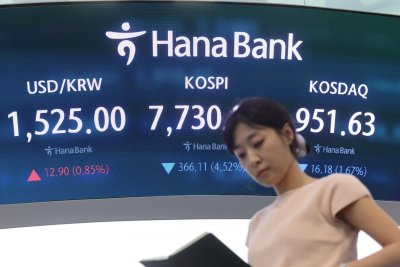
This photo, taken Wednesday, shows the trading room of Hana Bank in Seoul as South Korean stocks fell more than 4 percent amid escalating Middle East tensions and a tech sell-off. Photo by Yonhap

South Korean stocks plummeted more than 4 percent Wednesday amid escalating tensions between the United States and Iran and a tech slump fueled by concerns over the valuation of stocks related to artificial intelligence (AI). The local currency was trading lower against the U.S. dollar.

The benchmark Korea Composite Stock Price Index (KOSPI) shed 366.11 points, or 4.52 percent, to close at 7,730.82, almost eclipsing most of the over 8 percent surge from the previous day.

At one point, the index fell as low as 7,541.11.

Due to the sharp fall, the Korea Exchange had activated a sell-side sidecar for the index at 1:16 p.m., halting program trading for five minutes.

Trade volume was moderate at 457.5 million shares worth 39 trillion won (US$25.6 billion), with losers outnumbering winners 547 to 343.

Foreigners continued their sell-off for the 23rd consecutive session, dumping a net 2.77 trillion won, while retail investors and institutions purchased local shares worth 4.86 trillion won. Institutions sold 2.27 trillion won.

Market analysts said the KOSPI lost ground as tensions resurfaced in the Middle East after the U.S. struck Iran in response to the shooting down of an American Apache helicopter in the Strait of Hormuz and then Tehran hit back.

The risk-on appetite was also sapped by an overnight tech slide on Wall Street caused by concerns over the valuation of the AI stocks on news that Crusoe Energy Systems, a data center developer, suspended one of its projects upon the request of an unidentified big tech customer.

The tech-heavy Nasdaq composite closed 0.97 percent lower, and the S&P 500 dropped 0.26 percent, while the Dow Jones Industrial Average rose 0.17 percent.

Major tech shares led the market decline, with Broadcom losing 1.12 percent, Apple sliding 3.64 percent, Micron falling 1.4 percent and Nvidia down 0.2 percent.

Investors’ eyes are now on the upcoming release of the U.S. Consumer Price Index (CPI), which could give further clues on the U.S. Federal Reserve’s monetary policy amid bets on a hawkish pivot and the initial public offering of SpaceX later this week.

“The South Korean stock market was weighed down as risk aversion sentiment strengthened ahead of the U.S. CPI and Oracle’s earnings release, once triggering a sell-side sidecar,” Lee Kyoung-min, an analyst at Daishin Securities, said.

Lee said a hot inflation report could further contract the market sentiment, raising concerns over a possible U.S. rate hike.

In Seoul, market top-cap Samsung Electronics slid 6.06 percent to 302,500 won, while its chipmaking rival SK hynix plunged 7.54 percent to 2.05 million won.

AI investment firm SK Square shed 6.78 percent to 1.18 million won, and Samsung Electro-Mechanics shot down 8.38 percent to 1.8 million won.

Samsung Life Insurance dipped 6.36 percent to 368,000 won, and Samsung C&T plummeted 5.01 percent to 407,500 won.

Auto shares were also weak, with Hyundai Motor down 5.79 percent to 602,000 won, and its sister Kia losing 2.8 percent to 159,700 won. Hyundai Mobis dropped 4.2 percent to 570,000 won.

Internet portal operator Naver, which had recently rallied on news on its partnership with Nvidia, nosedived 11.67 percent to 227,000 won. Home appliances maker LG Electronics shot down 9.68 percent to 224,000 won.

Major shipbuilder HD Hyundai Heavy was among the few gainers, jumping 4.74 percent to 641,000 won.

Defense giant Hanwha Aerospace also climbed 1.48 percent to 1.03 million won.

The Korean won was quoted at 1,524.2 won against the U.S. dollar at 3:30 p.m., down 12.1 won from the previous session.

Bond prices, which move inversely to yields, closed mixed. The yield on three-year Treasurys added 2.5 basis points to 3.881 percent, and the return on the benchmark five-year government bonds dropped 3.2 basis points to 4.070 percent.

Copyright (c) Yonhap News Agency prohibits its content from being redistributed or reprinted without consent, and forbids the content from being learned and used by artificial intelligence systems.

Source link

Texas Tech QB Brendan Sorsby is granted injunction to play in 2026

Texas Tech quarterback Brendan Sorsby has been granted a temporary injunction that allows him to practice and play with the Red Raiders in 2026 despite having been permanently banned by the NCAA for wagering on college sports.

Texas judge Ken Curry ruled Monday that the NCAA cannot block Sorsby’s final year of eligibililty. The Cincinnati transfer will have to miss the first two games of the season as one of the conditions of the ruling.

In his ruling, Curry stated that Sorsby would “suffer a probable, imminent and irreparable injury” without the injunction by missing out on the “elite coaching, training resources, camaraderie, and regimen that only being a member of a Division I college football team can provide.”

“I’m very grateful for the endless support I have received throughout this entire process. I am also grateful for the chance to rejoin my teammates,” Sorsby wrote in a statement posted Monday on Instagram. “This opportunity comes with the responsibility to remain focused on my personal growth, the ability to learn from this experience, and to be able to use my situation to help others going forward.”

The NCAA can appeal the injunction but did not immediately indicate its next steps in the matter. It is unclear how long such a process would take. Texas Tech’s season starts Sept. 5, with Sorsby first eligible to play when the Red Raiders host Houston on Sept. 18.

“The NCAA strongly disagrees with the court’s ruling in Sorsby’s case and is deeply concerned about the damaging, far-reaching and broadly destabilizing ramifications of this outcome — which undermines and corrupts the integrity of sports,” the association said in a statement.

“The NCAA is committed to supporting student-athlete mental health but must continue to aggressively defend against actions that defraud college athletics and threaten competitive integrity, such as betting on one’s own sport.”

Last month, Sorsby’s attorneys filed a lawsuit in Lubbock County District Court requesting that he be declared eligible for all team activities because the NCAA “failed to comply with its contractual commitments” to him as a student athlete and therefore “is precluded from enforcing its gambling bylaws against Mr. Sorsby to deny or withhold his reinstatement.”

Sorsby spent two years at Indiana and two at Cincinnati before transferring to Texas Tech this offseason for a reported multimillion-dollar deal. In late April, he and Texas Tech jointly announced that he had entered a residential treatment program for gambling addiction and would be away from the team for an indefinite period of time.

According to court records, Sorsby has admitted to betting at least $90,000 during his time as an NCAA student athlete, including 40 bets on Indiana football games he was not participating in as a freshman backup with the Hoosiers in 2022.

NCAA guidelines state that student athletes who bet on their own games or on other sports at their school could “potentially face permanent loss of collegiate eligibility.” Texas Tech was informed of an NCAA investigation into Sorsby’s gambling activity in March, according to court records, and declared him ineligible according to the association’s bylaws.

The NCAA has since denied two petitions from Texas Tech to have Sorsby’s eligibility reinstated.

“As we have said before, we do not believe that the circumstances of Brendan’s case warranted permanent ineligibility,” Texas Tech athletic director Kirby Hocutt said Monday in a statement. “As he returns to our football program, we remain committed to supporting Brendan’s recovery and ensuring his compliance with the court’s order. A comprehensive support structure, including clinical care, monitoring, and compliance checks, will remain fully in place for the duration of Brendan’s time as a student at Texas Tech.”

Georgia athletic director Josh Brooks, a member of the NCAA Football Oversight Committee, told Yahoo Sports that there should “be serious conversations about not playing Texas Tech in any sports” as a result of Monday’s decision.

“This is not about Texas Tech. It’s about protecting our own locker room,” Brooks said. “We cannot in good conscience put our student-athletes on a field where the competitive integrity of the contest is compromised and overridden by the courts.

“All [Football Bowl Subdivision] schools should only take the field against programs operating under a uniform, trustworthy standard of fairness. We’ve officially reached the point of no return.”

The Associated Press contributed to this report.


Source link

Britain gives tech firms 3 months to stop nude images on child phones

British Prime Minister Keir Starmer threw down the gauntlet to tech firms on Monday at London Tech Week at Olympia in west London, threatening to legislate unless they act to block children using their phones to shoot, share or view naked images. Photo by Carlos Jasso/EPA

June 8 (UPI) — British Prime Minister Keir Starmer issued an ultimatum on Monday to tech companies, including Apple and Google, to prevent explicit images from being taken or viewed on children’s mobile phones within three months or face legislation compelling them to comply.

Speaking at the London Tech Week show, Starmer said the initiative, requiring operating system developers to enable nudity-detection software or other technical fixes, was a global first that would make Britain the first country where children would not be able to shoot, share or view naked images.

“For too long, people have been told that [children sharing explicit images] is simply the price of modern tech — that nothing could be done. That government is powerless. That parents just have to accept it,” said Starmer.

“I reject that completely because tech should adapt to the needs of society, not the other way round. If we are serious about unlocking the opportunities that tech can bring then we must also be serious about preventing those who want to abuse it — the online predators.

“That is why today, I am calling for tech companies operating in this country to introduce vice controls that prevent children from sending and receiving sexually explicit images. Because this is not an impossible challenge. If they choose not, then we will act and we will change the law,” he added.

Adult phone users are exempted from the changes, but will be required to complete an age-verification process to prove they are over the age of 18.

The phone companies have until September to make the change or legislation will be introduced to Parliament requiring the appropriate software is installed on all phones and tablets sold in the four countries of the United Kingdom.

Starmer’s move came four weeks after Minister for Safeguarding and Violence Against Women and Girls Jess Phillips resigned, citing his failure to act on her recommendations to remove the ability for children to take explicit photos of themselves or others.

The government dismissed criticism from advocates of privacy and the right to expression, accusing it of trampling on people’s democratic freedoms.

“The government mandating that all phones in Britain require ID and surveillance software is a crossing of the Rubicon that would make the U.K. one of the most authoritarian internet regimes in the world,” said Big Brother Watch director Silkie Carlo.

Silkie warned it also raised the specter of spyware in the pocket of every person with a phone that would end up being “exploited for other purposes before long.”

Home Secretary Shabana Mahmood said the government’s motivation was stopping the coercion and sextortion of children and that it was not interested in “surveilling or policing” people’s phones.

“There is no reporting, no data collection, no monitoring, and no images leaving the device,” she explained.

The leader of the Conservative opposition Kemi Badenoch questioned how it would be achieved and said the approach was piecemeal, saying there needed to be a total ban that included social media for children younger than 16.

The BBC’s science team said the technical hurdles were considerable because so much of the child sexual abuse material was shared via encrypted apps such as WhatsApp, Signal and Discord, where the content being sent cannot currently be detected.

In April, the government announced it will pass legislation banning children from using smartphones in schools in England. The law will only apply to England because education policy is devolved to the parliaments and assemblies of the other countries of the United Kingdom — Scotland, Wales and Northern Ireland.

The law, an amendment to the government’s flagship education and child well-being bill, formalizes what is already policy in many schools but introduces a “clear legal requirement” that would empower them to enforce it — including removing phones from children before class.

The government is currently also running a public consultation on whether to implement an Australia-style ban on social media for children younger than 16 and a separate initiative to develop screen-time guidance for children older than 5, including the minimum age at which a child should be given first phone and how much time they should be on it.

Troops in landing craft approach Omaha Beach on D-Day in Normandy, France, on June 6, 1944. D-Day was the largest seaborne invasion in history and turned the tide of World War II. Photo by UPI | License Photo

Source link

KOSPI crashes over 8 pct on tech hemorrhage, U.S. rate woes; won rises after verbal intervention

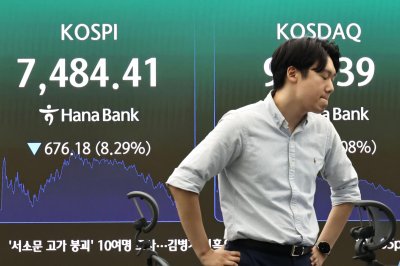
This photo, taken Monday, shows the trading room of Hana Bank in Seoul as South Korean stocks dropped more than 8 percent on concerns over AI profitability and fears over a possible rate hike by the U.S. Fed. Photo by Yonhap

South Korean stocks nosedived more than 8 percent Monday, extending their losing streak to a third consecutive session, as investors dumped market heavyweights on renewed woes over artificial intelligence (AI) profitability and concerns over a possible hawkish pivot of the U.S. Federal Reserve.

The local currency rose against the U.S. dollar after opening at a 17-year low, in the face of verbal intervention by financial authorities.

The benchmark Korea Composite Stock Price Index (KOSPI) plunged 676.18 points, or 8.29 percent, to close at 7,484.41, after falling as low as 7,442.73. The secondary KOSDAQ index sank more than 9 percent to end at 911.39.

The KOSPI’s trade volume was heavy at 448.3 million shares worth 47.8 trillion won (US$31.2 billion), with losers sharply outnumbering winners 873 to 42. Foreigners and institutions dumped local shares worth 355.5 billion won and 1.6 trillion won, respectively, while retail investors scooped up 1.76 trillion won.

The Monday crash was largely anticipated on sharp losses on Wall Street last week, fueled by semiconductor shares’ biggest daily percentage drop since March 2020 and fears over a possible rate hike by the Fed sparked by a hotter-than-expected U.S. jobs report for May.

The Dow Jones Industrial Average closed 1.35 percent lower Friday (local time), while the S&P 500 dipped 2.64 percent and the tech-heavy Nasdaq composite slid 4.18 percent.

Major U.S. chip shares sharply lost ground, with Nvidia slumping 6.2 percent, Broadcom contracting 7.92 percent and Micron shooting down 13.25 percent.

The Korea Exchange (KRX) had activated a circuit breaker for the KOSPI about three minutes after opening, halting trading for 20 minutes, and implemented a consecutive sell-side sidecar at around 9:34 a.m.

The KRX had also issued a sell-side sidecar for the secondary KOSDAQ market about six minutes after opening, suspending trading for five minutes, and activated a circuit breaker for the index later in the day after the KOSDAQ fell by more than 8 percent.

“Today’s pullback appears to be driven not by the weakening of market fundamentals, but by profit-taking sentiment among investors, mainly targeted at the semiconductor sector, as the market reacted more sensitively to negative developments after an extended rally of chip shares,” a report by Samsung Securities said.

The KOSPI has been one of the best performing stock indexes across the world in recent months, surging to near the unprecedented 9,000-point mark on Tuesday last week from the 5,000-point level earlier this year, mainly driven by major semiconductor shares, including Samsung Electronics and SK hynix.

“There is a lot at stake in this week’s financial market, with U.S. inflation data, treasury yields and the ongoing debate over the sustainability of AI-related investment all unfolding simultaneously,” said Seo Sang-young, an analyst at Mirae Asset Securities.

Han Ji-young, a researcher at Kiwoom Securities, also anticipated a “challenging” week for the KOSPI, noting that the release of the U.S. Consumer Price Index for May, the SpaceX listing and Oracle’s earnings results planned for this week may weigh on the market.

Market analysts also said news that Iran and Israel traded strikes dampened investors’ risk appetite, dimming hopes for peace in the Middle East.

Market top-cap Samsung Electronics slid 10.18 percent to 295,500 won, while its chipmaking rival SK hynix dipped 7.68 percent to 1.91 million won.

AI investment firm SK Square nosedived 11.13 percent to 1.12 million won.

Samsung Life Insurance lost 8.97 percent to 375,500 won, and Samsung C&T plunged 11.29 percent to 408,500 won.

Top automaker Hyundai Motor plummeted 8.71 percent to 639,000 won, and its auto parts making affiliate Hyundai Mobis shot down 12.2 percent to 612,000 won.

Leading battery maker LG Energy Solution pulled back 6.16 percent, and its smaller rival Samsung SDI sank 11.44 percent.

Home appliances maker LG Electronics slipped 11.55 percent to 268,000 won, while power plant manufacturer Doosan Enerbility shed 10.25 percent to 85,800 won.

Internet portal operator Naver was among the few winners, jumping 9.2 percent on news that the company is conducting a joint project with U.S. AI chip giant Nvidia to build a massive global AI factory and the nomination of Han Seong-sook, former chief executive officer (CEO) of Naver and incumbent minister of small and medium-sized enterprises (SMEs), as South Korea’s new prime minister.

SK Networks surged 30 percent to 14,170 won on SK Group and Nvidia’s announcement of a broader partnership for AI infrastructure.

The Korean won was quoted at 1,535.0 won against the U.S. dollar at 3:30 p.m., up 4.1 won from the previous session, after opening at 1,555.2 won, the lowest mark since March 6, 2009, when the global markets were in a financial crisis.

The local currency turned higher after financial authorities vowed stern action against excessive volatility and one-sided movements in the foreign exchange market.

Bond prices, which move inversely to yields, closed lower. The yield on three-year Treasurys added 5.8 basis points to 3.940 percent, and the return on the benchmark five-year government bonds gained 7 basis points to 4.190 percent.

Copyright (c) Yonhap News Agency prohibits its content from being redistributed or reprinted without consent, and forbids the content from being learned and used by artificial intelligence systems.

Source link

Texas defeats Texas Tech to repeat as NCAA softball champions

Teagan Kavan struck out five in the final two innings to back a strong start from Citlaly Gutierrez, and Kayden Henry homered to lead Texas to a 4-1 victory over Texas Tech on Thursday night at the Women’s College World Series for a second straight national championship.

Texas trailed 1-0 after four innings, but a bases-loaded throwing error by shortstop Hailey Toney allowed two unearned runs to score in the fifth for a 2-1 lead.

Henry homered off Red Raiders ace NiJaree Canady — in her final collegiate game — to begin the seventh and Leighann Goode singled to drive in the final run.

Gutierrez (11-3) allowed one run on three hits in 4⅓ innings. Kavan notched her fifth save.

Canady (29-7) went the distance and allowed four runs — two earned — on eight hits with three walks.

Lauren Allred had an RBI single in the third to put Texas Tech up 1-0.

Coach Mike White led Texas to the school’s second title in his eighth season.

Second-year coach Gerry Glasgo has led the Red Raiders to their only two WCWS appearances. Texas Tech fell 7-3 in the opener.

Texas won the rubber game of the three-game series against Texas Tech last season to claim its first title.

Source link

China Tech Stocks Surge on AI Optimism Despite Middle East Risks

Technology stocks led a broad market rally across China and Hong Kong on Tuesday as investors poured into artificial intelligence related companies despite continuing uncertainty surrounding developments in the Middle East.

The strongest gains came from major technology firms including Tencent and Meituan, helping push Hong Kong’s technology index to one of its biggest daily advances in months. The rally reflected growing investor confidence in China’s technology sector, particularly in artificial intelligence, even as markets monitored fragile diplomatic efforts and ceasefire discussions involving regional conflicts.

The performance highlights an increasingly important theme in global markets: investors are weighing geopolitical risks against the powerful growth narrative surrounding artificial intelligence and technology innovation.

Background

Chinese technology stocks have experienced a volatile few years marked by regulatory scrutiny, slowing economic growth, property market challenges, and shifting investor sentiment.

However, the global artificial intelligence boom has provided a fresh catalyst for the sector.

As major technology companies race to develop AI models, digital assistants, and enterprise applications, investors have increasingly focused on firms capable of benefiting from the next phase of technological transformation.

At the same time, geopolitical developments continue to influence market sentiment. Escalating tensions in the Middle East, concerns about energy prices, and broader uncertainty in global financial markets have periodically weighed on risk assets.

Against this backdrop, Tuesday’s rally suggests that technology driven growth expectations remain a dominant force in investor decision making.

What Happened?

Major Chinese and Hong Kong equity indices posted strong gains:

  • Hong Kong’s Hang Seng Index rose 2.5 percent.
  • The Hang Seng Tech Index surged 4.7 percent.
  • China’s STAR 50 Index gained 1.6 percent.
  • The ChiNext Index climbed 2.7 percent.
  • The CSI300 advanced 1.5 percent.
  • The Shanghai Composite Index increased 0.4 percent.

Technology stocks were the primary drivers of the rally.

Tencent shares jumped more than 10 percent following reports that the company is moving closer to launching an artificial intelligence agent integrated into WeChat, China’s largest social media and messaging platform.

Meituan also gained strongly after investors reacted positively to signs that intense competition in China’s food delivery industry may be beginning to ease.

The rally extended beyond technology, with artificial intelligence related shares and non ferrous metal companies also recording significant gains.

Tencent’s AI Push Captures Investor Attention

Why Tencent’s Move Matters

The strongest market reaction centered on Tencent.

Reports suggesting that the company is nearing the launch of an AI agent for WeChat generated excitement because of the platform’s enormous user base of approximately 1.4 billion people.

If successfully deployed, such an AI assistant could become one of the largest consumer facing artificial intelligence applications in the world.

The development is significant because AI competition is increasingly shifting from standalone chatbots toward integration within existing digital ecosystems.

Companies that already possess massive user networks may have advantages in scaling AI services rapidly.

The Strategic Importance of WeChat

WeChat occupies a unique position within China’s digital economy.

The platform combines messaging, payments, shopping, business services, entertainment, and social networking into a single ecosystem.

Integrating AI directly into this environment could significantly enhance user engagement while creating new revenue opportunities through advertising, commerce, and premium services.

Investors appear to be viewing Tencent’s AI ambitions as a potentially transformative growth driver.

Why Meituan’s Gains Matter

Signs of Competitive Stabilization

Meituan’s rise may appear surprising given its latest quarterly loss.

However, investors focused less on earnings and more on indications that subsidy driven competition in China’s rapid delivery sector is beginning to moderate.

For much of the past year, food delivery companies have engaged in aggressive pricing battles designed to capture market share.

While beneficial for consumers, these strategies have pressured corporate profitability.

Evidence that the competitive environment is stabilizing could improve future earnings prospects across the sector.

Shift Toward Profitability

Investors often reward companies when they believe industry conditions are becoming more rational.

For Meituan, expectations of reduced subsidy spending may be viewed as a pathway toward stronger margins and improved financial performance.

The AI Investment Narrative Continues

Artificial Intelligence Remains a Global Theme

One of the most important lessons from Tuesday’s rally is that artificial intelligence continues to dominate market thinking.

Despite geopolitical uncertainty, investors remain eager to identify companies positioned to benefit from AI adoption.

This trend is not limited to the United States.

Chinese technology firms are increasingly being evaluated based on their ability to develop competitive AI products, infrastructure, and services.

Zhipu AI’s Listing Plans

Another development attracting attention was the announcement that Zhipu AI intends to pursue a domestic stock market listing in Shanghai.

The move highlights growing confidence among Chinese AI firms and demonstrates the sector’s increasing importance within China’s capital markets.

A successful listing could further strengthen investor interest in domestic AI development.

The Middle East Factor

Why Investors Remain Cautious

Although technology optimism drove markets higher, geopolitical developments remain a significant source of uncertainty.

Investors continue monitoring negotiations involving the United States, Iran, Israel, and regional actors.

Potential disruptions to energy markets remain a key concern because rising oil prices can increase inflation pressures and slow economic growth globally.

Markets Are Balancing Two Competing Forces

Current market behavior reflects a balancing act.

On one side are geopolitical risks, including conflict, energy market volatility, and diplomatic uncertainty.

On the other side is enthusiasm surrounding technological innovation and artificial intelligence.

Tuesday’s rally suggests that, at least for now, investors believe technology driven growth opportunities outweigh immediate geopolitical concerns.

Analysis: Why China’s Technology Sector Is Regaining Momentum

The significance of Tuesday’s rally extends beyond a single trading session.

It reflects a broader reassessment of China’s technology sector.

For several years, investors viewed Chinese technology companies primarily through the lens of regulatory risk, slowing growth, and geopolitical tensions.

Today, artificial intelligence is changing that narrative.

Investors increasingly see Chinese firms as participants in a global technological transformation rather than merely domestic internet companies.

Tencent’s gains illustrate this shift particularly well.

The market reaction was not driven by short term earnings or cost cutting measures. Instead, it was driven by expectations regarding future technological capabilities and growth potential.

Another important factor is capital flows.

China remains one of the few major emerging markets attracting investment across equities, bonds, and currencies simultaneously. This provides a supportive backdrop for asset prices even when external risks remain elevated.

At the same time, investors should not ignore underlying challenges.

China’s economy continues to face pressures from weak consumer demand, property sector difficulties, and slower growth compared with previous decades.

Artificial intelligence enthusiasm may boost valuations, but sustained market strength will ultimately require broader economic improvement.

Nevertheless, Tuesday’s performance suggests that global investors increasingly view China’s technology sector as a key participant in the AI revolution rather than merely a recovery story.

Future Scenarios

Scenario One: AI Momentum Continues

Technology companies successfully launch new AI products and attract additional investment.

This could drive further gains across China’s technology sector and strengthen market sentiment.

Scenario Two: Economic Weakness Limits Gains

Artificial intelligence enthusiasm remains strong, but broader economic challenges constrain corporate earnings and consumer spending.

Technology stocks continue rising, though at a slower pace.

Scenario Three: Geopolitical Risks Reemerge

Escalating tensions in the Middle East or worsening global economic conditions trigger risk aversion.

Investors shift away from growth assets, leading to increased market volatility.

What’s Next?

Investors will closely watch Tencent’s progress in launching AI features for WeChat and monitor adoption rates if the product is introduced.

Attention will also focus on upcoming earnings reports, AI related announcements, and developments surrounding Zhipu AI’s planned listing.

Beyond technology, markets will continue evaluating geopolitical developments in the Middle East and their potential impact on energy prices and global investor sentiment.

The interaction between technological optimism and geopolitical uncertainty is likely to remain one of the defining themes for financial markets throughout the coming months.

Conclusion

Tuesday’s rally demonstrates that artificial intelligence remains one of the most powerful forces shaping global investment decisions. Strong gains in Tencent, Meituan, and other technology companies highlight growing confidence in China’s ability to participate in the next phase of AI driven innovation.

While geopolitical risks continue to create uncertainty, investors appear increasingly willing to look beyond short term tensions and focus on long term technological opportunities. Whether this momentum can be sustained will depend not only on AI breakthroughs but also on the broader health of China’s economy and the stability of the global geopolitical environment.

With information from Reuters.

Source link

UCLA softball eliminated from WCWS by Kaitlyn Terry, Texas Tech

Jordan Woolery nearly saved UCLA’s season Sunday night at the Women’s College World Series. She lined a single up the middle in the ninth inning off former teammate Kaitlyn Terry to score Rylee Slimp from second base and pull the Bruins within a run of Texas Tech.

But Red Raiders ace NiJaree Canady replaced Terry in the circle and retired the final two batters, stranding Megan Grant at second in UCLA’s 8-7 season-ending loss.

Woolery, the nation’s RBIs leader, homered twice and drove in five runs for UCLA (53-10), which got nine innings and 181 pitches from workhorse Taylor Tinsley.

The Bruins struggled to gain traction against Terry, who joined Texas Tech following last season’s exit from the WCWS. Terry replaced Canady in the third inning and retired 10 of the first 11 batters she faced.

But in the seventh, UCLA scored three runs to force extra innings. Pinch-hitter Ramsey Suarez ignited the rally with a 270-foot home run to left field off Terry. Facing Canady, pinch-hitter Jazmine Leyva singled down the right-field line. Two batters later, Woolery blasted a 267-foot homer over the center-field wall to tie the score.

Despite the late heroics, it wasn’t enough to keep UCLA’s season alive. Texas Tech (59-8) will play Alabama (56-7) Monday at 4 p.m. PT.

Source link

Seoul shares close at new high on tech rally, Mideast optimism

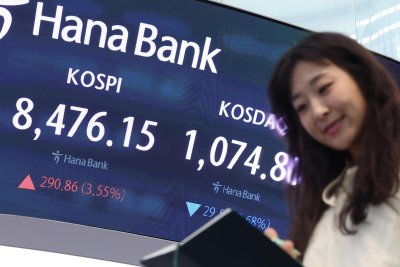
This photo, taken Friday, shows the trading room of Hana Bank in Seoul as South Korean reached a new high on AI stock gains and optimism for a Middle East peace deal. Photo by Yonhap

South Korean stocks rebounded to a fresh all-time high Friday, driven by strong gains in stocks related to artificial intelligence (AI) and renewed optimism about a potential ceasefire in the Middle East. The local currency fell against the U.S. dollar.

The benchmark Korea Composite Stock Price Index (KOSPI) added 290.86 points, or 3.55 percent, to close at 8,476.15, after hitting a new intraday high of 8,615.09.

Trade volume was heavy at 701.5 million shares worth 73.7 trillion won (US$48.9 billion), with losers outnumbering winners 686 to 205.

Foreign and individual investors unloaded local shares worth a net 1.04 trillion won and 1.4 trillion won, respectively, while institutions scooped up a net 2.37 trillion won.

The index restarted its record-breaking run after losing 0.53 percent the previous day. The KOSPI had risen for four consecutive sessions starting May 21, breaching the 8,000-point level for the first time Tuesday.

Overnight news reports that the United States and Iran had reached an agreement to extend the current ceasefire for 60 days and resume talks on Tehran’s nuclear program pushed up the index.

AI shares were boosted by the latest reports that Nvidia Corp. founder Jensen Huang plans to visit South Korea next week.

“Backed by gains in major stocks, the KOSPI rallied on news of Jensen Huang’s planned visit,” said Lee Kyung-min, an analyst at Daishin Securities. “Stocks related to Huang’s Korean visit closed in positive territory.”

Market bellwether Samsung Electronics jumped 5.84 percent to 317,000 won, and its chipmaking rival SK hynix advanced 1.92 percent to 2.33 million won.

LG Electronics shot up 29.93 percent to 293,000 won, and internet giant Naver surged 14.15 percent to 234,000 won. The two companies were reportedly on the top of Jensen Huang’s Korean schedule.

Top carmaker Hyundai Motor rose 6.79 percent to 723,000 won, and its auto parts affiliate Hyundai Mobis moved up 11.95 percent to 768,000 won.

Leading battery maker LG Energy Solution advanced 3.62 percent to 458,000 won, and pharmaceutical giant Celltrion gained 1.53 percent to 192,900 won.

However, major bank share Hana Financial Group retreated 0.17 percent to 115,100 won, and food giant Nongshim was down 0.77 percent to 385,000 won.

The Korean won was quoted at 1,507.9 won against the U.S. dollar at 3:30 p.m., down 5.1 won from the previous session.

Bond prices, which move inversely to yields, closed higher. The yield on three-year Treasurys fell 3.5 basis points to 3.731 percent, while the return on the benchmark five-year government bonds dropped 6.8 basis points to 3.924 percent.

Copyright (c) Yonhap News Agency prohibits its content from being redistributed or reprinted without consent, and forbids the content from being learned and used by artificial intelligence systems.

Source link

Beware of Financial Scammers Wielding Deepfake Tech

Deepfake fraud is becoming a persistent, multiyear corporate risk as synthetic voices circulate undetected.

Deepfake-enabled fraud, which began as novel technical exploits, is now a persistent operational risk with a multi-year shelf life within the corporate ecosystem. According to deepfake-detection provider Resemble.AI, deepfakes typically remain in circulation for three-and-a-half years.

Resemble.AI’s 2025 Deepfake Threat Report, published in March, references an incident in which a voice clone of a German energy company CEO remained in circulation for nearly six years, although it resulted in only a €243,000 loss in 2019.

Determining losses from such attacks is difficult; for the 41 documented incidents last year cited by the research, only $74.9 million in verified losses were reported, with a median per-incident loss of $243,000. However, the authors noted that 71% of victims did not report financial losses, suggesting a higher volume of hidden liabilities.

“What makes them so effective is that they enable both real-time impersonation and the creation of synthetic identities stitched together from real and fake data,” said Dominic Forrest, CTO of biometric security vendor Iproov. “These are extremely difficult to detect, and once trusted, they can be used to bypass controls and commit fraud.”

AI Arms Race

Detecting deepfakes is a growing concern; the authors of the Resemble.AI report estimate that deepfake-based fraud attacks on corporations reached 8.5 billion potential incidents, ranging from audio impersonations of executives to doctored or fake images. The most common targets, Forrest noted, are on account openings, payment authorization, credential reset, and high-value transactions.

Telling a deepfake from the genuine article has become an AI-on-AI battle, experts warn.

The generative AI models producing deepfakes improve continuously via scaling and data, while deepfake detectors rely on signals like artifacts and inconsistencies, which disappear as models improve, said Siwei Lyu, professor of Computer Science and Engineering and director of the Institute for AI and Data Science at the State University of New York at Buffalo.

“In practice, detectors lag by about six to 18 months on specific modalities,” he said. “But more importantly, they are chasing a moving target whose failure modes are actively being optimized away.”

Forrest suggests that firms move their identity verification from single checks to a multi-layered approach: “You need to confirm that a real person is physically present, not a deepfake, while also analyzing the digital environment for signs of compromise. No signal should be trusted in isolation.”

This article first appeared in the May edition of Global Finance Magazine.

Source link

Kenya’s Power Grid Limits Tech Growth

An ambitious data center project stalls due to insufficient electrical capacity.

Kenya is positioning itself as Africa’s Silicon Savannah and its premier tech hub. Touting itself as a “full-package investment destination,” part of the strategy has been encouraging global tech giants to set up operations in the country.

Lately, however, the plan has run into a roadblock: electrical capacity.

Pull back to May 2024, when Microsoft Corp., in partnership with G42, an Emirati-based AI developer, unveiled plans to invest $1 billion in a data center in Kenya powered by geothermal energy.

Described as the single largest and broadest digital investment in the country’s history, the center would be the heartbeat of a digitally led economy in Kenya and the wider East Africa region, anchored in AI and cloud-computing services.

Two years later, the project has been abandoned on account of too little electricity to power the center.

According to G42, the facility was supposed to be located some 100 kilometers northwest of Nairobi, the epicenter of geothermal energy production. Initially, it would have required 100 megawatts of electricity to run, but when fully operational, 1 gigawatt.

The Power Bottleneck

For a country whose installed electricity capacity stands at only 3,840 MW (3.8 GW), and where national connectivity is approximately 76%, the realization was astounding.   

“To switch on that one data center, we would need to shut off power for half the country,” said President William Ruto at a recent state event. “That’s when I knew there was a problem.” Kenya continues to lose high-value investments due to low electricity capacity, he conceded; to attract and secure investment, it needs at least 10 GW.

That leaves Kenya with no ongoing power generation projects or plans for more in the future.

The stalling of the data center is bad news for Microsoft. The tech giant saw East Africa as a ripe market for its Azure products and other cloud and AI-powered solutions for businesses and the public sector. A key focus was to help governments digitize operations and service delivery, starting with Kenya, which has indicated plans to move more of its services to the cloud. Another goal was to help startups, entrepreneurs, and organizations build a digital ecosystem offering critical solutions to key sectors of the economy.


Source link

Texas Tech QB sues NCAA to play in 2026 despite gambling infractions

Texas Tech quarterback Brendan Sorsby has sued the NCAA in an attempt to be allowed to practice and play with the Red Raiders in 2026, his final season of college eligibility.

Late last month, Sorsby and the Red Raiders announced that the fifth-year player had entered a residential treatment program for gambling addiction and would be away from the team for an indefinite period of time.

A lawsuit filed Monday in Texas’ Lubbock County District Court requests that Sorsby be declared eligible for all team activities because the NCAA “failed to comply with its contractual commitments” to him as a student-athlete and therefore “is precluded from enforcing its gambling bylaws against Mr. Sorsby to deny or withhold his reinstatement.”

The filing also asks for “temporary and permanent injunctive relief enjoining the NCAA from interfering with his ability to practice, play, and participate fully as a member of the Texas Tech football team for the 2026 season.”

If he remains ineligible for college football, Sorsby intends to declare for this summer’s NFL supplemental draft. Athletes who enter that draft forfeit all remaining college eligibility.

“The relief is narrow: one student-athlete and one senior season,” the filing states. “The NCAA will suffer no cognizable harm from letting Mr. Sorsby play football while this case proceeds. But if this Court does not act, no future judgment can give Mr. Sorsby what the NCAA will have taken from him.”

As a freshman at Indiana and a low-ranked quarterback on the Hoosiers’ depth chart, the lawsuit states, Sorsby “placed small bets — typically between $5 and $50 — on the Indiana football team to win or for teammates to exceed expectations. He was not traveling with the team, and not privy to game plans; betting was his way of feeling connected to a team he could only watch from the sidelines.”

The most recent NCAA guidelines about sports wagering state that student-athletes who bet on their own games or on other sports at their school could “potentially face permanent loss of collegiate eligibility.”

Sorsby stopped betting on Indiana football once he became the backup quarterback, according to the filing, and since then hasn’t bet on any of his teams (he transferred to Cincinnati in 2024 and to Texas Tech this offseason). However, the lawsuit states, “his gambling escalated into a compulsion he could not control.”

According to the filing, Sorsby and Texas Tech were notified by the NCAA in mid-April that it had opened an investigation into the quarterback’s gambling.

“Mr. Sorsby did not deny, deflect, or delay in response,” the lawsuit states. “He immediately admitted to Texas Tech that he had placed bets in violation of NCAA rules, but he also emphasized that he never bet on a game he played in and never took any action to influence the outcome of any game because of a bet. He recognized he had a gambling addiction.

“In response, Texas Tech determined that it would declare Mr. Sorsby ineligible, as required by the Bylaws. But unlike the NCAA, Texas Tech decided to support him in seeking treatment for his addiction and to seek reinstatement of his eligibility in light of the undisputed evidence that Mr. Sorsby had not committed any integrity violation; his gambling was the product of a mental health disorder.”

The lawsuit states that Texas Tech has made multiple attempts to initiate Sorsby’s reinstatement with the NCAA. “Throughout the process, the NCAA has arbitrarily stalled at every turn,” the filing states, “despite the fact that it knows that the clock is ticking for Mr. Sorsby.”

The NCAA said in a statement to media outlets Monday that it “has not received a reinstatement request for this case.”

“The NCAA generally doesn’t comment on pending reinstatement requests, but the Association’s sports betting rules are clear, as are the reinstatement conditions,” the NCAA said. “When it comes to betting on one’s own team, these rules must be enforced in every case for the simple reason that the integrity of the game is at risk. Every sports league has these protections in place, and the NCAA will continue to apply them equally because every student-athlete competing deserves to know they’re playing a fair game.”

Texas Tech said in a statement emailed to The Times: “After finalizing an agreed-upon stipulation of facts between Texas Tech University, the NCAA and Brendan Sorsby, the University has declared Sorsby ineligible for competition. Texas Tech intends to quickly initiate the reinstatement process.

“Texas Tech’s primary focus remains supporting Sorsby’s health and well-being.”

Source link

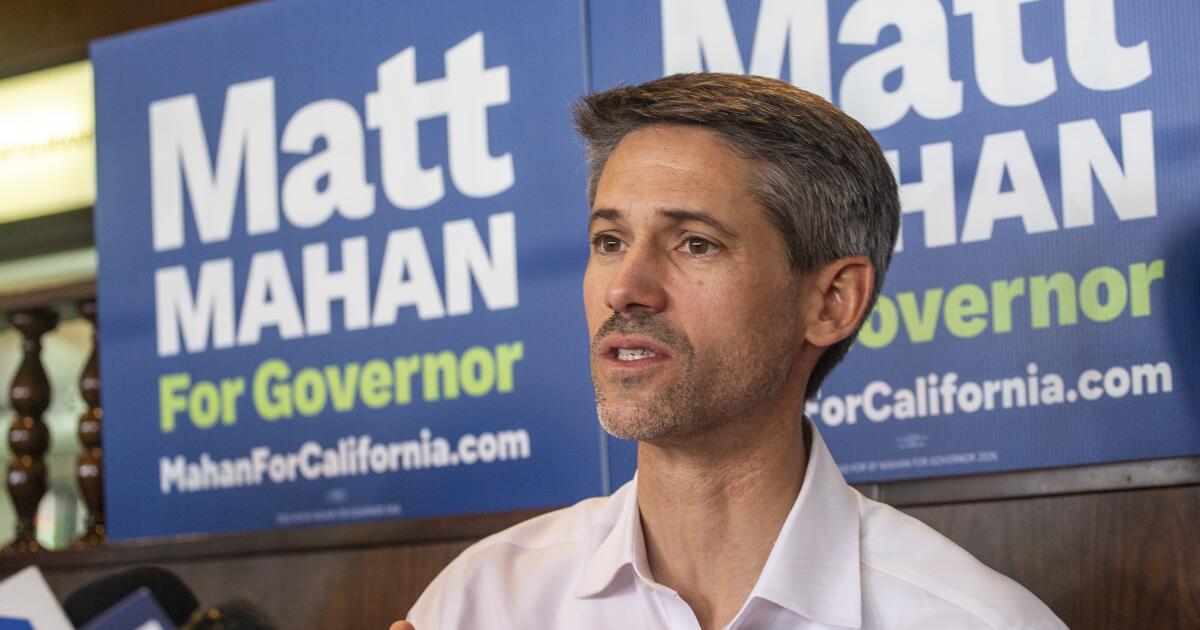
Tech leaders funding Matt Mahan’s campaign for California governor say it’s not about tech

San José Mayor Matt Mahan’s run for California governor has been defined from the start by his donor list.

Mahan entered the race late and with little statewide name recognition, but catapulted into contention thanks to massive funding from billionaire tech titans, venture capitalists, cryptocurrency investors and other Silicon Valley elites. In a state with more than 23 million voters and hugely expensive media markets, the money signaled Mahan would be a contender.

It also spurred accusations from his more liberal Democratic competitors and powerful labor leaders that Mahan is beholden to Big Tech, including forces aligned with President Trump.

California Labor Federation President Lorena Gonzalez Fletcher recently described Mahan as “funded by Trump’s big tech billionaires,” while fellow Democratic candidate Tom Steyer — a billionaire running against corporate interests — called him “MAGA Matt Mahan.”

That framing has persisted, despite Mahan being a centrist Democrat who has publicly criticized Trump.

On Thursday, Mahan released a four-page “Plan to Hold Big Tech Accountable and Ensure AI Works for All Californians.” The proposal called for AI and data centers to pay for their power and water needs, fund workforce stability initiatives and ensure human oversight of AI tools in critical sectors such as healthcare. It also called for the state to use AI to become more efficient, to bar cellphones in schools and to require parental consent for kids 15 and under joining social media.

In an interview with The Times, Mahan, 43, said AI is “one of the most significant trends in society” and needs to be addressed.

He also rejected the notion that he would do Big Tech’s bidding, and the idea that his support from tech leaders is entirely or even largely premised on his plans for their industry.

“I’ve spoken very little about tech with any of my donors,” he said.

Mahan said his fundraising has instead been “centered on how we get California on a better path in terms of building housing, improving the quality of our public schools, solving our biggest problems,” which “just resonates with people in the tech industry.”

A ‘digital native’

Mahan, the son of a teacher and a mailman, grew up in the farming community of Watsonville but commuted to San José to attend high school at Bellarmine College Prep on scholarship as a low-income student. He went on to Harvard University, where he was student body president and classmates with Facebook founder Mark Zuckerberg, spent a year in Bolivia building irrigation systems, and then taught for two years in Alum Rock as part of the Teach for America program.

He then joined Causes, an early Facebook application that allowed nonprofits to build grassroots support online, and rose to become chief executive. In 2014, he co-founded Brigade, a nonpartisan platform where voters could advocate for issues, which was acquired in 2019. He won a San José City Council seat in 2020, and was elected mayor in 2022.

An early mayoral profile described Mahan as painting a whiteboard behind his desk to “write on the wall as I did in my tech days.” Another noted he used ChatGPT to write speeches. A third recounted how he’d used AI to make city buses run faster.

Mahan said he learned as a startup leader and a classroom teacher that metrics matter — that “when we take our precious tax dollars and invest them in public services, we should measure our performance.”

He said he has always believed government should take the best tech has to offer while being vigilant about the risks it poses, which maybe comes naturally to him as a millennial who remembers “the world before the internet” but is also something of a “digital native.”

Donors explain

Between Jan. 1 and April 18, Mahan’s campaign raised nearly $13.5 million, according to state campaign finance filings. During the same period, an independent expenditure backing Mahan called Back to Basics raised about $22.7 million, while another launched by the group Deliver for California raised nearly $3.3 million.

The donors are a who’s who of tech leaders, venture capitalists and other leaders in the gig, gaming, digital media and AI defense fields.

Sergey Brin, the co-founder of Google, gave the maximum individual contribution of $39,200 to Mahan directly, and $1 million to the Deliver for California committee. Reed Hastings, the co-founder and chairman of Netflix, gave the maximum contribution to Mahan, plus $1 million to the Back to Basics committee.

Some donors, such as LinkedIn co-founder Reid Hoffman, who gave the maximum to Mahan, are well-known supporters of progressive causes. Others, such as Palantir co-founder Joe Lonsdale and crypto founder David Marcus, who maxed out to Mahan, are also Trump backers.

Brin, a friend of Gov. Gavin Newsom since the Democrat was mayor of San Francisco, has been moving rightward recently. He has donated to the Republican National Committee and in March was appointed to the White House tech advisory council. He’s also a major donor to the nonprofit opposing the ballot measure for a new tax on California billionaires — which Mahan also is against.

Brin, Lonsdale and Marcus did not respond to a request for comment. Hastings and Hoffman declined to comment.

Several other tech donors did speak with The Times — and universally described their support for Mahan as less to do with his tech policies, and more to do with issues important to all Californians.

Jamie Siminoff, who sold his home security startup Ring to Amazon for $1 billion and gave the maximum donation to Mahan, said he thinks L.A., where he lives, is the “greatest city in the world” and California is the “best state in the world.” But he sees Mahan as someone who could make improvements by bringing the state toward the political middle on public safety, housing and homelessness.

“He’s just like a nice, pragmatic, sort of centrist person, from what I can see, [who] wants to make California better, and I’m 100% behind that.”

Siminoff said it doesn’t hurt that Mahan speaks the same language as many tech leaders, who are mostly just “pragmatic inventors and entrepreneurs” who want California’s leader to be “principled in thinking about fixing things.”

Ruchi Sanghvi, the first female engineer at Facebook and a former Dropbox executive who state records show donated $25,000 to Mahan, said she has known Mahan since he was leading Causes but fell out of touch. When he entered the governor’s race, and she “got all these emails from people that I respect” saying they were supporting him, she asked for a meeting.

At that meeting, she said, Mahan “really dug in on some of the core issues that I care about,” including housing, homelessness and education.

The San Francisco resident, political independent and mother of three said the idea that tech leaders are backing Mahan because they believe he will scratch their back in business is wrong. Referring to his tech plan’s restrictions on social media for youth, she said, “I don’t think of that as scratching my back.”

Instead, “what really resonates with me and my peers is that, yes, he is pragmatic,” Sanghvi said. “He cares about measurable outcomes, which I think is very critical.”

Marc Merrill, co-founder, co-chairman and chief product officer of L.A.-based video game developer and e-sports company Riot Games, gave the maximum to Mahan, as did his wife, Ashley, founder of the sleepwear brand Lunya. In a statement to The Times, Merrill said he and his wife are lifelong Californians who love the state and support Mahan because of his record “addressing California’s most pressing challenges with practical, results-oriented solutions” in San José.

Merrill said Mahan brought down violent crime, reduced homelessness with “data-driven programs that address root causes rather than just managing the problem,” and “fostered an environment where businesses are choosing to invest and grow in the city.”

Tech vs. labor?

Gonzalez Fletcher said tech leaders have long “been very clear about their desire to support candidates who won’t regulate AI, to support candidates who will go after organized labor” — and their support for Mahan is no different.

She pointed as an example to a March event attended by Mahan and hosted by one of his most vocal backers: Garry Tan, a venture capitalist and chief executive of Y Combinator, a startup incubator in San Francisco.

At the event — which was part of Tan’s launch of a new statewide group called Garry’s List, which he has described as a “Rotary Club for radical centrism” — Chris Larsen, the co-founder of the cryptocurrency network Ripple, railed against the influence of unions in California politics and the “weak” response from business leaders, according to video.

“We’ve got to fight on par with the unions when they’re proposing stupid, job-killing ideas like the San Francisco CEO tax,” Larsen said. He noted that several other candidates for governor, including former Orange County Rep. Katie Porter, whom he’d donated to, had backed the measure to tax companies that pay their chief executive 100 times more than their average employee.

Neither Tan nor Larsen responded to a request for comment.

Gonzalez Fletcher, a former state legislator, said the argument that California Democrats have caused the state’s biggest problems by bowing to unions is false, and that what is more true is that “ruling class” Democrats such as Newsom “acquiesce to business interests” driving the state’s affordability and homelessness crises.

She said employers get away with underpaying workers and big landlords are allowed to take advantage of renters. She said Airbnb, as a tech example, has gone unchecked despite causing “a lot of the removal of housing stock.”

She said one reason she opposes Mahan is that he “suffers from the same love affair with Big Tech” as Newsom.

Steyer — who has funded his own campaign to the tune of nearly $200 million — has repeatedly struck a similar note.

Earlier this month, his campaign wrote that “Mahan continues to fail working Californians by catering to tech billionaires and wealthy special interest groups.” In February, it wrote that although Mahan had the support of “powerful special interests hellbent on keeping California a playground for the rich,” Steyer had the backing of “bus drivers, cafeteria workers, and custodians.”

Airbnb declined to comment but in the past has denied claims its platform substantially contributes to housing affordability issues, and has donated to housing initiatives. Airbnb co-founder Nathan Blecharczyk, a Mahan donor, did not respond to a request for comment.

Mahan said he values unions, in part because he grew up in a union household and benefited from the high-quality healthcare that provided, included when he was hospitalized for a collapsed lung as a teenager.

He said he has also worked with tech employers who “are inventing the future, quite literally,” and “creating a lot of jobs and opportunity.”

Mahan said the idea the two are inherently at odds is false, because “business needs labor, and labor needs business,” and the real question is “how to balance everyone’s needs.”

“If we don’t have a strong enough regulatory environment, and business has too much power, workers can be exploited, the environment can be exploited and we can see really negative social outcomes,” he said. “But the flip side is also true. If labor in our politics has too much power, you can also see distortions, you can see investment flow elsewhere, you can see less housing get built.”

Mahan said that “neither side has a monopoly on the truth,” and that government has to “bring people together and strike the right balance.”

He also defended Airbnb, which in San José pays taxes just like hotels, he said.

“We don’t see Airbnb as an antagonistic thing. We don’t let them take over the market, we regulate them, we charge them, and we use their tax revenue to provide services to people.”

He said the state’s housing crisis is due to over-regulation slowing new building to the point where it cannot keep up with job growth — which he called “fundamentally unsustainable and unfair” to low-income folks pushed out of job centers as a result.

The answer is building more homes, more quickly, he said, including by reducing building fees and streamlining permitting processes — which he said he has done in San José and would replicate statewide as governor.

“I am, first and foremost, focused on making government deliver results that make a real difference in people’s lives,” he said. “That’s my North Star.”
Source link

‘The world is sounding an alarm’: Why big tech is the new colonist | Features

Istanbul, Turkiye – When investigations by Al Jazeera and other media outlets in 2024 revealed that Israeli-linked artificial intelligence (AI) systems such as Lavender and Gospel had helped generate thousands of military targets in Gaza, critics warned that warfare was entering a new era – one driven not only by soldiers and bombs, but by algorithms, data, and surveillance technology.

Then, in September 2024, thousands of pagers and walkie-talkies used by members of Hezbollah exploded in coordinated attacks in Lebanon, widely attributed to Israeli intelligence operations that had turned ordinary communication devices into weapons.

And, last year, reporting by Al Jazeera also raised concerns about the use of cloud and data infrastructure linked to major US technology companies in Israeli surveillance operations involving Palestinians.

For a growing number of scholars, economists and political thinkers, such developments reflect more than just the changing nature of conflict. They show how power in the modern world is increasingly exercised not just through military force, but through technology, finance and control over information.

That argument has revived broader debates around decolonisation – a term historically associated with the dismantling of European empires after World War II, when countries across Asia, Africa and the Middle East gained formal independence.

But many proponents of what is termed “decolonial theory” – a school of thought arguing that colonial-era systems of power and hierarchy still shape modern politics, economics and knowledge – argue that colonial power structures never fully disappeared. Instead, they evolved, embedding themselves in global financial systems, technology platforms, media networks and even the production of knowledge itself.

Dependence of Global South countries on Western technology, digital infrastructure and global markets can create new forms of political and economic vulnerability, particularly across the Global South.

“A generation may have grown up believing they had never experienced colonialism or exploitation,” Esra Albayrak, board chair of the NUN Foundation for Education and Culture and daughter of Turkish President Recep Tayyip Erdogan, told Al Jazeera during the World Decolonization Forum in Istanbul on May 11-12.

“Yet, mentally, they may still be living under colonial influence.”

The war in Gaza marked a turning point, Albayrak says, shining a spotlight on how international principles are not applied equally. Global institutions have so far failed to stop what many countries and rights groups have described as genocide against Palestinians.

“The world is sounding an alarm, and we can no longer afford to remain indifferent to it,” she said.

A techno-feudal era

Albayrak argues that a handful of technology companies are emerging as new, invisible centres of power, shaping how information is produced, circulated and consumed in the digital age.

She describes the digital sphere as the realm of what she calls “future colonialism”, warning that AI systems trained largely on Western-centric data risk reinforcing existing global inequalities.

“When AI systems are run by those tech companies and trained on Western sources, they risk carrying the hierarchies of the past into tomorrow’s digital world, as they now have personalised data, suppressing identity,” Albayrak said.

By this, she means that most major AI models are still trained largely on English-language and Western-produced data – a pattern critics say risks sidelining non-Western languages, cultures and perspectives.

On social media platforms, algorithms tend to amplify some conflicts while rendering others nearly invisible, effectively shaping what billions of users see, discuss and remember online.

Walter D Mignolo, professor at Duke University, argues that while what we historically see as “formal colonialism” may have largely ended, systems of Western dominance continue through economics, culture, technology and knowledge production.

“Coloniality is not over. It is all over the world,” Mignolo said, arguing that modern ideas of development and progress often have the effect of pressuring societies to conform to Western norms.

Rather than simply resisting those systems, he said, societies must find a way to “re-exist” by rebuilding intellectual and cultural autonomy outside dominant global frameworks.

Colonisers in the financial age

The March 2026 Global Debt Report by the Organisation for Economic Co-operation and Development (OECD) reveals that 44 countries face severe debt burdens, often aggravated by global conflicts, forcing some governments to spend more on interest payments than on health or education.

This is not a new phenomenon, as developing countries have been labouring under the weight of foreign debt for decades.

But British political economist and author Ann Pettifor told Al Jazeera that modern forms of domination are now increasingly embedded not in empires or nation-states, but in financial systems operating beyond democratic oversight.

Pettifor points to the growing influence of “shadow” banking networks – financial institutions operating largely outside traditional banking regulations – and giant asset managers such as BlackRock, which manages $13 trillion in assets.

Much of the global financial architecture now functions largely outside the regulatory control of governments, she says, including that of Western states themselves.

“This is not a state colonising other states,” Pettifor said. “This is the financial system colonising the whole world, including my country and the US.”

She argues that elected governments increasingly struggle to control key economic realities – from energy prices to commodity markets – because those systems are dictated by global financial actors operating far beyond public accountability.

In Nigeria, for example, Pettifor says, efforts to expand domestic refining capacity continue to face pressure from international financial institutions and global energy markets to keep fuel prices tied to global markets and maintain reliance on imported refined oil products, despite its vast oil reserves.

Coordinated cooperation between developing nations may be necessary to challenge the dominance of Western-centred financial systems, Pettifor says, pointing to growing efforts across parts of West Africa to expand regional refining capacity and reduce dependence on imported fuel. Yet such ambitions can also leave critical sectors dependent on the decisions and influence of a small number of powerful private actors.

Global financial markets, algorithm-driven platforms, and foreign-controlled digital infrastructure increasingly define everyday life – from fuel and food prices to the information people consume online and the technologies governments and societies depend on, observers say.

A ‘mastery complex’

As wars become increasingly influenced by AI, digital infrastructure and financial dependency, debates around colonisation are focusing less on territorial control and more on who influences energy prices, lending systems, access to technology and the flow of information across borders, observers say.

Albayrak draws a parallel between today’s debates around technology and global power and Rudyard Kipling’s 1899 poem “The White Man’s Burden”, published as the US took control of the Philippines following the Spanish-American War. The poem framed colonial expansion as a moral obligation to “civilise” other societies rather than an exercise of domination.

Albayrak said such traces of “mastery complex” still survive today, though in different forms – not necessarily through military occupation, but through technological, financial and informational influence.

But what the world really needs, she argues, is a global order built not on hierarchy, but on shared responsibility.

“The burden should belong to humanity collectively.”

Source link

United States China Tech Rivalry Delays Nvidia AI Chip Exports

The latest developments surrounding Nvidia’s H200 chip sales to China highlight the growing complexity of the technological rivalry between the United States and China. Although Washington has reportedly approved several major Chinese firms to purchase Nvidia’s advanced artificial intelligence chips, no deliveries have taken place so far.

The situation reflects how geopolitical competition is increasingly disrupting even officially approved commercial agreements in the semiconductor sector.

Nvidia, the world’s leading artificial intelligence chip manufacturer, now finds itself caught between United States export control policies and China’s push for technological self reliance.

What Is the H200 Chip?

The H200 is Nvidia’s second most powerful artificial intelligence chip and is designed for advanced AI model training and data center operations.

The chip is particularly valuable for companies developing large language models, cloud computing systems, and next generation AI applications.

Before export restrictions tightened, Nvidia dominated China’s advanced AI chip market with an estimated market share of around 95 percent.

China also represented a major source of revenue for Nvidia, making access to the Chinese market strategically important for the company’s long term growth.

Which Chinese Companies Were Approved?

According to reports, the United States Commerce Department approved around ten Chinese firms to purchase H200 chips.

These reportedly include major Chinese technology companies such as:

  • Alibaba
  • Tencent
  • ByteDance
  • JD.com

Several distributors were also reportedly approved, including:

Under the licensing terms, each approved customer could reportedly purchase up to 75,000 chips.

However, despite these approvals, no actual sales or deliveries have yet been completed.

Why Have the Sales Stalled?

The delays appear to stem from concerns on both the United States and Chinese sides.

Chinese Concerns

Chinese authorities reportedly fear that reliance on Nvidia chips could undermine Beijing’s efforts to strengthen its domestic semiconductor industry.

China has invested heavily in local AI chip development, particularly through companies such as Huawei.

Beijing increasingly sees semiconductor self sufficiency as a national security priority amid escalating technological competition with Washington.

There are also concerns within China regarding supply chain security and possible vulnerabilities linked to imported American technology.

Recent Chinese regulations aimed at reducing foreign dependence in critical technology sectors have reportedly intensified scrutiny of these chip purchases.

United States Restrictions

The United States has simultaneously imposed strict export control requirements on advanced semiconductor sales to China.

Chinese buyers must reportedly prove that the chips will not be used for military purposes and that adequate security procedures are in place.

Nvidia must also satisfy inventory and compliance conditions under American export laws.

Additionally, reports suggest the Trump administration negotiated an unusual arrangement in which the United States would receive a portion of revenue generated from the chip sales. This reportedly requires the chips to pass through American territory before shipment to China.

Such conditions have further complicated the transaction process.

Jensen Huang’s Diplomatic Push

Nvidia Chief Executive Officer Jensen Huang has emerged as a key figure in efforts to preserve Nvidia’s access to the Chinese market.

Huang reportedly joined President Donald Trump during a diplomatic visit linked to talks with Chinese President Xi Jinping.

His participation underscores the economic significance of the semiconductor dispute and the importance of China to Nvidia’s business strategy.

Huang has repeatedly warned that export controls risk permanently weakening Nvidia’s position in China while encouraging Chinese firms to accelerate domestic alternatives.

The Larger Strategic Battle

The Nvidia dispute reflects a broader struggle between the United States and China over technological dominance in artificial intelligence.

Washington increasingly views advanced semiconductor technology as a strategic national security asset. American policymakers fear that unrestricted access to advanced AI chips could strengthen China’s military and technological capabilities.

China, meanwhile, sees semiconductor independence as essential to reducing vulnerability to foreign pressure and sanctions.

As a result, both sides are attempting to balance economic interests with long term strategic competition.

Implications for the Global AI Industry

The uncertainty surrounding Nvidia’s China business could have major implications for the global artificial intelligence industry.

If Chinese companies lose access to Nvidia chips, they may accelerate investment in domestic alternatives, potentially reshaping the global semiconductor market over time.

At the same time, restrictions on AI chip trade risk fragmenting the global technology ecosystem into competing American and Chinese spheres.

This could reduce international collaboration, disrupt supply chains, and intensify geopolitical competition over emerging technologies.

Future Outlook

Despite current delays, neither the United States nor China appears willing to completely sever technological and commercial ties.

However, the Nvidia case demonstrates that semiconductor trade between the two powers is becoming increasingly politicized and strategically sensitive.

The future of AI competition may ultimately depend not only on innovation, but also on which country can build the most resilient and independent technology ecosystem.

For Nvidia, maintaining its position between the world’s two largest economies will likely remain one of its greatest strategic challenges.

Conclusion

The stalled Nvidia H200 deal illustrates how deeply geopolitical tensions now shape the global technology industry.

Although the United States has approved limited chip exports to China, political distrust, national security concerns, and strategic competition continue to obstruct implementation.

As artificial intelligence becomes central to economic and military power, semiconductor trade is no longer simply a commercial issue. It has become a defining arena in the broader contest between Washington and Beijing for technological leadership in the twenty first century.

With information from Reuters,

Source link

Justin Bieber plays an A-list Montecito party with defense execs

Just weeks after Justin Bieber’s well-received Coachella headline gig, the singer played a small private event for tech, entertainment and defense industry moguls. Executives at controversial firms, such as surveillance tech giant Palantir, were also on the bill.

Bieber was a headliner at WNDR, entertainment executive Jeffrey Katzenberg’s invitation-only confab at the Rosewood Miramar in Montecito last week. The programming for the event was first reported by Puck.

The ultra A-list talks and guests included director James Cameron and former Disney CEO Bob Iger, YouTube CEO Neal Mohan, FIFA President Gianni Infantino, Oprah Winfrey and Julia Roberts, comedians Chris Rock and Trevor Noah and artist Jeff Koons on a panel discussion with LACMA chief Michael Govan.

Bieber, meanwhile, performed a Wednesday poolside set for attendees at the Rosewood. The “Swag” singer reportedly became the highest-paid headliner in Coachella history last month, and its most lucrative merch seller.

Representatives for Bieber did not immediately respond to a request for comment.

While there was lighter programming (like a karaoke party with pop producers StarGate and a talk about snacks with chef Nancy Silverton), the bill included talks and cameos from major weapons and surveillance technology firms noted for their support for — or deep engagement with — the Trump administration.

One panel featured Anduril Industries’ Palmer Luckey, who recently welcomed Defense Secretary Pete Hegseth to its Southern California headquarters. “We are rebuilding the Arsenal of Freedom,” Hegseth said after the Anduril visit.

Palantir Chief Executive Alex Karp led another talk. Palantir’s AI-driven defense and surveillance software has faced scrutiny around how tech like its Maven Smart System may have been used to target civilians in the Iran war.

Karp also published a recent book, “The Technological Republic,” where he wrote that “We must resist the shallow temptation of a vacant and hollow pluralism. We, in America and more broadly the West, have for the past half century resisted defining national cultures in the name of inclusivity. But inclusion into what?”

Katzenberg’s WNDR conference is one of several recent multi-discipline, ultra-elite gatherings hosted by CEOs, including Jeff Bezos and Eric Schmidt. Katzenberg founded his investment firm WndrCo in 2017.

Source link