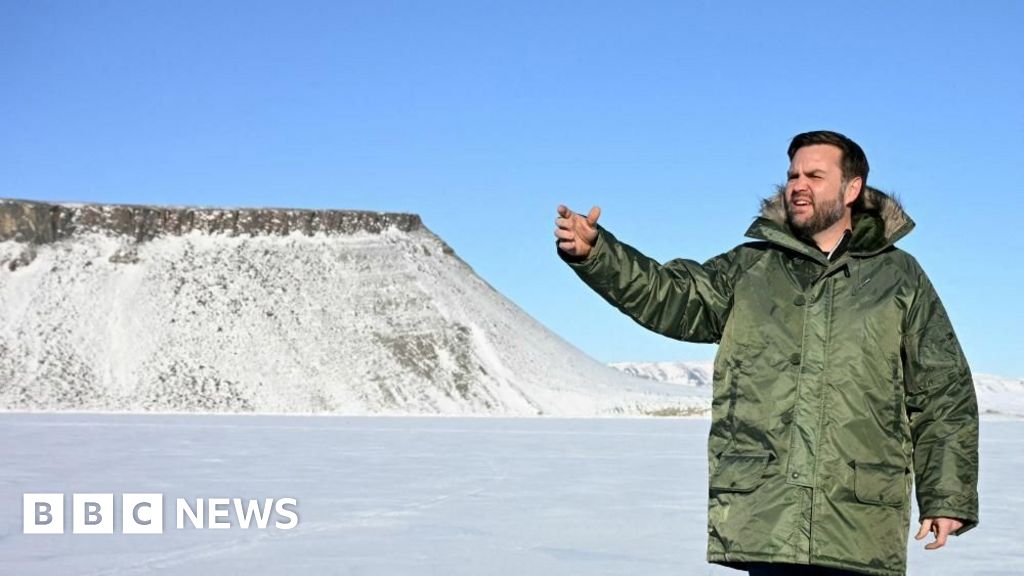
US in closely guarded talks to open new bases in Greenland
It is seeking to open three bases in the south of the Arctic territory, according to multiple officials familiar with the talks.
Source link
It is seeking to open three bases in the south of the Arctic territory, according to multiple officials familiar with the talks.
Source link

Russian President Vladimir Putin has suggested that former German Chancellor Gerhard Schroeder could coordinate talks with the European Union to secure a peace deal in Ukraine – a proposal met with scepticism by EU officials.
European Council President Antonio Costa said recently he believed there was “potential” for the EU to negotiate with Russia and to discuss the future of Europe’s security architecture.
list of 3 itemsend of list
Asked on Saturday whom he would like to see restarting talks with Europe, Putin said he would “personally” prefer Schroeder, who led Germany from 1998 to 2005 and has remained close to the Kremlin leader since leaving office.
A day later, the Russian leader said the four-year-old war may be “coming to an end”, adding that he was ready to hold direct talks with his Ukrainian counterpart, Volodymyr Zelenskyy, in Moscow or a neutral country.
Speaking after Saturday’s celebrations for Victory Day, which marks Russia’s victory over Nazi Germany in 1945 at the end of World War II, Putin added he would be willing to meet Zelenskyy only once the terms of a peace agreement had already been settled.
Russia had announced a unilateral two-day ceasefire on May 8-9 to mark Victory Day, while Zelenskyy countered it with his own proposed pause in fighting starting earlier, on the night of May 5-6.
As part of a broader Washington-led push for peace, United States President Donald Trump on Friday announced a three-day pause in the conflict, but both sides have since accused the other of breaking it.
As US-backed peace talks between Kyiv and Moscow stall, here is a look at who Schroeder is and whether he could be a trustworthy mediator.
The 82-year-old leader of the Social Democratic Party (SPD) served as Germany’s chancellor from 1998 to 2005, focusing his political goals on European integration, reducing unemployment, liberalising German citizenship laws, curbing nuclear power and rebuilding the economy.
Disagreements over the Iraq war caused a serious rift in German-US relations in 2003, when Germany sided with France and Russia in opposing military intervention in the country over claims that the then-Iraqi president, Saddam Hussein, was producing weapons of mass destruction.
After leaving office in 2005, Schroeder almost immediately took a job as chairman of a controversial German-Russian consortium building a gas pipeline under the Baltic Sea. He held key roles in Russian energy projects, including work on the Nord Stream gas pipelines and a seat on the board of Russian oil firm Rosneft, which he gave up in 2022.
While he quit that role, the former chancellor has remained close to Putin, standing apart from most Western leaders since Russia invaded Ukraine in 2022 and facing heavy criticism in Germany.
His failure to publicly condemn Russia’s invasion of Ukraine has cost him several privileges normally granted to former chancellors, including receiving a state-funded office, making him a controversial figure at home.
Schroeder referred to Putin as “a flawless democrat” in 2004, declaring himself “thoroughly convinced that the Russian president wants to transform Russia into a democracy and that he is doing so out of a deeply held conviction”.
The then-German chancellor had little to say about Russian attempts to influence the elections in Ukraine during those years or about the Kremlin’s attacks on press freedom. On the contrary, under his leadership, Germany deepened its economic ties with Russia, grew trade and increased its dependency on Russian oil and natural gas.
In his book Klare Woerter (Straight Talk), Schroeder spoke about his relationship with the Russian leader, who worked as a KGB spy in the then-East Germany in the 1980s and is fluent in German.
“The most important thing for a friendship is a common language,” Schroeder, who has two adopted children from Russia – Viktoria and Gregor – said. “It makes everything easier.”
Their friendship reportedly continued to blossom over the years. Schroeder criticised moves to impose sanctions and eject Russia from the Group of Eight and even backed a Kremlin argument comparing the annexation of Ukraine’s Crimea region with NATO’s intervention in Serbia’s Kosovo province in 1999, which he himself helped lead as the German chancellor.
The US-backed talks have faltered over the latest Russian offensive to seize the remaining parts of Ukraine’s eastern Donetsk region, which Moscow has demanded Kyiv cede before it considers ending its war. Meanwhile, the two sides continue to carry out strikes against each other, with Ukraine making significant inroads in destroying Russian energy infrastructure in recent weeks.
On Sunday, Ukrainian officials said Russian attacks had killed at least three people, and that close to 150 combat engagements had occurred on the front lines in the previous 24 hours, despite the three-day pause in fighting.
“In other words, the Russian army is not observing any silence on the front and is not even particularly trying to,” Zelenskyy said in his evening address, adding that Ukrainian troops were responding and defending their positions.
On Sunday, Russia’s Ministry of Defence accused Ukraine of violating the pause, saying it had downed 57 Ukrainian drones over the past day and “responded in kind” on the battlefield.
Control of the Russian-occupied Zaporizhzhia Nuclear Power Plant, Europe’s largest, has also been a point of contention.
While Putin suggested the war was “coming to an end” on Saturday, Kremlin spokesman Dmitry Peskov said peace in Ukraine was a “very long way” away.
On Sunday, Russia’s Interfax news agency quoted Kremlin adviser Yury Ushakov saying that US envoys Steve Witkoff and Jared Kushner would visit Moscow “soon enough” to continue talks with Russia.

EU foreign policy chief Kaja Kallas reacted with scepticism to Putin’s proposal. “If we give the right to Russia to appoint a negotiator on our behalf, you know, that would not be very wise,” she told reporters on Monday in advance of foreign ministers’ talks in Brussels.
“Gerhard Schroeder has been a high-level lobbyist for Russian state-owned companies. So it’s clear why Putin wants him to be the person so that actually, you know, he would be sitting on both sides of the table,” she added.
Germany dismissed Putin’s suggestion on Sunday. The Reuters news agency quoted a German official as saying the offer was not credible because Russia had not changed any of its conditions, stressing that any talks with the EU would need to be closely coordinated with member states and Ukraine.
The official, who spoke on condition of anonymity, said Putin had made a series of bogus offers aimed at dividing the Western alliance.
Talks between Lebanese and Israeli delegations to be held in Washington, DC, next week, the official tells Al Jazeera.

Published On 7 May 20267 May 2026
The United States is trying to de-escalate Israel’s actions in Lebanon as it pushes for solidifying an ongoing ceasefire and moving to the next phase of negotiations between the two sides, according to a Lebanese official.
The official, who spoke to Al Jazeera Arabic on condition of anonymity, revealed on Thursday the details of the planned second stage of negotiations between Israel and Lebanon after an initial round in Washington, DC, in mid-April, which led to the current status quo of a ceasefire being declared but attacks continuing.
list of 4 itemsend of list
Delegation-level negotiations will begin on May 17 in the US capital, the official said, adding that the talks will address both security and political tracks to resolve issues of a full Israeli withdrawal from southern Lebanon, borders, prisoners, displaced people and reconstruction.
The Reuters and AFP news agencies, both quoting an unnamed State Department official on Thursday, reported that the upcoming talks are due to be held May 14 and 15.
Israel continued to pound southern Lebanon on Thursday, killing one person and injuring several, according to Lebanese state-run media, a day after it targeted a commander of Hezbollah’s elite Radwan Force in the southern suburbs of Beirut.
The strikes put pressure on the Lebanon ceasefire, which emerged in parallel with a US-Iran truce in the wider war in the Middle East. A halt to Israeli strikes in Lebanon is a key Iranian demand in Tehran’s negotiations with Washington.
The Lebanese official told Al Jazeera that the country’s presidency has been seeking to discuss a final cessation of hostilities with Israel.
The expected step before May 17 is an extension of the truce and an Israeli commitment to a ceasefire, the official said, adding that the recent attack on Beirut’s southern suburbs was an Israeli message intended to obstruct the negotiation process.
Lebanon is not moving towards signing a peace agreement but towards a nonaggression pact, the official said.
The Lebanon ceasefire, announced on April 16 by US President Donald Trump, has led to a reduction in hostilities. The Beirut area, for example, was not struck by Israel for weeks before Wednesday’s attack.
However, since it went into effect, Israel and Hezbollah have traded accusations of violating the ceasefire in other areas, particularly in southern Lebanon.
More than 2,700 people have been killed in the war in Lebanon since March 2, Lebanon’s Ministry of Public Health said. About 1.2 million people have been driven from their homes in Lebanon, many of them fleeing from southern Lebanon.
Israel has announced 17 soldiers have been killed in southern Lebanon along with two civilians in northern Israel.
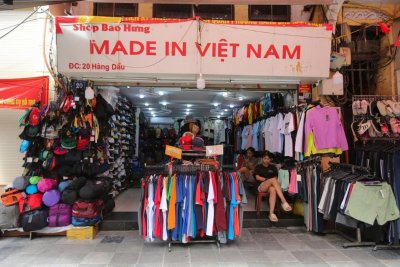

A series of meetings will help determine whether the United States and Vietnam can preserve a trade relationship that has become central to supply chain resilience, U.S. business interests and Vietnam’s continued economic ascent. File Photo by Luong Thailinh/EPA
May 7 (UPI) — As Washington and Hanoi enter a dense stretch of trade diplomacy, the coming weeks will test whether one of the Indo-Pacific’s most pragmatic economic partnerships can sustain its momentum or become entangled in the very frictions it has worked to avoid.
A series of meetings — including Section 301 hearings on industrial capacity from Tuesday to Friday this week, forced labor discussions April 28 to May 1 and bilateral consultations next Monday and Tuesday, arrives at a pivotal juncture.
They will help determine whether the United States and Vietnam can preserve a trade relationship that has become central to supply chain resilience, U.S. business interests and Vietnam’s continued economic ascent.
At its core, the U.S.-Vietnam Comprehensive Strategic Partnership is grounded not in diplomacy alone, but also in economic logic.
Partnership built on complementarity
Over the past decade, Vietnam has emerged as one of the fastest-growing U.S. trading partners, driven by a convergence of structural interests. As American firms diversify production beyond China, Vietnam has become a preferred destination, offering cost competitiveness, political stability and deepening integration into global value chains.
U.S. data show Vietnam ran a $123.5 billion trade surplus with the United States last year — the fourth-largest imbalance after China, the European Union and Mexico. It is a figure that has drawn increasing scrutiny in Washington even as it reflects the depth of bilateral trade integration.
From electronics to apparel and consumer goods, Vietnam-based production is often embedded within supply chains designed and financed by U.S. and allied firms. American companies benefit from lower production costs and diversified risk, while Vietnamese exports sustain growth and employment at home.
Disrupting this ecosystem through blunt trade measures risks undermining the very businesses Washington seeks to protect.
Hanoi has consistently signaled a willingness to engage. It has approached trade tensions not with confrontation, but with negotiation — a posture that stands in contrast to more adversarial economic relationships. The upcoming consultations should reinforce that cooperative trajectory, not derail it.
Rethinking “overcapacity”
The debate over “overcapacity” has become a central issue in U.S. trade discussions, with concerns that the term is being applied broadly across different economic models.
In Vietnam’s case, officials and industry observers note that production growth is largely driven by market-based investment and global supply chain shifts rather than state-directed industrial surpluses.
“Vietnam’s overcapacity is much different from China’s,” said Murray Hiebert, head of research for Bower Group Asia. “China’s factories are producing huge surpluses that it dumps onto the world’s markets below market prices. Instead, Vietnam relies on foreign investment companies to produce for export.”
He noted that Vietnam’s export engine is overwhelmingly foreign-driven, with multinational firms, particularly from the United States and South Korea, accounting for roughly 80% of outbound shipments, while domestic producers contribute only about one-fifth.
“Vietnam’s economy is largely a manufacturing platform for foreign companies,” Hiebert said. “U.S. policymakers need to understand Vietnam did not create overcapacity by subsidizing manufacturing, but by courting foreign investors who used Vietnam as a low-cost base to serve global markets.”
Vietnam’s manufacturing expansion has been shaped by global supply chain realignment, accelerated by U.S.-China trade tensions and pandemic-era disruptions, rather than by state-led efforts to flood international markets. Many of the factories operating in Vietnam were relocated or expanded by multinational firms seeking to maintain access to U.S. consumers.
To conflate this model with subsidy-driven overproduction risks misdiagnosing the issue and penalizing a partner that has facilitated, rather than distorted, market outcomes.
Labor reforms and supply chain progress
Concerns over labor practices and supply chain integrity remain part of the policy conversation, particularly in the context of ongoing forced labor discussions. But these concerns should be weighed against Vietnam’s steady, if incremental, progress.
In recent years, Hanoi has undertaken significant labor reforms aligned with the International Labor Organization, including updates to its labor code, expanded worker representation rights and enhanced compliance mechanisms.
Vietnam has also prioritized traceability and transparency across key export sectors. From fisheries to manufacturing, authorities have invested in monitoring systems, strengthened inspections and improved regulatory oversight — steps aimed at meeting the expectations of international partners and markets.
This is an evolving process, not a completed one. But the trajectory is clear: Vietnam is moving toward higher standards, not retreating from them.
The case for market economy recognition
Another unresolved issue, Vietnam’s designation as a non-market economy under U.S. trade law, has become increasingly difficult to justify.
Vietnam operates within the framework of the World Trade Organization and has been recognized as a market economy by more than 70 countries. Its private sector has expanded rapidly, its regulatory environment continues to evolve and its integration into global markets is deepening.
Maintaining Vietnam’s current non-market economy designation under U.S. trade law has raised concerns among policymakers and business groups, who say it could affect the application of trade remedies and investor confidence. The issue comes as Washington seeks to expand economic partnerships across the Indo-Pacific.
Avoiding unintended consequences
Intellectual property has emerged as a new point of tension in U.S.-Vietnam trade relations. Ambassador Jamieson Greer, the U.S. trade representative, has designated Vietnam as a “Priority Foreign Country” — its most serious classification — in its latest intellectual property rights report, opening the door to a potential Section 301 investigation within 30 days.
The designation, the first of its kind in more than a decade, reflects ongoing U.S. concerns over Vietnam’s intellectual property protections and could affect the trajectory of current trade negotiations.
Sweeping trade measures designed to address structural concerns could disrupt supply chains, raise costs for American businesses and consumers, and weaken a partnership that has delivered measurable benefits. In an already fragile global economy, such outcomes would be counterproductive.
Vietnam’s own incentives align with stability. Its growth depends on open markets, foreign investment and compliance with international standards. That alignment should be viewed as a strategic asset.
Washington should avoid applying a China-centric lens to Vietnam’s trade profile, said Dan Harris, a partner at the law firm Harris Sliwoski. Treating Vietnam as an “overcapacity” case without clear evidence risks penalizing U.S. firms that relocated production there in line with Washington’s own push to reduce reliance on China and strengthen supply chain resilience.
“We will end up punishing the companies that did what we asked,” Harris warned.
He added that the broader strategic context matters: Vietnam’s long history of conflict and mistrust with China sets it apart from Beijing, even as it emerges as an increasingly important U.S. partner in the Indo-Pacific.
But the implications of Washington’s trade posture toward Hanoi extend far beyond economics. Vietnam’s export-driven growth, fueled primarily by multinational investment rather than state subsidies, has quietly elevated the country into a strategic linchpin in the Indo-Pacific.
A stable and prosperous Vietnam not only supports supply chain diversification, but also reinforces the rules-based order in the South China Sea.
Economic resilience in Vietnam is not peripheral to U.S. strategy. It is foundational to maintaining balance in contested Indo-Pacific waters. Trade policy cannot be divorced from strategic reality: A weakened Vietnamese economy would do more than disrupt production flows. It could undercut one of the region’s most important counterweights to China’s expanding maritime presence.
Balancing trade and security alignments
Rising risks of policy missteps could carry strategic costs. Analysts warn that overly punitive U.S. trade measures, particularly those misreading Vietnam’s market-driven model, may push Hanoi toward alternative economic alignments, reshaping regional supply chains and weakening U.S. influence in an increasingly competitive Indo-Pacific.
U.S. policymakers are weighing more targeted, cooperative measures in managing trade concerns with Vietnam, including a bilateral supply chain monitoring mechanism, expanded data-sharing on industrial capacity and the potential creation of a standing U.S.-Vietnam trade and standards working group.
The approach aims to address regulatory and transparency issues while maintaining stability in the broader economic partnership.
The challenge for Washington is alignment – translating economic logic into strategic necessity. That means recognizing Vietnam not as a trade problem to be managed, but rather as a partner whose economic trajectory is increasingly central to the region’s stability and security.
Beyond trade flows and investment figures, the U.S.-Vietnam economic relationship carries broader strategic significance. It reinforces a rules-based framework in the Indo-Pacific and supports cooperation across sectors ranging from technology to maritime security.
Any escalation in trade tensions between the United States and Vietnam could disrupt commercial ties and place broader strategic cooperation at risk, as both sides seek to sustain recent gains in economic and security engagement.
James Borton is a non-resident senior fellow at Johns Hopkins SAIS Foreign Policy Institute and the author of Harvesting the Waves: How Blue Parks Shape Policy, Politics, and Peacebuilding in the South China Sea. Borton is the editor-in-chief of the South China Sea NewsWire. The views and opinions expressed in this commentary are solely those of the author.
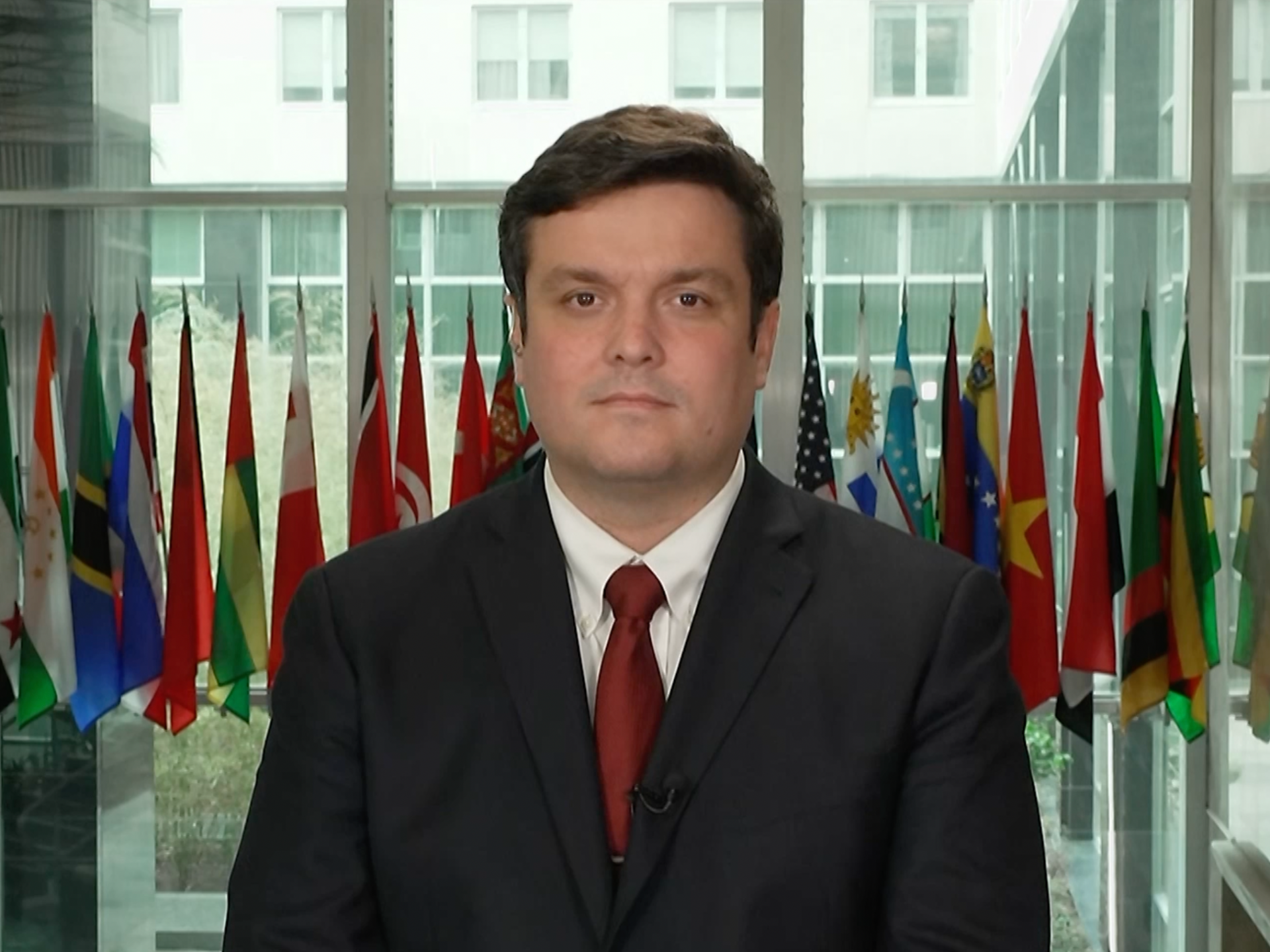
US State Department spokesperson Tommy Piggott tells Al Jazeera that the United States is working to create conditions for “good faith conversations” between Lebanon and Israel, while accusing Hezbollah of trying to derail diplomacy through attacks and threats.
Published On 7 May 20267 May 2026
Share
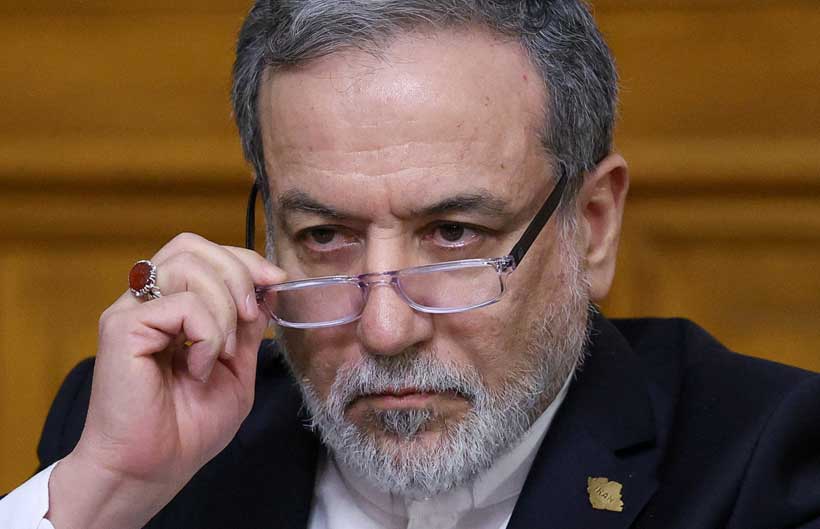
Iran has said it will only accept a fair and comprehensive agreement in ongoing negotiations with the United States, as talks continue alongside a fragile ceasefire in the Middle East conflict. Foreign Minister Abbas Araqchi made the remarks following discussions with Wang Yi in Beijing.
At the same time, Donald Trump has pointed to what he described as significant progress, announcing a temporary pause in US naval operations linked to the Strait of Hormuz to support negotiations. The strait remains largely restricted, disrupting global oil flows and contributing to an ongoing energy crisis.
What does Iran mean by a comprehensive agreement
The key question is what Iran is asking for. A comprehensive agreement suggests Tehran wants more than a temporary ceasefire. It likely includes guarantees on sovereignty, relief from military pressure, and recognition of its rights under international agreements such as nuclear development for peaceful purposes.
This position indicates Iran is negotiating for long term security and political legitimacy rather than short term concessions.
What is the United States offering in response
The United States appears to be using a mix of pressure and incentives. Military actions and blockades continue, but the pause in naval escort operations signals willingness to de escalate if progress is made.
Statements from US officials show a firm stance on preventing Iran from controlling key shipping routes, while still leaving room for diplomacy. This creates a dual track approach of negotiation backed by force.
Why is the Strait of Hormuz central to the talks
The Strait of Hormuz is critical because it carries a significant share of global oil supply. Its disruption has already triggered sharp movements in energy markets and raised concerns about global economic stability.
Control over this route gives Iran strategic leverage, while reopening it safely is a priority for the United States and global markets. This makes the strait a core bargaining point in negotiations.
Implications for global markets and politics
The negotiations are directly influencing oil prices, currency markets, and investor sentiment. Even signals of progress have led to falling oil prices and improved market confidence.
Politically, the situation affects domestic dynamics in the United States, where rising energy costs are a concern ahead of elections. It also shapes regional power balances across the Middle East.
Analysis what are the possible outcomes
There are three main paths forward. First, a comprehensive agreement could stabilise the region, reopen energy routes, and reduce global economic pressure. Second, prolonged negotiations without resolution could keep markets volatile and maintain the current fragile ceasefire. Third, a breakdown in talks could lead to renewed escalation, further disrupting oil supply and increasing geopolitical risk.
The most realistic short term outcome appears to be continued negotiations with limited de escalation steps. A full agreement will likely require compromises on both security concerns and economic demands.
With information from Reuters.
Iran’s foreign minister meets his Chinese counterpart one week before President Donald Trump’s visit to Beijing.
Published On 6 May 20266 May 2026
Iran’s Foreign Minister Abbas Araghchi is holding talks with his Chinese counterpart, Wang Yi, in Beijing amid tensions with the United States in the Strait of Hormuz.
Araghchi’s one-day trip on Wednesday comes a week before US President Donald Trump’s scheduled visit to Beijing for a summit with President Xi Jinping on May 14 and 15.
list of 4 itemsend of list
China’s official Xinhua news agency reported the meeting between Araghchi and Wang had begun, without providing further details.
Araghchi’s visit to Beijing marks the first time he has travelled to China, a close ally of Tehran, since the US-Israeli war on Iran began on February 28. Araghchi had spoken with Wang by telephone at least three times following the start of the war.
Earlier in Washington, DC, US Secretary of State Marco Rubio expressed hope that Beijing would reiterate to Tehran the need to release its chokehold on the Strait of Hormuz.
Iran effectively closed the strait, through which major oil and gas supplies passed, after the war began, sending prices of fuel and fertiliser skyrocketing and rattling the global economy.
Following a ceasefire in April, the US imposed its own blockade on Iranian ports in a bid to compel Tehran to agree to Washington’s terms in peace talks.
Al Jazeera’s Katrina Yu, reporting from Beijing, said two things will be front and centre on the agenda of Araghchi and Wang’s meeting – maintaining the ceasefire and reopening the Strait of Hormuz.
“We know that China has been very critical of the US’s naval blockade on Iranian ports, calling it dangerous. But increasingly, Beijing has also been critical of Iran’s decision to continually close that vital chokepoint,” Yu said.
Wang is expected to speak to Araghchi about what kind of support China can continue to offer Iran if it continues to close the strait.
“Iran will need Chinese backing, for example, at the United Nations, to continue to block any action that would put any additional sanctions on Iran because of its closure of the strait,” Yu said.
“Reportedly, the Iranian foreign minister is looking for clarity from Beijing as to what it will put on the table when Xi meets with Trump, and whether Beijing will be making any concessions to Washington that could make Tehran nervous.”
China, in return, “wants its own assurances that Iran won’t act in any escalatory way or any dramatic fashion in the lead up to that very important meeting”, she added.
Araghchi and Wang’s meeting came as Trump announced a pause on a US military operation to escort stranded ships out of the Strait of Hormuz.
The effort, which began on Monday, ratcheted up tensions, with the US military claiming it sank several Iranian boats that attempted to interfere in the operation. The United Arab Emirates also reported coming under missile and drone attacks from Iran, with one assault sparking a fire at an oil refinery. Tehran denies the launching the attacks.
Trump said on Truth Social the pause was based “on the request of Pakistan and other Countries” and because “Great Progress has been made toward a Complete and Final Agreement with Representatives of Iran”.
Pakistan has been leading efforts for a peace deal between Iran and the US.
The two sides held direct talks in Islamabad on April 11 and 12, but the negotiations ended without an agreement. Key sticking points include US demands for Iran to halt all nuclear enrichment and Tehran’s wish to continue to exercise control over the Strait of Hormuz.

US Defense Secretary Pete Hegseth says ceasefire with Iran remains in place despite growing tensions in the Strait of Hormuz.
Published On 6 May 20266 May 2026
Share
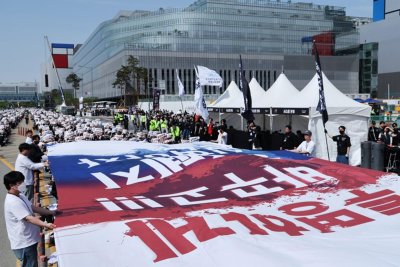

Samsung Electronics union members hold a large banner during a protest outside the company’s semiconductor plant in Pyeongtaek, South Korea, 23 April 2026. The union has announced plans to launch an 18-day general strike from 21 May to 07 June, which could result in losses for the company of up to 30 trillion won (US $20.3 billion). Photo by HAN MYUNG-GU / EPA
May 4 (Asia Today) — A rift among Samsung Electronics labor unions is widening after a union representing many workers in the company’s device business withdrew from a joint wage negotiation front.
Industry officials said Monday that Samsung Electronics Union Donghaeng, led mainly by workers in the Device eXperience division, sent an official letter to two other unions announcing its withdrawal from the 2026 joint wage bargaining group.
The unions had formed a joint bargaining team in November for wage and collective agreement talks. After negotiations with management stalled, they reorganized the group as a joint struggle headquarters.
The Donghaeng union said it decided to break away because of failed communication and damaged trust among the unions.
“Even when we proposed agenda items for the rights and interests of all union members rather than a specific department, the two unions showed no response or willingness to discuss them,” the union said in the letter.
The union also said it had repeatedly been disparaged and labeled a “company-friendly union,” making it impossible to maintain a cooperative bargaining relationship.
The Donghaeng union has about 2,300 members, with about 70% from the Device eXperience division, which oversees Samsung’s TV, home appliance and smartphone businesses. The union plans to notify management Wednesday of its withdrawal and request separate negotiations.
It also plans to pursue independent activities, including sending letters to executives and staging one-person protests.
The split is expected to deepen tensions among Samsung Electronics unions. Internal criticism has grown that the Samsung Electronics branch of the Super-Enterprise Labor Union, which recently became the company’s majority union, has focused too heavily on performance bonus demands for the Device Solutions division, Samsung’s semiconductor business.
Membership in the Super-Enterprise Labor Union branch has fallen from more than 76,000 to the 74,000 range, and some employees have called for a new union representing only Device eXperience workers.
The joint struggle headquarters, now without the Donghaeng union, still plans to begin procedures for a full strike May 21. Participation by Donghaeng union members is expected to be decided individually.
— Reported by Asia Today; translated by UPI
© Asia Today. Unauthorized reproduction or redistribution prohibited.
Original Korean report: https://www.asiatoday.co.kr/kn/view.php?key=20260504010000424

SPICE GIRLS fans might not be getting a reunion tour for their 30th anniversary — but they could be enjoying something a lot more futuristic.
Victoria Beckham has confirmed they are in discussions about a hologram spectacular, a year after I revealed talks were under way with former manager Simon Fuller.
With a full-blown comeback looking unlikely, Posh said the girls all reckon a digital show would be “great” — and have already been chatting about it over dinner.
The concept would follow in the footsteps of ABBA Voyage, which turned the Swedish band into digital avatars and has been raking it in since launching in East London in 2022.
Victoria said on SiriusXM radio: “I think it would be a great idea.
“The principle of it would be great.
“We were talking about it at dinner, but we’ll see.”
It comes after Melanie C poured cold water on reunion hopes, insisting a tour “is not happening”.
So fans shouldn’t hold out for the band hitting the road together anytime soon.
Still, a Spice Girls show without the stress of rehearsals, travel or arranging five schedules sounds very on- brand.
And if anyone can make Girl Power go digital, it’s music boss Simon, who first dreamed up ABBA’s avatar take
My insiders first told me of the girl-group’s plans last May, with Simon keen to celebrate their greatest hits with the show.
A source added: “Simon is desperate to have one last hurrah with the Spice Girls and this is his latest idea.
“He was the person who came up with the original idea for Abba and their digital show and he thinks this model could work perfectly for the group.
“Simon knows this plan would mean the band would be making money in their sleep and it would open up their music to a whole new generation.
“It’s a really exciting concept and he thinks he could make it work.”
Now he’s got Posh on board, I don’t think there is anything stopping them.
SUCCESSFUL musicians can be lazy sods after years of having lackeys looking after their every whim.
And Damon Albarn has revealed he’s become so high and mighty, that he’s decided to stop doing anything not worth his time.
The result, my friends, is absolutely disgusting.
The Blur frontman said: “Sometimes I don’t even really wipe my bum properly.
“No, it’s not all the time, but you know what I mean. I just don’t allow many of the conventions that slow the day down to get in my way.”
Defending his toilet habit, Beatlebum singer Damon, insisted: “It’s more of the principle of the thing.
“If I’m in a hurry, I won’t waste extra time doing something that is not necessary to do at that moment.”
Remind me to never sit down wind of him at a party.
HOLIDAY-loving Dua Lipa wore denim and stripes as she zipped off on another trip with her actor fiancé Callum Turner.
They have just returned from a romantic getaway to Copenhagen and she shared snaps online of them together and him tucking into a burger.
But it sounds like she may soon have a surprise up her sleeve, after sending fans wild with a message about a potential film of her Radical Optimism tour, which kicked off in November 2024 in support of her third album.
Dua shared a video on WhatsApp of herself performing and people screaming in the crowds.
In an accompanying note to fans, she wrote: “Happy 2 years of Radical Optimism . . . how should we celebrate?”
Her song End Of An Era features in new flick The Devil Wears Prada 2 and with the singer already hard at work on her next album, now would be the perfect time to close the book on her previous one.
THE World Cup kicks off in just over a month and Olivia Rodrigo is already proving she’s on the ball when it comes to the beautiful game.
But rather than getting behind the US team, she’s more focused on La Liga champs Barcelona, teaming up with the Spanish club and Spotify to create a limited-edition jersey.
Perhaps we just forget about her trip to Stamford Bridge in 2023 to see Chelsea when it was proudly claimed she was a Blues fan.
The women’s team will wear the tops in their home match against Levante on Thursday. On Saturday, Olivia will play a Spotify Billions Club Live gig there.
Olivia, who follows acts such as Ed Sheeran, Drake and The Rolling Stones by featuring on the club’s kit, said: “Seeing ‘OR’ on a Barcelona jersey, I don’t even know how to process that.
“Getting to perform for the fans who’ve been listening since day one, in a city like Barcelona, is going to be special.”
EUPHORIA actor Jacob Elordi has broken his foot.
The Page Six gossip column in the US said the Aussie heartthrob’s injury means he is out of the running to be on the Cannes Film Festival jury, which he was expected to be part of.
The festival starts next Tuesday, but the injury means we are unlikely to see him striding down the red carpet.
THERE were plenty of doubters and mixed reviews – but The Devil Wears Prada 2 certainly hasn’t fallen out of fashion.
It has topped the box office worldwide, and over the weekend banked $233.6million, including $77million in North America.
That’s more than double the $27.5million the original 2006 flick made in its opening weekend.
It’s finally proof there is demand for female-fronted films, after male movies such as Michael and Project Hail Mary dominated in cinemas.
Meryl Streep, Emily Blunt and Anne Hathaway reprise their roles, with all eyes back on Runway magazine and its editor Miranda Priestly.
Unlike the fictional mag, there’s nothing to worry about with these bumper figures.
CAMERON DIAZ has become a mum for the third time, aged 53.
She and hubby Benji Madden, of rock band Good Charlotte, have welcomed a baby boy called Nautas.
The Charlie’s Angels actress, who had daughter Raddix and son Cardinal by surrogate, previously said she was conscious about being an older mum.
RIHANNA gets fruity in an new shoot for her Savage X Fenty’s latest undies range.
The singer, who looked stunning in sett decorated with strawberries, wrote on X: “It’s giving everything but basic for your everyday basics.”
Rihanna has been really quiet lately, with all whispers of new music once again dying down – a decade after the release of her last album, Anti.
C’mon girl, it’s what we RiRi want.
KATY PERRY and Justin Trudeau have got themselves in a right little pickle.
The singer proved her unlikely romance with the former Canadian Prime Minister had gone from strength to strength – when she shared loved-up photos on Instagram, including one of their personalised jar of pickles.
The label shows the couple under the name “Katy & Justin’s Pop + Policy Pickles.”
Customised jars like theirs set customers back £22, but she clearly enjoyed the savoury souvenir, given that she shared the photo with her 200million followers.
Katy, pictured with her arms wrapped around her boyfriend, will head out on a six-week tour next month with stops in Dublin, Cardiff, and Isle of MTV festival in Malta.
At least with this momento stashed in her suitcase, she will have a reminder of home.
PRIMAL SCREAM frontman Bobby Gillespie has taken a swipe at rock royalty, accusing some of music’s biggest names of getting too cosy with the Royal Family.
The singer didn’t hold back as he blasted those who accept honours, taking aim at the likes of Sir Brian May, Sir Paul McCartney and Sir Rod Stewart.
At the launch of the David Bowie: You’re Not Alone immersive experience in London, Bobby said: “David Bowie was one of the few admirable rock stars who never took an honour from the Royal Family, which I think is incredibly cool.
“Maybe the coolest thing he ever did.
“The rest of them grovel on their knees, Bowie was like, nah. Too cool.”
Bobby made it clear his admiration for Bowie goes far beyond just snubbing a title, though.
He added: “I was a teenager in the Seventies so I’d be going to school in the morning and my mum would have the radio on and The Jean Genie would be blasting out, or Suffragette City or Golden Years.
“So since I was a conscious kid, a teenager, a pop music fan, he’s always been there.”
Bobby also praised Bowie’s constant reinvention, which he says helped shape his own band’s sound.
He added: “The way that he changed as an artist from album to album – he did different styles, as did The Beatles – that’s been a big influence on Primal Scream.”
ROBBIE WILLIAMS had to grin and bare it after breaking off half of his front tooth.
He shared this smiley selfie with the damaged gnasher on full display, telling his Instagram followers he hadn’t noticed it was missing until getting into bed with his wife Ayda Field.
Robbie revealed: “She said I look like Dumb And Dumber. Fair enough, I guess I do.”
But Rob is in Miami and his dentist is in Los Angeles, so he’s in a quandry over whether to fly five hours to get it fixed before his upcoming shows.
Whatever he does, I doubt he will be taking PALOMA FAITH’s advice.
She commented: “Knock them all out to match.”
That sounds more like a threat than a solution.

Published on
The major AI company Anthropic is exploring a potential partnership with the British semiconductor firm Fractile to secure a steady supply of chips for custom inference and reduce the significant overheads associated with current semiconductor solutions.

According to reports, these talks represent a strategic effort by the San Francisco-based firm to decrease its dependency on Nvidia whilst enhancing the speed and efficiency of its current and next-generation models.
As the global demand for generative AI capacity continues to climb, the financial burden of the hardware required to run these systems has become a primary hurdle for developers.
Anthropic, which has received multi-billion-dollar investments from both Amazon and Google, currently relies heavily on Nvidia’s H100 units alongside custom processors provided by its cloud partners.
However, the high market price and limited availability of these industry-standard chips have squeezed profit margins, prompting firms to look elsewhere.
According to industry analysts, a deal with a specialised firm like Fractile could allow Anthropic to exert greater control over its technical infrastructure.
This strategy reflects a broader trend among tech giants, including Microsoft and Meta, who are increasingly moving away from general-purpose chips in favour of internal or boutique designs.
Founded in 2022 by Oxford PhD Walter Goodwin, Fractile has gained significant attention for its unconventional approach to processor design.
Unlike standard chips that must constantly shuttle data between the processor and separate memory modules, Fractile’s “memory-compute fusion” architecture keeps data directly on the chip using static random-access memory, or SRAM, which does not need to be refreshed.
According to the British start-up, this method can run large language models up to a hundred times faster than existing hardware while lowering operational costs by 90%.
While these performance claims are impressive, the technology is still in the development phase.
Fractile has not yet launched a commercial product, and its specialised chips are not expected to be ready for full-scale data centre deployment until 2027.
Despite the long timeline, the start-up is reportedly in negotiations to raise $200 million (€170.5m) in funding at a valuation exceeding $1 billion (€853m).
The potential partnership highlights the growing significance of the UK’s semiconductor sector on the world stage. If a formal agreement is reached, Fractile could become Anthropic’s fourth major chip supplier, joining the ranks of Nvidia, Google and Amazon.
According to market reports, the discussions remain at an early stage and no binding contract has been signed.
However, the interest from a major player such as Anthropic suggests that in the AI race, the ability to deliver faster and cheaper compute power is the defining factor.


AS Maura Higgins’ career has soared since making the final of Love Island in 2019, her romantic life has gone the other way.
The Irish beauty has been linked with famous hunks including Pete Wicks, Curtis Pritchard, Giovanni Pernice and Joey Essex.
But Maura, 35, reveals that some high-profile stars actually struggle to cope with her popularity and success.
She said: “My friends tell me that I need someone quieter than me.
“Some of my ex-partners didn’t like me overshadowing them — it was probably an ego thing.
“My friends keep saying that my next partner needs to let me shine and be who I am.”
The former hairdresser and grid girl showed she was not afraid to speak her mind on Love Island seven years ago.
Fans loved her and TV companies could not wait to snap her up.
She was soon signed for Dancing On Ice, and by 2024 she was starring on I’m A Celebrity.
Now she has cracked America, too.
She has just been announced as a competitor on Dancing With The Stars, the US version of Strictly, which follows on from her presenting Love Island USA and finishing runner-up on the American version of The Traitors in February.
It has led to her walking some of the biggest red carpets Stateside, including at the Oscars.
And her work there has seen her gain American friends, including fellow Traitors star and Melrose Place actress Lisa Rinna.
Maura recently went to Lisa’s home for an event and was blown over by the relationship she has with husband of 29 years, Clash Of The Titans and L.A. Law star Harry Hamlin.
Maura told Cosmopolitan: “Harry gave a speech, and I sat there thinking, ‘That’s exactly what I want’. He spoke about her with so much respect, and he adores her.
“I genuinely thought, ‘That’s the type of relationship I want. I want a man to let me be me and not try to dim my light’.”
It was during her stint on the fifth series of ITV2 reality series Love Island that she began her first high-profile romance, with Curtis Pritchard.
After leaving the villa, they dated for eight months but Maura says: “I feel like starting on Love Island is why everyone is so invested in my love life and wants to know whether I’m single or dating.”
It is probably also because there have been so many relationships with fellow celebrities.
Next came another ex-Love Islander, Chris Taylor, in 2020, followed by Strictly pro Giovanni Pernice in 2021.
At the time, friends said he had “never felt like this about anyone before”. But four months later it ended, leaving Maura reportedly “blindsided”.
In October 2022 she was photographed kissing Towie star Joey Essex at an awards bash.
A ten-month relationship with American stuntman Bobby Holland Hanton followed.
Next came Towie lothario Pete Wicks. The pair split in February last year after a series of rows.
And on Valentine’s Day she was overheard telling a friend who asked where he was: “I don’t know, probably cheating”.
But the following month, she was caught in a cheating drama of her own — kissing married I’m A Celeb campmate Danny Jones, the McFly guitarist, at a Brit Awards after-party. He later apologised to his wife.
Maura then started to spend more time in America.
Now, the announcement that she will star in the new series of the US dance show cements her place as America’s Irish sweetheart.
But many people are now commenting on her accent, with American fans on social media joking about her saying, “tink”, instead of “think”.
Maura told Cosmo mag: “Everyone’s spelling it T-I-N-K! Even I’m doing it now.
“My Irish fans — they’re all DM-ing and making videos. I’ve seen a few Irish people get defensive and say, ‘You shouldn’t be doing this’.
“But look, if I’m OK with people making fun, then I tink it’s fine.”
After she landed the job on Dancing With The Stars she told fans: “I tink I’m very excited.” And she told American TV show ABC News how she “manifested” her appearance on the dance show.
She said: “I was asked to do Dancing With The Stars Ireland when I first came off Love Island. But around that time there was a lot going on.
“And then when Strictly came about I was very tempted because I always wanted to do a dance show.
“I dunno, like my sights were always set on Dancing With The Stars America and I didn’t want to do anything that would jeopardise that position.
“It’s something I’ve been manifesting. I’ve had it on my vision board for the past couple of years.
“And now it’s actually happening. I cannot believe it.”
Maura revealed that although she rarely cries, she was overcome with emotion when she landed the gig.
She said: “I don’t get like that about anything. I don’t think I’ve ever had a moment like that, but because I really wanted it . . .
“If I could get to the finale I’d be over the moon. Obviously I’d love to win. I’ve never won a show in my life.”
It does mean, though, that she will be spending more time in America — and less in the £1.25million home she bought last year in a gated community in Essex.
Maura was so excited when she got the keys that she set up her own Casa A’Maura Instagram — a nod to the Casa Amor villa on Love Island.
But since then she has barely been at the house and only posted twice — one picture of her bean bags in an empty lounge and a second of her cooking pasta, with Sex And The City playing on a TV in the background.
She previously revealed she has not had time to furnish it as she has not been home due to her hectic schedule.
As well as her TV career, Maura has also landed lucrative tie-ins with brands including Primark, L’Oreal Paris, Mac, Ann Summers, Victoria’s Secret and Uber.
Her face may be everywhere, but it has also come under scrutiny on social media, with some asking if she has had tweakments.
Others have commented about her weight loss since her days on Love Island.
Maura told Allure mag: “I have never in my life had cheek filler. If they’re talking about Botox, however, yes, I do get Botox.
“But the only filler I’ve ever had was lip filler, and I’ve not had it in years.
“I’ve had my teeth done. I had Invisalign when I came out of Love Island, and then I had bonding over my teeth, which obviously is going to change my face a lot.”
But one thing she is never without is a spray tan — something that will hold her in good stead as she competes for the glitterball as Ireland’s current hottest export.
She said: “When I’m tanned I feel good, and I’m ready to take on the world”.

