switzerland

Inside the UK’s ‘Little Switzerland’ with beautiful views and ‘spectacular’ autumn walks

This beautiful seaside town has gorgeous coastal walks and plenty to see

As the summer throngs start to thin out, late August and September offer an ideal opportunity to discover Devon’s coastline, with less crowded beaches, gentler temperatures and beautiful walks just waiting to be enjoyed. A delightful seaside town nestled between steep hills and the Bristol Channel has been crowned Devon’s finest seaside destination by Which?, placing it squarely on the map for an idyllic West Country escape.

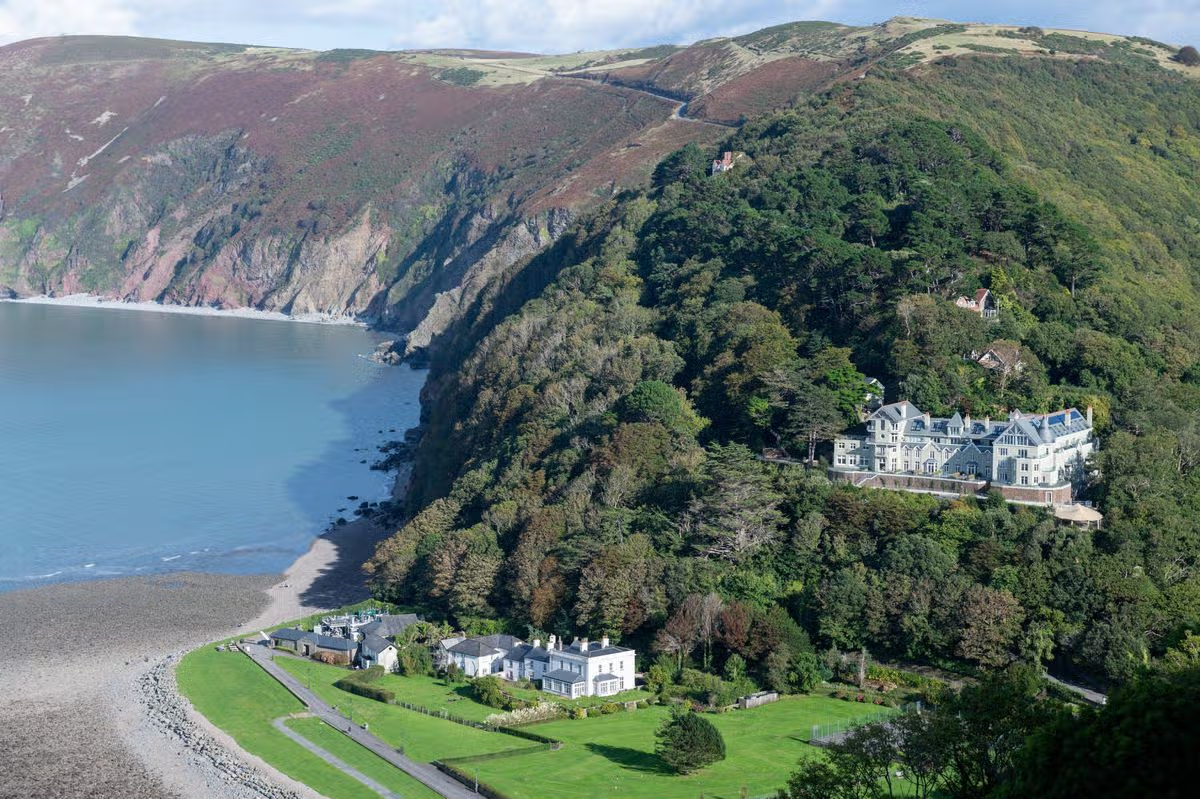
Lynmouth is the sort of spot that appears almost impossibly picturesque, with its lovely riverside location, striking coastline and classic village appeal. Perched on the fringes of Exmoor National Park, it’s encircled by breathtaking scenery and is frequently dubbed “Little Switzerland”.

The region is a paradise for ramblers, with the South West Coast Path and Tarka Trail winding through the village and providing numerous routes to discover. Tourists can trace the River Lyn upstream to Watersmeet, a striking wooded gorge looked after by the National Trust, complete with riverside paths and a tea garden.

Among Lynmouth’s standout features is the renowned Lynton and Lynmouth Cliff Railway, which has linked the twin villages since 1890. The 260-metre railway holds the title of the world’s highest and steepest water-powered railway, with travellers enjoying panoramic coastal vistas as they journey between the two settlements.

Those looking to transform their visit into a romantic getaway, River View is a second-floor flat positioned directly alongside the river in Lynmouth. The property boasts a furnished balcony with views over the bay, and on a clear day, guests might even glimpse the Welsh coastline in the distance.

Within, the flat provides a cosy open-plan lounge and kitchen space kitted out with everything required for an uncomplicated self-catering break. A king-size master bedroom with an en-suite shower room delivers a peaceful retreat in which to relax after a day discovering the coastline.

The balcony proves a particularly beautiful location for a morning cuppa or an evening tipple, with vistas across the river and the neighbouring village. There’s also no need to fret about preparing every meal, with numerous cafes and eateries nearby for breakfast, lunch or dinner.

For a different setting, Ilfracombe sits less than 20 miles away, celebrated for its selection of restaurants and historic harbour. Guests can also catch sight of Damien Hirst’s eye-catching ‘Verity’ statue positioned at the harbour entrance before returning to the tranquil environment of Lynmouth.

For even more striking scenery, holidaymakers can make the 1.5-mile trip to the Valley of Rocks, where soaring cliffs and distinctive rock formations form one of Exmoor’s most spectacular landscapes. The area is also home to intrepid goats and some of the highest sea cliffs in Britain, making it a memorable spot for a coastal walk.

If a large group gathering is in the pipeline, the area is additionally home to Lynhurst, a spacious, impressive property just a brief stroll from the historic village of Lynton. Nestled within stunning gardens and natural woodland, it boasts a games room with a slate pool table and dart board, alongside an outdoor table tennis table for abundant entertainment.

Visitors who have previously enjoyed a stay at River View have posted glowing reviews online. One guest said: “Lovely apartment. Perfectly situated with everything we needed. A real ‘home from home’. We love Lynmouth and will be back.”

Another added: “A wonderful location for walkers as several spectacular river and coastal walks from the door. Great for visitors with dogs, close to the promenade for walks and meeting lots of other dogs.”

A more in-depth review explained: “A small but well-equipped and comfortable flat with beautiful views over the river to the sea. Good location to explore the area. Luckily found a temporary parking spot initially on Riverside Road in order to unpack, as the flat entrance is on a pedestrianised street.

“Parking permit was £25 for the week at the nearby Upper Lyndale car park. Tesco delivered groceries without difficulty. Walks locally and some National Trust properties made it a very enjoyable week in a lovely location.”

One guest pointed out, however, that “the two flights of steep stairs would need to be taken into consideration by anybody perhaps not a 100% fit”, while another revelled in the scenery, commenting: “We had the door open all the time and could listen to the water and the wildlife, which we really enjoyed.”

Source link

UEFA football leaders meet to shape strategy to oust FIFA’s Infantino | Football

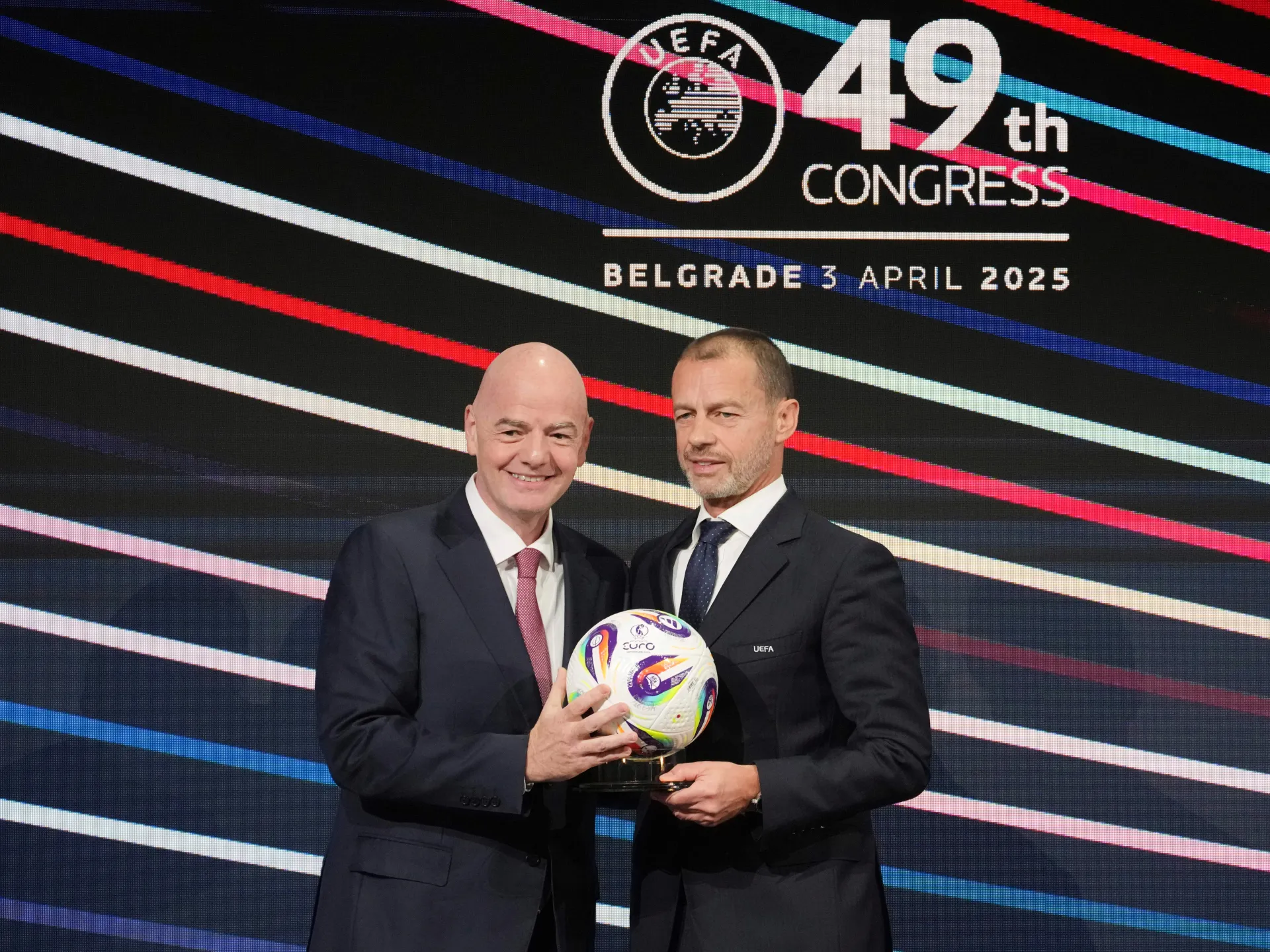
European football leaders meet on Wednesday with the aim of shaping strategy to oust Gianni Infantino as FIFA president.

European football leaders were gathering Wednesday with time pressing to find a candidate and shape their strategy for trying to oust Gianni Infantino as president of FIFA.

UEFA has called its 55 member federations to a previously scheduled summit on Thursday in Berlin that arrives in the midst of European efforts to get a new leader for football’s world body.

Recommended Stories

list of 4 itemsend of list

Infantino’s divisive World Cup private investment plan – that failed within days of being revealed in July – pushed UEFA to act on longstanding mistrust of its former employee’s increasingly executive presidency at FIFA.

UEFA’s longer-term plans include preparing a criminal complaint against Infantino in Switzerland for possible financial mismanagement in the World Cup sell-off deal. It has asked courts in the United States to authorise discovery of evidence.

“Somewhere along the way things went too far with FIFA, and we’re looking to put things back where they belong,” UEFA general-secretary Theodore Theodoridis said last month.

Europe’s 55 count for more than a quarter of FIFA’s 211 member federations that can vote in the election on March 18 in Rabat, Morocco. Research by The Associated Press news agency suggests Infantino already has about 90 votes pledged – albeit before any potential opponent is known.

Still, UEFA is not a united bloc. Infantino has support promised from Azerbaijan, the home country of a close aide, and Latvia. On Wednesday he met with football and government officials in the Czech capital Prague.

First, UEFA and its allies worldwide need to agree on at least one candidate to challenge Infantino by the November 18 deadline to enter the race.

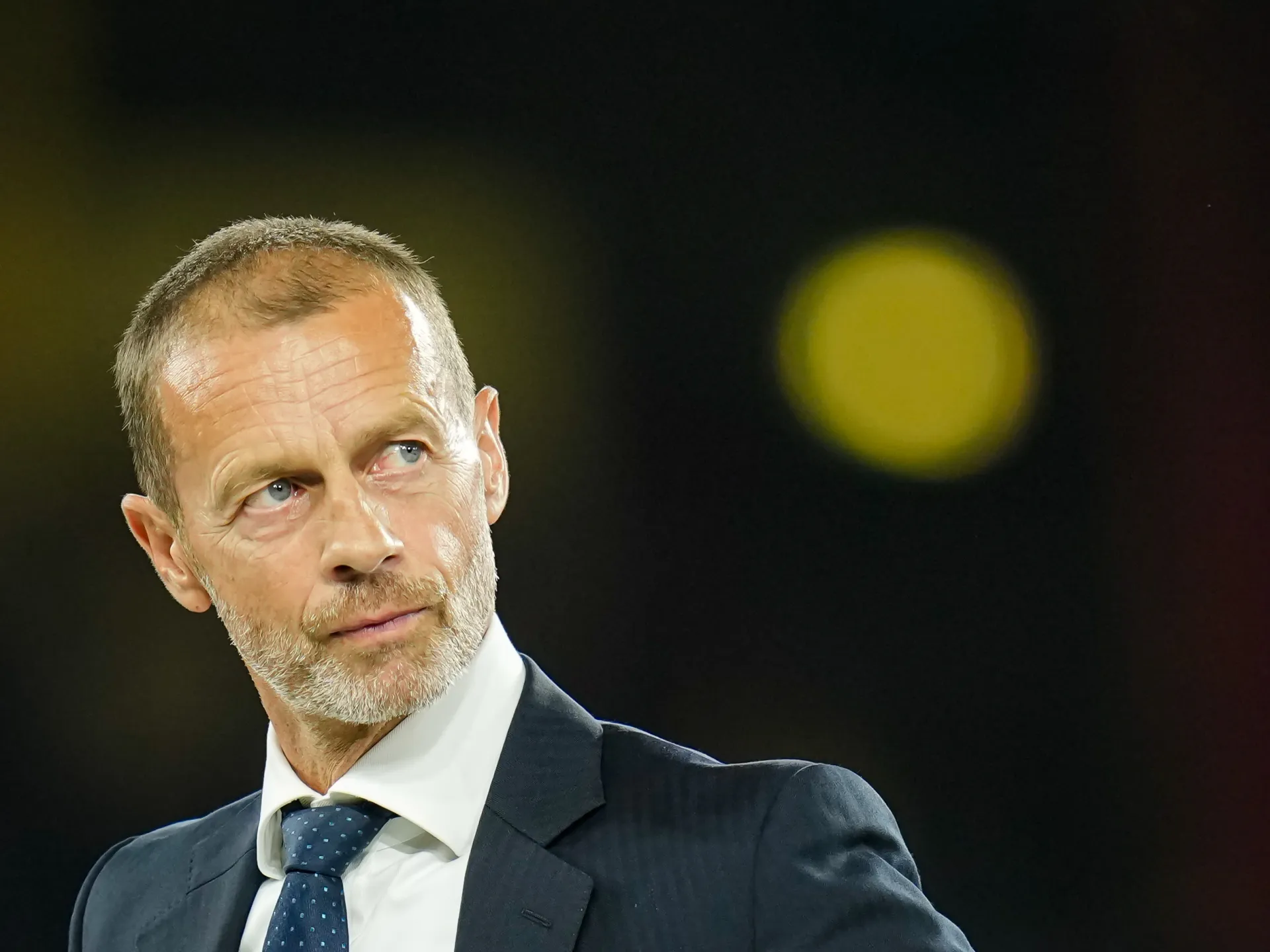
UEFA President Aleksander Ceferin was joined in August by his fellow FIFA vice presidents from Asia and North America in denouncing Infantino for deception and breach of trust over the World Cup sell-off plan.

Still, neither Ceferin nor his counterparts at the AFC and CONCACAF, Sheikh Salman bin Ebrahim Al Khalifa of Bahrain and Victor Montagliani of Canada, currently look set to be on the FIFA ballot.

Ceferin has long dismissed any talk of himself running to lead FIFA, though he said last month at UEFA meetings in Greece there were “many, many” potential candidates.

Montagliani is expected to focus on his own re-election at CONCACAF in February.

Sheikh Salman has been Infantino’s FIFA election opponent before. He had been favourite in a five-man campaign that Infantino eventually won in February 2016.

Speculation has often pointed to Paris Saint-Germain president Nasser Al-Khelaifi, a close ally of Ceferin. The Qatari member of UEFA’s executive committee ruled himself out last week at a meeting of the influential European Football Clubs group he leads.

Infantino is part of UEFA’s focus in Berlin for the biennial business meeting of top executives from its member federations, which can debate policy, strategy and international football competitions.

The meeting is expected to discuss proposals for a more transparent FIFA and a presidential candidate willing to commit to those reforms.

Source link

CAS to hear Senegal appeal over AFCON title awarded to Morocco | Football

Court of Arbitration for Sport (CAS) hearing set to begin after Senegal stripped of Africa Cup of Nations title by CAF.

The long-running saga over the winner of this year’s Africa Cup of Nations (AFCON) title will move closer to resolution on Thursday when Senegal’s appeal, ⁠after being stripped of the title, is heard by the Court of Arbitration for Sport in Lausanne.

Senegal are contesting the Confederation of African Football’s decision to declare Morocco champions, despite Senegal beating the hosts 1-0 after extra time ⁠in January’s final in Rabat.

Recommended Stories

list of 4 itemsend of list

Senegal walked off the pitch for 14 minutes after a penalty was awarded against them late in regulation time, with several players returning to the dressing room in protest before they resumed play.

Morocco failed to convert the spot kick, sending the match into extra time, where Senegal scored the winner to secure victory.

However, they were stripped ‌of the title two months later after CAF’s Appeal Board ruled that Senegal had forfeited the match by walking off the pitch, overturning the result and awarding a 3-0 victory to Morocco.

Senegal quickly followed with an appeal to CAS, which was lodged on March 25 but is only being heard on Thursday. Senegal want to be reinstated as winners, and a panel will listen to arguments from Senegal, Morocco and CAF.

“After the hearing, the panel will start its deliberations. At this stage, CAS cannot state when a final decision will ⁠be rendered but it will not be on the date of the hearing,” CAS ⁠said in a statement.

Three-man CAS panel to hear Senegal and CAF arguments

The panel will be presided over by French civil rights expert Gerald Simon, with assistance from Italian international law professor Luigi Fumagalli and Hamburg-based lawyer and professor of law at the University of Zurich, Ulrich Haas.

They are ⁠likely to hear arguments from Senegal that the Laws of the Game determine the referee’s decisions on incidents of play are final and cannot be challenged after the ⁠fact.

Also important is an interpretation of the articles of the tournament regulations on ⁠which CAF’s Appeals Board ruled in Morocco’s favour, which state that “if, for any reason whatsoever, a team refuses to play or leaves the ground before the regular end of the match without the authorisation of the referee, it shall be considered the loser and shall be eliminated for ‌good from the current competition.”

Senegal’s lawyers are expected to argue that the articles must be interpreted strictly and that a temporary departure from the field cannot be equated with abandoning the match, while Morocco are expected to ‌argue ‌for an opposing interpretation, according to which a team that leaves the field without the referee’s authorisation must be considered the loser and definitively eliminated from the competition, even if its departure was not permanent.

The hearing takes place behind closed doors.

Qualification for AFCON 2027 has already begun, with Senegal drawing the opening game of Patrick Vieira’s tenure as coach with Mozambique on September 25, before winning 1-0 in Ethiopia on September 29.

Morocco have won both of their opening games, beating Gabon and Lesotho.

Source link

How Switzerland lost 20 percent of its ice in five years | Climate Crisis News

Switzerland’s glaciers are rapidly receding due to a combination of winters with too little snow and record-high temperatures across Europe this summer, scientists say. In all, one of the world’s top ski destinations has lost nearly one-fifth of its glacial ice in just five years.

In a report (PDF) published by the Swiss Glacier Monitoring Network (GLAMOS) and the Swiss Commission for Cryosphere Observation of the Swiss Academy of Sciences (SCNAT) on Thursday, researchers said Swiss glaciers lost 5.5 percent of their ice volume over the hydrologic year ending September 30, 2026, and nearly 20 percent since 2021.

Recommended Stories

list of 3 itemsend of list

Why is Switzerland, famed for its Alpine terrain and winter sports, losing its glaciers and what does this mean for the country?

Here’s what we know.

What have scientists discovered?

In September, a GLAMOS team visited 23 glaciers in Switzerland to record end-of-summer measurements of ice melt and snow accumulation.

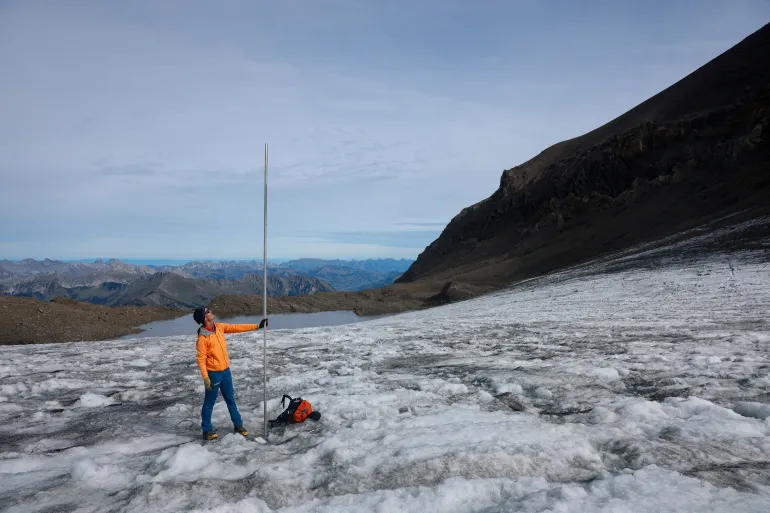
Visiting one glacier named Scex Rouge in the Western Swiss Alps in early September, GLAMOS chief Matthias Huss, one of the report’s researchers, told the Reuters news agency that a measuring pole, about four metres (13 feet) high, was drilled into the ice in July to provide the team with a point of reference.

“Now when we have come back here, we saw the pole was out by three metres [10ft]. So just in August and September of this year, even excluding the heatwaves of June and July, we have lost three metres of ice at an elevation of almost 3,000 metres [9,843ft],” he explained.

“This clearly indicates these conditions that we had this summer, they are just inconsistent with the survival of these small glaciers in the Alps,” he added.

Glaciologist at ETH Zurich and head of GLAMOS Matthias Huss holds a pole that indicates four metres of ice lost over the past year on the Scex Rouge glacier amid climate change at Glacier 3000 in Les Diablerets, Switzerland
Glaciologist at ETH Zurich and head of GLAMOS Matthias Huss holds a pole that indicates four metres of ice lost over the past year on the Scex Rouge glacier amid climate change at Glacier 3000 in Les Diablerets, Switzerland [File: Denis Balibouse/Reuters]

Why are glaciers in Switzerland losing ice?

According to the report, the total mean thickness of individual glaciers in Switzerland has fallen by between 2.5 and four metres in 2026. At glacier tongues – narrow glacial extensions of a glacier which project from land into a body of water – it had decreased by as much as 10 metres in some places over the summer.

“We can clearly attribute the massive ice loss to the warming, and thus anthropogenic [caused by humans] climate change. The summer has been the hottest on record in Switzerland. In addition, there was little snow in winter, and therefore the glaciers were poorly protected when the heat started,” GLAMOS chief Huss told Al Jazeera.

He noted that while their measurements have indicated that the melting has affected all glaciers in Switzerland equally, the effects were most visible on smaller glaciers.

“Those shrink very quickly and sometimes even completely disappeared. Also, large glaciers lost an enormous quantity of ice, but they remain impressive,” he added.

The report’s scientists warned that the glaciers also lost a total of about 2.2 trillion litres of water (581 billion gallons) between July and September alone.

“This is more than four times the annual drinking water consumption of all Swiss households,” the report’s researchers said and warned this could impact the country’s future water supply.

What does this mean for Switzerland?

Switzerland is a country known for winter sports and Alpine tourism, which depends on the glaciers. About 4 percent of the country’s entire workforce is employed in the tourism sector.

“This affects tourism and also how we perceive the mountains – they are no longer white but increasingly grey and black,” he told Al Jazeera.

He added that the water provided by glaciers is also important for the economy. “It is used to fill up hydropower lakes that produce clean energy, and supplies the biggest streams of Europe,” he said.

“We’re not yet seeing the full consequences as glaciers are still around and they contribute water when we need it. But this potential is soon being lost,” he added.

Harry Zekollari, a glaciologist and associate research professor at the Department of Water and Climate at the Vrije Universiteit Brussel, shared a similar view.

He stressed that glaciers are important natural water suppliers, as they provide water when people need it most – in summer, when it is hot and dry.

“With climate change, glaciers initially provide more water during summer as they rapidly melt. However, as glaciers become smaller, there is less ice to be melted, and as such the water supply in summer decreases. This peak in water supply has now been passed for glaciers in the European Alps, meaning that we expect glaciers to provide less and less water in the coming years,” he told Al Jazeera.

“Glacier changes can also cause natural hazards, and since most of the ice lost turns into water that reaches the oceans, the consequences of glacier loss [in Switzerland and elsewhere] will be felt for coastlines all around the globe,” he added.

Is there a solution?

Yes. According to Zekollari, in order to save as much glacier ice as possible in Switzerland, the world needs to stabilise rising temperatures as soon as possible.

“Projections for the European Alps and Swiss glaciers show that if we are able to rapidly stop emissions, we may still be able to save about one-third of their ice mass. However, in a case with strong warming, these glaciers are projected to lose more than 90 percent of their volume by 2100,” he said.

He noted that the situation is less grim globally as some glaciers in other regions are more persistent.

“However, even globally, future emissions play a big role and will decide whether we lose about 25 percent of glacier mass by 2100 – that’s the good case, with limited warming – or rather 50 percent – the bad case, with more warming,” he said.

“The losses in the longer term – past 2100 – are even larger due to the long response of glaciers, but also here it is the future warming that decides how much remains. Every 0.1 degree Celsius warming matters.”

Source link

UEFA’s Ceferin says FIFA trust still broken after Infantino investment row | Football

UEFA president speaks for the first time since FIFA said it would review its decision-making, says trust still broken.

UEFA president Aleksander Ceferin says trust in world football has not ⁠been restored following the collapse of FIFA’s controversial private investment plan.

The remarks, made in a video address to the ⁠Portugal Football Summit on Wednesday, were Ceferin’s first public comments since FIFA president Gianni Infantino offered a review of the governing body’s decision-making.

Recommended Stories

list of 4 itemsend of list

Ceferin said unity, transparency and governance that served the wider game were essential to maintaining trust in football. “Yet not everyone places the game above their own ambitions.”

“Trust in our sport rests on three pillars: unity, transparency, and governance that serves the many, not the few. ‌In recent times, all three were disregarded by people who had sworn to protect them.

“The project that shattered the unity of world football may be abolished, but the trust it broke has not returned, and repairing it is our work now.”

Ceferin did not name Infantino or FIFA, but his comments were an apparent reference to the abandoned proposal to sell a 20 percent stake in FIFA’s commercial rights, including the World Cup, to private investors. The plan ⁠was dropped in July after fierce opposition from UEFA, the Asian Football ⁠Confederation and the Confederation of North, Central America and Caribbean Association Football (CONCACAF).

“Football is not for sale,” Ceferin said. “That is the message UEFA has carried for years, and I’m certain this summit will carry it further.”

His intervention came two days after Infantino sought to address the fallout in a letter ⁠to the FIFA Council and the presidents of all 211 member associations.

He said he would ask the council whether it wanted to commission an ⁠independent external review of FIFA’s governance framework for major strategic initiatives ⁠and proposed consultations with confederations, member associations and other stakeholders on strengthening its decision-making processes.

He said any review could examine the roles of the president, bureau, council and congress and ways to improve transparency and accountability.

The letter has so far failed ‌to win over several federations that had criticised Infantino over the investment proposal.

Infantino has said he remains fully committed to leading FIFA and is expected to seek another term at the presidential ‌election ‌in March 2027.

Ceferin said those running the sport needed to remember whom they served.

“The game will remain safe if those who govern it remember whom they govern it for,” he said.

Source link

FIFA President Infantino’s letter a ploy for re-election, says German FA | Football

Infantino proposed an independent review of FIFA’s decision-making process amid criticism to his leadership.

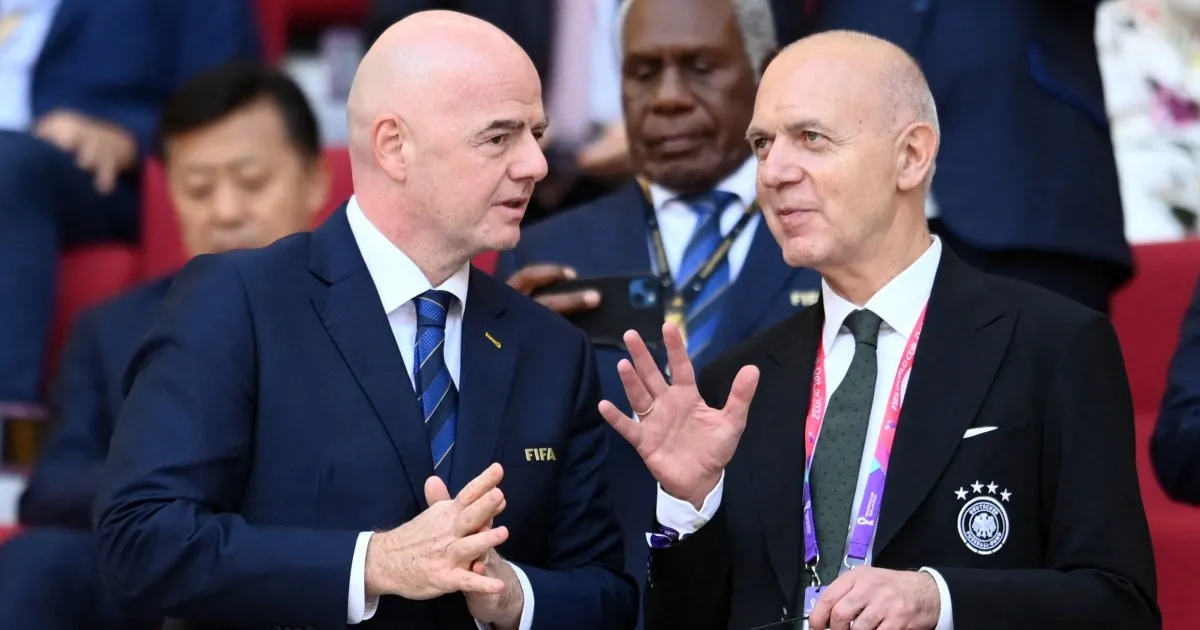
A letter from FIFA President Gianni Infantino this week to ⁠all 211 members, offering to discuss reforms within world football’s governing body – amid an ongoing crisis over his failed plan to sell a stake in the World Cup – is a ⁠mere ploy to get himself re-elected, Germany’s Football Association (DFB) President Bernd Neuendorf has said.

In Monday’s letter seen by the Reuters news agency, Infantino proposed an independent review of FIFA’s decision-making process, in a move that could help him regain support after the withdrawal of his controversial private investment plan.

Striking a ‌conciliatory tone, he also said he would propose consultations with confederations, member associations and other stakeholders about strengthening FIFA’s decision-making.

Infantino faced a fierce backlash over his proposal to sell a 20 percent stake in FIFA’s commercial rights, including the World Cup, to private investors.

The plan was abandoned in July after strong opposition and boycott threats, with UEFA, the Asian Football Confederation and CONCACAF calling for changes to FIFA’s leadership.

They said there had been no consultation with any continental confederation at ⁠any stage, with Infantino acting alone. UEFA has said a change in leadership was now necessary, with the European body having lost faith in the current president.

“I regard Gianni Infantino’s letter as a transparent ploy to secure ⁠his re-election next year,” said DFB President Neuendorf on Tuesday. “Fundamentally, FIFA now seems to have recognised that changes are essential.

“However, Gianni Infantino ⁠is definitely not the right person to lead a reform ⁠process. He has squandered all credibility.”

Neuendorf is also a member of the FIFA Council, the organisation’s main decision-making body.

Infantino said in the letter that member associations’ positions on proposals or governance matters would not affect their ‌treatment by FIFA, whose development and solidarity programmes would continue under existing rules.

The Swiss is up for re-election in March next year, with his opponents struggling to find a candidate ‌to ‌challenge the president. Sources familiar with the discussions told Reuters this month that he still had enough votes to win, prompting opponents to focus on curbing his powers.

Source link

FIFA’s Infantino ‘must go, no ifs or buts’, blasts German FA vice president | Football

Hans-Joachim Watzke, one of German football’s vice presidents, adds to list calling for Gianni Infantino’s resignation.

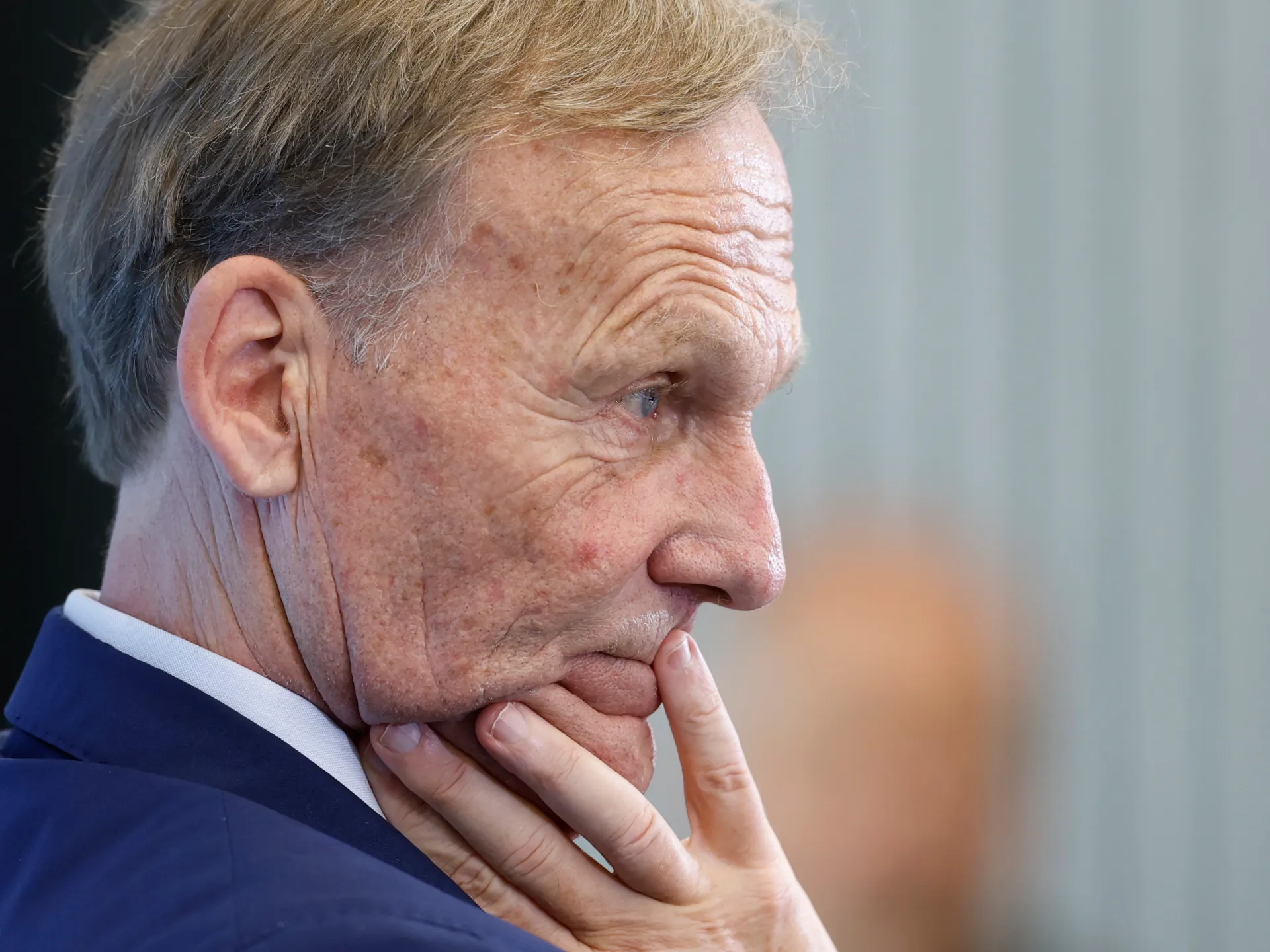
Gianni Infantino must leave the FIFA presidency “no ifs or buts”, according to Hans-Joachim Watzke, one of the vice presidents of the German Football Association (DFB), as he spoke at a festival dedicated to artificial intelligence in Berlin.

The DFB was one of the few federations not to sign a letter of support for Infantino’s re-election as FIFA president in six months’ time.

Recommended Stories

list of 4 itemsend of list

“He has to go, no ifs or buts,” declared Watzke, who said late on Thursday that three points in particular counted against the Swiss.

The first was the FIFA Peace Prize, launched by Infantino and awarded in December 2025 to US President Donald Trump, to whom Infantino is close, during the draw for the 2026 World Cup.

Infantino “created this prize himself, and he decided on it himself,” said Watzke.

“You can’t just invent something on your own and then announce it, it’s madness,” said Watzke.

Watzke also condemned the controversial handling of the Folarin Balogun red card during this year’s World Cup, which was hosted in the US, Canada and Mexico.

The American forward was sent off in the last 32 but his automatic one-match suspension was lifted after a phone call from Trump to Infantino.

“It can’t be that when someone gets sent off, the head of state calls the FIFA president, and, remarkably, the whole thing is immediately overturned. That’s madness,” said Watzke.

The third issue was the project, unveiled on July 28 and dropped four days later, to create a commercial company that would have been open to private investors and became a focal point of the rebellion against Infantino.

“It’s completely insane,” said Watzke. “Nobody knew about it, his vice presidents in FIFA knew nothing, the Council knew nothing.”

DFB president Bernd Neuendorf said earlier in the week in an interview with RTL/ntv television that it was also time for Infantino to depart.

“The relationship of trust with Gianni Infantino, under this FIFA leadership, has of course been completely shattered,” he said.

“It’s important that this Infantino system comes to an end.”

For now, Infantino is the only candidate for the FIFA presidency in the election scheduled for March 18, 2027, with candidacies open until November 18.

Source link

Pretty UK seaside town dubbed ‘Little Switzerland’ is ideal for an autumn escape

The village has been crowned the finest seaside destination by Which? and is a must-visit for anyone seeking a peaceful autumn break in the UK

As the summer crowds begin to thin out, late September offers the perfect chance to explore the UK’s stunning coastline, with quieter beaches, milder temperatures and spectacular coastal paths just waiting to be discovered. Tucked away on the north Devon coast, one spot is a picture-postcard seaside village where the East and West Lyn rivers meet the Bristol Channel.

A charming seaside village tucked between dramatic hillsides and the Bristol Channel has been named Devon’s best seaside destination by Which?, cementing its status as an essential stop for a quintessential West Country getaway. Lynmouth sits beneath its hilltop neighbour, Lynton, with both forming part of the spectacular Exmoor National Park.

Sitting on the edge of Exmoor National Park, it is surrounded by stunning landscapes and is frequently likened to “Little Switzerland”.

At the heart of the village is its harbour, a reminder of Lynmouth’s roots as a small fishing settlement. Its history stretches back centuries, with records dating to at least the 13th century.

One of the area’s most famous attractions is the Lynton & Lynmouth Cliff Railway, which connects the seaside village with Lynton high above. The historic railway is powered by water and offers visitors a memorable way to travel between the two communities while taking in the surrounding scenery, reports the Express.

Today, Lynmouth offers a winning combination of harbour views, rushing rivers, wooded valleys and dramatic coastline. With Exmoor’s walking trails right on its doorstep, it is an appealing destination for anyone looking to escape the crowds and enjoy a peaceful slice of the Devon coast.

Visitors can follow the River Lyn upstream towards Watersmeet, a magnificent tree-lined gorge managed by the National Trust, complete with riverside walkways and a charming tea garden.

For those looking for a spectacular group getaway, the area is also home to Lynhurst, an impressive and distinguished property just a short walk from the historic village of Lynton.

Tucked within stunning gardens and natural woodland, it features a games room with a slate pool table and dartboard, as well as an outdoor table tennis table to keep guests thoroughly entertained.

For couples in search of a romantic getaway, River View is a second-floor apartment set right on the riverbank in Lynmouth. The property features a furnished balcony overlooking the bay, and on a clear day, guests may even spot the Welsh coastline in the distance.

Inside the apartment, visitors will find a cosy open-plan living and kitchen area, fully kitted out for a hassle-free self-catering break. A king-size master bedroom with an en-suite shower room offers a peaceful retreat in which to unwind after a day exploring the local coastline.

The balcony is a particularly lovely spot to savour a morning coffee or an evening drink, with sweeping views across the river and the picturesque village below. With plenty of cafés and restaurants nearby serving breakfast, lunch and dinner, there’s absolutely no pressure to cook every meal either.

For a change of scenery, Ilfracombe lies fewer than 20 miles away, well known for its diverse dining scene and historic harbour. Visitors can also take in Damien Hirst’s iconic ‘Verity’ statue at the harbour entrance before heading back to the tranquil surroundings of Lynmouth.

Previous guests at River View have been fulsome in their praise online. One visitor wrote: “Lovely apartment. Perfectly situated with everything we needed. A real ‘home from home’. We love Lynmouth and will be back.”

Another noted: “A wonderful location for walkers as several spectacular river and coastal walks from the door. Great for visitors with dogs, close to the promenade for walks and meeting lots of other dogs.”

One particularly detailed review read: “A small but well-equipped and comfortable flat with beautiful views over the river to the sea. Good location to explore the area. Luckily found a temporary parking spot initially on Riverside Road in order to unpack, as the flat entrance is on a pedestrianised street.

“Parking permit was £25 for the week at the nearby Upper Lyndale car park. Tesco delivered groceries without difficulty. Walks locally and some National Trust properties made it a very enjoyable week in a lovely location.”

One guest noted that “the two flights of steep stairs would need to be taken into consideration by anybody perhaps not a 100% fit”, while another savoured the surroundings, remarking: “We had the door open all the time and could listen to the water and the wildlife, which we really enjoyed.”
River View can be booked through Holiday Cottages, with a four-night stay in September starting from £449.

Source link

EES delays update over 9 UK tourist destinations – key details

EES delays update over 9 UK tourist destinations – key details – The Mirror


reach logo

At Reach and across our entities we and our partners use information collected through cookies and other identifiers from your device to improve experience on our site, analyse how it is used and to show personalised advertising. You can opt out of the sale or sharing of your data, at any time clicking the “Do Not Sell or Share my Data” button at the bottom of the webpage. Please note that your preferences are browser specific. Use of our website and any of our services represents your acceptance of the use of cookies and consent to the practices described in our Privacy Notice and Terms and Conditions.

Source link