

Sipping coffee in a grand square at one of Europe’s oldest cafe’s, Lucy Williamson discovers a Mediterranean escape that manages to be a city break, beach holiday, and history lesson all at once
A spa day in the UK can easily set you back £150 before you’ve even ordered lunch. So when I found myself sipping coffee in a grand Maltese square at one of Europe’s oldest cafes, watching the morning sun bounce off honey-coloured limestone buildings after a £40 flight from London, I couldn’t help feeling I’d stumbled across one of Europe’s best-value city breaks.
Malta has long been a favourite with British travellers. Yet somehow it still feels slightly overlooked when conversations turn to weekend escapes. People talk about Lisbon, Barcelona and Rome. Meanwhile, sitting in the middle of the Mediterranean, Malta quietly enjoys more than 300 days of sunshine a year; making it one of the sunniest in Europe.
I spent three days there for a spontaneous solo trip and quickly realised Malta has cracked something many destinations haven’t. It manages to be a city break, a beach break and a history lesson all at once, without requiring military-grade holiday planning.
The first thing working in Malta’s favour is its size. This is not a destination where you’ll spend half your holiday staring at Google Maps, wondering whether the slightly disappointing mural is really worth a 45-minute metro journey and an existential crisis in the heat. Most places are close together. The capital city, Valletta, is wonderfully walkable.
Do you have a travel story to share? Email webtravel@reachplc.com
Things to do
If you stay in neighbouring Sliema, as I did at the Preluna Hotel (about £200 for two nights, includes its own beach club) accommodation is often cheaper than inside the capital itself. And the short ferry across to Valetta costs just a few euros. It glides over the water toward a city that looks like an enormous sandcastle built by a giant child who grew up to become an architect.
Many of the highlights cost nothing. The Upper Barrakka Gardens offer some of the finest views in the Mediterranean. Down below, crowds gather for the Saluting Battery (every day at 12pm and 4pm) where cannons are still fired in a tradition dating back centuries. Men in historical uniforms are responsible for the blasts which are to let everyone know what time it is. I loved it, but it seems an incredibly loud and dramatic alternative to just looking at your phone.
Jokes aside, it is an impressive tradition, although you only need to forget it’s happening once to understand why locals still flinch.
You also cannot miss the staggering Baroque interior of St John’s Co-Cathedral (€15 for adults) a church so violently covered in 24-carat gold leaf that it looks like the inside of a divine Ferrero Rocher.
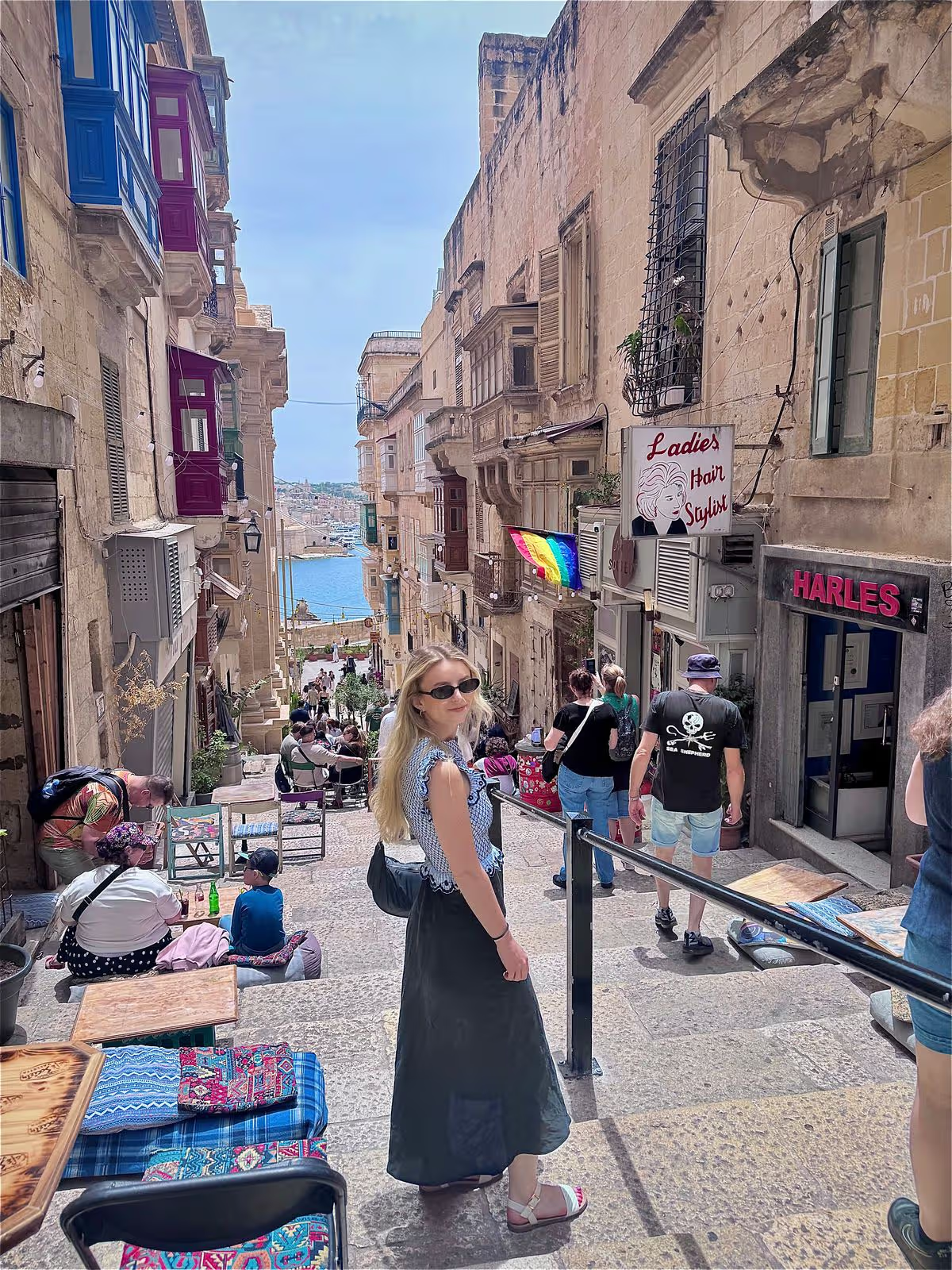
Elsewhere, the city’s streets themselves do much of the heavy lifting. Ornate balconies lean over narrow lanes while laundry flutters overhead on washing lines. It is a deeply moving reminder that even though Valletta was built by the Knights of St John to defend European civilization from the Ottoman Empire, your romantic view of a historic fortress city is occasionally interrupted by a pair of massive beige knickers blowing in the wind.
Locals treat the sea like a public swimming pool that happens to have excellent views. Rocky platforms replace sand. Towels appear. People jump straight into the Mediterranean without the usual British negotiation involving sunbeds, parasols and passive aggressive towel placement.
No one seems to be running a system. It works anyway.
British nostalgia with better weather
Malta occasionally feels like Britain left something behind and never quite bothered to come back for it.
The island was part of the British Empire for more than 150 years, and the influence is still visible in ways that feel slightly surreal. English is an official language. Red phone boxes still stand in corners like they are waiting for a call that will never come.
I wandered into the local branch of Marks and Spencer to check on the progress of British civilization. I can confirm they did not have any picky bits in the Malta store; the traditional British tapas. But they did have tinnies – the traditional fuel for a British explorer. A Monsoon sits nearby. Even a copy of that day’s Daily Mirror at the local newsagent’s.
Where to eat
That blend of influences extends to the food scene. Malta borrows happily from Italy, North Africa and Britain, creating a character all of its own.
One street that perfectly captures the atmosphere is St Lucia Street. By day, it’s an attractive stepped lane. By night, it transforms into one of Valletta’s most buzzy dining spots, with tables cascading down the stone steps like a very tasty avalanche. I spent my second evening at Taste nursing an Aperol Spritz and a plate of rigatoni, which seemed to accidentally on purpose precede a huge tiramisu (€25 bill).
One of Europe’s oldest cafes
For a deeper glimpse into Malta’s past, I found myself at Caffe Cordina, one of Europe’s oldest cafés and one of Valletta’s most enduring institutions.
You will have to resist the temptation to just wander into the air-conditioned void of Starbucks just down the road for some whipped cream and regret. Keep walking, because you will be rewarded with an establishment that has spent nearly two centuries serving Maltese society.
The family’s story began in 1837, when their ancestors arrived from Italy and sold nougat from a donkey cart. They eventually opened a small shop that was destroyed by a German bomb during the Second World War. Yet, as the current owner, Luca Cordina, told me, that bomb was ironically “the best thing that ever happened to us”. It forced his grandfather, Cesare, to take out a bank loan, pivot, and establish the café in its current Valletta location in 1944.
It was a massive gamble. “My grandfather’s friends actually questioned him about the decision, calling him crazy,” Luca explained, noting that the bustling square we see today was little more than a garden at the time. But Cesare believed in the location when very few people did. His response to the doubters was simple: “When the sun rises, it warms everyone”.
That warmth has since attracted a staggering mix of patrons, hosting everyone from Queen Elizabeth II and King Charles to the 1984 Italian national football team. The café inspires just as much loyalty from its staff as its customers, with one employee noted to still be working the floor at 76 years old.
I had a coffee and a traditional ricotta pastizzi (€5.70 bill) and watched the world go by – stunning.
‘The Silent City’
My other favourite lunch spot was in Mdina, the former capital and one of the most atmospheric places on the island.
Game of Thrones fans will recognise parts of it immediately. Everyone else will spend the visit walking past groups who are absolutely certain they are standing exactly where something important happened and are more than willing to explain it in detail whether you asked or not.
It is known as the Silent City because it is incredibly quiet, which is a nice change from London, where the soundtrack is the incessant beeping of a stolen Lime bike.
That wonderful silence was much enjoyed on the roof terrace of the family-run cafe – Fontanella Tea Garden – which is built into the city wall and offers one of the best panoramic views around (Pizza + coffee came to €19).
Mdina is completely enclosed within ancient walls to stop medieval enemies from entering, though it seems they let any old person in these days – especially if you are wearing shorts and carrying a bottle of Fanta Lemon.
The verdict
Three days felt about right. Long enough to see Valletta, Mdina and the coastline without rushing. Short enough that it never drifted into routine. May was an ideal time to go – still warm, not baking, and a little quieter.
Malta works best for couples or solo travellers (like me on this occasion!) who like variety without effort. You get history, sea swims, good food and a walkable city without needing to plan your day around transport logistics or opening times.
Flights from London can be found for around £40 one way. I flew from Luton and returned to Gatwick using Avios points via British Airways, which made the trip back feel particularly smug.
By the time I got home, I’d spent less than many people pay for a day wrapped in a fluffy robe somewhere in the Home Counties.
The cost
- Flight from London to Malta (one-way): £40
- Preluna Hotel, Sliema (2 nights): £200
- St John’s Co-Cathedral entry: €15
- Dinner at Taste (Aperol Spritz, rigatoni, tiramisu): €25
- Coffee and ricotta pastizzi at Caffe Cordina: €5.70
- Pizza and coffee at Fontanella Tea Garden: €19
- Sliema–Valletta ferry: €5
- Return flight: Not included (paid using Avios points via British Airways) – would have been about £80
Approximate combined total: ~£295
Follow Lucy’s travels on TikTok and Instagram.