submarine

Iranian Submarine Sunk By ATACMS Short Range Ballistic Missile

A submarine is among the Iranian naval vessels that U.S. forces have struck with Army Tactical Missile System (ATACMS) short-range ballistic missiles. ATACMS cannot hit moving targets, so the submarine would have had to have been stationary in port when struck. TWZ was first to report earlier this week that M142 High Mobility Artillery Rocket System (HIMARS) launchers firing ATACMS, as well as Precision Strike Missile (PrSM) short-range ballistic missiles, had been aiding in the destruction of Iran’s Navy as part of Operation Epic Fury. The conflict has also marked the first combat use of PrSM, which brings a major boost in range over ATACMS.

Chairman of the Joint Chiefs of Staff U.S. Air Force Gen. Dan “Razin” Caine put a particular spotlight on the contributions of field artillery units in current operations against Iran at a press conference at the Pentagon this morning.

A M142 HIMARS launcher fires a PrSM short-range ballistic missile in support of Operation Epic Fury. CENTCOM

“Today, I’m going to talk about our incredible artillery force, comprised of American soldiers and Marines who’ve been sinking ships, [and] destroying depots,” Caine said. “Our Army and Marine artillerymen are hitting sites that Iran relies on to project power beyond their borders and protect our deployed [forces].”

“In just the first 13 days of this operation, our artillery forces have made history. They fired the first Precision Strike Missiles ever used in combat, reaching deep into enemy territory,” the Chairman continued. He also said that soldiers from the Army’s 3rd Battalion, 27th Field Artillery, part of the 18th Field Artillery Brigade based at Fort Bragg, North Carolina, were the ones to fire the first PrSMs against targets in Iran.

In a historic first, long-range Precision Strike Missiles (PrSMs) were used in combat during Operation Epic Fury, providing an unrivaled deep strike capability.

“I just could not be prouder of our men and women in uniform leveraging innovation to create dilemmas for the enemy.”… pic.twitter.com/bydvIv5Tn5

— U.S. Central Command (@CENTCOM) March 4, 2026

“They used Army ATACMS to sink multiple ships, including a submarine,” Caine added. “And they’ve done all of this with the precision and determination that comes from relentless training and trust in each other and in their weapon systems.”

“We’ve rendered the Iranian Navy combat ineffective,” but “continue to attack naval vessels,” Caine also said, speaking generally.

Caine did not name the Iranian submarine that was destroyed using ATACMS, nor did he say what class it was. TWZ has reached out for more information. There is no known operational version of ATACMS capable of hitting moving targets, so, as already noted, the missile would also have had to have been employed against a submarine in port or one that was otherwise stationary.

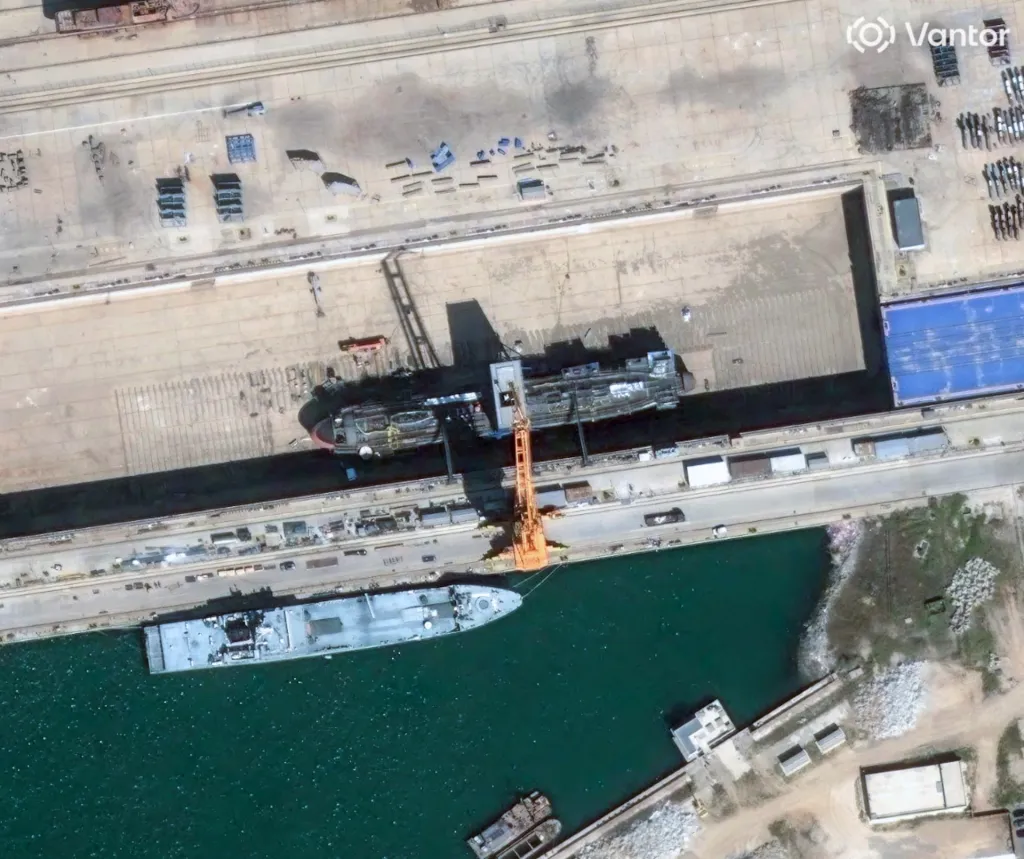
A review of satellite imagery in Planet Labs’ archive does show one of Iran’s three Russian-made Kilo class diesel-electric submarines sunk at Bandar Abbas as of March 4. The submarine had looked to be untouched in an earlier Planet Labs image taken on March 2 in the aftermath of a wave of strikes, as TWZ previously reported. Bandar Abbas is the Iranian Navy’s main base and occupies a particularly strategic position along the Strait of Hormuz.

One of Iran’s Kilo class submarines, as well as several Ghadir class boats, are seen along the pier at right in this satellite image of the Iranian Navy’s base at Bandar Abbas taken on March 2, 2026. PHOTO © 2026 PLANET LABS INC. ALL RIGHTS RESERVED. REPRINTED BY PERMISSION

In a video address on March 5, U.S. Navy Adm. Brad Cooper, head of U.S. Central Command (CENTCOM), had also said that “the most operational Iranian submarine … now has a hole in its side.” What submarine Cooper was referring to here remains unclear, but it may have been the Kilo class submarine struck at Bandar Abbas. At that time, his comments were also taken by many to be a reference to the IRIS Fateh, a domestically-produced diesel-electric coastal attack submarine that entered Iranian service in 2019. The fate of that boat remains unconfirmed.

The IRIS Fateh seen ahead of its launch in 2019. IRNA

On March 10, CENTCOM released the video seen below, showing strikes on various Iranian vessels at sea and in port, including what looks to be a Ghadir class diesel-electric midget submarine. That boat was struck by an AGM-114 Hellfire missile, a U.S. official told TWZ. How many Ghadir class submarines were in Iran’s inventory before the current conflict is not clear, but prior estimates had generally put the size of that fleet at between 16 and 20 hulls.

U.S. forces are degrading the Iranian regime’s ability to project power at sea and harass international shipping. For years, Iranian forces have threatened freedom of navigation in waters essential to American, regional and global security and prosperity. pic.twitter.com/gIBN02mowh

— U.S. Central Command (@CENTCOM) March 10, 2026

Regardless, it makes good sense that the U.S. military would focus on neutralizing Iran’s submarine force, and doing so in port if possible, as part of the larger objective of neutering the country’s naval capabilities. Finding, fixing, and engaging submerged submarines, even older and louder designs, can take significant time and effort, as you can read about in more detail in this past TWZ feature. Iranian submarines could have been used to discreetly lay mines, as well as to attempt attacks on friendly warships or commercial vessels. As it stands now, maritime traffic in and out of the Persian Gulf through the Strait of Hormuz has still ground to a virtual halt over concerns about mines and other remaining Iranian threats, which is already having global ramifications.

Chairman Caine’s comments today also reinforce the role that ATACMS and PrSM have been playing in the current conflict, in general. TWZ previously noted that this is a preview of what one would expect to see from U.S. forces in other future conflicts, especially when it comes to using ballistic missiles in the anti-ship role as part of a high-end fight with China in the Pacific. PrSM, which only began entering service in the past two years or so, offers significantly greater reach than ATACMS, allowing it to hold a much broader swath of territory at risk from any launch position.

Just yesterday, Lockheed Martin also announced the first test launch of a full-up Increment 2 PrSM, an anti-ship optimized version in development now. In that test, a HIMARS launcher fired the Increment 2 missile, which flew out to a range of around 217 and a half miles (350 kilometers), according to a company press release. The Increment 2 PrSM features an additional multi-mode seeker specifically designed to allow it to engage moving targets at sea. Lockheed Martin also released the rendering below as part of its announcement yesterday, which looks to show apertures for the seeker system around the nose.

Lockheed Martin released this rendering along with its announcement about the successful PrSM Increment 2 test launch. Lockheed Martin

Questions do remain about the anti-ship and/or moving target capabilities that might be found on baseline Increment 1 PrSMs. A pair of “early operational capability” PrSMs – a term generally understood to refer to Increment 1 missiles – were fired at what was described as a moving maritime target during a test in the Pacific back in 2024.

In the meantime, the older ATACMS, which PrSM is set to eventually replace, has now scored a hit against an enemy submarine, albeit one not on the move.

Contact the author: joe@twz.com

Joseph has been a member of The War Zone team since early 2017. Prior to that, he was an Associate Editor at War Is Boring, and his byline has appeared in other publications, including Small Arms Review, Small Arms Defense Journal, Reuters, We Are the Mighty, and Task & Purpose.


Howard is a Senior Staff Writer for The War Zone, and a former Senior Managing Editor for Military Times. Prior to this, he covered military affairs for the Tampa Bay Times as a Senior Writer. Howard’s work has appeared in various publications including Yahoo News, RealClearDefense, and Air Force Times.


Source link

The Last Time A U.S. Navy Submarine Sunk An Enemy Ship In Combat

Today’s sinking of an Iranian warship by a U.S. Navy nuclear attack submarine is a hugely significant event in the annals of military history. After all, you have to go back to the final days of World War II to find the last time a U.S. submarine sank an enemy vessel. Since then, however, submarines under the flags of different navies have sunk vessels in combat.

You can catch up with our coverage of the sinking of the Iranian warship here.

In fact, there are some varying accounts as to which U.S. Navy submarine was the last to sink an enemy vessel. The situation at sea as World War II was drawing to a close in the Pacific was a chaotic one, with an increasingly deadly U.S. Navy submarine force tearing through the remnants of Japanese shipping, with subs racking up multiple victories in a short space of time.

Officer at periscope in control room of submarine in Pacific. 1945. (Photo by JAZZ EDITIONS/Gamma-Rapho via Getty Images)
A U.S. Navy officer at periscope in the control room of a submarine in the Pacific in 1945. Photo by JAZZ EDITIONS/Gamma-Rapho via Getty Images

With the Imperial Japanese Navy (IJN) in disarray and with Japan still reeling from the two atomic bombs dropped on it, what was left of its seagoing force provided relatively easy pickings for U.S. submarine commanders.

As such, it was on VJ-Day, or Victory over Japan Day, that U.S. subs claimed their last victims before today’s action.

According to available records, on August 14, 1945, the same day that saw President Harry S. Truman announce Japan’s unconditional surrender, two U.S. submarines sank three Japanese warships.

The first victim — a Japanese submarine — appears to have fallen to the USS Spikefish (SS-404).

A bow view of USS Spikefish (SS-404) underway on the surface after World War II. National Archives

Commissioned in June 1944, the Spikefish was a Balao class submarine, the Navy’s largest submarine class, with 120 boats completed. With a surfaced displacement of 1,526 tons, the Balao was around 311 feet long and had a speed of 20 knots surfaced, reduced to 8.75 knots submerged. Moving on the surface at a speed of 10 knots, the boats could cover 11,000 nautical miles.

As of the night of August 13, 1945, the IJN transport submarine I-373 was surfaced in the East China Sea, southeast of Shanghai. Transport submarines of this type were used by the Japanese to transport troops and supplies between mainland Japan and remote islands. Spikefish sighted the Japanese sub on its radar at 8:10 p.m. and also detected emissions from its air-search radar. Spikefish got closer before losing visual contact, after which the I-373 disappeared below the waves. Just after midnight, Spikefish regained radar contact. At 4:24 a.m., Spikefish fired a spread of six Mk 14 torpedoes at a range of 1,300 yards. Two of the torpedoes hit I-373, sinking it. Spikefish surfaced and found five survivors in the water, all of whom refused rescue, a grim reflection of the bitter fighting at this late stage of the Pacific conflict. One IJN crew member was forcibly brought aboard the U.S. sub; his 84 compatriots died.

In previous days, the USS Torsk, a Tench class submarine, commissioned in December 1944, had been marauding in and around the Tsushima Strait, which lies between Korea and Japan. Here, the boat had been picking off Japanese merchant vessels and warships.

USS Torsk (SS-423) underway after the war. National Archives

The Tench class was essentially an improvement of the earlier Balao and Gato classes, moderately bigger but more strongly built and with more fuel. These boats had a surfaced displacement of 1,570 tons, were also around 311 feet long, and had similar surfaced and submerged speeds to the Balao. Thanks to their additional fuel capacity, the Tench boats had a range of around 16,000 nautical miles.

On August 14, Torsk encountered a medium-sized Japanese cargo ship accompanied by the Japanese Type C escort vessel CD-47, off Maizuru in the Sea of Japan. At 10:35 a.m., Torsk launched a Mk 28 torpedo, an experimental type with acoustic homing. The torpedo smashed a hole in the stern of the escort, which quickly went below the waves. An attempt was made to sink the cargo ship, too, as it entered harbor, but the torpedoes missed.

A Japanese Type C escort vessel, of the same kind sunk by USS Torsk. IJN

At around midday, a second Type C escort vessel, CD-13, arrived, apparently in pursuit of Torsk. After firing off a Mk 28 torpedo, Torsk dived for safety. From a depth of 400 feet, Torsk launched a Mk 27 torpedo, a weapon known as “CUTIE,” this time with passive homing. The hydrophone operator on the Torsk then detected a large explosion, indicating the Mk 28 had found its target. The Mk 27 impacted moments later.

A different Japanese transport after having been torpedoed by the American submarine USS Raton (SS-270). National Archives

While the timings are not entirely clear, CD-13 is widely identified as being the last Japanese warship to be sunk in World War II, and therefore the last enemy vessel to have been sunk by a U.S. submarine until today.

The war still wasn’t over for Torsk, however. With more patrol vessels arriving, plus patrol aircraft, the submarine had to remain submerged for more than seven hours after CD-13 went under. After this date, other Japanese vessels would continue to be sunk by mines that had been laid earlier, including by submarines.

Torsk received two battle stars for its World War II service and is today preserved in the Historic Ships collection in Baltimore.

BALTIMORE, MARYLAND, UNITED STATES - 2011/08/17: USS Torsk, Submarine Memorial, Inner Harbor. (Photo by John Greim/LightRocket via Getty Images)
USS Torsk is preserved in the Historic Ships collection in Baltimore, Maryland. Photo by John Greim/LightRocket via Getty Images

At a press conference today, Secretary of War Pete Hegseth said that the sinking of an Iranian warship by an as-yet unidentified U.S. submarine marked the “first sinking of an enemy ship by a torpedo since World War II.”

This is not true.

The Torsk may have been the last U.S. submarine to have sunk an enemy ship prior to today, but other navies have achieved the same feat.

Back in 1971, during the Indo-Pakistan War, the Indian Navy frigate INS Khukri was sunk by the Pakistan Navy submarine PNS Hangor. The Khukri, with a displacement of around 1,200 tons, became the first warship anywhere to fall prey to a submarine since the end of World War II.

A poor-quality but rare view of PNS Hangor in December 1971, while sailing toward its deployment area during the Indo-Pakistan War of 1971. Wikimedia Commons/Public Domain

The Falklands War, fought in the South Atlantic in 1982, between the United Kingdom and Argentina, saw the first instance of a nuclear-powered submarine sinking an enemy vessel.

On May 2, 1982, in a somewhat controversial incident, the Argentine Navy cruiser ARA General Belgrano was sunk by a torpedo launched by the British nuclear-powered attack submarine HMS Conqueror, with the loss of over 300 crew.

The Royal Navy 1945 - 1975, HMS CONQUEROR, the Churchill class nuclear powered submarine, underway in the early 1970s. In 1982, the submarine sank the Argentine cruiser ARA BEL GRANO during the Falklands Conflict. She was decomissioned in 1990. (Photo by Royal Navy Official Photographer/ Crown Copyright. Imperial War Museums via Getty Images)
The Royal Navy Churchill class nuclear-powered attack submarine HMS Conqueror, underway in the early 1970s. Photo by Royal Navy Official Photographer/Crown Copyright

The controversy around the incident centers upon the fact that General Belgrano was targeted when it was outside a so-called ‘total exclusion zone,’ covering a 200-nautical-mile radius from the Falklands. While there were subsequent protests about the legality of the action, the fact remains that the British had previously warned Argentina that any ships that posed a potential threat to its own task force would be sunk.

The Argentine Navy cruiser ARA General Belgrano lists heavily to port in the Atlantic Ocean, after being attacked by the British Conqueror during the Falklands Conflict. Press Association

Until the sinking of the Russian Navy’s Slava class cruiser Moskva by Ukrainian anti-ship missiles in 2022, the sinking of the General Belgrano was the last time a cruiser was fully destroyed by enemy action.

Another disputed incident occurred in 2010, with the sinking of the South Korean warship ROKS Cheonan.

On March 26, 2010, the Cheonan, a Pohang class corvette, sank in the Yellow Sea, off the country’s west coast, killing 46 of the 104 personnel on board. Exactly why the warship sank remains a matter of conjecture, although a South Korean-led investigation concluded that the vessel was sunk by a North Korean torpedo fired by a midget submarine. The U.S. Navy also stated that the sinking was caused by a non-contact homing torpedo that exploded near the ship. North Korea denied responsibility.

100913-N-4366B-501 PYEONGTAEK, Republic of Korea (Sept. 13, 2010) Rear Adm. Hyun Sung Um, commander of Republic of Korea (ROK) Navy 2nd Fleet, and Rear Adm. Seung Joon Lee, deputy commander of ROK Navy 2nd Fleet, brief Adm. Patrick M. Walsh, commander of U.S. Pacific Fleet, on the findings of the Joint Investigation Group Report of the ROK Navy corvette ROKS Cheonan (PCC 772). A non-contact homing torpedo exploded near the ship March 26, 2010, sinking it, resulting in the death of 46 ROK Navy sailors. (U.S. Navy photo by Lt. Jared Apollo Burgamy/Released)
Republic of Korea Navy and U.S. Navy officers inspect the corvette ROKS Cheonan. U.S. Navy photo by LT Jared Apollo Burgamy/Released

The manner of the sinking certainly appears consistent with a torpedo hit, with an explosion reported near the stern of the ship that caused it to break in half soon afterward.

Since then, the closest we have come to seeing submarines destroying other vessels has been sinking exercises (SINKEX) and similar tests. At times, these have also provided a rare glimpse into the effects of potential adversaries’ submarine weapons capabilities. Case in point, the sinking of a decommissioned Chinese amphibious landing ship by a People’s Liberation Army Navy submarine, seen in the video below: 

The cloak-and-dagger nature of submarine operations means that many details about their use in combat remain closely guarded secrets. In the case of the Cheonan, we may never exactly know what happened to it. For the time being, we also await more information about today’s sinking of the Iranian frigate. What is certain, however, is that this was an unprecedented event, at least as far as the modern U.S. Navy is concerned, and a truly rare action by any standards.

Contact the author: thomas@thewarzone.com

Thomas is a defense writer and editor with over 20 years of experience covering military aerospace topics and conflicts. He’s written a number of books, edited many more, and has contributed to many of the world’s leading aviation publications. Before joining The War Zone in 2020, he was the editor of AirForces Monthly.


Source link