struggles

Tanner Scott struggles and Phillies make him pay in Dodgers’ loss

Philadelphia’s Edmundo Sosa sauntered out of the box, motioning with one hand in a pump-wave in front of 51,794 Dodgers fans. The left fielder, who had taken over for Brandon Marsh in the top of the sixth, connected on a four-seam fastball that Dodgers reliever Tanner Scott left too far over the plate for a two-run home run that put the Phillies ahead.

The Dodgers had been playing with fire all night, but they couldn’t regain momentum after Scott’s struggles, losing to the Phillies 4-3 to set up a Sunday series rubber match.

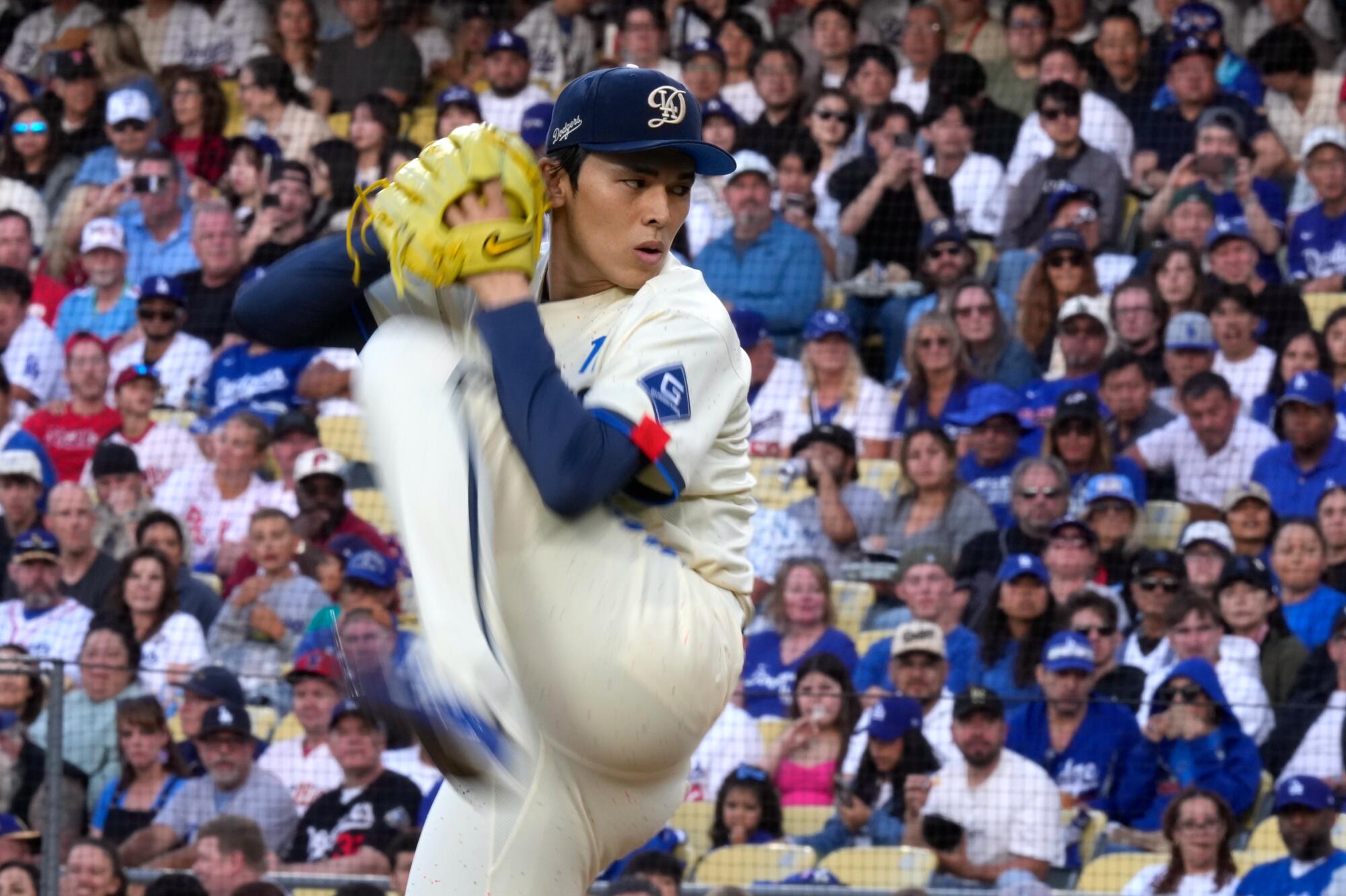
The Dodgers (37-21) started strong, with pitcher Roki Sasaki giving up just three hits and one earned run over 5⅓ innings.

Sasaki’s elevated velocity posed early concerns for the Dodgers as he struggled more with his command. The right-hander crossed the 100-mph threshold for the first time this season on two pitches: a 100.4mph four-seam to J.T. Realmuto and another fastball, this time 100.1mph, to Kyle Schwarber.

Three of his four pitches — the four-seam, slider and splitter — averaged at least 1.2 mph faster than his yearly average. As a result, he struggled with location. Neither his slider and splitter hit the zone more than 45% of the time. Even his fastball hit the strike zone a mere 55%.

Dodgers manager Dave Roberts warned about this scenario when Sasaki’s fastball had only reached an upper limit of 99.5 mph.

“I think now the velo is certainly in a good spot,” Roberts said before the game. “I do believe that if he wanted to throw 100 miles an hour, he could do that, but it wouldn’t be where he needed to throw it.”

Dodgers starting pitcher Roki Sasaki delivers during the first inning Saturday against the Phillies.

Dodgers starting pitcher Roki Sasaki delivers during the first inning Saturday against the Phillies.

(Mark J. Terrill / Associated Press)

Still, the Phillies (30-28) struggled to generate consistent momentum despite Sasaki’s location problems. Phillies third baseman Alec Bohm hammered a four-seam fastball that skimmed the top of the strike zone over the center field wall. The rest of the Phillies lineup ended most of their at-bats with little luck, striking out seven times and walking only once.

Roberts pulled Sasaki with runners on first and second in the sixth. Left-hander Alex Vesia walked Bryce Harper but escaped a one-out, bases-loaded jam by striking out Sosa and forcing Alec Bohm into a ground out to third.

By then, the Dodgers had already established a lead. Alex Call put them on the board in the second on a poked single through the gap between second and short. In the fourth, Call reached third on a double and throwing error from Adolis García. Santiago Espinal hit a sacrifice fly to deep center field, driving in Call.

Mookie Betts also found his footing after he went 0 for 3 on Friday. The shortstop struggled in the first four games of the Dodgers’ homestand, batting .200 across 15 plate appearances. Against the Phillies on Saturday night, Betts laced two singles and a double.

Andy Pages scored on a close play at the plate after Betts singled to shallow right field in the seventh. Although catcher J.T. Realmuto missed tagging Pages’ foot, the Dodgers center fielder’s cleat didn’t appear to touch the plate. After a long review, the safe at home call stood.

But the Dodgers’ good fortune didn’t last. Scott gave up an RBI single to Bryce Harper, and it was like the Phillies could sense exactly when the reliever’s pitches crossed over the zone. Scott (1-2) then gave up the home run to Soto before going down in order on three groundouts in the ninth.
Source link

French Open 2026 results: Casper Ruud overcomes struggles with Paris heat to reach second round

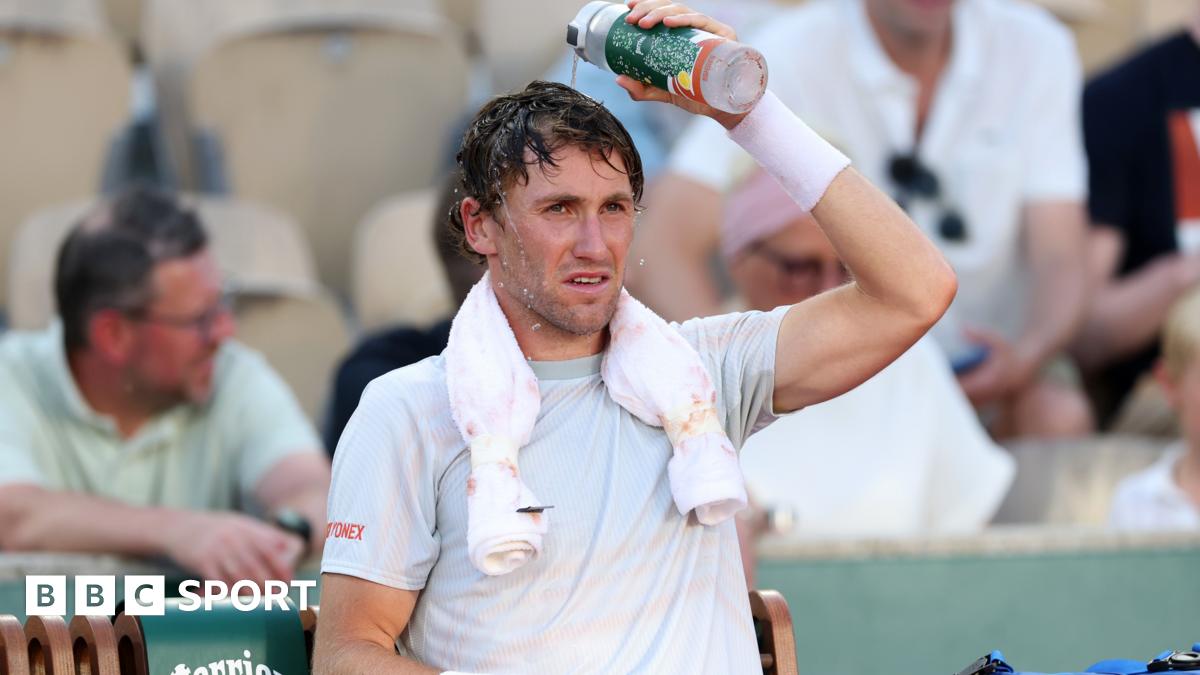
Ruud, a two-time runner-up at Roland Garros, said: “As we know, there’s a bit of a heatwave at the moment and that can sometimes cause problems.

“It felt like it was a bit of a kind of heatstroke feeling. I experienced something similar some years ago when I played in Washington DC and I had to retire in the third set because I had that – that’s the only time I had that same feeling as I had today in the fourth set where I felt at times really dizzy, really tired and walking around like a zombie almost.

“Luckily, I was 2-1 up still and allowed myself to kind of lower the intensity a bit to get my pulse and body temperature down as much as possible in the fourth to see if there was any chance to finish in the fifth and have some extra energy. Luckily, that ended up working.”

Asked if he felt it was a mental victory or physical victory, the 27-year-old said: “It feels like a mental win.

“At times in the fourth [set] I was thinking ‘I have to book the flight home tomorrow and I’ll be watching from home on the sofa the next two weeks’. Luckily, that’s not the case.

“Physically, also, I’m proud because I never really gave in. I didn’t give up.”

Source link

Column: Obama’s strong terms curbed Iran. Trump struggles to secure even a weak deal

President Trump, it’s well known, is into gold. Every day brings new evidence that he’s thoroughly enjoying the “golden age” he pronounced in his inaugural address — as few other Americans are — with stock trades, crypto profiteering and much more, even a new taxpayer-financed slush fund to reward his allies.

As for me, I’ve gone into silver. That is, I constantly look for the silver linings in Trump’s heinous acts.

One silver lining, of course, is his cratering job-approval numbers in the polls, especially among the young and Latino voters who made his reelection possible. But here’s another: By his humiliating failure to bring Iran to heel, nearly three months after starting a war that he said would last weeks at most, Trump has brought new, more positive attention to what he again this week derided as “Barack Hussein Obama’s Iran nuclear deal.” (The emphasis on “Hussein” is Trump’s, always.)

The president, along with his Republican cheerleaders, counts his first-term abrogation of the 2015 Iran nuclear agreement, the Joint Comprehensive Plan of Action, as a signature achievement. This week, yet again, he falsely claimed that had he not done so, Iran would have a nuclear weapon. In fact, his action in 2018 taking the United States out of the multinational deal subsequently led to Iran’s rebuilding of its nuclear program, the emboldening of the Iranian hard-liners now in power and the Middle East morass in which the United States is now mired.

That quagmire has left Trump seeming desperate for a deal — almost certainly a worse deal than the one Obama struck. Call it JCPOA Lite.

If he were able to get Iran’s sign-off on the sort of detailed, restrictive agreement that Obama and other world leaders won 11 years ago, he’d be trumpeting himself as the world’s greatest dealmaker. (He does that anyway, but his record proves otherwise.) Instead, by his own failure to date, Trump has invited reconsideration of the very agreement he decried as the “worst deal ever” on his march to election and reelection.

No sooner was the 2015 deal signed than Trump and Republicans succeeded in defining it as a giveaway to Iran that assured, not hindered, its development of a nuclear weapon to threaten Israel and the world. Opponents condemned the agreement for not addressing Iran’s other threats, notably its support for militant proxies throughout the Mideast. Some Democrats, notably Senate Minority Leader Chuck Schumer of New York, were among the foes. Other Democrats, cowed by opposition to the agreement by Benjamin Netanyahu’s Israeli government and pro-Israel lobbyists, were all but mute in the pact’s defense.

Now some Democrats are belatedly finding their voice (and, post-Gaza, some willingness to defy Israel). Along with nonpartisan experts, those Democrats are drawing comparisons between the 2015 agreement, flawed yet successful, and Trump’s promised yet ever-elusive alternative. What’s ironic for Israel and Netanyahu, still implacably against negotiating with Tehran, is that they could end up, under Trump, with a nuclear deal that gives Iran more leeway than the hated JCPOA did.

As Americans are being reminded, the 2015 deal wasn’t just between Iran and Obama, as Trump has long suggested; other signatories were China, Russia, Britain, France, Germany and the 27-nation European Union. Reconstituting that group would be all but impossible today.

The pact’s 159 highly technical pages and five appendices — a far cry from the short-lived one-pager that Trump officials teased earlier this month — required Iran for 15 years to limit its nuclear program to civilian purposes, forfeit more than 97% of its enriched uranium and submit to intrusive monitoring by the International Atomic Energy Agency to ensure compliance. In return, Iran gradually got relief from some, but not all, international economic sanctions and access to Iranian funds that were frozen after the 1979 Islamic revolution. Presumably, after 15 years, the agreement would have been extended somehow.

By all accounts, including those of Trump’s first-term intelligence and national security officials, Iran was complying when he abandoned the deal. Its “breakout time” for building a nuclear weapon was about a year — time enough for the world to intervene — instead of two to three months. Now, though the president boasts he barred Iran from having that weapon by breaking the Iran nuclear deal, he incessantly tells Americans that he went to war against Iran on Feb. 28 because it was on the brink of a bomb — never mind that he also said he had “obliterated” Iran’s nuclear program last summer, a program that was in a well-monitored box until he first took office.

If you’re confused, you’re paying attention.

A month ago, Trump posted online that he was close to a deal “FAR BETTER” than the 2015 accord. “I am under no pressure whatsoever, ⁠although, it will all happen, relatively quickly!” To several reporters, he suggested he in fact had a deal and that Iran had agreed both to suspend its nuclear activities and to forfeit all of its enriched, near-weapons-grade uranium.

Preposterous claims, given Iran’s current government, and Tehran promptly denied them. It was a sign of Trump’s squandered credibility that few, if anyone, believed him in the first place. Nor have folks believed his more recent talk of imminent success; oil markets, too, have learned not to trust the president, as prices at the pumps attest.

On Tuesday at the White House, amid a noisy tour of the billion-dollar-ballroom construction site, Trump told reporters he’d been “an hour away” from striking Iran again that very day but Mideast leaders asked for more time for negotiations.

Don’t hold your breath.

But for the tragic consequences, Obama might be enjoying some justifiable schadenfreude about Trump’s travails.

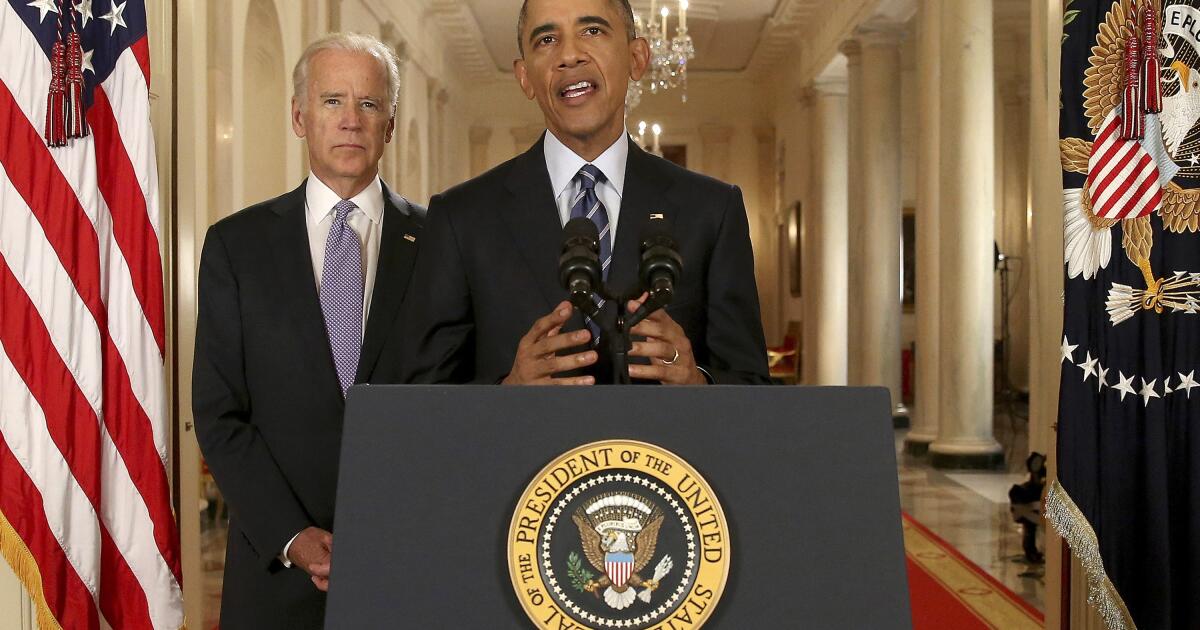
“We pulled it off without firing a missile. We got 97% of the enriched uranium out,” he told Stephen Colbert in an interview last week. Both U.S. and Israeli intelligence agreed that Iran was abiding by the nuclear limits, Obama added, “and we didn’t have to kill a whole bunch of people or shut down the Strait of Hormuz.”

That sure doesn’t sound like the “worst deal ever.” It wasn’t.

Bluesky: @jackiecalmes
Threads: @jkcalmes
X: @jackiekcalmes

Source link