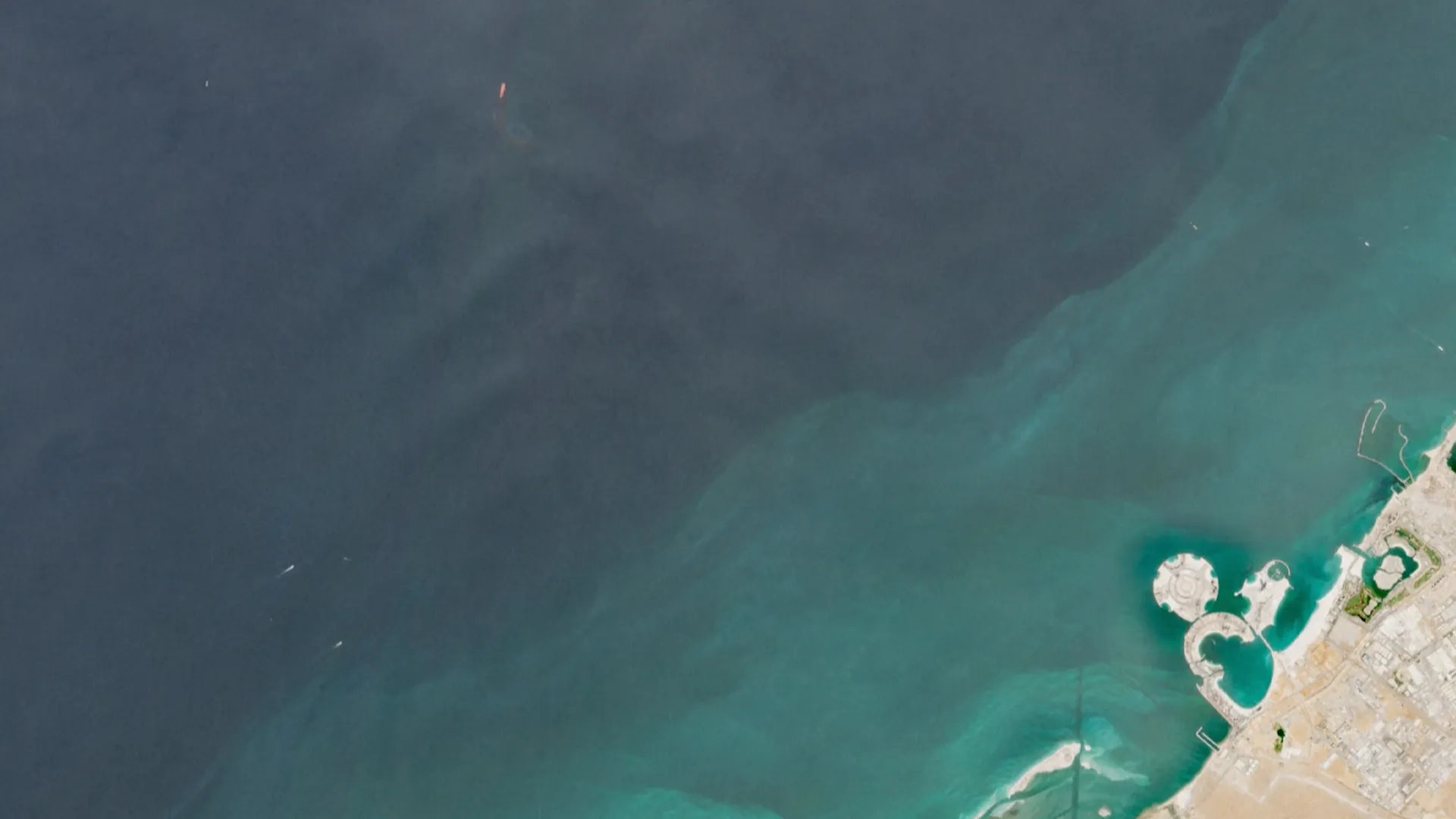
A ship came under attack in the Strait of Hormuz on Tuesday amid claims by Tehran’s top negotiator that the critically important sea route would remain closed. The unnamed vessel was sailing eastbound out from Persian Gulf when it was hit. File photo by Olivier Hoslet/EPA
Aug. 18 (UPI) — A ship transiting the Strait of Hormuz came under attack on Tuesday, sustaining at least one casualty, amid claims by Tehran’s top negotiator that the critically important sea route would remain closed pending the lifting of the U.S. naval blockade and the unfreezing of Iranian assets.
The British Royal Navy’s U.K. Maritime Trade Operations center said in an alert that the security officer of the ship’s owner had reported that the engine room of the vessel was struck by an unknown projectile while sailing outbound through Strait of Hormuz [from the Persian Gulf].
“The impact caused damage to the engine room and resulted in a crew casualty. The remaining crew are currently being assisted by the Omani Coast Guard. At present, no environmental impact has been reported,” said UKMTO which did not identify the ship.
It was not immediately clear if the affected crew member was injured or killed, or what type of weapon was used in the attack.
The incident coincided with comments by Bagher Ghalibaf, speaker of the Iranian parliament, vowing not to permit shipping to pass through the strait until the United States complied with terms set out in a cease-fire deal the two sides signed in June, including the lifting of sanctions preventing Iran from selling oil abroad.
“I want to state clearly that the Strait of Hormuz will not be opened until the American commitments stipulated in the memorandum of understanding… are implemented,” Ghalibaf said in an address carried on Iranian state television.
Sailings through the strait have remained drastically curtailed, as they have been since the war started on Feb. 28, despite the 14-point framework calling for it to be reopened to commercial vessels for the duration of the 60-day deal, which expired Monday.
The state-run Islamic Republic News Agency added the ending of all military threats and operations by the United States to Ghalibaf’s list of demands.
The U.S. Navy is currently enforcing a blockade preventing ships from entering or leaving Iranian ports.
Martin Luther King Jr. delivers his famed “I Have a Dream” speech from the steps of the Lincoln Memorial in Washington on August 28, 1963. The speech galvanized the nation’s civil rights movements and led to the passage of the 1964 Civil Rights Act, the 1965 Voting Rights Act and the 1968 Fair Housing Act. File photo by UPI | License Photo
An Indian vessel was struck and sank near Yemen on Tuesday. File photo by Yahya Arhab/EPA
Aug. 5 (UPI) — An Indian cargo ship has sunk after being struck by a projectile off Yemen, officials said, raising concerns that the Middle East war’s maritime front is expanding.
It was unclear who launched the projectile, but the vessel, identified as the MSV Faize Noore Oliya, was hit in the Red Sea off Hodeidah, a port controlled by the Iran-backed Houthis.
The attack occurred amid a Houthi-declared maritime blockade targeting Saudi Arabia and Saudi-linked shipping in the Red Sea.
All 14 sailors on the ship were safely rescued by the Yemeni Coast Guard and transported to the Port of Mokha, India’s minister of ports, shipping and waterways, Sarbananda Sonowal, said in a statement Tuesday.
Of the 14 sailors rescued, 13 were Indian. Their condition was not known.
“India strongly condemns this unprovoked attack on the defenseless mechanized sailing vessel,” he said, adding that he instructed the director general of the Maritime Administration to coordinate with all relevant agencies to ensure the “absolute security of Indian seafarers in the region and provide all necessary assistance to the rescued crew.”
India’s Ministry of External Affairs said in a separate statement that its embassy in Riyadh was closely monitoring the situation and coordinating with the Yemeni authorities concerning the safety and security of the crew.
While no group has yet claimed responsibility, the Yemen government-aligned National Resistance Forces has blamed the Houthis.
“The Houthis targeting today of the Indian ship is an extension of their terrorist behavior directed against the Yemeni people,” Maj. Gen. Sadiq Dwaid, spokesperson for the National Resistance Forces, said in an online statement.
“They have previously targeted oil export ports — the main source of salaries for state employees — and Yemeni ports in general, as well as commercial ships, and their support and management of piracy operations in collaboration with the pirates of the African Horn.”
The Houthis, who are locked in a civil war against the internationally recognized Yemeni government, imposed their blockade on July 20, specifically preventing Saudi Arabian ships from transiting the Bab el-Mandeb Strait, which connects the Red Sea and the Gulf of Aden.
The Iran-backed militia accuses Saudi Arabia of laying an “unjust and oppressive siege” against it by supporting the Yemeni government in the civil war.
The Houthis have struck at least two Saudi tankers since. If the Houthis are confirmed to have carried out the attack, it would be the first known strike on a non-Saudi vessel since they declared their maritime blockade of Saudi Arabia on July 20.
It also comes as Iran has been enforcing a blockade of the Strait of Hormuz, which is on the northeastern side of Saudi Arabia.
Aug. 2 (UPI) — U.S. Rep. Marcy Kaptur was hospitalized on Sunday after being struck in a hit-and-run accident in Ohio, her office said.
Kaptur, D-Ohio, was on her way to church, riding as a passenger, when the car was hit shortly before 11 a.m.
“She is active, alert, and being treated for non-life threatening injuries,” the statement from her office said. “We look forward to additional information from Toledo Police as they investigate the accident.”
One witness told WTOL 11 the other driver was picked up by a third vehicle and fled the scene.
“Toledo Police Accident Investigators have responded to the scene, and the investigation remains active and ongoing,” Toledo police said in a statement obtained by CBS News.
Kaptur, 80, is the longest-serving woman in congressional history, having first been elected to her seat in 1982.
Weekly insights and analysis on the latest developments in military technology, strategy, and foreign policy.
Ukraine claims that 28 Russian vessels were hit by aerial drones in the Sea of Azov on Saturday. The strikes are the latest in a campaign that Ukrainian authorities assert has resulted in nearly 80 Russian vessels, mostly so-called shadow fleet oil tankers, being attacked in that body of water on a daily basis since July 6.
As a result of these attacks, “Russia temporarily stopped shipping through the Don-Azov Channel, a navigable waterway linking the Don River with the Sea of Azov,” Reuters reported, citing three grain export industry sources.
The move came after 13 Russian vessels, including 10 tankers, were attacked in this body of water on Friday. Market analysts noted to Reuters that about 25% of wheat exports from Russia, the world’s largest exporter of the grain, pass through the Sea of Azov.
Russia has suspended new applications for vessel transit through the Kerch Strait and halted navigation on the Don-Azov Canal, Reuters reported. The move follows Ukrainian drone attacks on Russian vessels in the Sea of Azov. Euronext wheat futures rose 4%. #Ukrainepic.twitter.com/5pETqKD75K
“Overnight on 11 July, the Birds of the Unmanned Systems Forces hit 21 tankers, 4 tugs, 2 cargo vessels, and 1 special-purpose vessel in the Sea of Azov,” Ukraine’s 414th Separate Unmanned Strike Aviation System Brigade, known as “Magyar’s Birds,” stated on X. The cutting-edge unit is named for Ukraine’s drone force commander Robert Brovdi, also known as Magyar.
In addition to striking the ships, Magyar’s Birds claimed to also have hit “53 legitimate military targets were engaged deep inside the enemy’s rear in Crimea and the southern part of the temporarily occupied territories, including fleet assets and energy infrastructure. Operation ‘Crimean Switch Off’ has no end date.”
The shadow tanker fleet was engaged by drone pilots from a wide array of units, the brigade added.
“The technological humiliation of the empire continues,” Magyar’s Birds proclaimed. “It will fall because of Crimea.”
TWZ cannot independently verify the claims; however, many videos have emerged on social media purporting to show the results of these attacks. Magyar’s Birds has released six compilations of them.
Magyar’s update: Another bad day to be a tanker.
28 shadow de-fleet vessels of the rf hunted down overnight on 11 July in the Sea of Azov by the Birds of the Unmanned Systems Forces.
A total of 76 vessels were struck over six days (06–11.07.26). The Molochka is doing its job.… pic.twitter.com/nhM9Di3DRg
— 414 Magyar’s Birds (@414magyarbirds) July 11, 2026
The brigade began releasing videos of these strikes on July 6. This first one shows two ships being hit in a compilation of videos showing strikes on targets mostly on Crimea. The targets included S-400 air defense systems, radars and an oil depot.
⚡️ Don’t joke about fuel shipments to Crimea. We warned you.
Two fuel tankers carrying gasoline from Taganrog to Crimea were hunted down in the Sea of Azov; on land – two S-400 “Triumf” air defense systems, an oil depot burning in Kerch, and a Nebo-U radar.
— 414 Magyar’s Birds (@414magyarbirds) July 6, 2026
The next day, July 7, Magyar’s Birds released a video that opened with a wide view of almost two dozen tankers lined up in the Sea of Azov. The video then cuts to show several of those vessels being struck and burning. The unit claimed eight tankers, a cargo ship and a ferry were hit.
Holy shit.
Madyar’s Birds took out 8 Russian tankers, 1 cargo ship, and 1 ferry from the shadow fleet in a single night (!).
At this point, Ukraine is effectively seizing control not only of the northern Black Sea, but of the entire Sea of Azov as well. pic.twitter.com/7Hj1DUVbu3
— Illia Ponomarenko 🇺🇦 (@IAPonomarenko) July 7, 2026
On July 8, Magyar’s Birds claimed nine more Russian tankers were attacked.
Magyar’s update: the tanker hunt continues.
🔥 The USF Birds struck 9 more russian shadow fleet tankers during the night of July 8 in the Sea of Azov.
🌶️ 21 vessels were hit over the past 72 hours: 19 shadow fleet tankers, 1 cargo ship, and 1 ferry in Kerch.
— 414 Magyar’s Birds (@414magyarbirds) July 8, 2026
Magyar’s Birds released another video on July 9 claiming 14 Russian ships were hit overnight.
Magyar: Shadow fleet massacre continues.
🔥 14 vessels hit overnight on July 9 in the Sea of Azov by the Birds of the Unmanned Systems Forces.
The worms’ shadow fleet keeps shrinking: 35 tankers, cargo ships, and auxiliary vessels hit within the past 96 hours. (Full timeline… pic.twitter.com/PNwRY7cg0F
— 414 Magyar’s Birds (@414magyarbirds) July 9, 2026
Friday, July 10, Magyar’s Birds claimed strikes on 10 tankers, a cargo vessel, a ferry and a sea tug.
Magyar’s update on new Chornobaivka in Azov Sea:
The Azov branch of Chornobaivka already 48: +13 shadow fleet vessels hunted down on the approaches to Crimea overnight on 10 July.
🔥 Birds of the Unmanned Systems Forces struck 48 vessels within 120 hours – the fleet is becoming… pic.twitter.com/S0wmmi5Y71
— 414 Magyar’s Birds (@414magyarbirds) July 10, 2026
In addition to the videos released by the unit, others emerged on social media showing the aftermath of these attacks.
❗️Consequences of the 🇺🇦Ukrainian drone strike on the 🇷🇺Russian dry cargo ship FAVORI (Volgo-Don type, Project 1565A) in the Sea of Azov pic.twitter.com/MCfwC5fmPa
— 🪖MilitaryNewsUA🇺🇦 (@front_ukrainian) July 10, 2026
Footage shows Ukrainian Armed Forces drones attacking tankers belonging to the Russian shadow fleet in the Sea of Azov. In the last four days alone, the Ukrainians have damaged or destroyed 49 Russian vessels. pic.twitter.com/Ejv7aPv9JS
— Jürgen Nauditt 🇩🇪🇺🇦 (@jurgen_nauditt) July 10, 2026
Magyar’s Birds doesn’t name the types of drones being used, but the video displays show they are from Fire Point, which makes several kamikaze drones as well as the FP-5 Flamingo cruise missile.
Roy Gardiner, a former Canadian military officer who is part of the Defense Tech For Ukraine collective and is an expert on Ukrainian drone warfare, surmised that the attacks are by the FP-2 drone.
FP-1 and FP-2 – Drones that inflict pain on the Russian rear! | Weapons with @StarskyUA
“It’s the only UAV available in large numbers and with the range to carry that much explosive, other than the long-range AN-196 Liutyi, which is a lot more expensive and illogical to use for this mission,” Gardiner, who uses the @GrandpaRoy2 handle on X, told us.
Ukrainian UAVs have struck about 175,000 tons of shipping in the Sea of Azov over the last few days — these are World War II numbers. https://t.co/P4IEJb77M0
Fire Point co-owner Denis Shtilerman recently told the TSN media outlet that the company has increased the warhead of its FP-2 strike drones to 200 kilograms. A change in the wing design enabled the drone to achieve a flight range of up to 370 kilometers with those warheads, he claimed.
УКРАЇНСЬКІ ДРОНИ СТАЛИ НОСІЯМИ РАКЕТ! Деталі від українських розробників / ТСН.Тиждень
That range gives Ukrainian forces fire control over virtually all of the Sea of Azov, a body of water north of the Black Sea. The videos indicate this is made possible by high-speed satellite data links allowing for man-in-the-loop operations at great distances. This has enabled Ukraine’s sea drones since their arrival but the miniaturization of the technology has now allowed for large-scale use on one-way attack munitions.
Sea of Azov (Google Earth)
In addition to the aerial drones striking these tankers, Ukraine’s SBU state security bureau used Sea Baby sea drones to attack a Russian tanker in the Black Sea on June 8. As we have frequently reported, Ukraine’s naval campaign has focused overwhelmingly on the Russian Black Sea Fleet. Many successful attacks have been recorded against Black Sea Fleet vessels and facilities, forcing the general evacuation of Russian naval assets from occupied Crimea and to bases in Russia proper.
The Sea of Azov campaign has some Russian milbloggers chiding Moscow for not doing enough to protect these tankers.
“The ‘Military Informant’ Telegram channel complained that the defenseless manner in which the tankers had travelled had become in effect a shooting gallery for Ukrainian drone operators, with no cover from a Black Sea Fleet, which could nowadays barely defend itself,” the BBC recently noted.
The Kremlin is certainly paying attention to Ukraine’s targeting of refineries, oil depots, ports, ships and other energy infrastructure.
Russian nationalist and Z-blogger Vitaly Voronov is disgusted that Ukrainian drones have reached Omsk, well to the east of the Urals in Siberia.
Russian President Vladimir Putin “is concerned enough to address the fuel shortage publicly on state TV, insisting the Ukrainian attacks are ‘obviously creating problems’ but insisting ‘it’s not critical,’” BBC explained.
There’s good reason for Putin to be concerned.
“Russian gasoline output fell to a level equivalent to only around 65% of the seasonal average consumption after Ukrainian drone attacks led to stoppages at large oil refineries,” Reuters reported on Friday, citing “two industry sources and Reuters calculations.”
As a result of the Ukrainian attacks, Russia – long a major oil exporter – is now turning to imports to cover the gap and meet the demands.
“Supplies of gasoline and diesel from Belarus to Russia hit a monthly record in June, while industry sources said last week that Russia had started seaborne from India,” Reuters added. “Traders said that up to 6,000 tons of gasoline per day are delivered from neighboring Belarus to Russia. Stockpiles are also being tapped.”
Russia is also taking the drastic step of considering bans on exports of diesel, gasoline and jet fuel.
All this comes as both Ukraine and Russia are jockeying for territory and influence amid a slow-churning, on-again, off-again effort by President Donald Trump to end the conflict.
Ukraine’s success in targeting Russia’s energy infrastructure and isolating Crimea has likely had an effect on Trump, who has repeatedly changed his stance on which side he favors.
As we recently reported, Trump and Ukrainian President Volodymyr Zelensky had a remarkably warm bilateral meeting at the NATO Summit in Ankara, Turkey, earlier this week. So much so that the American leader promised his counterpart licenses to manufacture Patriot air defense system interceptors, something Zelensky has sought for years without success.
Ukraine continues to struggle badly to fend off Russian ballistic missile barrages and remains overmatched in terms of troops and equipment on the battlefield, where fighting has ground to a virtual standstill. Despite that, Kyiv is proving that asymmetric efforts like the Sea of Azov campaign are helping to offset Moscow’s advantages.
July 9 (UPI) — Iran’s Islamic Revolutionary Guard Corps said early Thursday that it has launched attacks targeting U.S. bases in Kuwait and Bahrain, hours after U.S. Central Command announced the completion of its attacks against Iran.
The tit-for-tat strikes follow President Donald Trump a day prior saying the cease-fire agreement between Washington and Tehran was all but over, and threatened the return to all-out war in the Middle East.
Fighting had simmered between the two sides following last month’s agreement to conditions that could lead to an end of the war, but the Strait of Hormuz has proved a sticking point. The Trump administration is demanding a return to freedom of navigation through the chokepoint; Iran is seeking to maintain control over the vita energy transit route.
As negotiations were stalling, three commercial vessels were struck while transiting the strait, resulting in the United States attacking Iran early Wednesday, kicking off the continuing retaliatory strikes as Iran appears unrelenting in its oversight of the Strait of Hormuz.
“America still hasn’t learned that bullying and breaking promises are no longer cost-free. Let me put it plainly: if you strike, you’ll get hit,” Iranian Parliament Speaker Mohammad Bagher Ghalibaf said in a social media statement early Thursday.
“Don’t flail around pointlessly, or you’ll sink ever deeper: the Strait of Hormuz will only open with ‘Iranian arrangements,’ not American threats.”
The IRGC said it had not only attacked but “smashed important infrastructure and facilities” at Arifjan and Ali Al Salem bases in Kuwait and Juffair and Sheikh Isa bases in Bahrain.
State-run Islamic Republic of Iran Broadcasting reported that Iran early Tuesday was attacking U.S. bases from Bushehr city, stating the United States had targeted those assets hours earlier.
The state broadcaster also claimed the U.S. 5th Fleet headquarters in Bahrain was also hit.
The extent of potential damage was not immediately clear, but both Kuwait and Bahrain confirmed incoming attacks.
The elite military unit in charge of protecting the Islamic regime warned that the United States that “should it repeat its aggression, our crushing responses will expand to other American bases in the region,” it said.
The attack came as the U.S. Central Command announced that it had completed strikes against Iran late Wednesday.
CENTCOM said late Wednesday that it had completed strikes against about 90 Iranian military targets, including air defense systems and coastal surveillance assets, were hit. The announced follower an earlier round of U.S. attacks overnight Tuesday that struck about 80 targets in Iran.
July 6 (UPI) — An oil tanker was struck by an unknown projectile near the Strait of Hormuz early Tuesday, the British military said, renewing tensions amid U.S.-Iran negotiations.
The unidentified ship was hit about 8 nautical miles off the coast of Limah, Oman, the United Kingdom Maritime Trade Operations Center said in a statement.
The ship’s master reported the incident at 1:19 a.m. local time, it said.
The strike to the port side of the vessel caused a fire, officials said, though no casualties or environmental impact was reported.
Though Iran has eased its maritime blockade of the Strait of Hormuz, Tehran continues to seek control over the vital energy transit route.
Following the strike, Iran’s state-controlled Islamic Republic of Iran Broadcasting reported that the Qatari tanker Al Rekayyat was targeted after allegedly ignoring Iranian warnings against transiting through what it called the “Omani route” of the Strait of Hormuz.
It said the tanker was being escorted through the route by the U.S. Navy.
It was not immediately clear whether Al Rekayyat had been struck or whether it was the vessel reported by UKMTO.
Al Rekayyat is a liquefied natural gas tanker sailing under the Marshall Islands flag, according to the Marine Traffic website.
Iran has been blamed for attacks on more than 15 ships during its effort to control shipping through the Strait of Hormuz since the United States and Israel launched a joint offensive against Tehran on Feb. 28.
The strait has been a sticking point in ongoing negotiations between the United States and Iran toward ending the war. Iran has resisted the Trump administration’s demand for freedom of navigation through the strait, seeking to maintain authority over shipping routes there.
Late last month, the newly founded Persian Gulf Strait Authority warned vessels attempting to transit outside its approved routes that their security cannot be ensured.
Last week, the two sides held indirect talks in Doha, but made little progress.
Rescuers in Kyiv are racing to find people trapped under the rubble of partly demolished apartment blocks, after at least nine were killed in Russia’s second round of strikes on the Ukrainian capital in a week.
Kyiv’s top military administrator Timur Tkachenko said 46 people were injured, with at least five children injured.
The strikes come on the eve of the Nato summit in Turkey, where Ukrainian President Volodymyr Zelensky is expected to hold talks with US President Donald Trump.
Hours before the latest strikes, Zelensky warned that Moscow was preparing a second “massive strike” on Kyiv following its attacks on Thursday that killed 30 people.
Russian ballistic missiles hit several buildings across the city, Mayor Vitaly Klitschko said, adding that fires had broken out in some apartment complexes.
Warehouses and a garage workshop were also damaged, according to the mayor.
Photos emerging from Kyiv show smouldering wreckage and charred cars littered throughout the city. Footage also shows crews continuing to comb through wreckage on Monday morning to find survivors.
Zelensky said on Sunday, hours ahead of the strikes, that intelligence indicated that Kyiv would come under a second wave of Russian attacks in a week.
After a barrage of drone and missile strikes through Thursday night, tens of thousands of residents evacuated to metro stations around the city as alarms blared in the early hours of Friday morning.
Ukraine accused Moscow of deliberately attacking civilian areas in the attack, which left at least 30 people dead. Russia said it had targeted military and energy bases in retaliation for recent Ukrainian strikes on power stations and energy facilities in Russian territory.
Such attacks continued overnight with power being cut off temporarily in the city of Sevastopol in Russian-occupied Crimea.
Ahead of the Nato meeting, Zelensky urged allies to not delay on supplies of long-range missiles to be used against Russia.
He wrote on X: “Any delay with missiles for our air defense… means the loss of lives, and it encourages Russia to continue the war.”
Zelensky has also appealed to the US to grant Ukraine licences to manufacture Patriot defence missiles.
June 25 (UPI) — A cargo vessel in the Strait of Hormuz was attacked Thursday, prompting officials to halt the evacuation of sailors stranded in the chokepoint by the war.
It was unclear who attacked the cargo ship. According to the British navy’s United Kingdom Maritime Trade Operations office, the vessel was struck on its starboard side by an unknown projectile at about 5:40 p.m. local time. It was about 7 1/2 nautical miles southeast of Dahit, Oman, when it was attacked, it said.
The vessel’s bridge sustained damage, but no casualties or environmental impact were reported.
Following the attack, the United Nations’ International Maritime Organization paused its evacuation operation in the Strait of Hormuz.
“I have decided to temporarily pause its implementation in order to reconfirm that the necessary safety guarantees continue to be in place for the ships on our evacuation list and all those in the region,” IMO Secretary-General Arsenio Dominguez said in a statement.
The war, which began Feb. 28, left some 11,000 sailors stranded in and around the Strait of Hormuz, a vital energy shipping route. The IMO announced the evacuation operation Tuesday, after the United States and Iran agreed to a Memorandum of Understanding that seeks to pave a path to ending the war.
The vessel struck Thursday was not transiting the Hormuz under the IMO’s evacuation framework, the U.N. agency said.
Though it unclear who was responsible for the attack, the Iran’s U.S.-sanctioned Persian Gulf Strait Authority, newly created by Tehran to oversee and manage the strait, issued an advisory Thursday, stating it is not responsible for the protection of vessels transiting “outside designated routes.”
“Any consequences arising from unauthorized routing shall be the sole responsibility of the vessel owner, charterer and master,” it said.
Control of the strait has been a focus of ongoing U.S. efforts to end the war.
Iran effectively closed the strait after being attacked Feb. 28, causing energy prices to surge and threatened nations with worsening energy crises.
Since then, Iran has attempted to maintain control of the strait and has sought to impose fees on ships that transit it.
The United States is seeking to secure free maritime travel through the strait as part of the MOU. U.S. Secretary of State Marco Rubio is currently in the Middle East trying to sell the MOU to allied nations.
However, the Institute for the Study of War said in a report Thursday night that Iran’s alleged attacks and threats directed at vessels in the strait “advance its objective of establishing control over the waterway” as well as “undermine international efforts to guarantee safe passage through the Strait of Hormuz.”
“Iran is using military threats and economic incentives to try to convince Gulf states to support its efforts to control the strait, but the Gulf states appear to be resisting Iranian pressure at present,” it said.
June 15 (UPI) — Police in New Jersey’s Stafford Township said an Immigration and Customs Enforcement agent fired his gun at a fleeing vehicle moments after being struck.
The Stafford Township Police Department said in a statement shared to social media that ICE was attempting to apprehend a suspect around 9:30 a.m. in Manahawkin when the person fled in a vehicle.
The suspect’s vehicle, which witnesses identified to News 12 New Jersey as a white van, struck an ICE officer, who then fired his gun at the vehicle.
Witnesses said the shot shattered the back window of the van, but the vehicle did not stop.
“The suspect fled the scene in the vehicle and has not been located at this time. The agent reportedly sustained unknown injuries and it is unknown if the suspect was injured at this time,” police wrote.
The department said police were not involved in the original ICE operation Monday morning. The department secured the crime scene and managed traffic while the Federal Bureau of Investigation was called in to investigate.
Police administered first aid to the injured ICE agent and “facilitated his transport for further treatment,” the statement said.
ICE provided a statement to NBC10 Philadelphia identifying the suspect as Friedrich Castillo-Ormeno, a Peru native who was ordered to leave the country by given an immigration judge on Jan. 30.
Ukrainian President Volodymyr Zelenskyy arrives at No.10 Downing Street in London on March 17. On Monday, Ukrainian forces said they attacked several Russian locations overnight, including multiple oil depots. File Photo by Hugo Philpott/UPI | License Photo
June 8 (UPI) — Ukrainian forces struck oil depots in Russian-occupied Crimea as well as other command and ammunition locations in Russia, the Ukrainian military said.
The strikes took place late Sunday, the general staff of Ukraine‘s military said in a Facebook post Monday, according to a translation by Ukrinform.
The Grushevaya oil depot in Krasnodar Krai and the Feodosia and Semikolodezyanskaya oil depots in Crimea were among the targets hit during the attacks, The Kyiv Independent and Ukrinform reported. Ukraine also struck the Krasny Line Production Dispatch Station in Volgograd oblast, which supplies oil to the Volgograd refinery and the Sheskharis export terminal.
Ukrainska Pravda reported that the Grushevaya oil depot is one of the largest oil storage facilities in the Caucasus, holding between 1.3 tons to 1.5 tons of petroleum. The site is used to store and transport oil for maritime export and generates a large amount of revenue for Russia.
There were large fires and billowing smoke reported at the oil depots said to be hit.
The strikes hit Russian drone command posts in various locations in Zaporizhzhia, Donetsk and Kursk oblasts. The military also said it hit areas with concentrations of Russian personnel in Donetsk, Zaporizhizhia and Sumy oblasts.
The Russian military said it struck down 310 Ukrainian drones overnight throughout Russia, Crimea, and the Black and Azov Seas.
Troops in landing craft approach Omaha Beach on D-Day in Normandy, France, on June 6, 1944. D-Day was the largest seaborne invasion in history and turned the tide of World War II. Photo by UPI | License Photo