Emma Raducanu will miss the US Open as she continues her recovery from a stress fracture.
The British number one suffered the injury to her right lower leg during the grass-court season and made a late decision to pull out of Wimbledon.
The 2021 US Open champion will now sit out this year’s event at Flushing Meadows, which begins on 23 August.
The decision was made after the 23-year-old’s latest consultations with her medical team. She had only recently stepped back on court wearing a protective boot.
Last summer Raducanu won her first matches at the US Open since she became a surprise champion but the past 12 months have been frustrating because of more persistent physical issues.
A foot injury severely hampered her pre-season training before she spent two and a half months off court with a post-viral illness after initially falling unwell in early February.
She returned for the end of the clay-court season having rehired Andrew Richardson, the coach who guided her to the US Open title, but the pair’s time on court together has been limited.
Raducanu enjoyed one of the best weeks of her career by reaching her biggest final since New York at Queen’s Club in June, but she has not played since.
Travel experts at Slingo have put together a guide to the rules and fines for Brits travelling to Spain so that holidaymakers can enjoy the summer without stress
Many Brits will be getting ready to jet off to Spain this summer(Image: aire images via Getty Images)
Travel specialists at Slingo have compiled a comprehensive guide to the rules for visiting Spain in 2026, helping holidaymakers make the most of their summer break without any unwanted hassle. Dom Aldworth, brand marketing coordinator at Slingo, said: “Everyone knows that the British public love a holiday, and now that it’s nearly spring, UK tourists will be starting to think about where they want to travel to this summer.
“However, before you pack your suitcase, it’s important to educate yourself on any travel rules, especially as new regulations are announced every year. This way you can enjoy your summer holiday, whilst staying safe and being respectful to local laws.”
Night swimming
The city of Benidorm, in Costa Blanca, announced they will be charging tourists between £650 and £1,020 for going to the beach between midnight and 7am. That includes swimming in the sea or sleeping on the sand.
The specialists noted: “This rule has been introduced to reduce the risk of any swimming-related accidents during the times when lifeguards are not available. In order to not waste the resources of local emergency services, it’s best to keep your beach activities to the daytime,” reports the Express.
Mindful recreation
Stripping off on a non-nudist beach could leave tourists facing a fine of £647. Nevertheless, nudist beaches are available at most Spanish holiday hotspots, “so if you wish to sunbathe naked, there are places to do this respectfully”.
Drinking alcohol and smoking cigarettes on the beach in Benidorm is also strictly prohibited, with penalties of £550 and £1,700 respectively. This is down to littering concerns, as well as considerations for public health.
Taxis
GOV.UK has cautioned British tourists to only use registered taxis in Spain this summer, as passengers caught travelling with unlicensed taxi services could face fines of up to 600 euros (£510).
The travel experts commented: “This is due to transport risks, so make sure you book your taxi or airport transfer through a licensed firm.”
Noise pollution
Alicante, in Costa Blanca, imposed hefty fines for rowdy tourists, ranging from playing loud music on the beach to making excessive noise in your accommodation.
“These regulations are tighter versions of rules the city council implemented in March 2019, and could cost Brits up to 30,000 euros (£25,556). Everyone wants to have a good time on holiday, but you can have fun and respect others at the same time.”
Unlicensed parties
The travel experts said: “If you’re travelling to Majorca or Ibiza this summer, be wary of where you’re partying. Authorities are closing in on any unlicensed or unruly parties and will issue a fine to anyone involved in the organisation and marketing of the event, as well as attendees. This could result in a £25,000 fine.”
These gatherings are typically hosted at villas and private residences, lacking the safety provisions of emergency exits, capacity restrictions, and qualified security personnel that licensed bars possess.
A savvy shopper has shared the travel essentials she found in Poundland, including 100ml travel-size suncreams and shampoos that are perfect for those travelling with only hand luggage
08:03, 27 Jun 2026Updated 08:03, 27 Jun 2026
She shared what she’d managed to find that would make life a lot easier when travelling (stock image)(Image: Ray Orton via Getty Images)
The prospect of travelling with only hand luggage can fill many holidaymakers with anxiety, prompting them to fork out for hold luggage when their liquids won’t fit in a carry-on bag. The reason, of course, is that when passing through airport security, liquids are restricted to 100ml — which can be a real headache, given that many suncreams come in 250ml bottles, or, even more frustratingly, 125ml — just over the limit.
However, a savvy traveller named Sham has flagged that Poundland stocks “100ml suncreams,” meaning you’ll have “no stress at security” as your liquids will be fully compliant with rules and regulations. Getting through airport security with hand luggage only can actually be a doddle with the right products in tow — and also spares you the nail-biting wait at the baggage carousel, desperately hoping your suitcase has made it to your destination in one piece.
She noted that the mini products are priced at £2, quipping: “We know Poundland’s not all a pound anymore.” Sham revealed that the store stocks suncream, sprays, and even travel-sized shampoos and conditioners — ideal for those heading away long enough to need a hair wash.
She also spotted towel clips for just £1, so you needn’t worry about your towel taking flight if your destination turns out to be a touch on the breezy side. Rounding things off, there was a Malibu fake tan that Sham said she was keen to try before her holiday, adding that she’d heard great things about it — and at just £2, it seemed well worth a go.
In the comments section, one user wrote: “Ah, I need to get to Poundland! Going away soon, so these would be perfect.”
Content cannot be displayed without consent
A second chimed in: “Buying s**** to take on holiday is the most British thing ever. You don’t need half that s***, it will be left in the bag in the hotel the whole holiday.”
However, Sham hit back: “It saves a right packet taking the small ones, perfect amount for your hol.” And there’s no denying that SPF is absolutely essential.
NHS advice on keeping yourself safe in the sun
Sunburn increases your risk of skin cancer. And it does not just happen on holiday. You can burn in the UK, even when it’s cloudy.
There’s no safe or healthy way to get a tan. A tan does not protect your skin from the sun’s harmful effects. Aim to strike a balance between protecting yourself from the sun and getting enough vitamin D from sunlight.
Spend time in the shade when the sun is strongest. In the UK, this is between 11am and 3pm from March to October.
You can also check the UV index on a weather app or website. If it’s three or higher, consider protecting your skin.
Make sure you:
spend time in the shade between 11am and 3pm
never burn
cover up with suitable clothing and sunglasses
take extra care with children
keep babies under six months out of direct sunlight
use at least factor 30 sunscreen – make sure to use enough and re-apply frequently
Do not rely on sunscreen alone to protect yourself from the sun. Wear suitable clothing and spend time in the shade when the sun’s at its hottest.
When buying sunscreen, the label should have:
a sun protection factor (SPF) of at least 30 to protect against UVB
at least four-star UVA protection
UVA protection can also be indicated by the letters “UVA” in a circle, which indicates that it meets the EU standard.
Make sure the sunscreen is not past its expiry date. This is marked by a symbol of an open jar, an M and a number, which shows how many months the sunscreen will last once it’s been opened. Do not spend any longer in the sun than you would without sunscreen.
Major US banks proved resilient under the Fed’s severe 2026 stress test scenario.
This year’s Federal Reserve Stress Test, which involved 32 U.S. banks, simulated a hypothetical real estate Armageddon in which commercial real estate prices fell 39%, housing prices declined 30%, unemployment spiked to 10%, and economic output dropped commensurately.
The results were encouraging.
Capital declined only 1.6 percentage points in aggregate, according to a Federal Reserve Board statement. All of the banks remained at their minimum common equity Tier 1 capital requirements despite having $708 billion in total hypothetical loan losses.
Of the projected losses, the Fed identified approximately $200 billion in credit card losses, $160 billion in commercial and industrial loan losses, and $75 billion in commercial real estate losses.
“Today’s results underscore the strength of the banking system,” Vice Chair for Supervision Michelle W. Bowman said in a prepared statement. “As we work to increase the transparency and accountability of the stress test, public feedback will help us continue to improve and instill greater confidence in the stress test and its results.”
Compared to last year’s stress test, this one saw a larger decline in aggregate capital due to higher loan losses stemming from increased loan balances and the greater severity of certain test variables, and lower projected unrealized gains in bank securities resulting from smaller hypothetical interest rate declines in the scenario.
The results, however, showed a projected increase in capital from higher interest income driven by recent bank financial performance, offset by the same hypothetical interest rate declines.
Regardless of their results, participating banks will not need to adjust their stress capital buffers since the Fed voted to maintain the current requirements until 2027.
Test Format Change
“This year marks the transition between the Federal Reserve’s existing stress test framework and an updated one that aims to enhance transparency, reduce volatility, and provide opportunities for public comment on the models and scenarios,” said Greg Baer, president and CEO of the Bank Policy Institute, in a statement. “We hope that the revised framework will shed more light on the inputs and provide more certainty. We have also recommended that the most recent Basel proposal be updated to eliminate overlaps with the stress test. These combined changes will allow banks to plan capital more efficiently and support more lending and capital markets financing.”
The Fed opened the 2026 test scenario for comments in October 2025 to improve transparency while avoiding litigation it faced in previous years over opacity and defects in the test itself.
“Capital requirements should not be set in a way that is shielded from meaningful public scrutiny,” the Fed’s Bowman said. “As vice chair for supervision, I am committed to providing transparency and accountability for both the Board and our supervised firms. This is essential for maintaining the value of our stress testing program, and for supervision and regulation more broadly.”
ALL eyes have been on Dua Lipa and Callum Turner, who threw a three-day party in Sicily after tying the knot in London recently.
But why leave all the fun to the stars?
Sign up for the Travel newsletter
Thank you!
Lovebirds Dua Lipa and Callum Turner celebrate their weddingCredit: BackGridTropical Sky hosts weddings in the Maldives, Seychelles and Thailand, among other destinationsCredit: supplied
A destination wedding or celebration doesn’t need to come at an A-list cost.
There are tour operators and cruise lines offering packages to take logistical faff out of the equation at a relatively affordable price.
Couples can get up to £1,800pp off if they book before June 30, with complimentary wedding packages for anyone splashing out on a seven-night stay in a Harmony Concierge Junior Ocean View Suite or a Splash Two-Bedroom Family Room.
A seven-night all-inclusive getaway to the 4* Coconut Bay Beach Resort & Spa for up to four is from £1,849pp – including free wedding.
Anyone wanting family and friends to join can get a ten per cent discount when booking between five and nine rooms.
Princess Cruises has classic packages for the happy couple, plus two guests, that cost £2,606Credit: Supplied
IF you love the ocean, why not go for a wedding afloat.
Princess Cruises has classic packages for the happy couple, plus two guests, that cost £2,606.
Included are a ceremony performed by the captain, fresh florals, wedding cake, sparkling wine toast, dedicated photographer, romantic breakfast for the couple, stateroom gifts and goodies, pre-cruise and onboard wedding co-ordinator and keepsake certificate.
Packages that accommodate up to 18 guests cost from £4,842, including extras such as live music and cocktails.
The packages are on top of the cruise price itself.
Those who like the sound of tropical climes can book a seven-day Western Caribbean with Mexico cruise on board Star Princess.
It costs £649pp based on two sharing an inside cabin.
One of Tui’s most popular venues is Sensatori Atlantica Aphrodite Hills in CyprusCredit: TUI
TUI was voted best for weddings and honeymoons at the British Travel Awards last year and can host events at more than 200 venues, including castles, yachts and hotels, in 18 sun-soaked destinations.
Couples have a team of wedding specialists, available seven days a week.
On top of stylish rooms, the chic resort has a knock-out spa ideal for bride prep, and a golf course.
Wedding packages at the Tui Blue collection venue start from £4,439 and typically include wedding co-ordinator services, ceremony venue and set-up, bridal bouquet and groom’s buttonhole, wedding cake and celebratory drinks, photography options, reception and dining arrangements, guidance on legal requirements and accommodation arrangements.
JET2 has a Classic package from £1,650, which covers the ceremony, pre-planning, assistance with legal documentation and flowers for the coupleCredit: Jet 2
JET2 has a Classic package from £1,650, which covers the ceremony, pre-planning, assistance with legal documentation and flowers for the couple.
Those looking to throw a photographer into the mix should book the Deluxe service (from £2,299), which also comes with a hair and make-up artist and wedding flowers for two attendees.
The Ultimate package includes all the above, plus a private reception venue, three-course meal and DJ, from £4,250.
You do have to pay for your actual holiday on top of that, but with weddings at home often exceeding £20,000, these prices compare well. Destinations include Cyprus, Zante, Crete and Rhodes.
Try the 4* Venus Hotel and Suites, Zante, where a week’s B&B is from £759pp, including flights from Newcastle on May 1, next year.
Weekly insights and analysis on the latest developments in military technology, strategy, and foreign policy.
The U.S. Air Force has confirmed it has come up with a new set of requirements as it continues to look for a successor to its hard-working MQ-9 Reaper fleet. In contrast to the Reaper, the replacement aircraft is likely to be more flexible in terms of mission spectrum. At the same time, the service wants to use new manufacturing technologies to ensure that it can be built at scale and at a lower price point than the MQ-9. This would allow it to be bought in larger numbers and risked more freely in contested environments.
All this reflects the continued high utility placed on the MQ-9 fleet, as well as its considerable loss rates sustained against mid-tier and lower-tier adversaries. It also points away from filling the MQ-9’s role with a far more exquisite, costly, but more survivable asset, which seemed to have been the direction the Air Force was heading, at least in part, for many years now. With this in mind, this new direction appears to accept that many losses will occur in future combat scenarios and embraces that reality to leverage quantity over quality for whatever eventually takes over from the MQ-9.
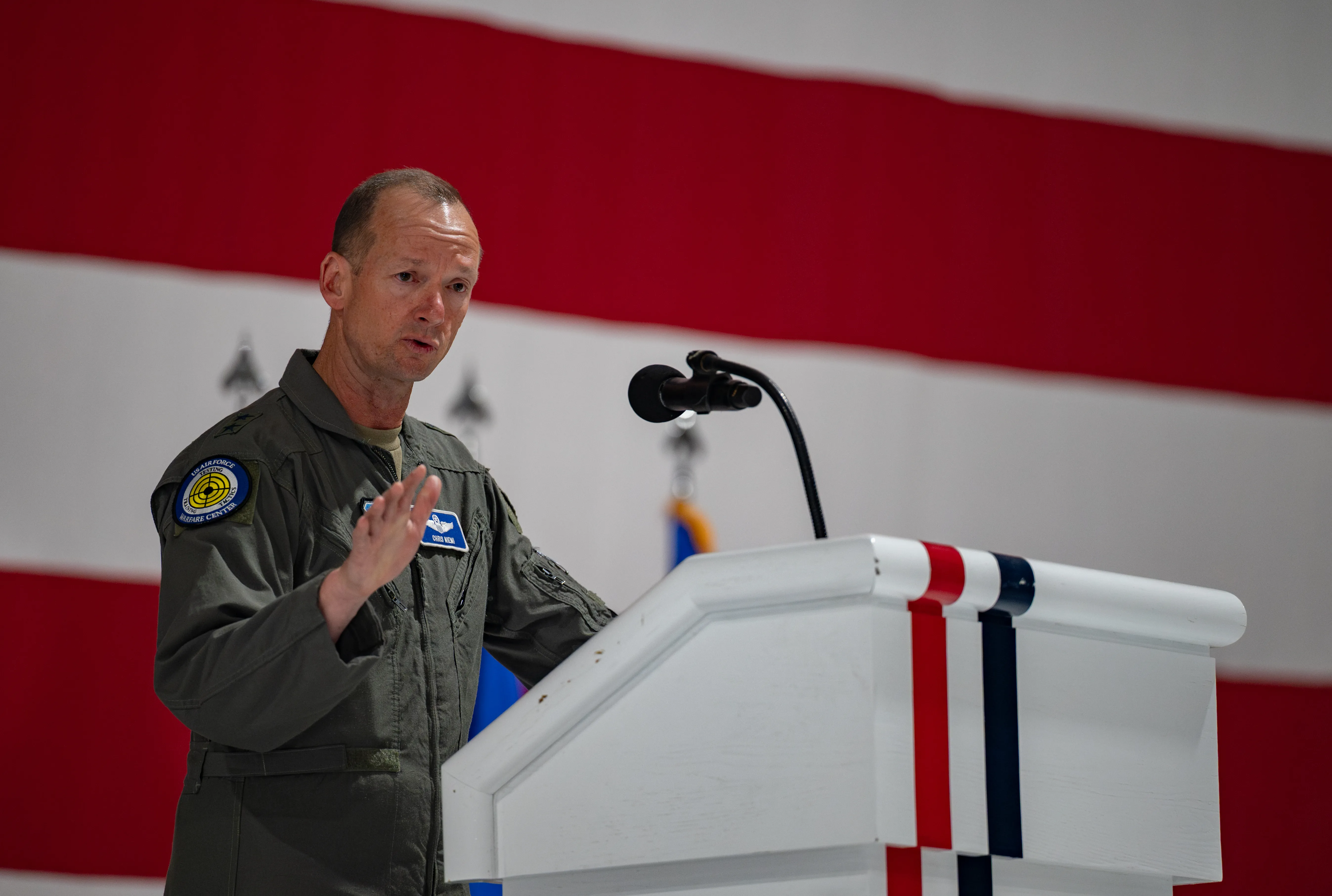
Testifying before a Senate Armed Services Committee hearing yesterday, Maj. Gen. Christopher Niemi, the acting head of Air Force Futures, said that a new requirements document for an MQ-9 replacement had been approved. Aviation Weekwas first to report the development.
U.S. Air Force Maj. Gen. Christopher J. Niemi, seen in June 2025, when he was the U.S. Air Force Warfare Center commander. U.S. Air Force photo by Airman 1st Class Jennifer Nesbitt Airman 1st Class Jennifer Nesbitt
The approval clears the path for the Air Force to begin a new acquisition process for an uncrewed aircraft system (UAS) that will assume the MQ-9’s role. A medium-altitude, long-endurance (MALE) system, the Reaper is primarily used for intelligence, surveillance, and reconnaissance (ISR) and strike missions.
Niemi told the Senate Armed Services Committee that improvements in technology since the MQ-9 was developed mean the service now considers it possible for a new drone to be “more flexible,” leaning upon open architectures.
At the same time, modern production methods mean the new drone will be easier and cheaper to produce “in mass numbers,” Niemi said. The result should be a drone that the Air Force can “use in a more attritable way.”
A U.S. Air Force MQ-9 Reaper, assigned to the 432nd Wing, sits on the flightline while being prepared for takeoff at Creech Air Force Base, Nevada, June 2, 2025. U.S. Air Force photo by Senior Airman Renee Blundon
Interestingly, within the Air Force, there has in recent years been a shift away from the term attritable — meaning inexpensive enough to be willing to lose on high-risk missions while being capable enough to be relevant for those missions — to “affordable mass.” This is something TWZpreviously highlighted was already happening back in 2021.
This change came about as a way of helping define the kinds of advanced drones that the Air Force is planning to acquire in the coming years, reflecting that their capabilities will necessarily come at a cost that will make them less than “attritable.”
Last month, the Air Force published a market survey notice, requesting information from industry on a new attritable ISR drone.
This notice included some key performance parameters for the drone, including a range of up to 932 miles and a 20-hour endurance. The attritable nature of the drone was reflected in a requirement for it to fly 100 missions with a “low-to-medium acquisition” cost.
The basic Reaper can fly for more than 20 hours unarmed, or more than 12 hours with weapons. In the case of the MQ-9B version, with an extended wingspan, flight endurance can be increased to more than 40 hours.
An aerospace ground equipment specialist assigned to the 174th Attack Wing, New York Air National Guard, checks data on an MQ-9 Reaper, armed with Hellfire missiles, during Exercise Sentry South 26-2 in Gulfport, Mississippi, March 3, 2026. U.S. Air National Guard photo by Staff Sgt. Dylan McCrink
“Operators desire low-cost, fast-to-field, fast-to-deploy airborne ISR mass to increase mission flexibility and mission surging,” the market survey notice added.
The process of figuring out what to replace the Reaper with has been ongoing for many years now. However, the latest effort is noteworthy for its emphasis on a lower-cost, more attritable platform.
Back in 2020, the Air Force published a request for information for a program dubbed MQ-Next, also seeking an MQ-9 successor. This was focused on ISR and strike capabilities, but also stated a desire for reduced operating costs and greater persistence, survivability, and range.
By 2021, the Air Force was concentrating more on a family of systems — the so-called Next-Generation Multi-Role Unmanned Aerial System Family of Systems (Next-Gen Multi-Role UAS FoS) — including a growing emphasis on low-observable (stealth) technologies. The same year, the service said it was seeking a replacement for the MQ-9 that could possibly include defensive counter-air capabilities to protect high-value manned aircraft, such as tankers, as well as potentially fly red air aggressor missions. Fast forward to today, and it’s clear that these higher-performance air-to-air focused missions could be taken over, at least in part, by the current Collaborative Combat Aircraft program. As a result, whatever replaces the MQ-9 is unlikely to have such broad requirements.
The Next-Gen Multi-Role UAS FoS included scope for platforms that could be survivable and reusable, or ones that would be attritable or expendable. This was not a single platform solution, either. It would likely need to include a mix of systems.
A Northrop Grumman concept for a possible stealthy MQ-Next. Northrop Grumman
The 2021 document also stipulated that the MQ-9’s successor should be tailored for Great Power Competition, pointing to a drone ecosystem suitable for the kinds of highly contested environments that would be encountered during a conflict with a peer rival such as China or Russia. At the same time, the solution was also intended to fly missions in more permissive environments, like the MQ-9.
Around this same time, the Air Force also said it wanted to leverage advances in development and manufacturing, meaning that smaller numbers of manned aircraft could be produced quickly to meet dynamically evolving threats. This reflected the Air Force’s “Digital Century Series” that was in vogue at that time, and which led to talk about “throwaway” technology and essentially “disposable” aircraft. Some of this appears to have made it into these new requirements, which stipulate that the aircraft needs to be able to fly just 100 missions.
Meanwhile, the latest statements from the service describe a drone with increased flexibility achieved through open architecture, rather than building bespoke batches of drones for particular requirements. Previous statements from the service outlined an aspiration to have its new drone capable of accommodating rapidly reconfigurable payloads, something that open architecture would expedite.
An MQ-9 Reaper assigned to the 174th Attack Wing flies over Hancock Field Air National Guard Base, Syracuse, New York, following a routine training flight, October 31, 2024. U.S. Air National Guard photo by Senior Airman Dylan McCrink Staff Sgt. Dylan McCrink
Above all else, the MQ-9 successor will still have to operate in contested environments.
In his testimony yesterday, Niemi presented a vision of a new drone, the design of which would stress being attritable, rather than survivable.
The Pentagon has long worked on the basis that a future conflict with a peer rival, and especially with China in the Pacific, would see it facing highly robust anti-access/area-denial (A2/AD) scenarios. With that in mind, previous Reaper replacement studies had suggested that low observability would need to be incorporated into the design.
An MQ-9 armed with an AIM-9X Sidewinder air-to-air missile. U.S. Navy
The latest thinking seems to reject that, or at least reorient the program toward a lower-cost platform of the kind that the Air Force would be able to field in mass, as well as to absorb the anticipated attrition in a high-end conflict. This does not preclude this airframe from featuring low-observable elements. In fact, it most likely will. But those would be more aggressively balanced against cost.
Concerns over the MQ-9’s vulnerability to air defenses have been ongoing for years now, although usually the nuances of this issue are not portrayed accurately in the media. Regardless, many MQ-9s were lost over Yemen, against a bottom-tier force. The war with Iran earlier this year underlined both the great utility and vulnerabilities of the platform. At least 24 Air Force Reapers were destroyed during the war, but these aircraft were pushed deep into Iran, loitered there for hours on end, and did some of the most important air-to-ground strike and surveillance work during the air campaign. While the Air Force says it plans to “buy back” some of the losses from that conflict, that will come with a hefty price tag, something that the service will want to avoid with its next ISR/strike drone. Furthermore, production of the MQ-9A model has now ended in favor of the MQ-9B.
The assumption that the MQ-9 replacement will be acquired in significant numbers is also noteworthy in terms of the current Air Force Reaper fleet, which includes more than 130 MQ-9As, according to Aviation Week.
MQ-9 Reapers assigned to the 49th Aircraft Maintenance Squadron parked on the flightline for display during the Legacy of Liberty Air Show at Holloman Air Force Base, New Mexico, April 18, 2026. U.S. Air Force photo by Airman Jose Veras
What appears to be missing at this stage, or at least obscured, is an acquisition strategy for the new drones. As well as the aerial platforms, the MQ-9 successor will require suitable new ground control systems, sensors, and data exploitation technologies, all of which are compatible with open-architecture standards. These systems will also have to leverage the latest technologies to allow the drones to be more effective and more survivable over the battlefield.
Since MQ-Next, the U.S. drone landscape has changed considerably in terms of manufacturers. A few years ago, Northrop Grumman, Lockheed Martin, and General Atomics would have been seen as the front-runners for the MQ-9 replacement. Now, there are more contenders, often with a founding focus on rapidly scaling up production at low cost. Still, these firms have much to prove, especially considering the risk in replacing an aircraft as important as the MQ-9. At the same time, in the more advanced drone space, the legacy defense “prime” contractors are also making major progress in leveraging new technologies to reduce production costs and migrating away from exquisite, very expensive drones as their default offerings.
A rendering General Atomics released in 2021 of a concept for MQ-Next. General Atomics
Back in 2021, the Air Force was promoting a “Speed to Ramp” initiative for its MQ-Next, which would see the first iterations of this capability fielded before “the 2026/2027 timeframe.” Other solutions under the same effort would begin to be fielded “in the 2030 timeframe,” the Air Force said.
While the latter timeline might still be somewhat achievable, it will require a considerable effort and investment and, not least, the firming up of the requirements for exactly what the Air Force wants its MQ-9 replacement to look like.
What we do know is that, while the Reaper’s replacement might not be as survivable as once envisioned, it will certainly be tailored to the increasingly harsh realities of a conflict against an advanced peer-state adversary.