The Coronation Street star will fly back to the UK for further tests this weekend
(Image: ITV)
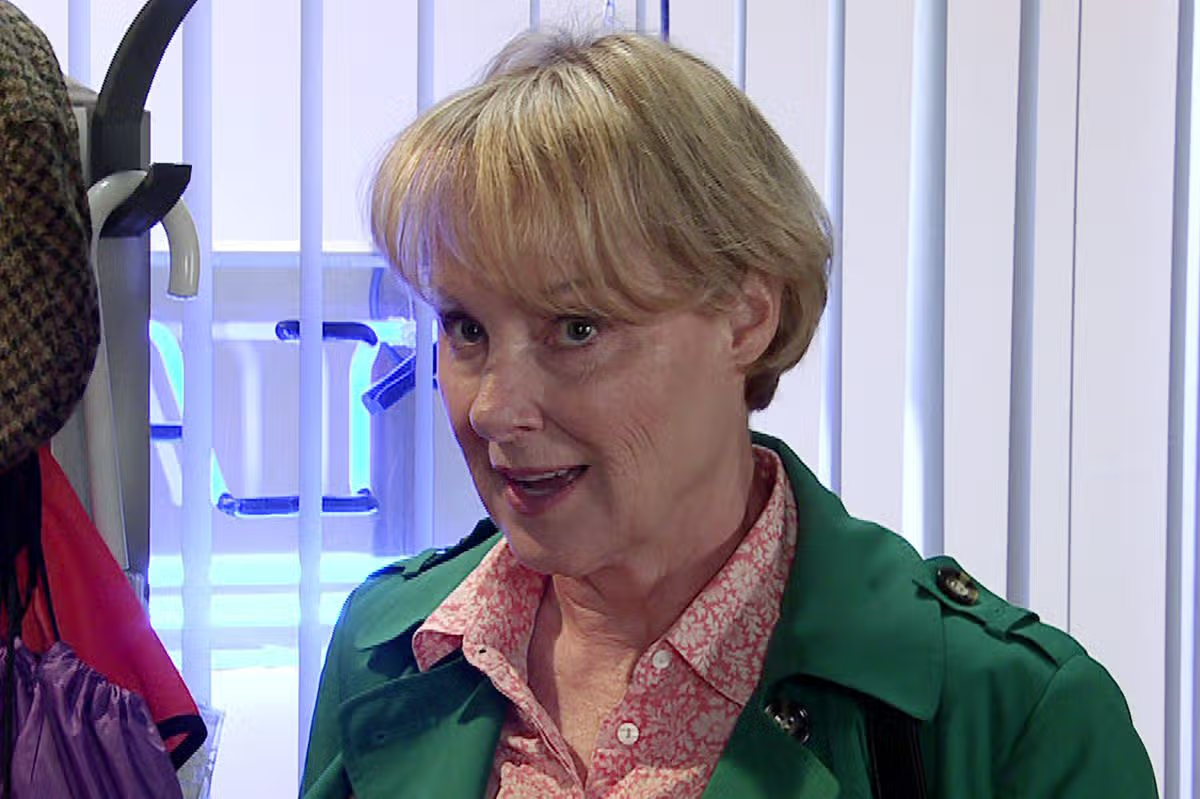
Coronation Street legend Beverley Callard reveals she has been diagnosed with breast cancer. Callard, best known for her role as Liz McDonald, said she is in the “early stages” and will be going ahead with further treatment before returning to the screen.
The actress is soon to join the Irish soap Fair City as a new character named Lily, long-lost mother of existing character Gwen Connolly. She found out the news just 20 minutes before having to film one of her first scenes.
She told RTE’s Late Late Show on Friday: “I’ve had some tests just before I left the UK, and literally, 15, 20 minutes before I was in my dressing room at Fair City, getting ready to go on, and I was quite nervous and thinking, ‘I hope everybody thinks I’m all right’, whatever.
“And my consultant rang me and said, ‘you’ve got to come back to the UK’ I said, ‘Well, I can’t possibly, I’ve just taken a new job’. I said ‘I’m away for a month’, and I was diagnosed with breast cancer.
“But I’m fine, I’m absolutely fine. My head was a bit mashed for the first few days. It’s very early stages, and I’m along with thousands of other women as well.
“It’s early stages, I travel back to the UK tomorrow, just for a couple of weeks, they’re going to test lymph nodes and lymph glands and all that. But then I need an operation and some radiotherapy, and then I’m coming back to Fair City, so I will be back in just a few weeks.”
She added: “I just thought, the world is full of strong, feisty women and I love strong, feisty women, and I just thought, rather than read about it in a newspaper and it all be distorted and everything else, I just said it, so that’s it.”
Callard and her husband are set to move to Co Wicklow as she is filming the soap. After acting in Corrie from 1989 to 2020, Callard said she was looking forward to her first appearance on Irish soap Fair City, which will hit the screen on February 19.
The picturesque village has one single road running through it and is home to a beloved country restaurant with rave reviews — ideal to spend a day in the countryside.
The stunning village boasts a rich history and breathaking views(Image: The Calf’s Head)
A charming Lancashire village featuring just one street and boasting a highly-rated country restaurant offers the perfect destination for your next family day out or catch-up with mates.
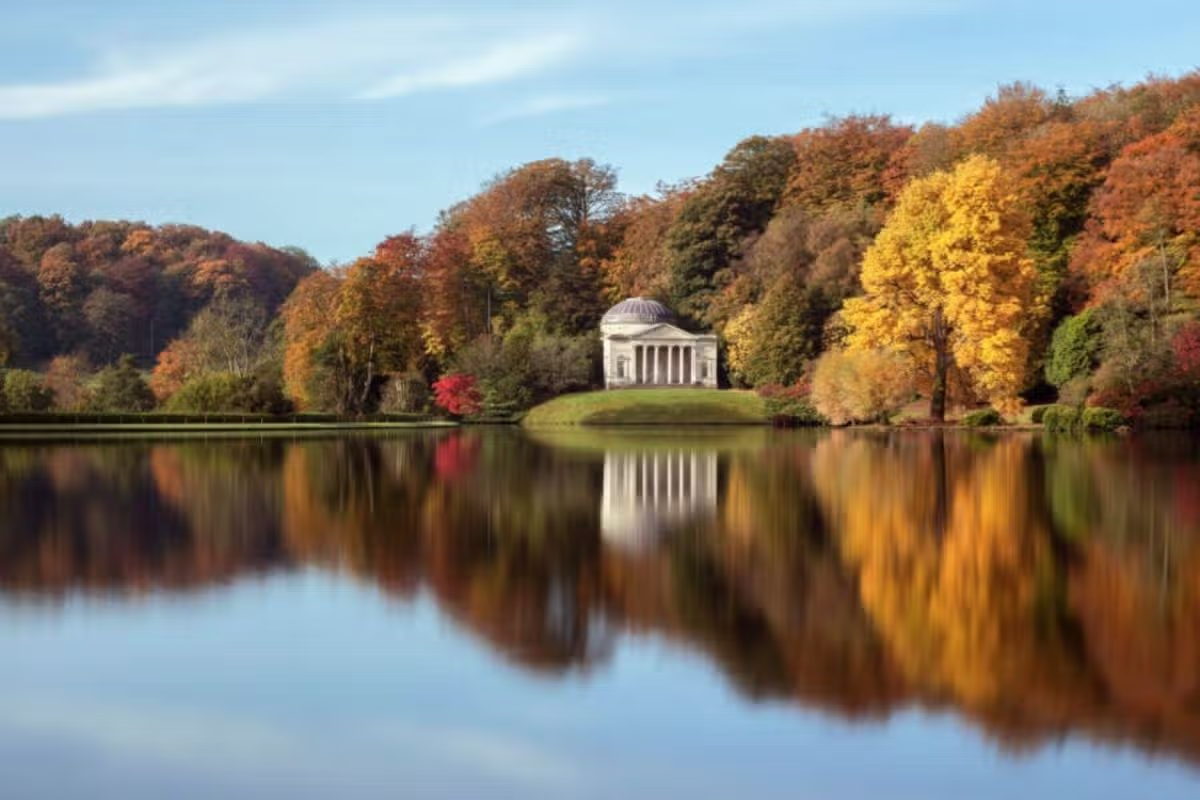
This distinctive linear village lies next to the renowned Pendle Hill, which provides a breathtaking backdrop to this peaceful hamlet.
Tucked away in the Ribble Valley district, east of the bustling market town of Clitheroe, this compact village serves as an ideal location for a peaceful retreat surrounded by natural beauty.
Its solitary road runs through the settlement before narrowing to a single-track lane leading to neighbouring Downham.
Despite the conservation village of Worston being relatively under the radar, it provides plenty of attractions for a fulfilling day trip.
A serene haven away from urban hustle and bustle, Worston boasts a fascinating and layered past. Back in 1778, workmen broadening the village road to Chatburn discovered 1,000 Roman coins (Denarii) in this modest settlement.
There’s also a prehistoric burial site located on Worsaw Hill, reports Lancs Live.
Located a stone’s throw from the village, Worsaw Hill is a Bronze Age burial mound displaying faint earthworks at its peak, potentially revealing traces of an ancient community from bygone times.
A cavern near the hill’s base enhances its enigmatic appeal, whilst the rocky outcrops and gentler slopes of Worsaw Hill prove excellent territory for fossil enthusiasts.
This tranquil single-track hamlet boasts numerous historical connections, featuring three Grade II Listed structures: the 17th-century Crow Hill Cottage, the 19th-century Worston Old Hall, and the Wall surrounding Worston Old Hall.
Remarkably, Worston Old Hall contains pieces of the historic Sawley Abbey embedded within its construction.
Tucked away beyond the village’s solitary main thoroughfare lies the remarkably intact remnants of an old bull ring, hidden within a compact meadow.
The stone and bronze tethering ring used during the bull-baiting period remains perfectly preserved on the village green.
This bull ring is thought to have been the epicentre of village activity in bygone days.
After the bull-baiting tradition faded, legend has it that anyone seeking confrontation would approach the bronze ring and rattle it vigorously to provoke a duel on the village green.
Charming countryside restaurant worth a visit
At the centre of tranquil Worston sits a much-loved rural restaurant and pub, treasured by locals and tourists alike.
The Calf’s Head ranks as Worston’s premier venue, earning an impressive 4.1 out of 5 rating on Tripadvisor. It stands as the village’s sole dining and drinking destination.
With stunning vistas across Pendle Hill, the Calf’s Head serves authentic ales and an impressive wine collection, alongside a comprehensive menu featuring freshly prepared dishes showcasing locally sourced ingredients. Its sprawling, well-kept gardens and outdoor dining space offer guests the opportunity to savour meals in the fresh air whilst taking in breathtaking views across the Lancashire countryside.
Diners have heaped praise on the food at Calf’s Head, with one guest sharing on Tripadvisor: “We were holidaying in the area and decided to try the Calf’s Head for an evening meal.
“We were not disappointed, the food was plentiful and tasty and it was so good to see some traditional meals on the menu. I loved the homely atmosphere in the restaurant, it was a dark November evening when we visited and it felt very cosy. We will return when we’re next in the area.”
Another glowing review says: “Just had the most amazing afternoon tea in celebration of family birthdays. Soup to start, unlimited tea, varied sandwiches, delicious cakes and scones with jam and cream.
“The staff were friendly, the views were stunning and we loved every part of it. Amazing value at £22.50 per person. Thank you so much.”
Meanwhile, another satisfied visitor said: “We stayed for two nights, having both breakfast and evening meal both days. Delicious food and great service on each occasion, despite the fact they were incredibly busy on Sunday. (Judging by the food, I’m not surprised – our lamb burgers with goat’s cheese and caramelised onions were superb, as was the lasagne.)
“The setting is perfect – in a lovely walled garden by a stream, in a pretty little village. Add in a comfy bed, tea and coffee-making facilities and piping hot water; we couldn’t have asked for more. Thank you!”
Best Lancashire holiday cottage deals
This article contains affiliate links, we will receive a commission on any sales we generate from it. Learn more
Lancashire is known for its wide open skies, stunning landscapes and lively coastal resorts. Sykes Cottages has a wide range of self catering accommodation across the county from £42 a night.
Oakland civil rights attorney James Cook has been on the ground in Minnesota for months figuring out answers to these question as he goes.
A fast-talking Minneapolis native who still lives in the Twin Cities part time, Cook is one of a handful of attorneys who have dropped everything to aid (for free) those caught up in the federal crackdown — protesters, immigrants and detained citizens — too many of whom have found themselves facing deportation, arrest or even been disappeared, at least for a time.
Civil rights attorney James Cook in the rear view mirror as he makes phone calls in his car in Minneapolis.
(Caroline Yang/For The Times)
“They are leaders that are on the ground really helping people through this process,” Minnesota school board member Chauntyll Allen told me.
She’s one of the protesters arrested inside a local church, charged with conspiracy to deprive others of their constitutional rights by Pam Bondi’s politicized Department of Justice, which also Friday arrested journalist Don Lemon for the same incident. Cook is one of the lawyers now representing Allen.
“It shows us that the judicial arm, or some of the judicial arm of our democracy, is willing to step up and ensure that our democracy stands strong,” Allen said of Cook and others like him.
While it’s the images of clashes in the streets that captivate media and audiences, it’s lawyers like Cook who are fighting an existential battle in the background to preserve the rule of law in a place where it is increasing opaque, to put it gently.
The legal work behind detentions has largely been an overlooked battlefield that will likely rage on years after ICE departs the streets, leaving in its wake hundreds if not thousands of long-and-winding court cases.
Beyond the personal fates they will determine, the outcome of the civil litigation Cook and others are spearheading will likely force whatever transparency and accountability can be pulled from these chaotic and troubling times.
It’s time-consuming and complicated work vital not just to people, but history.
Or, as Cook puts it, “I’ll be 10 years older when all this s— resolves.”
Federal agents stand guard against a growing wall of protesters on Jan. 24 in Minneapolis, just hours after Alex Pretti was shot by federal agents.
(Caroline Yang/For The Times)
Cook told me this while on his way to the Bishop Henry Whipple Federal Building where some detainees are being held, maybe. It’s hard to find out. A few years ago, when immigration enforcement in Minnesota ramped up under the first Trump term, activists tried to get the name of the building changed, arguing Whipple, the first Protestant Episcopal bishop in the state, had been an advocate of the marginalized and wouldn’t want his name associated with what the feds were up to.
Cook is well aware that the guns carried by the federal agents are not for show, even without the Boss’ new ballad. Just a few days ago, one of the first times he drove his beat-up truck up to the gate, the federal guards at Whipple pointed their guns at him.
“I’m like, ‘Hey, I’m going to take my keys out of the ignition, drop them on the ground. So please don’t shoot,’” he said.
They lowered the guns, but Cook was scared, a feeling that doesn’t come easy.
Long before his law degree, when he was a punk-rock loving teen in the 1980s, fresh out of Southwest High, the public school not too far from Whipple, a former coach convinced him to give up college dreams and instead pursue a shot at making the first Muay Thai kickboxing team at the Olympics.
The martial art ended up not making it as an official Olympic sport, but the experience launched Cook into a professional boxing and kickboxing career that took him to competitions around the world, and taught him fear is not a reason to back down.
But, “Father Time is undefeated,” Cook said. “I got older and I started losing fights, and I was like, all right, time to get back to life.”
That eventually led him to obtaining a law degree in San Francisco, where after an intern stint as a public defender, he decided he wanted to be a trial attorney, fighting in court.
Civil rights attorney James Cook has been doing pro bono immigration work since the crackdown began in Minneapolis.
(Caroline Yang/For The Times)
He started cold-calling John Burris, another Bay Area lawyer who is an icon of civil rights and police misconduct cases. Burris, who has been called the “Godfather of Police Litigation,” was involved in the “Oakland Riders” case in 2000, when officers were discovered to have planted evidence. He also represented Rodney King, the family of Oscar Grant, and the family of Joseph Mann among many others.
But Burris, a boxing fan, didn’t respond to Cook’s calls until the young lawyer offered him free tickets to one of his fights, which he was still doing on the side.
“And then immediately I got a call back,” Cook said.
Burris said Cook’s history as a fighter intrigued him, but “I did say to James, you can’t be a fighter and lawyer. You can’t get punched in your head all the time.”
Cook did not take this advice.
Still, Burris said, “It was his persistence that I admired, because the type of work we’re involved in, you need people who are dedicated, who have some real commitment to the work, and he showed that kind of consistency and dedication.”
Cook’s been working with Burris more than 20 years now, but until recently, the labyrinth of the immigration system wasn’t his area of expertise. It’s been a crash course for him, he said, on the often arcane laws that govern who gets to stay in America and who doesn’t.
It’s also been a crash course on what a civil rights emergency looks like. Along with his work looking for locked-up immigrants, Cook spends a lot of time on the streets at protests, helping people understand their rights — and limitations — and seeing first hand what is happening.
“If you ever wondered what you would have done in Germany, now is the time,” he said. “Now is the time to do something. People are being interned.”
In the hours after Pretti was shot, Cook was at the location of the shooting, in the middle of the tear gas, offering legal help to anyone who needed it and bearing witness to conduct that will almost certainly face scrutiny one day, even if government leaders condone it now.
Law enforcement officers launch tear gas canisters as they work to push the crowd back and expand their perimeter in Minneapolis on Jan. 24.
(Caroline Yang/For The Times)
“The way the officers chase people down, protesters who were really just protesting lawfully and were beaten and pepper sprayed and gassed — all those are civil rights violations,” Burris said. “And so the law is the guardrails. So there has to be lawyers who are prepared to protect those guardrails and to stand as centurions, as I refer to us.”
Cook has tried to calm protesters, he told me, and prevent clashes. But people are mad, and resolute. His greatest fear is summer — when warm weather could bring even larger crowds if enforcement is still ongoing. He’s worried that the actions of the federal agents will spill over into anger at local cops enforcing local laws, leading to even more chaos.
“I’ve always supported cops as long as they do their job correctly,” Cook said.
For now, he’s taking it one day at a time, one case at a time, one name at a time.
Protesters raise an inverted American flag as law enforcement officers launch tear gas canisters in Minneapolis after Alex Pretti was killed by federal agents.
(Caroline Yang/For The Times)
Tuesday, Cook passed through the armed checkpoint at Whipple carrying a list of about seven people, folks who have been picked up by federal agents for one reason or another, or reasons unknown, and now cannot be located. They are not in the public online system that is meant to track detainees, and family and friends have not heard from them.
If he’s lucky, Cook will get information on one or two, that they are indeed inside, or maybe at a detention center in Texas, where many have been sent. But there will be more whose location remains unknown. He’ll make calls, fill out forms and come back tomorrow. And the tomorrow after that.
“This is what we do,” he said. “I’m always in it for the long run. I mean, you know, shoot, yeah, that’s kind of the way it works.”
MINNEAPOLIS — A federal judge says she won’t halt the immigration enforcement surge in Minnesota as a lawsuit over it proceeds.
Judge Katherine M. Menendez on Saturday denied a preliminary injunction sought in a lawsuit filed this month by state Atty. Gen. Keith Ellison and the mayors of Minneapolis and St. Paul.
It argued that the Department of Homeland Security is violating constitutional protections. The lawsuit sought a quick order to halt the enforcement action or limit its scope. Lawyers with the U.S. Department of Justice have called the lawsuit “legally frivolous.”
The ruling on the injunction focused on the argument by Minnesota officials that the federal government is violating the Constitution’s 10th Amendment, which limits the federal government’s powers to infringe on the sovereignty of states. In her ruling, the judge relied heavily on whether that argument was likely to ultimately succeed in court.
The federal government argued that the surge, which it calls Operation Metro Surge, is necessary in its effort to take criminal immigrants off the streets and because federal efforts have been hindered by state and local “sanctuary laws and policies.” State and local officials argued that the surge is political retaliation after the federal government’s initial attempts to withhold federal funding to try to force immigration cooperation failed.
“Because there is evidence supporting both sides’ arguments as to motivation and the relative merits of each side’s competing positions are unclear, the Court is reluctant to find that the likelihood-of-success factor weighs sufficiently in favor of granting a preliminary injunction,” the judge said in the ruling.
U.S. Atty. Gen. Pam Bondi lauded the ruling Saturday on social media, calling it “another HUGE” legal win for the Justice Department.
Federal officers have fatally shot two people on the streets of Minneapolis, Renee Good on Jan. 7 and Alex Pretti on Jan. 24.
Emmerdale legend Glenda McKay has announced her new role as Dr Pearce in HollyoaksCredit: Instagram/@reddoormanagementThe star has landed herself a soap hat-trick having appeared on Emmerdale, Coronation Street and now Channel 4’s HollyoaksCredit: Rex Features
Channel 4 bosses have cast the 54-year-old actress with the intention to include her in a forthcoming storyline.
It’s been revealed Glenda is playing a new character named Dr Pearce, though it’s currently unclear how long the soap star will remain on the show for.
The soap star’s exciting new casting was confirmed in a post shared by the talent agency Red Door Management.
They said in a post on social media: “Tune into Hollyoaks at 7pm this evening on E4 to catch Red Door’s Glenda McKay as Dr Pearce.”
Glenda’s Hollyoaks role comes just months after she appeared in a guest stint on rival soap Coronation Street.
On the cobbles, Glenda played a social worker named Alison Hale who was dealing with street couple Tim and Sally Metcalfe as they fought to foster the Michealis’ children following their mum Lou’s imprisonment.
The actress left Emmerdale over 25 years ago when she was killed off in a memorable storyline which saw her brutally pushed off a cliff.
Glenda’s Emmerdale character, Rachel Hughes, was embroiled in a number of the show’s biggest storylines from affairs to having a secret childCredit: RexThe 54-year-old made her debut on Emmerdale back in 1988Credit: Alamy
She spent more than 11 years on the soap and appeared in almost 750 episodes.
Her character, Rachel Hughes, was embroiled in a number of the show’s biggest storylines from affairs to having a secret child.
Glenda’s final storyline saw her enter a toxic relationship with teacher Graham Clark. He coerced her into dressing differently and forced her to dye her hair in an attempt to mould her into his dead wife.
Twisted Graham then attempted to force himself on her as she tried to break up with him.
He later chased Rachel and cornered her on a clifftop, she confronted him, and Graham ultimately pushed her to her death.
The evil teacher then lead Rachel’s friends and fellow villagers to believe that she was missing.
Since leaving Emmerdale in 1999, Glenda has only landed a handful of TV roles including guest stints on Hollyoaks and Doctors.
In 2005, Glenda appeared in Coronation Street for one episode as a love interest of cabbie Lloyd Mulaney (Craig Charles).
But in recent years, the former soap star made a startling career change as she ditched acting to work as a primary school teacher.
Many Angelenos have never set foot in Monrovia, the mountain-view town nestled in the San Gabriel foothills, or even heard of it — unless they read their Trader Joe’s labels, many of which name the city as the distribution site. It’s still a bit of an insider’s secret, which locals like myself tend to appreciate.
Get to know Los Angeles through the places that bring it to life. From restaurants to shops to outdoor spaces, here’s what to discover now.
Monrovia embodies the word “picturesque” in a way Thornton Wilder would’ve appreciated: Neat little historic homes — many designed in the Arts and Crafts and New Mediterranean architectural styles — line neighborhood streets abundant with native plants. Residents, by turns sweet and quirky, seem like they could be plucked right out the “Gilmore Girls” town of Stars Hollow: You might meet an award-winning whistler who hosts an annual music festival in Library Park or a mayor whose husband campaigns for her by strolling the streets wearing a sandwich board. Monrovians are intensely proud of their city, telling their stories through a historical museum and an archive called the Legacy Project. On Friday evenings, they often come together in Old Town Monrovia, where four blocks of the main thoroughfare of Myrtle Avenue are shut down to traffic for a street fair complete with bounce houses, food trucks and a petting zoo. Their event calendars are peppered with frequent festivals in Library Park and the county fair-esque Monrovia Days town birthday celebration.
Los Angeles County’s fourth-oldest city, Monrovia was incorporated in 1887 after William N. Monroe, a former superintendent for Southern Pacific rail company, along with James F. Crank, Edward F. Spence and John D. Bicknell, plotted a 120-acre town centered at Orange (now Colorado Boulevard) and Myrtle Avenue. Historic gems can be found all around: You can still admire the Mayan Revival-style architecture of the century-old Aztec Hotel or look for the brass plaques displayed on more than 40 of Monrovia’s “first houses” built before the end of 1887. Just be on the lookout for the bears: They’re the unofficial mascot of Monrovia, since they languidly amble our streets, inspire our art (you’ll find bear murals and sculptures throughout town) and even bathe in our hot tubs.
In general, daily life in Monrovia feels mellow, slow and friendly. Seeing and being seen isn’t as much of an objective as savoring a breakfast of runny eggs while reading a newspaper, meandering by the lit-up park fountain or hiking through the 80 acres of wilderness at Monrovia Canyon Park. Don’t expect to get anywhere in town fast, especially during rush hour along Huntington Drive, Foothill Boulevard or the 210. In getting around, public transit can come to the rescue: the GoMonrovia Lyft Pass offers $6 local Lyft rides, and the city is connected by Metro to Pasadena, Highland Park, Union Station, Azusa, Long Beach and other locations. Monrovia isn’t for everyone but it’s as close to paradise as anything I’ve ever found in Los Angeles County. I hope to someday be considered one of the city’s quirky characters who has long called this place home.
What’s included in this guide
Anyone who’s lived in a major metropolis can tell you that neighborhoods are a tricky thing. They’re eternally malleable and evoke sociological questions around how we place our homes, our neighbors and our communities within a wider tapestry. In the name of neighborly generosity, we may include gems that linger outside of technical parameters. Instead of leaning into stark definitions, we hope to celebrate all of the places that make us love where we live.
Our journalists independently visited every spot recommended in this guide. We do not accept free meals or experiences. What L.A. neighborhood should we check out next? Send ideas to guides@latimes.com.