injury woes continue as Teoscar Hernández leaves Dodgers’ win over Rockies with strained hamstring.
The Dodgers’ recent string of injuries continued Wednesday when left fielder Teoscar Hernández pulled up limping after trying to beat out a grounder to shortstop.
Once he was thrown out in the second inning of the Dodgers’ 4-1 win against the Rockies, Hernández took his time walking across the field back to the dugout.
The Dodgers announced that he sustained a left hamstring strain. Utility player Hyeseong Kim replaced Hernández in left field.
This series, as results went, was a success for the Dodgers. They swept the Rockies, outscoring Colorado 24-10 over the course of three games. But the injury losses dealt a blow.
Earlier this month, the Dodgers’ rotation bore the brunt of the injury bug. But recently, it has spread to the position players. Over the last week, three Dodgers position players have left games with injuries.
Last Friday in Milwaukee, third baseman Max Muncy was hit in the wrist by a pitch and sidelined for three games.
Utility player Kiké Hernández made his season debut Monday, after starting the season on the injured list while recovering from offseason surgery on his left elbow, and helped fill in for Muncy’s temporary absence. But Hernández logged just four at-bats before landing on the IL again, lifted from Tuesday’s game with a strained left oblique.
Even after tweaking his oblique in batting practice Monday, Kiké Hernández went four for four with two doubles and a home run as he played through the injury.
Teoscar Hernández’s hamstring strain came in the midst of a hot offensive stretch. Entering Wednesday, he had a 1.072 OPS in his last 13 games.
Manager Dave Roberts also pulled Shohei Ohtani from the Dodgers’ blowout win Tuesday, after he was hit on the right hand by a changeup. But that had more to do with the score, an opportunity to get Dalton Rushing more at-bats, and getting Ohtani ready for his start on the mound Wednesday.
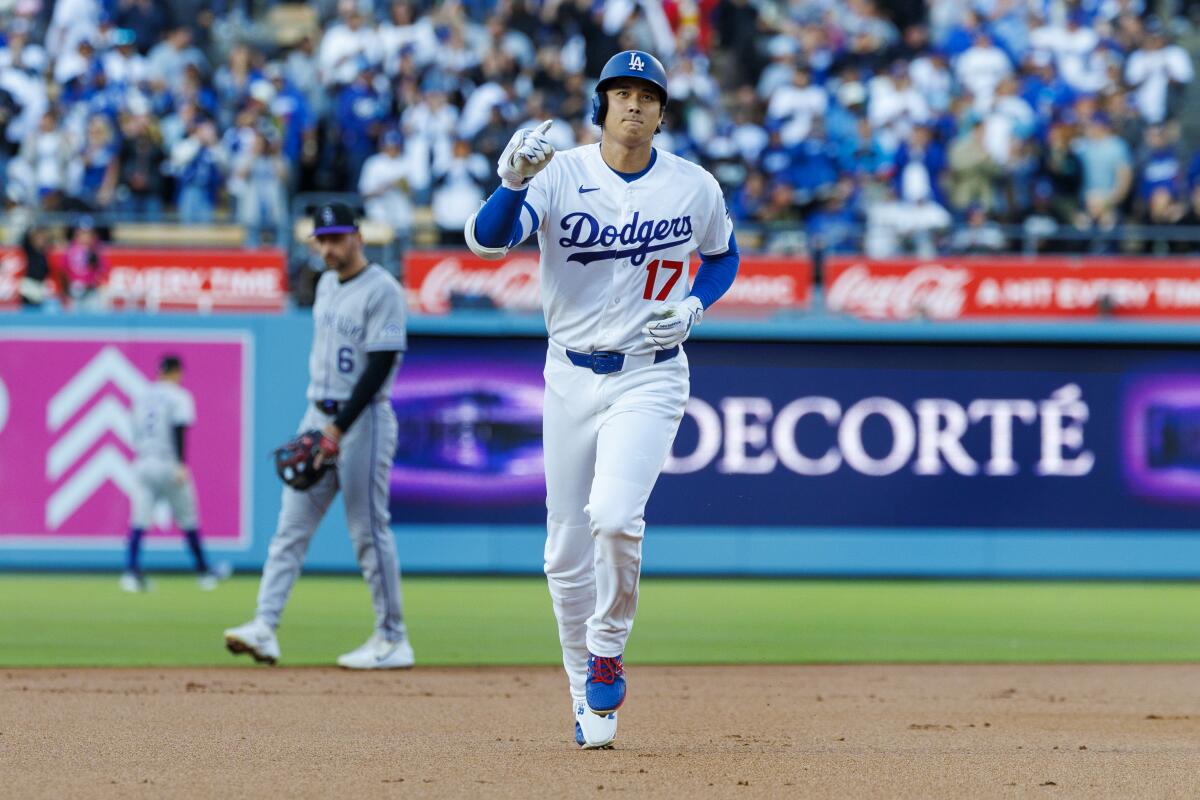
For the second week in a row, Ohtani was in the batting order while also pitching. And for the second pitching start in a row, he gave himself run support with a leadoff home run.
This jumped off his bat at an exit velocity of 111.3 mph, according to Statcast, landing on the netting beyond the center field wall.

Shohei Ohtani runs the bases after leading off Wednesday’s game with a home run.
(Gina Ferazzi / Los Angeles Times)
His pitching performance was less straightforward. He held the Rockies hitless through six innings. But he still gave up a run, thanks to a total of five free passes (four walks and a hit batter).
Two of them set up the Rockies’ scoring opportunity. With runners on first and third in the fourth inning, the Rockies’ Willi Castro hit a grounder to the right side of the infield, pulling first baseman Freddie Freeman away from the base.
But second baseman Alex Freeeland, recalled Wednesday as the corresponding move as Kiké Hernández went on the IL, ranged to his left and dove to first base with the ball, beating Castro to the bag for the second out of the inning. Ohtani acknowledged Freeland with a point.
A run scored, but Freeland’s hustle set up Ohtani to get out of the inning without further damage.
The Dodgers held the Rockies hitless until the eighth inning, when Tyler Freeman hit a ground-ball single through the right side of the field off reliever Tanner Scott, in the midst of a scoreless inning.
Meanwhile, the Dodgers scored almost all their runs on homers, with Freddie Freeman and Andy Pages adding their own solo blasts after Ohtani, and Alex Call contributing an RBI single.