Stephen

Examining “hatemonger’ Stephen Miller’s new plan to assail Latinos

Last week voters across the country rejected Republican politicians and the Trump administration’s agenda. Democrats gained control of both the House of Representatives and the Senate — nabbing historic pickups in Republican strongholds such as Kansas, South Carolina and Texas.

Notably, Latino voters turned their back on Republicans after giving Donald Trump 48% of the vote in 2024. A New York Times voter analysis found that Latino voters shifted 29 points toward Democrats between 2024 and 2026, compared with a 15-point shift among voters overall.

After the monumental about-face, President Trump processed the defeat by blaming everyone around him for the blue tsunami.

After Trump-endorsed candidates lost pivotal Senate seats, the president posted on social media, “I wasn’t on the Ballot and if I was, we would have won IN A LANDSLIDE!”

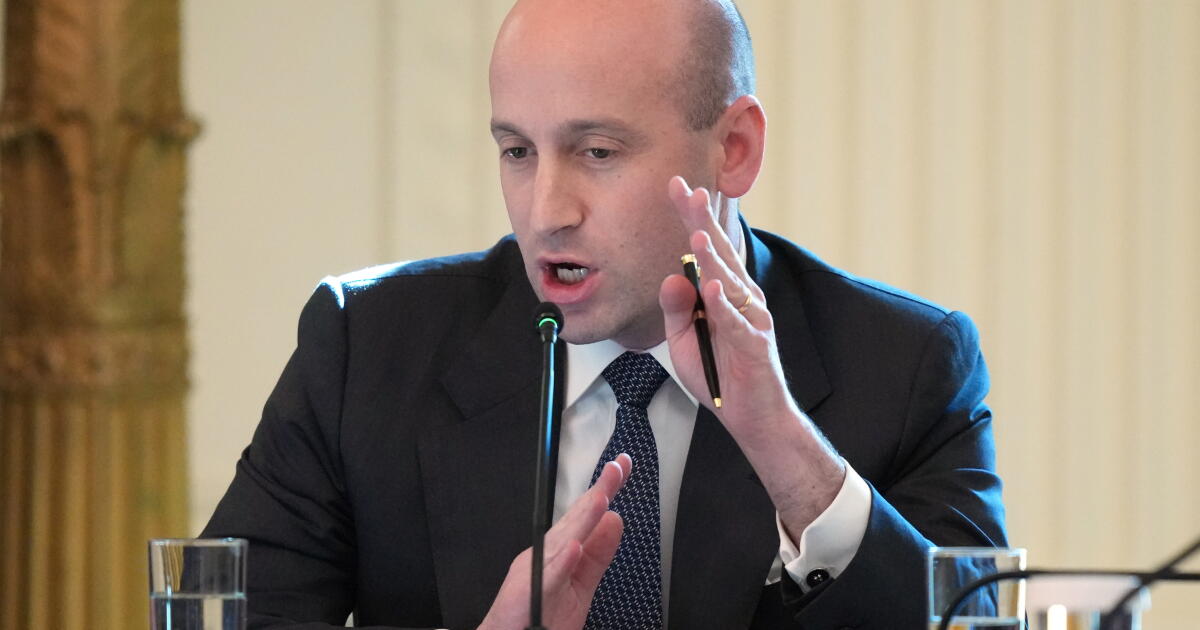
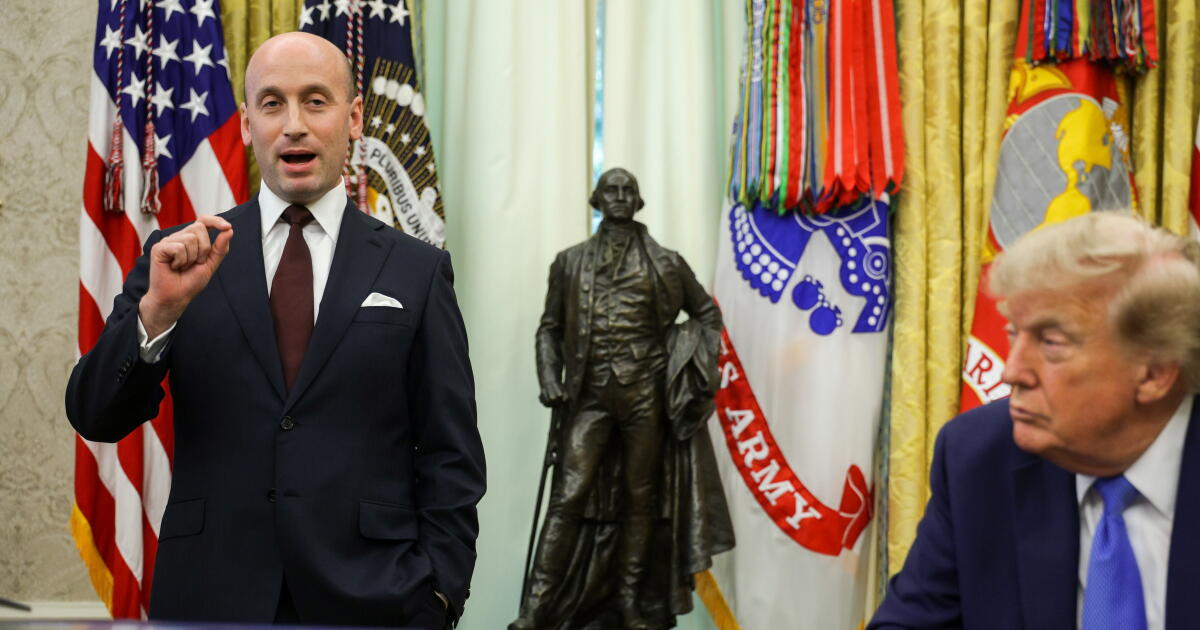
The resignation of White House Chief of Staff Susie Wiles last week was perhaps the most telling move about how Trump plans to deal with Republican losses nationwide. Wiles was promptly replaced with far-right advisor Stephen Miller, who previously served as the deputy chief of staff.

“I wanted to make a change,” Trump told reporters Nov. 6. “I think Susie’s done a very good job. … Stephen’s been great and we’ve got to make moves.”

Political observers now fear the appointment signals Trump will double down on an agenda that has alienated broad swaths of voters, including Latinos, who were among the most targeted demographic in the administration’s campaign of aggressive immigration enforcement spearheaded by Miller.

To better understand what Miller’s promotion will mean for the president’s future plans, The Times spoke with New York Times contributing writer and USC associate professor of journalism Jean Guerrero, who literally wrote the book on Miller.

Her 2020 book, “Hatemonger: Stephen Miller, Donald Trump, and the White Nationalist Agenda,” examined Miller’s upbringing, the political forces that shaped his ideologies and the origins of his anti-immigrant policies.

This interview has been edited for clarity and length.

With the big news of this election cycle being that Latinos turned their back on Trump, do you see the appointment of Stephen Miller as an act of revenge by Trump? What do you think he’s trying to signal for his agenda over the next two years with this promotion?

I think he’s trying to signal that he plans to double down on talking down on Latino and immigrant communities because [Trump and his allies] need the war on immigrants to continue their war on the working classes, which is what this is all about.

The general public is fed up with this administration because of how de-prioritized working families have been, and that’s across the board: white, Latino, Black, Asian. The war on immigrants is central to that de-prioritization because by criminalizing a sector of the population and keeping [them] in the shadows and in fear, they are able to suppress wages for the entire working class and they’re able to keep immigrants from being able to organize with their citizen co-workers in the workplace.

What do you think we can expect to happen to immigrant Latino communities specifically under this era of Stephen Miller?

I think what we’re going to see is an extreme expansion of the war on immigrant communities and their allies specifically. That is going to disproportionately target U.S. citizen Latinos — using what power and privilege they’ve been able to accumulate through the sacrifices of their parents and grandparents — who are at the front lines of defending their community members.

Your book discussed how Miller’s high school years helped shape his anti-immigrant, anti-Latino sentiment and how that seems to have stemmed a bit from going to a public school in Santa Monica. Can you talk a little bit about that?

A lot of people get surprised when they learn that Stephen Miller was from Santa Monica, because it’s a liberal enclave, but he is very much a product of the liberal hypocrisy that he witnessed growing up in California. What he witnessed remains true of establishment and corporate Democrats today, which is a professed concern for marginalized communities and performative support for social justice, while completely neglecting to pursue any concrete policies that would make the lives of marginalized communities any better.

One of the ways he exploited that fact to rise in power was by aligning himself with the conservative movement that was growing rapidly in California during the 1990s, led by David Horowitz — a conservative activist in Studio City — who became one of Stephen Miller’s main mentors and who groomed a generation of young conservatives to use the tools and terms of the civil rights movement against the gains of the civil rights movement. Miller learned to perceive multiculturalism and people of color as an existential threat to the U.S.

Do you think that putting Miller in the position of chief of staff is a way for Trump to reposition this war on immigrants as his main thing and to move away from the more economic and cost-of-living concerns that people also seem aggravated by?

They’re going to continue to try to frame immigrants as the enemies of the working classes, which is masterful gaslighting. By doing that, they are ensuring that citizen workers don’t organize alongside immigrants for higher wages, for economic equality. I think the immigration issue is actually at the heart of the economic issues that people are upset about. I say that because you saw the mass deportations affecting things like construction sites, which were left empty of workers, so people who were trying to build housing at a time of housing scarcity were being targeted. You saw farmworkers getting targeted in the fields, which led to higher food prices.

The war on immigrants is a war on the working classes. By doubling down on it, Trump is going to be trying desperately to confuse people into thinking that immigrants are to blame for the economic pain that everybody is feeling. When in reality, the economic pain that everybody is feeling is because of this war on immigrants which is pouring billions of taxpayer dollars into mass surveillance, mass incarceration of people based on their race and language. It is a huge waste of taxpayer dollars.

Trump has been speaking out of both sides of his mouth on his immigration messaging. He recently acknowledged that people might have thought he was too tough on immigration, but this appointment of Miller signals that he will be going harder on the issue. What is the calculation there in your view?

He’s trying to exploit the echo chambers, which makes sense for a dear friend of the tech elites for him to know how to do that. He’s hoping that one piece of information will reach one audience and another piece of information will reach the other audience. So the people who are fed up with the war on immigrants will hear him say that he’s scaling it back and they’ll be happy and they’ll support him. The people who love the war on immigrants, which are fewer and fewer every day, will hear about Stephen Miller and get really excited about that. He’s just hoping that the [online] algorithm will work in his favor.

You’ve previously spoken about noticing a shift in Miller’s immigration mindset over the years, can you talk about that change?

During the first administration, he was focused entirely on strangling legal pathways into this country, such as gutting the asylum and refugee systems, and restricting green card access and separating families at the U.S.-Mexico border. All of this geared towards racially reengineering the demographics of this country. During the second administration, he’s done some of that with these mass deportations where he’s directed agents to round people up at worksites and where they’ve been racially profiling people and detaining people based on their skin color and language and blue-collar jobs as opposed to their criminal records.

At the same time, Miller has been one of the most vocal proponents of Trump’s foreign interventions and invasions, which have set the stage for the mass displacement of new refugees and immigrants. Watching Miller be so vocally supportive of these interventions, I realized he had shifted, and that he was no longer primarily motivated by restrictionist ideologies and white nationalist ideologies — it was about class.

Trump and Miller are using the war on immigrants to manufacture and maintain a permanent underclass in the United States, which is something that has been done by many administrations for many generations. But they’ve taken it to an astounding level that has caused an unprecedented amount of economic, spiritual and psychological pain across this country.

With Democrats gaining a bunch of seats in the Senate and the House, and taking control of a bunch of state legislatures, what can they do to potentially minimize Miller’s effect in the White House?

It is imperative that the Democrats use their majorities not only to investigate the crimes against humanity that this administration has been committing, but also to deliver on behalf of working families. At the center of that has to be ending the war on immigrants. They have to abolish ICE. They have to pass legislation to protect the longtime undocumented population — who Democrats have said that they’ve been going to protect for many administrations and have not prioritized, even when they previously had majorities in Congress.

If they do not deliver on behalf of working families by emancipating the subjugated classes, then they’re admitting they too are in alliance with the pillaging classes and that they are no different from Trump and Miller. The main thing they have to do is counter any maneuvers that Miller is going to be making from the White House. They can’t just be all talk. They have to deliver in concrete ways for working families and they’re not going to be able to do that if they ignore the immigrant community that has been at the center of the Trump administration’s persecution.

Nithya Raman’s win upends L.A. Latino politics

A few weeks back in this newsletter, I discussed how Latino voters would be the deciding factor in the L.A. mayoral race as the demographic helped carry Mayor Karen Bass in the primary, with her winning 35 Latino-majority neighborhoods in the June 2 election.

Five months, much campaigning and the botched response to a massive warehouse fire in heavily Latino Boyle Heights later, Bass’s competitor, Councilmember Nithya Raman, courted the Latino vote in last week’s election. A Times analysis of early election returns showed Raman won big in the heavily Latino neighborhoods such as Wilmington, South L.A. and Pico-Union.

My colleague and Latino voting expert Gustavo Arellano wrote about how Raman’s win was the death knell for L.A.’s Latino political establishment.

Arellano discussed how Bass consistently aligned herself with a cohort of moderate Latino politicians — such as City Councilmembers Monica Rodriguez and Imelda Padilla, Assemblymember Celeste Rodriguez and Rep. Luz Rivas — at reelection events. Conversely, Raman focused on activating younger, more progressive Latinos throughout her campaign.

The L.A. Latinos’ traditional political machine was in trouble before hitching its wagon to Bass’s failed reelection campaign, Arellano noted. It began in 2022 when three City Council members were embroiled in an audio leak scandal, which created an avenue for two democratic socialists to grab council seats. The Latino old guard also lost two more council members in 2024, and former L.A. Mayor Antonio Villaraigosa, bastion of that political class, ran a supremely unsuccessful gubernatorial campaign this year.

Raman’s grassroots approach met Latino voters where they were and not where she thought they were supposed to be — something Bass’ chief campaign strategist, Julie Chavez Rodriguez, could learn a lesson from.

“The mayor ran on a very institutional playbook of getting a bunch of Latino politicians together so they could tell Latinos how to vote,” Marco Santana, who ran for City Council earlier this year, told Arellano. “That doesn’t work anymore. Latinos want deeds.”

One actor’s pursuit to dub “The Lion King” in Quechua

Voice actor Fernando Valencia grew up in the Andean Peruvian town of Huanimpampa, where the Indigenous language of Quechua is still an integral part of everyday life. He noticed that the dialect is never represented in dubbed versions of Hollywood family hits, which creates a barrier for comprehension among children whose primary language is Quechua.

To point out this lack of availability and to show that an avenue for accessibility was possible, Valencia dubbed segments of Hollywood blockbusters such as “Star Wars: The Empire Strikes Back” and “The Lion King” into the language spoken by nearly 10 million South Americans.

He has since dared to dub “The Lion King” — the first movie Valencia watched in its entirety as a child — fully into Quechua. Valencia’s attempts are documented in Peruvian filmmaker Augusto Zegarra’s debut feature, “Runa Simi,” which is the name of the Quechua language in Quechua and translates to ”language of the people.”

De Los contributor Carlos Aguilar recently spoke with Valencia and Zegarra about the film and the voice actor’s monumental undertaking.

“If I keep my language and culture in a fragile little jar, someone will come along and trample it, and it will disappear forever,” Valencia said. “But if I open this little jar and build bridges, it will be difficult to eliminate it because it will be integrated into the world.”

A similar linguistic venture to preserve a native language was completed by Tweedie Waititi, the sister of Oscar-winning director Taika Waititi, who partnered with Disney to dub multiple titles into te reo Māori.

Valencia’s mission was given a major bump after Peter and Benjamin Bratt, whose mother, Eldy Banda, is an Indigenous activist of Quechua descent, signed on to the project as executive producers.

“It felt like a statement to have someone who has never heard of the Quechua language, maybe someone in Europe or the U.S., ask what runa simi is and then being able to tell them: ‘You’re already speaking it! By saying the words runa simi, you’re already using the language,’” Zegarra said.

Stories we read this week that we think you should read

Unless otherwise noted, stories below were published by the Los Angeles Times.
Politics and immigration

Arts and entertainment

Southern California

Source link

Stephen Curry defends wife Ayesha aftercomments by Gilbert Arenas, others

p]:text-cms-story-body-color-text”>

One scene features Ayesha and Daddario sharing a five-second kiss. Naturally, folks on social media had some very mature reactions, such as “I’ve never seen her look at Steph like this,” and “can’t believe my goat Steph gotta go through this” and “grounds for a divorce.”

Ayesha even jumped into one of the threads. “It’s not even real,” she wrote, adding a laughing emoji, “you guys are annoying.”

The kiss also became a topic on several podcasts. Arenas and Young discussed it Sunday on their “We Said What We Said” podcast, with Arenas doing most of the talking and Young, who played with Stephen on the Warriors during the 2017-2018 season, mainly expressing agreement.

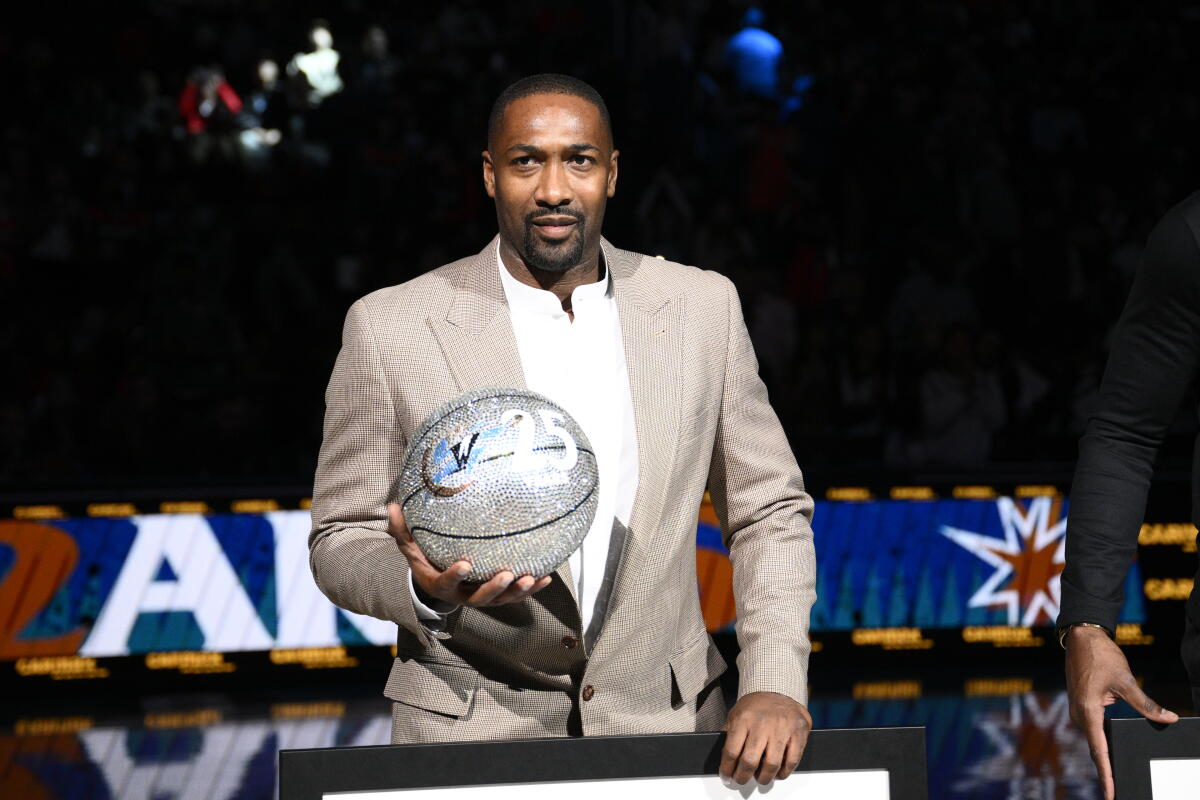
Gilbert Arenas holds a silver, sparkling basketball while wearing a beige jacket and cream-colored shirt.

Former Wizards player Gilbert Arenas is honored during a 2022 halftime ceremony in Washington, D.C.

(Nick Wass / Associated Press)

“When you’re talking about an American family, [Stephen] is the definition of what everybody sees as a father,” Arenas said. “Got the best kids. The only blemish in the family is the wife in a sense ‘cause she doesn’t act like the other superstars’ wives.

“We don’t want to hear you,” Arenas said of the public’s feelings on star athletes’ significant others. “We just want to know you’re there, you’re fine, you are taking the pictures. But we don’t want to know you.”

In another video, posted Tuesday, Arenas tried explaining that he had been talking about Ayesha‘s behavior only in comparison with that of her husband.

“She’s not doing anything wrong as for just women themselves. She’s not,” Arenas said. “But you’ve got to remember, he’s 100% clean. … Like he’s, he is the pope in a sense, right? You make one mistake, you are the worst out of the two, is basically what I’m saying.”

In an episode of the “Speakeasy” podcast titled “VIDEO: Steph Curry’s Wife KISSES ANOTHER MAN!” the unmarried Acho states he wouldn’t be OK with a significant other kissing someone else in a movie.

“It wouldn’t be me and it couldn’t be me,” Acho said. “Here’s the thing. I don’t think people were meant genetically, physically, anatomically, spiritually designed to watch their partner kiss another person, whether it’s done in the name of acting or not. I just do not think that we were like physically and emotionally designed for that.”

Source link

Stephen Miller: Immigration hard-liner and critic of Democrats

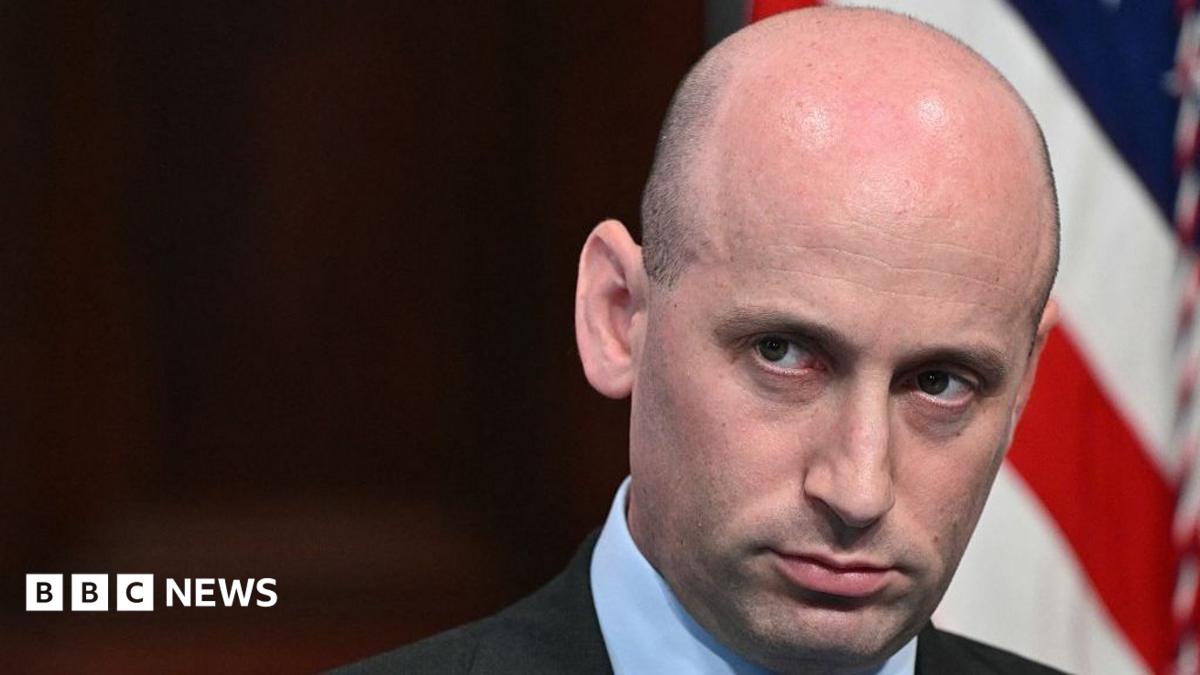
President Trump’s new White House chief of staff, Stephen Miller, is behind many of the administration’s signature domestic policy initiatives, especially its sweeping crackdown on immigration.

An outspoken defender of Trump’s most far-reaching goals to remake government going back to his 2016 run for president, Miller is known for his harsh language and unrelenting bombast, attracting outsize attention from supporters and critics alike. His record is likely to be scrutinized by Democrats in his powerful new role as he leads Trump’s White House through a lame-duck period after the Republican Party lost both houses of Congress in overwhelming fashion.

Here are some memorable things Miller has said through the years:

On immigration

During a surge in illegal border crossings during the Biden administration, Miller described migrants as invaders, even though many were escaping poverty and violence in their home countries.

“We are being conquered,” he told Fox News in December 2023. “We have millions of people coming in from different cultures and different ways of living and different belief systems.”

Miller also warned that “a generation from now,” people “will not know the country that they are living in. These consequences are permanent. Unless there’s massive large-scale deportations by the millions, it will be irrevocable.”

On federal agents’ killing of Alex Pretti

After federal agents shot and killed Alex Pretti during protests against the Trump administration’s immigration crackdown in January, Miller posted on social media that the 37-year-old Minneapolis resident was a “domestic terrorist” and an “assassin” who had “tried to murder federal agents.”

Later, Miller said in a statement that the federal officers in Minneapolis “may not have been following” protocol.

On Venezuela and Greenland

In January, after a U.S. military invasion captured Venezuelan President Nicolás Maduro, Miller used a lengthy post on X to decry “reverse colonization” in which he suggested that Western nations were sacrificing too much for the developing world and that such a practice “has been a long self-punishment of the places and peoples that built the modern world.”

In another post, he defended the right of the U.S. to take over Venezuela’s vast oil reserves, writing: “American sweat, ingenuity and toil created the oil industry in Venezuela. Its tyrannical expropriation was the largest recorded theft of American wealth and property. These pillaged assets were then used to fund terrorism and flood our streets with killers, mercenaries and drugs.”

He defended Trump’s assertion that the U.S. was now running Venezuela, by telling CNN’s Jake Tapper: “You can talk all you want about international niceties and everything else. But we live in a world, in the real world, Jake, that is governed by strength, that is governed by force, that is governed by power. These are the iron laws of the world.”

In the same interview, Miller also argued that the U.S. could seize Greenland by military force from NATO ally Denmark. “Obviously, Greenland should be part of the United States,” he said.

“Nobody’s going to fight the United States militarily over the future of Greenland,” Miller said.

On deportations

In May of 2025, Miller suggested that the Trump administration was looking for ways to expand its power to deport migrants who are in the United States illegally. To achieve that, he said, officials were “actively looking at” suspending habeas corpus — the constitutional right for people to legally challenge their detention by the government.

“The Constitution is clear — and that, of course, is the supreme law of the land — that the privilege of the writ of habeas corpus can be suspended in a time of invasion,” Miller said. “So, I would say that’s an option we’re actively looking at. Look, a lot of it depends on whether the courts do the right thing or not.”

In the nearly 18 months since, the idea has not been publicly pursued by the Trump administration.

On family separation

During Trump’s first term, Miller championed a strict immigration deterrence policy that previous administrations had been hesitant to adopt: family separation. It called for routinely having federal agents separate children from their parents if families were apprehended illegally crossing the border.

Miller defended the policy to the New York Times in 2018, saying it “was a simple decision by the administration to have a zero-tolerance policy for illegal entry, period.”

“The message is that no one is exempt from immigration law,” he added.

The tactic sparked widespread outcry, and the Trump administration did not revive it in its second term. Still, Miller has helped promote mass deportation of people already living illegally in the U.S. that has divided families according to legal status.

On the Statue of Liberty

During Trump’s first term in 2017, Miller appeared in the White House briefing room to detail for reporters plans to cut back on the number of green cards issued, while prioritizing English speakers and skilled workers.

Asked if doing so might violate the spirit of the poem on the Statue of Liberty, that reads in part, “Give me your tired, your poor, your huddled masses yearning to breathe free,” Miller responded, “I don’t want to get off into a whole thing about history here.” He then did just that.

“The poem that you’re referring to, that was added later, is not actually a part of the original Statue of Liberty,” Miller said.

On birthright citizenship

When the U.S. Supreme Court blocked Trump’s attempt to throw out birthright citizenship — which grants citizenship to any child born on U.S. soil — Miller said immigrants and their children pose an existential threat to the nation.

“This is absolutely a deep knife wound in the heart of the American republic,” he told Fox News in June. “If your ruling requires you to suicide your civilization, your reading of the Constitution is wrong.”

On vaccines

Miller is one of many members of the administration who has expressed skepticism about childhood vaccines. In August, he praised the president for signing an executive order aimed at curtailing the vaccine schedule for children.

“Millions and millions of parents feel they’ve been pressured when their children are just weeks out of the hospital to take five shots, six shots, seven shots all at once,” said Miller, a father of four, including an infant born in June. “Nobody has studied it. Nobody’s looked at it. Nobody’s thought about it.”

His comments contradict what the Centers for Disease Control and Prevention has said, which is that research shows getting several vaccines simultaneously “does not cause any chronic health problems.”

On the Democratic Party

In August 2025, Miller appeared on Fox News to respond to criticism from Democrats over Trump’s deployment of the National Guard in Washington and other U.S. cities — brushing aside concerns that the presence of troops was frightening residents, while having only a questionable impact on crime.

Miller used the occasion to take aim at Democrats more broadly.

“The Democrat Party does not fight for, care about or represent American citizens,” he said. “It is an entity devoted exclusively to the defense of hardened criminals, gang bangers and illegal alien killers and terrorists.”

Miller added: “The Democrat Party is not a political party. It is a domestic extremist organization.”

Weissert and Balingit write for the Associated Press.

Source link

Stephen Miller rises, but California hopes it can blunt his force

President Trump’s appointment of Stephen Miller — the architect of the administration’s extreme crackdown on immigration — to White House chief of staff is sparking alarm among immigrant advocates and politicians across California.

But this week’s sweeping Democratic victories are giving immigrant communities hope that control of Congress will give them more tools to fight Miller’s policies.

Miller grew up in Santa Monica but has become a relentless critic of California, specifically its immigration policies, protections and, in many ways, identity. Southern California was the first city targeted by widespread immigration raids last year, upending the region in ways that continue to reverberate, particularly for immigrant communities.

Miller’s promotion, announced Friday, is seen by many as an indication that the president has no intention of backing away from some of his most polarizing policies during his last two years in office, despite devastating midterm losses for Republicans across the country. Many viewed the nationwide Democratic swing — in South Carolina, Texas, California’s Central Valley and across the Midwest — as a rebuke of the administration’s first two years, particularly the major immigration crackdown that went far beyond Trump’s promise to focus on the “worst of the worst,” instead arresting thousands without criminal convictions, many of whom had lived in the country for decades.

“We’re concerned that this means the president may be doubling down on his domestic agenda of ICE crackdowns and on deportations if Stephen Miller is at the helm,” said Jamal Abdi, the president of the National Iranian American Council. “He thinks that every problem starts with the immigrant community — and that getting rid of them is the solution.”

Abdi worries that Miller’s latest promotion will further anti-immigrant policies, which have long painted Iranians and other immigrant communities as threats. He is hopeful Miller will help end the military’s war in Iran but fears that may mean more focus domestically on immigrants, especially Iranians, who have been demonized amid hostilities. The diaspora is highly concentrated in Los Angeles, which is home to the largest group of people of Iranian descent outside of Iran.

“We are definitely not out of the woods, and it seems like maybe the president might do less damage abroad but will really focus energy domestically,” Abdi said.

Angelica Salas, executive director of the Coalition for Humane Immigrant Rights in Los Angeles, said seeing more power in the hands of Miller — who she said was behind the Trump administration’s strategies that included “warrantless arrest, racial profiling, excessive use of force, medical neglect in detention centers, people deported illegally” — is threatening.

“Now he’s the chief of staff, and so that means that he has access to every single Cabinet secretary to unleash his reign of terror on our people,” Salas said. During the midterm elections, she said her team was aware of an influx of Department of Homeland Security sightings and activity in the Southland.

“We saw people arrested the day after the election in a massive way and it almost feels very vengeful,” she said. “Almost [like saying], ‘You know you can’t stop us.’”

Now, she and other immigration advocates are preparing themselves for “even more abuse from this administration,” Salas said.

But Ahilan Arulanantham, faculty co-director of UCLA’s Miñana Family Center for Immigration Law and Policy, said Miller’s promotion doesn’t change anything for him.

“He’s been adopting the most extreme authoritarian and racist views and espousing it publicly … for the entire two years of this administration,” Arulanantham said. “Whether he does it as the deputy chief of staff or chief of staff … I don’t have a view of the difference.”

Despite widespread backlash to the immigration raids last year, particularly after federal agents killed two civilians in Minnesota, the administration did pull back some of its most aggressive tactics. But Miller has remained intensely focused on his goal to limit immigration dramatically and deport undocumented migrants.

Miller’s new role will come as the administration prepares to face a Democratic-led House of Representatives and Senate, which could provide the strongest check yet on the executive branch since Trump began his second term.

“Congress has tremendous opportunity to constrain what the federal government can do in the form of abusive immigration practices,” Arulanantham said. “Congress has a huge amount of leverage that it could choose to use to force the administration to change its conduct — in the way that voters have clearly demanded.”

He hopes Congress will pass laws that limit how the Department of Homeland Security enforces immigration laws, including how agents use warrants — or don’t, what they wear while on duty and what factors they can consider when stopping someone.

Members of Congress appeared to agree with that approach.

“Stephen Miller should lawyer up,” U.S. Rep. Robert Garcia (D-Long Beach), who is set to lead the House Oversight Committee once the next Congress is sworn in, wrote in a statement Friday. He and his colleagues are committed to fighting “against his hateful policies in Congress and the courts.”

“Just days after the American people rejected his corrupt and lawless presidency, Donald Trump is doubling down,” Garcia said. “Stephen Miller is the architect of the unconstitutional ICE raids that have terrorized our communities and kidnapped and killed American citizens and immigrant families.”

Sen. Alex Padilla (D-California) characterized Miller as the man most responsible for “the cruelest immigration policies this country has seen in modern times: family separations, detainment of babies and children, militarized raids, arbitrary arrest quotas, and the horror unleashed in communities across the country,” Padilla said.

“We will use every tool at our disposal — oversight, investigations, subpoenas, and our leverage over federal funding — to expose this Administration’s abuse of power and hold those responsible accountable.”

Standing up to the administration was a similar response for lawmakers in Los Angeles. City Councilmember Eunisses Hernandez, whose district was targeted by some of the most extreme immigration sweeps last year, called Miller’s appointment an act of desperation by Trump.

The councilmember said it won’t deter her office or the community from resisting harsh immigration policies and continued activity in L.A.

“We’re going to fight back,” Hernandez said. “Even when we were on the losing side, when we didn’t have the majority in the Senate or the House, many of us were still fighting against those raids, fighting for our communities, fighting to make sure people are fed and housed.”

Source link

With Stephen Miller pick, Trump readies for a battle

Miller is best known for being the driving force behind the Trump administration’s aggressive immigration enforcement policies, which has included ramping up funding for enforcement operations across the US.

He made headlines when he called Alex Pretti, who was shot and killed by federal immigration officials during a massive deportation operation in Minneapolis, a “domestic terrorist” and an “assassin”. He would later walk back those words, saying federal agents “may not have been following” proper protocol.

He has also reportedly played a leading role in the US military operations in Venezuela and against suspected drug trafficking operations in the Caribbean and eastern Pacific, which critics have condemned as extra-judicial killings.

Miller joined Trump’s political operation early in his 2016 presidential bid as a strategist and incendiary warm-up speaker at his raucous campaign rallies.

He was one of the few senior White House staffers to persevere through the entirety of his first term. He stayed loyal to Trump during his political exile following attempts to overturn his ballot-box defeat in 2000 failed. He then returned in the influential role of deputy chief of staff for policy in Trump’s second term.

Wiles, who co-managed the president’s successful 2024 re-election campaign, developed a reputation as a cool professional who avoided the White House staffing upheavals, dramatic policy reversals and personality clashes that typified Trump’s first presidential term.

The president, however, began souring on Wiles in recent months, as his political standing in the US declined, culminating in Tuesday’s electoral rout. He also reportedly chaffed at news stories indicating that those in Wiles’ orbit were landing lucrative consulting jobs through their connections to the president.

Source link

Trump names Stephen Miller chief of staff, replacing Susie Wiles

President Trump on Friday announced his appointment of Stephen Miller as his chief of staff, to replace Susie Wiles.

Miller, the current deputy chief of staff, has helped design Trump’s immigration policies and spearhead his mass deportation campaign.

His appointment as chief of staff, a powerful position for driving the president’s policy agenda, managing his staff and twisting the arms of allies and opponents alike to bend to the executive’s will, ends speculation that Trump might ease back from his less popular policies or moderate following devastating losses for his party in the midterms. The losses were driven in part to losing Latino voters and many congressional seats along the southern border.

Miller is widely seen as among Trump’s more extreme advisors. But Trump on Friday called Miller one of his “most trusted advisors,” and said he would take over as chief of staff Monday.

Trump said Wiles “has done an outstanding job,” and will be moving to his political operation.

This is a developing story and will be updated.

Source link

Trump says making adviser Stephen Miller White House chief of staff | Donald Trump News

United States President Donald Trump has said he is making Stephen Miller his new White House chief of staff.

Trump made the announcement on his Truth Social account on Friday, calling Miller “one of my most trusted advisors”. He said Miller would become chief of staff starting Monday, replacing Susie Wiles.

“Susie Wiles, who has done an outstanding job, will be moving over to the Trump Political Operation. I want to thank her for her service as Chief of Staff — She has done a great job!”

Miller has been one of Trump’s closest confidants and advisers across both his presidential terms, after joining then-candidate Trump as a campaign adviser in 2016.

He has been the main architect behind the president’s hardline border and deportation policies, a rallying issue in the US midterm elections.

Democrats are widely expected to launch investigations into Miller upon taking control of the US House of Representatives and Senate in January.

Trump had been widely expected to shake up his staff following the midterm drubbing, which saw Democrats net seven US Senate seats, with two states, Alaska and Mississippi, still counting their results. Democrats have also won 253 seats in the 435-member US House, with 27 races still set to be counted.

Despite the vote largely seen as a referendum on Trump, Miller’s appointment largely represents a doubling down on his most controversial policies.

Miller has not yet commented on the election results, but in a post on X on election day, he urged Trump supporters to vote.

“Send a message to the corrupt media, corrupt Democrats and corrupt leftwing politicians who want to steal your future and destroy the inheritance of your children,” he wrote. “Get to the polls and protect the ones you love.”

For her part, Wiles, who has been credited with orchestrating Trump’s election comeback in the 2024 race, said serving as a chief of staff was “the honor of a lifetime”.

“I’m so proud to have been a part of what we’ve accomplished together from securing our border and cutting taxes to strengthening our economy and putting America First,” she said.

Source link

Stephen Curry, Warriors hold nerve to beat Timberwolves in tight NBA battle | Basketball

Stephen Curry scored 44 points and grabbed eight rebounds, and the Golden State Warriors escaped with a 119-114 win over the Minnesota Timberwolves in Minneapolis.

Yaxel Lendeborg added 26 points in Wednesday night’s match for Golden State, which won its second straight game after losing its first three contests of the season. Brandon Williams chipped in 11 points off the bench.

Recommended Stories

list of 4 itemsend of list

Jonathan Kuminga scored 20 points against his former team to lead Minnesota, which dropped its second game in a row after a 3-0 start. Jaden McDaniels and Terrence Shannon Jr each finished with 19 points, and Ayo Dosunmu contributed 17.

The Timberwolves outscored the Warriors 66-55 in the second half but could not complete the comeback attempt. Bones Hyland made a bank shot to trim the deficit to three points in the final seconds, but Curry ended the scoring with two free throws.

The Warriors led 93-81 at the end of the third quarter.

Golden State increased its lead to as many as 24 points midway through the second half. Curry converted a three-point play to give the Warriors a 78-54 lead.

Minnesota closed the third quarter on a 27-15 run to cut the deficit to 12. Hyland came off the bench and made a pair of 3-pointers to help the Timberwolves draw closer.

Golden State led 64-48 at the half.

The Warriors closed the first quarter on a 21-9 run to grab a 30-23 advantage. De’Anthony Melton knocked down a pair of 3-pointers during the run, and Lendeborg added a driving layup and a 3-pointer.

Another layup by Lendeborg gave Golden State its first double-digit lead of the game at 48-38 with 6:29 left in the half.

Golden State scored seven of the final nine points of the first half to go ahead by 16. Lendeborg made a 3-pointer and Will Richard and Curry made two free throws apiece.

Simons fuels fourth-quarter flurry as 76ers power past Pacers

Tyrese Maxey led a balanced attack with 27 points, and Anfernee Simons ignited a deficit-erasing, fourth-quarter run, as the Philadelphia 76ers overtook the Indiana Pacers for a 114-109 victory in Indianapolis.

Simons finished with 20 points off the bench, while Joel Embiid had 21 points and 11 rebounds, Jaylen Brown 20 points and 10 rebounds and LeBron James had 13 points and 10 assists for the 76ers.

Pascal Siakam totalled 26 points to complement 11 rebounds and Andrew Nembhard chipped in with an 18-point, 14-assist double-double for the Pacers.

In a game that featured a 37-point explosion by the 76ers in the second quarter and two Pacers bursts during a 36-point response in the third period, Philadelphia found itself down 88-75 before dominating the final 12 minutes.

Simons buried a 3-pointer 18 seconds into the fourth quarter and the 76ers didn’t slow down until they had run off 26 of the period’s first 34 points to go up 101-96 with 4:24 to go. He had another 3-pointer in the run, James added one and Embiid contributed a three-point play.

Consecutive hoops by Siakam and Nembhard got the hosts within one with 3:07 to play, and it remained a one-score game into the final 90 seconds until Maxey secured Philadelphia’s fourth win in five games with a pair of 3-pointers in the final 1:10.

The 76ers outscored the Pacers 39-21 in the final period.

Indiana had taken its second-half lead with 17-0 and 13-2 third-quarter flurries, the latter helping put the 76ers in a 13-point hole entering the final 12 minutes.

Aaron Nesmith had 18 points, Kelly Oubre Jr had 15 and Obi Toppin had 13 for the Pacers, who lost their second straight.

Cavaliers spoil AJ Dybantsa’s Wizards debut

Evan Mobley scored 24 points and Peyton Watson had a season-high 22 points as the Cleveland Cavaliers beat the visiting Washington Wizards 121-111, spoiling the NBA debut of top overall draft pick AJ Dybantsa.

Dybantsa had a team-high 19 points in 27 minutes, making 8 of 12 field goal attempts with two rebounds and two assists.

Mobley, who scored 10 points in the fourth quarter, also grabbed 12 rebounds as Cleveland rallied from a 13-point deficit. Donovan Mitchell posted 19 points and seven assists, and Jarrett Allen had eight points, 12 rebounds and three blocks.

Anthony Davis and Alex Sarr each scored 18 points for the Wizards, while Kyshawn George had eight points and a career-high 11 assists. Trae Young added 14 points and eight assists, and Bilal Coulibaly made 8 of 9 shots and scored 17 off the bench.

The Cavaliers went in front for the first time since the first quarter at 94-92 on Mobley’s slam to begin the fourth. Dybantsa put Washington back ahead 105-104, but Cleveland scored the next nine points in completing a perfect three-game homestand.

Dybantsa drove the lane two minutes into the third to extend the Wizards’ lead to 76-63, but Cleveland ended the period on a 29-16 run. Mitchell made two free throws to tie it at 92-92 going into the fourth.

Coulibaly scored 14 points without a miss in the first half as Washington carried a 69-59 advantage into the break. Dybantsa had 11 points in 14 minutes and Young had seven points and six assists, while Watson had 16 for the Cavaliers.

Sarr scored 13 points in the first, his season high for a game, as the Wizards built a 42-34 lead. Dybantsa, Mitchell and Mobley all had nine points apiece as the teams combined to make 9 of 13 3-point attempts and go 15 of 16 at the foul line.

Dybantsa attacked the basket on the opening possession, drawing a foul and making two free throws 16 seconds in.

Source link

Russia frees American Stephen Hubbard after 4 years behind bars | Prison

US citizen Stephen Hubbard has been freed from a Russian prison, four years after being convicted of being a mercenary for Ukraine, a claim he denies. The 74-year-old’s release coincided with US envoy Steve Witkoff’s visit to Russia to try and get Moscow to rejoin peace talks.

Source link

Russia releases detained American Stephen Hubbard during a visit by U.S. envoy

Dasha Litvinova and Eric Tucker

Russia on Wednesday released a retired American teacher who had been imprisoned on charges of fighting as a mercenary in Ukraine, U.S. envoy Steve Witkoff said Wednesday at a meeting with Russian President Vladimir Putin in St. Petersburg.

The release of Stephen Hubbard had been foreshadowed a day earlier in Washington, when President Trump told reporters at the White House that he had talked with Putin “at length” about the issue and had asked him to free the Michigan man.

Hubbard is the second American detainee in just over two months to be freed by Russia, and his exit from custody occurred not only during a visit by Witkoff but also at a time when Trump has taken a series of actions meant to benefit Russia as Washington’s alliance with Ukraine shows signs of fraying.

Hubbard was sentenced after a closed trial in 2024 to nearly seven years in prison. Prosecutors said he had signed a contract with the Ukrainian military after Russia sent troops into Ukraine in February 2022, and that he fought alongside them until being captured two months later. The U.S. government under the Biden administration designated Hubbard as wrongfully detained.

Witkoff, a key Trump administration envoy who has tried without success to steer Russia and Ukraine toward a settlement to end a war that will hit the five-year mark in February, thanked Putin for releasing Hubbard, telling him, “Because of you, he’s going home to his family.” The Russian leader responded that Hubbard was at the St. Petersburg airport, Pulkovo, after the release.

The release occurred at a dynamic moment in relations between the United States, Ukraine and Russia, with the Washington-Kyiv alliance being stretched by tensions over drone support as the Trump administration advances policies that aid Putin.

Trump decided Friday, for instance, to waive sanctions on Russia in a bill that Congress overwhelmingly passed to support Ukraine. Named after late South Carolina Republican Sen. Lindsey Graham, the legislation targeted the flow of financial resources fueling Russia’s war.

That reversal followed Trump’s announcement of a deal to import Russian diesel fuel in a long-shot effort to curb high gas prices ahead of the U.S. midterm elections next month.

Witkoff met with Ukrainian President Volodymyr Zelensky in Norway on Tuesday. He was expected to exchange ideas from that meeting, as well as proposals from European and American colleagues, in his talks with Russian leaders in St. Petersburg on Wednesday.

Hubbard is the second American freed by Russia in about the last two months, following the release in August of Marine veteran Robert Gilman, who had been gravely ill and was imprisoned on disputed charges of assaulting a police officer.

Some two dozen Americans remain imprisoned in Russia for various reasons, according to the Foley Foundation, a hostage advocacy organization.

Hubbard had been imprisoned since 2022 on charges that Hostage Aid Worldwide, a hostage advocacy group, has called bogus.

The organization in August posted an open letter to Trump that it said was written by Patricia Hubbard Fox, Hubbard’s sister, in which she offered praise for Trump but also said brother had been subjected to “constant beatings, torture and starvation” while in custody.

“Even so, everything that you’re doing isn’t going to matter to my kidnapped, American Veteran brother, Stephen James Hubbard (soon to be 74) if Putin won’t cave and let him come home and he dies up there in a Nazi prison (crying),” the letter said.

Litvinova and Tucker write for the Associated Press. Tucker reported from Washington.

Source link

Stephen Fleming suggests England coach should be English

New Zealander Stephen Fleming, England’s new Test coach, has suggested the national team should be led by someone from England.

Fleming, who will take charge of his first series in South Africa in December, is the latest overseas coach to lead the England men’s team.

Since 1999, only two Englishmen – Peter Moores (twice) and Chris Silverwood – have been in charge of the Test side, while Ashley Giles had a spell as white-ball coach.

In the same time period England have been led by two Zimbabweans, in Duncan Fletcher and Andy Flower, and Australian Trevor Bayliss – while Fleming has succeeded his fellow Kiwi Brendon McCullum, who remains white-ball coach. Another Australian, Matthew Mott, also had time in charge of the white-ball team.

Fleming’s backroom team, announced last week, is heavily weighted towards homegrown coaches.

Former England opener Marcus Trescothick, who was in interim charge of the Test team earlier this year, is joined by ex-England wicketkeeper James Foster and former spinner Richard Dawson.

Jonathan Trott, an Ashes winner with England, is about to begin a spell in charge of England Lions. Both Trott and Dawson were in the running for the Test job before Fleming was appointed.

Speaking on BBC Radio 5 Live, former New Zealand captain Fleming said it will be a “priority” of his tenure to help develop English coaches.

“I do believe that primarily the national team should be coached by a national representative,” said Fleming.

“I’m grateful for the opportunity, but there will be some development in terms of the coaching, and you can see by our staff.”

As well as Fleming and McCullum filling the head coach roles for the men’s national teams, England’s selector, Marcus North, is Australian.

In September it was announced that another Australian, Leah Poulton, will become the managing director of England women. Between 2020 and 2023 England women’s head coach was Lisa Keightley, the former Australia international.

In addition to developing the coaches on his own staff, Fleming said he will also occasionally invite county coaches and former England players into the set-up.

“There are some really key people who have come back into the system and I’m really pleased about that,” he said.

“I look forward to working with them, but it is a real focus and it’s an ambition as well that you will also get county coaches who will be introduced at certain times and you will get past players that will be asked to come back as well.

“It’s really inclusive and a comfortable nature of using what’s around, but also driving what should be driven within the county game and the English game.”

Source link