statewide office

Hilton warm on tax cuts, tepid on Trump, cold on offshore wind during town hall

California Republican gubernatorial candidate Steve Hilton dove deep into his housing platform and lobbed a few attacks at his Democratic opponent, Xavier Becerra, during a town hall with Los Angeles news outlets Tuesday.

Hilton also pointed to some disagreements with President Trump, providing daylight between himself and a president who remains deeply unpopular in California, during the event hosted and livestreamed by the Los Angeles Times and LAist.

Democratic Gov. Gavin Newsom’s final term ends in early January, providing California voters the opportunity to select a new governor at a time of conflict between the state and the Trump administration over environmental policies, immigration, healthcare and other pressing issues.

Ballots already have started to arrive in California voters’ mailboxes ahead of the Nov. 3 election.

Here are the top takeaways from the discussion with Hilton:

Walking the tightrope on Trump

Republicans running for statewide office already have an uphill battle because of California’s heavily Democratic electorate. It’s an acute challenge this year, campaign experts say, because many Democratic voters are itching to help their party regain control of Congress and neutralize Trump’s agenda.

Trump endorsed Hilton in April, which helped the former Fox News host pull ahead of his GOP rival, Riverside Sheriff Chad Bianco, and secure the second-place spot in the primary election, behind Becerra.

On the campaign trail, Hilton has remained supportive of Trump and said Democratic policies, not the war in Iran, are to blame for high prices.

Pressed to name an instance where he disagrees with the president, Hilton named federal funding cuts for the University of California, threats to withdraw Customs and Border Protection agents from airports in states with sanctuary policies, and the federal government buying stakes in California-based companies.

The Republican said those differences are rooted in his strong support for states’ rights.

“The broader point I want to make, and you can track this back to the commentary and what I’ve written over the years, is I’m a strong believer in decentralizing power,” he said. “I think there’s far too much involvement of the federal government in our affairs in California, and I’m going to be a very strong advocate for bringing those powers back in all sorts of ways.”

Gas prices, taxes and housing permits

Hilton described California’s cost of living as “a nightmare” and a major contributor to residents and businesses moving out of the state.

He laid out an affordability plan, which he refers to as “Califordable,” that he would prioritize if elected governor. His plan includes:

  • Ending income taxes for Californians who earn $150,000 or less.
  • Slashing oil industry regulations and clean energy mandates for utility companies to achieve $3 gas and lower electric bills.
  • Ushering in a new construction boom of single-family homes, including by developing 10 new cities around the state, and capping government fees on newly constructed houses.

He blames the state’s affordability woes on Democrats, who have controlled the state legislative seats and held every elected statewide office since 2009.

“It’s not just that it’s time for some change in California, it’s time for balance. It’s time to try something different after 16 years of doing it the same way,” he said.

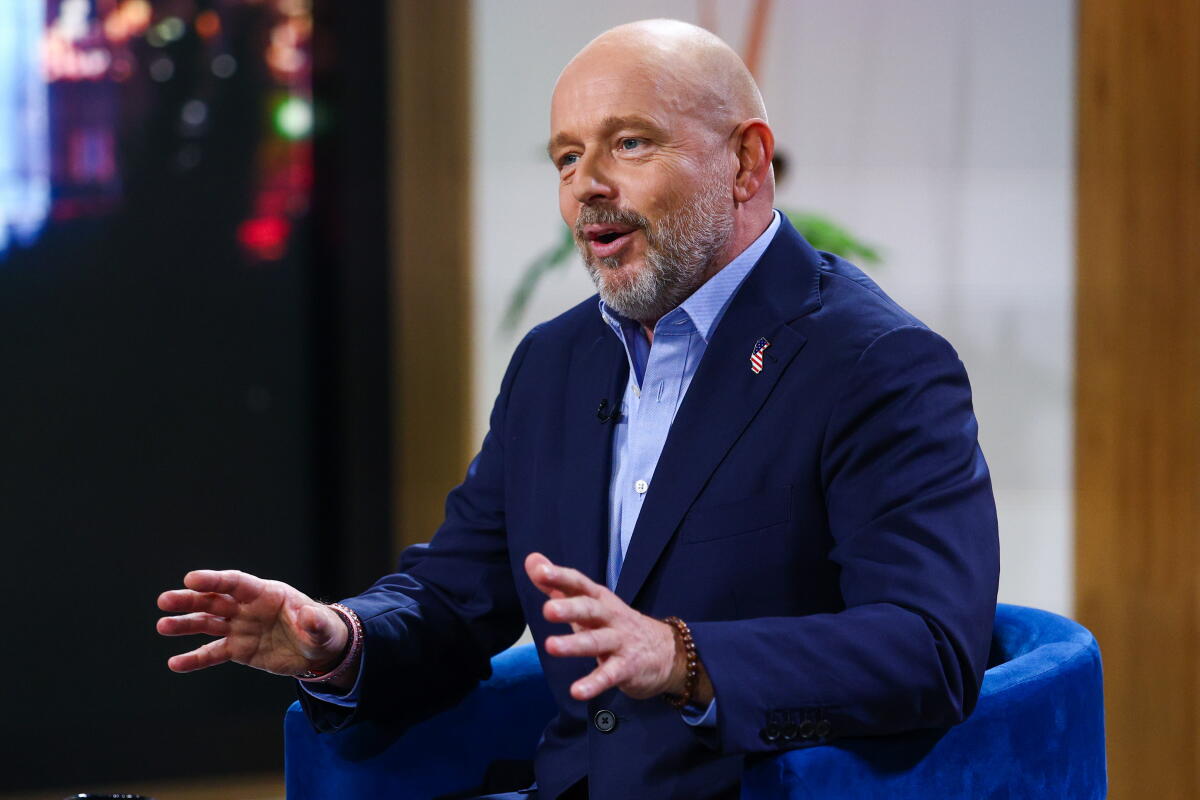
Republican gubernatorial candidate Steve Hilton.

Republican gubernatorial candidate Steve Hilton said he does have some policy differences with President Trump during a town hall at the Los Angeles Times Building on Tuesday in El Segundo.

(Ronaldo Bolanos/Los Angeles Times)

Hilton said he would stop enforcing laws requiring communities to meet housing production goals and instead focus on building in undeveloped areas of the state that want new homes.

“We’ve got this attitude that the only place you can build is inside what’s currently developed, and that’s motivated by a desire to stop traffic and sprawl and all these things. But the consequence of that is that you end up finding [it] almost impossible to build anything” because of permitting battles and lawsuits, he said. “My plan is to open that up so that we build outwards, not just upwards, increasing the amount of space we use for housing.”

How he would pay for it all

Hilton said that Newsom and Democratic lawmakers have gotten accustomed to spending big and that he wants to return California’s state budget to its pre-pandemic size.

Earlier this year Newsom signed a budget just shy of $352 billion. His first budget as governor, in 2019, clocked in at nearly $215 billion.

The growth occurred during a time “when around 2 million people on net have moved out of the state,” Hilton said. “So we’re spending twice as much for a big reduction in population and worse results.”

He said he could offset the tax cuts by ending funding for high-speed rail, trimming state agencies by 5% and cracking down on Medicaid fraud. Together, he estimates those cuts would save about $25 billion annually. He has also promised to end state-funded healthcare for undocumented immigrants and to hollow out agencies that regulate the state’s air quality and coastlines.

Another round of attacks on Becerra

While he largely stayed focused on policy, Hilton criticized Becerra’s record as U.S. Health and Human Services secretary and dinged him for skipping the town hall.

“Looking forward to perhaps one day having another chance to sit down with my competitor in this race, Xavier Becerra. We’ve had one debate. He promised that there would be debates, plural. Not to be today. But hopefully we can have that conversation because Californians deserve a conversation about the future of our state,” he said during his opening remarks.

On Monday, Hilton attacked Becerra for having “pulled out” of the debate, though the Democratic candidate never agreed to attend a debate proposed by The Times and LAist. Becerra’s spokesperson said the campaign declined the invitation because of a full campaign schedule.

In the weeks following the June primary election, Becerra made himself scarce on the campaign trail and attended few public events. In August, he told reporters there would be multiple debates. He and Hilton faced off last week in an hourlong debate on CNN but no other debates have been announced.

Offshore wind projects “grotesque,” Hilton says

At a time when the Trump administration has systematically dismantled climate and environmental policies, Hilton took care to cast himself as an environmentalist who is concerned about climate change.

He criticized many of the policies favored by Democrats, however, as a “very one-dimensional way of thinking” and offered a more business-friendly approach to addressing climate change:

  • Planting 3 billion trees and restoring wetlands.
  • Expanding the use of climate-friendly geothermal energy near places such as the Salton Sea and Sonoma and Modoc counties.
  • Expanding oil production in California, which he said reduces the need to import foreign oil on tanker ships that spew carbon emissions.

“So that’s a way of reducing carbon emissions that doesn’t burden working people and small businesses with the highest energy costs in the country. We’ve got to get the balance right,” Hilton said.

Hilton aligns with Trump’s vehement opposition to offshore wind projects, a potential source of abundant renewable energy. This year, the Trump administration announced deals to pay wind project developers billions to abandon U.S. wind leases off the coasts of California, North Carolina, New York and New Jersey.

“I think offshore wind is an absolute abomination. I mean, you look at beautiful Morro Bay or Humboldt up in the northern part of our state,” Hilton said. “The industrialization of our coastline that offshore wind would create, I think, is just grotesque, and I’m dead against it.”

Working across the aisle

When asked how he would work with a Democratic majority in the state Legislature, Hilton said he has experience doing it — as an advisor to former United Kingdom Prime Minister David Cameron, he shared an office with a member of the opposite party.

“We worked together very well. Didn’t agree on everything,” he said. “That would be my attitude. I’m very open. I’m not tribal. I’m not particularly partisan. I’m a pragmatic, problem-solving kind of person, and I’m looking forward to working with the Legislature.”

He said he would press the Legislature to cut spending and “the endless number of bills that they pass every year. … But I want to work together to reduce costs for Californians.”

Hilton also found alignment with Democrats who ran in the gubernatorial primary, including former Orange County Rep. Katie Porter, San José Mayor Matt Mahan and former Los Angeles Mayor Antonio Villaraigosa.

“Katie Porter in the primary … actually endorsed my tax plan. Matt Mahan and I agree on a lot of things to help” cut costs and speed up housing constriction, he said. “Antonio Villaraigosa, we agreed on a lot of things to do with energy policy. So I think there are Democrats who we’ll be able to work with to get consensus on some of the things that we need to get done.”
Source link

Southern Democrats see hope for first time in years, seek to build on discontent of midterm voters

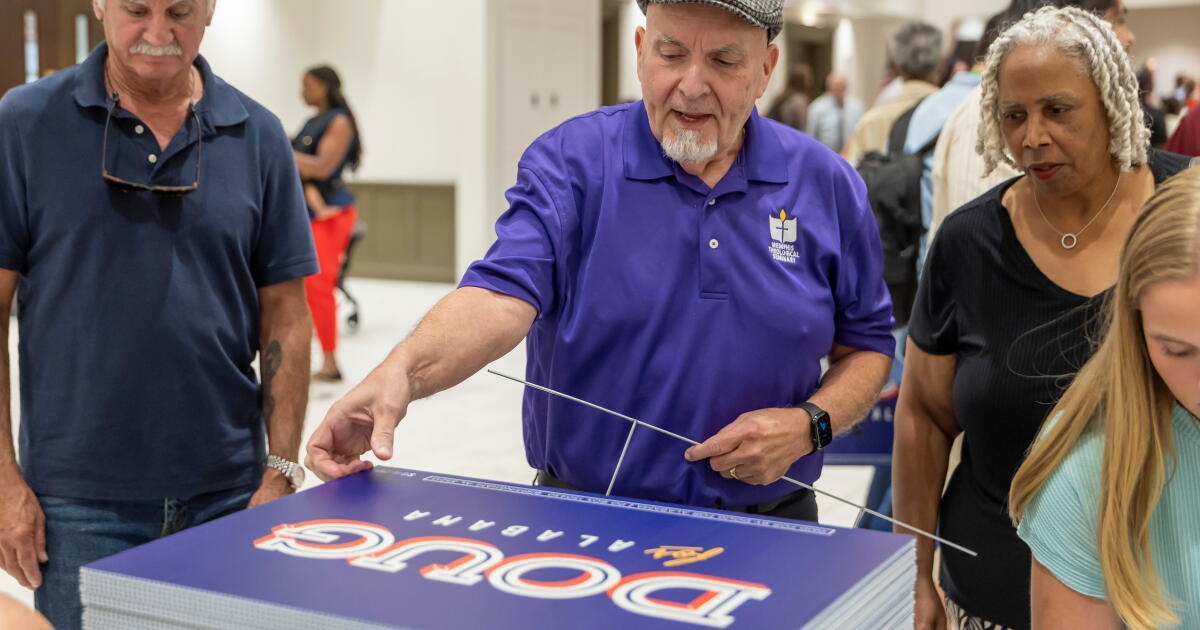
People crowded shoulder to shoulder upstairs in a south Alabama coffee shop, in a region sometimes called the reddest in the heavily conservative state.

They were there to hear Doug Jones, the Democratic nominee for governor and the last Democrat to hold statewide office in Alabama.

“Alabama has been under Republican control for almost two decades. We’re not getting any better,” said Jeff Scroggins, 61, a government contractor from Slocomb who was part of the crowd that came to Mural City Coffee Company and said he is voting for the Democrat.

Scroggins, who usually votes Democratic, called himself the “black sheep of the family” in supporting Jones this fall against Republican U.S. Sen. Tommy Tuberville, but said there are more Democrats and “stubborn independents” in the state than people realize.

Jones and other Democrats running in Alabama and neighboring states are banking on it.

“People want change,” Jones said after an hour of talking with people who came to see him. “That is the real key. People are not satisfied with their government of Alabama.”

Democrats sense a shift among voters

Deep South Democrats, largely absent from statewide offices, are aiming for a comeback this year. They are seeking to mobilize Black voters who are angered about the Republican moves to dismantle minority congressional districts, as well as voters who are frustrated with high gas prices, the Iran war, data centers and other issues.

Jones is trying to win a rematch with Tuberville after the Republican ousted him in a 2020 Senate race. Jones would be the first Democrat since 1998 to win an Alabama governor’s race.

In Mississippi, prosecutor Scott Colom is trying to unseat Republican Cindy Hyde-Smith and become the state’s first newly elected U.S. senator since 1946. In Georgia, former Atlanta Mayor Keisha Lance Bottoms is trying to reverse a losing streak in races for governor that began for Democrats in 2002. Elsewhere, Democrats are trying to pull off U.S. Senate upsets in Louisiana and South Carolina.

In Alabama, Jones’ town halls have attracted hopeful Democrats, some independents and even a few Republicans. Their concerns mirror those of voters nationwide: the rising cost of living, worries over data centers and the affordability of healthcare, issues they say have gone unaddressed by the Republicans who control the state.

Some said state policies, including an abortion ban that makes no exemption for rape, have been too extreme. Others said some comments by Tuberville, such as calling Islam “a cult,” are embarrassing to the state.

Still, the math across the Deep South has been difficult for Democrats. Other than Jones’ victory in the special U.S. Senate election, the last Democrat holding statewide office in Alabama was defeated in 2012. Statewide Democratic candidates have hit a ceiling of around 40% of the vote in recent elections.

The results are similar in most other Deep South states. In Georgia, U.S. Sens. Raphael Warnock and Jon Ossoff, who is seeking reelection this year, offer a bright spot for Democrats.

Jones noted that Alabama saw a surge in the number of people voting in the Democratic primary. While about 58% of primary voters were Republican, the Democratic primary vote doubled since 2022. Some counties, including a tech hub in north Alabama, saw more Democratic votes than Republican.

Optimistic about their chances, Democrats are running candidates in all major state races for the first time in years.

“The numbers are there,” Jones said. “It’s a question of getting those voters out.”

Republican gerrymandering creates a backlash

In nearby Troy, a crowd gathered on the campus of Troy University to hear Jones speak alongside Shomari Figures, one of Alabama’s two Black U.S. House members. The district was substantially redrawn by Republicans after the U.S. Supreme Court earlier this year gutted the Voting Rights Act.

Figures said there is an excitement he has not felt since Jones’ 2017 Senate victory. Figures won election two years ago after a federal court ruled that Alabama had been illegally diluting the voting power of Black Alabamians and ordered new district lines. The Supreme Court’s reversal this year allowed state Republicans to reshape the district and substantially reduce the percentage of Black voters who align with Democrats.

Figures said the goal of the redraw was obvious: to reduce Black representation.

“But we are going to win it in November,” he said.

Figures has often emphasized the economic needs of the district at a time when affordability is one of the main topics of the midterms. He noted that the individual median income in Alabama is $34,000.

“Let that sink in — $34,000 before taxes, before rent, before water, before lights, before gas, before cellphone, before health insurance, before car insurance, before childcare, before food,” he said.

Alabama is one of 10 states that did not expand Medicaid under the Affordable Care Act, a decision that Jones and Figures said leaves thousands of working people without access to healthcare coverage.

Figures faces Trump-endorsed Republican Rhett Marques, a state lawmaker. Marques framed the race as “common sense” versus “craziness.” Both have raised about $1.3 million so far.

In Mississippi, Colom looks to make history

Colom echoes many of Jones’ and Figures’ arguments in his bid against Hyde-Smith.

“We’ve been gifted an opportunity,” he said, pointing to Mississippi’s large base of Black Democratic voters, Hyde-Smith’s relatively low profile in her first full Senate term and voters’ frustrations over the economy.

With the largest share of Black voters of any state, Mississippi’s general elections have been closer for years than its immediate Southern neighbors. Trump won by double digits in each of his three presidential contests, but in 2023 Republican Gov. Tate Reeves managed to win reelection by a margin of just 3 percentage points.

Colom insists he can close the gap by increasing Black turnout and peeling off enough disenchanted white voters from Republicans. It is the same kind of electoral math that propelled Ossoff and Warnock in Georgia.

“For me, it can’t be just about getting a Senate majority,” Colom said. “It’s got to be about having a party that represents rural America again, suburban America, urban America — a party that makes sure we actually deliver for voters in ways that make their lives better, and we don’t come up with excuses as to why we can’t do it.”

Republicans say they aren’t worried

Alabama’s Republican Party chairman, Scott Stadthagen, said Democratic priorities, in his opinion, “are far outside the views of conservative Alabamians.” He said there has been previous chatter of a Democratic resurgence, and “each election cycle, we remain the brightest red state in the decidedly conservative southeastern United States.”

Tuberville has declined Jones’ challenge to debate. Expressing confidence about November, Tuberville said he is running “against an ideology that’s not very compatible with the people of Alabama.” He will appear with Trump at a rally in Mobile next week.

“I’ve been representing Alabama for six years, and we’ll turn it over to the voters here in about six, seven weeks and see what they say,” Tuberville told reporters.

As the November election draws closer, Democratic candidates are attracting impressive crowds.

To Sam Phillips, who attended the rallies in Dothan and Troy, the crowds and energy felt different from previous election years.

“It doesn’t get any redder than here, and there was a whole lot of excitement in both places,” the 67-year-old said. “So I feel optimistic.”

Gwendolyn Davis, a 67-year-old retired special education teacher, left the town hall in Troy with an armful of yard signs for Figures and Jones. She said she is determined to reach people who have been sitting out elections.

“If we don’t get people out to vote, it will be kind of heartbreaking,” she said.

Chandler and Barrow write for the Associated Press. Barrow reported from Atlanta.

Source link

Texas candidate’s racist post shows what’s wrong with politics

In the second week of the college football season, in a clash of titans, the University of Texas scored 21 unanswered points to surge past Ohio State in the fourth quarter and win, 24-23.

The comeback, Gov. Greg Abbott decreed, was the greatest home victory in more than 130 years of Longhorn football.

A screen grab of one celebratory moment showed a group of students ecstatic beyond belief. They were clad in the university’s signature burnt orange. Two wore cowboy hats. One flashed “Hook ‘em Horns,” the university’s proud hand signal.

To see the picture earlier this month was to witness pure, untempered joy.

But Bo French, the Republican candidate for Texas Railroad Commission, saw something different.

Most of the students were darkly complected and apparently of South Asian heritage. French posted the photo and wrote on X, “I heard UT graduation this year looked like this. I didn’t believe it. The problem is now obviously far worse than anyone imagined.”

He followed with a second post, doubling down on the racist “Great Replacement” theory.

“Like body-cams exposed criminals, social media is exposing how many Americans have been displaced by foreigners,” French spewed. “It’s everywhere and far worse than any of us could imagine.”

In many places, French’s unapologetic, unvarnished bigotry would be disqualifying. But given Texas’ strong Republican leaning he stands a better-than-even chance of being elected in November to the state Railroad Commission, which, despite its name, oversees Texas’ vast oil and gas industry.

The hateful gibe was perfectly in character. “In some ways in Texas this is old news,” said Brandon Rottinghaus, who teaches political science at the University of Houston.

Last year, as chairman of the Tarrant County GOP, French posted an online poll asking, “Who is a bigger threat to America?” The choice on offer: Muslims or Jews.

Speaking in March at a political conference, he urged President Trump to round up and deport every Muslim in the country, calling the Islamic faith subversive and a clear and present danger to America.

“The Republican Party is used to Bo French making these kinds of outrageous statements,” Rottinghaus said.

Still, the response to French’s latest acrid emission was telling, not least for what it says about reflexive partisanship and today’s political reward structure.

As you’d expect, his Democratic opponent, state Rep. Jon Rosenthal, was scathing. “I spent 25 years as an oil and gas engineer,” he wrote on social media. “Bo French spent Sunday morning sorting our student section by skin color … A man who can’t tell a Longhorn from a foreigner has no business regulating anything in TX.”

The state’s outgoing U.S. senator, Republican John Cornyn, was also quick to denounce French. “This is the Republican nominee for statewide office,” Cornyn said in a post. “Are other Republican elected officials going to condemn the intolerance and racism, or look the other way while it becomes normalized.”

For Abbott and for Ken Paxton, who beat Cornyn in an eye-gouging, rabbit-punching Republican Senate primary, the answer was, for all intents, the latter.

“That is not my message,” Abbott said in a written statement, summoning the moral clarity and political courage of a puff pastry. “We all support our college football teams. The way we win the state is the same way we win football games. We unite under the brand of Texas.”

Then, just to have it both ways, Abbott suggested “that doesn’t mean that Texas cannot also lead in having the toughest immigration laws of any state in America and freezing H1B visas at our universities.” (The overwhelming majority of those holding H1B visas are Asian nationals from India and China.)

Paxton responded by attacking his Democratic opponent, state Rep. James Talarico, for saluting Cornyn for taking a stand against French’s prejudice. “I condemn racism in all its forms,” Paxton wrote on X, adding, “Only one person in this race has a history of dividing Texans by race, and it’s James Talarico.”

A simple, straightforward condemnation shouldn’t have been hard. Lacey Hull, a Republican state representative from Houston, was among those in the GOP who showed how.

“Please delete this,” she urged French on X. “This post breaks my heart. I see college kids cheering on their football team. I see Texans.”

But Abbott, bidding for an unprecedented fourth term, is facing a tougher than expected race against Democratic state Rep. Gina Hinojosa.

Paxton, whose unsavory resume includes impeachment, indictment, petty theft and charges of adultery, has managed the rare feat of turning his race against Talarico into a nail-biter. (It’s been more than three decades since a Democrat won statewide office in Texas.)

Both need a robust GOP turnout to win in November and neither wants to risk alienating too many within the party’s xenophobic, anti-immigrant wing.

“They’re concerned about turnout,” said Mark Jones, a political scientist at Rice University. “Texas is a red state, but one thing that Republicans are concerned about is that the base may not turn out in as large a number as they need.”

Given French’s loathsome history, Abbott and others in the party establishment worked hard to keep him from winning the Republican nomination, Rice noted. But not Paxton. He headlined the kickoff to French’s campaign and has good reason to be glad he won and is now part of the GOP ticket.

His presence means that Paxton is only the second most odious figure seeking statewide office in Texas in November.

Source link