It’s election day in California’s 2026 primary, and you’re headed to the polls — until you realize you’re not sure you’re registered, or fear you might not make it to the vote center on time.
Here are some common election day concerns and challenges and how to end your Tuesday with an “I voted” sticker.
Eligible citizens who need to register or re-register to vote within 14 days of an election can complete this process and vote at county elections offices, polling places or vote centers. To register you’ll need to provide a driver’s license, a state identification number or the last four digits of your Social Security number.
A complete list of county election office addresses can be found here.
Your submitted ballot will be processed and counted once the county elections office has completed the voter registration verification process.
If you’re unsure about your voter status, you can find your record here by providing some personal information including your date of birth and driver’s license number.
I don’t know where my polling place is
You can find your nearest polling place on the California secretary of state’s website here.
You can also use Los Angeles County’s voter center locator on the registrar-recorder/county clerk website here.
On election day, voting centers are open from 7 a.m. to 8 p.m. across the state.
I can’t submit my mail-in ballot myself
You can have someone else submit your ballot.
Anyone can drop off your mailed ballot as long as you authorize them to do so and they do not get paid on a per-ballot basis, according to the secretary of state.
You and the person you’ve authorized to submit your mailed ballot must fill and sign the outside of the ballot envelope.
I forgot my check-in code for in-person voting
Los Angeles County election officials say you can check in at a vote center by scanning your “quick check-in code” — a number that verifies your voter registration.
Your code can be found on your mailed sample ballot and vote center postcard. Take either of those hard copies to the vote center.
If you forgot the hard copies, you can retrieve the code by verifying your voter registration here. You’ll need to input your last name, birth date, the house number of your residential address and ZIP Code. For assistance call, (800) 815-2666, Option 2.
I want to drop my ballot in a box but fear it’s too late
There are three ways you can submit your mailed ballot on election day:
You can put it in a ballot drop box. The cutoff time for doing so is 8 p.m., which is also when the polls close on election day.
Drop it off at a vote center, where the deadline is the same.
Drop it off at a United States post office. Be sure to get a hand-stamped postmark from a postal employee. Mailed ballots must be postmarked on election day and received no later than seven days after election day.
I think I forgot to sign by mailed ballot envelope
If you failed to sign your vote-by-mail ballot return envelope, your vote will still count.
Your county elections official will notify you by mail, phone or email, according to the secretary of state. You can also be notified by way of the “Where’s My Ballot?” tracking tool if you have signed up for automatic notifications that will ping you if there are issues with your ballot.
Your county elections office will provide you with a form to fill out and return completed.
The form will be given to you two days prior to the day your county certifies the election, so be sure to fill it out and return it to your county elections office right away.
I’m going to be late getting to the polls; can I still vote?
In California, any voter who is in line at 8 p.m. when the polls are scheduled to close is allowed to vote, according to the secretary of state.
If there is a line when the polls close, a poll worker stands at the back of the line to let people who arrive after 8 p.m. know that the polls have closed.
Any voter who arrives after the polls have closed may not be allowed to vote, even if voters who were in line to vote before the polls closed are in the process of voting.
California voters are deeply divided over the trustworthiness of state elections heading into Tuesday’s primary, with most Democrats but less than half of Republicans expressing confidence in the electoral process, according to a new poll.
The polarized view follows a years-long campaign by President Trump and his Republican allies to question the legitimacy of American elections, especially in California and other blue states. It also follows robust efforts from liberal leaders, elections officials and voting rights experts to denounce Trump’s claims as baseless.
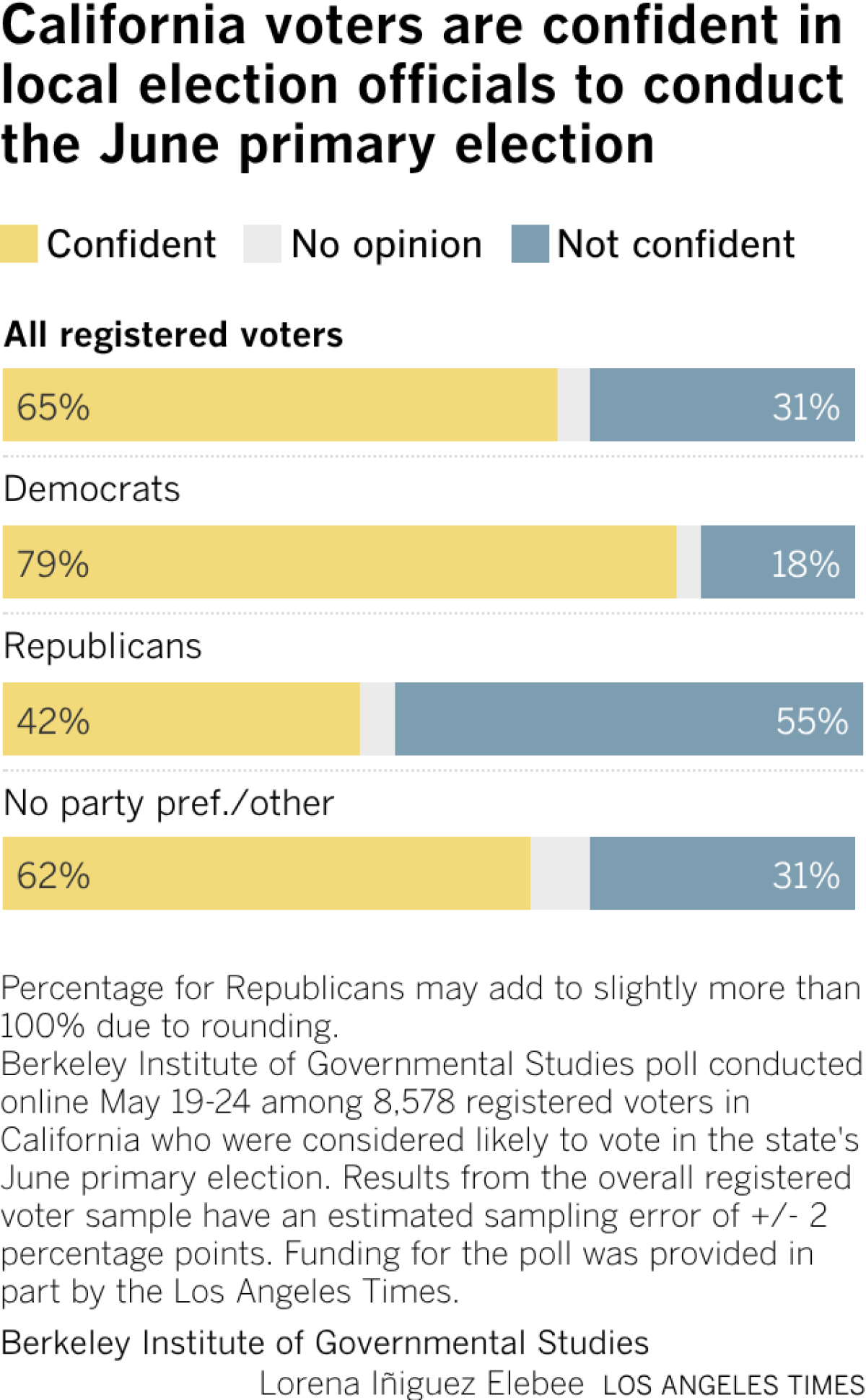
Overall, registered voters in the state — which skews heavily Democratic — expressed confidence in local election officials by a 2-to-1 margin, with 65% expressing confidence and 31% expressing a lack of confidence, according to the poll released Tuesday by the UC Berkeley Institute of Governmental Studies and co-sponsored by The Times.
However, those figures shift dramatically when sorted by political party, and even more when parsed by partisan leaning.
For example, 79% of Democratic voters expressed confidence in local officials running a secure and fair election, compared to 62% of independent voters and 42% of Republican voters, the poll found.
While 82% of voters who identified as strongly liberal expressed confidence, just 38% of voters who identified as strongly conservative did so.
A volunteer assists Melani Hurwitz at a polling location Monday at the Cal State Long Beach Walter Pyramid.
(Eric Thayer / Los Angeles Times)
“It’s clearly a partisan issue, and it is being promoted by the president and others who are his followers,” said Mark DiCamillo, the director of Berkeley IGS polls. “Strong conservatives and the Republicans are the least confident, and a lot of them are saying [they are] not at all confident. That’s a pretty extreme statement.”
Rick Hasen, an election law expert and director of the Safeguarding Democracy Project at UCLA Law, said he expected Republican confidence to be even lower given Trump’s decade of undermining trust in elections, especially in liberal, diverse states such as California. But he said neither Trump’s narrative nor public sentiment about election security — which generally shows voters are more confident “when their side wins” — reflects reality, which is that “our elections are administered well.”
“There’s very little evidence of manipulation or of fraud or even of incompetence,” Hasen said. “Anyone who looks objectively would see that there are numerous safeguards to ensure we have free and fair elections in California.”
Trump has long contended without evidence that voter fraud is pervasive among undocumented immigrants and in states, such as California, that use mail ballots, and blamed his 2020 loss to Joe Biden on such fraud despite experts rejecting the claim and Trump’s own allies and lawyers being unable to prove it.
A voter casts their vote inside the Westchester Family YMCA Annex on Monday.
(Kayla Bartkowski / Los Angeles Times)
Since returning to the White House last year, Trump has tried to implement strict new requirements for voter ID and proof of citizenship and to limit or bar mail-in voting, and called for greater federal or Republican Party control over state-run elections. In February, he said that “Republicans ought to nationalize the voting” in “at least 15 places” where they lose.
Democratic leaders, elections experts and voting rights advocates have all pushed back. They’ve backed their assurances that the state’s elections are safe with lawsuits to block Trump’s efforts to assert federal control. They also warn that his administration may try to intervene anyway, including by sending federal immigration agents to polling locations or intercepting or invalidating mailed ballots.
Last week Gov. Gavin Newsom signed a bill barring federal agents and other law enforcement from interfering with local and state elections officials or confiscating ballots, voter rolls or voting machines without a warrant. Newsom said California voters were experiencing “legitimate anxiety” over election integrity given the threats from the Trump administration and the recent actions of Riverside County Sheriff Chad Bianco — a MAGA-backed Republican candidate for governor who recently seized hundreds of thousands of ballots as part of what he said was an investigation into potential fraud in last year’s election.
An election worker collects extracted vote by mail ballots to be tallied at the Los Angeles County Registrar-Recorder/County Clerk Ballot Processing Center in City of Industry.
(Gary Coronado / For The Times)
Newsom said he expects Trump to interfere with the upcoming election as well because “every single thing that Donald Trump is saying only suggests that he will do more, not less, to intimidate and to impact the outcome of this election,” but that the state stands ready to respond.
California Atty. Gen. Rob Bonta last week said that his office is preparing for “all different types of scenarios” involving federal interference, from ballots being seized to immigration agents showing up at polling locations.
“We are currently monitoring any potential risks or threats, and we’re ready for any possibility,” he said.
Sen. Alex Padilla (D-Calif.) last week blasted the U.S. Postal Service for issuing a proposed rule to implement Trump’s mail ballot changes, despite the ongoing litigation. In April, Rep. Nancy Pelosi (D-San Francisco) helped convene a pair of “shadow hearings” in California where fellow House Democrats and a panel of experts shot down Trump’s claims about widespread fraud and expressed confidence in state elections.
A Berkeley IGS Poll from a year ago found that California voters support requiring first-time voters to show ID to prove citizenship in order to register, and that most supported requiring a government ID every time a voter casts a ballot. However, another Berkeley IGS Poll from last month found that strong majorities of California voters believe American democracy is under attack or being “tested.”
Dean Logan, head of the L.A. County registrar-recorder/county clerk’s office, said that overall confidence, “despite a sometimes volatile state and national narrative,” was “gratifying.”
“Election officials take connection to their community seriously. We recognize that our job is to facilitate their voting experience, and that voter participation is key to election security,” Logan said. “Regardless of party affiliation, our role as election officials focuses on the function and process of ensuring the voice of the electorate is heard and that compliance with the election laws adopted in our state is achieved.”
Jesse Salinas, president of the California Assn. of Clerks and Elections Officials and the registrar of voters in Yolo County, said local elections officials are “proud to be a steady source of trust at a consequential moment,” and stand ready to “open our doors to any voter who wants to see firsthand how our elections work and to answer any questions they may have.”
Times staff writer Iris Kwok contributed to this report.
COLLEGE STATION, Texas — Two days after failing to capitalize off numerous scoring opportunities against Texas State, USC battered the Bobcats early and often to remain alive in the College Station Regional.
Third baseman Kevin Takeuchi set the tone with a grand slam in the first inning as USC beat Texas State 15-4 Sunday afternoon before a crowd of 6,885 at Blue Bell Park
With the victory, the Trojans (45-16) advance to the regional final against Texas A&M on Sunday night. The Trojans must beat the Aggies to force a winner-take-all game Monday at a time to be determined.
The Trojans avenged the 5-4 loss they suffered against Texas State on Friday night in the regional opener. In that loss, USC stranded 13 runners, struck out 12 times and left men in scoring position in each of the first seven innings.
The Trojans have been on a tear ever since. They crushed Lamar 19-6 on Saturday and then battered Texas State. The Trojans wasted no time jumping on the Bobcats in the rematch.
Abbrie Covarrubias led off with a single. Texas State sophomore right-hander Cade Smith then hit Adrian Lopez with a pitch and walked Augie Lopez to load the bases. Takeuchi followed with his grand slam to center.
“It just helped me pitch with freedom,” USC freshman starter Diego Velazquez said of the grand slam. “A pitcher always feels good when you’re in the lead, especially with a grand slam. It just keeps everyone positive, so it definitely helped very much.”
Velazquez gave up two runs on three hits and three walks with three strikeouts in 3 1/3 innings. He was relieved by fellow freshman right-hander Gavin Lauridsen, who failed to retire a batter while giving up two runs on two hits and two walks. Freshman left-hander Sax Matson then pitched 3 ⅔ scoreless innings of relief to earn the victory.
Isaac Cadena made it 6-0 in the third with a two-run home run to right field. With one on and two outs in the fourth, Augie Lopez hit an RBI single in the fourth to give the Trojans a 7-0 lead. Reliever Alec Beversdorf then walked Takeuchi and hit Cadena to load the bases. Jack Basseer drew a walk to plate another run to give USC an 8-0 lead, prompting Texas State to make another call to the bullpen.
Texas State countered with four runs in the bottom of the fourth, highlighted by Coy DeFury’s two-run home run.
Lauridsen relieved Velazquez with one out in the fourth, but he couldn’t retire a batter. Brady Boles greeted Lauridsen with a single up the middle. After Jackson Cotton walked, Manny Salas cut USC’s lead to 8-3 with an RBI single through the right side.
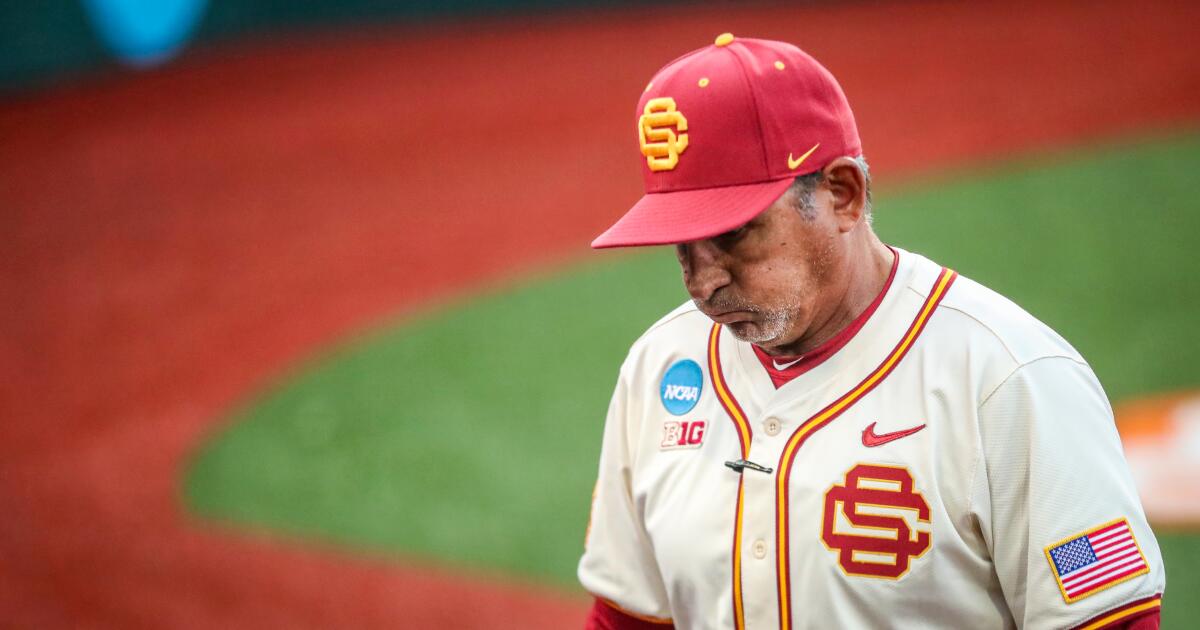
Clayton Namken followed with a walk, prompting USC coach Andy Stankiewicz to call on Matson, who took over with the bases loaded.
“I felt good about Diego on the mound here being able to compete and give us quality innings, and he did that,” Stankiewicz said. “I think he’d probably say he wanted to give us a little bit more, but he gave us three quality innings.
“And then Sax Matson came in and did a fantastic job. He came in and made some big, big-time pitches to get us out. It could have been a little dicey there.”
Both teams were retired in order in the fifth, but USC’s offense got back on track with a run in the sixth, two in the seventh and four more in the eighth.
“I think it just shows the type of bond we have all together,” Velazquez said. “We’re all pulling the rope for each other. I think it just shows how strong we are and how we’re able to pull off miracles and stuff.”
The June 2026 election has been dominated by a down-to-the-wire governor’s race that has been filled with drama, scandal and much national attention.
A large group of Democrats are vying to replace Gov. Gavin Newsom in this very blue state. But the candidates have — until recently — struggled to generate wide excitement, and it’s far from clear who will win. On the Republican side, commentator Steve Hilton has benefited from the divided Democrats (and a Trump endorsement) to remain near the top of the pack in polls.
But the governor’s race is far from the only vital decision voters will make.
Los Angeles residents will vote for mayor in a race that is far from certain. And there are numerous state, county, local and judicial candidates to choose from.
Here is a breakdown:
When is the election?
The election is Tuesday, but early voting has already been already under way.
You can find your polling place here or by calling (800) 345-8683. All polling locations are open on election day from 7 a.m. to 8 p.m.
(Photo illustration by Nicole Vas / Los Angeles Times; Francine Orr / Los Angeles Times)
What are the big statewide races?
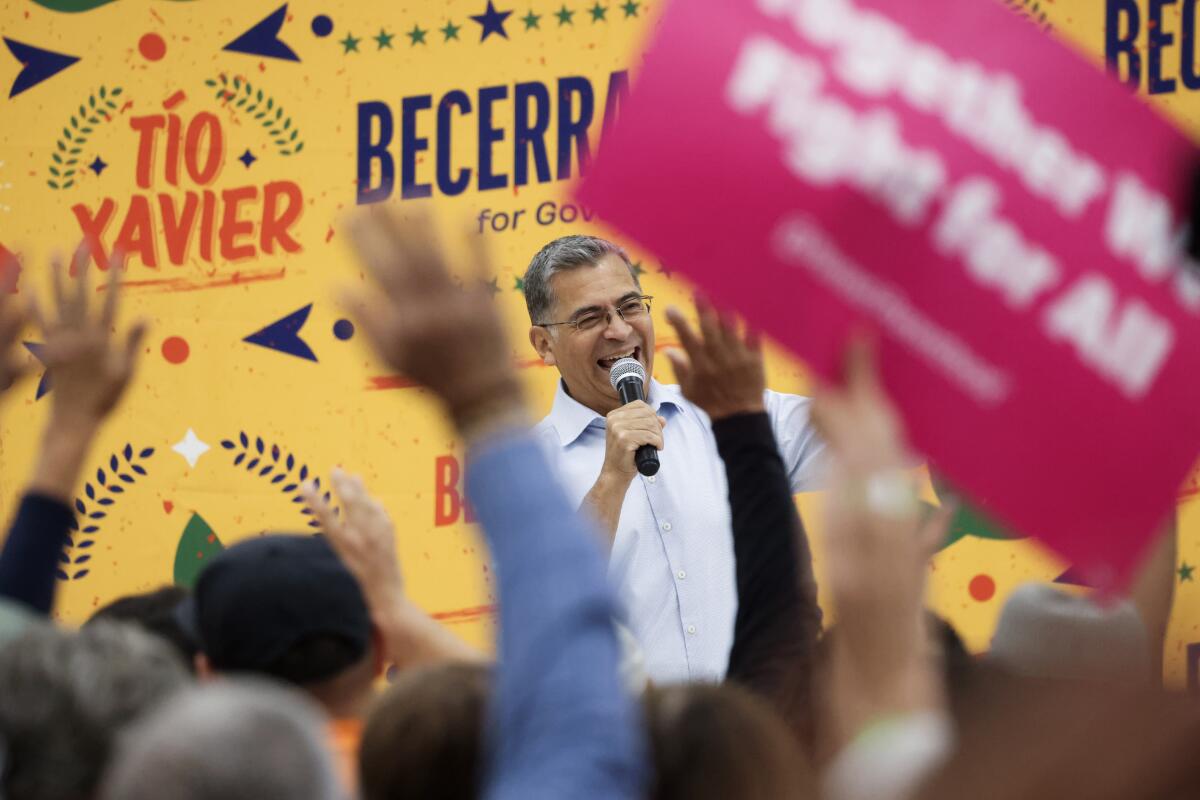
Let’s start with the race for governor, of course. With Newsom term-limited, Democrats and Republicans are competing for California’s open gubernatorial seat in what could reshape the state’s political landscape. Democrats went in hoping for easy sailing, but a wide field and no superstar name has left the race something of a tossup, though Xavier Becerra has been rising in recent polls. On the Republican side, Hilton continues to poll strongly.
There is a possibility California could make history: The state has never has elected a woman as governor, and only once has a person of color held the office.
But there are many down-ballot statewide races as well,
(Photo illustration by Nicole Vas / Los Angeles Times; Mark J. Terrill / Associated Press)
What are the big L.A. races?
The L.A. mayor’s race is grabbing all the attention. Polls show the leading candidates are Mayor Karen Bass, City Councilmember Nithya Raman and community activist and former reality TV personality Spencer Pratt. Those same polls show Bass has struggled in the aftermath of the 2025 firestorms, a big issue for Pratt. Another major topic is affordability, which Raman has taken up.
But there are several other competitive races plus ballot measures.
What are the big L.A. County races?
These contests don’t get the attention of the mayor’s and governor’s races, but L.A. County voters have a lot of choices to make.
California’s decision to redraw its congressional map to flip as many as five House seats to Democrats in November is poised to play a big and potentially decisive role in the nation’s broader, bare-knuckle fight for control of Congress.
Tuesday’s primary races — where the top two candidates will advance to November runoffs — won’t determine which Republicans are ousted in most cases, but they will provide an important first look at voter sentiment and bring the fall’s most crucial head-to-head contests into focus.
“There will be some real cues and signals about what to expect,” said Christian Grose, a redistricting scholar and political science professor at USC. “We’re going to know how strong the Democrats’ chances are going to be based on who advances.”
As one example, Grose pointed to the redrawn 22nd Congressional District in the Central Valley, where incumbent Rep. David Valadao (R-Hanford) is facing challenges from moderate Assemblymember Jasmeet Kaur Bains (D-Delano) and progressive college professor Randy Villegas.
Grose said Bains is probably a stronger challenger than Villegas in a district that’s still a reach for Democrats — even if “either one could probably beat Valadao if 2026 is a big Democratic wave.”
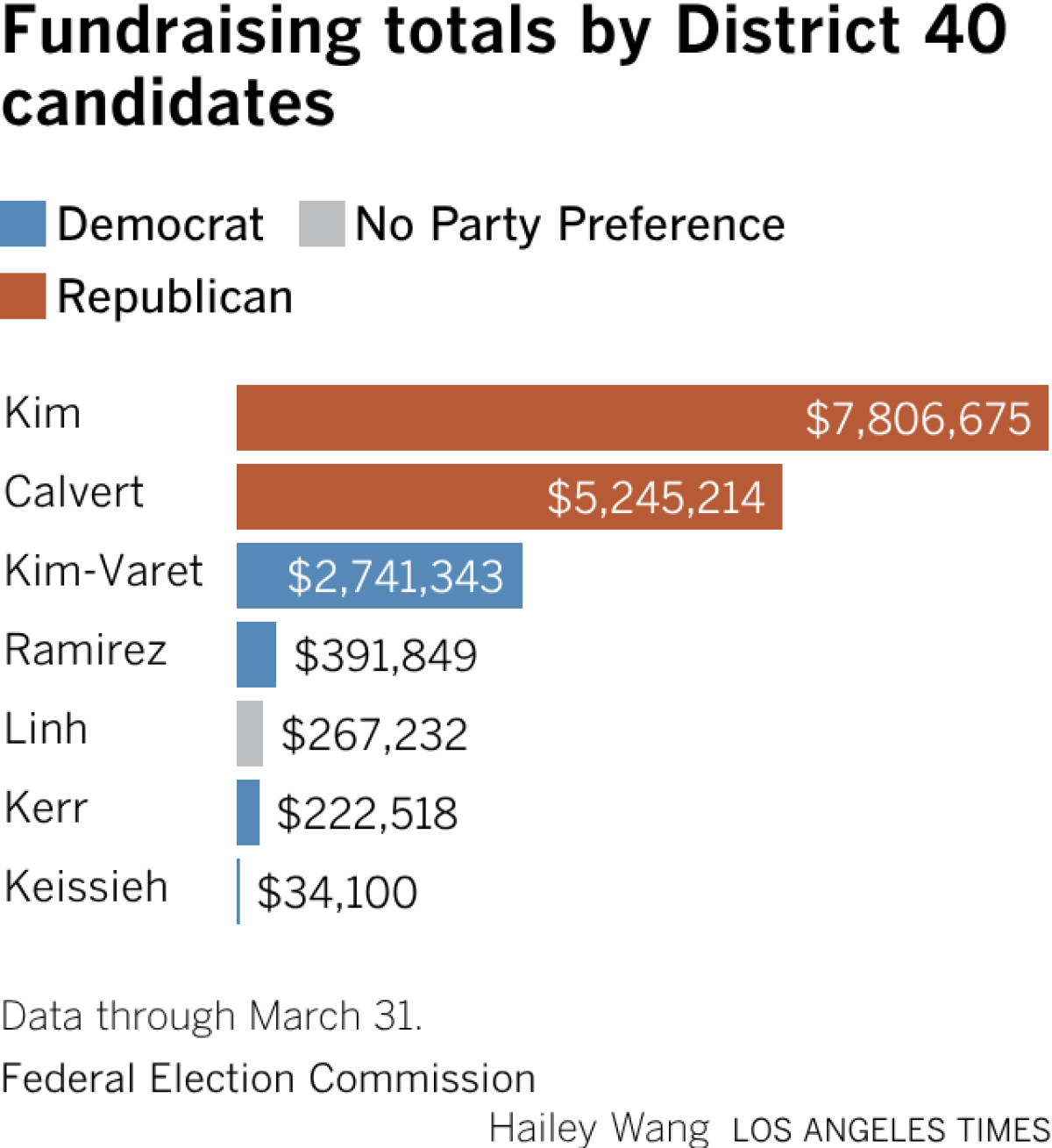
Grose will also be closely watching the race between incumbent Reps. Young Kim (R-Anaheim Hills) and Ken Calvert (R-Corona) in the redrawn Congressional District 40, which covers a swath of inland Orange County and portions of San Bernardino and Riverside counties, including parts of Kim’s and Calvert’s current districts.
The district race wasn’t designed to deliver Democrats a seat, but will produce “one of the first casualties for Republicans from the new map” — months before other expected ousters — if Kim and Calvert don’t both advance.
The national picture
The redistricting war was prompted by President Trump’s unprecedented pressuring of Republican-controlled states to redraw their maps mid-decade for partisan advantage in order to retain control of Congress, given his sinking approval ratings and a history of midterm voters punishing the president’s party.
The war ratcheted up — with more Republican states suddenly considering map changes — after a U.S. Supreme Court decision in April that weakened the 1965 Voting Rights Act and its long-standing protections for majority-Black districts in the South.
Republicans have now acted to redraw congressional maps in Alabama, Florida, Louisiana, Missouri, North Carolina, Ohio and Tennessee, with varying degrees of success, while a battle in Utah could add a single additional Democratic seat there. Attempts in other states have failed, including by the GOP in South Carolina and Democrats in Virginia.
Experts say the net result from the flurry of redistricting will probably be a gain of a handful or more seats for Republicans — but in a year when Democrats are expected to make gains more broadly, leaving control of the House up for grabs. California’s new map is “a huge deal” precisely because that math is so close, said David Wasserman, senior editor and elections analyst for the independent, nonpartisan Cook Political Report.
“Democrats are modest favorites for House control based on the political environment, but also because of California,” Wasserman said in an interview with The Times. “Picking up these four or five seats is a prerequisite to Democrats getting the majority.”
California seats in play
California has 52 seats in the U.S. House of Representatives, by far the most of any state. With their new map, California Democrats are hoping to increase their 43 House seats to 48. That would leave just four seats represented by members of the GOP despite Republicans accounting for a quarter of the state electorate.
But that outcome isn’t guaranteed.
Paul Mitchell, a Democratic redistricting expert who devised California’s new map, said the reconfigured congressional districts had to create a pathway for new Democrats to win additional seats without undermining incumbent Democrats’ reelection. And the result is a map with three pretty safe pickups for Democrats, and two districts that are “100% on the table, ready for Democrats to win,” but will nonetheless “require shoe-leather and grit.”
The redrawn congressional district boundaries enacted by Proposition 50 promise to shake up at least three seats, experts said.
Congressional District 1: Held by the late Rep. Doug LaMalfa (R-Richvale) for 13 years until his death in January, the district is currently rural and conservative, stretching from the Sacramento outskirts through Redding to the Oregon border and California’s northeastern corner. Under the state’s new congressional district map, it loses some of its rural reaches and picks up liberal coastal communities, and favors a Democrat such as state Sen. Mike McGuire, who is one of the leading candidates.
Congressional District 3: The seat is currently held by Rep. Kevin Kiley (I-Rocklin) and stretches from the Sacramento suburbs through Lake Tahoe and south along the Nevada border. Under the new map, it holds more tightly to the Sacramento suburbs, favoring a Democrat.
The changes were enough to convince an incumbent Democrat, Rep. Ami Bera (D-Elk Grove), to leave his current district — Congressional District 6, which includes the city of Sacramento and the suburbs of Roseville and Rocklin in Placer County — and run in District 3 instead.
Meanwhile, Kiley did the reverse. He quit the Republican Party, became an independent and announced he would be leaving District 3 and running instead in District 6 — the one Bera is leaving — against a slate of new Democratic challengers.
Congressional District 41. The seat is now held by Calvert, a 17-term incumbent, and currently stretches from Corona to the Coachella Valley. The new map made the district more liberal, losing voters in Riverside County and gaining them in Los Angeles County, and Calvert decided to run instead in Kim’s redrawn but still Republican-leaning Congressional District 40 that is just to the west.
The two toughest flips for Democrats, experts said, are Congressional District 22, Valadao’s heavily Latino district in the Central Valley, followed by Congressional District 48 in San Diego and Riverside counties, where Rep. Darrell Issa (R-Bonsall) decided to retire rather than run for reelection.
Valadao is viewed as especially vulnerable because of his recent support for Medicaid cuts, but he has proved resilient in the past. Meanwhile, his two leading Democratic challengers, Bains and Villegas, are in a bitter fight, with Bains receiving Democratic establishment support and Villegas winning endorsements from prominent progressives.
In Issa’s district, moderate Republican San Diego County Supervisor Jim Desmond is running against several infighting Democrats, including San Diego Councilwoman Marni von Wilpert and former Obama labor official Ammar Campa-Najjar.
Not new, or over
Jeff Wice, a New York Law School professor who was involved in California redistricting efforts in 2010, said the state “has long played hardball politics on redistricting,” including when then-Rep. Phil Burton, a powerful San Francisco Democrat, bragged more than 40 years ago that the complex congressional boundaries he’d crafted for Democrats were his “contribution to modern art.”
But in five decades studying redistricting, Wice said he has never seen such “politically driven, partisan politics” as are occurring now across the nation, which he said have “no root in law, reason or fairness” — and are only likely to continue.
“This state-by-state war is far from over, and may continue all the way through 2030,” he said. “A lot of it depends on the outcome of this November’s election.”
Wasserman said the country has “entered an era of no-holds-barred redistricting,” and he also sees redistricting efforts continuing — including in California, where they would present a distinct threat to the state’s few remaining Republicans.
Michael Li, senior counsel in the Democracy Program at the Brennan Center for Justice at NYU Law, said California is a “big part of the story” this election cycle, thanks to Proposition 50. “Democrats in California proved to be very determined and resourceful and managed to get that done, and right now California is the big offset to Republican gerrymandering around the country,” he said.
But what will come of it all — in California and across the country — is still to be determined.
“When you’re gerrymandering, you’re making a bet that you know what the politics of the future will look like, and it’s hard to predict,” he said. “It’s a high-risk, high-reward venture.”
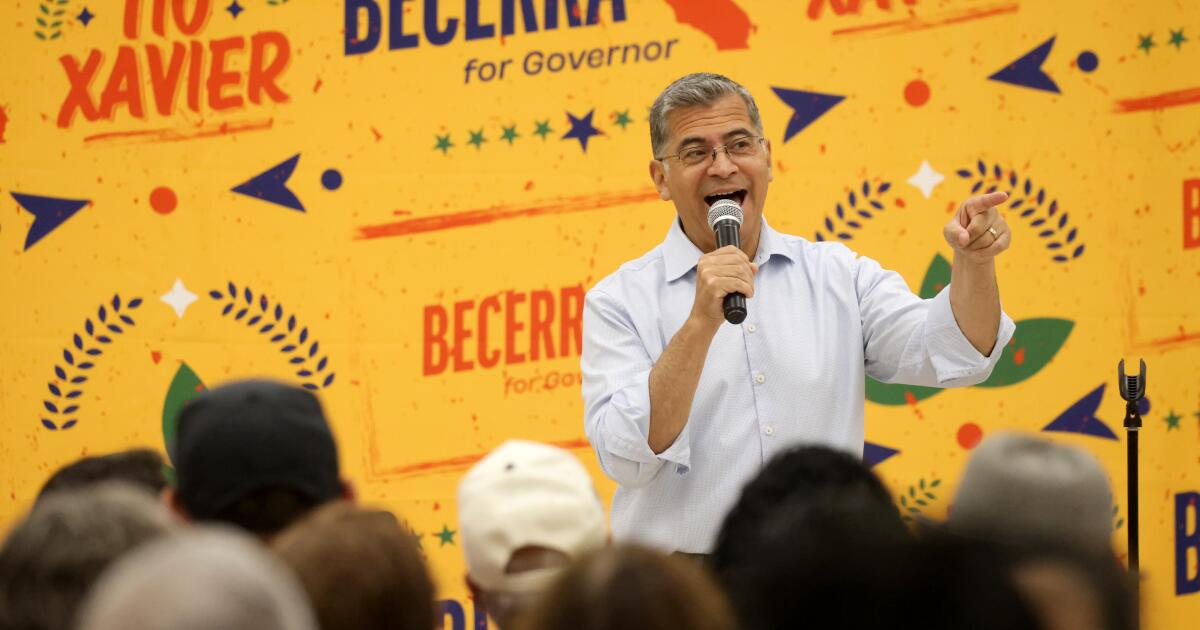
With former Biden Cabinet secretary Xavier Becerra surging in recent polls, the two candidates battling to win the second spot in this week’s primary and advance to the November election highlighted the strategic reasons why they believe voters ought to support them.
Republican Steve Hilton — a former conservative commentator who rocketed past his main GOP rival, Riverside County Sheriff Chad Bianco, after President Trump endorsed him in April — urged voters to back him to avoid the possibility of two Democrats facing off in November.
“I want us to fight like we are third. We aren’t going to let this slip away,” Hilton told a few hundred people at the Santa Monica Hilton Hotel & Suites on Sunday morning.
Steve Hilton surged ahead of his GOP rival, Riverside County Sheriff Chad Bianco, after receiving an endorsement from the president.
(Kayla Bartkowski/Los Angeles Times)
The former British political strategist once led the polls, but has slipped slightly behind Becerra. Not too far behind Hilton is billionaire hedge fund founder turned climate change activist Tom Steyer, a Democrat.
During his hour and a half appearance, Hilton veered between his oft-repeated criticisms about 16 years of Democrat-led rule in California to jabs at the top Democrats in the race.
Steyer’s nonstop advertising blitz is “one reason alone to defeat him,” while Becerra is the “living embodiment of more of the same.”
“Our secret weapon? The Democrat candidates,” Hilton said to chuckles.
Asked why voters shouldn’t back Bianco, Hilton said it was simple math. Only the first- and second-place finishers in the June 2 primary will advance to the general election, regardless of party affiliation.
“Every vote for Chad Bianco is a vote for two Democrats in the top two,” he said.
If a GOP gubernatorial candidate fails to make the November ballot, it would depress the Republican vote, harming the party’s down-ballot candidates, as well as handicap a Republican-led ballot initiative that would require voters to show government-issued ID to cast ballots.
California gubernatorial candidate Tom Steyer takes a picture with a volunteer during a Get Out the Vote rally at Los Angeles Trade Technical College on Sunday.
(Eric Thayer/Los Angeles Times)
Steyer, who has spent a record-breaking $216 million of his wealth on his gubernatorial bid, argued that he is the only candidate in the race who is not beholden to special interests. He hammered Becerra for the support he has received from corporations including Meta, Airbnb, Uber and Chevron. Steyer argued that Becerra, if elected governor, would be more responsive to special interests than financially strapped Californians.
“We’ve seen it in this race. Chevron cuts you a check and you look the other way when they hike prices at the pump. Meta gives you money and your AI plan starts sounding like ChatGPT,” Steyer, sporting a ball cap labeling himself a “class traitor,” told more than 500 supporters at a community college near downtown Los Angeles on Sunday afternoon. “That’s the story of Xavier Becerra.”
Corporations, along with labor unions and interest groups including the California Assn. of Realtors, have spent more than $18.7 million to boost Becerra as of Sunday, according to the election spending tracker California Target Book.
“These companies may be selfish, but they’re not stupid. They don’t give hundreds of thousands of dollars to get someone elected unless they know he’s going to be on their side,” Steyer said.
Though Steyer earned his fortune in part through past investments in private prisons, fossil fuels and private equity, his supporters described him as a reformed billionaire who stepped away from those industries more than a decade ago.
Francesca Fiorentini, a comedian and podcaster, compared Steyer to Charles Dickens’ fictional miser Ebenezer Scrooge.
“At the end of ‘A Christmas Carol,’ nobody turns to Ebenezer and is like, ‘No, I’m not gonna accept your gifts.’ No, they welcome him. They might clown him a little bit, but we need to welcome someone like Tom Steyer,” Fiorentini said. “Tom Steyer is actually listening, he actually cares, he’s actually changing his belief system and he’s acting accordingly.”
Though he mainly went after Becerra, Steyer also made sure to criticize Hilton.
“You are not voting for who’s on the ballot, you’re voting for the California that comes after,” Steyer said. “The California that Steve Hilton is running on sounds exactly like what Trump wants: higher prices, lower wages, and less freedom.”
His campaign underscored his attacks against Becerra by having a handful of supporters dressed as zombies speak outside of Becerra’s Sunday evening rally in Long Beach. Waving signs naming businesses that have supported Becerra, they wore lanyards describing “Big Oil,” “Big Tech” and other corporate sectors as Becerra’s “bestie.”
At a raucous rally, elected officials, labor leaders and reproductive rights advocates were among the speakers who introduced Becerra, who attacked Steyer and Hilton, though not by name.
“We are not going to let a billionaire or Trump’s handpicked candidate take over this state,” he told more than 1,000 people at the city’s convention center. “We are not going to let them gut Medicaid while Californians work hard to build a future. We are not going to let them buy an election…. Not here, not in this state, not on our watch.”
Becerra seemed in awe as he stood in front of the packed room.
“Look around this room. One of our opponents has a billion dollars in a checkbook,” he said. “We have something better… We don’t have the money, but we have the movement. We don’t have the money, but we’ve got the momentum. And in this state, if you’ve got the momentum, you run across the finish line, and you win, baby, you win.”
Becerra also released a new video that ostensibly attacks Hilton as “Trump’s favorite” — a thinly veiled effort to prop up Hilton among Republicans to ensure he finished ahead of Steyer in the primary. Given that Democratic voters outnumber Republicans by almost 2 to 1, Becerra would much rather face Hilton than Steyer in the general election.
Newsom’s campaign employed this strategy to boost GOP businessman John Cox in the 2018 gubernatorial election, as did then-Rep. Adam Schiff against Republican Steve Garvey in Schiff’s successful 2024 U.S. Senate race.
Billionaire Tom Steyer has argued that he is the only candidate not beholden to special interests.
(Eric Thayer/Los Angeles Times)
Steyer launched an ad this weekend titled “Risky” that implies Becerra could face criminal charges related to the acts of two former advisors who have plead guilty to federal charges related to stealing campaign funds from a dormant Becerra campaign account.
Becerra’s campaign called the ad defamatory in a cease and desist letter sent to the Steyer campaign on Saturday.
Becerra, Hilton and Steyer, the front-runners in the race, barnstormed the state in the final days before the June 2 primary. They devoted much of their attention to voters in Southern California, which is home to many of the state’s 23.2 million registered voters. Lower-polling candidates also stumped in the Southland — San José Mayor Matt Mahan greeted diners at Grand Central Market in downtown Los Angeles, and former Orange County Rep. Katie Porter kicked off a union canvassing event in Orange on Saturday.
Unlike recent contests to lead the nation’s most populous state, this year’s gubernatorial contest failed to energize the electorate. Despite a crowded field of candidates with notable resumes, as well as record-breaking spending by Steyer and independent-expenditure committees. Californians only recently tuned in.
Political experts of both parties believe voters malaise was due to fatigue about the nation’s political polarization, as well as Trump administration policies such as federal tariffs that drove up prices everywhere and some that disproportionately affected California, such as immigration raids. Southern Californians were also reeling from the devastating wildfires in the Pacific Palisades and Altadena and last year’s special election to redraw the state’s congressional boundaries.
Earlier this year, Democratic leaders worried that their voters would splinter among their candidates, creating a scenario where two Republicans advanced to the general election. They controversially urged their party’s candidates to assess their viability, effectively urging several low-polling candidates to drop out of the race.
Democratic turnout also prompted concerns. As of May 22, mail ballots returned by Democrats were 9.2% lower compared with the 2022 gubernatorial primary, while ballots returned by Republicans were 11.6% higher, according to Political Data Intelligence. But the return rates are shifting — as of Friday, Democrats were 7% behind their 2022 return rate, while Republicans were 6.8% higher.
The most recent polls suggest that the prospect of two Republicans advancing to the general election is nonexistent, and there is now a slim chance that two Democrats win the top two spots in the June 2 primary.
One more day and it’ll all be over. I’m referring to the primary election, of course, and the unremitting campaign ads that have infiltrated every aspect of our being as Californians.
Authentic or paid influencers promoting candidates on TikTok and Instagram. Facebook ads vilifying or praising various measures. Incessant, repetitive TV campaigns that get nastier with every election, yet still manage to feel like an analogue remnant from 1982. The worst? Those sponsored leaflets and postcard mailers that end up as makeshift coasters, mosquito swatters or unread refuse that goes straight from the mailbox into the blue recycle bin.
The king of ad spending is Democratic gubernatorial candidate Tom Steyer. He’s behind the most expensive political advertising campaign in the country this year. A former hedge fund manager, Steyer has reportedly spent more than $200 million on his campaign, with a major chunk of that for broadcast TV, cable and radio — 20 times the amount spent by fellow Democrat, former U.S. Secretary of Health and Human Services and California Atty. Gen. Xavier Becerra. And Steyer is still polling behind Becerra.
I never thought I’d write this but it’s not always about the money.
Xavier Becerra, front-runner in the race for California governor, speaks before a crowd at UFCW Local 1167 Union Hall.
(Genaro Molina/Los Angeles Times)
Voters have more resources than ever should they choose to actually research and learn about who and what is poised to shape the future of their city, county and state.
There’s no shortage of broadcast, cable, digital and print reporting about former reality TV personality turned mayoral candidate Spencer Pratt. He uses AI!
The battle between incumbent Karen Bass and her closest Democratic competition, Los Angeles city council member Nithya Raman, dominates local newscasts. And there’s pundits from both sides arguing for and against these choices on every available platform.
Given the amount of information now at voter’s fingertips, we should be the most informed voting populace in the history of ballot casting. But are we?
A new poll by UC Berkeley’s Institute of Governmental Studies that was co-sponsored by the Los Angeles Times asked 8,578 registered voters across California what sources they rely on to get news and information about election-related issues. The poll, which was conducted online May 19-24 in English and Spanish, found that nearly half of the state’s electorate (47%) said they refer to the official voter information guide that is mailed to voters in advance of each election.
Discovering that a nonpartisan, non-sponsored source of data topped the list is a welcome surprise. Today’s media-verse is so fractured and bifurcated along political lines, I just assumed that confirmation bias would drive most folks toward friendly sources, i.e. what they want to hear.
Not as surprising is that 44% of those polled said they use Google or other search engines to seek out election-related information, and greater than 3 in 10 obtain election-related information from social media (39%). Traditional means of information weren’t far behind search engines. Those polled said they still rely on national or cable TV news (39%), newspapers, online or in print (37%), and local TV news (35%). One in three (33%) get information word-of-mouth from family, friends, neighbors or co-workers.
Gubernatorial candidate and billionaire Tom Steyer, right, meets with supporters at a campaign stop.
(Sara Nevis/For The Times)
“The substantial differences in news sources across generation, education and partisanship suggest that we are a considerable distance from the information environment that dominated most of the 20th century, where local newspapers, network news and local television stations dominated,” said Professor Eric Schickler, co-director of the Institute of Governmental Studies. “This fragmentation means that voters may no longer share a common frame of reference when evaluating candidates and election issues.”
The increasingly splintered ways in which voters seek information, fueled by the rapid changes in technology and media, has kept political campaign strategists on their toes.
“Getting attention is the first barrier, and then once you have that attention, how do you convert that into support?” says Democratic campaign consultant and strategist Brian Brokaw. “You have to create a surround-sound effect in order to persuade the voter to go for your candidate or your issue, and they have to hear from multiple avenues. Voters are innately skeptical of advertising, especially when it’s a very direct sale from a candidate. That’s why you’re seeing the use of more influencers in campaigns, particularly paid influencers, who may or may not be disclosing that they are being paid. That’s been a prominent issue in the governor’s race.”
Age, or generational differences, are another deciding factor in where voters look for more intelligence on issues and candidates. The poll found that two-thirds of voters under the age of 30 (67%) and a majority of those ages 30-39 (52%) use social media such as Facebook, X, Instagram, or TikTok to get their information.
Getting to know a candidate, particularly via social media, isn’t necessarily part of a rigorous, fact finding mission. Laughing at Pratt’s Batman-themed video or Gov. Gavin Newsom’s satirical X posts are more about bonding with the person than unpacking their policies. Real or perceived, discovering a candidate via one’s Instagram feels more organic than seeing them on billboard or TV ad.
“One way that politics has changed is that people are craving authenticity. Someone like [Zohran] Mamdani, was very successful and promoted himself from the back of the pack to mayor of New York City. But what people are seeing doesn’t mean that’s the truth,” warns Republican consultant and campaign strategist Kevin Spillane. “I’ve been involved in politics for 40 years. A lot of people are not how they present themselves. But we still crave authenticity, we want to believe [in someone], we want that connection.”
We’ll soon see who Californians choose to represent them and their concerns — or which candidate waged the best campaign warfare, substantive political arguments be damned. But it may take a minute to count all the votes. California reached a record number of registered voters ahead of Tuesday’s primary election, according to the Secretary of State’s office. Officials say more than 23.1 million Californians are now registered to vote statewide.
West Coasters who want to understand what they’re voting for have infinite resources to turn to, some more useful than others. Sponsored mailers (the aforementioned mosquito swatters) only appealed to 9% of those polled as a useful source of information. But did you really need a poll to tell you that?
In a typical midterm year, Donna Layne casts her ballot long before election day.
But this time around was different for the 75-year-old Democrat. Late-cycle controversies and fear of a “wasted vote” leading to a lockout for Democrats in the race for California governor meant she didn’t make her final decision until Friday.
California Democrats have been wringing their hands for weeks about who would emerge as front-runners in the crowded race to replace termed-out Gov. Gavin Newsom. The sudden departure of high-profile candidate Eric Swalwell amid sexual assault allegations and California’s jungle primary system, which sends the top two vote-getters to the November general election regardless of their party affiliation, added pressure for Democrats to coalesce around candidates who had the best chance of advancing.
“I was concerned,” Layne said as she slid her ballot into a drop box. “I wanted to make my ballot count and I was afraid that there might be two Republicans because they had been polling pretty high, so I wanted to be strategic about it.”
On Friday morning, voters — predominately Democrats like Layne — trickled into the Orange County Registrar of Voters in Santa Ana to turn in their ballots. A few told The Times they frequently wait to vote until the days leading up to the election so they can watch all the debates and get the most up-to-date information about the candidates.
But most said they hung onto their ballots this year for far longer than usual.
As of Friday, 19% of California Republicans had already cast their ballot, compared with roughly 16% by the same time in the 2022 primary cycle, according to data from Political Data Inc.
An election worker separates ballots from vote by mail envelopes to be tallied at the Los Angeles County Registrar-Recorder/County Clerk Ballot Processing Center on Thursday in City of Industry.
(Gary Coronado/For The Times)
Meanwhile, only 14% of the state’s far-more-numerous registered Democrats have returned their ballots, down from 17% at this point in 2022. Only 29% of Democrats age 65 years and older — generally enthusiastic voters — had returned their ballots, down from 33% in 2022, data show.
But that doesn’t mean that Democrats will stay on the sidelines. Data show Democrats have started returning their ballots in earnest over the past several days, a trend that’s likely to continue through election day, said Paul Mitchell, the vice president of Political Data Inc.
“It’s the predominance of this fear that they’ve heard in the media — and that’s largely abated — that a Democrat won’t make it to the runoff,” Mitchell said. “In fact, there’s a growing sense that we could have two Democrats make the runoff, so that fear has — for the political class — gone away, but voters are still clinging to it.”
Democrat Xavier Becerra, the former Health and Human Services secretary, has risen steadily in recent polls, positioning him well to potentially advance to November. He was the leading candidate in a poll released Thursday by UC Berkeley’s Institute of Governmental Studies that was co-sponsored by the Los Angeles Times, garnering support from 25% of likely California voters.
Former U.S. Secretary of Health and Human Services and California Atty. Gen. Xavier Becerra, a front-runner in the race for governor, shares a light moment with supporters at the UFCW Local 1167 Union Hall in Bloomington, on Friday.
(Genaro Molina/Los Angeles Times)
Slightly behind with support from 21% of likely state voters was Republican Steve Hilton, a former Fox News commentator whom President Trump has endorsed. In third place with 19% support was another Democrat: Tom Steyer, a hedge fund founder and environmental activist.
With support increasing for Becerra, Hilton and Steyer since the last Berkeley IGS/Times poll in March, the survey provided the clearest indication yet that those candidates have separated themselves from the rest of the field.
Support for Riverside County Sheriff Chad Bianco, the only other major Republican candidate in the race, dropped 5 percentage points from the March poll to last week’s, putting him in a distant fourth at 11%. Former Democratic Rep. Katie Porter saw her support drop by almost half to 7%. Other prominent Democrats — San José Mayor Matt Mahan, former Los Angeles Mayor Antonio Villaraigosa and state Supt. of Public Instruction Tony Thurmond — were all in the low single digits, the poll found.
Republican candidate Steve Hilton speaks at a news conference outside the CIF State Track Championship in Clovis, where transgender athlete AB Hernandez will be was to compete Friday.
(Tomas Ovalle/For The Times)
Roughly a dozen registered Democrats interviewed by The Times said they cast their ballots last week for the person they thought would have the best chance of making it through the state’s jungle primary, even if it wasn’t their ideal candidate.
“I love Katie Porter,” said Connie Wadsley, 78. “I really do, but I just didn’t see her as being able to pull it off. I just don’t think society is ready for a woman governor as much as that pains me to say.”
In the end, Wadsley and her husband, Victor, cast their ballots for Steyer. Becerra, she said, is too much of a career politician for her liking, but Steyer impressed her with his promise not to take corporate money and his position on social justice issues.
“I think we need to shake things up in this state — in this nation,” she said. “Yeah, [Steyer] is a billionaire and I’m not really excited about that, but he truly seems to be spending his money on things that I feel are important.”
For some voters, the sheer volume of gubernatorial candidates — 61 in all — was off-putting. Some even organized gatherings with politically like-minded friends to discuss the best course of action.
“I think it was really overwhelming for a lot of people, especially when they got their ballot and saw all of those names,” said Linda Verraster, co-president of the Democratic Women of South Orange County. “There was this fear of making a mistake — air quotes — that would lead to two Republicans in the runoff.”
Gov.-elect Arnold Schwarzenegger, left, and Gov. Gray Davis joke with each other as Davis shows Schwarzenegger the governor’s private office at the Capitol in Sacramento on Oct. 23, 2003.
(Rich Pedroncelli / Associated Press )
The race seems somewhat reminiscent of the 2003 recall election when 135 candidates vied to replace then-Gov. Gray Davis amid the state’s energy crisis. Actor Arnold Schwarzenegger, a Republican, won decisively with roughly 48% of the vote.
But this race differs in a few key ways, experts say.
Mainly, while all of the top candidates have impressive resumes, there’s a lack of star power that could help propel someone to the forefront. Instead, Democrats “have an option of like moderate Dem to slightly less-moderate Dem,” said Matt Lesenyie, an assistant professor of political science at Cal State Long Beach.
“There’s a lot of people, but they occupy a very similar lane and I think that’s been a lot of the problem,” he said. “They’re loathe to really critique some of the foundational problems like a real ideological opponent would.”
Verraster put it even more simply: “There’s no unicorn.”
Still, she’ll be happy if either of the two Democratic front-runners — or both — make the ballot.
CLOVIS — Jurupa Valley senior AB Hernandez placed third in the CIF state championship long jump on Saturday, medaling in the event for the second consecutive year.
Hernandez, who is transgender, has faced harassment and ire from anti-trans protesters and conservative pundits during the past two years. She jumped 20 feet, 2 1/4 inches on Saturday, behind first-place finisher Ellie McCuskey-Hay of St. Ignatius (20-3½) and Gianna Gonzalez of Moorpark (20-3½).
Under CIF policy, transgender athletes who place at the state championships receive medals but do not displace cisgender girls in the final standings. The federation announced last year that the policy would apply specifically to the long jump, triple jump and high jump — the three events Hernandez competed in — and the rule remained in effect for her three events this weekend.
Hernandez shared her third-place podium with St. Mary’s Berkeley jumper Corrine Jones, who reached 19-9 ½.
Hernandez secured her place in Saturday’s finals on her opening long jump attempt Friday, posting a mark strong enough to hold the top qualifying position. She passed on her remaining two attempts after safely locking up advancement.
The atmosphere surrounding the state championships was notably calmer than a year ago, when demonstrations over Hernandez’s participation drew national attention. On Friday, the most visible protest activity came before the meet, when Republican California gubernatorial candidate Steve Hilton held a news conference outside Veterans Memorial Stadium, noting that the primary election was just four days away.
Standing before signs reading “Hey, CIF: Girls’ Sports Girls Only” on Friday, Hilton criticized the California Interscholastic Federation’s policies governing transgender athletes.
On Saturday, the Rainbow Families Action group hosted a news conference outside in support of Hernandez. Counter-protesters showed up toward the end and shouted toward the Hernandez supporters and the two sides exchanged some words before dispersing.
Inside the stadium, however, the focus largely remained on the competition. Spectators cheered as Hernandez began her long-jump approach, and some fans wore bracelets bearing the message “We Stand With AB.”
Event organizers prohibited signs inside the venue. Unlike last year, when advocacy groups on both sides staged more visible demonstrations, the off-track theatrics were largely absent.
Meanwhile, Democrat Tom Steyer released a video on X on Friday featuring a previous conversation with Hernandez, in which he expressed support for her participation in high school athletics.
The 17-year-old arrived in Clovis after sweeping all three of her events at the Southern Section championships.
Entering the state meet, Hernandez ranked among the nation’s top 10 performers in all three events. She shared California’s best high jump mark, was tied for second in the long jump and ranked second in the triple jump. She will compete in the high jump and triple jump later Saturday.
Weekly insights and analysis on the latest developments in military technology, strategy, and foreign policy.
In what appears to be the first incident of its kind, a Russian kamikaze drone strayed into Romanian airspace before striking a residential building, injuring civilians. While Russian drones flying into NATO airspace, whether accidental or deliberate, have become a feature of the war in Ukraine, this marks a notable milestone, although the nature of the repercussions remains unclear.
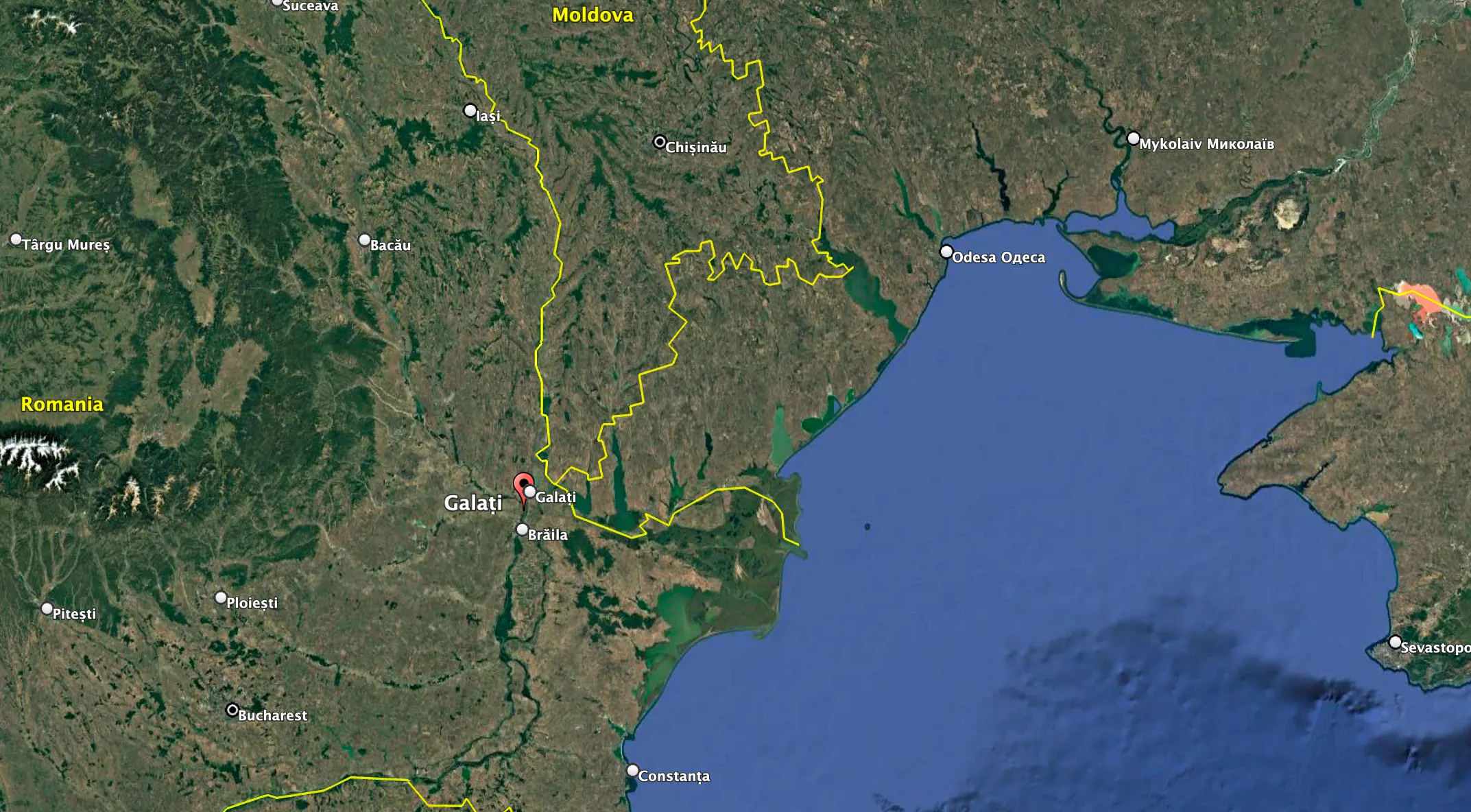
The Russian drone was part of a barrage involved in an overnight attack on Ukraine. It strayed into Romanian airspace before crashing into the roof of a residential building in Galați on the River Danube, in eastern Romania. The Romanian Ministry of Defense assesses that the drone was intended to attack one of several Ukrainian targets in the vicinity of the river border with Romania.
A russian drone carrying explosives, involved in the bombing of infrastructure in Ukraine crashed in Galați, Romania, causing a fire on the roof of a residential apartment building.
Two persons sustained minor injuries and several residents required medical attention, the… pic.twitter.com/P8jzYFrEEp
A senior NATO official confirmed to TWZ that it had detected and tracked the Russian drone, but it entered Romanian airspace only minutes before striking the apartment building. “To put this in context, you are talking about something that is travelling nearly 200km/h [124 miles per hour] over a populated area less than 15km [nine miles] from the border. Nonetheless, we are assessing what more can be done now to optimize Romania and NATO’s network of sensors and shooters to safely neutralize such threats,” the official added.
JUST IN: Images from inside the apartment hit by a Russian drone in Galați, Romania are now emerging. The images shows extensive damage, with the reinforced concrete ceiling completely perforated by the impact and explosion. A mother and her 14-year-old son were injured. pic.twitter.com/BRq9txK3QS
According to Ukrainian President Volodymyr Zelensky, the Shahed-type drone was involved in Russian strikes on the Odesa region, which borders Romania, targeting civilian container ships. Since the summer of 2023, Russia has embarked on a campaign to attack Ukrainian ports and other facilities on the Danube, with extensive use of drones. Overnight Russian strikes in the wider Black Sea region saw three foreign-flagged merchant vessels attacked, according to Kyiv, one of them being the Turkish-owned Ant, a dry cargo ship that was heading to Turkey from Odesa.
It is indeed necessary to step up pressure on Russia so that this war is not dragged out or expanded. Last night, the Russians carried out a deliberate strike on our southern region – Odesa region, which borders Romania. This was yet another cynical attack on civilian… https://t.co/lOcfhrwQAf
— Volodymyr Zelenskyy / Володимир Зеленський (@ZelenskyyUa) May 29, 2026
A map showing the approximate location of Galați on the River Danube, in eastern Romania, close to the borders with Ukraine and Moldova. Google Earth
The impact sparked a fire, injured two people, and forced the evacuation of several other residents.
The Romanian Ministry of Defense said the drone had been tracked by radar in Romanian airspace.
A Romanian Air Force F-16 fighter. U.S. Army National Guard photo by Staff Sgt. Jaccob Hearn Sgt. 1st Class Jaccob Hearn
There have been some mixed messages as to why the drone was not shot down.
The Romanian Ministry of Defense says that the pilots involved had authorization to engage targets throughout the alert.
President of Romania Nicușor Dan said that the decision not to engage the target was taken “because the conditions did not exist to destroy it without the heightened risk of endangering civilian safety.”
Regardless, Romania summoned Russia’s ambassador today, calling out the “irresponsible escalation” by Moscow.
“We will officially communicate the consequences that this lack of responsibility on the part of the Russian Federation will have for the diplomatic relations between our countries, as well as the next steps at the European level regarding sanctions packages,” the Romanian Foreign Minister Oana Țoiu wrote on X.
L-am convocat pe Ambasadorul Federației Ruse la sediul Ministerului Afacerilor Externe.
Siguranța României este prioritatea noastră absolută.
Avem confirmarea MAPN că drona care s-a prăbușit pe o clădire rezidențială din Galați este de proveniență rusească.
Meanwhile, Romania’s president, Nicușor Dan, said he had instructed the foreign ministry to prepare a package of measures regarding Romania’s relationship with Moscow, “proportionate to this very serious situation.”
Am avut o convorbire cu Secretarul General @NATO, @SecGenNATO , în urma celui mai grav incident de securitate produs pe teritoriul României de la începutul războiului de agresiune al Rusiei împotriva Ucrainei. Am condamnat ferm această încălcare inacceptabilă a suveranității…
Condemnation has also come from other NATO allies.
“I want to condemn this irresponsible act by Russia,” France’s foreign minister, Jean-Noël Barrot, said, adding that the drone had struck “a country of the European Union and a NATO country.”
A NATO spokesperson condemned “Russia’s recklessness” and said the alliance would strengthen its defences against all threats, including drones.
Meanwhile, UN Secretary General António Guterres has called for greater diplomacy, immediate de-escalation and “a full and unconditional ceasefire,” warning of “unknown and unintended consequences” from the escalation and intensification of Russian drone and missile attacks against Ukraine.
Russia’s war of aggression has crossed yet another line.
A Russian drone incursion struck a densely populated area in Romania, injuring civilians.
On EU territory.
We stand in full solidarity with Romania and its people.
As we continue strengthening our security and…
— Ursula von der Leyen (@vonderleyen) May 29, 2026
Romania has also called for the beefing up of its counter-drone capabilities to help prevent similar incidents in the future.
The Romanian Foreign Ministry today said it had asked NATO to accelerate the transfer of anti-drone capabilities in response to the drone strike.
PM @Bolojan: @GuvernulRo strongly condemns Russia’s violation of our airspace. We count on NATO Allies’ support and timely delivery of anti-drone capabilities. We are also focusing on rapid implementation of SAFE.
Romania already hosts several layers of NATO and NATO-linked air defense infrastructure, but most of these are designed to engage ballistic missiles and conventional aircraft, not large numbers of low, slow Shahed-type drones.
Air defense capabilities in Romania include the Aegis Ashore system at Deveselu, the most important NATO missile-defense installation in the region. It is a U.S.-operated land version of the naval Aegis ballistic missile defense system armed with SM-3 interceptors, integrated into NATO’s missile shield.
The U.S. Aegis Ashore site in Romania. U.S. Navy
Romania also operates Patriot PAC-3 systems, which are effective against aircraft, cruise missiles, and some ballistic missiles, but are an expensive option for routine drone interception.
A Romanian Army Patriot missile system during a live-fire exercise at the Capu Midia range in Romania, in November 2023. U.S. Department of Defense/Courtesy photo Tech. Sgt. Kristen Pittman
In addition, the country hosts rotational NATO fighter policing detachments, which provide additional air defense over the Black Sea and provide air policing patrols. Currently, a detachment of U.K. Royal Air Force Typhoons is in Romania as part of Operation Biloxi.
UK heatwave? ☀️
Still not as hot as a Typhoon afterburner on Op BILOXI.🔥✈️
🛫Typhoons from @RoyalAirForce continue to launch on BILOXI, sharpening combat edge alongside allies in support of @NATO enhanced Air Policing mission.
— Defence Operations 🇬🇧 (@DefenceOps) May 29, 2026
It should be pointed out that this is not the first incident in which a Russian drone flying from the Ukrainian side of the border has violated Romanian airspace. Drone wreckage was found in Romania, close to the border with Ukraine, in September and October of 2023, although there was no evidence that the NATO country was deliberately targeted. In December of the same year, NATO fighters deployed in Romania were scrambled to respond to a drone violation, with one of the drones exploding in Romanian territory, although it was not shot down. Since then, there have been multiple other Russian drone incursions, but no reported injuries as a result.
However, the overnight strike in Romania further underscores the potentially lethal risk of the war in Ukraine spilling over from Ukraine and into NATO territory.
It also coincides with Russian threats to step up its sustained assault on Ukraine. Moscow has continued using long-range missiles and drones to target Ukrainian cities and critical energy infrastructure, while Kyiv prepares for further waves of intense attacks.
Earlier this week, Zelensky said he was urging the United States to supply more Patriot systems to help defend against Russian ballistic missile strikes, amid an ongoing shortage of critical air defense systems. Speaking today, the Ukrainian leader said that Ukrainian intelligence has information indicating Russia is preparing a new large-scale attack on Ukraine.
As we have discussed in the past, Russian kamikaze drones heading toward population centers in NATO countries represent an entirely new level of threat to the alliance and one that NATO is currently not well-equipped to deal with.
Police and forensic investigators examine the location of impact over a damaged apartment after a Russian drone struck an apartment building in Galati, eastern Romania. Photo by Daniel MIHAILESCU / AFP DANIEL MIHAILESCU
Considering the intensity of Russian aerial bombardment of Ukraine, and the proximity of NATO borders, it was really only a matter of time until an incident like this occurred.
Already, Romania expanded its no-fly zone along a section of the border with Ukraine to up to 20 miles inside Romania and to a height of 4,000 feet. This was intended as a deterrent against Russian drones from deliberately entering Romanian airspace to reach enemy targets.
TWZ reached out to NATO for details of potential posture changes, and a senior official from the alliance confirmed that a NATO E-3A Sentry Airborne Warning and Control System (AWACS) aircraft was launched today to increase air-domain awareness.
A U.S Air Force E-3 Sentry taxis past a NATO E-3A Airborne Warning and Control System aircraft at NATO Air Base Geilenkirchen, Germany. U.S. Air Force photo/2nd Lt. Caleb Wanzer Capt. Caleb Wanzer
The same NATO official told us that one way to avoid similar incidents in the future would be to bring the MEROPS counter-drone system to Romania under NATO command and control.
“Another way is for Romania and other allies to continue the acquisition of more capabilities as part of the Eastern Flank Deterrence Initiative, which integrates sensing, decision-making and precision effects into a resilient, defense-in-depth concept,” the official added.
As you can read about here, MEROPS counter-drone systems, initially used in Ukraine, have also been deployed to protect U.S. troops from Iranian Shahed-136 munitions. The MEROPS is a small, relatively inexpensive drone built specifically to intercept long-range one-way attack drones.
A new system to identify and take down Russian drones is deployed to NATO’s eastern flank
Now that a Romanian residential building has been hit and people injured, this may push the needle further and lead to the more comprehensive deployment of counter-drone capabilities in this country and elsewhere on NATO’s eastern flank.
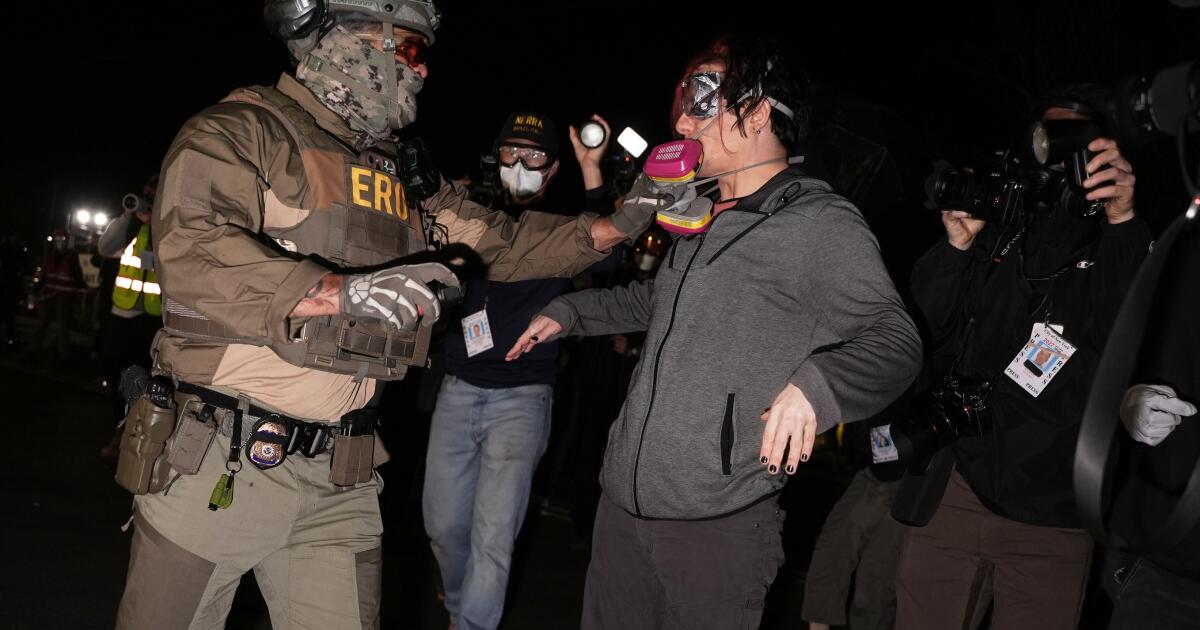
NEWARK, N.J. — New Jersey state police set up designated protest zones and vehicle checkpoints outside an immigration detention center in Newark on Friday, replacing federal immigration enforcement agents who have been clashing with protesters for days.
Gov. Mikie Sherrill said she sent in state police to bring order outside Delaney Hall as the demonstrations have intensified, with violence and arrests increasing as night falls.
“It has grown unsafe, and that’s completely unacceptable,” the Democratic governor said at a news conference announcing the new measures. “We need to take this opportunity to lower the temperature.”
As police erected protest barriers, U.S. Immigration and Customs Enforcement agents who had formed a line in front of protesters moved inside the building’s perimeter fence.
New Jersey State Police Lt. Col. David Sierotowicz said ICE officers agreed to stand down with state police assuming responsibility.
Demonstrators had mixed reactions. Some staged a sit-in and refused to move into one of the new protest areas police set up using metal barriers and concrete blocks.
Rachel Cohen worried that demonstrators exercising their 1st Amendment rights were being silenced.
“It is not helpful to quell protest for the sake of a false peace,” she said. “There is no peace while we are torturing our neighbors on [the] government dime inside this facility.”
U.S. Homeland Security Secretary Markwayne Mullin, on social media, called the measures a “win for law and order” and noted that Sherrill had resisted sending state police for days.
The protests began a week earlier after immigrant advocates said detainees inside launched a hunger strike over poor living conditions at the 1,000-bed facility, which opened last May.
Demonstrators have been attempting to block people and vehicles from entering and exiting, linking their arms in a human chain and using trash cans, umbrellas and other items as makeshift shields and barricades.
ICE officers wearing helmets and tactical vests have used pepper spray and batons to try to disperse the protesters and clear the roadway for vehicles.
At least six demonstrators were arrested and accused of assaulting law enforcement officers Wednesday night, and more have been arrested on other nights, according to the Department of Homeland Security.
Acting U.S. Atty. Gen. Todd Blanche shared images online Friday of bloody wounds and bruises sustained by ICE officers.
“These riots are clearly not ‘peaceful protests’ as you can see from the photos of these horrific wounds,” he said. “Assault a federal officer, you’ll be held accountable.”
Another demonstrator, Lisa O’Dwyer, said she was fine with the designated protest areas.
“I like to get my point across and stay safe at the same time,” the Westfield resident said.
Eyesha Marable, pastor at Mt. Zion AME Church in Millburn, agreed, even while acknowledging that there were “different schools of thought” among protesters.
“There are people here who are angry. Their family members are inside. Their friends are inside. People have been taken off the streets, out of their communities,” she said.
“We have to keep the peace,” Marable said. “The goal is to get our people free, to get them liberated, and we cannot do that if we’re fighting out here.”
State Atty. Gen. Jennifer Davenport said it was important to “de-escalate” the situation as “violence, either against protesters or by protesters, is unacceptable.”
Sherrill said she did not want to give ICE a pretext to expand operations in the state, noting that federal immigration officers around the country have killed and injured protesters in recent months.
“We all need to do everything we can to cool things down now,” she said.
The governor and other Democratic officials tried to visit detainees Monday but were denied entry.
Democratic members of Congress from New York City, however, were able to tour Delaney Hall the day after that. They reported dire conditions, with detainees being fed small portions of often spoiled food and their varied medical needs going ignored.
Families and supporters of detainees also say their loved ones have also been subjected to pepper spray and physical force in retaliation for their hunger strike and the protests outside.
Marcelo and Shaffrey write for the Associated Press and reported from New York and Newark, respectively.
Reporting from Sacramento — Paul Taybi is part of the 1.5%.
The 59-year-old retired founder of a data analysis company from El Cerrito is among that percentage of the wealthiest Californians paying the higher income tax rates that voters approved four years ago.
For the record:
9:44 a.m. May 30, 2026An earlier version of this story incorrectly stated that Paul Taybi owned four Bay Area apartment complexes. The rentals are single-family residences.
Now, with those rates set to expire, a coalition of teacher and service worker unions, medical groups and others are pushing Proposition 55, a ballot measure that would extend these higher taxes on the the highest earners through 2030.
Taybi isn’t happy about it. He said he plans to raise rents in the four Bay Area properties his family owns and ultimately move out of state in the coming years if the measure passes.
“I have no problem paying more taxes than a poor person does,” Taybi said. “But we’ve reached the point where my behavior has changed. It will change more. And a lot of people like me will say, ‘That’s the straw that broke the camel’s back.’”
If voters approve Proposition 55, the state will continue depending on Taybi and other wealthy Californians to fund a significant portion of schools, parks, road repairs, police, prisons and many other government services. Those paying the higher rates, which kick in for single and joint filers making more than $263,000 and $526,000 a year respectively, contributed almost $34 billion in income taxes in 2014, roughly a third of all state general fund revenue.
California’s reliance on the wealthiest taxpayers means the state is especially vulnerable to their bottom lines.
When presenting this year’s revised budget plan in May, Gov. Jerry Brown carried with him a chart titled, “Unpredictable Capital Gains,” noting how the state’s revenues were highly dependent on booms and busts in the economy. California’s finances, he said, are a “zig-zag reality.”
“In order to manage this budget,” Brown said, “it’s like riding a tiger.”
In the same presentation, Brown estimated that if Proposition 55 didn’t pass, the state would have a budget deficit in the next three years, which could lead to a new round of cuts in education, health and social services programs.
Though much more muted than before, the basic message is the same as it was in 2012.
Back then, the state remained at the height of a prolonged budget crisis. Brown and other proponents warned of massive cuts unless voters passed Proposition 30. The measure primarily raised income tax rates by 1% to 3% for the wealthiest taxpayers.
Under Proposition 30, the current tax rate is 10.3% for single filers earning between $263,000 and $316,000 in annual taxable income, 11.3% for those between $316,000 and $526,000, 12.3% for those between $526,000 and $1 million and 13.3% for those earning $1 million or more. The final 1% at the highest tax rate goes toward a mental-health fund that’s been recently retooled to pay for a $2-billion bond to help house the homeless.
Brown and other supporters pitched Proposition 30 as a Band-aid to carry the state through the worst of its financial calamities. Those higher income tax rates are set to expire in 2018. If Proposition 55 passes, the higher rates would be in place for 18 years.
The governor hasn’t taken a formal position on Proposition 55 and maintains he could balance the budget with or without it.
“I said it was temporary when I started, when I got Prop. 30 passed — I helped to pass it — and I think I’ll leave it there,” Brown said at the May budget presentation.
Some high earners who voted for Proposition 30 now say they’re opposed to the new measure because they were promised that the tax hikes would expire.
“I’m just incensed because I feel like a sucker,” said Martin Schwartz, 63, an electronics repair store owner in Chatsworth, who has paid the higher rates.
But supporters of the measure argue that the state’s still shaky revenues justify continuing to tax those in the top income brackets at higher rates.
“Have we stopped bleeding since 2012? Yes, but the problem still exists,” said Shay Lohman, president of the teacher’s union in the Rowland Unified School District in Los Angeles County. “The wound is still there.”
Increased tax revenues have also brought significant benefits. Since Proposition 30 passed, Lohman’s district brought back an elementary school music program that had been cut during the recession and is planning to start a dual-language Mandarin-English program next year, he said.
“Money has allowed something like that to happen,” Lohman said.
Though the income tax provisions are the same, Proposition 55 has some differences from Proposition 30. The new initiative does not extend a quarter-cent sales tax hike set to expire at the end of the year. It directs more of the money to the state’s Medi-Cal healthcare program for low-income residents. The measure will raise $4 billion to $9 billion a year, depending on the economy and stock market, according to the nonpartisan Legislative Analyst’s Office.
The campaigns for Propositions 30 and 55 are different as well. Four years ago, business and taxpayer groups mounted a robust effort, spending millions, including running television advertisements, to oppose the tax and support a second, unrelated ballot measure.
This time, opponents have only raised $3,000, according to the state campaign finance reports, while supporters have collected almost $53 million, primarily from the California Assn. of Hospitals and California Teachers Assn.
In pro-Proposition 55 television advertisements, advocates including state ControllerBetty Yee argue the measure will prevent education cuts without raising taxes.
A USC Dornsife/Los Angeles Times poll last month found 57% of registered voters were in favor of the measure. The poll even found support from a majority of those making more than $100,000 a year.
Rosary Academy sprint coach Jon Gilmer was worried 4×100-meter relayers Tra’via Flournoy, Justine Wilson, Pfeiffer Lee and Maliyah Collins might get complacent at prelims, but the Royals were the top qualifiers in 45.13 seconds — nearly a full second faster than Canyon Country Canyon (46.07) — at Buchanan High School.
“It’s different not having Calabasas here,” Gilmer said. “Now we’ve got to push ourselves.”
Rosary set a state record (44.23) at the Arcadia Invitational on April 11, but lost to the Coyotes one week later at the Mt. SAC Relays. However, the anticipated state finals clash was not to be as Calabasas dropped the baton in the Southern Section finals and failed to advance.
Collins had a huge lead by the time she received the stick for the anchor leg Friday.
“This is maybe our fourth- or fifth-fastest time but we just wanted to make finals,” said Wilson, who ran the second leg before handing off to Lee. “We want to run faster tomorrow when we go for a PR, the meet and the state record.”
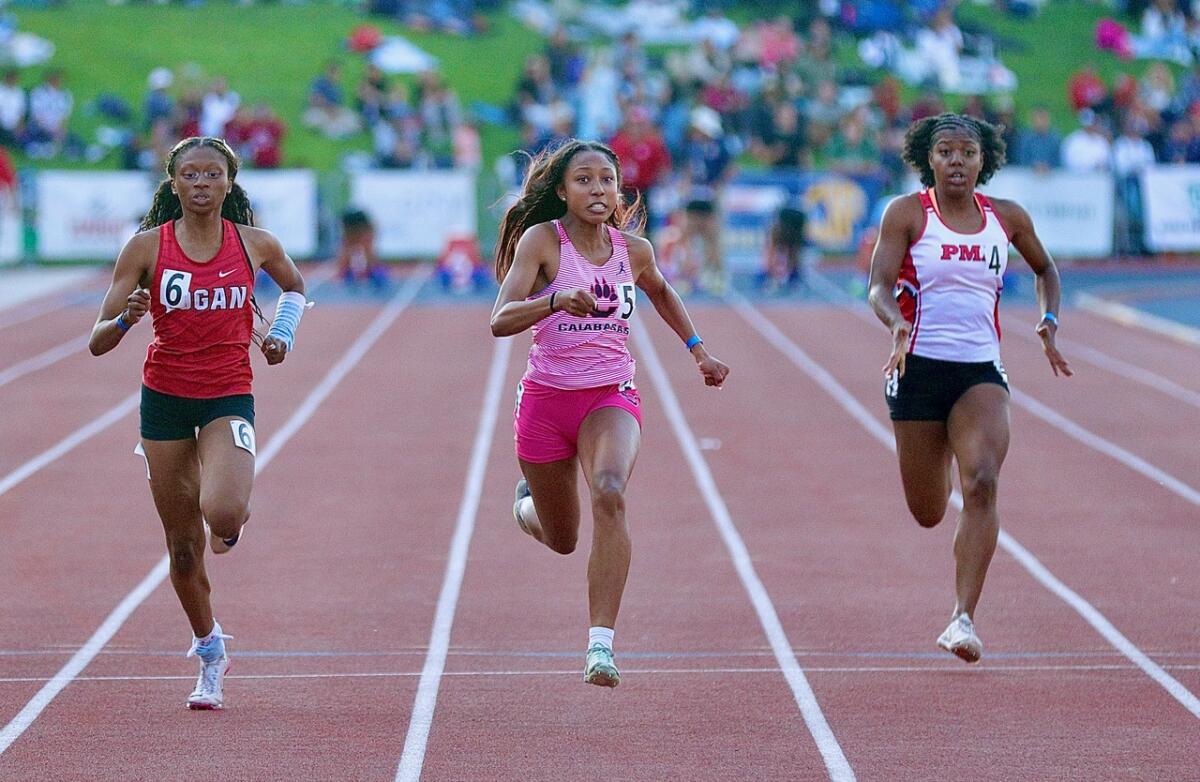
Calabasas might be out of the relay, but three Coyotes remain in contention in the 100, led by Malia Rainey (the top qualifier in 11.54), Marley Scoggins (11.63) and Olivia Kirk (11.63).
Calabasas sprinter Marley Scoggins, center, wins her 100-meter heat at the CIF state track and field preliminaries on Friday.
(Steve Galluzzo / For The Times)
Collins won her heat in 11.62, the third-fastest time.
Servite won the first heat in the boys 4×100 relay in 40.29 — two hundredths off its winning time at last year’s state finals — and is primed to defend its title in the event. Concord De La Salle (40.81) was the second-fastest qualifier, followed by the other heat winners, Rancho Cucamonga (40.87) and Loyola (40.93).
“We got the stick around pretty good today,” said Jorden Wells, who ran the first leg Friday instead of his customary second leg, which was run by Jaelen Hunter. “Did it feel different? Not really, I’ve done it before.”
Wells said his twin brother Jace will run the first leg Saturday, he will run the second while Kamil Pelovello and Benjamin Harris will stay in the third and fourth positions.
Harris, the favorite to win the 100 meters, won his heat in a wind-legal 10.36, but three others were fractions faster in wind-aided times — Elk Grove’s Cy Lugo (10.20), Will Wood’s Deshawn Seymour (10.34) and De La Salle’s Damari Dean (10.34). Newbury Park’s Jaden Griffin won the last heat in 10.37, setting the stage for an exciting finals sprint as all nine qualifiers ran under 10.48.
Harris put himself in position for a Saturday double by winning his 200 heat in 21.10 but as he did in the 100, Lugo (the Sac-Joaquin Section record holder) had the fastest time (20.73), followed by Seymour (20.88), Camren Hughes (20.93) of Palos Verdes and Jace Wells (21.02). Jordan Wells (21.11) also made the cut.
Newbury Park’s Jaden Griffin, center, shouts after winning his heat in the 100 meters at the CIF state track and field preliminaries on Friday.
(Steve Galluzzo / For The Times)
Servite (3:15.43) had the second-fastest qualifying time in the 4×400-meter relay behind only El Cerrito (3:14.96) of the North Coast Section.
Coming off a state-record 3:33.83 at the Masters Meet in Moorpark, Long Beach Wilson’s 4×400 girls relay had the fourth-fastest qualifying time (3:46.73) without two out of its best runners (Clara Adams and Saniah Varnado), taking second in the first heat behind San Luis Obispo (3:45.85) and safely advancing to the finals along with Heat 2 runner-up Rosary (3:45.08) and Heat 3 winner Canyon Country Canyon (3:46.77).
Having broken the Southern Section record in the 400 meters six days earlier in 51.98, Adams put it in cruise control to win her heat in 53.53, the fastest qualifying mark. Joining her in the final will be her three relay teammates Varnado (54.42), Wilson (54.57) and Fowler (54.62). Adams later won her 200 heat in 23.60, a tenth of a second behind fastest qualifier Naiaja Sizemore of Vanden.
San Jacinto Valley Academy’s Kaahliyah Lacy ran a wind-legal 13.59 for the top qualifying spot in the girls 100 hurdles and Varnado (40.85) was the top qualifier in the 300 hurdles.
Another showdown is brewing in the boys 400, where Loyola’s Ejam Yohannes (47.08) and Hunter (47.21) won their heats in the two fastest times Friday. Hunter clocked 46.32 to set a California freshman record last spring, but lost to Yohannes by 11 hundredths of a second at the Masters Meet.
City Section champion Jayden Rendon showed good form in his bid to defend the state 300 hurdles crown, posting the fastest prelims time (36.80). He also advanced to the finals in the 110 hurdles with a 13.83 effort. Moorpark’s Davis Benson (14.03) nabbed the last spot.
Corona Santiago’s Braelyn Combe, right, wins the first heat of the 800 meters at the CIF state track and field preliminaries on Friday.
(Steve Galluzzo / For The Times)
Corona Santiago senior Braelyn Combe won her 1,600 heat in 4:46.88 and is set for a four-lap battle with San Diego Section champion Chiara Dailey of La Jolla, who won the second heat in 4:46.00. Combe is the defending champion, having edged Hanne Thomsen of Santa Rosa Montgomery by five hundredths of a second in the finals last year.
“I just wanted to advance with as little effort as possible,” Combe said. “It was not as hard as I expected. I don’t want to leave any regrets. I’m taking it one race at a time.”
Combe also had the fastest time (2:08:25) of three heats in the 800 meters.
Venice senior Lawrence Kensinger, who set the City Section shot put record with a state-leading throw of 65 feet 11 inches last week, had the third-best mark at prelims (59-6¾) and easily advanced to the finals. Defending state high jump champion JJ Harel of Sherman Oaks Notre Dame tied nine others for the second-best mark (6-6) heading into the second day.
Aliso Niguel senior Jaslene Massey had the top marks in the girls shot put (51-3¾) and discus (175-6) and transgender athlete AB Hernandez from Jurupa Valley was the leading qualifier in the girls long jump (20-5½) and triple jump (41-8½) and was one of 13 qualifiers in the high jump.
AB Hernandez competes at the CIF state track and field preliminaries at Buchanan High School on Friday.
COLLEGE STATION, Texas — USC couldn’t hold on to the lead Adrian Lopez provided with a home run in the bottom of the eighth Friday night.
Texas State’s Chase Mora greeted reliever Adam Troy with a monstrous two-run home run to left field in the top of ninth inning, propelling the Bobcats to a 5-4 upset before a crowd of 6,956 at Blue Bell Park.
The Trojans had plenty of chances, and they wasted most of them in the opening round of the NCAA tournament’s College Station Regional.
Even though the Bobcats’ shaky defense spotted USC two unearned runs, the Trojans will surely lament stranding runners in scoring position in each of the first seven innings.
The Trojans will face Lamar University, which blew a five-run lead in a 7-5 loss against host Texas A&M, on Saturday at 1 p.m. PT.
If coach Andy Stankiewicz’s Trojans return to the Men’s College World Series for the first time since 2001, the 12-time national champions must do it out of the losers bracket.
USC right-hander Grant Govel, an All-Big Ten First Team selection, settled for a no-decision after giving up three runs on four hits with two walks and six strikeouts over 5⅔ innings.
He was relieved by freshman left-hander Sax Matson with one on and two outs in the top of the sixth. Matson escaped unscathed in the sixth, but he was relieved by right-hander Andrew Johnson with one on and two outs in the seventh.
The Trojans (43-16), who reached the Big Ten Tournament semifinals, have lost four of their last five games.
Mora’s sacrifice fly to right field gave the Bobcats a 1-0 lead in the second inning. The Trojans countered to tie the score with a run in the bottom of the second.
With runners on first and second and two outs, Abbrie Covarrubias hit a grounder to first. Texas State first baseman Jaquae Stewart booted the grounder for an error, allowing Isaac Cadena to score. Stewart almost made the situation worse with a wild throw to second, but Dean Carpentier was thrown out trying to reach third on the poor throw to second.
The Trojans benefited from more poor defense in the third. With one out in the inning, Augie Lopez reached on an error by Mora at third. Kevin Takeuchi followed with a double off the center-field wall. Jack Basseer broke the tie with an RBI single through the left side.
Covarrubias hit a solo home run to left in the fourth to put USC ahead 3-1. Texas State sophomore shortstop Brady Boles, who entered the regional with only one home run this season and two in his college career, tied the score 3-3 with a two-run home run to left field in the top of the fifth.
With California facing increasingly destructive wildfires, experts and officials have long urged the strategic removal of dense, flammable vegetation that can erupt into particularly destructive flames from a lightning bolt or the spark of a power line.
But after years of record investment by the state in such wildfire risk mitigation, two key money sources are drying up, potentially reducing the state’s annual budget for vegetation removal by hundreds of millions of dollars.
Wildfire resiliency advocates are warning that the loss of these funds will leave the state vulnerable to devastation, and are calling on California’s next governor to take that threat seriously.
Late Friday, however, state officials adopted a new structure for the emissions program, called cap-and-invest, that analysts say will likely reduce wildfire mitigation funding by $200 million per year. At the same time, the governor’s latest budget proposal puts the state on track to allocate the majority of the climate bond’s $1.5 billion in wildfire prevention money within just three years.
As a result, California could go from routinely pulling more than $600 million a year from these sources, to just $150 million, according to an estimate from the Wildfire Solutions Coalition — a group of more than 80 organizations representing conservationists, business owners, fire officials and tribal leaders.
The coalition is urging the state to find new sources of funding for the work.
“We have the scientists, we have the technicians, we have the advocates,” said Michelle Decker, who is on the coalition’s executive committee and serves as president and CEO of the Inland Empire Community Foundation. “We see this problem. We can get ahead of this problem. It is a revenue issue.”
California wildfires have become increasingly costly. The 2025 L.A. fires alone caused an estimated $250 billion in damage and economic loss. Insurance companies have already paid out $22.4 billion.
In attempt to reduce the risk of damage to communities and ecosystems, the state has employed a wide range of tactics. These includes fortifying homes against wildfires, replanting fire-ravaged forests and thinning out vegetation with prescribed burns, goat grazing and manual thinning with heavy machinery to reduce the intensity of potential fires.
Research suggests wildfire mitigation work pays off. A recent analysis of 285 fires in the western U.S. found that every dollar spent on landscape projects saved about $3.75 in wildfire damage.
But as funding from cap-and-invest and the climate bond dwindle, the state must increasingly turn to Cal Fire, which devotes only a small portion of its budget to mitigation work.
“This is not an issue that can be pushed off to a timeline based solely on politics,” said Steve Frisch, a founding member of the coalition and president of the Sierra Business Council. “Fire happens whether we want it to or not.”
After a series of destructive wildfires in Northern California and the 2017 Thomas fire in Southern California, the state legislature began to explicitly focus on funding wildfire mitigation.
In 2018, lawmakers directed $200 million per year of cap-and-invest funds to wildfire mitigation projects.
As the Woolsey fire in Southern California and the Camp fire in Paradise raged later that fall, Trump accused the state of “gross mismanagement” of forest lands and threatened to cut off federal funds unless it was corrected.
Gov. Gavin Newsom and the legislature, with a significant budget surplus, began earmarking even more funds, leading to a peak of $1.1 billion in wildfire mitigation investments during the 2021-2022 fiscal year.
After the surplus dwindled, the legislature opted in 2024 to put a $10-billion climate bond in front of voters — $1.5 billion of which was dedicated specifically for wildfire mitigation work.
Newsom has since pointed to this high state funding to call on the federal government to step up its own investments into forest management work.
The federal government manages 57% of all forests in the state. While the U.S. Forest Service spent $3.1 billion mitigating wildfire conditions in the state over the last few years, California spent $4.3 billion, according to the California Forest Resilience and Wildfire Task Force.
However, the state has already allocated about $600 million of the climate bond’s wildfire mitigation pot for the 2024-2025 and current fiscal years. The latest budget proposal would allocate more than $300 million for this upcoming fiscal year. While many advocates support allocating the money quickly, it leaves little for future years.
Once that money is spent, California has to pay off the $10 billion bond with interest. The result is an estimated price tag of $16 billion, paid in roughly $400 million increments every year, for 40 years, according to the state’s Legislative Analyst’s Office.
As for the cap-and-invest funds, a fraught months-long debate at the California Air Resources Board on how to extend the program beyond 2030 resulted in a compromise that will cut the revenue it generates in half, the Legislative Analyst’s Office estimates.
Since other projects get priority — including $1 billion every year for California’s high-speed rail project — the new proposal would “likely leave no funding” for the wildfire and forest resilience line item, the Legislative Analyst’s Office found.
Cal Fire still holds a modest annual budget for wildfire mitigation work. In the 2024-2025 fiscal year, the agency had $500 million for forest management and fire prevention that was not directly tied to cap-and-invest or the bond — up from about $65 million two decades prior.
As for the federal government, independent analyses by Grassroots Wildland Firefighters and NPR found that Forest Service wildfire mitigation work is on the decline amid federal staffing cuts. The Forest Service claims the decrease in work was primarily due to poor weather conditions for activities like prescribed burns and staff being occupied with firefighting.
Both the state and federal government’s investments pale in comparison to the spending of California’s investor-owned utilities. In 2025 alone, the utilities planned to spend more than $9.2 billion on preventing their equipment from sparking the next devastating wildfire, primarily funded by Californians’ electricity bills.
Record heat. Raging fires. What are the solutions?
Get Boiling Point, our newsletter about climate change, the environment and building a more sustainable California.
By continuing, you agree to our Terms of Service, which include arbitration and a class action waiver. You agree that we and our third-party vendors may collect and use your information, including through cookies, pixels and similar technologies, for the purposes set forth in our Privacy Policy such as personalizing your experience and ads.
Times staff writer Hayley Smith contributed to this report.
Democratic and Republican candidates vying to replace Democratic Gov. Gavin Newsom have been sparring on televised debates and exchanging campaign attacks since April to garner the attention of voters statewide.
The candidates include a Riverside County sheriff, a former senior advisor to British Prime Minister David Cameron, a former Los Angeles mayor, a billionaire hedge fund founder and two former members of the U.S. House of Representatives.
Recent polls showed that the leading Democratic candidate is Xavier Becerra, a former U.S. Secretary of Health and Human Services whose campaign is focusing on affordability and housing for what he calls “working Californians.” Vying for one of the top two spots in the June 2 primary are Republican contender Steve Hilton, a former Fox News commentator who was endorsed by President Trump, and Democratic billionaire Tom Steyer, a hedge fund founder turned environmental warrior.
Here is what the top candidates have said on important topics such as immigration, housing and homelessness, affordability and the entertainment industry.
Immigration and ICE
The U.S. Immigration and Customs Enforcement raids that began in California last summer have been hotly debated by Democratic and Republican candidates.
Here is what the candidates said during a debate in May or stated on their websites, as well as some criticism they have faced during the campaign.
Xavier Becerra vowed to protect and lead the state against the Trump administration’s attacks on immigrants and marginalized communities. Becerra’s rivals have accused him of failing to protect migrant children when he served as Health and Human Services secretary under the Biden administration.
Riverside County Sheriff Chad Bianco opposes “sanctuary city” laws that block local law enforcement from assisting federal immigration agents, calls for the deportation of criminal illegal immigrants and says the border must be secured. But he has also faced criticism from fellow Republicans for supporting a pathway to citizenship for lawful, working undocumented people and telling his constituents that his deputies were not taking part in Immigration and Customs Enforcement raids.
Former Fox News host Steve Hilton, who legally immigrated to the United States from the United Kingdom, opposes California’s state and local sanctuary policies, and said the state must cooperate with the federal government because the governor’s job is to enforce laws, whether the governor agrees with immigration enforcement activity or not.
San José Mayor Matt Mahan plans to demand ICE officers be unmasked, vows to go after agents and immigration agency leadership when they violate the constitution and shield communities from unwarranted harassment.
Former Congresswoman Katie Porter said California should enforce its sanctuary laws statewide, “so we don’t have crazy cowboys taking the law into their own hands.”
Billionaire hedge fund founder Tom Steyer wants to strengthen California’s laws to ensure law enforcement agents can’t profile Californians based on their race, ethnicity, language, occupation or location. He also wants legislation that will grant the state attorney general the authority to hold ICE agents accountable for violent and illegal acts on the job. He supports abolishing ICE. But he has faced heat on the campaign trail for his former hedge fund’s investment in the Corrections Corp. of America, now known as CoreCivic, which operates private prisons around the nation that are housing people picked up by federal immigration agents. Steyer has repeatedly expressed remorse about his former firm’s ties with the company and said he personally ordered the divestment from private prisons before he sold his stake in the hedge fund.
State Supt. of Public Instruction Tony Thurmond says he plans to levy a new tax on companies that operate ICE detention centers, fight to abolish ICE, protect California’s sanctuary laws and work with Congress to establish a pathway to citizenship.
Former L.A. Mayor Antonio Villaraigosa supports helping law-abiding immigrants and said violent criminals have been deported under the state’s sanctuary laws, despite claims to the contrary by Republican candidates.
Housing and homelessness
Here’s what each candidate said about the need to address the state’s housing shortage and its stubborn homeless problem:
Becerra said he plans to cut “unnecessary red tape” and speed up “approvals for projects that meet affordability and environmental standards.” On homelessness, Becerra said he wants to establish a $150-million annual homelessness prevention fund to pay rents and fight eviction or foreclosure.
Bianco said he wants to end “overregulation of our building industry” and eliminate the California Environmental Quality Act, the California Coastal Commission and the California Air Resources Board. On homelessness, he wants cities to clear encampments and prioritize mental health and substance abuse treatment. He wants to force people to accept drug treatment “when necessary.”
Hilton proposes to reform the California Environmental Quality Act so that only government prosecutors can sue, preventing private individuals and organizations from stopping or delaying new housing projects. He also said he believes rent control measures reduce the incentive to build housing and wants to restructure or eliminate them. On homelessness, Hilton wants to build more low-cost group shelters instead of permanent housing.
Mahan said he wants to lower developer fees and taxes for infill housing. Mahan also said more homes should be built off-site in California-based factories, making them cheaper than building them on site. On homelessness, Mahan wants to make the state’s Homeless Housing, Assistance and Prevention grant permanent and fund it at $1 billion a year.
Porter said she would “greenlight innovative building strategies, shred unnecessary red tape and create incentives” to build needed housing. On homelessness, Porter wants more interim housing, emergency rental assistance and rapid rehousing programs.
Steyer is pledging to make it harder for large corporations to buy up the state’s housing stock and wants to encourage cheaper methods of home construction. On homelessness, Steyer wants to expand interim housing options and homeless services.
Thurmond said he wants to build 2 million new homes for “working Californians,” on 75,000 acres of surplus land that local school districts own. On homelessness, Thurmond wants to increase the number of housing units that include mental health and substance abuse services.
Villaraigosa said he wants to cut development fees and reform CEQA to speed housing development, particularly for infill housing. On homelessness, Villaraigosa wants to double the state’s investment in Newsom’s Homekey program to build an additional 10,000 units of permanent supportive housing over five years.
A comprehensive guide on the candidate’s full views on housing and homelessness is here.
What the candidates have said about affordability
The candidates offered their ideas for making California more affordable during debates in April and May as well as on their websites.
Becerra said he will stand up to price gouging and unjustified rate hikes and use the power of the state to lower prices “where the market has failed.”
Bianco says he wants to cut taxes for working families and businesses, stop the “over-regulation on California’s economy,” support job growth and unleash the state’s energy resources to lower the price of gas and utilities.
Hilton said he wants to eliminate income taxes on people who earn less than $100,000 and on the first $100,000 for Californians who earn more than that. He also wants to end California’s current tax on tips to ensure tipped workers keep more of their earnings.
Mahan said he wants to enact a “Gas Tax Holiday” that ends or reduces the tax on gas. He also wants to remove barriers to building affordable housing by putting a cap on fees charged for new housing construction.
Portersupports single-payer healthcare, providing free child care and college tuition and making wealthy corporations pay their “fair share” in taxes. To pay for it, Porter would impose a progressive corporate tax, meaning more profitable businesses and corporations would pay a higher rate. She also supports ending income taxes for those who earn less than $100,000.
Steyer called himself the only candidate who is “willing to take on the corporate special interests” that drive up the cost of living in the state. He said he would like to lower gas prices as well as streamline permitting, reform zoning and enforce laws to build affordable homes faster. He also supports single-payer healthcare.
Thurmond wants to provide a tax credit to make it easier for Californians to pay for the rising cost of gas, groceries and housing. He plans to establish a universal childcare program and provide low-cost loans to help small businesses make improvements at their firms.
Villaraigosa plans to support a California Fuel Affordability Guarantee to cap gas prices for working families.
The entertainment industry
Here’s what some candidates have listed on their campaign websites about their ideas to support California’s entertainment industry.
Becerrasupports state requirements that mandate productions disclose how AI is being used, cutting the “bureaucratic friction” of getting a filming location permit and vows to uphold the state requirement that ensures digital platforms share meaningful performance data with the cast, writers and directors.
Hilton wants to restore California’s competitive edge as a place for productions by creating financial incentives for film productions, cover the initial and technical costs associated with the development of a film or television project and reserve funding for independent and mid-budget projects.
Mahan said he plans to expand and modernize production incentives, make them more competitive and ensure the protections are for everyone who works on a film or television project from the technical crew to writers, directors and actors.
Steyer said he would like to block corporate mergers in entertainment, defend and expand film tax credits and eliminate the regulations and hurdles for permitting and logistics that “slow down productions.”
Times staff writers Seema Mehta, Nicole Nixon and Andrew Khouri contributed to this report.
The top candidates for California governor crisscrossed the state Friday, all venturing to friendly political territory to woo voters and undermine their rivals as the June 2 primary election fast approaches.
The top Republican in the race, former Fox News host Steve Hilton, spent the day railing against transgender athletes before a high school track event in the Central Valley, an event sure to appeal to his base of President Trump supporters.
The front-running Democrats, former Biden administration Cabinet member Xavier Becerra and billionaire environmentalist Tom Steyer, rallied one of their party’s most influential constituencies: union members.
While both stuck with mostly an upbeat message and reiterated promises to lift up Californians struggling to make ends meet, Steyer afterward accused Becerra of being “a corporate Democrat who’s taking money from all these big corporations” who “doesn’t want to change things.”
Steyer’s had good reason to go after Becerra.
A new poll from the UC Berkeley Institute of Governmental Studies and co-sponsored by the Los Angeles Times showed Becerra leading the race with 25% support from likely voters, followed by Hilton at 21% and Steyer within striking distance at 19%. The two candidates who finish in first and second place in the primary will advance to the November general election, leaving the third-place finisher on the sideline.
Though he told reporters Friday morning that “I don’t pay attention to polls,” Steyer was energetic at a Northern California campaign event, where he held a private meeting with leaders of a union representing long-term caregivers. In brief remarks at the offices of SEIU Local 2015, Steyer described the race as a choice between a billionaire champion of working people and the corporate-backed Becerra.
“Does California work for Californians or does California work for corporations? The corporations think it works for them. They want it to continue to work for them and they’re putting up tens of millions of dollars to make sure they continue to make record profits,” he told dozens of home-care workers, teachers, construction workers and nurses at the West Sacramento gathering.
Groups including PG&E, the California Assn. of Realtors and the California Chamber of Commerce have spent more than $34 million opposing Steyer’s candidacy. The former hedge fund manager has pledged to lower energy bills by breaking up large electric utility monopolies.
As a billionaire who has so far poured $216 million of his own money into his gubernatorial campaign, Steyer has faced skepticism from some left-wing and working-class voters. But he is endorsed by progressives, including Rep. Ro Khanna (D-San Jose), and unions including the California Nurses Assn. and both major teachers unions.
“I voted for Tom. I was looking for a change,” said Alvenia Scott, a union board member who works as an in-home caregiver to her disabled sister.
“He really has some good ideas,” she said, adding that she had more qualms about Steyer’s lack of government experience than his wealth. “He made his way in life, more power to him.”
Hundreds of miles south in the Inland Empire, Becerra pledged to be on the side of unions if he is elected governor and urged voters to turn in their ballots in what has so far been a remarkably low-turnout election.
“I am with you. When I become governor and I sit behind that desk, you’ll have a union man sitting at that desk,” Becerra told about 500 people at the United Food and Commercial Workers hall in Bloomington.
He asked the crowd if they had cast their ballots and noted that not everyone raised their hand.
“Less than one in five Californians have actually cast their vote so far. We got to get that number way, way up,” he said, arguing that the election is about “sending a message all across the country that California will be counted, that California cannot be neglected, and that California will not take a knee to anyone in Washington, D.C.”
Only 12% of the state’s registered voters have cast ballots as of Thursday evening, according to the election tracking firm Political Data Inc.
Community college counselor Diego Rodriguez, 32, said he decided to vote for Becerra in recent weeks after seeing the former U.S. Health and Human Services secretary’s momentum in the race and researching his record.
“Also just his story. As someone who works in higher education, and seeing how Xavier, being first-generation, has benefited from higher education, and how he advocates for higher education,” the Rialto resident said. “Additionally, today, him being here at a labor union and advocating for the working class and labor, I think, is very important.”
“I think that people became aware of him more because of that,” Rodriguez said. “There was a lot of conversation online regarding that, but I think it allowed the spotlight to be brought onto him and it made people aware of his record.”
At a campaign stop in Clovis in the central part of the state, Hilton marveled that his campaign had spent only about $2 million in campaign advertising but was still polling above Steyer, according to the latest Berkeley IGS survey.
“We’re feeling confident,” said Hilton, standing in a suburban stretch of the city. Still, he warned that voters need to get out to support him and avoid a “complete disaster for California” of two Democrats advancing to the November election.
Hilton, who was endorsed by Trump in April, joined other politicians and leaders in Clovis in opposing trans athletes from competing at the 2026 CIF State Track & Field Championships.
The group met near where the championship events were scheduled to take place this weekend.
Asked why he was focusing on sports and gender in the final days of the race, Hilton said it’s “one of the main issues” that come up at town halls. If elected, he said he would seek to overturn the state’s 13-year-old law that allows students to participate in school activities and use facilities such as bathrooms based on their gender identity.
Hilton argues the law violates the state Constitution and will “suspend” it while he initiates legal proceedings to overturn it.
He also praised Spencer Pratt, a Republican and former reality TV star who is running for Los Angeles mayor, saying his candidacy has brought “excitement and energy” to the state’s primary election.
“For a long time in California, there’s been this sense that it’s all inevitable — there’s nothing you can do, Democrats run this place, just the way it is,” Hilton said. “I think that that’s changing. I think there’s this sense that something’s happening.”
BATON ROUGE, La. — Louisiana lawmakers passed a new congressional map Friday designed to pick up a Republican seat while leaving the state with just one of its two majority-Black House districts represented by Democrats.
Approval of the new House map came a month after the U.S. Supreme Court struck down the state’s current map as an illegal racial gerrymander, weakening the landmark 1965 federal Voting Rights Act. That decision intensified a national redistricting battle fueled by President Trump’s efforts to protect the Republicans’ slim House majority in the midterm elections.
Louisiana Republicans had considered drawing a map giving the party a shot at winning all six of the state’s U.S. House seats. But that would have required adding more Black voters to Republican-held districts, potentially backfiring with losses. Some Republicans said a 5-1 map better protects U.S. House Speaker Mike Johnson from facing a difficult reelection.
Republican Gov. Jeff Landry is expected to sign the new map into law.
In the weeks following the Supreme Court’s decision, several other Republican-controlled Southern states have seized upon a weakened federal Voting Rights Act to try to redraw their own congressional districts. It’s the latest flare-up in a heated national redistricting battle heading into the November elections, spurred along by Trump.
So far, Republicans are winning the redistricting contest. But that doesn’t necessarily mean they will win a narrowly divided U.S. House in November. So far, Republicans think they could gain as many as 14 seats from their redistricting efforts, while Democrats think they could gain six seats from new districts in California and Utah.
In Louisiana, Republicans currently hold four of six congressional seats on a court-ordered map drawn in 2024 to comply with the Voting Rights Act by including a second district with a majority-Black population.
That map, however, was challenged in court, and the Supreme Court responded on April 30 by striking it down as an illegal racial gerrymander.
Landry postponed the state’s U.S. House primary, scheduled for May 16, until later this summer to allow time for Republican lawmakers to draw and pass a new map.
The proposed map redraws Democratic U.S. Rep. Cleo Fields’ district, clustering it around predominantly white communities in the Baton Rouge area and southern Louisiana. It also adds part of Baton Rouge to a heavily Democratic, majority-Black district based in New Orleans currently represented by Democratic U.S. Rep. Troy Carter.
More lawsuits were expected over the new map.
Democrats say the proposed map could still constitute a racial gerrymander because it packs Black voters into a single congressional district. Meanwhile, the plaintiffs in the U.S. Supreme Court’s decision criticized the Legislature’s map for leaving a majority-Black district in place.
Several other Southern states also have acted on redistricting since the Supreme Court’s decision.
Florida’s Legislature passed new congressional districts just hours after the ruling, completing a redrawing that was in the works in anticipation of the decision. It could yield Republicans as many as four additional seats in the midterm elections.
Tennessee adopted new U.S. House districts a week after the ruling, carving up a majority-Black district based in Memphis in a Republican attempt to win an additional seat.
In Alabama, Republicans are attempting to pick up another seat by redrawing two districts where Black residents compose a majority or close to it. Democrats hold both seats, and the proposal is mired in a court battle.
South Carolina’s Senate, meanwhile, decided against redistricting, despite pressure from Trump.
On the cusp of California’s gubernatorial June 2 primary, voters are closely divided among three candidates vying to succeed Gov. Gavin Newsom at a perilous moment in the state and nation’s history, according to a poll released Thursday.
Among likely California voters, 25% support Xavier Becerra, a Democrat and former Biden Cabinet secretary, according to the survey by UC Berkeley’s Institute of Governmental Studies that was co-sponsored by the Los Angeles Times. Republican Steve Hilton, a former Fox News commentator and British political strategist, has the backing of 21%, while 19% backed billionaire hedge fund founder turned environmental activist Tom Steyer, a Democrat.
California gubernatorial candidate Xavier Becerra takes a selfie at an event while campaigning on May 26, 2026 in San Francisco, California. Becerra is the former United States Secretary of Health and Human Services and is running as a democratic candidate for governor. California’s statewide election is on June 2.
(Benjamin Fanjoy / Getty Images)
The survey provided the clearest indication yet that the three have separated themselves from the rest of the field. Support increased for Becerra, Hilton and Steyer since the last Berkeley IGS poll in March. Becerra leapfrogged everyone. In early March he wallowed near the bottom of the pack at just 5% support among likely voters, and now is the front-runner.
The other candidates floundered. Support for Riverside County Sheriff Chad Bianco, a Republican, dropped 5% and he now finds himself in a distant fourth place. Former Democratic Rep. Katie Porter of Irvine dropped by almost half to 7%. San Jose Mayor Matt Mahan, former Los Angeles Mayor Antonio Villaraigosa and state Supt. of Public Instruction Tony Thurmond — all Democrats — remained mired in the single digits.
Poll director Mark DiCamillo cautioned that it remains unclear which candidates will finish in first and second place in the June 2 primary, a pivotal question since only the top two finishers will advance to the November general election regardless of party affiliation. The low voter turnout thus far makes predicting the outcome especially difficult.
Although every registered voter in California was sent a mail-in ballot, many have not returned them or dropped them off at voting locations — a telltale sign of the uncertain nature of this year’s governor’s race. The survey, which included all 61 of the gubernatorial candidates on the ballot, found that Democratic turnout thus far is noticeably lower compared with past primary elections, DiCamillo said.
Steve Hilton, Republican gubernatorial candidate for California, arrives for a news conference at the San Jose Diridon Station in San Jose, California, US, on Tuesday, May 26, 2026. Republican gubernatorial candidate Steve Hilton is announcing his intention to halt future taxpayer-funded payments for California’s High-Speed Rail project, if elected in November.
(Jason Henry/Bloomberg via Getty Images)
“We’re assuming that … the Democrats will in fact turn out in the final week after we had concluded our poll and begin to make up ground on what looks like an early lead for Hilton, and those voters favor Becerra,” DiCamillo said.
The survey, conducted between May 19 and 24, found that likely Democratic voters favored Becerra over Steyer by 11 percentage points. Voters registered as “no party preference” were evenly divided between Becerra, Steyer and Hilton. Among likely Republican voters, Hilton led Bianco by almost 2 to 1.
Becerra also had a notable edge over Steyer among women and Latino voters, while Steyer had an advantage among Black voters. Hilton was favored over the two Democrats among self-identified libertarians and among voters in Orange County, the Central Valley and northern coast and Sierra region.
The poll found that 7% of voters remained undecided.
For the first time in more than a quarter of a century, the contest to lead the nation’s most populous state and the world’s fourth-largest economy has consistently lacked a front-runner despite a plethora of candidates.
Two of California’s best-known Democrats, former Vice President Kamala Harris and U.S. Sen. Alex Padilla, both toyed with a run for governor before deciding not to run, which contributed to the sluggishness of the race. The 2026 campaign for governor also languished in the shadow of the mayhem stirred up by President Trump, including his immigration raids throughout Southern California, and the devastation wrought by the 2025 Pacific Palisades and Altadena wildfires.
But a whirlwind of recent developments has drawn attention to the race.
Tom Steyer, Democratic gubernatorial candidate for California, during a campaign event in Santa Rosa, California, US, on Wednesday, May 27, 2026. California is holding its primary election on June 2. Photographer: David Paul Morris/Bloomberg via Getty Images
(Bloomberg/Bloomberg via Getty Images)
Additionally, record-breaking amounts of money have flowed into the race. Steyer has smashed state self-funding records by contributing $212 million to his campaign as of Tuesday, according to the California secretary of state’s office. Nearly $85 million has been donated to independent expenditure committees by corporations, labor unions, tech titans, Native American tribes and other special interests, most of which will have policy interests that will be in front of the next governor.
Although the 2026 California governor’s race lacks the allure of recent contests that featured candidates such as global movie star Arnold Schwarzenegger, political scion Jerry Brown and former San Francisco mayor and likely 2028 presidential candidate Gavin Newsom, it is unfolding at a crucial time for Californians.
The state’s most vulnerable residents are facing severe reductions to medical care because of looming federal healthcare funding cuts, and California’s budget, already volatile because of its reliance on the state’s wealthiest residents, may grow more unpredictable. California’s highest-in-the-nation gas prices increased even more because of the U.S.-Iran war, adding to the state’s entrenched affordability crisis, which has driven many residents out of the state.
The cost of living, homelessness and public safety were among the top concerns expressed by voters, according to the poll. Protecting voting rights was also supported by most voters, though their underlying concerns could be starkly different based on their political views.
Democrats have been focused on the disenfranchisement of voters, a fear that has heightened in the aftermath of a recent Supreme Court decision that gutted a section of the Voting Rights Act that forced states to draw voting districts to help elect Black or Latino representatives to Congress. Republicans echo President Trump’s claims of elections being rigged.
Los Angeles, CA – MAY 06, 2026: Chad Bianco is interviewed after the California Gubernatorial debate at Skirball Cultural Center on Wednesday, May 6, 2026 in Los Angeles, CA.
(Jason Armond/Los Angeles Times)
Voters split largely along party lines about issues such as Trump’s policies about climate change, immigration and taxes.
Voters’ uncertainty in the governor’s race is partly driven by California’s unique, voter-approved “jungle” primary system, in which the two candidates who win the most votes in the June 2 primary advance to the November general election, regardless of party affiliation.
Although the state’s voters are largely registered Democrats, the party’s leaders feared earlier this year that they would splinter among the multiple Democrats on the ballot, leading to Hilton and Bianco advancing to the November general election and ensuring that a Republican would be elected governor. Bianco had the backing of 11% in the new Berkeley survey.
The Republicans were once roughly tied in polls, until Trump endorsed Hilton in April. More than one-third of likely Republican voters said Trump’s endorsement of Hilton made them more likely to support him. Among voters who identified with the “Make America Great Again” movement, nearly two-thirds supported Hilton while less than 3 in 10 backed Bianco.
Though Bianco’s followers seem to be more passionate, “Hilton has got the much broader base of support, and then he got Trump’s endorsement,” DiCamillo said.
He added that Hilton’s rise is unusual in California, where statewide candidates typically spend enormous sums of money to raise their visibility among the state’s 23.1 million registered voters.
“What’s interesting about Hilton is that he hasn’t really done much of his campaigning in the traditional way. He hasn’t run huge amounts of television advertising, you don’t see his name out there in the traditional media, other than in free media,” DiCamillo said. “You can see that in the data, because almost a third of voters still have no opinion of Hilton … about what it was back in March, which is startling for a candidate who is among the leaders.”
Democrats’ fear of being locked out of the November general election led party leaders and allies to effectively urge low-polling candidates to drop out of the race in remarkable public statements in March.
The tables have since turned — the prospect of two Republicans winning the top spots in the June primary appear nonexistent, while polling shows a small possibility of two Democrats advancing to the general election.
“I’m not saying it’s likely, but it’s possible that two Democrats could emerge, and that would have huge implications on turnout in the [November] election,” DiCamillo said, pointing to California congressional races that could shape control of the U.S. House of Representatives. “If you don’t have a Republican at the top of the ticket, it would be dismal for the Republicans’ chances.”
The poll of 8,578 registered California voters was conducted online in English and Spanish and has a margin of error of about 2 percentage points in either direction.
There are plenty of compelling storylines involving Southland teams and athletes heading into the CIF state track and field championships this weekend in Clovis, perhaps none more enticing than Long Beach Wilson’s bid for the national record in the girls’ 4×400 relay.
Having just smashed Long Beach Poly’s 22-year-old California standard of 3:35.49 with their 3:33.83 clocking at the Southern Section Masters Meet in Moorpark last Saturday, the foursome of Brooke Blue, Brooklyn Fowler, Saniah Varnado and Clara Adams will try to go even lower.
Adams also established herself as the favorite to win the 400 meters at Buchanan High in Clovis — prelims are Friday and finals Saturday — after a blistering 51.98-second effort at the Masters Meet that broke the Southern Section record. The Bruins are vying for a fourth consecutive team title.
Servite won the boys’ team title last year and is well positioned to defend it if the Friars pile up points as expected in the relays and sprints, paced by junior Benjamin Harris, who anchored their nation-leading 39.70 clocking at the Arcadia Invitational, which broke the Friars’ own 4×100 state record. Harris remains the front-runner in the 100. His wind-aided 10.17-second timing in the 100 last weekend equaled the fourth-fastest time in state history.
Harris is the clear favorite since the last two state champions — Brandon Arrington of Spring Valley Mount Miguel (who reclassified from the 2026 to the 2025 recruiting cycle) and Concord De La Salle’s Jaden Jefferson (who graduated early) — are not in the field. Harris’ wind-aided 20.51 in the 200 two weeks ago also sets him up for a duel with Nicolas Obimga of Torrance (the wind-legal state leader at 20.66) and Elk Grove’s Cy Lugo (20.67), the Sac-Joaquin Section record holder.
In the 400, Servite’s Jaelen Hunter (whose 46.32 last spring was a state freshman record) will try to avenge his loss to Loyola’s Ejam Yohannes by 11-hundredths of a second at the Masters Meet.
Defending state 300 hurdles champion Jayden Rendon of Carson faces stiff competition in that event from state leader Brady Tse of San Jose Harker, Palm Desert’s Kingston Penny and Etiwanda’s Brandon Andrade.
Venice senior Lawrence Kensinger threw himself into the front-runner role with a personal-best and City Section record mark of 65-11 on May 21 and Sherman Oaks Notre Dame’s JJ Harel will try to repeat as high jump champion after clearing a state-leading 7-01 in the section finals two weeks ago.
Braelyn Combe beat Santa Rosa Montgomery’s Hanne Thomsen by five-hundredths of a second in a personal-best 4:35.64 in last year’s state 1,600 final and the Corona Santiago senior is favored to win that event again while attempting to become the first girl in state history to pull off a 1,600, 800 and 4×800 relay trifecta.
Irvine’s Summer Wilson, who broke the Woodward Park course record at the state cross-country finals in the fall and breezed to victory in the 3,200 meters at last week’s Masters Meet in a personal-best 10:14.25, is the co-favorite to win the eight-lapper Saturday along with La Jolla’s Chiara Dailey, the San Diego Section 800, 1,600 and 3,200 champion.
With just days left to cast your vote in California’s primary election on June 2, The Times has answers to your last-minute questions about the voting process.
Here’s what you need to know:
What are the key races to watch?
The California governor’s race is a tight battle between Democrats and Republicans who are vying to replace Democratic Gov. Gavin Newsom, who is serving his second term and cannot run again. Top candidates include a Riverside County Sheriff, a former senior advisor to British Prime Minister David Cameron, a former Los Angeles mayor, a billionaire hedge fund founder and a member of the U.S. House of Representatives. Your guide to the race for California governor can be found here.
In the Los Angeles city mayoral race, incumbent Karen Bass faces a reelection challenge from a field of candidates that include a reality TV personality, a tech entrepreneur, a City Council member and a progressive community leader. Your guide to the L.A. mayor’s race can be found here.
What is on the ballot?
There are several races, ballot measures, local district seats and statewide races that Southern Californians must decide on.
Most of the attention will be on the races for California governor and the mayor of Los Angeles.
City of Los Angeles residents have several other items to consider, including:
County of Los Angeles residents will be asked to vote on:
Voters will decide on six local congressional district seats and other statewide races including the:
A comprehensive breakdown of each race or proposed tax measure can be found here.
What is an open primary?
An open primary allows the top two candidates who garner the most votes to move on to the general election in November, no matter what party they belong to.
This system could allow two candidates from the same party to advance to the general election.
Is it too late to vote by mail?
No. You can return your vote-by-mail ballot by:
Dropping it off in the return envelope at a secure official drop box now through the close of polls on June 2.
Dropping it off in person at a polling place, vote center or county elections office by 8 p.m. on June 2.
Dropping it off at the post office. Mailed ballots must be postmarked on or before election day and received no later than 7 days after election day. To ensure your ballot is postmarked by election day, mail it at least five days before June 2. If mailing on election day, get a hand-stamped postmark from a postal employee at a United States Post Office.
What is the deadline to return a vote-by-mail ballot?
In order to be counted, vote-by-mail ballots must be postmarked on or before election day, June 2, and received by your county elections office by June 9.
How do I check if I’m registered to vote?
To find out if you’re registered to vote, visit the secretary of state’s website. You’ll need to enter a California driver’s license or identification number or the last four digits of your Social Security number.
You also can call the state’s voter hotline (available in 10 languages) at (800) 345-8683 to get a paper application mailed to you, or you can pick up one at a county election office, most California libraries and United States Post Office locations, as well as many federal, state and local government offices — including the Department of Motor Vehicles.
If you opted to register online, officials say you should wait at least 24 hours before checking your voter status.
How do I register to vote? Can I register on election day?
Eligible citizens who need to register or reregister to vote within 14 days of an election can complete this process to register and vote at county elections offices, polling places or vote centers.
To find an early voting location, use the secretary of state search tool here. You can find your local polling places here.
Your submitted ballot will be processed and counted once the county elections office has completed the voter registration verification process.
How do I check my voter status?
You can check your voter status from the California secretary of state website here. To find your record, you’ll need to provide your full name, date of birth, state driver’s license or identification card number and the last four digits of your Social Security number.
Where is my closest drop box?
Secure ballot drop-off locations opened May 5. You can visit the Los Angeles County Office of the Registrar-Recorder/County Clerk’s website here to find a ballot box near you.