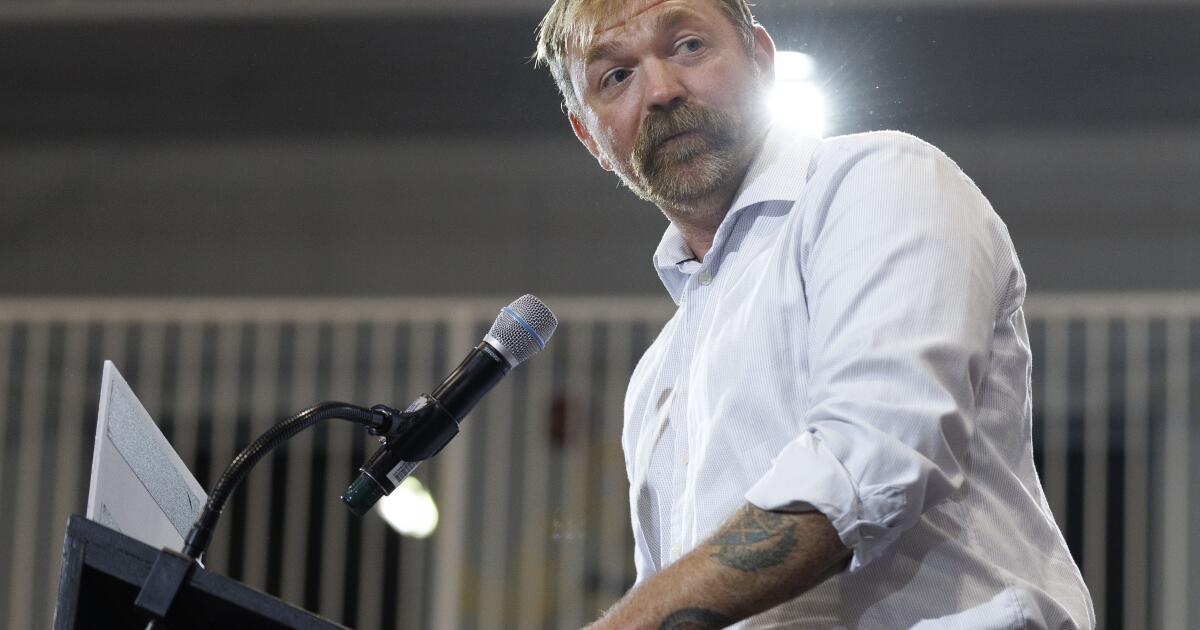
Graham Platner’s ruined campaign in Maine adds pressures for Democrats
WASHINGTON — The campaign of U.S. Senate nominee Graham Platner was buckling in Maine on Tuesday after he was accused of rape, injecting uncertainty into a contest that is central to determining which party wins Senate control in November’s midterms.
The situation set off swift debate about how state Democrats would choose Platner’s replacement if he were to withdraw, and which Maine figures might be best positioned to play off the progressive messaging he used to win over voters.
With Maine viewed by Democrats as a key seat to win in their long-shot bid for a Senate majority, the decision would be high stakes, analysts said. In the meantime, with uncertainty clouding the race, the shake-up could put additional pressure on the party to win Senate races in states seen as more difficult to flip.
Platner has denied the rape allegation, which came in a Politico report Monday from a woman who said Platner forced her to have sex with him when he was intoxicated. Platner said Monday that he would “reflect” on his candidacy but has not withdrawn.
“The calculation that almost everyone on the Democratic side is making is that with Platner in it, it is an unwinnable race,” said John Cluverius, director of survey research for the Center for Public Opinion at UMass Lowell, “and without Platner in it, they have a much better chance.”
An oyster farmer and Marine veteran, Platner had entered the race to challenge Republican Sen. Susan Collins as an outsider and was seen as riding an anti-establishment wave of support.
His candidacy highlighted the split within his party between progressives and establishment Democrats and represented a matchup between an older incumbent and a younger outsider candidate.
By Tuesday afternoon, Platner’s financial backing was disintegrating and prominent Democrats had withdrawn their support — including Sen. Bernie Sanders (I-Vt.), a key endorser of Platner’s, who said Tuesday afternoon that he had told Platner to withdraw.
A spokesperson for Platner’s campaign did not immediately respond to a request for comment Tuesday.
Rep. Ro Khanna (D-Fremont), who had been one of Platner’s most visible backers, quickly withdrew his endorsement Monday.
“I’ve been very clear that sexual assault or violence against women is a red line. These allegations are very serious and credible,” Khanna, who has been a prominent supporter of victims of the late sex offender Jeffrey Epstein, wrote on X.
The California congressman had been among progressives, including Sanders and Sen. Elizabeth Warren (D-Mass.), who previously stood by Platner. Khanna had rallied for Platner at a pre-primary event in June after a set of allegations about the candidate’s “unsettling” conduct from his exes reported by the New York Times and the revelation that he had sent sexually explicit messages to women outside his marriage.
Platner’s collapse comes after the fall of former California Rep. Eric Swalwell, whose ascendant campaign for governor was ended in April after he was accused of sexual assault.
As in Swalwell’s case, Platner’s support has unraveled quickly, leaving him with little path forward.
The Democrats’ formal Senate campaign arm and the Senate Majority PAC, which is aligned with Senate Minority Leader Chuck Schumer, both pulled investment from the race, their leaders said in statements. Swing Left, an organization working to flip seats for Democrats, removed Maine from its target Senate races for now.
“We continue to believe this seat is winnable if Platner is not on the ballot,” said Senate Majority PAC spokesperson Lauren French.
Under state law, Platner has until Monday to withdraw in order for the Maine Democratic Party to be able to nominate a replacement. The committee would have until July 27 to do so.
For Collins, facing a new candidate could make for a harder race than going up against Platner, analysts said.
The fifth-term senator has survived reelection repeatedly, including in 2020, when the state went blue in the presidential election, but drawn ire from some moderate and left-leaning voters who want her to push back more forcefully against President Trump.
Without Maine, Democrats would have to pick up an additional race in a state that went for Trump in 2024 in order to flip the four seats required to win a majority.
To get to four, the party needs to win some mix of Maine, North Carolina, Ohio, Texas and Iowa and must also retain its seats in Michigan, Georgia and New Hampshire.
That scenario could be within reach for Democrats but they face a steep climb, a New York Times/Siena poll released last week found.
“This does put enormous pressure on Democrats across the country with every viable race,” said David Niven, who teaches American politics at the University of Cincinnati. “The margin of error was already slim, and it’s approaching none.”
In Texas, a heated and expensive race has shaped up between Democrat James Talarico, a state representative who is facing Republican Ken Paxton, the state attorney general.
“I would suspect that Democrats are going to be relatively all-in on Texas simply because they can no longer rely on Maine in the way they thought they were going to be able to,” said Mark Jones, a political science professor at Rice University.
The Politico report came after a string of other controversies for Platner, who had successfully batted them away ahead of the state’s June primary.
His quick rise in the campaign excited Democrats looking for younger, non-establishment leaders. His primary opponent, Maine Gov. Janet Mills, suspended her campaign in late April, clearing his path.
But questions about the rushed vetting of Platner soon arose.
He faced scrutiny over a tattoo on his chest that was widely recognized as a Nazi symbol, which he then said he had covered up, and a tranche of deleted Reddit posts that he said were “stupid” comments from a time when he had post-traumatic stress disorder.
Ahead of the primary, the report of his extramarital texts and the allegations by exes about volatile behavior revived questions about his candidacy; Platner described them as politically motivated and privately assured Democratic leaders that nothing else was coming.
The situation “reinforce[s] the need for more careful vetting [of] first-time outsider candidates,” said Dan Schnur, who teaches political communications at USC, UC Berkeley and Pepperdine.
“Every political professional knows that the most important type of candidate research is not opposition research — it’s research on your own candidate,” Schnur said.
Progressive leaders on Monday sought to validate the success of Platner’s campaign in energizing Maine voters while disavowing Platner. They urged Democratic leaders to stick with a candidate who shares Platner’s working-class image if he withdraws — something Platner may hope to influence, the New York Times reported.
“To the Democratic establishment: this is not your opening,” Joseph Geevarghese, executive director of the progressive organization Our Revolution, said in a statement. “Whoever leads this movement forward must be someone who has actually lived the fight Graham Platner ran on.”
Some Democrats were already looking to the party’s gubernatorial primary candidates as possible replacements, including Maine Secretary of State Shenna Bellows, former state Sen. Troy Jackson and former state health official Nirav D. Shah.
The July deadlines would leave enough time before November for Democrats to persuade voters of a new candidate, said Mark Brewer, a political science professor at the University of Maine, but how the party chose to select a replacement would probably be as important as whom it chose.
“Having a 100-person executive committee select it on their own would probably not sit well with Platner’s supporters,” Brewer said. “A caucus they could pull off; if they want to be as open and inclusive as possible, that’s probably their best option.”
McDaniel reported from Washington and Kwok from Los Angeles.