Becerra’s time in Washington: Steady rise with a bumpy final ascent
WASHINGTON — Xavier Becerra was dubbed a “rising star” before he even entered the halls of Congress.
His June 1992 Democratic primary victory over Los Angeles school board member Leticia Quezada in California’s 30th Congressional District earned the 34-year-old candidate that description in The Times.
When the boyish, affable congressman became the first Latino lawmaker appointed to the powerful House Ways and Means Committee in his second term, national outlets took notice.
Thirty years later, in the final weeks of his gubernatorial race with Republican Steve Hilton, Becerra now finds himself poised to lead the most populous state in the country.
An examination of Becerra’s more than 25 years in Washington shows a politician who was skilled at building important alliances and amassing power on Capitol Hill, but had some stumbles along the way and faced criticism for his performance in his highest profile role.
Becerra built his reputation as a diligent consensus-builder — a workhorse rather than a show horse, to use an analogy favored by political scientists — but also revealed himself to be an ambitious political operator in key moments.
“He’s an affable person who’s not afraid to pull out a knife in politics while smiling,” said Christian Grose, a political science professor at USC.
Becerra’s campaign declined to comment on his time in Washington.
Becerra’s origin story traces back to his youth in Sacramento, and a moment when a high school friend was about to throw out a blank, unused application to Stanford University. The elite university was only 125 miles away, but it might as well have been across the ocean from the working-class world Becerra was raised in. Still, he applied.
Becerra — whose parents spent their early years in Mexico — became the first in his family to graduate from college when he earned a degree from Stanford in 1980.
He earned a law degree there four years later, and it was at Stanford that he met his wife, Carolyn Reyes, who became a physician.
After living in Boston while Reyes attended Harvard Medical School, Becerra moved to Los Angeles to work for state Sen. Art Torres. Within a few years he was tapped by Henry Lozano, then chief of staff to trailblazing Latino Rep. Edward Roybal, to run for state Assembly in 1990; and then, two years later, to succeed Roybal, who was retiring after 30 years in Congress.
Roybal endorsed Becerra, whose victory in the heavily Latino district that included Central and Eastside Los Angeles communities, was seen as a passing of the torch to the next generation.
Frank Villalobos, the founder and president of Barrio Architects, was among the leaders in East L.A. who encouraged Becerra to run for political office, and he said he was impressed early on by Becerra’s genuine commitment to the community and his ability to unite the area’s sometimes divided political factions.
“I thought if we kept this going, someday he’ll become the governor,” Villalobos said.
Becerra was part of a wave of young Latino lawmakers entering Congress, and his growing power within Democratic ranks helped him escape Roybal’s long shadow. Soon after Becerra’s barrier-breaking appointment to the Ways and Means Committee — which writes tax legislation — Becerra became chair of the Congressional Hispanic Caucus, a position he held from 1997 to 1999.
An early test
He put his growing stature to the test a few years later when he decided to enter the L.A. mayor’s race in 2001.
It didn’t go well.
Former state Assembly Speaker Antonio Villaraigosa was also running, and Becerra — who had slept on Villaraigosa’s couch when he first ran for Congress — faced criticism for potentially splitting the Latino vote.
Becerra performed poorly, winning only 6% of the vote in the Democratic primary. His nice-guy reputation took a hit when his campaign was found to have been behind automated phone calls attacking Villaraigosa by a woman who falsely gave the impression that she was county Supervisor Gloria Molina, whose endorsement had been crucial in Becerra’s first run for Congress.
Becerra also faced criticism for his role in contacting White House staffers as part of an effort to push for the release of convicted L.A. cocaine dealer Carlos Vignali, whose father was a political contributor to Becerra. Vignali’s sentence was commuted by President Clinton on his last day in office; Becerra acknowledged calling the White House several times to discuss the possibility of Vignali’s release. Villaraigosa also wrote a letter on Vignali’s behalf.
Becerra told The Times in 2001 that he wasn’t lobbying for Vignali’s release, but merely asking White House officials to review the details of the conviction on behalf of the family.
“If I was going to try to put pressure on, I would have tried to call the president,” Becerra said at the time.
Villaraigosa fared better than Becerra but ultimately lost the 2001 election to City Atty. James Hahn, then rebounded to win the first of two terms as mayor in 2005.
Becerra got the better of Villaraigosa in their rematch this year in the Democratic gubernatorial primary, and won Villaraigosa’s support after.
“We’ve been friends a long time and, yes, we’ve been adversaries as well, but most of the time we’ve been friends,” Villaraigosa told The Times. “He’s got the experience and the wherewithal to lead this state.”
As for Becerra as a house guest during his first run for Congress?
“He makes his bed. He was neat,” said Villaraigosa. “He was pretty inconspicuous.”
Capitol Hill climbing
After his mayoral defeat, Becerra’s focus returned to Washington, where an alliance with another powerful Californian was a boon to his career on Capitol Hill.
Becerra was a close ally of former House Speaker Nancy Pelosi (D-San Francisco), serving as assistant to the speaker from 2007 to 2009.
John Lawrence, Pelosi’s former chief of staff, said that Becerra’s standing within the California delegation and particularly among Latino lawmakers was a big part of his appeal.
“Speaker Pelosi had set a goal of elevating minorities and women who had historically been excluded from leadership,” he said.
Their relationship took a hit after Becerra told progressive lawmakers in 2009 that he believed party leadership gave up too easily on including a public option in the Affordable Care Act, which was signed into law the following year.
“I understand I have tire tracks on my back because Xavier threw me under the bus,” Pelosi said during a Democratic Party leadership meeting in 2009, Politico reported.
And Pelosi would later question Becerra’s appointment in 2021 to be secretary of Health and Human Services. She has not endorsed Becerra in the gubernatorial race.
But any bad blood between the two didn’t stop Becerra from continuing to advance within the party ranks.
He became chair of the House Democratic Caucus in 2012, leading weekly meetings of all Democrats in the House and uniting the party’s members.
Former Wisconsin Democratic Rep. Ron Kind said Becerra was an excellent listener and skilled at building consensus.
“He could get in the room with anyone and find common ground,” Kind said.
Becerra joined several high-stakes negotiations, notably a 2013 bipartisan effort to pass comprehensive immigration reform, in the wake of the “Gang of Eight” deal struck in the Senate.
John Yarmuth, a Democratic congressman from Kentucky who was also part of the House negotiation, said Becerra was “an amazing positive force” in the process.
“I think he, more than anyone else, was focused on fixing the problem,” Yarmuth said.

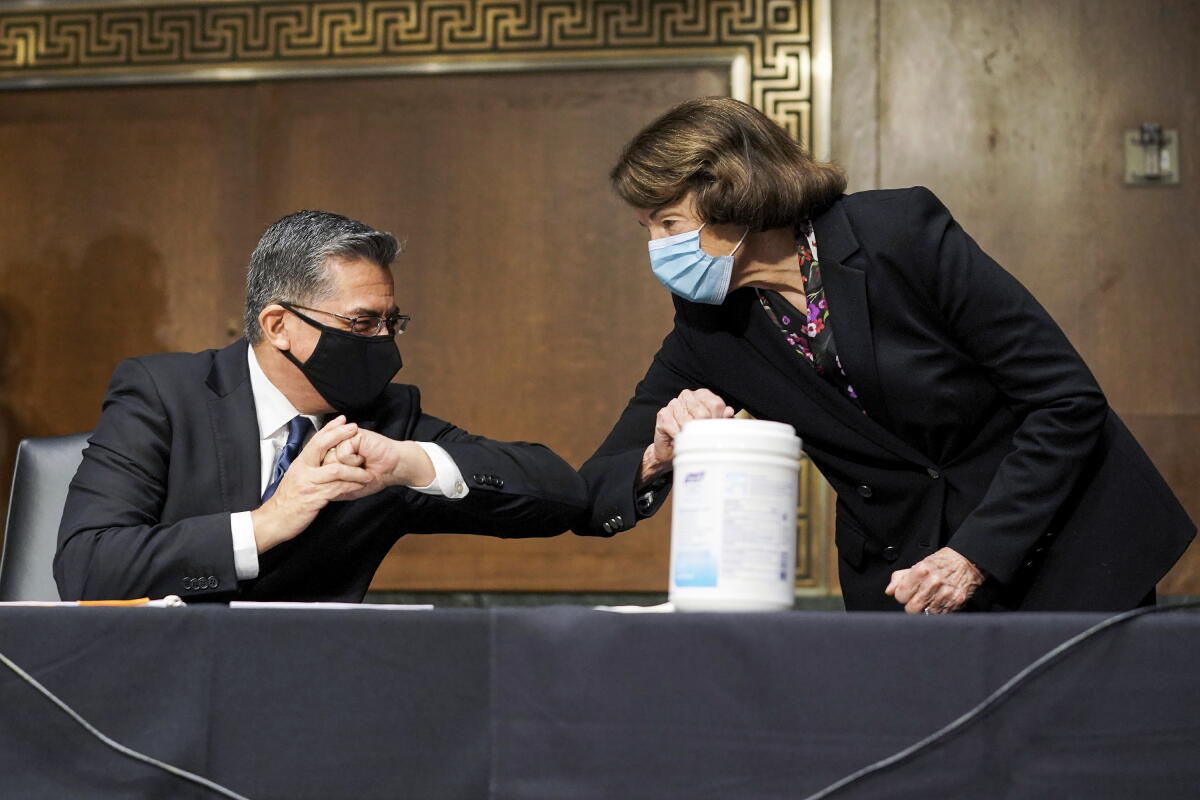
Xavier Becerra bumps elbows with U.S. Sen. Dianne Feinstein (D-Calif.) before his Senate committee confirmation hearing for Health and Human Services secretary in 2021.
(Greg Nash / Associated Press)
The group was able to achieve a compromise, but it never saw the light of day.
Then-House Speaker John Boehner, an Ohio Republican, later blamed then-President Obama, whom he accused of “poisoning the well” on an immigration compromise. Yarmuth said Republicans were spooked about potential blowback.
Several potential off-ramps appeared during Becerra’s time in Washington. He was considered by Obama for U.S. trade representative in 2008, but Becerra declined the offer. After flirting with the idea of running for outgoing U.S. Sen. Barbara Boxer’s seat, Becerra declined to enter the race, ultimately won by then-California Atty. Gen. Kamala Harris. He was briefly floated as a potential running mate for Hillary Clinton in the 2016 presidential election, but that didn’t materialize either.
In late 2016, Becerra found himself at a crossroads.
After more than a decade on the Ways and Means Committee, he faced the possibility of becoming the top Democrat on the committee and had the endorsement of the outgoing top Democrat, Rep. Sander Levin of Michigan.
But Harris’ victory in the 2016 Senate race created a vacancy for state attorney general.
Becerra decided to return home to Sacramento to take the role and spent the next four years as the state’s top law enforcement official, serving as “defender-in-chief” of the state, as USC’s Grose put it, against the Trump administration.
Fraught second act in D.C.
Becerra returned to Washington in 2021 for a second act that would prove to be far more controversial than his first.
Despite having no background in healthcare, Becerra was nominated to be the secretary of Health and Human Services and confirmed, over significant opposition by Republicans.
He took the reins of the healthcare agency as the country was still grappling with the COVID-19 pandemic and struggled to establish a clear role for himself in a response effort that was centered in the White House.
In his first year in office, he was called out by reporters for failing to hold regular press briefings.
And he faced criticism when health officials under his purview offered contradictory information in late 2021 about reduced quarantine requirements for people testing positive for COVID-19.
He continued to face criticism for the disappearance of thousands of unaccompanied migrant children who were supposed to be monitored by the agency’s Office of Refugee Resettlement after entering the country.
And Becerra’s chief of staff at Health and Human Services and longtime advisor, Sean McCluskie, pleaded guilty last year to participating in a scheme to use campaign funds from a dormant Becerra state political committee to pay for McCluskie’s frequent travel between Washington and California.
Dana Williamson, a longtime political consultant for Becerra and former chief of staff to Gov. Gavin Newsom, pleaded guilty earlier this year for her role in the scheme. McCluskie and Williamson are scheduled to be sentenced in December. Neither Becerra nor Newsom were accused of wrongdoing.
Democratic operative Xochitl Hinojosa, who served as the spokesperson for the Department of Justice in the Biden administration, earlier this year offered a blunt assessment of Becerra’s performance.
“He was not effective in government, and I think that a lot of people in the Biden administration are talking about this because they realize that he was not an effective HHS secretary,” Hinojosa said on CNN in May.
While other members of the Biden administration have defended Becerra’s performance, his time at the helm highlighted an issue that even allies concede has bedeviled Becerra in the past, his tendency to sometimes recede into the background.
Loretta Sanchez, a former Democratic congresswoman from Orange County who credits Becerra with encouraging her to run for Congress, put it simply.
“Will Xavier be bold?” she said. “I hope he takes those bold moves, because California needs it.”