stadium

There might be one advantage to climate change. More home runs at Dodger Stadium

Not much good comes to mind when you think about the effects of climate change.

Wildfires, floods, melting ice caps, heat waves, the bleaching of ocean reefs.

But then there’s baseball, and one possible silver lining.

Has global warming turned Dodger Stadium into a home run launching pad?

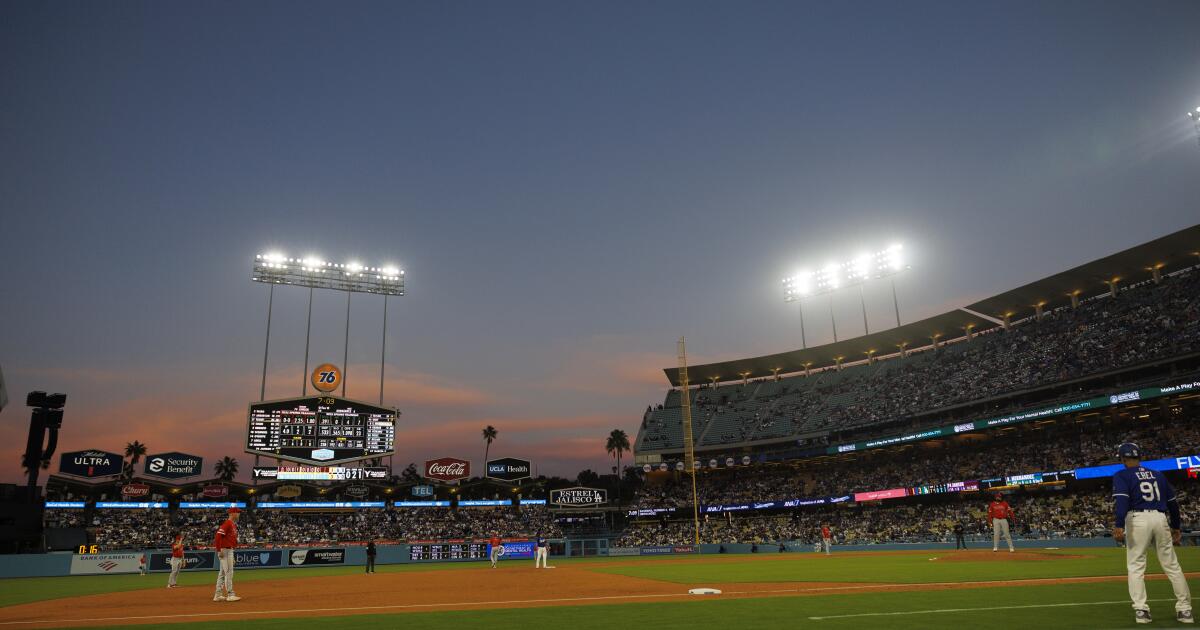
I was watching Monday night’s ESPN telecast of the L.A. game against Tampa Bay when the play-by-play announcer said that once upon a time, it was an article of faith that fly balls didn’t carry far in the heavy night air of Chavez Ravine.

However, the announcer continued, a Dodger executive had told him that over the last several years, “in general, the marine layer is gone, and the ball has started to carry at night, and you can see it now in the numbers. It is a great home run hitters park.”

This is statistically true. Between 2020 and 2025, Dodger Stadium had more home runs than any other major league park, although this year’s total is lagging behind last year’s pace. In all of Major League Baseball, home run totals have fluctuated but gradually increased over the years, with this year’s pace running slightly ahead of last year’s.

That can’t all be attributed to climate change, as retired Dodger great Steve Garvey is going to explain in a minute. When considered city by city and decade by decade, there are lots of factors in home run totals, from ballpark dimensions to playing strategies to the number of long ball hitters in each lineup.

But with Dodger Stadium, the marine layer angle jumped out at me because I’m always on the lookout for relatable ways to tell the climate change story. In the past, I’d written about the gradual demise of Joshua trees, the effect of receding fog and higher heat on the California wine industry, the growing nuisance of backyard bug bites and the gradual migration of juvenile great white sharks up the coast.

And now we have to ask ourselves: Is global warming producing more home runs than steroids did?

The warm-up is real, but it isn’t new. In Game 2 of the 2017 World Series, the temperature at Dodger Stadium topped 100 when the first pitch was thrown, and the ballpark was like a popcorn machine. The Dodgers and Astros combined for a record eight home runs, and The Times’ story quoted a NASA climate scientist who noted that the marine layer was a no-show.

While watching Monday night’s game, I emailed Dodger fan Edgar McGregor, the meteorologist who warned neighbors about the catastrophic weather conditions that resulted in the Eaton fire. I asked what he thought about this theory of a link between a diminished marine layer and the number of home runs.

“There is absolute truth to that,” said McGregor, explaining that “when oceanic temperatures are warmer, the marine layer is weaker.”

McGregor broke down the aerodynamics: “Cold air is dense, so a baseball has to push more atoms out of the way as it travels deep. Warm air has lower density, so balls travel farther.”

UC climate scientist Daniel Swain said this pattern will accelerate “for the rest of our lives as air continues to warm and baseballs continue to meet less and less resistance.”

This doesn’t mean that an infield pop-up will become a home run, but Swain said balls travel four inches farther per 1 degree Fahrenheit increase, “meaning that the average hit goes about 1-2 feet further than it would have in the early 20th century.”

That doesn’t sound like a staggering difference, but with thousands of batted balls over the years, that’s a lot of outs turning into doubles, triples and home runs. Swain sent me a 2023 study from the American Meteorological Society journal titled “Global warming, home runs, and the future of America’s pastime.”

Researchers reviewed data between 2010 and 2019, finding that “higher temperatures substantially increase home runs,” with about 50 per year “attributable to historical warming.” That adds up to about 500 more home runs.

The scientists concluded: “Each degree of global warming is associated with an additional 95 home runs per baseball season.”

Home runs bring fans to their feet, as in Monday night’s game, when Kyle Tucker pumped one that made it just over the right field wall and Miguel Rojas popped the game-winner with a shot that barely cleared the left field fence. So I don’t want to sound like a party pooper, but there is no bigger story in the world than the accelerating destruction of the only sandlot we’ve got.

If the right team hits a homer, feel free to go ahead and cheer. But if the wrong team hits one, you can remind friends and loved ones that each homer is like a fossil fuel bugle call signaling the end of the world as we know it.

Thankfully, the marine layer has not yet disappeared entirely. We still got some May gray this year and some June gloom as well. I wondered, though, if there were any retired Dodgers out there who might be thinking they’d have walloped more home runs if they’d had the advantage of warmer air.

“I do remember some balls just not traveling far, especially compared to day games,” said James Loney, who played first base for the Dodgers from 2006 to 2012 and had 106 career homers with three teams.

Today’s Dodgers hit a lot of home runs primarily because the lineup is stacked, Loney said. But he said he recalled players from visiting teams hammering a long ball and passing him at first base, thinking “they had a home run, and then making a right turn back to the dugout.”

Garvey, also a first baseman, slugged 272 home runs in his 18-year career and told me that if he were playing in this era, “I probably would have hit another 40 or 50 home runs.”

But Garvey, who started with the Dodgers in 1969, said weather is just one of many factors that have led to more home runs in today’s game, which has abandoned finesse in favor of brute force.

Garvey said the bats are harder, the balls are livelier, the pitchers throw harder (more velocity means more pop for batters) and launch angles are talked about more in baseball than at Cape Canaveral.

“We never heard the term ‘launch angle,’” said Garvey, who told me he went up to the plate trying to hit a line drive, not a moon shot.

“My goal used to be a .300 average, 200 hits, 100 RBIs and 20-plus home runs,” said Garvey, who hit 20 or more homers six times, with a high of 33 in 1977.

Today’s Dodgers have plenty of swat in their lineup, ranking behind only the Yankees in home runs so far as they chase a third straight World Series ring. They’re in first place even though one of their biggest bombers, Shohei Ohtani, is about a dozen homers shy of last year’s pace.

But Swain has good news for Ohtani, for Dodger fans and for manufacturers of short-sleeved shirts.

“This year, there is going to be exceptionally high humidity for most of baseball season in SoCal due to the developing very strong El Niño event and record warm coastal ocean temperatures,” he said.

“So, it’s indeed plausible,” Swain continued, “that the combination of long-term warming from climate change, plus shorter-term warming and humidity increase from El Niño and near-shore ocean warming, might increase the number of home runs this season.”

One can only hope the home team does the most celebrating.

Go Dodgers.

steve.lopez@latimes.com
Source link

Every stadium that will host 2026 World Cup matches

The 2026 World Cup, the largest ever, will be played in three countries and 16 stadiums, organized by geography, not national borders.

Seven of the 11 U.S. venues — all but Kansas City, Philadelphia, Santa Clara and Miami — plus Vancouver normally have artificial-turf fields.

So for the World Cup, which FIFA mandates must be played on grass, those surfaces underwent multi-million-dollar transformations, with state-of-the-art fields — each with its own root system and irrigation methods — rolled out across the plastic turf.

Additionally, stadiums that have corporate names not affiliated with FIFA sponsors — SoFi Stadium, Mercedes-Benz Stadium, etc. — will use generic names such as Los Angeles Stadium and Atlanta Stadium during the tournament.

Source link

U.S. opens World Cup with hope soccer brings joy, eclipses angst

In many ways, the most ambitious World Cup in history — which kicked off Thursday in Mexico City — has inspired more angst than anticipation, more fear than fervor.

The competition, returning to North America for the first time in more than three decades, has expanded to 48 teams and 104 matches, to be played over 39 days in 16 cities in the U.S., Mexico and Canada. The complex planning was eight years in the making.

Yet even before the competition opened with Mexico facing South Africa at the iconic Estadio Azteca, it has been marred by a number of controversies that threaten to overshadow the soccer and cloud the tournament’s legacy.

“I view this World Cup as the most politically combustible World Cup in recent history. And that’s saying something,” said Jules Boykoff, a political science professor at the University of Portland and author of eight books on the politics of international sport.

“We’re in uncharted territory in many ways.”

Relations between the host countries, once strong, have been strained by the Trump administration’s tariff policies and disagreements over border security. Travel bans have barred potential World Cup visitors — and even support staff and match officials — from entering the U.S. and others are fearful of making the trip, worried about ICE raids and immigration roundups.

The U.S. is at war with a tournament qualifier, Iran. And Iran has fired missiles and drones on Jordan, Qatar and Saudi Arabia, nations that also are World Cup participants.

The International Sports Press Assn. said Iranian and African journalists have been denied visas to cover games in the U.S., and Iran protested after more than a dozen members of its support staff had their requests to enter the U.S. rejected. The Iranians, who were forced to move their training base from Tucson to Tijuana, will spend limited time in the U.S. during group-play games that will take place in Inglewood and Seattle.

Players and journalists from Senegal, Uzbekistan and Iraq have been detained at U.S. airports for up to seven hours by immigration officials. Then on Monday, Omar Artan, a decorated referee and the first Somali official selected to work a World Cup, was turned away at Miami International Airport.

In addition, ticket prices have been so high and the lottery process for obtaining them so opaque, the attorneys general of New York and New Jersey have begun formal investigations into FIFA practices. Other states, including California, hosting tournament matches have begun asking questions as well.

All that has conspired to produce a World Cup that is struggling to catch on with the public. According to a recent poll by Yougov.com, a majority of Americans — 54% — say they are not at all interested in the tournament and nearly six in 10 say they will not watch any matches.

“People are just in a bad mood,” Boykoff said. “It’s a tough time.”

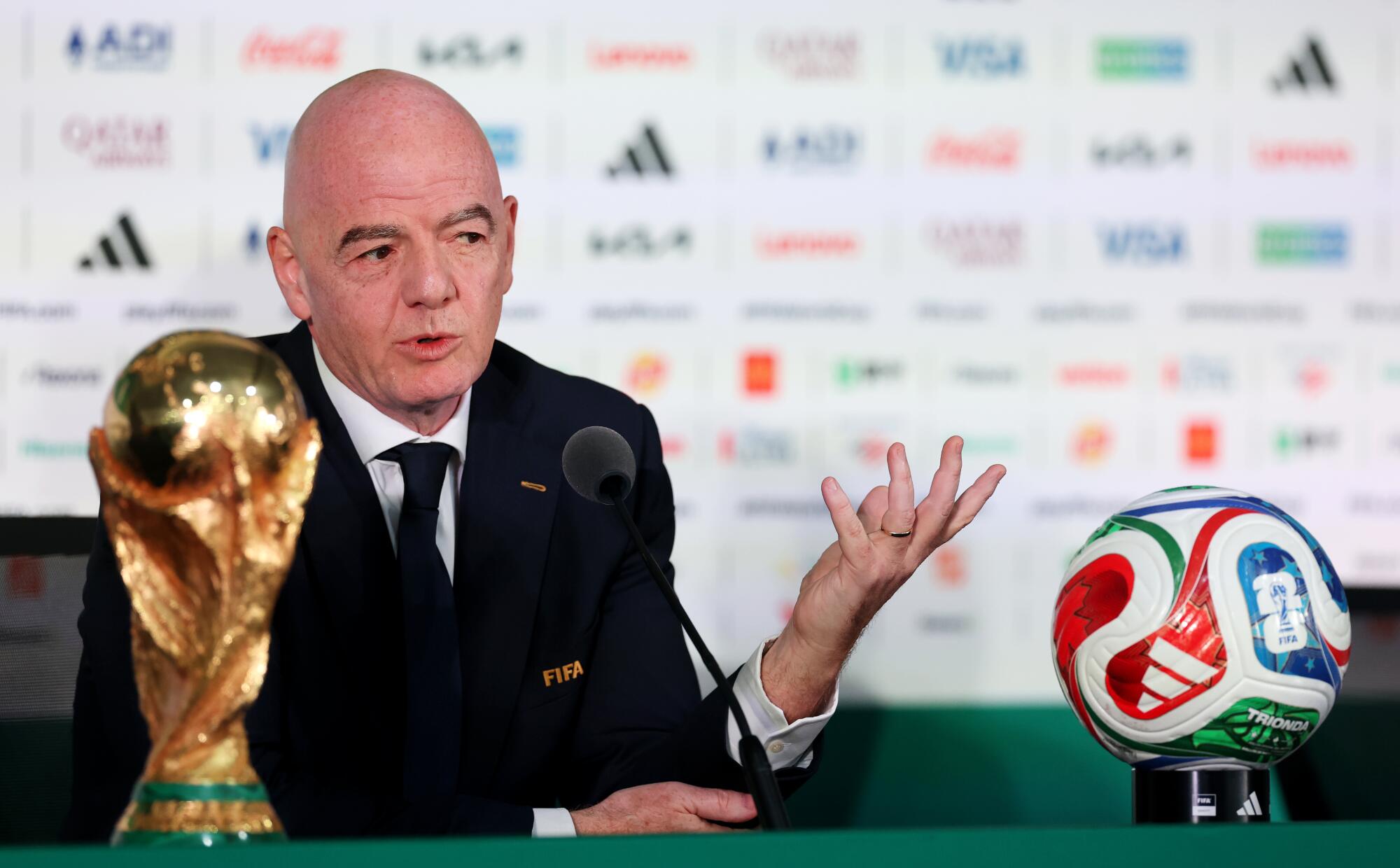
FIFA president Gianni Infantino remains optimistic, promising this will be “the biggest, the most inclusive, the greatest FIFA World Cup ever.” He made the same claim about the 2022 World Cup in Qatar and the 2018 tournament in Russia.

FIFA president Gianni Infantino speaks during a news conference on Wednesday before the start of the World Cup.

FIFA president Gianni Infantino speaks during a news conference on Wednesday before the start of the World Cup.

(Carl Recine / Getty Images)

“The World Cup should be understood as both a global sporting celebration and a major commercial enterprise, with these two dimensions being mutually enforcing rather than contradictory,” said Steve Georgakis, a lecturer on sports studies at the University of Sydney and a frequent author on soccer.

This year’s tournament is projected to swell FIFA’s coffers by nearly $9 billion and the TV ratings, it says, will be massive.

“Its universal appeal combined with the participation of 48 nations ensures that it remains a genuinely global sporting event,” Georgakis said.

Boykoff has his doubts.

“In this particular political moment, with the Trump administration being erratic and impulsive and needing a win from this tournament and the fact there’s so many moving parts geopolitically, I don’t have confidence that it’s just going to end up being a soccer-focused next five weeks,” he said.

This is not the first World Cup to kick off under some kind of black cloud.

The 1974 tournament in West Germany was tarred by the geopolitical fallout of the 1973 Yom Kippur War. Four years later Argentina’s military dictatorship used the World Cup to sportswash a “Dirty War” in which as many as 30,000 people were tortured, murdered and disappeared.

The 2010 and 2014 World Cups were troubled by cost overruns and delays in the construction of stadiums and other infrastructure and the threat of labor unrest while global outrage over human rights violations and discrimination against women and LGBTQ people hung over the last two tournaments.

Those issues never fully disappeared but were overshadowed by the brilliance of the soccer. Jonathan Wilson, a columnist with the Guardian and author of “The Power and the Glory: The History of the World Cup,” expects the same this summer.

“The other stuff will still be there in the background,” he said, “but fundamentally the football will, for the vast majority of people, take over. It’s just sort of a natural cycle.”

Argentina star Lionel Messi controls the ball during an international friendly against Iceland on Tuesday.

Argentina star Lionel Messi controls the ball during an international friendly against Iceland on Tuesday.

(Butch Dill / Associated Press)

And as with every World Cup, there undoubtedly will be unforgettable moments.

Argentina’s Lionel Messi and Portugal’s Cristiano Ronaldo, the top scorers in soccer history, will be playing in their sixth and final World Cups — Messi chasing a second straight title and Ronaldo pursuing the only prize that has eluded him.

Kylian Mbabbe will be trying to take France to a third consecutive final while young superstars like Erling Haaland of Norway and Lamine Yamal of Spain will be looking to put their mark on their first World Cups.

Four teams — Jordan, Curacao, Cape Verde and Uzbekistan — have qualified for the tournament for the first time.

And there will be other storylines no one saw coming, all of which will contribute to the narrative of this World Cup.

“Major sporting events have a way of capturing public attention and shifting the conversation toward what is happening on the field rather than off it,” Georgakis said.

How much the actions of the Trump administration affect that calculation remains to be seen.

There are travel restrictions in place that fully or partially bar citizens from 39 countries — including a number of World Cup participants — from entering the U.S. And the administration has said ICE and Homeland Security personnel will have a visible presence at World Cup venues, including SoFi Stadium in Inglewood, where the American team will begin play Friday.

“There will be federal agents,” confirmed L.A. County Sheriff Robert Luna, who added that he could not guarantee immigration sweeps would not take place. “ They told us that specifically would not be occurring,” he said. “Any of that’s subject to change.”

Mexico fans celebrate during a watch party at Plaza Mexico in Lynwood on Thursday.

Mexico fans celebrate during a watch party at Plaza Mexico in Lynwood on Thursday.

(Kayla Bartkowski / Los Angeles Times)

The difficulty in obtaining visas and the fear of being rounded up by immigration agents are being blamed, in part, for less-than-expected tourist traffic. Hotel operators in all 11 World Cup host cities say bookings for the tournament are well below projections. Several countries have issued warnings about travel to the U.S.

Then there are the own goals from FIFA over tickets and parking prices as high as $900 at some stadiums, weather issues and a short-lived ban on water bottles.

FIFA has defended its policies on ticket prices by arguing that premiums are necessary to maximize revenue, which it will invest in global soccer development. Variable, market-based pricing, it said, simply reflects standard entertainment practices in North America. The organization did, however, reverse its ban on fans bringing bottles into games. Spectators are now allowed to enter stadiums with one soft, plastic 20-ounce water bottle.

And despite a warning from climate scientists that one in four World Cup games could be played in dangerously hot conditions, FIFA will start 40 of them at 3 p.m. or earlier local time, the warmest time of day, to accommodate European TV viewers.

Georgakis said the play on the field will have to overcome all those issues if this World Cup is to earn a favorable place in history.

“Ultimately the success of the World Cup will be judged by what happens on the field,” he said. “If the football is compelling, dramatic and memorable, the tournament will likely be remembered as a great World Cup. If the play falls short, then the off-field issues such as ticket prices, extreme heat, ICE enforcement activities, the Trump administration will receive great attention and could shape perceptions of the event.”

Source link

Thousands welcome U.S. men’s soccer team to SoCal ahead of World Cup

With its World Cup opener just four days away, the U.S. team moved into its temporary home in Irvine on Monday, where the players found thousands of new Southern California neighbors waiting in line to watch them kick a ball.

After the U.S. announced that Orange County Great Park would be its base for at least the group stage of the tournament, the City of Irvine held a raffle for passes to see the team train in its only public workout.

Thirty-two thousand people applied and 5,500 received access on a warm Monday morning to watch the team rush through a light 45-minute practice that was notable primarily because it was the first in which injured center back Chris Richards was fully involved. Richards tore two ligaments in his left ankle playing for Crystal Palace, his English club team, on May 17 and hadn’t played or fully trained since. The team is rushing to get him ready in the hopes he can play at some point in the three-game group stage.

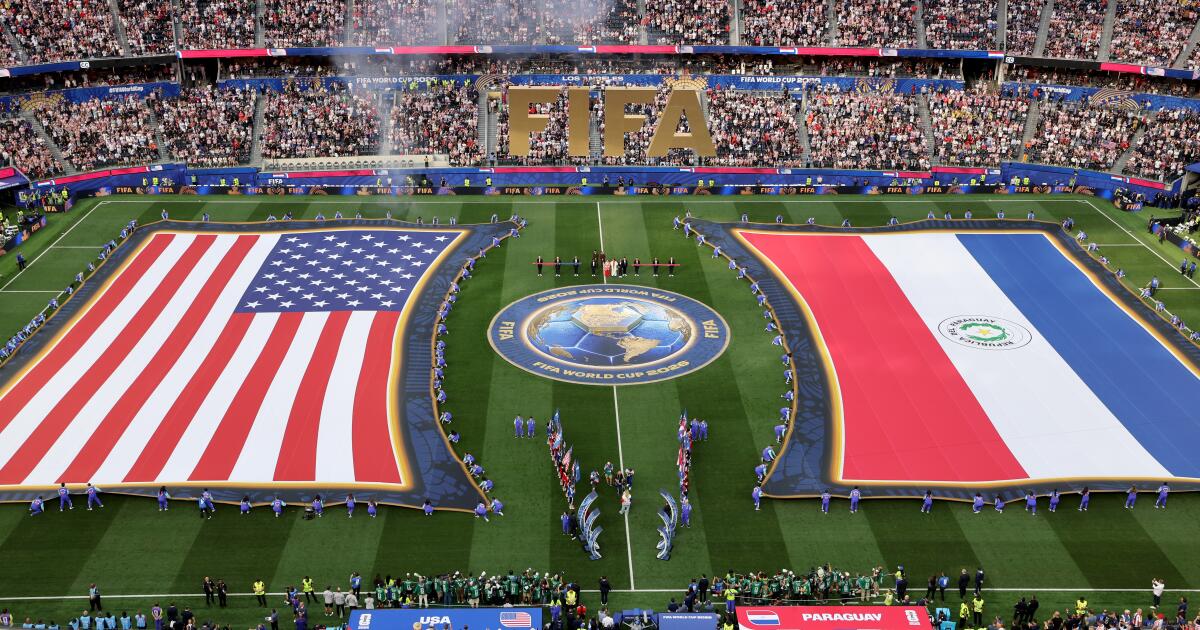
But the practice was also notable because it was the first at Championship Soccer Stadium, about 50 miles southeast of SoFi Stadium in Inglewood, where the U.S. will open its World Cup on Friday against Paraguay.

“[The] environment and facilities are crazy. It’s more than we expect,” U.S. coach Mauricio Pochettino said of the venue. “We are so grateful.”

Championship Soccer Stadium is owned and managed by the city, which has leased it to the Orange County Soccer Club of the second-tier USL Championship. But the club was temporarily evicted in late April to make space for the national team — which is just fine with them.

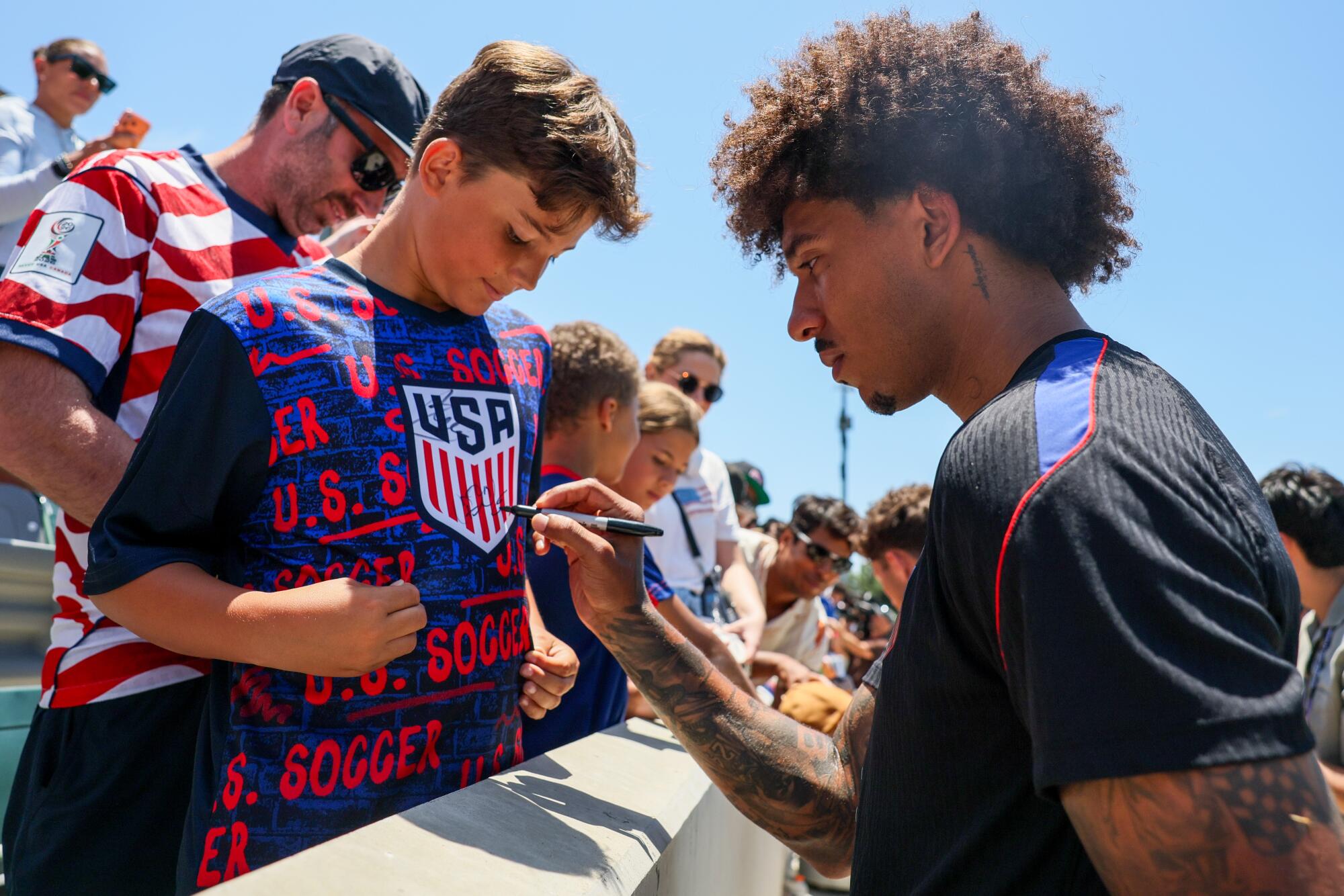
Irvine, CA - June 08: USMNT player Chris Richards autographs the shirt of a young fan.

U.S. men’s soccer player Chris Richards autographs the shirt of a young fan during a team practice Monday.

(Ronaldo Bolaños / Los Angeles Times)

“How can you not be excited about the host nation training in your facility?” said Dan Rutstein, president of business operations of the Orange County club.

“We’re proud to be associated with the U.S. national team. We wouldn’t want to ever block anything, even if we could.”

(And they couldn’t, the city said.)

The Great Park is a sprawling 500-acre complex built on the site of the former Marine Corps Air Station El Toro, which closed in 1999 after 56 years training pilots for conflicts from World War II through the first Gulf War. In 2001, voters approved a proposal to convert the space into a public park and nature preserve, one which now includes, among other things, five sand volleyball courts, four basketball courts, 25 tennis courts, 12 softball and baseball fields, the ice arena where the Ducks practice and 25 soccer fields, including the pristine one FIFA just installed inside the 5,500-seat stadium.

“The idea was that this would be a quality facility, a great park that we hope will rival San Diego’s Balboa Park and other great parks across the country,” Irvine mayor Larry Agran said. “It took a lot of nurturing, a lot of time, a lot of work.”

Bringing the World Cup — or at least a World Cup team — to Irvine also took a lot of time and work. Agran said the city put out feelers about hosting a training base five years ago and made the first cut in 2024 when the Great Park was placed on a list of options distributed to tournament qualifiers.

Over the next two years, Rutstein said, about a dozen national teams sent representatives to have a look while Sam Zapatka, the operations manager of the USMNT, said he scouted 27 facilities from Seattle to San Diego. After his first visit to the Great Park, however, he said he stopped looking and in March, the team announced it would train in Irvine.

On Monday, when the players filed out of the stadium’s locker room, which FIFA expanded and upgraded, they were greeted by rhythmic clapping and chants of “USA! USA!”

1

U.S. men's soccer player Weston McKennie takes part in a training session at

2

U.S. men's soccer players (from left) Weston McKennie, Christian Pulisic and Sergino Dest take part in a training session.

3

U.S. men's national soccer team coach Mauricio Pochettino waves to fans attending practice on Monday.

4

U.S. coach Mauricio Pochettino speaks to players after

1. U.S. men’s soccer player Weston McKennie takes part in a training session at Orange County Great Park. (Ronaldo Bolanos / Los Angeles Times) 2. (Ronaldo Bolanos/Los Angeles Times) 3. U.S. men’s national soccer team coach Mauricio Pochettino waves to fans attending practice on Monday. 4. Pochettino speaks to players after drills at Orange County Great Park on Monday. (Ronaldo Bolanos / Los Angeles Times)

“I think we’ve all been, I wouldn’t say overwhelmed, but possibly surprised by the excitement and the buzz,” said captain Tim Ream, who led the team onto the field. “Pulling up here with 5,500 fans ready to watch a training session is incredible.

“We get to train in an actual stadium with a good pitch. The support, really, from all the kids out there is amazing. You want to feel like you have a good home base, right? So really, we’re looking forward to being here.”

Especially after 5,000 of your neighbors show up for the housewarming party.

Source link

Iran soccer team heads for Mexico to prepare for World Cup

Iran’s national soccer team set off from Turkey for their World Cup training base in Mexico on Saturday, with some members of their entourage reportedly still without U.S. visas, before three group matches in the United States later this month.

The Iranian Football Federation’s secretary-general, Hedayat Mombeini, and its vice president, Mehdi Mohammad Nabi, were among 14 staff and officials without U.S. visas before games in Los Angeles and Seattle, according to Iranian state television.

It was unclear whether the federation’s president, Mehdi Taj, had been issued a visa.

The team’s participation in the World Cup has been complicated by the Iran war. Problems with processing visas had earlier led Iran to move its training base from Tucson, Ariz., to Tijuana, Mexico, which is on the border with California.

The federation accused the U.S. of “vindictive behavior” in refusing visas for “key managerial and administrative members” of the team.

The decision had “effectively denied the Iranian national team the opportunity for a level playing field and a competition free from discrimination,” according to a statement on the federation’s website. It added that the federation would pursue the matter through world soccer authority FIFA.

The Iranian Embassy in Ankara, Turkey, meanwhile, responded to an earlier social media post from U.S. Ambassador Tom Barrack, in which he congratulated his embassy staff for processing the Iran team’s visas.

“You cannot whitewash conduct that violates FIFA regulations and breaches the United States’ host obligations merely by praising yourselves,” the Iranian post read. “This represents the worst possible form of politically biased interference in sport.”

One U.S. official earlier told the Associated Press that all players on the Iranian team were approved for visas, while a second official said visas had been issued for players, coaches, trainers and some support staff. A third official suggested that some applicants affiliated with the team had been rejected for requesting visas “under false pretenses.”

The officials spoke on condition of anonymity because they weren’t authorized to discuss the visas publicly.

The squad has been preparing for the World Cup at a training camp in Antalya. The team said that it has already received visas from the Mexican Embassy in Ankara.

The players, dressed in blue blazers over white T-shirts, left the luxury Mardan Palace hotel in Antalya on Saturday afternoon. They boarded a private jet at the Mediterranean city’s airport and were due to fly directly to Mexico.

Iran plays its first two games in Inglewood against New Zealand on June 15, and Belgium six days later, then heads to Seattle to face Egypt on June 26. Iran and the U.S. could meet in the round of 32 on July 3 in Arlington, Texas, if both teams come second in their groups.

In March, U.S. President Donald Trump had discouraged Iran from participating in the tournament, saying he didn’t think it was “appropriate” and raising concerns over players’ “life and safety.” A day later, Iran’s national team pushed back, saying “no one can exclude” it from playing.

Iran finalized its team on Monday, including 17 home-based players whose clubs haven’t played since February because of the war. Star forward Sardar Azmoun was dropped in March, reportedly because of a social media post that angered Iranian authorities during the war.

Change in water bottle policy

FIFA announced that it will now allow fans to bring their own water bottles to some stadiums during the World Cup, adjusting a policy that had barred spectators from bringing refillable water bottles into the tournament’s 16 stadiums across North America, including some with limited or no shade from the sun.

FIFA in a social media post said fans will be permitted to bring one soft plastic 20-ounce, factory-sealed, disposable water bottle into any match taking place in the United States or Canada.

In a video released by FIFA, Chief Operating Officer Heimo Schirgi said fans will still not be permitted to bring in hard sided, reusable water bottles “due to safety and security reasons.”

Going green

As the tournament opens on Thursday, 13 of the 16 stadiums have earned LEED certification, the world’s most widely used green building rating system, the U.S. Green Building Council said. Ten have been certified since 2024 through the rigorous process to ensure buildings meet strict sustainability standards. The council expects at least two of the three remaining stadiums to achieve certification in the coming weeks.

Together, the LEED-certified stadiums have installed over 11,500 solar panels to generate clean electricity. Because of the changes made, they will save over 100 million gallons of potable water annually and eliminate more than 5 million single use plastics annually, according to information shared by the stadiums. Four venues are reusing, recycling or composting nearly all waste, preventing it from reaching a landfill.

Source link

SoFi Stadium workers vote to authorize strike ahead of World Cup

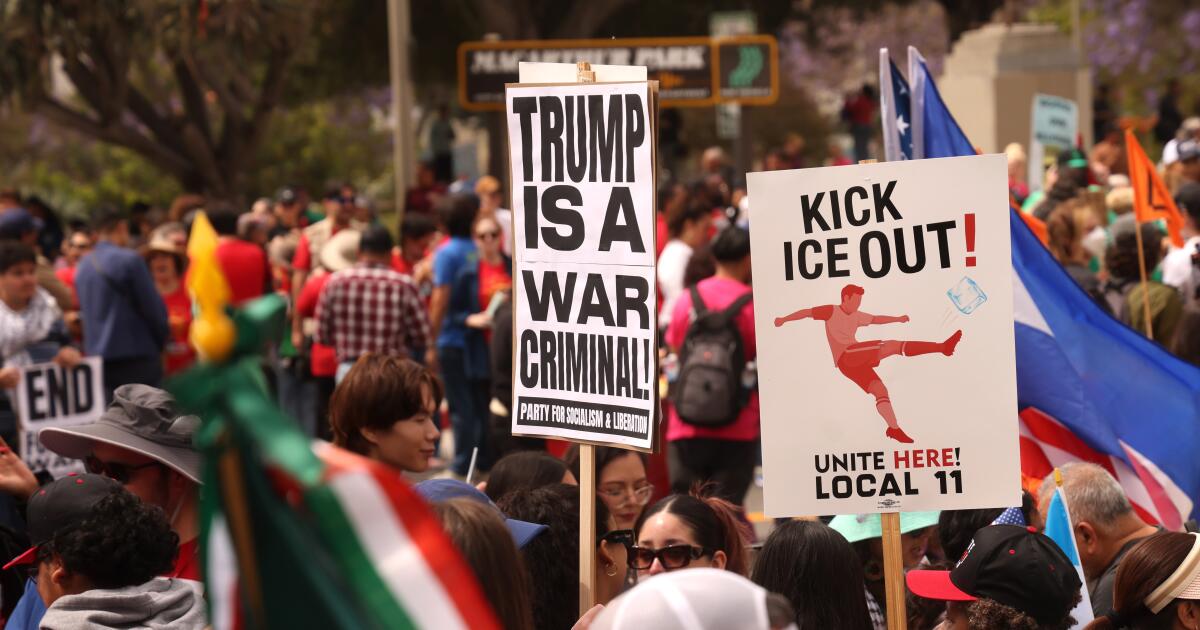
Nearly 2,000 food and beverage workers at SoFi Stadium voted overwhelmingly Friday to authorize a strike just a week before the venue will stage the first World Cup game on U.S. soil in more than three decades.

Negotiations on a labor contract between Unite Here Local 11, the union representing the cooks, dishwashers, concession workers and bartenders at SoFi and, Legends Global, the stadium’s food-service operator, are expected to continue Monday despite the vote. But Kurt Petersen, the union’s co-president, said if an agreement isn’t reached workers will walk off the job and the 70,000 fans arriving for the June 12 match between the U.S. and Paraguay will be greeted by hundreds of picketers.

Union members have been working without a contract for a year and Petersen said Unite Here is demanding salary increases, protection against subcontracting and job loss through automation, and are protesting the collection of sensitive private information such as nationality and home addresses that FIFA, organizer of the World Cup, said it needs to accreditate workers.

Workers are also demanding the right to walk off the job if federal immigration enforcement enters the stadium and creates a reasonable fear for their safety. Ninety-six percent of the vote was in favor of strike authorization.

Legends Global, the stadium’s food-service operator, responded to the vote with a statement.

“Legends Global has presented progressive wage proposals to Unite Here Local 11 throughout our negotiations and remains confident an agreement is within reach,” it read. “While we expect a contract will be finalized in time, a contingency staffing plan is in place to ensure seamless operations and no disruption to fans. We remain committed to delivering an outstanding hospitality experience at the FIFA World Cup matches.”

That contingency plan would involve hiring replacement workers who would have to undergo the same detailed accreditation procedures demanded by FIFA, plus job training. SoFi Stadium is scheduled to play host to eight World Cup matches, including two of the U.S. team’s three group-stage games. The first of those is on June 12 when the U.S. faces Paraguay in its World Cup opener.

Petersen said the union is looking for “substantial increases” in hourly pay, to more than $30 an hour. Legends’ most recent proposal calls for wage freezes for some workers and a 25-cent hourly increase for cooks and dishwashers, the union said.

But perhaps the biggest sticking point is FIFA’s demand for workers’ sensitive personal information, including Social Security numbers and fingerprints, to process background checks. Under California privacy laws, workers have the right to know exactly what personal information their employer collects, how it will be used, and who it will be shared with. Local 11 said its members fears such information, if collected, could be made available to the Department of Homeland Security and ICE.

According to Petersen, when workers were originally hired by Legends they submitted the documentation necessary for employment, and under the current collective bargaining agreement the company does not have the right to request it again for FIFA.

FIFA has refused to comment on the contract talks, saying they are “between Legends Global and Unite Here Local 11.” But its insistence on collecting personal information is something Legends cannot address during contract talks, which makes a resolution impossible.

FIFA said it was partnering with the governments of the U.S., Canada and Mexico, the three countries in which the 39-day tournament will be played, “to enhance safety and security of all workers, staff, team members, vendors, journalists, volunteers, and spectators by mitigating potential insider threats. … Such name checks do not constitute pre-employment checks.”

All data collected during the name-check process, FIFA said, will be processed “in accordance with applicable data protection and privacy laws, and will be deleted by FIFA as soon as it is no longer needed for purposes of adjudicating requests for credentialed access to FIFA-controlled spaces.

Source link

World Cup fans squeezed by botched ticket sales, steep water prices

It wasn’t too good to be true, but it was too good to remain true.

World Cup fans still reeling from FIFA’s pricey water policy change have a new gripe: Soccer’s governing body is demanding payment from about 60 people who secured tickets for free because of a glitch on the FIFA website during checkout.

FIFA confirmed the mistake with a swift response, issuing a statement that said pay up or stay home:

“The tickets requested by these fans remain reserved, and the affected fans have been invited to complete payment of the correct amount. FIFA regrets the error and any inconvenience caused.”

What, did anyone think a governing body denying fans free water in the summer heat would allow 60 souls into stadiums without paying admission? Even when FIFA admitted its mistake?

One week before matches begin in 16 North American venues, including SoFi Stadium that will be referred to during the tournament as Los Angeles Stadium, FIFA reversed its policy that allowed refillable plastic bottles when temperatures were high enough to justify it.

Now, no plastic water bottles are allowed except the ones sold in the stadium. Last summer during the Club World Cup, bottled water at FIFA venues fetched $4 to $6.

Coca-Cola products will be sold at all World Cup venues, including Dasani water. In a statement to the Athletic on Thursday night, FIFA skirted questions about whether it was influenced by commercial priorities.

“The decision to prohibit capped water bottles is based on a number of factors related to safety and security, including mitigating risks to players and spectators, ensuring a safe and efficient ingress experience for all attendees, and the presence of additional heat mitigation and alternative hydration strategies at FIFA World Cup 2026 stadiums,” the statement read.

Toronto Mayor Olivia Chow questioned FIFA’s motive.

“Why do you need to buy a water bottle when you can just carry your water in? It is cheaper that way and it is good for the environment,” Chow told CTV News. “It is outrageous. They are just trying to make more money. They are already making billions of dollars. Stop it.”

Chow’s ire likely grew upon learning that the group-stage matches the 60 people who now must pay for tickets FIFA mistakenly provided them are all in Toronto.

Complaints have mushroomed for months about World Cup ticket price fluctuations caused by sophisticated algorithms that can dramatically increase costs based on demand. Prices adjust in real time, increasing when interest surges.

The attorneys general of New Jersey and New York a week ago launched an investigation into World Cup ticket sales following reports that fans were misled about the locations of seats they purchased.

The attorneys general sent subpoenas to FIFA, requesting details about ticketing practices for eight World Cup matches hosted in New Jersey, including the World Cup final.

FIFA has about $6.14 billion in total assets and $3 billion in cash reserves.

The organization has defended its steep ticket prices, saying they reflect standard practices for major global sporting and entertainment events.

Longtime soccer journalist Simon Kuper explained to The Times’ Kevin Baxter that FIFA can maximize profits because it has no competition.

“If you think of McDonald’s or Nike, they’re trying to please consumers because they know the consumers can go someplace else,” Kuper said. “There’s only one World Cup, so FIFA is a monopoly purveyor. It’s more like one man running the cash box.”

Parking will be another opportunity to generate revenue. A spot nearly two miles from SoFi Stadium will cost $300 for the U.S. opener against Paraguay next week.

Source link

Where to eat and drink near SoFi Stadium in Inglewood

Making a rib stop on the way to a game and then eating your barbecue inside your car — or, better, on the hood of your car if you don’t want sauce-stained seats — has been a classic move since the days the Lakers used to play at the Forum in Inglewood. Lately, however, it’s getting harder to find old-school L.A. barbecue — the wood-smoked ribs and links and small ends that have long powered this city. Luckily, Inglewood is home to two outposts from the first family of L.A. barbecue: Woody’s (see separate entry), started by the late Woodrow “Woody” Phillips and Phillips Bar-B-Que from Woody’s cousin Foster Phillips, who still inspires younger pitmasters. Where Woody’s has patio seating, Phillips, in traditional barbecue style, is a take-out-only shop with a tightly packed parking lot off Centinela Avenue. It’s the only location that remains after the 2024 closure of Phillips’ Crenshaw spot. Recently, I stopped in for pork ribs so tender the meat easily came free from the bone; small ends, a meaty cut Phillips helped popularize; plus sides of greens and an especially cheesy macaroni and cheese. If you order your rib sauce hot, it may not be as spicy as it was in the old days, but it still has the sweet taste of nostalgia.


Source link

Ryan Ward becomes an unlikely star in Dodger Stadium debut

An eerie silence descended upon Dodger Stadium as the swatted ball soared toward the right field corner.

What was this? Who was this?

This wasn’t a crowd-roaring drive by a future Hall of Famer. This wasn’t a Ravine-rattling shot by a perennial All-Star.

This was rare. This was weird. This was a long fly by a long-shot outfielder ending a long minor-league journey with his first appearance at Dodger Stadium.

The ball flew and flew and, suddenly, this was a home run. A home run? Who was that again?

The stunned crowd erupted.

And Ryan Ward danced.

Yeah, the sunny 28-year-old did the Freddie Freeman Hop as he rounded second base in a wonderful show of giddy celebration by a guy who’s earned it.

“Kind of a blackout, if I’m going to be honest with you,” Ward said. “Hit it and kind of just went numb.”

Feel free to go numb with him. With his fourth-inning solo blast in Sunday’s 9-1 victory over the Philadelphia Phillies, this not-exactly-a-kid-anymore was the once-in-a-lifetime story.

After seven minor league seasons, his first major-league home run.

After 156 minor-league homers, his first big-league dinger.

After years of trudging through Great Lakes and Ogden and Tulsa and Oklahoma City, his first big fly at 1000 Vin Scully Ave.

In fact, it was his first game at Dodger Stadium, period, and he soaked in the atmosphere with the same wide-eyed wonder as all those little leaguers who marched around the field before the game.

”When I went out to left field, kind of just looking around, taking it in, just realizing how special it was, just have fun with it, enjoy it all,” he said.

The Dodgers’ series win against a team that will challenge them in October was especially a blast for the “others,” the role players who wind up being so important, with Ward and Alex Freeland homering while Alex Call hit a two-run single.

“Everybody in this locker room is a superstar,” Freeland said. “A lot of us get overlooked just because we have guys like Shohei and Freddie. Everybody in this clubhouse can ball.”

Nobody was as excited to just be in the clubhouse as Ward, who is one of the little-known casualties of the Dodgers’ success, a decent hitter from their farm system who has never gotten a chance because the Dodgers don’t have a need for just-decent hitters.

Ryan Ward hits a solo home run for the Dodgers in the fourth inning Sunday against the Phillies.

”When I went out to left field, kind of just looking around, taking it in, just realizing how special it was, just have fun with it, enjoy it all,” Ryan Ward said after hitting a solo home run Sunday.

(Ronaldo Bolaños / Los Angeles Times)

When it comes to position players, with the exception of the former prospect Andy Pages, they buy stars, they trade for stars, they hoard stars, and they rarely give a long look to anybody who isn’t guaranteed to be a star.

It is in this environment that Ward has surely asked himself, what does he have to do?

He was drafted out of Rhode Island’s Bryant University in 2019 and by 2021 he was showing home-run power with 27 jacks at class-A Great Lakes. Every year he climbed the minor league ladder, and every year he grew stronger, with 34 homers and 104 RBIs two years ago, and 36 homers with 122 RBIs last year when he was named Pacific Coast League MVP.

How long has he been in the bush leagues? He is triple-A Oklahoma City’s career leader in home runs.

But he was prone to slumps, and oversized swings, and average defensive skills, and last season at Oklahoma City his strikeouts equaled his RBIs.

So he never got even a major-league sniff, leading him to spend his winters working a snow plow with his father to stay in shape, yet he never complained.

“Even talking to Freeland today on the bench, and he made a note that Ryan was probably the most positive guy down there in triple A, and that speaks to his character,” said manager Dave Roberts. “And if there’s anyone that has the right to be salty and frustrated, it’s him, but he was professional about it, and he was an easy one to recall and get him here.”

This finally happened late last month when Ward was recalled to briefly fill a hole when Freddie Freeman went on paternity leave. He played two games in Colorado, had a couple of hits, and was sent back down.

This weekend, he was recalled again to replace Teoscar Hernández, who was placed on the injured list with a strained left hamstring. Ward was jammed in the lineup Sunday, struck out against Phillies’ rookie Andrew Painter in the second inning, then made contact on a 1-and-0 pitch and sent it whirling into the right-field bullpen.

“Watching it go over the fence was really cool,” he said.

Ryan Ward celebrates as he runs the bases after hitting a home run in the fourth inning Sunday against the Phillies.

Ryan Ward celebrates as he runs the bases after hitting a home run in the fourth inning against the Phillies.

(Ronaldo Bolaños / Los Angeles Times)

Watching the ball returned to his locker in a glass cube was perhaps just as cool. And then celebrating afterward by getting doused with all sorts of stuff by his thrilled teammates? Off the charts.

“I’m probably gonna smell for a little bit,” he said.

Smell of what?

“You name it.”

Considering Ward hit his homer in the fourth inning, you’re probably wondering how he performed the rest of the game. Well, um, there was no rest of the game. He was almost immediately benched again for Call.

And the struggle continues.

“Keep trying to grind your game as much as you can and just kind of force the door down,” he said.

Bang. Bang. Bang.

Source link