
Stack

When Bamboo Diplomacy Meets the American Tech Stack

Vietnam’s sovereign AI relies heavily on open-weight models developed in the United States. However, as Washington and Beijing are moving to restrict access to these technologies, Hanoi’s bamboo diplomacy offers little protection to its AI ambitions.

In mid-July, Vietnam approved its National Digital Transformation Strategy for 2026-2030 under Decision 1266/QD-TTg, and the National Data Strategy under Decision 1308/QD-TTg. Both strategies aim for national digital sovereignty, domestic self-reliance and state-level data governance on the assumption that artificial intelligence (AI) models would remain a public good. Within days, the United States (U.S.) and China signalled their readiness to restrict access to those models.

Made in America

Vietnam’s current AI systems are modified versions of foreign tech. On the ground, Viettel, the state military telecom giant spearheading Vietnam’s AI goals, announced its VT-Super-120B-A12B Vietnamese language model had matched the accuracy of major global models of similar size. It was built by adapting Nemotron, Nvidia’s freely downloadable model family, to Vietnamese data. Viettel’s earlier model was also built on Meta’s Llama 3, trained with Nvidia tooling, and run on a cluster of 22 DGX B200 supercomputers at its Hoa Lac centre.

Stay ahead of the geopolitical week.

MD Briefing delivers expert analysis across five global fronts — the Indo-Pacific, energy, geoeconomics, European security, and the Middle East — every Monday morning. Free.

Moreover, VNG’s GreenNode subsidiary introduced GreenMind-Medium-14B-R1, the first open-source Vietnamese reasoning model built to run on Nvidia’s software and a single Nvidia H100 graphics chip. Meanwhile, FPT Corporation committed $200 million to build its AI factory powered by Nvidia hardware.

At the state level, Vietnam’s Ministry of Science and Technology met with senior executives from Qualcomm in Hanoi on July 17. Deputy Minister of Science and Technology Hoang Minh and Qualcomm’s Executive Vice President Durga Malladi discussed expanding cooperation in AI semiconductors, research and development, and workforce training.

While Vietnam has made its bets on the U.S. for its AI ambitions, other Southeast Asian countries are leaning towards China. Indonesia’s Indosat Ooredoo Hutchison partnered with AIonOS on DeepSeek-powered services, and Malaysia’s Communications Ministry launched a sovereign full-stack AI ecosystem running on Huawei hardware.

Outside Two Blocs

AI governance is dividing into two blocs. One bloc is the U.S.-led Pax Silica initiative, which coordinates trusted supply chains for semiconductors, critical minerals and AI infrastructure with 24 signatories. Singapore, the Philippines, India, Japan and South Korea are among them. The Philippines converted membership into commitments by agreeing in April 2026 to a 4,000-acre economic security zone in the Luzon economic corridor designated as the initiative’s first AI-native industrial hub.

The other is the Chinese-backed World Artificial Intelligence Cooperation Organization, signed into existence in Shanghai on July 16 by 29 governments. The membership also includes Russia, Belarus, Cuba, Venezuela and most of Central Asia, alongside Vietnam’s neighbours Laos, Cambodia and Myanmar.

Membership in either bloc could offer access to supply chains, technical assistance and software distribution during a diplomatic crisis.

However, Vietnam belongs to neither group because of its long-standing bamboo diplomacy, a policy of balancing relations between Washington and Beijing without taking sides. This leaves Hanoi in an awkward position. Vietnam depends heavily on American technology, but enjoys none of the guarantees or protections of one.

Weaponising Access

Export controls on chips work because processors are physical goods, subject to customs enforcement. On May 31, the Bureau of Industry and Security extended licensing requirements to any China-parented buyer worldwide, closing loopholes in Singapore and Malaysia.

AI models do not behave the same way. Access to a closed system can be revoked instantly by flipping an application programming interface (API) key. For example, on June 12, Anthropic suspended access to its Fable and Mythos models to comply with U.S. Commerce Department export controls, restoring access only on July 1 after those controls were lifted. Such events largely explain why governments prefer AI models they can host locally.

In contrast, an open-weight model, once downloaded, cannot be recalled by any foreign regulator. Instead, global superpowers exert control by forcing major tech companies and code-sharing platforms to block downloads from specific regions or countries. They can also pressure developers to restrict future model updates to dodge penalties from Washington or Beijing.

This fight over AI access is now an open battle. On July 16, Chinese startup Moonshot AI unveiled Kimi K3, a 2.8-trillion-parameter model that independent evaluators say matches top American models at a fraction of their operating cost. On July 21, Treasury Secretary Scott Bessent signalled that Washington could sanction Chinese tech firms, citing American-model watermarks found inside Chinese ones. Days later, China’s Ministry of Commerce called the investigations groundless, threatened countermeasures, and began consulting Alibaba, ByteDance and Z.ai on export controls covering model weights, training data and chip designs.

Why It Matters

For years, nations have built digital capacity cheaply and quickly by customising open-weight AI models. Kimi K3 seemed to promise that era would continue. Instead, the geopolitical fallout exposed the fragility of relying on superpower goodwill.

For Vietnam, the real threat is getting left behind. Washington or Beijing cannot delete the AI models already sitting on Vietnamese servers. What they can block is future releases. If both superpowers restrict open-weight models, Vietnam’s AI ecosystem gets stuck using today’s tools while the rest of the world moves forward. A national tech stack built on frozen updates decays one generation at a time. States that have not localised model weights face an even harsher reality. Their access relies on live connections and downloads that can vanish overnight with a new policy.

At its core, this is a problem of time. Vietnam’s bamboo diplomacy relies on having time to adapt. Trade deals and defence agreements move slowly, giving Hanoi room to bend without breaking. AI access, however, moves instantly as access disappears with a revoked key or a blocked download link.

Diplomatically, Vietnam tries to stay neutral at all costs. However, its technology does not try to do so. All of its major AI models are built on American weights, run on American chips, and improve when American companies release new ones. Vietnam acts as if it can delay picking a side, but with every new AI update or blocked release, the cost of delay becomes more expensive. In the past, diplomatic pressure moved slowly through international summits. Today, that pressure speeds up with every new model release.

Source link

Forget the average beach read — Claire Vaye Watkins’ wild desert story is what your stack is missing

If you get out to Joshua Tree and the night is clear, look up. You’ll see not just the stars, but a massive swath of the Milky Way. It’s a reminder that the vastness is always present, beyond the city’s bright lights. And once dawn comes, the desert performs the same magic: long horizons, unfamiliar landscapes, the creeping feeling that we are small, short-lived creatures on an immense ancient planet. No wonder some people find it unsettling.

On the Shelf

Yellow Pine

By Claire Vaye Watkins
Riverhead Books: 256 pages, $29

If you buy books linked on our site, The Times may earn a commission from Bookshop.org, whose fees support independent bookstores.

Not the characters in Claire Vaye Watkins’ new novel “Yellow Pine,” who embrace the desert in the extreme. They live at the far side of the Mojave Desert where California meets Nevada. Wherefore the pines, you ask? The book’s title is a wry joke — “Yellow Pine” is not a forest, not a tree. It’s a massive solar array slated to be built nearby in the Nevada desert. A ragtag crew of desert dwellers are hoping to stop it, or at least slow down the grinding wheels of capitalism that see the desert merely as an empty space for the taking.

Primary among them is Rose, a 30-something single mom who lives near the end of a very, very long dirt road in a cabin she calls Nothingness Flats. Rose works for an environmental nonprofit that has gone remote because it’s the pandemic; she often spirals at the state of the world. “Sometimes I think I can feel the planet just hemorrhaging under all this greed. Like it’s tectonic,” she laments.

Rampant environmental destruction notwithstanding, the novel kicks off with the joyous return of Miles, the guy who got away. He is an outdoor person, like Rose; has trouble fitting into societal norms, like Rose; and he is an ideal intellectual partner for her, bantering, well-read and ready to engage. Also, they have great sex.

Lest I portray this as a typical summer beach read, Watkins’ writing is in a special, different mode. Her latest books somehow cut past narrative traditions and portray plot and emotion more directly. Another novel might find Rose, after she decides she loves Miles so much that she wants to get pregnant, going to a doctor, getting tests, worrying about being almost 40 and what that means. Rose does none of that — she just suddenly deeply wants a baby, and that desire is vivid in the text. Overexplained storytelling is set aside for something that’s striking and vivid.

When I reached Watkins via Zoom to talk about the book, I asked her how she does it. “Partly it’s an intuition I have about what makes an interesting story,” Watkins says. “A story requires a lot of improbable decisions. Maybe they’re not great decisions, but the person doesn’t know that at the time.”

In “Yellow Pine,” Miles is not without some red flags. In my reviewer’s copy, I found myself scrawling “bad idea!” in the margin, trying to warn Rose about him. It gives the story some tension, and shows that our heroine isn’t perfect — she’s just doing her best under desert skies.

Rose lives in Tecopa, population 120, among people who’ve chosen the isolation, quietude, natural beauty and brutal conditions on purpose. Of the real-life people in these communities, Watkins says, “It’s really tough. The environment is extreme. There are no amenities. There’s no jobs. … I think there’s a refusenik quality to them.”

Nevertheless, some of them come together to try to forestall the installation of the solar array. They point out that “solar farm” is a misnomer because the land — an alluvial plane with Yucca colonies dating back hundreds of years, creosote rhizomatic rings even longer — will be scraped and fenced. What happens to the endangered desert tortoises is awful. These activists are trying every legal recourse and have set up a tiny camp at the edge of the property. Sweetly, and with little hope, they make a small community of people who understand each other and the desert landscape that others see as a blank space on the map.

“In California most of the biodiversity in the state is in the inland deserts, partly because a lot of the other ecosystems have been totally destroyed, you know? It’s a very alive place,” Watkins explains.

In “Yellow Pine,” Rose’s conviction that she should get pregnant grows to a point where she comes up with a wild scheme to make that happen. It is very funny, outsized and unexpected. It’s a small individual resistance to the impending destruction of the desert.

Watkins is very good at making a humorous turn at the end of thoughts, sentences, books. This is her fourth. Her debut, the short story collection “Battleborn” in 2012, set her on a trajectory of accolades; 2021’s “I Love You But I’ve Chosen Darkness,” was an L.A. Times book prize finalist. She is currently a professor of writing at UC Irvine.

“The thing I love about novels, writing them and reading them, is that it’s private thoughts,” Watkins says. “It’s this cool technology that we’ve come up with to deal with the fact that we don’t know what’s going on in each other’s heads and hearts and how painful that can be.”

She adds that a novelist’s job is to care about the reader. “There’s something really beautiful about, I’m going to do my very best with my part and then I give it to you, and I let it go and I trust you and I respect you,” she says. “I love the world when I’m writing and my books are like acts of love, partly because I really struggle. I’m not walking around loving my fellow man easily.”

When our Zoom began, she apologized for the noises outside — construction, dog walkers, gardeners. I couldn’t hear them at all, but I got the impression that those intrusions and distractions were weighing on her. “I feel like I have a very sensitive instrument,” she says. “I get a little agitated and the pace is really, really different.”

I had been expecting to reach her at an improbable desert outpost, like a Death Valley library with Wi-Fi, but instead reached her in Orange County. It’s for her job, and also as a part-time parent, much easier for amenities. It’s a busy town where there are lots of people, lots of businesses, lots of traffic, the hectic pace of modern life — but still, the desert has its pull. She splits her time between the two locales.

“Yellow Pine” is a testament to her beloved remote corner of the Mojave, its beauties, hardships and endangerments. The place has been an essential part of her creative process and project. “What we do for fun in Tecopa is like, watch the sky. That’s our entertainment, you know?” she says, reflecting on the long moments of silence that stretch out over the evenings. “And it’s like, ‘wow.’”

Source link

Space Shuttle Endeavour Looks Absolutely Incredible In All Its ‘Full Stack’ Glory

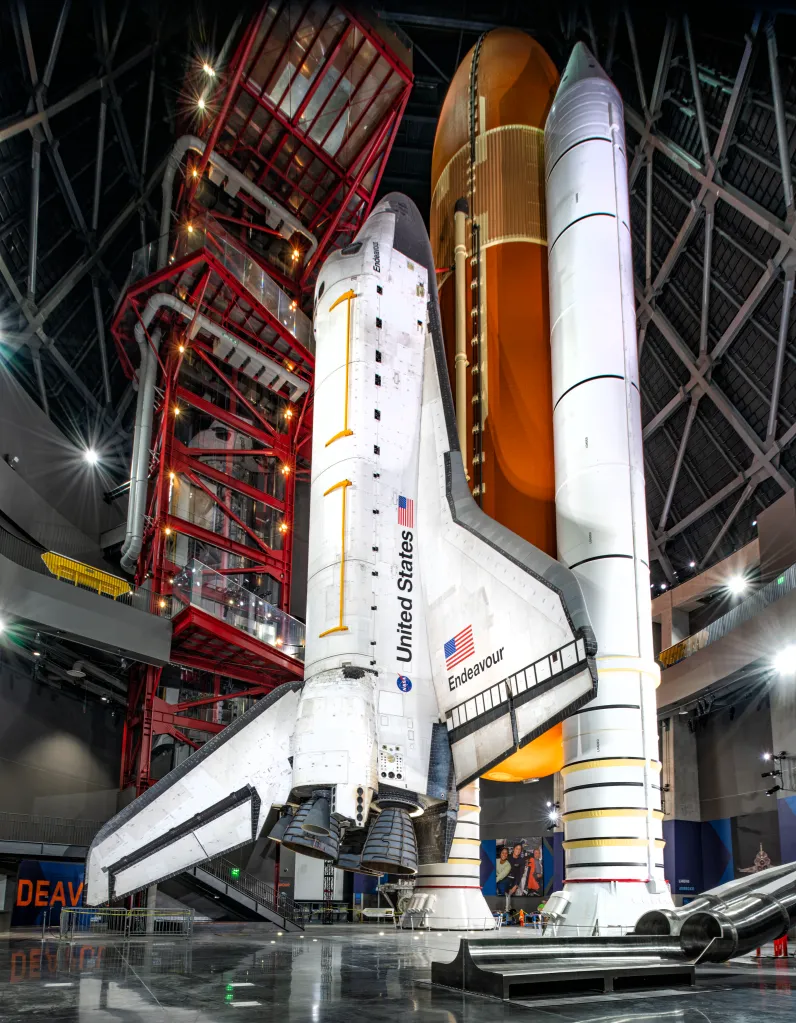
The California Science Center (CSC) in Los Angeles gave a sneak peek today of its long-awaited, much anticipated attraction — the towering Space Shuttle Endeavour in its ‘full stack’ configuration. The spacecraft was the last of five orbiters ever built and the most advanced. After a long wait, the public will soon be able to view it in all its glory inside its purpose-built permanent display building.

Endeavour is the centerpiece of The Samuel Oschin Air and Space Center. It is a 200,000-square-foot expansion of the museum and will be “the only place in the world to see a complete, authentic space shuttle system, displayed in a 20-story launch position,” CSC said in a media release on Wednesday.

The exhibit is set to open on Nov. 13, 2026.

California Science Center
Mike Kelley
Mike Kelley
The Space Shuttle Endeavour will be the centerpiece of a new museum exhibit opening in the fall in Los Angeles.

Endeavor was born out of the tragic loss of Challenger on January 28, 1986.  NASA had to figure out how to replace the doomed orbiter. It looked at several options.

Feb. 1, 2003: Space shuttle Columbia disaster thumbnail

Feb. 1, 2003: Space shuttle Columbia disaster


The first shuttle, Enterprise, was built as a developmental test vehicle and made its first independent flight from the back of the converted 747 Shuttle Carrier Aircraft (SCA) on Aug. 12, 1977. Enterprise was also used for fit checks on the launch pad and many other engineering and testing activities, but it was not built to fly into space. Although it was available for modification and could feasibly be altered for full duty, NASA decided converting it for orbital work was not the best move. Instead, the all new orbiter that would be named Endeavor was authorized for construction in 1987.

Endeavour lifted off on its maiden voyage on May 7, 1992, and flew 25 times, with its final flight coming in May 2011. As the last of its breed, it incorporated new features and upgrades, including being the first shuttle to carry a Station-Shuttle Power Transfer System (SSPTS), according to Space.com. Endeavour also had “the first fully activated Advanced Health Management System to watch over the shuttle’s three main engines during launch, as well as a three-string global positioning system (GPS) for pinpoint navigation during landings,” the publication added. In addition, the last of the orbiters was built with the most advanced avionics, with glass displays, when it entered service.

Space Shuttle Enterprise - Free flight Test - ABC News - 8/12/1977 thumbnail

Space Shuttle Enterprise – Free flight Test – ABC News – 8/12/1977


During its time in space, Endeavour performed a variety of tasks, including helping to construct and sustain the International Space Station. Throughout its career, it spent 299 days in space, orbiting the Earth nearly 4,700 times and logging close to 123 million miles, according to NASA.

“Among Endeavour’s missions was the first to include four spacewalks, and then the first to include five,” the space agency added. “Its STS-67 mission set a length record almost two full days longer than any shuttle mission before it. Its airlock is the only one to have seen three spacewalkers exit through it for a single spacewalk. And in its cargo bay, the first two pieces of the International Space Station were joined together.”

It also flew the first mission to service the Hubble Space Telescope.

IN SPACE - AUGUST 15: In this handout photo provided by NASA, backdropped by the blackness of space and Earth's horizon, the Space Shuttle Endeavour, docked to the Pressurized Mating Adapter (PMA-2) on the International Space Station, is featured in this photograph taken by a crewmember during the mission's first planned session of extravehicular activity (EVA) August 15, 2007 in Space. (Photo by NASA via Getty Images)
The Space Shuttle Endeavour, docked to the Pressurized Mating Adapter (PMA-2) on the International Space Station, is featured in this photograph taken by a crewmember during the mission’s first planned session of extravehicular activity (EVA) August 15, 2007 in Space. (Photo by NASA via Getty Images) NASA

During an 11-day mission in 2000, the astronauts “used the radar instruments in Endeavour’s payload bay to obtain elevation data on a near global scale,” NASA noted about the mission with a military connection. “The data produced the most complete, high-resolution digital elevation model of the Earth. The SRTM comprised a cooperative effort among NASA with the Jet Propulsion Laboratory (JPL) in Pasadena, California, managing the project, the Department of Defense’s National Imagery and Mapping Agency [now the National Geospatial Intelligence Agency], the German space agency, and the Italian space agency. Prior to SRTM, scientists had a more detailed topographic map of Venus than of the Earth, thanks to the Magellan radar mapping mission.”

Endeavour, like the rest of the orbiters, always captured the public’s imagination. In December 2008 the spacecraft made its voyage back to Kennedy Space Center in Florida after landing at Edwards AFB. A photo of that trip, taken from an F/A-18B Hornet flying overhead, was once described by TWZ as “Arguably The Most Spectacular Photo Of NASA’s Shuttle Carrier Aircraft Ever.” You can read more about that picture and the flight in our story from the time here.

NASA photo by Carla Thomas www.twz.com

On September 21st, 2012, NASA delivered Endeavour to Los Angeles, noted AmericaSpace.com. “Over the course of four days in October, the orbiter gradually crept her way through the city’s narrow streets.” The move captured a huge amount of attention.

While plans had been in the works for a while to house Endeavour in a purpose-built exhibit, a major issue developed.

“An earthquake-resistant building large enough to house a 184-foot-tall Shuttle stack had a staggering cost estimate of $400 million,” AmericaSpace.com explained. “The California Science Center was unable to raise enough money to build the facility prior to Endeavour’s arrival. The museum still needed to protect the orbiter from the elements, so it built a metal hangar to temporarily house the spacecraft. The more aspirational exhibit would be conducted at a later date.”

That later date will be in November, as we noted earlier. 

Space shuttle Endeavour's trek across LA: Timelapse thumbnail

Space shuttle Endeavour’s trek across LA: Timelapse


The CSC is one of four locations where the surviving shuttle fleet is being displayed.

Shuttle Atlantis is located at the Kennedy Space Center Visitor Complex; Discovery at the Steven F. Udvar-Hazy Center and Enterprise at the Intrepid Sea, Air & Space Museum. While each display is unique, and Kennedy Space Center’s is very dramatic, showing the orbiter as it would look in orbit, nothing compares to how CSC is displaying the full Shuttle Launch System (SLS) with its boosters and fuel tank in the vertical orientation, looking like it’s about to blast off one more time.

Contact the author: howard@twz.com

Howard is a Senior Staff Writer for TWZ. He writes frequently about conflict, focusing heavily on the Middle East and Ukraine, and interviews with military and intelligence officials and industry leaders from around the globe. He lives near Tampa, Florida, home of U.S. Central Command, U.S. Special Operations Command.


Tyler’s passion is the study of military technology, strategy, as well as foreign policy, and he has fostered a dominant voice on those topics in the defense and national security space. Tyler was the creator of the hugely popular defense site Foxtrot Alpha before developing TWZ, which he continues to lead as the Editor-In-Chief to this day.


Source link