Paris, France – Saturday is a day of many unknowns. That was how the French newspaper Le Monde described it as France braced for possible nationwide demonstrations bringing together high school students, trade unions and “yellow vest” activists.
The protests began in mid-September at a high school in the Paris suburb of Creteil, where students took to the streets over dilapidated buildings, overcrowded classrooms, teacher shortages and what they see as a deeply unequal education system.
Recommended Stories
list of 3 itemsend of list
Since then, the mobilisation has spread to thousands of “lycees”, or upper secondary schools, across the country. It is now beginning to reflect broader anxieties in a country grappling with a combination of fiscal pressures, economic stagnation and mounting social discontent.
Teachers, trade unions and university students have joined the movement.
On Saturday, some “yellow vest” activists – remnants of the participants in the grassroots cost-of-living protests that shook President Emmanuel Macron’s first term in 2018 – have also called on supporters to join the students.
“High school students are fighting for their future. Workers are fighting to earn a living from their labour. Retirees are fighting to preserve their dignity. Our paths may differ, but our concerns can converge,” Jerome Rodrigues, a prominent “yellow vest” activist, said in a video message released last week that called on people to join Saturday’s demonstrations.
Now France is waiting to see whether those calls will translate into a large, coordinated mobilisation.
Warlike injuries
Authorities have described the unrest as among the most violent in decades, saying more than 900 police have been injured since the start of the protests. But critics argued that although some demonstrators have engaged in violence, they represent a minority and the actions of a few risk overshadowing the grievances of the wider movement.
The government has also faced criticism over its response to the protests, including the detention of thousands of minors and the use of force against young demonstrators.
More than 6,700 children had been taken into police custody since mid-September, according to reports published this week.
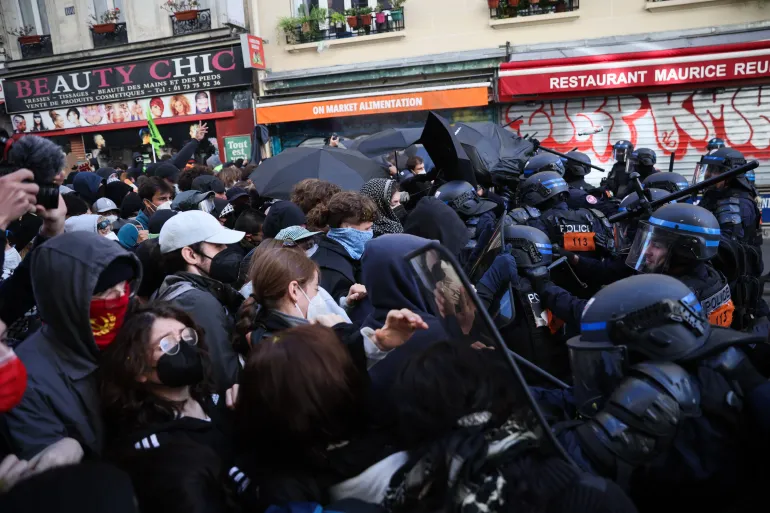
Protesters clash with police during a demonstration against the high cost of living, in Paris on October 17, 2026 [AFP]
Human rights lawyers said several teenage students have suffered warlike injuries.
Two cases have drawn particular attention: A 15-year-old lost his hand in the explosion of a stun grenade outside a school in the northern city of Lens, and a 16-year-old in western Tours lost his sight due to an injury caused by a rubber bullet.
There are fears of further clashes on Saturday.
“This is a moment of fatigue in the country,” Prime Minister Sebastian Lecornu said on Thursday. “We are in an atmosphere of perma-crisis: wars, inflation and issues surrounding purchasing power.”
The government has accused the far-left France Unbowed (LFI) party of inflaming the protests. The party has rejected the accusation.
While France suspended the use of stun grenades for the student demonstrations, Interior Minister Laurent Nunez said on Friday that he authorised police to use them in the event of what he called “urban violence”.
Nunez also said he is expecting a “fairly significant” turnout on Saturday.
Hundreds of protest sites
Calls on social media for members of past protest movements to join the current one have been made for weeks. The website 17octobregiletjaune.net, which tracks “yellow vest” actions, listed more than 1,750 planned protest locations across the country.
The government has tried to quell student anger by scrapping plans to increase some higher education registration fees and promising to deploy 3,000 substitute teachers to high schools. This week, it set up a national online survey for pupils to hear their concerns.
But Mathieu Roger-Lacan, a French literature teacher in a disadvantaged area and author of A Language of One’s Own, a book about the growing language gap, argued that these measures fail to address the deeper problem: an education system that struggles to provide equal opportunities.
“If you have a pool that is leaking, the answer should not be to put more water into it but to work on its structure – and that costs money too,” he said.
For Roger-Lacan, the problem is not simply how much France spends on education but how it distributes those resources.
A government report published this week said that 32 percent of the French education ministry’s budget for next year will go towards funding the pensions of retired civil servants.
Students are not only complaining about deteriorating school buildings and overcrowded classrooms but also expressing a deeper anxiety about their future.
For many, a diploma no longer feels like a guarantee of stable employment or social mobility. That concern is compounded by questions about the quality of education itself amid evidence of persistent weaknesses in French students’ academic performance.
In September, the Organisation for Economic Co-operation and Development (OECD) said that French 15-year-olds’ results in mathematics and reading had fallen to among their lowest levels on record.
“There is a gap between the diploma we give at the end of school, which is given to a huge part of the population, and the reality around us, which is that many of these young students have great difficulties even in writing French,” Roger-Lacan said.
Competing demands
The protests come at a very difficult time for the government, which is caught between demands for better-funded public services and the need to rein in France’s debt.
The government recorded a deficit of 152.5 billion euros ($171.3bn) last year, equivalent to 5.1 percent of France’s gross domestic product (GDP). By contrast, the European Union average is 3.1 percent.
Meanwhile, public debt ballooned to 115.6 percent of GDP, the third highest in the EU after Greece and Italy.
Lecornu’s proposed 2027 budget seeks to reduce the deficit through spending restraint and tax measures, including a freeze on public sector pay and limits on pension increases.
Whether the government can make those savings without deepening public anger is another question.
The debate touches a nerve in France, where the welfare state and access to public services remain central political issues.
Macron’s decision to raise the retirement age from 62 to 64 triggered months of mass demonstrations in 2023, exposing deep opposition to reforms that many saw as unfairly burdening workers.
Now as the government prepares its next budget, it faces the challenge of persuading the public that spending cuts and other savings are necessary without further eroding confidence in public institutions.
The political stakes are high. The budget bill will be debated in a deeply divided parliament as parties position themselves before the 2027 presidential election, which will mark the end of Macron’s presidency.
Police have detained hundreds as students protest overcrowded classrooms, teacher shortages and crumbling facilities.
Published On 1 Oct 20261 Oct 2026
French students have set fire to bins and erected blockades outside schools in several cities, protesting overcrowded classrooms, teacher shortages and crumbling facilities.
Several school principals were injured, harassed or assaulted during blockades at high schools on Thursday, according to reports from regional education authorities, prefectures and union representatives.
Recommended Stories
list of 2 itemsend of list
Police have already detained hundreds of protesters at the lycees, which students aged 15 to 18 attend for their final three years of secondary education in France.
At Marseille’s Victor Hugo high school, the teachers were inadvertently splashed as a student attempted to throw petrol into a rubbish bin, local authorities said. Earlier, the prosecutor’s office had said the teachers had been assaulted and “doused in petrol”.
At another school in the city, Saint-Exupery high school, hundreds of young people surrounded a firetruck that had arrived to put out a blaze in the morning, police said. The attackers forced the firefighters to flee the vehicle, then set it alight.
In Nantes, firefighters extinguished a fire at a high school entrance following what regional education officials called a gathering “marked by violence towards staff”. In Strasbourg, trams were halted to “restrict the movements of rioters and demonstrators”, and students burned barriers on tram tracks, authorities said.
“There are 35 of us per classroom. With 35 degrees Celsius [95 degrees Fahrenheit] in summer, it’s unbearable. There aren’t enough toilets, and there are water leaks in some rooms,” Raphael, a 17-year-old who withheld his surname for fear of reprisals, told the AFP news agency outside a protest in Strasbourg.
“The building is falling apart, the cafeteria is too small. There’s zero budget, zero resources, not enough supervisors.”
His frustration echoes a wave of student anger that has spread across France since last week, as high school pupils protest and grievances snowball into nationwide unrest.
Some 340 demonstrations were under way outside high schools by mid-morning on Thursday, with more than 160 schools shut down as a result, police said.
University students joined in, blocking access to about 30 campuses, including in Paris and Marseille, according to a student union.
Authorities have reported many dozens of injuries – some from thrown objects, others reportedly from police riot-control projectiles.
Interior Minister Laurent Nunez said police have opened internal investigations into brutality allegations involving three students.
Prime Minister Sebastien Lecornu convened a crisis meeting and asked ministers to cancel upcoming official travel so authorities could focus on the demonstrations, his office said.
French Education Minister Edouard Geffray said that he would successively meet representative staff unions and parent and student associations on Friday.
The unrest has become entangled in the race to succeed President Emmanuel Macron next May. The government has accused the far-left France Unbowed party of encouraging the protests. Presidential candidate Jean-Luc Melenchon said Wednesday that his party “called for nonviolent methods of struggle” and criticised the government’s response as repressive.
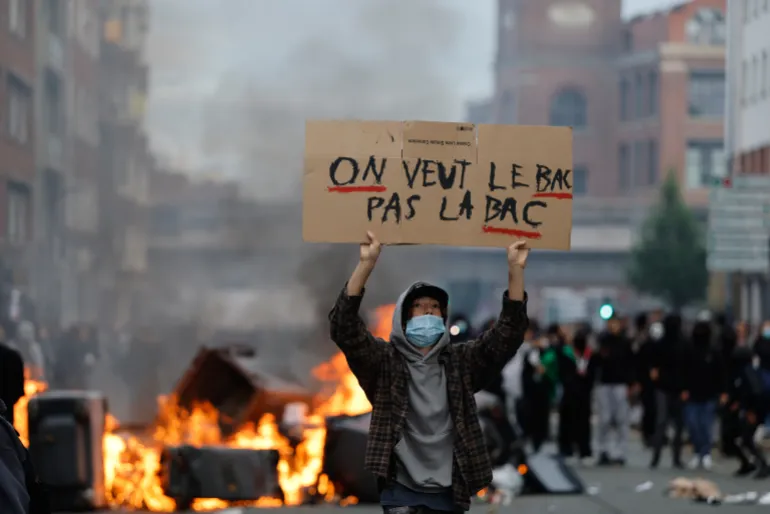
A student holds a board reading, ‘We want the BAK [high school diploma], not the BAC [anti-criminality units]’ during a protest to demand more resources at school, in Lille, France [Jean-Francois Badias/AP]
Chester County public health officials did not wait long to launch a response to the growing measles outbreak in their community, which shares a border with Lancaster County, the epicentre of the outbreak.
Jeanne Franklin, the director of the health department, said officials have been using some of the strategies they employed during the Covid pandemic – knocking on doors in the community to let them know about the outbreak and offering private settings, like people’s homes, for immunisations.
Since the outbreak started, the county has given 538 MMR vaccines, 340 of which they administered in private settings.
“People have called up and said, ‘I can’t get to your clinic, or, I don’t want people to know I’ve changed my mind,” Franklin said. “‘If you can come to us, that’s a lot easier.'”
The boots-on-the-ground approach has helped the health department dispel misinformation and build trust with the community, local health officials said.
In recent years, childhood vaccination rates have fallen across the country as false theories about the safety of the measles vaccine have proliferated on social media.
Those theories have found roots even in an insulated community with limited access to computers, Weiser said. She has heard people ask if there are heavy metals in the vaccine that could make them magnetic, or if the shot has a computer chip in it.
“You’re clearly getting information from that hard-core group that is promoting that misinformation and disinformation,” she said.
People in this “hard-core group”, who are staunchly against vaccines, are unlikely tobe swayed, experts and officials themselves said.
But now, local health officials said, many affected by the Pennsylvania outbreak are seeing their neighbours fall seriously ill and asking thoughtful questions. Weiser said many are parents who are unfamiliar with the shots and are scared to make the wrong choice for their children.
“There is the classically-defined anti-vaxer, versus people who are unaware or their culture feels differently,” Franklin said. “The thinking and the willingness to discuss and possibly change your mind is different between those two bookends.”
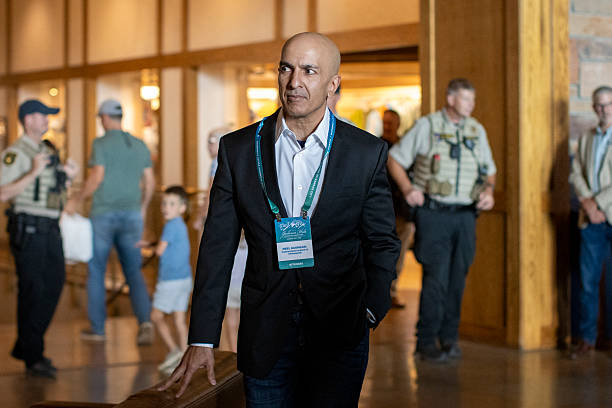
Minneapolis Federal Reserve President Neel Kashkari said inflation remains unacceptably high, with price pressures spreading well beyond energy markets disrupted by the Iran war.
“The inflation that the American people are feeling every day is much beyond just oil prices. It’s