People in Ceuta face harsh living conditions, overcrowding, limited aid, and alleged abuse while awaiting decisions about their future.
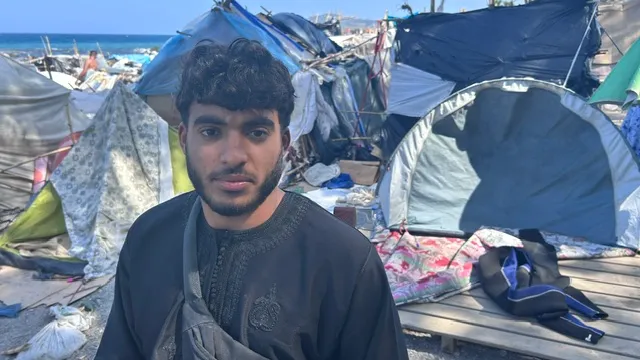
Ceuta, Spain – For more than a month, 21-year-old Anis Fadi, a university graduate and qualified accountant, has been sleeping in a makeshift shelter.
At the end of July, he crossed the border from Morocco to the Spanish enclave of Ceuta, on the North African coast, along with about 70,000 others.
Recommended Stories
list of 4 itemsend of list
At his migrant camp on Trampolin Beach, he queues for hours each day for food at a Red Cross centre.
“I don’t even have a tent,” he told Al Jazeera. “We make shelter with old pieces of wood, sticks from broken branches, and whatever else we find here.”
Anis Fadi, a 21-year-old graduate, believes Europe would offer him better employment opportunities than Morocco [Peter Smith/Al Jazeera]
When the wind blows, these makeshift shelters offer little protection, and soon the temperature will dip.
“There are a lot of people worse than me,” said Fadi.
The Spanish government estimates that between 6,000 and 10,000 who made the crossing remain stranded. Officials in Ceuta believe the figure is closer to 13,000 people.
Thousands of people remain stranded in Ceuta having crossed the border in July [Peter Smith/Al Jazeera]
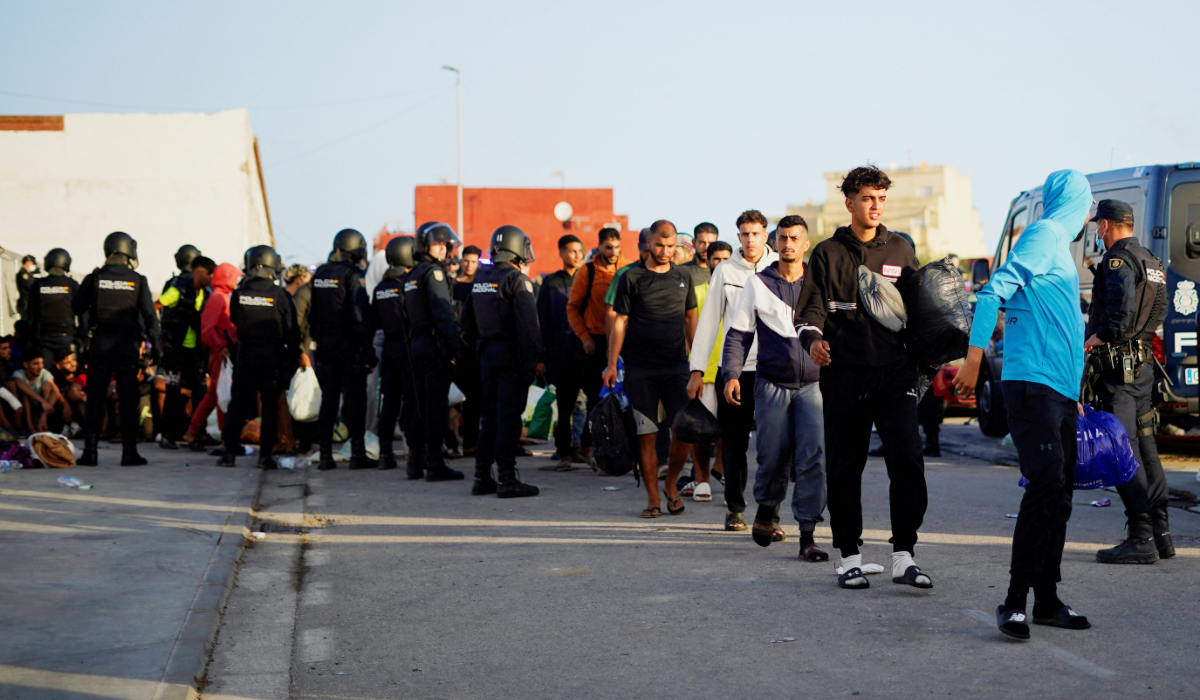
About 5,000 – mostly women and children – have been given temporary accommodation by the authorities. The rest sleep outside.
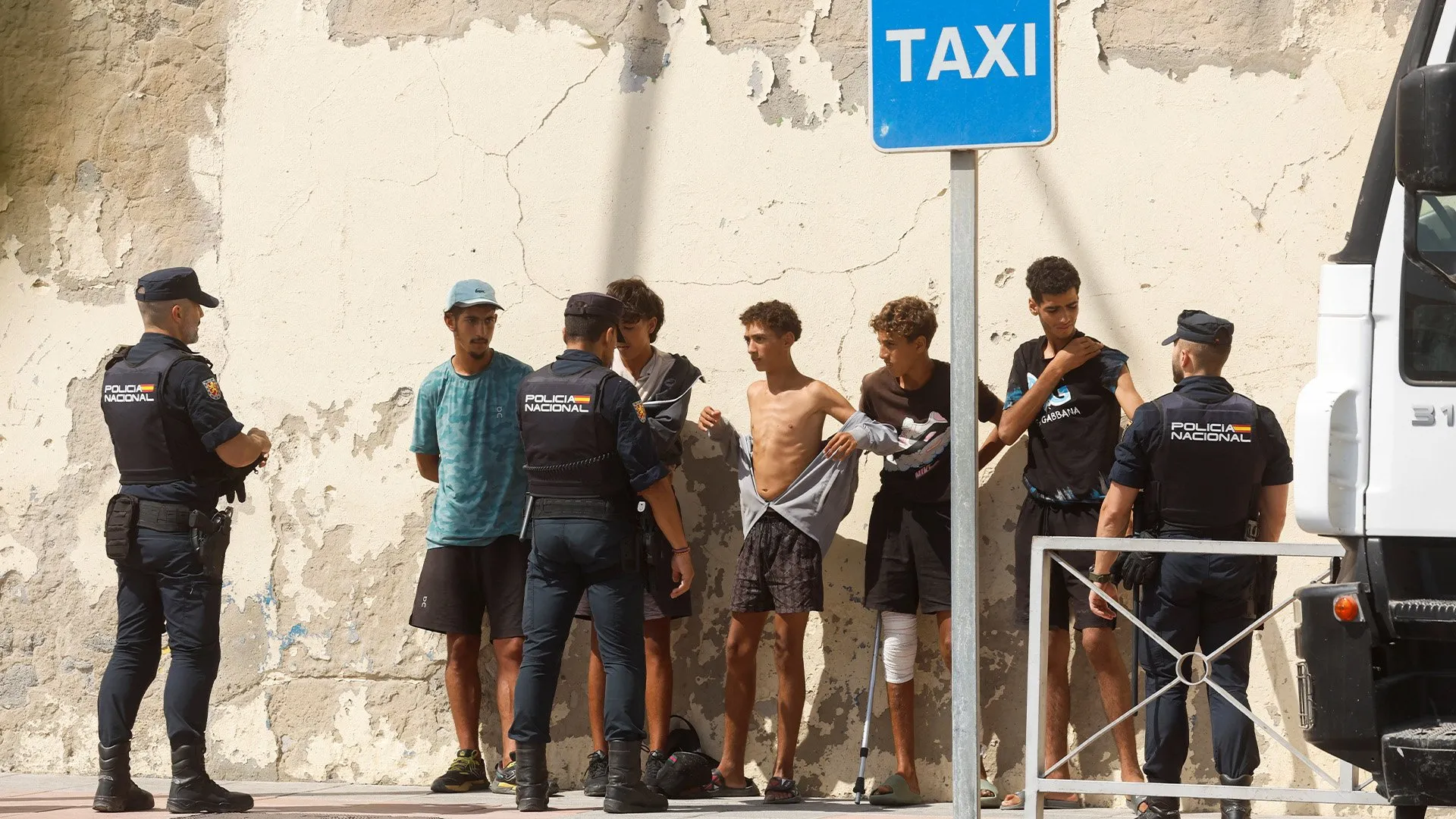
Fadi said, as he waits for food in the heat, police officers with batons shout orders at the crowds.
“It’s a hard life here,” he said, but he does not regret leaving Morocco.
“Life was harder there for me. I didn’t see any future for myself.”
‘We are not criminals’
More than 100 people died in the crossing. Fadi said he swam for hours to reach Ceuta, believing it was a gateway to Europe, where he imagines a better life awaits.
He believes men like him who “have the skills … don’t have the chance”.
“We are not criminals,” he said, in response to the anti-migration rhetoric and protests that followed the crossing. “We just want to work.”
Right-wing European politicians have framed the Ceuta crossing as a threatening invasion.
Migrant children take toys at an industrial area in Ceuta, Spain, September 21, 2026 [Jon Nazca/Reuters]
In Spain, protests have erupted against the government’s handling of the crisis.
Ceuta is usually home to about 84,000 people. Its population almost doubled at the outset of this crisis. Though most have returned, the enclave has been struggling to cope with the pressure of hosting those who remain.
After a new temporary shelter opened up recently, offering space for about 1,700 people, it hit capacity within hours.
Claims of abuse
As humanitarian groups struggle to provide basic needs, Nolte Bauer, from Mission Lifeline International, said migrants also feel unsafe.
“Outside the official camps there is a lack of basic hygiene,” he said. “There is insufficient medical aid and the immediate danger of violence, especially at night.”
His organisation often receives reports of people being beaten.
Members of the Spanish NGO Medicos del Mundo (Doctors of the World) help injured migrants at an industrial area in Ceuta, Spain, September 21, 2026 [Jon Nazca/Reuters]
Several people interviewed by Al Jazeera said they had been abused by men in military or police uniforms. Some were wounded, with cuts to the head or bruising around the body.
“These are racist people, these soldiers,” one man who requested anonymity told Al Jazeera. “They found me sleeping and they started to hit me without any reason. They broke one of my hands; they wanted to break the other one. They also beat me on my knees.”
Some said they were afraid to go to hospital, fearing they could be deported, and instead sought help from aid groups. NGO volunteers told Al Jazeera they had treated wounded men.
People play with a ball surrounded by tents at the Trampolin Beach in Ceuta, Spain, September 19, 2026 [Jon Nazca/Reuters]
But Spanish authorities rejected any claims of abuse and discrimination, telling Al Jazeera that the police acts “with absolute respect for human rights”.
They say they are expanding accommodation and providing food and medical care while migrants are identified and their cases are processed.
The government has said the aim is to return to Morocco those who do not have a legal status to remain in Spain, while Ceuta’s leaders have repeatedly called on Madrid and Europe for more support.
With Wowcher you can buy a 4* holiday to Marrakesh including a hotel stay and return flights from £59pp from October 5-9.
Seville, Spain
One of the best things about Seville is that it’s less than three hours away from the UKCredit: Alamy Stock Photo
Under three hours away from the UK, Seville is Spain’s fourth-largest city with lots to offer from its tasty tapas and fabulous flamenco.
Not to mention in early October temperatures tend to sit around 26C on sunny days.
Top spots to see include Plaza de Espana – and pop by El Rinconcillo, the city’s oldest tapas bar where a huge glass of wine barely costs £3.
With loveholidays, book a stay at the Ilunion Alcora Sevilla which has sweeping views of the city, and a luxury swimmingpool.
A four-night stay between October 19-23 starts from £279pp with return flights to London Gatwick.
Sharm El Sheikh, Egypt
Dubbed to be super popular next year (so get ahead of the game), Sharm El Sheikh is in Egypt.
The resort city on the Red sea has world-class reefs, incredible beaches and average highs of 31C in October.
Sharm El Sheikh has world-class reefs and incredible beachesCredit: Getty
For Brits, it has lots to offer alongside its sunshine like all-inclusive hotels and waterparks.
With Wowcher, there’s an offer for a seven-night 4* all inclusive Sharm El Sheikh getaway with return flights – the hotel has a spa, sauna, gym, tennis courts and watersports.
Book a stay at the Sharm Club Beach Resort from £299pp
Antalya, Turkey
Antalya has bright blue seas and can be as high as 26C in OctoberCredit: Getty
If you’re seeking autumn sunshine, why not look in what has been called ‘paradise on earth‘?
To make it even better, the average flight time from the UK is around four and a half hours.
There’s a current offer with Wowcher for a 4* Antalya getaway in a sea view hotel stay with breakfast and return flights included.
Book a stay from 5-8 October from £159pp.
Limassol, Cyprus
In Limassol, the largest waterpark is Fasouri Watermania WaterparkCredit: Alamy
Five hours away from the UK is the city of Limassol in Cyprus which has daytime highs of 27C next month.
Some favourite sunbathing spots include Kourion Beach and Pissouri Beach which has been described as a “beautiful rustic pebble beach with pristine water.”
With loveholidays, you can book into the Troodos Hotel which is minutes from Mount Olympus and is surrounded by natural beauty.
A seven-night holiday between October 5-12 starts from £369pp.
Reggio Calabria, Italy
Head to southern Italy for warm weather and vineyard toursCredit: Getty
In just three hours, you could be basking in the Italian sunshine in Reggio Calabria with city with sun, beaches, mountains, waterparks and lots ofhistory.
Not to mention there are highs of 26C in October and Brits can fly directly to Reggio Calabria from London Stansted and return fares start from under £30.
As southern Italy is the perfect place for vineyards, there are even vineyard tours and wine tastings for £20.
You can book a getaway with loveholidays to La Bussola a hotel with huge swimming pools and plenty of space to sunbathe.
A seven-night break between October 4-11 starts from £270pp.
Tenerife, Canary Islands
Tenerife has golden sand beaches and a huge Thai-themed waterparkCredit: Getty
The Canary Islands are a safe option for autumn sunshine, and in October, the island of Tenerife has highs of 26C.
The island also has hundreds of beaches, coastal towns with bustling promenades and head up to Mount Teide National Park on the cable car.
Siam Park, an enormous Thai-themed waterpark is open throughout next month too.
It has high-speed slides, family zones, beaches and plenty of swimming pools.
With Wowcher, book an all-inclusive break to Tenerife from October 5-8 including return flights from £169pp.
Fuerteventura, Canary Islands
Fuerteventura is the sunniest Canary IslandCredit: Getty
Tenerife’s trusty neighbour, Fuerteventura has the same high temperatures – and can actually be cheaper.
On the second largest Canary Island, you can explore a number of beaches like Playa de Matorral, Corralejo and Playa Bajo de la Burra.
It’s easy to take a boat excursion out into the waters and go snorkelling to spot colourful fish and sometimes even stingrays.
Also make sure to check out Acua Water Park and hike on Corralejo Natural Park.
With Wowcher, book an all-inclusive break to Fuerteventura including return flights from £179pp.
Sousse, Tunisia
Sousse is a coastal city in Tunisia and lots of pretty beachesCredit: Corbis via Getty Images
It’s no secret that Tunisia is a top spot when it comes to staying sunny during autumn.
In October, daytime highs can reach 28C – perfect sunbathing weather.
Sousse in particular is known for its sandy beaches and modern marina with boutique shops and boat trips.
Tunisia is relatively cheap too with a pint of beer costing less than £2.
With loveholidays, book a seven-night break between October 9-16 to Riadh Palms which has an enormous swimming complex – prices start from £415pp.
Dubai, UAE
Dubai has highs of around 35C in October making it the ideal autumn getawayCredit: Stefan Tomic
In the UAE, Dubai offers all the delights of an autumn getaway from its many luxury hotels to its thrilling waterparks and exotic beach clubs.
You can do all this next month while enjoying highs of 35C – and Emirates offers direct flights to Dubai which get there in seven hours.
Don’t forget to hit the shops or head to the Grand Souk for tasty treats like stuffed breads.
Or try a Iranian falooda — a sorbet-like dessert made of thin rice noodles and syrup.
With Wowcher, book a break to Dubai (a four or seven night stay) including breakfast and return flights from £449pp.
In terms of the ongoing conflict in the Middle East, the FCDO no longer advises against travel to the UAE, but warns that “the situation in the Middle East remains unpredictable”.
Madrid boss Jose Mourinho accuses officials of bias after his side’s 2-1 derby defeat by Atletico Madrid.
Published On 22 Sep 202622 Sep 2026
La Liga President Javier Tebas has hit out at what he calls accusations of a refereeing “conspiracy” by Real Madrid after their derby loss to Atletico Madrid.
Real Madrid coach Jose Mourinho brought two printed screenshots of what he thought were red-card tackles committed by Atletico players to his post-match news conference after Sunday’s 2-1 defeat.
Tebas responded to a pro-Real article on social media with a lengthy riposte on Tuesday to allegations of a “conspiracy” against the 15-time European champions.
“Here they go again, the mouthpieces and the regime’s television, building the same old narrative – the permanent conspiracy,” said Tebas, who has often been at odds with Real Madrid and the club’s outspoken president, Florentino Perez.
“This article goes further. It claims that referees harm ‘the business that feeds them’.
“What exactly is it asking for? Refereeing based on revenue, viewership or the badge? What a way to understand equality in the competition.
“Real Madrid are crucial to La Liga. But claiming that ‘La Liga is worth nothing’ without them reveals the disdain for the other clubs, their fans and their history. The competition belongs to no one.”
Madrid have made a stuttering start to the season and already sit six points behind reigning champions and early leaders Barcelona in the La Liga table.
“Claiming that referees are directed against Real Madrid is living in another galaxy,” Tebas added.
“That narrative serves as an excuse to cover up other shortcomings that are plain to see in these first matches of the season.
“It’s more comfortable to point to a conspiracy than to explain what’s happening on the pitch.”
Mourinho returned for a second spell in charge at the Santiago Bernabeu in the close season, tasked with ending a two-year spell without a major trophy.
After the heated capital derby on Sunday, Mourinho was furious that Atletico defender Cristian Romero was not sent off for a stamp on Jude Bellingham and also complained about a challenge by Lee Kang-in on Federico Valverde before the visitors were themselves reduced to 10 men five minutes after half-time.
Valverde finished the match but was later diagnosed with “severe trauma to his left ankle”, the club said in a statement. The midfielder will undergo further tests, it added.
“We could skip the press conference because the story of the match is right here,” Mourinho said, holding up the images in what was the start of a near five-minute rant.
“Those were two clear red cards. The difficulties we’ve faced since the sending-off: 11 against 10. Well, we can imagine what 50 minutes of 11 against nine would have been like if justice had been done.”
Authorities estimate that at least 10,000 people remain in the enclave of Ceuta after a record surge of 72,000 migrants crossed from Morocco to Ceuta over the course of two days in late July, overwhelming local resources and creating a humanitarian crisis.
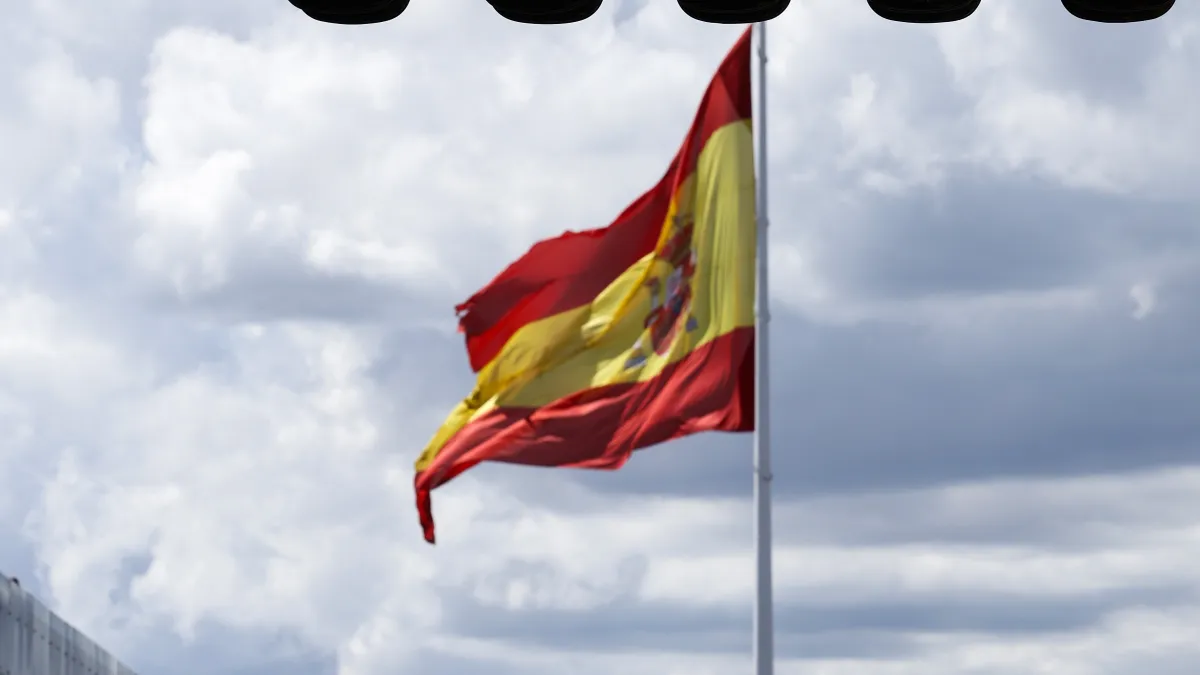
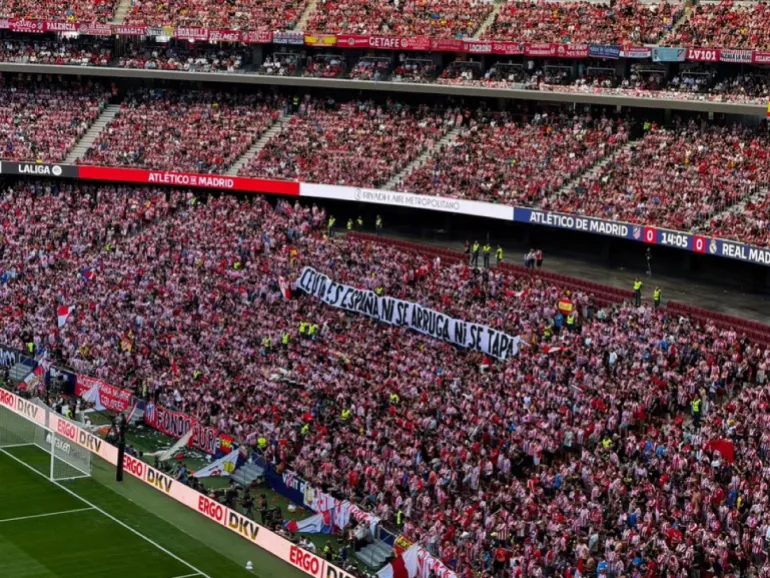
Madrid, Spain – Thirteen minutes into La Liga’s Madrid derby on Sunday, a banner was unfurled in the Metropolitano Stadium’s south stand stating: “Ceuta es Espana. Ni se arruga, ni se tapa.” (Ceuta is Spain. It is neither rolled up, nor covered.)
It was a reference to the controversy involving Real Madrid players Kylian Mbappe, Vinicius Junior and Ibrahima Konate, who in a previous football match against Elche had rolled-up shirts carrying a solidarity message linked to Ceuta, the Spanish enclave at the centre of growing political tensions between Spain and Morocco over the influx of migrants and refugees.
Recommended Stories
list of 4 itemsend of list
A record 72,000 migrants crossed from Morocco to Ceuta over the course of two days in late July, overwhelming local resources and creating a humanitarian crisis. The Spanish NGO Caminando Fronteras documented 141 deaths across both sides of the border in the immediate aftermath.
Mbappe and Konate have strong ties to the African continent. Konate was born and raised in Paris by parents who migrated from Mali, while France captain Mbappe grew up in Bondy, outside Paris, to parents who came from Cameroon and Algeria.
Mbappe said his gesture did not reflect a lack of support for Ceuta.
“I also wanted to think about all the people who are suffering, because in the end I am human and I don’t want to prioritise the suffering of one group over another,” he said.
He also said he wanted to acknowledge migrants who had suffered or lost their lives during the crisis.
Real Madrid later said it respected each player’s freedom to participate in the initiative. A day earlier, Barcelona had chosen not to wear the shirts before their La Liga game against Levante.
La Liga president Javier Tebas, meanwhile, criticised the three Real Madrid players and said he did not regard the campaign as political. David Aganzo, president of Spanish footballers’ union AFE, said players instead needed to be properly informed about what they were being asked to wear and why.
While the debate over Spanish football’s support for Ceuta followed Real into their derby against fierce rivals Atletico Madrid on Sunday, it also united supporters from both sides for two minutes as they joined in chants of “Ceuta no se vende, Ceuta se defiende” (Ceuta is not for sale, Ceuta must be defended) before the usual hostility of the derby resumed.
Mbappe and Vinicius were also the target of whistles from both sets of fans when Real’s starting XI was announced prior to kickoff.
Jorge Garcia, a 32-year-old Atletico Madrid supporter, believed they deserved the jeering.
Speaking to Al Jazeera after the match, Garcia termed the players’ move “disrespectful” to both Ceuta and Spain.
Fans hold a banner during the Atletico Madrid vs Real Madrid La Liga match at the Metropolitano Stadium in Madrid, Spain on Sunday, September 20, 2026 [Leyla Hamed/Al Jazeera]
The campaign was launched on September 11 by Asociacion Valenciana de Empresarios (AVE), a non-profit business association, which described the move as an expression of solidarity with Ceuta’s residents and businesses amid an influx of migrants and a message of “territorial and social cohesion in Spain”.
AVE is chaired by businessman Vicente Boluda, a former interim Real Madrid president whose maritime group also operates in Ceuta.
Spain coach Luis de la Fuente travelled to Ceuta with the World Cup trophy, declaring: “This is Spain, this is Ceuta.” Real Madrid president Florentino Perez later visited and said the trip had been organised weeks earlier and was not a response to the controversy involving his players.
Youssef Temsamani, a Spain-based Moroccan journalist, believes the players found themselves in a difficult position: wearing the shirt could be interpreted as taking a political position, but declining to do so could be portrayed as showing a lack of solidarity.
Temsamani said migrants should also form part of discussions about solidarity with Ceuta, and criticised descriptions of the crossings in parts of Spain’s political and media debate as an “invasion” or “occupation”.
Luhay Hamido, president of AD Ceuta football club, defended the right of individual players to make their own decisions and said he respected those who wore it and those who did not.
“We cannot force anyone to identify with a cause they do not understand,” he told Al Jazeera, suggesting footballers are sometimes simply told to put on a shirt in the tunnel without having received a full explanation.
The scale of the crisis that prompted the solidarity campaign remains difficult to quantify precisely. Spain’s Interior Ministry put the number of people who irregularly crossed into Ceuta on July 30 and 31 at 72,000, saying more than 70,000 initially returned to Morocco.
Seven weeks later, the government estimated that 9,000 to 10,000 migrants remained in Ceuta. RTVE reported on September 20 that around 8,300 people were being accommodated in different facilities while more than 4,000 remained on the streets, reflecting discrepancies between estimates compiled at different stages of the crisis. The new temporary centre at the port reached its capacity of 1,700 people within hours of opening.
Hamido said the crisis had also directly affected AD Ceuta, with several advanced signings collapsing because players and their families were worried by what they had seen on television. The club began paying for prospective signings to visit the city before making their decision.
At the same time, he described the support from Spanish football as “pure fuel for us”, giving Ceuta “strength, hope and energy”, and said AD Ceuta could act as an “amplifier” so the city was not forgotten.
Away from the stadiums and political arguments, football is also played in the neighbourhoods in Ceuta, where migrants had gathered in the largest numbers.
There, children could be seen playing barefoot in the street, marking out makeshift goals against walls and turning whatever space they could find into a football pitch. Some wore shirts bearing the names of Yamal, Hakimi or Mbappe – players whose own family histories stretch across borders.
For Hamido, ordinary people caught in the crisis should not be castigated.
“[These] people, in the end, are not to blame,” he told Al Jazeera.
What to know as Brits may soon be turned away from 30 countries – The Mirror
Need to know
New scheme will be a requirement for British passport holders travelling to around 30 European nations, including Spain, France and Italy
(Image: Erlon Silva – TRI Digital via Getty Images)
British travellers to face new entry fees for European holidays from 2026 – what you need to know:
British holidaymakers face being turned away at European borders from 2026 unless they pay for a new digital travel document.
UK passport holders will need to register with the European Travel Information and Authorisation System (ETIAS) to enter 30 countries including Spain, France and Italy.
The fee has nearly tripled from the original estimate, now costing 20 euros per person instead of 7. A family of four with two children would pay 40 euros in total, with under-18s and over-70s exempt.
The scheme covers popular destinations across Europe, with travellers able to stay up to 90 days within any 180-day period once approved.
While most applications are expected to be approved “almost immediately”, rejections can occur for invalid passports, security risks, or incomplete applications.
The long-delayed system is now expected to launch within months, with the authorisation stored electronically against passports.
Should your application be denied, you have the right to appeal this decision.
Fuming Real Madrid manager waves printouts of what he believes were clear red-card tackles by Atletico Madrid players following his team’s loss.
Published On 21 Sep 202621 Sep 2026
Jose Mourinho needed only a sheet of paper to deliver his verdict on La Liga’s Madrid derby, waving images of two first-half tackles as he accused the officials of losing control in Real Madrid’s 2-1 defeat by Atletico Madrid.
Real were furious that Atletico defender Cristian Romero was not sent off for a stamp on Jude Bellingham and also complained about a challenge by Lee Kang-in on Federico Valverde, before the visitors were themselves reduced to 10 men five minutes after half-time in the heated capital derby on Sunday.
Valverde finished the match but was later diagnosed with “severe trauma to his left ankle”, the club said in a statement. The midfielder will undergo further tests, it added.
“We could skip the press conference because the story of the match is right here,” Mourinho said, holding up the images in what was the start of a near five-minute rant.
“Those were two clear red cards. The difficulties we’ve faced since the sending-off: 11 against 10. Well, we can imagine what 50 minutes of 11 against nine would have been like if justice had been done.”
Jude Bellingham reacts after being fouled [Ana Beltran/Reuters]
Real defender Dean Huijsen was dismissed for bringing down Giuliano Simeone inside the area as the last defender, allowing Alejandro Grimaldo to score with a low spot kick. Jonathan David doubled Atletico’s lead six minutes later, with Antonio Ruediger heading in a free kick late to reduce the deficit.
Mourinho said he could only “hug” his players after what he described as a first half “full of class and great character”, but he aimed sharp criticism at referee Miguel Angel Ortiz Arias and those who appointed him.
“They’ve put a referee, aged 41, with no international experience – it’s certainly not because he’s a great referee,” Mourinho said.
“Then the poor chap has come here and hasn’t been able to cope with the pressure – and it really is intense pressure. I call it ’80s-style pressure’ here in this stadium, which you hardly ever see these days.”
Asked about being six points behind Barcelona, Mourinho offered a pointed reply.
“If they just leave us in peace and let us compete on a level playing field with everyone else, we’ve still got a long way to go,” he said.
“I don’t want to go so far as to say this was set up … I want to believe that they simply made a mistake.”
Referee Miguel Angel Ortiz Arias speaks to Mourinho during the match [Oscar Del Pozo/AFP]
Asked about Mourinho’s comments, Atletico manager Diego Simeone urged restraint.
“Whoever is speaking – be it me, Mourinho, Hansi Flick or Manuel Pellegrini, anyone – we have to be careful what we say,” Simeone said. “When you step outside the bounds of respect, whoever you are, it’s not on. You can’t cross that line.”
Simeone preferred to focus on Atletico’s performance.
“Today we saw a great match; we defended very well against a team that plays very well,” he said.
“We controlled the match when it was 11 against 11. We continued to control it when it became 10 against 11. But this isn’t just another step towards continuing to grow and improve.”
Atletico climbed above Real to second in the standings on 16 points, five behind leaders Barcelona and one ahead of Real and Real Betis.
Atletico Madrid coach Diego Simeone was all smiles at full time [Juan Barbosa/Reuters]
The game hinged on Huijsen’s red card early in the second half for pulling down Giuliano Simeone in the box.
Published On 20 Sep 202620 Sep 2026
Atletico Madrid edged 10-man Real Madrid 2-1 in a La Liga derby clash to leave Jose Mourinho’s side trailing leaders Barcelona by six points.
Dean Huijsen was sent off early in the second half for Los Blancos on Sunday before Alejandro Grimaldo and Jonathan David’s goals earned Diego Simeone’s Atletico victory, with Antonio Rudiger pulling one back late on.
Atletico rose to second, five points behind Barca and one ahead of Real Madrid, who chalked up a second defeat of the campaign.
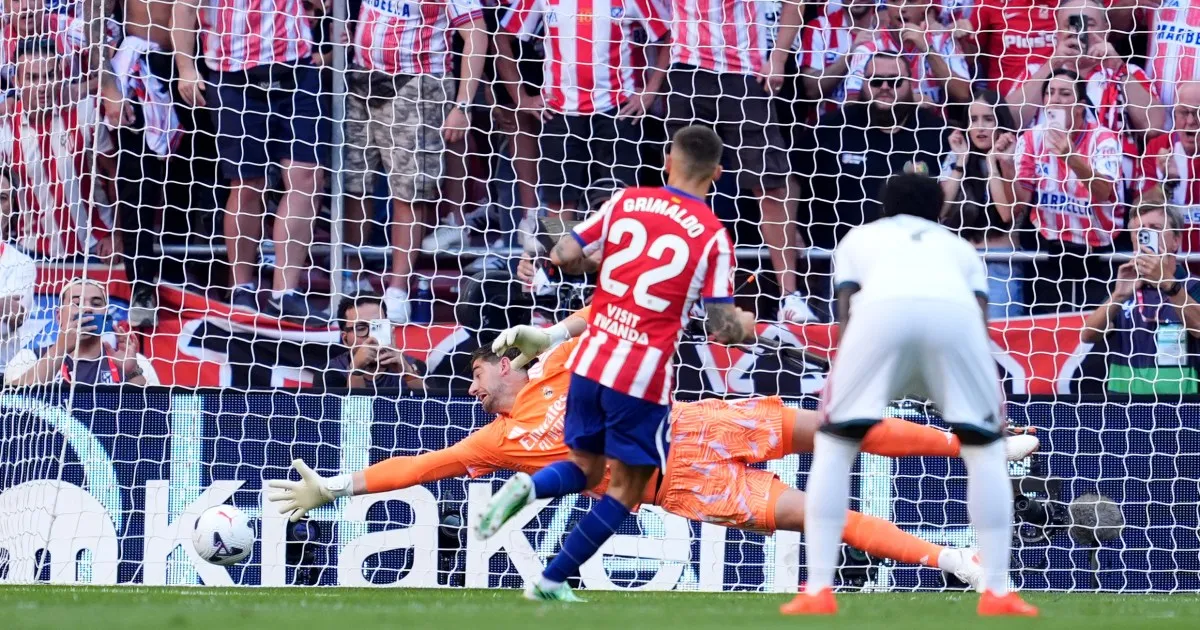
The game hinged on Huijsen’s red card early in the second half, for pulling down Giuliano Simeone in the box which led to a penalty, tucked away by Grimaldo to set Atletico on their way.
Mourinho started with Aurelien Tchouameni in midfield over Bernardo Silva, opting for defensive clout over creativity.
There was more tension than footballing quality in the first half, with neither side capable of creating any clear chances.
The main talking point was an incident between Jude Bellingham and Atletico defender Cristian Romero.
The England international threw himself into a tackle and Romero trod on his leg, with Bellingham booked initially, but after a VAR review the referee removed the card and issued it to the Atletico man.
Madrid were also unhappy with a heavy tackle by Lee Kang-in on Federico Valverde which went unpunished just before half-time.
It was a scrappy battle, intense but lacking excitement comparative to the star power on the pitch, especially in Madrid’s front line, with Vinicius Junior, Kylian Mbappe and Bellingham kept quiet.
The game burst into life early in the second half when Huijsen pulled back Giuliano Simeone’s arm as the forward ran through on goal and Atletico were awarded a penalty.
Huijsen was dismissed after a VAR review and Grimaldo beat Madrid goalkeeper Thibaut Courtois from the penalty spot.
Mourinho reacted immediately by replacing the underwhelming Vinicius and Arda Guler and sending on club record signing Yan Diomande and Rudiger.
It was Atletico who struck next, though, with Canada international David tucking away Giuliano Simeone’s raking low cross on 59 minutes for his third goal in three matches.
The hosts came close to getting a third but Courtois made an excellent save to deny Julian Alvarez and Ibrahima Konate reacted brilliantly to head Grimaldo’s effort from the rebound off the line.
Atletico goalkeeper Jan Oblak saved from Diomande and Bellingham rowed with Giuliano Simeone as Madrid’s frustrations showed, impotent to change the course of the game.
Madrid pulled a goal back in the final stages with Rudiger heading Bernardo Silva’s cross past Oblak. However, it was too little too late for Mourinho’s side.
Who: Atletico Madrid vs Real Madrid What: La Liga Where: Metropolitano Stadium, Madrid, Spain When: Sunday, September 20, at 4:15pm (14:15 GMT) How to follow:Al Jazeera Sport will bring you all the build-up from 11:15 GMT before our live text commentary stream
Atletico host bitter city rivals Real for the Madrid derby as both sides look to keep up with early La Liga pacesetters Barcelona.
Madrid trail unbeaten champions Barcelona at the top of the table by three points, with Atletico third.
Atletico have bounced back from back-to-back defeats to Bilbao and Liverpool earlier in September, beating Real Sociedad 3-0 and Osasuna 4-0 in their last two games.
Real come into the game in decent form under boss Jose Mourinho but have had wobbles this month, with a defeat to Betis and scoring late to beat bottom club Elche after squandering a two-goal lead.
Improving Atletico cruise to win over Osasuna
Atletico Madrid thrashed Osasuna 4-0 on Wednesday to build some form in the run-up to Sunday’s derby clash against rivals Real Madrid.
Jonathan David, Lee Kang-in, Robin Le Normand and Alex Baena’s goals helped Diego Simeone’s side cruise to a comfortable home victory.
They were without injured striker Julian Alvarez, but it did not matter after they secured a second straight win to cut the gap on top two Barcelona and Real Madrid.
The comfortable victory was important for an Atletico side with lots of new faces still bedding in, after two defeats in their three matches prior.
“We controlled it in the first half even though we weren’t clinical,” said coach Diego Simeone. “We were clinical in the second half and controlled the game.”
Atletico Madrid’s Alex Baena runs with the ball during the win over Osasuna at the Metropolitano Stadium [Oscar del Pozo/AFP]
Mourinho rues lack of game control
Real Madrid squandered a two-goal lead before substitute Carlos Espi struck in stoppage time to secure a dramatic 3-2 victory at Elche in La Liga on Tuesday.
Real went 2-0 up inside 33 minutes through a Matias Dituro own goal and Kylian Mbappe, but second-half strikes from Abiel Osorio and Fer Nino hauled Elche level before Espi restored the visitors’ lead in the 91st minute.
It was the second time in six league matches that the 21-year-old Espi had come off the bench to score a late winner, although Mourinho remained concerned by Real’s failure to control the second half in advance of Sunday’s derby against Atletico Madrid.
“The problem seems obvious to me. It’s harder to know why, but it’s easy to understand that there are matches that seem over and, in the end, aren’t,” said Mourinho.
“[There are] matches where we have three, four, five chances to finish them and don’t,” he said at the pre-match news conference.
“After failing to do so, it feels like we go from ease, because it seemed easy, to losing control.”
Mourinho said his team’s defensive issues were of concern.
“Not just for Sunday’s match, but for every match. I like my team to score goals … but I also like controlling matches,” explained Mourinho.
“I don’t like gifting control. It’s not about the goals, it’s about giving away control of the match.”
Mourinho’s side gave him a fright during their win over Elche [Alberto Saiz/AP Photo]
Prediction
The Opta supercomputer has made Real Madrid the favourites, with a win probability of 46.6 percent. Atletico were given a 28.3 percent chance of winning, while a draw was estimated at a 25.1 percent likelihood.
Head-to-head
The rivals have faced each other on 243 occasions; Real Madrid won 125 games, Atletico won 60, while 58 matches ended as draws.
Last five encounters:
March 22, 2026: Real Madrid 3-2 Atletico (La Liga)
January 8, 2026: Atletico 1-2 Real Madrid (Spanish Super Cup semifinal)
September 27, 2025: Atletico 5-2 Real Madrid (La Liga)
March 12, 2025: Atletico 1-0 Real Madrid (Champions League last 16, second leg)
March 4, 2025: Real Madrid 2-1 Atletico (Champions League last 16, first leg)
What happened the last time the two clubs played each other?
Vinicius Jr scored twice as Real Madrid fought back to beat Atletico Madrid 3-2 at the Santiago Bernabeu in a breathless Spanish capital derby in March.
Atletico’s Ademola Lookman opened the scoring in the 33rd minute, finishing a slick counterattack involving Matteo Ruggeri and a delightful back-heel from Giuliano Simeone.
Vinicius equalised from the penalty spot in the 52nd minute, after David Hancko clumsily tripped Brahim Diaz, and Federico Valverde capitalised on a Jose Maria Gimenez error three minutes later to make it 2-1 to Real.
Nahuel Molina silenced Real’s Bernabeu stadium with a thunderous 30-metre strike in the 66th minute, but Vinicius restored Real’s lead with a cracking solo effort six minutes later.
Vinicius Jr celebrates scoring his team’s winner [Florencia Tan Jun/Getty Images]
What happened in the corresponding fixture last season?
Julian Alvarez scored twice as Atletico Madrid came from behind to thrash city rivals Real Madrid 5-2 in a pulsating derby in September 2025.
Atletico’s aggressive start paid off when Robin Le Normand opened the scoring with a header in the 14th minute.
However, Kylian Mbappe burst through to level with an unstoppable strike from close range in a quick counter in the 25th minute, with Arda Guler netting a volley from a Vinicius Jr cross 11 minutes later to put the visitors in front.
Alexander Sorloth’s header in added time before the break gave Atletico a boost, and they regained the lead five minutes into the second half when Alvarez converted a penalty after Guler’s high boot clipped Nico Gonzalez on the face inside the box.
After Alvarez extended their lead in the 64th minute with a sublime free kick into the top corner, substitute Antoine Griezmann sealed the win in a quick counter in added time.
Alvarez scores Atletico’s third from the spot [Angel Martinez/Getty Images]
Atletico Madrid’s team news
Alvarez, Pablo Barrios, and Sorloth are doubts, as all three are struggling with muscle issues.
Jonathan David is likely to continue up front if Alvarez is absent or starts on the bench.
New mandatory entry requirement for UK travellers is about to come into force
A new scheme is about to come into force(Image: South agency via Getty Images)
British passport holders could be turned away at the border in Spain, France, Italy and several other destinations due to a post-Brexit scheme set to launch later in 2026.
Once the initiative comes into effect, UK holidaymakers will be required to pay for a digital travel authorisation document to gain entry to around 30 European nations. British travellers will need to register with the European Travel Information and Authorisation System (ETIAS), which will soon become an entry requirement for visa-exempt nationals visiting a specific group of 30 countries.
With a valid ETIAS travel authorisation, travellers can enter these European countries as often as they wish for short-term stays, typically up to 90 days within any 180-day period. Originally, the ETIAS was expected to cost around 7 euros per person, however it has since been confirmed the fee will be nearly triple that amount, coming in at 20 euros per eligible traveller.
Those aged under 18 or over 70 are exempt, meaning a family of four travelling with two children would pay 40 euros in total. Once the scheme is up and running, failing to hold a valid ETIAS could see you refused entry to any of the following countries: Austria, Belgium, Bulgaria, Croatia, Cyprus, Czech Republic, Denmark, Estonia, Finland, France, Germany, Greece, Hungary, Iceland, Italy, Latvia, Liechtenstein, Lithuania, Luxembourg, Malta, Netherlands, Norway, Poland, Portugal, Romania, Slovakia, Slovenia, Spain, Sweden, and Switzerland.
The scheme has faced numerous delays, and it is now anticipated that ETIAS will be launched over the next few months. The ETIAS is stored electronically against the passport.
While the vast majority of applications are expected to be approved “almost immediately”, if the system detects an error in your ETIAS submission, it could face rejection. Reasons for ETIAS applications being refused are reported to include holding an invalid passport, being considered a “risk” or having a Schengen Information System (SIS) alert, submitting an incomplete application, or failing to attend a mandatory interview.
Should your ETIAS application be turned down, you have the right to lodge an appeal.
Police in Ceuta used batons and fired shots into the air as they began moving migrants from beaches to a new camp. Nearly 10,000 remain in the Spanish territory weeks after a record influx saw more than 72,000 people cross from Morocco.
Real Madrid stars including Kylian Mbappe rolled up T-shirts showing support for Ceuta, but President trip ‘unrelated’.
Published On 18 Sep 202618 Sep 2026
Real Madrid President Florentino Perez attended an event at Ceuta city hall on Friday in a visit to show solidarity with the Spanish territory, saying that it was not related to any recent developments.
On Tuesday, before Real’s La Liga match with Elche, Kylian Mbappe, Vinicius Jr and Ibrahima Konate obscured the message “We are all mackerels”, which appeared on T-shirts worn by the rest of the players. “Mackerels” is a nickname for people from Ceuta, and the shirts were designed to show support for them.
Recommended Stories
list of 4 itemsend of list
Mbappe said on Wednesday that he did not want to prioritise the suffering of one group over another. Real told the news agency Reuters that they respected their players’ freedom to make their own decisions, but noted that they had shown support for Ceuta a week earlier with a tifo during their Champions League match with Inter Milan.
Perez was accompanied by honorary Real Madrid President Jose Martinez Pirri, a native of Ceuta. They were welcomed by Regional President Juan Jesus Vivas.
“I want to emphasise, to avoid any doubts, that today’s event has been prepared over several weeks with the president of Ceuta, not due to any recent news,” Perez said at the city hall.
“And I also take this opportunity to convey all our support, all our affection, and our solidarity during these very difficult times to all Ceutans. It is our wish that normality resumes as soon as possible in Ceuta.”
In July, more than 70,000 irregular crossings into Ceuta from Morocco took place, causing disruption in the territory. Real Madrid’s show of solidarity is one of many gestures that have taken place across Spain since the mass crossings.
World Cup winners Spain choose Cueta to announce Nations League squad in solidarity with migration crisis in region.
Published On 18 Sep 202618 Sep 2026
Spain coach Luis de la Fuente announced his Nations League squad from Ceuta on Friday in a show of support for the Spanish city in northern Africa that has become the centre of a migration crisis.
For his first squad announcement since Spain won the World Cup in July, De la Fuente revealed his list in a video featuring him in Ceuta accompanied by residents of the Spanish exclave. More than 70,000 people stormed across the border in late July from Morocco, with more than 100 dying in the chaos. Most quickly returned, but a few thousand remain in the city of just over 80,000.
Recommended Stories
list of 4 itemsend of list
De la Fuente did not directly mention the border crossing or its impact, but did say: “This is Ceuta, this is Spain.” It echoed the rise in sentiment in Spain that Ceuta – a territory that until the mass crossing was mostly an afterthought for most mainland Spaniards – needs to be supported.
Spain opens the Nations League against England at Wembley Stadium on September 26 , when its players will wear two stars on their shirts for the first time since winning their second world title.
After visiting London, Spain will host Croatia on September 29 and the Czech Republic on October 3 , before visiting Croatia on October 6 .
De la Fuente kept his World Cup squad mostly intact.
Inter Milan goalkeeper Josep Martinez replaces Barcelona’s Joan Garcia, who is out with a minor knee issue. Real Madrid defender Dean Huijsen is in for Marcos Llorente, who retired from international football. Fermin Lopez replaces fellow Barcelona midfielder Gavi, while Espanyol striker Roberto Fernandez got his first call-up, replacing Borja Iglesias.
Ceuta is one of two Spanish territories on the north African coast along with Melilla. Ceuta has been in Spanish possession since 1580. Christians and Muslims, Spanish and Moroccan residents and day workers all live there in relative harmony behind a border fence that many migrants from across Africa attempt to cross or swim around for a better life in Europe.
A Real Madrid supporters’ group has demanded a public apology from their star striker Kylian Mbappe and two of his teammates after the trio declined to fully wear a T-shirt in support of the people of Ceuta.
Mbappe, Vinicius Junior and Ibrahima Konate wore a tribute shirt along with the rest of the squad ahead of Madrid’s 3-2 win at Elche on Tuesday in La Liga, although theirs were partially rolled up to cover the message.
Spain’s Nations League squad:
Goalkeepers: Unai Simon (Athletic Bilbao), David Raya (Arsenal), Josep Martínez (Inter Milan)
Defenders: Aymeric Laporte (Athletic Bilbao), Pau Cubarsi (Barcelona), Eric Garcia (Barcelona), Marc Pubill (Atletico Madrid), Alejandro Grimaldo (Atletico Madrid), Marc Cucurella (Real Madrid), Dean Huijsen (Real Madrid), Pedro Porro (Tottenham).
Midfielders: Rodri Hernandez (Barcelona), Pedri Gonzalez (Barcelona), Fermin Lopez (Barcelona), Martin Zubimendi (Arsenal), Mikel Merino (Arsenal), Fabian Ruiz (Paris Saint-Germain), Alex Baena (Atletico Madrid).
Forwards: Lamine Yamal (Barcelona), Dani Olmo (Barcelona), Ferran Torres (Paris Saint-Germain), Yeremy Pino (Crystal Palace), Nico Williams (Athletic Bilbao), Mikel Oyarzabal (Real Sociedad), Victor Munoz (Liverpool), Roberto Fernandez (Espanyol).
MADRID: The Spanish government on Sunday said more than 5,300 of the migrants who remained in Ceuta after July’s influx had returned to Morocco in a month, as it faces pressure to restore normality to the increasingly tense city.
The new figures come as criticism over the speed at which the migrants are being returned from the Spanish north African territory damages Socialist Prime Minister Pedro Sanchez before next year’s election.
More than 70,000 migrants entered Ceuta on July 30 and 31 in an unprecedented and deadly rush, with most returning to Morocco in the following hours.
The government has had to identify the thousands of migrants who have remained for weeks to check if they are entitled to asylum, while unaccompanied children cannot be summarily deported.
Angel Victor Torres, the minister tasked with leading the government’s response, said in a video posted to social media that 5,321 people had “voluntarily returned” to Morocco since August 10.
Ninety people had “given up” their request for international protection and “almost 1,000 people are being registered with the aim of being able to complete their return proceedings,” Torres added.
The minister did not say how many migrants remained in Ceuta after those returns, a figure that has consistently sparked controversy between the leftist government and the conservative-run city.
On Friday, Ceuta’s leader Juan Jesus Vivas, of the main opposition right-wing Popular Party, put their number at 13,000, but the government’s estimations have been significantly lower.
Locals have protested regularly as the migrants continue to camp on beaches and sleep in the streets, accusing the government of abandoning the overwhelmed city amid a humanitarian crisis.
The migration ministry announced on Sunday the creation of another 864 places in temporary migrant shelters, taking the total to around 4,300 and with a view to reaching 6,000 “in the near future.”
Doubts about what the government knew beforehand and the possible role of Morocco, with which Madrid has spent years trying to improve relations, have also increased the political fallout for Sanchez.
The spot has been hailed by holidaymakers as the best beach on the White Isle, and with warm 23°C temperatures in October and November it’s the perfect spot for an autumn break away from the crowds
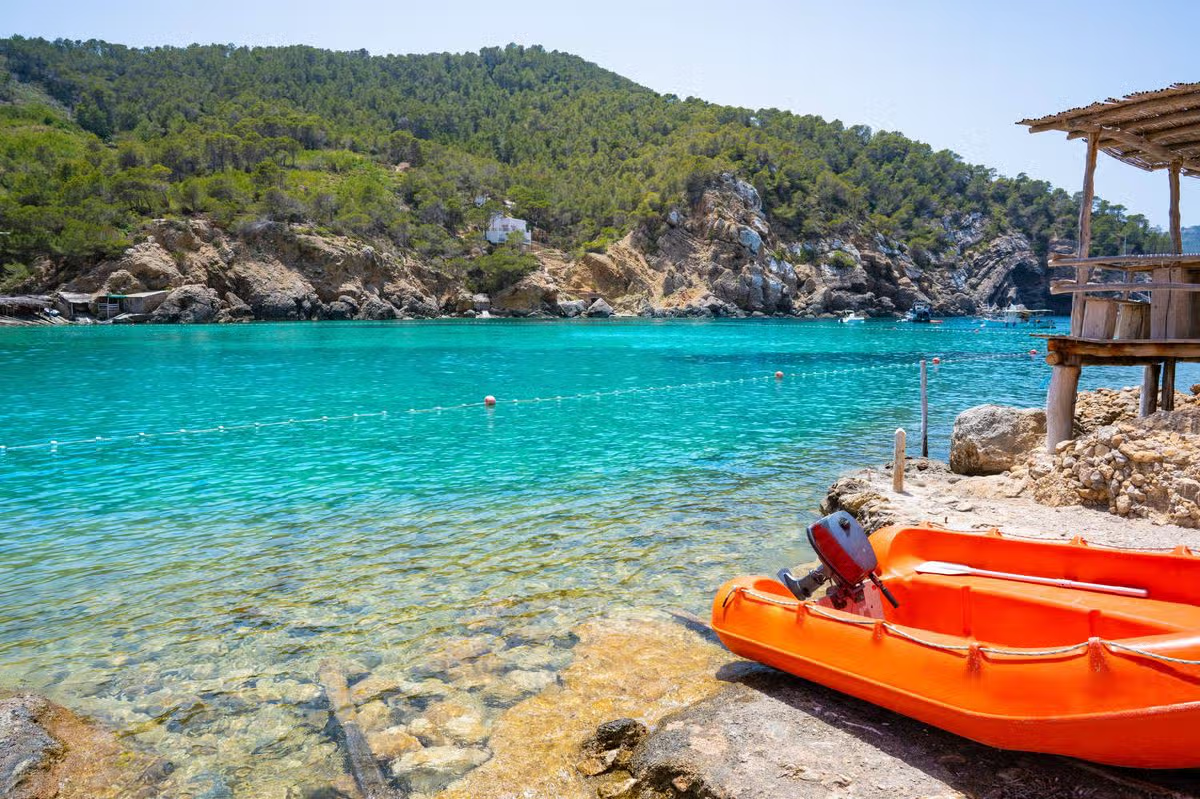
One European spot has dramatic scenery that sets it apart from other spots(Image: LUNAMARINA via Getty Images)
Tucked between pine-covered hills, the sheltered cove has a mix of golden sand and pebbles, while its clear waters are ideal for swimming and snorkelling. But it is the dramatic scenery that really sets the European spot apart.
Off the coast sits Cap Bernat, a distinctive rock formation often nicknamed the “Finger of God”. It has become an iconic part of the skyline and provides a spectacular backdrop as the sun sets over the water.
Cala Benirràs is one of the most famous coves in northern Ibiza, but it offers a very different experience from the island’s glamorous beach-club hotspots.
The beach is particularly famous for its bohemian atmosphere and stunning sunsets, with visitors gathering to watch the sun disappear behind the rocky coastline.
Benirràs has also long been associated with drumming at sunset, which has become part of the cove’s identity.
However, visitors should be aware that the traditional large-scale Sunday drumming sessions have been restricted in response to the huge crowds they attract.
Smaller, informal drumming sessions can still take place, but it is best to check the arrangements before travelling if this is a key reason for your visit.
Despite its popularity, Cala Benirràs retains a relatively natural and rustic feel compared with some of Ibiza’s more polished beach destinations. The seabed is rocky in places, adding to its appeal for snorkellers, while the sheltered bay usually offers calm, clear water.
There are also several places to eat and drink around the cove, including Elements Eivissa Beach Club, which sits directly on the beach, alongside more casual dining options nearby.
For visitors looking to experience a quieter, more bohemian side of Ibiza, Cala Benirràs offers a combination of clear waters, pine-covered hills, spectacular sunsets and its famous rock formation that makes it well worth a visit, reports the Express.
Best time to visit
Autumn breaks offer quieter beaches and warm, sunny weather, with package holiday prices often considerably cheaper than during the pricier summer period. Holding out just a few weeks for an October escape could see travellers discovering hidden gems in some of Europe’s most sought-after destinations like Spain or Portugal for a fraction of the cost.
When experts at Wizz Air pinpointed the best under-the-radar coastal destinations in Europe for the shoulder season, Cala Benirrás in the north of the island earned top marks for tranquillity.
The airline previously carried out an analysis of beaches across more than 50 European countries, evaluating crowd levels, average temperatures, and daylight hours throughout September, October, and November.
By calculating beach space per visitor, Wizz Air ranked destinations according to the amount of room available to unwind and bask in the late-season sunshine.
‘Hidden gem’
This Ibizan ‘hidden gem’ has been hailed as the “best beach on Ibiza, especially in October” by Tripadvisor user Debra H. Captivated by their visit to this tranquil corner of the White Isle, the traveller went on to say: “It’s not just a beach for a day trip or the Sunday drumming it’s a place to come early in the morning and get to know. We really liked Elements cafe, nice food sitting and chilling on the sofa as with music. Lovely family friendly and I love the rock there like a giant goddess. Highly recommend. Most favourite beach in Europe.”
Another late-season visitor, Emily S, shared the same enthusiasm, describing it as a “beautiful bohemian feeling beach, perfect place for sunset”.
They added: “We visited Ibiza at the end of October. End of season, so this beach was lovely. Not too busy, with a relaxed, friendly, safe feel. Beautiful sheltered cove with stunning views out to sea, and amazing clear waters with lots of fish.”
Ibiza boasts average temperatures of around a balmy 23°C (73°F) throughout October and November, making it ideal for those looking to soak up the last of the summer sunshine.
Cala Benirrás is just a 10-minute bus ride from the nearest town of Port De San Miguel, which is home to hotels, villas and a broad range of amenities.
HOPPING from place to place in a motorhome may not sound a particularly relaxing way to spend a week, compared to lying on a sun lounger at a resort.
But there’s a sense of excitement with a road trip that no fly-and-flop holiday could ever match.
Hit the road with the Swift Trekker 584Credit: SuppliedThe Tudor Market Square in ShrewsburyCredit: Getty
The sheer adventure, access to off-grid locations and freedom to move wherever the wind takes you are something money can’t buy.
That’s why I dragged my wife and two kids (aged six and three) away from the beach for our first ever campervan voyage, through the West Midlands, rural Shropshire and the North Welsh countryside.
Sign up for the Travel newsletter
Thank you!
And it beat all of our beach holidays, hands down.
We were in a Swift Trekker 584, a beast of a motorhome that’s nicer than my house, with sleeping space for four people, a roomy bathroom and mini kitchen complete with oven and hob.
From day one my boy fully embraced #vanlife, becoming a key helper in the not-so-glam, but necessary, daily tasks as we moved between driving, eating and sleeping — hooking up the electricity and water, ensuring things were properly stowed away and always making sure the toilet hatch was closed.
We cheated a little by switching out motorhome staples like spag bol or soup for the occasional restaurant but, by the end, we’d fully mastered road-trip life.
Our first base was Llanberis, a stunning village at the foot of Snowdon offering brilliant hiking in the surrounding mountains and watersports at two lakes on its doorstep.
Ahead of arrival, we’d booked a pitch with Morris Leisure, a highly rated camping operator specialising in motorhomes and caravans, with parks across North Wales, Herefordshire and Shropshire.
The Severn Valley Railway is great fun for allCredit: AlamyTom and his son in a museumCredit: Supplied
Its Llanberis Touring Park is ideally located, with direct footpaths to Snowdonia and a five-minute walk to the village centre.
Some pitches have electricity and wifi while others have fresh water, plus there’s a shower block and a laundry area.
And the best thing is, if you are motorhome novices like us, there’s an on-site shop crammed with anything you may have forgotten, plus caravan accessories and essentials.
After Wales, we made our way to the market town of Oswestry and Park Hall Farm (make sure to watch one of the hilarious pig races), then it was on to the Shropshire town of Shrewsbury.
Its high street is frequently named one of the best in the UK, so we had high hopes.
It didn’t disappoint. Rather than being overrun with vape shops, bookies and barbers, the main stretch was littered with Tudor architecture and chock-full of independent shops, cafes, pubs, restaurants, museums and galleries.
The place is buzzing and a pleasure to walk around.
Kids will love the Quarry Park for the splash zone, while budding young artists may prefer to get stuck into one of the workshops at Shrewsbury Museum & Art Gallery.
Stopover at Llanberis Park in SnowdoniaCredit: SuppliedOr you can ditch the road for the water and book a trip along the river Severn with Sabrina BoatCredit: Alamy
Or you can ditch the road for the water and book a trip along the river Severn with Sabrina Boat.
Prefer to travel by train? The Severn Valley Railway is a delightful experience and offers day trips through the rolling countryside, as well as special themed events.
Those visiting during October half-term will be able to book Halloween-inspired journeys from Kidderminster station, with scare trains for little ones as well as those aged 18 and over.
Our only regret was missing out on a film at Old Market Hall cinema, an independent screen sitting in a beautiful building dating from 1596.
It’s not just the destinations themselves that make a motorhome trip so magical, though.
Journeying along the A4086 and the A5 offered gorgeous scenery and rolling hills that kept us entertained for hours.
When we eventually dropped off the van, our home for the week, it was with a very heavy heart.
No motorhome trip will ever be stress-free and it does require a level of planning and organisation beyond your average resort holiday.
But the freedom can’t be matched.
And the memories from our motorhome will long outlive those from a Spanish sun lounger.
GO: CAMPERVANNING
STAYING THERE: Morris Leisure has seven touring caravan sites and holiday home parks in the UK.
Motorhome pitches at Llanberis cost from £46 per night.
Gabriel Jesus claims he was forced to train alone before Barcelona move, but Arsenal ‘surprised’ by criticism.
Published On 11 Sep 202611 Sep 2026
Arsenal boss Mikel Arteta said he was “very surprised” by Gabriel Jesus’s claim that he was forced to train alone and was given no information prior to joining Barcelona.
Jesus ended his four-year spell with the Gunners in September and has since made it clear he felt disappointed with the way his exit was handled.
Recommended Stories
list of 4 itemsend of list
The Brazilian striker said in an interview this week that “out of nowhere they put me to train apart from the group,” adding that “nobody told me nothing” before he signed for Barcelona.
Responding to Jesus’s criticism, Arteta insisted he had spoken to the former Manchester City star about the transfer and had parted on good terms.
“Very surprised, to be fair. Especially because with Gabi (Jesus) I had an individual talk in the dressing room,” he told reporters on Friday.
“I don’t know what words were said; it’s fine. The words that we used were all about gratitude.”
Arteta also came under fire from former Arsenal striker Ian Wright, who recently said he was “uncomfortable” with what he perceived to be a lack of dialogue between the club and Gabriel Martinelli, who moved to Saudi Pro League side Al Hilal on September 3.
But Arteta used the presence of Leandro Trossard, who was sold to Besiktas in July, to watch Arsenal’s victory over Chelsea last weekend as an example of the club’s bond with their former players.
“I don’t know, it’s OK. Sometimes I understand that when you have to deliver bad news, or news that people don’t expect, somebody has to be the bad cop. If I have to be, I have to be and I understand,” he said, before the Premier League champions’ trip to Sunderland on Saturday.
“What is important is normally what happens three months or six months later. When Trossard comes, he’s in the dressing room with all of us, the atmosphere and the relationship you have.
“Thank God so far that with all the players that left, at some point the relationship has been really good. I hope this is the same case.”
Hundreds of people fled a massive fire that destroyed dozens of migrant shelters in Ceuta, Spain. Authorities reported no casualties and are investigating whether the blaze was deliberately set.
After lower house approval, the bill to grant tens of thousands of Sahrawis citizenship now goes to the Spanish Senate.
Published On 10 Sep 202610 Sep 2026
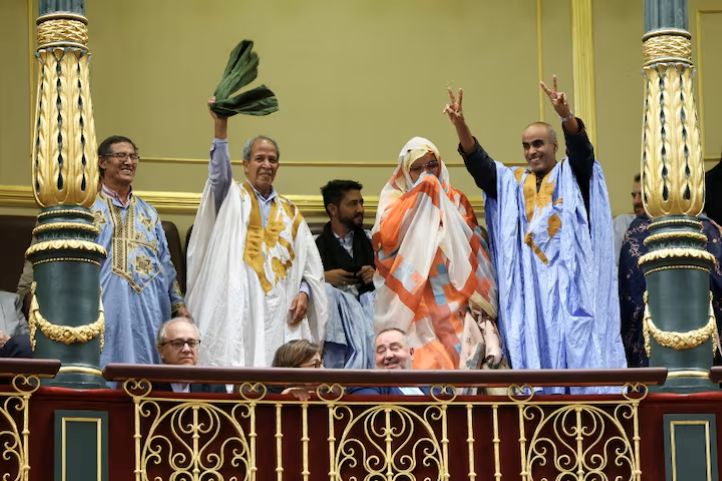
Spanish lawmakers have backed legislation that would grant citizenship to tens of thousands of Western Saharans who were born when Spain ran the disputed territory now largely controlled by Morocco.
Spain’s lower house of Parliament on Thursday approved the legislation 168-31, with 145 abstentions.
Recommended Stories
list of 3 itemsend of list
The bill still requires Senate approval before becoming law.
The text grants Spanish nationality to Sahrawis born before September 29, 1977 and to their children through naturalisation, even if they never resided in Spain.
Although the exact number of beneficiaries is unknown, Sahrawi groups estimate that between 70,000 and 120,000 people could benefit from the legislation, which supporters described as addressing a “historical injustice” by colonial Spain in the Western Sahara.
Tensions with Morocco
The vote comes at a particularly sensitive time for Madrid’s historically delicate relations with Rabat due to the migration crisis in Spain’s north African territory of Ceuta, and the mass arrival of at least 70,000 migrants from Morocco in July.
Spain’s leftist government has avoided blaming Morocco – which does not recognise Spanish sovereignty over Ceuta and Spain’s other North African territory of Melilla – but the right accuses Rabat of orchestrating the surge for political motives.
Morocco claims sovereignty over Western Sahara and began asserting control over the territory after Spanish rule ended.
The Algerian-backed Polisario Front independence movement seeks recognition of an independent state called the Sahrawi Arab Democratic Republic.
Many Sahrawis live in refugee camps in Tindouf in western Algeria, or elsewhere abroad, while others remain in Western Sahara.
Against this backdrop, the initiative to grant Spanish nationality to Sahrawis has divided opinion in Morocco but not prompted condemnation from the government.
Moroccan media quoted Ramadan Messaoud, a member of the Royal Advisory Council for Saharan Affairs, as saying in July that Rabat had “no problem” with Sahrawis obtaining Spanish citizenship. Others had done so “over the past few years”, noted Messaoud, who is also president of the Sahrawi Association for Human Rights.
‘Restoring’ identity
Western Sahara was a Spanish colony until 1975, when Spain relinquished its administration under agreements with Morocco and Mauritania.
Spain’s ruling Socialist Party and its junior left-wing partner Sumar, which filed the initiative, were among those who supported the bill, while the opposition conservative People’s Party abstained and far-right Vox voted against it.
“With the adoption of this legislation, we are restoring – and I emphasise, restoring – the Spanish national identity card to those Sahrawis who once held it and from whom this state took it away,” said Tesh Sidi of the leftist Sumar coalition, the first woman of Sahrawi origin to serve in Spain’s Parliament.
The bill will now go to the Senate, where amendments are expected, before returning to the lower house for final approval.
MADRID: Spain’s lower house voted on Thursday to grant citizenship to Sahrawis born when Madrid administered the North African territory of Western Sahara as a colony, a move that could inflame delicate relations with Morocco.
The legislation, which a statement from parliament said was approved with 168 votes in favor, 31 against and 145 abstentions, would also allow descendants of those granted citizenship to acquire it.
Some 70,000 to 110,000 Sahrawis could be eligible for Spanish citizenship, according to local media.
Spain’s ruling Socialist Party and its junior left-wing partner Sumar, which filed the initiative, were among those who supported the bill, while the opposition conservative People’s Party abstained and far-right Vox voted against it.
“With the adoption of this legislation, we are restoring – and I emphasise, restoring – the Spanish national identity card to those Sahrawis who once held it and from whom this state took it away,” said Tesh Sidi of the leftist Sumar coalition, the first woman of Sahrawi origin to serve in parliament.
Tensions with Morocco
Tensions have grown between Spain and Morocco following the mass arrival of at least 70,000 migrants in Spain’s North African enclave of Ceuta in July.
Spain controlled Western Sahara under various administrative arrangements from 1884 until 1976. Morocco claims sovereignty over Western Sahara and began asserting control over the territory after Spanish rule ended.
The Algerian-backed Polisario Front independence movement seeks recognition of an independent state called the Sahrawi Arab Democratic Republic.
Many Sahrawis live in refugee camps in Tindouf, Algeria, or elsewhere abroad, while others remain in Western Sahara. Spain had supported a referendum in the territory — in line with United Nations resolutions — until Sanchez’s government reversed course in 2022 and backed Morocco’s position. Tensions eased somewhat after that shift, with Madrid describing Rabat’s autonomy proposal for Western Sahara as “serious, credible and realistic”.
TO ESCAPE the chaos of summer and enjoy the delights of quieter hotels, lots of us like to book holidays between September and November.
Those three months have lots of names like the ‘magic period’ or ‘shoulder season‘ and taking a break then can save you some serious cash.
Two coastlines in Spain came up trumps for cheap autumn holidaysCredit: AlamyThe beautiful Albanian coastline also came in as being very affordable for BritsCredit: Alamy
Whether you want a quick trip to Spain or a holiday to African resorts for winter sun, there are some great deals out there, and lastminute.com have helped us find some of the best.
They told us: “Once the peak summer period has passed, travellers can often find significantly better value on flights and holidays, while still enjoying warm weather and everything a destination has to offer, proving that it is better to leave it until the last minute.”
Sign up for the Travel newsletter
Thank you!
The cheapest spot is Costa Dorada in Spain where on average holidays cost £79pppn.
The Costa Dorada is a region along the Mediterranean coastline and includes popular spots like Tarragona and Salou.
What’s even better is that you can definitely still spend time on the beaches too as in October there are average daytime temperatures of around 22C.
It’s also home to the enormous PortAventura World which is one of Europe’s biggest theme parks – and is home to Europe’s tallest and fastest accelerator coaster Red Force in Ferrari Land.
It’s a beach front spot with rooms that have views of the coast along with a restaurant, bar, swimmingpool, sun terrace and spa.
A four-night stay for two with return flights to London Luton in October starts from £248pp – or £62pppn.
If you want to add half-board to have breakfast and dinner included it’s an extra £26pp.
Hotel Best Negresco in Spain costs as little as £62per night with lastminute.comCredit: Unknown
The second cheapest destination for autumn is Sousse in Tunisia.
The coastal resort city is known for having bright blue waters and plenty of beach clubs.
Visitors can explore the Medina of Sousse – a historic walled quarter that is an open-air market where you can pick up ceramics, leather bags, shoes and jewellery.
With lastminute.com you can book to stay at the Hotel Royal Jinene Beach & Spa from £66pn – and it includes return flights and half board.
The hotel has an indoor pool, outdoor pool with a big slide, bar, restaurant and coffee house as well as activities like tennis and mini golf.
There’s also a spa and live music nights and a short walk away is the sandy Plage El Menchia.
A four-night stay for two people with half board and return flights to London Southend in October is £264pp – or £66pppn.
It’s back to Spain for the third cheapest destination in autumn which is the Costa Brava where on average a holiday is £87pppn – although there are cheaper deals to be found.
The coastal region in northeastern Spain has lots of beaches with cliff backdrops and coves.
Sousse in Tunisia is the second most affordable spot according to lastminute.comCredit: TripAdvisor Hotel Tahití Playa & Suites 4Sup in the Costa Brava is a few steps away from the beachCredit: lastminute
The Costa Brava has 300 days of sunshine every year and is mild throughout September and October.
Sarandë is known as the the ‘city’ of the Riviera.
It’s surrounded by the blue waters of the Ionian Sea with seafood restaurants and cheap beer, with pints as little as £1.30.
Here, you can book a stay in the four-star Bougainville Bay Hotel which is considered a gallery itself full of sculptures, paintings and mosaics.
The hotel is next to the sea and you can enjoy the views from its beautiful infinity pool.
Bougainville Bay Hotel has an infinity pool looking over the Albanian coastlineCredit: Lastminute Stay at the Yocca Hotel Residence in Tunisia – it has an outdoor pool and pretty gardenCredit: Lastminute
It also has four bars, two restaurants and four swimming pools.
In October, temperatures in the daytime sit around 21C – although they do drop in the evening.
A four-night stay for two including breakfast in October at the Bougainville Bay Hotel including return flights to London Stansted is £229pp – or £57.25pppn.
Coming in fifth position for being one of the cheapest spots for a holiday in autumn is Hammamet.
The coastal resort town in northeastern Tunisia boasts golden beaches and there’s plenty of historical sites to explore if you fancy a wander.
Hammamet is a great spot for anyone wanting a dose of sunshine and heat as in October temperatures can be as high as 26C.
For Brits it’s ideal as it’s as little as three and a half hours away from the UK.
The Yocca Hotel Residence is slightly outside of the city with spacious rooms some of which have balconies, swimming pool, garden, terrace and restaurant.
A six-night stay for two at the Yocca Hotel Residence including return flights from London Gatwick is £308pp – or £51.34pppn.
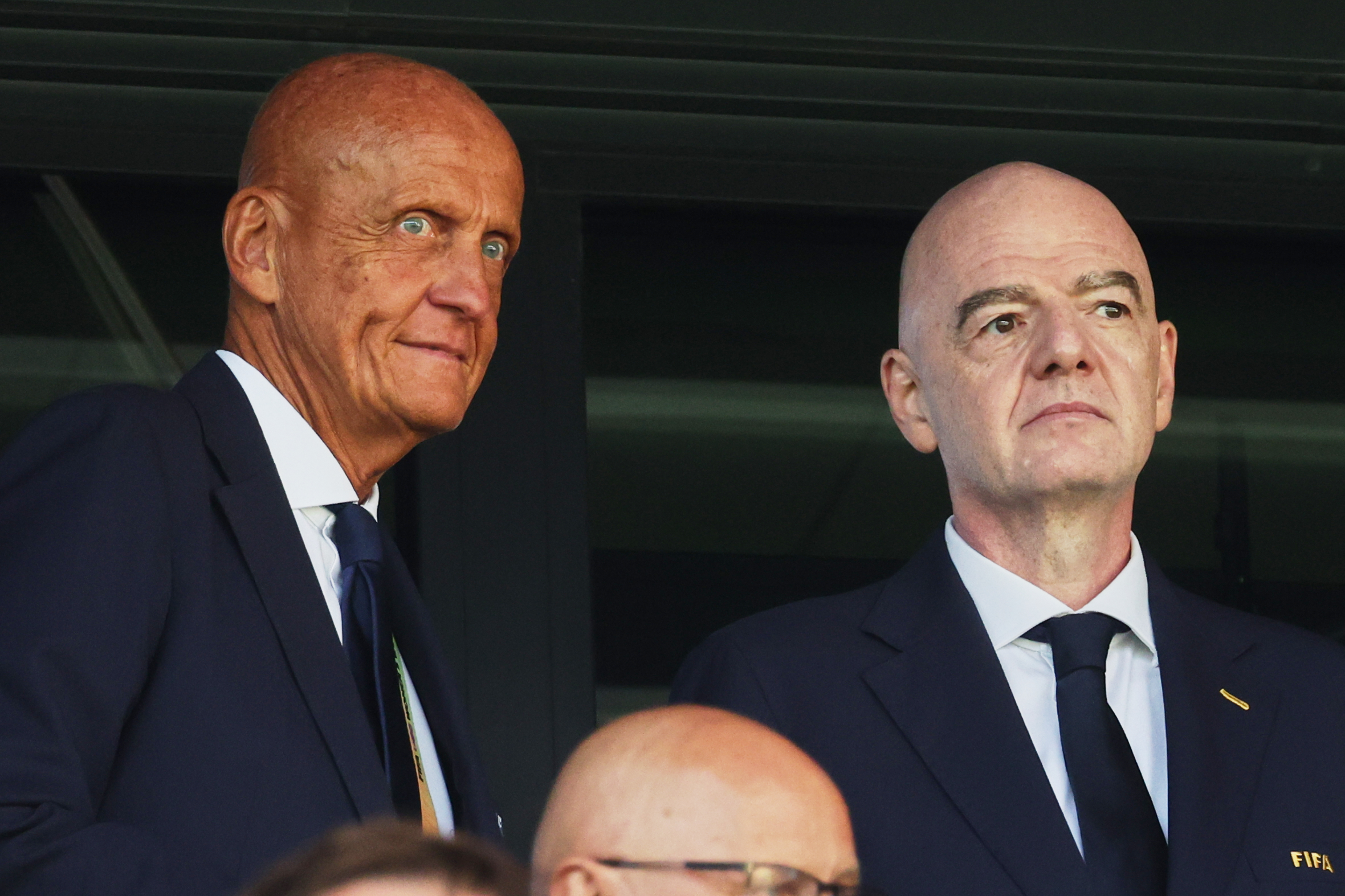
CASABLANCA, Morocco: Morocco and Spain are arguing over the right to host the 2030 World Cup final — with besieged FIFA boss Gianni Infantino hovering backstage.
FIFA has yet to officially announce which country will host the biggest match of the biggest event in soccer. And even though the 2026 edition just finished with Spain winning the title this summer, Moroccan and Spanish officials are staking their claim on the next final.
The tussle over the soccer match also comes with Spain still reeling from a massive border crossing by tens of thousands of migrants who pushed through the frontier from Morocco into the north African Spanish enclave in late July.
One big game for two proud countries
The head of Moroccan soccer boasted that his country had it locked up on Thursday.
“The city of Benslimane will host the World Cup final. Hate it or love it, and if anyone wants to talk on top of that, let them talk,” Moroccan federation president Fouzi Lakjaa told a political rally.
“The city is Benslimane, the Hassan II stadium is the stadium, and I hope that Morocco will be playing it,” he added.
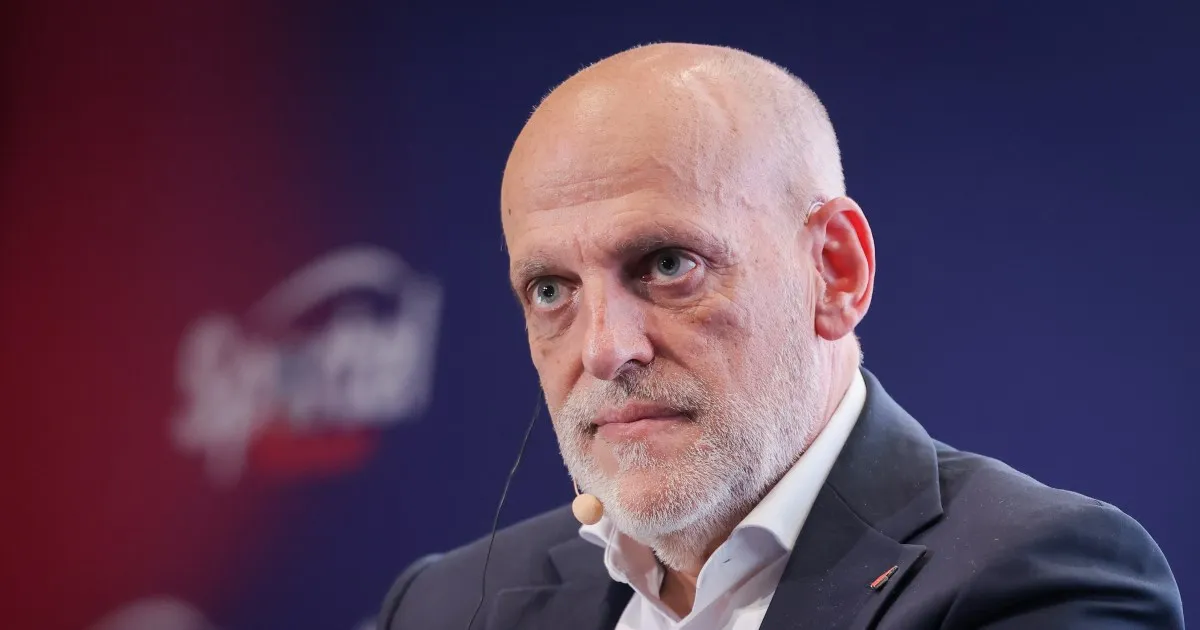
This week, the head of the Spanish soccer federation, Rafael Louzán, insisted it was Spain that deserved the game, while acknowledging that it has not been guaranteed that honor.
“We all signed to accept the candidacy … it’s too bad that, regarding the final, it wasn’t made clear, totally clear, where it is to be played,” Louzán said. “Spain, as world champion both in men’s and women’s soccer, must host the final.”
European soccer officials believe that the sprawling, multi-nation 2030 event, which includes Portugal and even a handful of games in South America, should be considered a European event with the final on the continent.
In a request for comment by the Associated Press on Thursday, FIFA said its decision will be made “in due course.”
Infantino has found support in Morocco
The dispute over the final comes with Infantino under intense pressure after UEFA, the umbrella organization of European soccer federations, led a successful revolt to scuttle his plan to sell stakes in the World Cup.
By contrast, six Arab nation federations, including Morocco’s, have backed him since that fiasco.
The King Hassan II Stadium near Casablanca is being built in Benslimane, on the outskirts of Casablanca. It is planned to seat 115,000 spectators. Spain can offer the home stadiums of Real Madrid or Barcelona as potential sites for the final.
Infantino has recently made two trips to Morocco, meeting with King Mohammed VI during annual celebrations of his ascent to the throne in July and then holding a FIFA crisis meeting there in August.
World Cup final spat among other tensions
When confirmed three years ago, the joint candidacy between Spain, Portugal and Morocco looked like a perfect event to bridge Europe and Africa and strengthen bonds between the western Mediterranean neighbors.
But the dispute over the final comes with diplomatic tensions between Madrid and Rabat already frayed over who was responsible when tens of thousands of mostly Moroccans driven by posts on social media pushed into the small Spanish enclave of Ceuta that borders Morocco. Spain’s prime minister said 140 people died in the crossing.
Spain’s government has been under political pressure at home to get tough on Morocco, which it has said acted in good faith in the border crisis. Spanish police assessments couldn’t rule out complicity by Moroccan security forces but said that it was unlikely the Moroccan government had intentionally orchestrated it.





![Fans hold a banner during the Atletico Madrid vs Real Madrid match in the Spanish La Liga at the Metropolitano Stadium in Madrid on Sunday, September 20, 2026 [Leyla Hamed/Al Jazeera]](https://i0.wp.com/occasionaldigest.com/wp-content/uploads/2026/09/Ceuta-banner-Atletico-Madrid-vs-Real-Madrid-Leyla-Hamed-1789993641.jpeg?w=640&ssl=1)