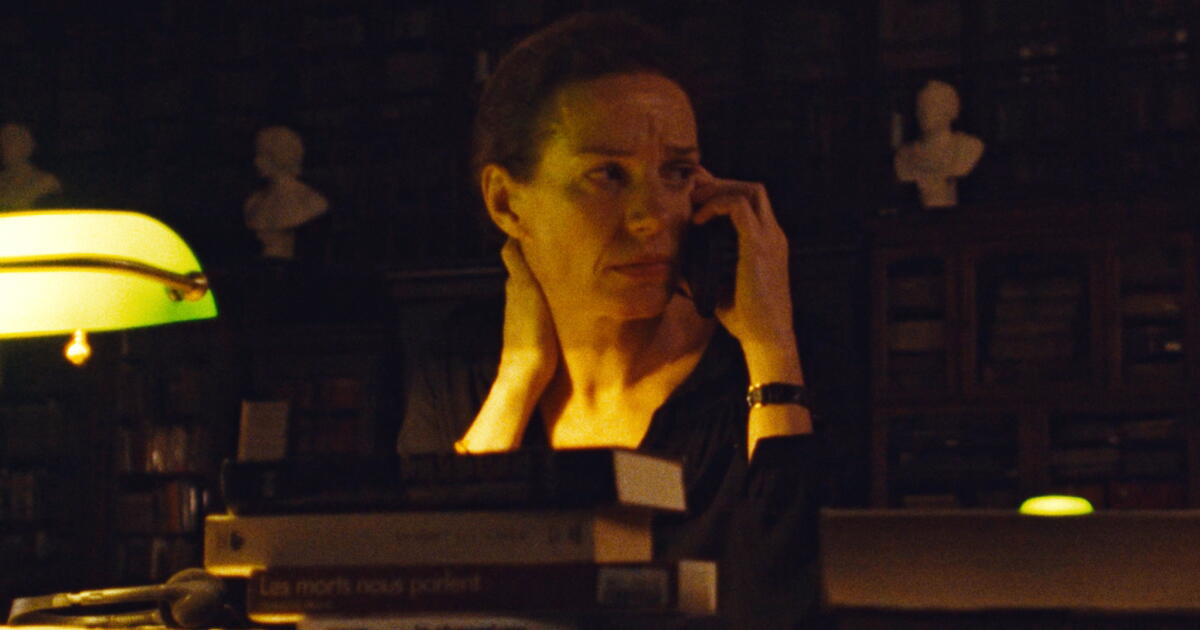
A researcher falls down a rabbit hole of academia in “Chronovisor,” a singular indie that sneaks up on you. Filmmakers Jack Auen and Kevin Walker — who operate under the name Cosmic Salon — make movies in the belief that intellectual pursuits can be both exciting and cinematic. “Chronovisor,” a pleasurably hand-crafted curio, firmly asserts that the sensorial possibilities of film can seem infinite.
That said, the movie opens deceptively: Béatrice (Anne-Laure Sellier), a professor of philosophy at Columbia in New York, is clearly boring her two unseen colleagues over drinks with a monologue about her theories of memory and brain function. Alone afterward, however, with the camera following her as if she were a secret agent and the orchestral swell of Gustav Holst’s “The Planets” lending Hitchcockian tension, the real story begins to unfold in large, ornate libraries.
What draws Béatrice’s attention is a fantastical claim made by a Benedictine monk in an Italian magazine article from the 1970s. He insists he discovered an instrument with the power to pull images and sound from the whole of human history, presenting them on a television screen. With this time-shaping device called the Chronovisor, Father Pellegrino Ernetti professed to have seen footage of the crucified Christ and even enjoyed a lost play staged by an ancient Roman dramatist. At the end of a slow zoom shot, we see the article’s title in Italian until it’s translated for us in English: “A Machine Has Been Invented That Photographs the Past.”
With that, “Chronovisor” and its obsessed protagonist enter a trancelike, analog-heavy state in which obscure texts in myriad languages tease a concealed parascientific history of potentially great importance. In other words, get ready to read a lot and yet, surprisingly, to enjoy the immersion, as one might the hushed thrill of a surveillance sequence. As Béatrice’s amateur detective work pulls her in deeper, the strands begin to suggest a conspiracy, one marked by mysterious disappearances and the clandestine sway of the Vatican.
The question of what’s real and not isn’t only Béatrice’s to unpack — you may wonder yourself whether Auen and Walker have fabricated their esoteric source materials and invented the strange saga of Ernetti. They haven’t. Not entirely, that is, which is part of the woozy enjoyment. Enhanced by cinematographer Leo Zhang’s atmospheric 16mm grain and a natural onscreen performance from first-time actor Sellier (a real-life French scholar in behavioral science), “Chronovisor” hums with deep appreciation for research and evidence. We get both a tantalizing armchair mystery steeped in occult-ish authenticity, but also a sly commentary on our own relationship to the pursuit of curiosity.
If your own interpretation of Béatrice’s quest leads to the realization that this supposedly long-lost technology may already be with us, so be it. The filmmakers surely won’t disabuse you of that notion. They save their most disorienting trick for last: a reality-bending sequence that could qualify as video art. Whether it proves anything is, of course, up for grabs, but it surely helps “Chronovisor” remain wonderfully unclassifiable.
‘Chronovisor’
In English, French, Italian and German, with subtitles
Summer mornings in the Hill Tracts region of Bangladesh are a respite from the dissonance of honking cars and construction of the capital city of Dhaka. It was a welcome change to hear chickens and the sound of … wait, was that Julie Andrews’ voice echoing over the hills?
I was visiting my home country when I heard a group of schoolchildren playing ektaras, a traditional string instrument, and singing the “Do-Re-Mi” song for their morning assembly.
I used my phone to show them a picture of Andrews. “Do you know her?” They immediately leaped in excitement. They didn’t know the composer Richard Rodgers or lyricist Oscar Hammerstein II. But they knew Andrews — even though 60 years have passed since “The Sound of Music” and these children live in a remote Bangladeshi village. The recognition is evidence of something extraordinary.
Andrews is turning 91 on Thursday, and there are calls online to bubble wrap her, just in case. She is indeed a global treasure, and she has been earning plaudits and admirers for eight decades.
Andrews trained in the Italian bel canto tradition and from a young age sang challenging coloratura arias with precision, clarity and range. The bright, happy tone, perhaps a subconscious decision rather than anatomical alone, provided her respite from the doodlebug bombs that fell during her childhood in England in World War II. British critics had dubbed her as the “youngest prima donna,” a title usually reserved for opera greats, and it wasn’t undeserved. At just 12, she routinely floated high Fs above the treble staff during live performances.
Yet before opera could claim her, Broadway stepped in. From “The Boy Friend” to “My Fair Lady” and then “Camelot,” she won the hearts of theater goers and creators alike. Lyricist Alan Lerner described her as “an amazingly quick study in music … who meets any challenge with an unabated eyelid that makes you wonder how Britain ever lost the empire.”
Her voice then was so precise that the late maestro André Previn, who led the London Symphony Orchestra, proclaimed: “No one’s diction in any field of singing can come close. … You understand every syllable from the second balcony — I don’t understand how you do that.”
It’s inaccurate to romanticize her legacy in 2026 as simply nostalgic. That would overlook the depth and progressive nature of her characters. She was essentially the first female superhero on the big screen, as Mary Poppins — who could fly and create alternate realities with the snap of her heels, but whose more stunning superpower at the height of the Cold War was to charmingly portray capitalism as dangerous.
In “Victor/Victoria,” she navigated a gender-bending performance that challenged societal norms, playing a woman who impersonates a man impersonating a woman when it was taboo to speak about any layer of that. Her most overlooked and perhaps her best dramatic role was in “Duet for One,” a 1986 film about a musician who suffers from multiple sclerosis. Tragically this became a moment of life imitating art, foreshadowing her own destiny to lose her instrument after throat surgery in 1997.
Rather than retreat, Andrews adjusted and leaned into voice acting with characters like the dominant Queen Lillian in “Shrek” films, Gru’s hilariously villainous mother in “Despicable Me” and the mysterious Lady Whistledown in “Bridgerton,” for which she won an Emmy, twice.
In real life, the flying super governess fought to adopt two babies from Vietnam just after the fall of Saigon, helping to raise awareness of the need for adoptive parents. She then co-founded the Operation USA disaster relief charity and opened the Japanese wing for the United Nations Development Fund for Women.
Whether it was to support UNICEF after the devastating Bhola cyclone hit present-day Bangladesh in 1970 or jetting to Jordan and Senegal to support women’s and children’s activities, she was a quiet champion for the underserved. In her most famous role, in “The Sound of Music,” she was a savior for children being displaced by war.
Andrews is mostly out of the public eye, but her singing is eternal and accessible. YouTube is home to a trove of Andrews performances, including “This Is My Beloved” from “Kismet,” full-voiced “When You Wish Upon a Star,” from pianissimos to fortes, high B-flats and all — her classical skill shines through. These recordings remind us that beyond just the formulaic legato phrasing that singers from the Italian tradition follow, and the clear resonance, her work it set a gold standard for musical storytelling that few have surpassed since.
Julie Andrews is no longer trilling on the Alps, nor is she reprising her role as queen of Genovia in a “Princess Diaries” film, but her voice, and what it represented for more than 80 years, endures. It lives on not just in films and recordings but also ringing in the minds of children and adults alike, from her hometown of Walton-on-Thames to the Hill Tracts of Bangladesh. In an age of doom scrolling (and alarmingly low singing standards), her vast career offers a rare resonance and a continuing masterclass.
Shams-il Arefin Islam, a Yale-Berkeley College associate fellow who works on climate mitigation and adaptation, is a classically trained tenor.
Four days before they’re set to play the first-ever concert by their new band, Dhani Harrison and Nigel Godrich sit down to enjoy a post-rehearsal libation in the parking lot of a North Hollywood practice space.
“Is there an opener?” asks Godrich, who holds a bottle of fancy root beer. Harrison, who’s clutching a Sapporo, grabs his friend’s drink and neatly pops the top off using his own bottle.
“I went to Brown,” he says with a little smile. “That’s what they teach you in the Ivy League.”
Harrison, 48, is the son of the late Beatles legend George Harrison; long before college, he got a priceless musical education from his father, whose final solo album — 2002’s Grammy-winning “Brainwashed” — Dhani helped complete after George’s death in 2001. Godrich, 55, made his name working in the studio with Radiohead on game-changing records like “OK Computer” and “Kid A”; he’s also produced for Beck, Paul McCartney and Roger Waters and played with Thom Yorke and Flea in Atoms for Peace.
Now the two have teamed up in Dragonflies, a spacey and atmospheric art-rock duo with a self-titled debut album due Friday from Dark Horse Records, the label George Harrison founded in 1974 and Dhani Harrison relaunched in 2020. This weekend, Harrison and Godrich will celebrate the LP’s release with two shows at Hollywood Forever’s Masonic Lodge, where they’ll be joined by guitarist Nick Valensi (of the Strokes) and drummer Joey Waronker (who’s played with Beck, R.E.M. and Oasis).
Asked how exactly the group came together, Godrich and Harrison look at each other across a picnic table and shrug. “The real reason we did it was as a vehicle to hang out,” Godrich says of the two, who’ve been pals since both were living in Los Angeles in the early 2000s and who both found themselves back home in England a few years ago.
Yet “Dragonflies” has plenty to offer the rest of us: Built around Harrison’s high, sighing vocals, the music moves with a funky rhythmic propulsion rooted in Godrich’s signature tape loops; lush string arrangements by David Campbell (also known as Beck’s dad) add a touch of slightly spooked romance to songs about nature and friendship.
Harrison describes the band’s sound as “a bit creaky” and compares it to the feeling of being out on the water. “I always thought that’s a cool place to start — like you’re on a sinking ship,” he says.
Godrich laughs and adds, “Well, I hope not.”
For Harrison, working with Godrich provided a kind of full-circle moment nearly two decades after he caught one of Atoms for Peace’s first gigs at downtown L.A.’s Orpheum Theatre in 2009.
“I remember it made me want to quit music,” he says, which draws a frown from his bandmate.
“That’s not a great review,” Godrich says.
“No, that concert blew me away,” Harrison replies. “I went home and I was like, Oh, they’ve already done all the things I want to do. So I just went and sulked for a few days.”
Dragonflies began after Harrison returned to England, where he’d grown up on his father’s Friar Park estate, following the death of his grandmother, who famously raised George Harrison’s widow, Olivia Harrison, in Hawthorne. “I was still here basically to be around her,” says the musician, who formed the bands Thenewno2 and Fistful of Mercy while in L.A. “When she passed, that was the last of my grandparents. My mom was living in England, and so I just thought, Well, time to go.”
Harrison sought out Godrich for help on his 2023 solo album, “Innerstanding”; later, he lent the producer one of his dad’s old tape machines — “They did ‘Shankar Family & Friends’ on it,” he points out — which led to a series of casual jam sessions at Godrich’s studio in London’s Brixton neighborhood.
“It was like, ‘Hey, you want to get some Japanese food and make some tape loops?’” Harrison recalls.
Godrich notes proudly that “the way the record was made was completely mechanical,” meaning nothing was programmed on a computer but instead recorded “live on the fly” using older equipment.
“Fortunately, we both own a ridiculous amount of analog gear,” Harrison adds. “Because we’re nerds.”
“I’m not a nerd,” Godrich says. “I hate gear chat.”
“That’s true,” Harrison says. “He doesn’t nerd out about that stuff — I’m the nerd. He won’t even let me use six Kaoss Pads onstage.”
What’s a Kaoss Pad?
“You don’t want to know,” Godrich replies.
Gearhead or no, the producer was adamant that Dragonflies not rely on prerecorded backing tracks when it starts playing live.
“No computers were harmed in the making of this show,” Harrison says — thus the extra players.
(Brian Feinzimer / For The Times)
Waronker is an old friend of Godrich’s who played drums in Atoms for Peace and on Beck’s “Sea Change” and “Morning Phase” (not to mention Beck’s brand-new “Ride Lonesome,” which Godrich mixed); the producer has known Valensi since he “didn’t work with the Strokes,” as he puts it, in 2003, when Godrich tried a couple of sessions with the New York garage-rock band before deciding it wasn’t a good fit.
Godrich says he plays bass in the live group because it’s easy. But also: “Bass is such an important part of the sound that if somebody else was doing it, they would never do it the same as me, and it would annoy me.”
Top three bass players of all time, according to Dragonflies?
“McCartney’s good, isn’t he?” Godrich asks.
“Les Claypool,” says Harrison. “I’m a huge Primus fan.”
“I like David J from Bauhaus,” Godrich says. “He’s an incredibly innovative bass player — always did very interesting things. Stylistically, he’s someone that I probably copy a lot from. It’s just the root notes, but whoever’s in control of the root notes is in control of everything.”
“It really is a power move to be the bass player,” Harrison says.
“I don’t want to be at the front — that’s not my thing,” says Godrich. “I don’t want to be the guy.”
Does Harrison?
“It takes me a while to get warmed up,” he says. “I don’t really look at people when I’m playing a show. I’m not sure if that means I’m mildly spectoral. I took the test, actually — I scored highest in my old band. I know a lot of neurodivergent people who perform.” He shrugs. “Sometimes you don’t get to choose if you’re the guy, but you’re the guy.”
In addition to his father, one of Dhani’s mentors was George’s friend and latter-day creative partner Jeff Lynne, who for all his musical genius has never seemed particularly comfortable onstage.
“He’s brilliant at what he does, but you talk about in-ear monitors or the sound onstage or the lighting or something, and it’s over,” Harrison says. “It’s too much input. That’s why Jeff wears the Spider-Man goggles,” he adds, referring to the ELO frontman’s ever-present aviator shades. “He has too much Spider-Sense. My dad was the same way. He definitely was like, ‘Look at him — don’t look at me!’”
After Dragonflies’ Hollywood Forever shows, Godrich and Harrison have dates scheduled in Europe for November and hope to play more in the future, depending on when Godrich finishes a couple of records he’s producing. (To give a sense of the stress he’s under, he mimes putting a gun to his head.) The duo already has enough material for a second album too.
How much time does Harrison intend to dedicate to the project?
“As much as I can, really,” he says. “How much do you want to hang out with your mate? I got bored of being Dhani Harrison anyway — I like being Dragonflies now.”