What to know about all the voting rights cases in California
The U.S. government seems to be coming for California (again). Big surprise.
But scratch the surface of the recent Department of Justice voter fraud blitz and the ugly truth peeks through — this is an attack on immigrants of color, no different than accusing the Haitians of Ohio of eating cats and dogs or the aggressive escalation of detaining and deporting Black and brown people with no criminal record.
It’s meant to excite and appease the Christian nationalist contingent of MAGA voters — including Trump advisor Stephen Miller — who make no secret of their belief that even some naturalized citizens should be forced out of the country if they aren’t white.
Just a few days ago, the White House posted on social media that “If you import the third world, you become the third world.” Not be be outdone, the fine Americans at the Department of Homeland Security responded with what seems to be a problematic mission statement that may wind up in court documents: “Reject the third world. Export the third world.” So far in President Trump’s second term, only 20% of the nearly 1 million people deported had a criminal record, according to the Migration Policy Institute.
Speaking of court documents, wow, do we have a lot to go through. Turns out not a lot of judges are into voter suppression.
After First Assistant U.S. Atty. Bill Essayli, the son of Lebanese immigrants and the first Muslim to serve in the California Legislature, announced charges against 28 Californians — all immigrants — who allegedly registered or voted illegally, the legal battles went into overdrive.
There’s the U.S. Justice Department case claiming California is somehow stopping the feds from enforcing federal voting laws, despite those 28 cases. There’s a ruling in a different case that prevents the Department of Homeland Security from going door-to-door in California and other places checking on immigration status and voter registration — a terrifying overreach of power meant to intimidate legal voters.
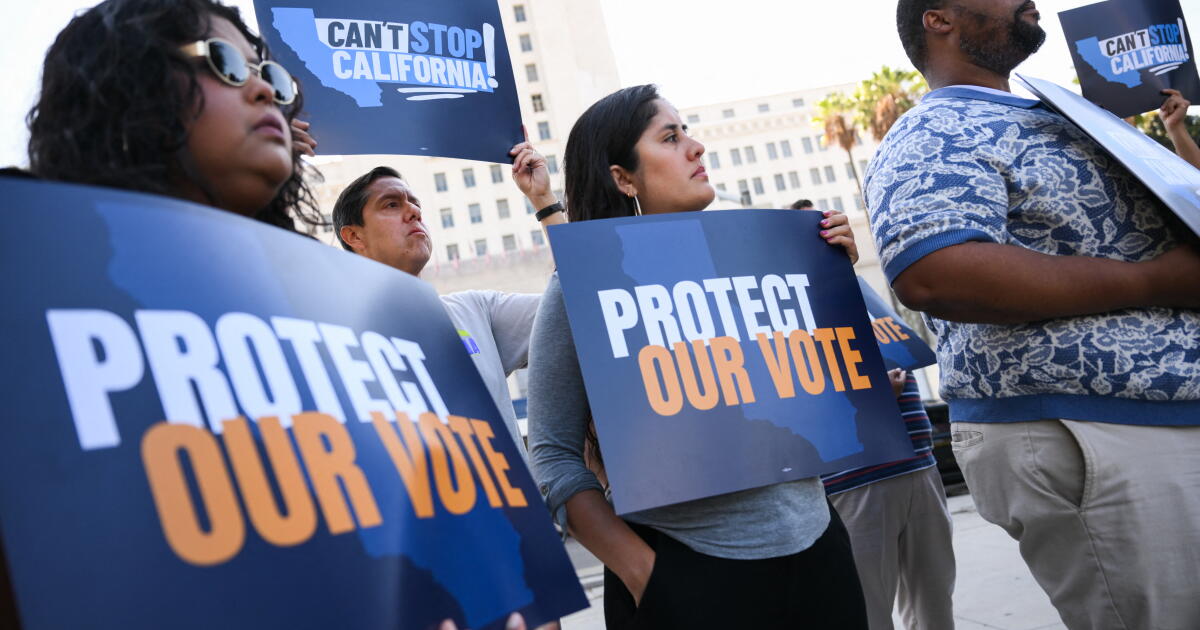
And there’s the ongoing lawsuit from the UCLA Voting Rights Project and the Coalition for Humane Immigrant Rights in a Washington courtroom — a case that could take the lead in protecting the midterms.
Here’s what you need to know about all three, and what comes next.
Stop the knocks
Starting around August, Homeland Security began knocking on the doors of residents in California and eight other states in what it dubbed a “surge” in investigations on voter fraud.
These in-person checks were based on lists of folks the government thought might not be legally allowed to cast a ballot — and focused on naturalized citizens, according to court documents. They were also, according to the court, unreliable and included “instances where DHS simply did not have data to determine that the individual did not engage in voter fraud,” the California judge in the case wrote, meaning it was a giant fishing expedition.
In addition, Homeland Security was apparently investigating nonprofits and other organizations that help get out the vote, including interrogating the staff and covertly infiltrating their operations, according to court documents.
That’s McCarthyism-level scary. The California Nurses Assn. and its parent union, National Nurses United, filed a lawsuit to stop the Homeland Security surge, arguing in part that one of their core missions is political organizing and turning out voters, and that the operation directly harmed them by scaring their members away from that work.
They also have a lot of members who are naturalized citizens. Four union members told the court that they didn’t want to participate in the union’s election work because they were afraid of being targeted by the government, citizens or not.
The court found that fear “objectively reasonable” and ordered Homeland Security to stop the door-knocking until after the election. The judge then stayed that order until Friday to give the government time to appeal. So far, the government hasn’t filed that objection.
“So many people in the United States are suffering under Trump’s corrupt and cruel policies on behalf of the billionaire class that he knows cannot hold onto power in these upcoming elections without illegally suppressing our vote through outright harassment, intimidation, and even detention,” said Puneet Maharaj, executive director of the two nurses groups.
Emergency relief
At the same time, the Department of Justice this week filed a suit against California seeking an emergency order to force the state to segregate 20,000 ballots of folks it claims may not be citizens — an unprecedented ask in furtherance of the long-running conspiracy theory that immigrants who lack legal status are in a scheme with Democrats to vote en masse.
State Atty. Gen. Rob Bonta has asked the court to throw out the case, in part because the federal government can’t prove it’s actually being harmed in any way by state law. The feds have already filed charges in those 28 cases claiming voter fraud, so it’s hard to argue that state law is preventing them from going after illegal voters.
But the feds are arguing that the state is aiding and abetting illegal voting by not segregating those ballots, even though there is no proof they are in the hands of noncitizens. A review by the Los Angeles County registrar’s office found that about 40% of those on the list were born in the United States.
Trump even threatened that election officials could be jailed for not bending to his will.
Attorneys general from other states filed a friend of the court brief siding with California, arguing that the Justice Department is basically trying to create a new law where “the executive branch can invent new election requirements, unmoored from any constitutional or statutory authority, and demand that States enforce them in the middle of an election.”
The court will rule on that next week.
Beyond Nov. 3
Our final case takes us to Washington, where the UCLA Voting Rights Project and the Coalition for Human Immigrant Rights, or CHIRLA, are asking for their own temporary restraining order — this one stopping the government from carrying out its ballot segregation scheme and from using its flawed, janky methods for supposedly identifying noncitizen voters.
I’ve written about this lawsuit before, and how the Voting Rights Project beat back Riverside County Sheriff Chad Bianco’s attempt to snatch ballots. The court will probably make a ruling in that one next week as well.
But election day is less than two weeks away, and many have already voted. So what does it all mean?
It means we’re in for a rough ride. The Trump administration is not dumb. Midterms might not go the way Republicans would like, potentially even giving control of both the House and Senate to Democrats. Some experts and legislators are concerned that all these ballot drama is posturing for that midterm loss — creating a reason to potentially question results or even refuse to seat newly elected Democrats when the time comes.
That would be unthinkable, unprecedented, a constitutional crisis. But impossible? Nope.
And almost certainly, no matter what voters decide, Trump will spin it back to that white nationalism — the idea that “true” Americans are being replaced through fraud, violence and vote stealing, a trio of conspiracies glued together by the sticky, tricky manipulations of a man who will do anything for power.
What else you should be reading:
The must-read: How Meta struck a deal to keep Mark Zuckerberg in California despite looming billionaire tax
The California angle: As companies leave California, is the state’s $4.25-trillion economy really in trouble?
The L.A. Times Special: In Trumpworld, dogs who commit voter fraud aren’t as bad as immigrants
Stay Golden,
Anita Chabria
—
Was this newsletter forwarded to you? Sign up here to get it in your inbox.