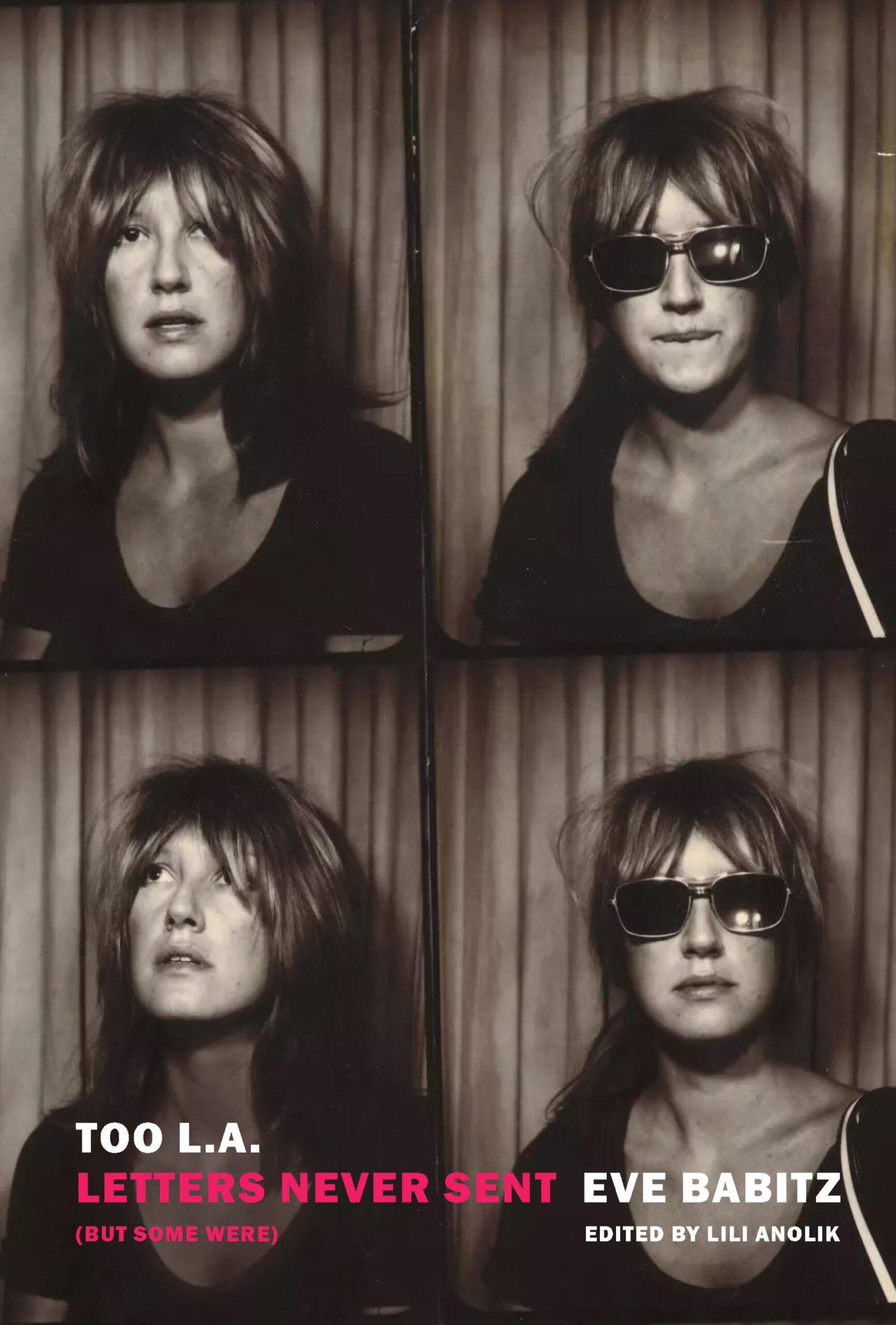
What did L.A.’s ultimate party girl say about pleasure and fame? A peek inside Eve Babitz’s private letters in “Too L.A.”
Last things first: Eve Babitz is a major minor L.A. writer who died five years ago at age 78. She spent nearly a quarter-century as a recluse, having suffered in 1997 a shocking and disfiguring accident while striking a match to light her Tiparillo. Her thin Indian skirt caught fire searing her panty hose into her flesh, leaving her with third-degree burns over more than half her body. She never published again, though many championed her gifts, including me. At the time of her misfortune, I was book editor of the Los Angeles Times. I had long admired her, especially the rollicking and indispensable “Slow Days, Fast Company,” first published in 1977, a charming and insightful series of stories bursting with pluck and sass. I recommended to John Carroll, the then-editor of the paper, that he make her a columnist and urged Babitz to write him directly. She did, and that letter from October 2000 is the last included in “Too L.A.: Letters Never Sent (But Some Were),” a book of letters expertly edited and chosen by Lili Anolik. Babitz tells Carroll that “what the paper needs is some writers that cause such an uproar, people will have to read it in order to stay abreast of the edge.” Babitz knew what she was talking about. She’d been living on that edge since she was a teenager at Hollywood High in the late 1950s.
Book Review
Too L.A.: Letters Never Sent But Some Were
By Eve Babitz; edited by Lili Anolik
New York Review of Books: 448 pages, $19
If you buy books linked on our site, The Times may earn a commission from Bookshop.org, whose fees support independent bookstores.
The posthumous resurrection of Babitz’s writings is most welcome. Yet there is a risk of overpraising her merits. She was an unabashed booster of the glossy L.A. that became synonymous with a rising creative elite whose élan and narcissism she found irresistible.
Lili Anolik makes the case in her perfervid introduction: “The letters are everything you could want” and often “profound” and “frequently brilliant, invariably amusing.” She says they deserve to be put on the short shelf next to Virginia Woolf’s imperishable “A Room of One’s Own” for they are “every bit as candid, every bit as lucid, every bit as brutal, every bit as delicate as Virginia Woolf’s celebrated manifesto.”
If only.

“Too L.A.: Letters Never Sent (But Some Were)” by Eve Babitz
(New York Review Books)
Regrettably, Anolik, who is almost singlehandedly responsible for Babitz’s literary exhumation, has so fallen in love with her subject as to almost blind her to Babitz’s defects, both with respect to her writing and to the life. With two previous books — “Hollywood’s Eve” (2019) and “Didion and Babitz” (2024) — prompted by Anolik’s riveting March 2014 Vanity Fair profile, Anolik has become Babitz’s greatest champion. Now with “Too L.A.,” a title taken from Babitz’s own over-oxygenated writing, she has gathered and edited a trove of letters. They brilliantly reveal Babitz’s eye for the deep shallow as well as explore the porous boundary between the largely self-inflicted injuries of her private life and the glittering sheen of her public persona. Babitz herself, on the strength of these 197 letters, only 30 of which she ever mailed, understood in a way Anolik doesn’t the limitations of her talents, even as she strives to slip the shackles of a mansplaining culture which at almost every turn tried to blunt her ambitions, both artistic and writerly, even as her editors and admirers sought (often with her ardent encouragement) to slip between her sheets.
Eve Babitz was born in 1943 to Hollywood neo-royalty. Her Brooklyn-born father, Sol, was first violinist for both the Los Angeles Philharmonic Symphony and then the 20th Century Fox Studio Orchestra. Sol would ultimately marry Lily Mae Laviolette, a beautiful Cajun Catholic shiksa willing to convert to Judaism. Eve’s godfather was Sol’s good friend Igor Stravinsky. When puberty burst upon her at age 14, Babitz’s blossoming made her a prime candidate for induction by the fast-track girls at Hollywood High who called themselves the Thunderbird Girls and cruised the Sunset Strip in their cool cars, looking for the main chance.

From left, Sol Babitz, Mae Babitz, Mirandi Babitz and author Eve Babitz gather at a launch party for her book “Slow Days, Fast Company” in 1977.
(Photograph by Paul Ruscha; courtesy of Mirandi Babitz / The Huntington Library)
At 20, Babitz posed nude playing chess with the fully clothed Marcel Duchamp to promote Duchamp’s retrospective exhibition at the Pasadena Art Museum. At the time, Babitz was having an affair with the museum’s 32-year-old married director, Walter Hopps, which perhaps explains Babitz’s reluctance to have her face photographed so as not to give the game away to Mrs. Hopps, who attended the opening. A month later, Babitz confides in an (unsent) letter: “Everything’s so fabulous for me now I can’t believe it. There’s nothing like two boyfriends to do it for you every time. There are such fabulous boys around and they take you out on dates and to movies and I feel just like a teenager. (I’m recapturing my lost youth.) I get to get dressed up and I flirt outrageously and put people on and I do things like look soulfully out the window and man it’s just too hoozie for words. … If only all of this could last forever — not that it will, but I can.”
She spent the rest of her life torn between the excitements of everyday life — cruising the hangouts du jour (Barney’s Beanery in the early 1960s where she met many of L.A.’s up-and-coming artists — Ed Kienholz, Billy Al Bengston, Laddie Dill, Peter Alexander, and the Ruscha brothers, Ed and Paul, both of whom she’d bed, Paul becoming an on-again, off-again boyfriend whose bisexuality made for a sometimes tenuous connection; and after seducing Jim Morrison before he became famous and later the Troubadour in the late 1960s which was a happy hunting ground — Steve Martin, Glenn Frey, Don Henley, J.D. Souther, Country Joe Mcdonald, Jackson Browne, to name only a few, and then Ports restaurant where she anchored a corner table) — and the seductions of drugs — uppers, acid (which she seemed to ingest with an alarming frequency), pot, of course, and then by the mid-1970s, tragically, an Everest of cocaine. She had entered what she aptly called the era of “squalid overboogie.”

Eve Babitz and her frequent companion Paul Ruscha celebrate the 1977 release of Babitz’s seminal “Slow Days, Fast Company.”
(Photograph courtesy of Mirandi Babitz / The Huntington Library)
The name-dropping is relentless and if, like me, you have an insatiable appetite for hoovering them up, this volume will not disappoint. Still, there are many pages of vapid jottings — “I cleaned the house, did the laundry, and vowed to quit smoking” — that suggest why Babitz was a failure as a novelist (see her dud “Sex and Rage”) and a superb writer of short stories and essays that stylishly plumbed the depths of her own sensibility precisely in the degree to which she was uninterested in other people.
Nearly 30 years after she stripped to please her married lover and startle the unsuspecting Duchamp, the father of Dada, and eight years after she joined AA in 1982 — the year her beloved father died of Huntington’s disease at age 70 which ultimately would also kill her — and gave up drugs and alcohol and (almost entirely) writing as well, which had always been seen by her as enabled by dope of one kind or another, she boasted that, looking back, “Everybody wanted to be me — they looked at me with yearning faces, and said, ‘Boy, you sure had fun.’ ” She was not entirely wrong. She had struck many admirers both then and now, as the quintessential California girl, a daughter of Dionysus, whose devotion to pleasure was free of misgiving or regret. She detested the East Coast avatars of apocalypse, like Nathanael West, who saw only doom and gloom in sunny L.A. Babitz, by contrast, saw things sunny side up. If Joan Didion was unsettled and made anxious by the hot Santa Anas that regularly kicked up, Babitz luxuriated in them, recalling how she and her sister would as young girls rush to embrace them, spinning madly round and round. In a 1977 unsent letter to Joseph Heller, who had championed her work when she had sent him an unsolicited fan letter after having read “Catch-22” when it was first published and she was barely 20, she declares proudly: “I’m a gossip storyteller who likes L.A. rather than hates it.” She refers to her “shallow nature,” writing that “I feel like an upstream salmon, determined to reach the shallow water, no matter how fast the river is running the other way.”

Eve Babitz, the ultimate Hollywood reveler, on Sunset Boulevard in 1980.
(Los Angeles Times)
On the evidence of these letters, she had two great loves: Ahmet Ertegun, a principal founder of Atlantic Records, and Tom Dowd, renown recording engineer and producer who worked for Ertegun. Of the two, Ertegun had the edge, if for no other reason than he came with buckets of dough, making possible assignations at his regular bungalow at the Beverly Hills Hotel with limo pickup and dropoff services, and the best champagne and other assorted stimulants. Ertegun was effortlessly elegant and erudite, and there was no one he didn’t know and who wouldn’t return his calls. He was married, age 45, 20 years older than Babitz, when they fell for each other in 1969. She began sleeping with him even as she agreed to profile him for Jann Wenner’s newly launched Rolling Stone. The writing didn’t go well. Wenner wanted a tougher piece than she was willing to write. Ultimately, she abandoned the assignment, claiming (not unreasonably) that she didn’t see how she could write objectively about a man she loved.
Babitz courted danger with heedless bravado and exemplary recklessness. She once had the moxie to rid herself of a would-be rapist: When told not to scream, she said with unimaginable sangfroid: “Why not?” The man bolted. It might be said of Babitz, as Oscar Wilde said of his life, that she spent her talent on her writing and reserved her genius for her life. Sculpting her natural gifts of wit and brazenness into a living artwork dazzled all who came within her orbit. Her lust for life was palpable. The letters are proof. She came at people without fear. She left them without apology. She was the boss of herself. She was the girl who seemed to have it all. The only thing she lacked was inexperience.
Wasserman, a former book editor of the Los Angeles Times, is publisher of Heyday Books, a nonprofit, independent publishing house founded in 1974 in Berkeley. He is the author of “Tell Me Something, Tell Me Anything, Even if It’s a Lie: A Memoir in Essays.”