Trump’s border chief defends wall plans in Texas’ Big Bend despite a court setback
BLAINE, Wash. — The Trump administration’s top border official defended plans to build a wall and other infrastructure in Texas’ Big Bend region despite mounting opposition against the project and a court-ordered pause on construction, saying his goal of fortifying the country’s borders was “non-negotiable.”
In an exclusive interview with the Associated Press, Customs and Border Protection Commissioner Rodney Scott argued that the $46-billion wall project was justified despite a bipartisan coalition of landowners, local businesses and environmentalists who view it as a waste of taxpayer money that could be destructive to a region with historically low migrant crossings.
“Our No. 1 goal right out the gate is we have to know who and what is coming into the United States,” Scott said on Thursday. If the Big Bend region were left without a wall or other border infrastructure while other areas along the border get those fortifications, he said, “I am 100% convinced it will be completely overrun and destroyed.”
The fight over Big Bend has become a major test for how far the Republican administration is willing to go for the border wall, President Trump’s signature infrastructure project.
Scott, a former Border Patrol agent, was tapped by Trump to complete it.
His agency is responsible for executing a plan funded last summer by Republicans in Congress to line the roughly 2,000-mile border with Mexico with a mixture of 30-foot-tall steel walls, vehicle barriers, new roads and surveillance technology to prevent illegal immigration and smuggling.
The Trump administration says it is building about 12 miles a week. Scott, who gets daily progress updates, said it will be complete by the end of Trump’s second term. The primary border wall — some areas also get a secondary layer — will be done by the end of December 2027.
“We’re actually ahead of schedule,” Scott said.


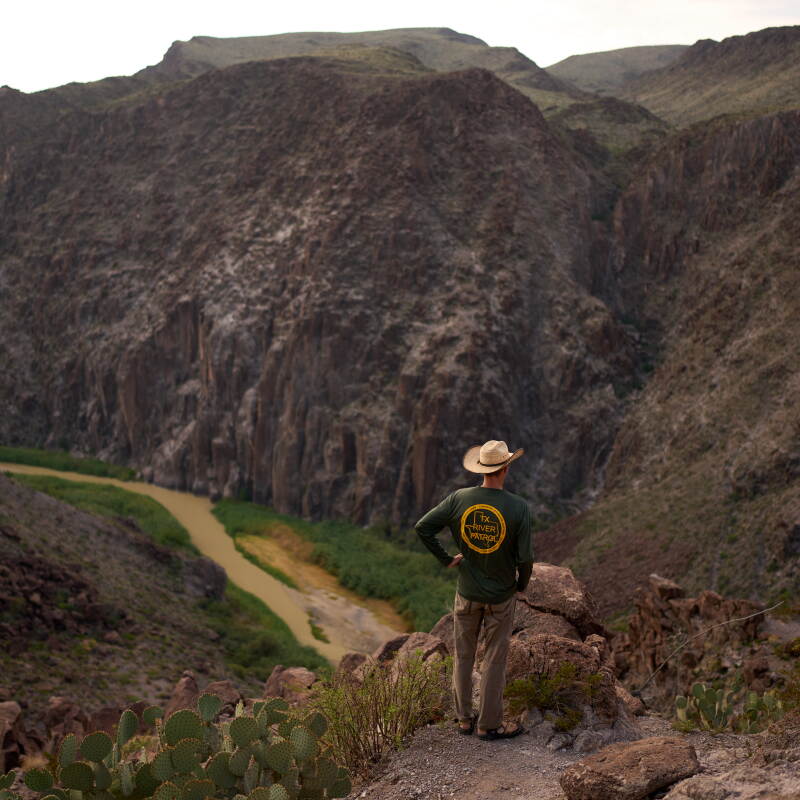
1. Charlie Angell stands on an overlook of the Rio Grande river 2. Pamela Priddy, center, holds up signs with others during a weekly protest against barriers along the border in the Big Bend region, Saturday, Sept. 26, 2026, in Study Butte, Texas. (John Locher / Ap Photo/john Locher)
Big Bend is a test for the Trump administration’s plans for the wall
The wall plan has run into resistance in places like Big Bend. The Trump administration was dealt a major setback earlier this month when a judge ordered a pause on border wall construction in the region, citing what could be a likelihood that plaintiffs “will suffer serious, irreparable harm without an injunction.” The administration has asked the Supreme Court to lift the order.
The ruling included any construction in Big Bend National Park, an area that has seen a loud bipartisan outcry, including from some Republican lawmakers.
After bulldozers were spotted in the park tearing up ground in August, Scott ordered a pause on all construction-related activity there while he went to talk to people in the region. He said the agency is making other outreach to locals to discuss how to build projects so they don’t mar the park.
“We’re talking through and figuring out what is the right solution for that area,” he said.
Scott said he can’t get into specific details on what the agency’s plans are for the park because of the numerous ongoing lawsuits, but he reiterated that the project won’t include tall steel walls.
He also said that the agency’s stated goal of protecting the country and knowing what’s coming in and going out is “non-negotiable.”
He said the region’s formidable natural barriers were not enough to prevent people from entering the country illegally through other more navigable points. And he expressed concern that cartels that control smuggling from Mexico into the U.S. would exploit any opening.
CBP has come under fire for immigration enforcement tactics
Scott leads an agency of 67,000 employees responsible for controlling who and what comes into the country through official border crossings like airports or seaports and stopping illegal smuggling and migration outside those official border crossing points.
The agency came under heavy scrutiny last year when its officers were sent into cities deep inside the country to help carry out Trump’s immigration crackdown alongside Immigration and Customs Enforcement.

Agents with the Department of Homeland Security, which includes Immigration and Customs Enforcement, Border Patrol and Customs Enforcement patrol in a neighborhood after apprehending a person on Jan. 31 in St. Paul, Minn.
(Eric Thayer/Los Angeles Times)
As protests against an operation rocked Minneapolis, a Border Patrol officer and a CBP officer both fired shots in an encounter that killed a U.S. citizen, Alex Pretti. The shooting eventually prompted the Trump administration to wind down high-profile city-based crackdowns. A CBP officer who was the face of the missions, Gregory Bovino, who led a helicopter raid at a large apartment building and used chemical agents to confront demonstrators, retired earlier this year.
Scott said while CBP still helps ICE, it’s now less involved in immigration enforcement far from the country’s borders because ICE has since hired more officers to its ranks. Scott wouldn’t comment on the investigation into the Pretti killing, saying that it was being handled by the FBI and was ongoing. And when asked about Bovino’s tactics, he said the officer didn’t report to him during the operations.
Scott spoke to the AP just outside the border with Canada, where he met with border security representatives from other countries to share information about threats and trends. During his trip, he visited an operations center where he said Canadian and American law enforcement work together.
That border has far fewer threats than the U.S. border with Mexico. Scott said cartels in Mexico are increasingly sending drones into the United States to move contraband and keep tabs on Border Patrol agents. In Mexico, the cartels have been using drones to attack each other or Mexican law enforcement.
The Department of Homeland Security, which includes CBP, recently announced temporary flight restrictions targeting unauthorized drone activity in a zone extending a mile north of the U.S.-Mexico border as a way to counter cartels.
“We want to make sure,” Scott said, “that threat does not come into the United States.”
Santana writes for the Associated Press.