smaller

How Drone Detection Is Evolving To Counter Smaller, Faster, And Swarm Threats

It’s the dead of night when the buzz of the engines of a series of Shahed-136 one-way attack drones breaks the silence. Carrying their lethal payloads the drones slip into the darkness with a distant supply base as their target. Tracking, identifying, and then destroying this swarm of drones is no easy task.

The unmanned aircraft system (UAS) threat environment is changing rapidly with an increasing variety of killer drones that demand differing methods of tracking and identification to engage and defeat them. Operational users are learning from rapidly-evolving- conflicts, and modern air defense methods increasingly rely on scalable, layered, and persistent sensing teams that can detect and track small, fast, low-altitude, and even swarming, aerial threats in all kinds of complex situations, on land or at sea.

A layered system is required to tackle the toughest drone threats. USAF

Ray Bischoff served active-duty with the U.S. Army for nearly 25 years, and he’s now the senior director of business development at Leonardo DRS, specialising in evaluating tactical formations and defensive requirements at all operational levels throughout the Department of War and allied nations. He is particularly focused on emerging threats from drones..

Bischoff spoke at length with TWZ’s Jamie Hunter about the use of tactical radar systems as part of a layered counter-drone system that is sufficiently versatile to tackle the toughest drone problems now, and what may come in the near future.

JH: Can you set the scene with regards to how you see the counter-UAS mission right now from a sensing perspective.

RB: The counter-UAS environment is changing and advancing very quickly. At the top level, we need to employ a variety of sensor systems – in this particular case we’re talking about tactical radars – but there are many other types of sensors, and at the highest end of the threat level it’s about connecting these together into a networked architecture.

Layering different systems in depth is vital, both from a communications architecture perspective and physically layering them in different places to protect different routes or avenues of approach, or sensitive facilities.

Look at the Strait of Hormuz, for instance, which is a vast area, with a layered and networked system to maximize the depth of coverage. The primary reason for this is that the biggest enemy in many situations like these is time. That networked architecture and having sensors in depth really gains you time, which gives you opportunities to make a better decision, time to reposition, to better evaluate. You need time to evaluate what different things in space are doing, where they’re going or where they’re coming from.

JH: When you say layered, are you talking about different systems that can look in different ways over different distances and systems in different positions that help you with that time element? What does layered actually mean?

RB: You can layer different types of sensors. Think of baseball. If all your players are home-run hitters, you probably aren’t going to do very well. You need to have different skills across your team to succeed, and it’s the same thing here. Layering of radar sensing bands, different types of technology such as electro-optic and infra-red that “see” in long, short and midwave, acoustic sensors, electronic warfare sensors to look for signals and other types of energy. It’s also about physically layering them in space, or depth.

Large drone swarms are particularly challenging to defend against. U.S. Army

We often see large exquisite sensors that have a lot of range and cover a large area. But this makes them susceptible to being targeted and destroyed. Layering sensors gives you redundancy, retaining the ability to defend. So, this is layering both in physical location, and in different types of technology.

This way, if one of your sensors is taken down by any means – for example by electronic countermeasures – your other systems can theoretically continue to operate. Just think how you can see, smell, touch, taste – it’s the same concept with layering different types of technologies, which is exactly what we at Leonardo DRS do and we integrate them so we can interact and share information to maximize the benefits of this layered approach. A team ultimately makes the sensors more effective across networks and architectures.

JH: Presumably you get good indicators on developments from the current operations in Ukraine. You already mentioned the Strait of Hormuz as well. What are the big lessons that you’re getting here about different types and sizes of drones?

RB: Without going into the details of combat operations, the bottom line is you have to advance your technologies at the rate or as close to the rate of the advancement of the weapons systems that are being utilized. We’re seeing a mixture of things when it comes to the UASs; that’s larger craft that are getting faster and can carry heavier payloads, or smaller ones with longer ranges that can move through areas almost undetected. 

There’s been so much investment in UAS technology, and they are becoming cheaper and easier to manufacture. People can 3D-print these things in their houses now. So, looking at this from a sensing perspective, that layering is becoming increasingly important.

We are looking to do things to counter these developments, such as maybe elevate the sensors to “see” across the top of the trees or place a sensor down in a valley – so that adds layering in altitude or elevation to remove blind spots. Just like the military, if you’re setting-up a defensive position, you have to cover what we called “dead space” where you can’t see with eyes or sensors from ground level.

Leonardo DRS’ 202 Expeditionary Skid (U-KIT-0091) is based on the company’s Extended Multi-Mission Hemispheric Radar. Leonardo DRS

JH: Can we dig further into the role of tactical radars in counter-UAS, specifically Leonardo DRS’ 202 Expeditionary Skid, which I believe is based on your Extended Multi-Mission Hemispheric Radar [exMHR].

RB: Radars “see” things that are physically present in space and time, and that’s why they are such great tools in the counter-UAS kit bag of sensors. That said, some radars are affected by weather and other factors, some work better in particular environments.

The 202 Expeditionary Skid is a new system from Leonardo DRS that uses our long-range exMHR, which is a software-defined AESA [Active Electronically Scanned Array] pulse-Doppler radar. It operates in the S-Band and that’s a very reliable band for all weather conditions including strong performance in dust storms and rain. When you get into K, Ku, and X-bands, they typically have smaller beams and therefore greater accuracy, but they suffer in poor weather and can become extremely degraded. S-band radar suffers significantly less degradation in that environment.

The 202 Expeditionary Skid, also known as U-KIT-0091, has a single radar panel that has a search area of 90 degrees by 90 degrees, so we often mount them in groups of four to provide full 360-degree coverage. Each panel has a really fast scan rate, much faster than a traditional spinning radar set. Plus, having multiple radar faces to make up a complete system is much more survivable. They can also overlap their field of regard without impairing each other.

We have sought to provide a solution that marries an appropriate level of range, accuracy, capability, and performance, that can still be very flexible in its ability to relocate or change mission sets. This is designed to be extremely versatile, meaning that it operates in different environments quickly. U-KIT-0091 has been purposefully designed to be mobile in a compact system that can either be used by itself or networked and fused together with other systems. Back to the baseball analogy, this is the kind of guy you really want on your team because you can use them wherever you need them.

The radar or set of radars sit on a small skid system that can slide into the back of a pickup truck, into the back of a tactical vehicle, onto a trailer, you can set it just about anywhere and it occupies a four-by-four-feet position. It has its own power generation, its own positional information that works in denied environments, basically it’s capable of working by itself from the get-go. The best part is that it’s truly mobile – the operator doesn’t have to stop the vehicle to make it work. You can turn it on and set-off. It’s working. If you come to a stop, it’s still working. It can be mounted on a ship, it can be taken airborne by an aircraft, so it’s got land, sea, and air applications. We’ve installed these on all types of ground platforms, water-based platforms, on top of a building or some sort of structure and it’s already in service, but I can’t specify where. It tracks drones very well, but of course it can track just about anything that can exist in that space.

The 202 Expeditionary Skid U-KIT-0091 mounted in the back of a pickup truck. Leonardo DRS

JH: So you could strategically locate several of your radars to look in different directions or be positioned to look in a certain direction if you knew the expected paths that the threats would use?

RB: The system is designed exactly for things like that. Instead of putting all of your eggs in one basket, you disperse your eggs, and focus on different avenues or approach angles so that you can then have sensors strategically located where they can pick up these things and then as long as they’re networked back into weapons systems that have the overlapping fields of fire or bubbles – coverage areas – then you can protect your area. 

Any time you can decouple a sensor from a weapon system or multiple types of sensors from each other, you stand a far greater chance of survivability and optimizing accuracy. If you put all your eggs in one basket, and if you lose that basket, you lose everything. In addition, if you separate sensors, you gain accuracy because you have different angles and you can leverage simple geometry.

JH: Could you depict what an end-to-end engagement might look like using your tactical radar.

RB: The radar sensors will typically be emitting energy as they search for objects in a particular space. If something is detected and determined to be a valid target then the data is sent from the radar to some type of a command and control system, which may well be receiving information from other complementary sensors too. It then fuses that data and passes it to an effector, whether that’s a non-kinetic or a kinetic system, for engagement.

Meanwhile, the radar continues to track and it can determine whether that object was removed or if its path changed, and so on and so forth. But you know, a lot of these radars operate in a way whereby they can be turned on or off by different sensors to avoid them having to constantly transmit energy, they’re very customizable to meet the requirements and the emissions that are needed, whether that’s air defense, counter-drone, etc.

They can operate independently too, maybe covering a small area that needs to be protected, and integrated with a localized weapon system, or, as I already explained, they can be networked into a much larger set-up, they are modular, open system architecture and easily incorporated.

Most customers tend to choose their own command and control systems, which is why the plug-and-play part of our system is so important. It really doesn’t matter what they want to partner it with, what we provide enables that very easily.

A counter-drone exercise run by the Joint Task Force-National Capital Region/United States Army Military District of Washington. U.S. Army/Sgt. Zack Stine

JH: To be clear, your tactical radars could be deployed to defend the entire eastern seaboard of the U.S., they could be positioned to defend an air base, or they could be used to defend a ship in the Strait of Hormuz.

RB: The architecture can scale geographically through a distributed, networked sensor approach. The specific coverage area depends on factors including sensor density, the threat environment, command-and-control integration, and the available effectors.

Customers can deploy multiple radars and feed them into a single command-and-control system, positioning sensors to optimize coverage for the operational need. For example, one radar set could cover a valley vulnerable to low-flying drone ingress, while another positioned on higher ground provides longer-range surveillance. The key is a modular capability that enables users to tailor coverage and layer sensors where they are most needed – without relying on one large radar system to see everything from a single location.

JH: I’m keen to know what you consider to be the most challenging drones to detect and track. Is the challenge the speed they’re traveling out at, maybe new low observable designs, or the fact they’re flying very low. What are the big issues you’re seeing?

RB: It’s really all of the above. The other really challenging problem is when something is flying very low to the ground. The lower they bring them in altitude, they are harder to track as an independent target.

The challenge with drone swarms isn’t detection – if you can see the drones, you can track them. The harder problem is managing those tracks, deciding which threats matter most, and assigning the right effector to each one.

If 100 drones are inbound, it’s not just about having 100 weapons available. It’s about coordinating a fast, cost-effective response across a large number of simultaneous threats.

Ultimately, pairing radars and electro-optical/infrared sensors together is the way to go, because each of those have their own strengths. One of those sensors is going to see the drone better than the other, plus you have the redundancy that at least a couple of them will “see” the threat and give you enough information in sufficient time to prosecute it. Fitting into that team, however it is constructed, is exactly how we position our 202 Expeditionary Skid U-KIT-0091 radar.

Contact the write: Jamie.Hunter@teamrecurrent.io

Jamie is TWZ’s Branded Content and YouTube Editor, overseeing the content side of the site’s industry partner programs and our expanding video programs. He lives in London, U.K. but is regularly on the road particularly with our international trade show presence.


Source link

‘It feels like Italy with the volume turned down’: readers’ favourite (smaller) city breaks in Europe | City breaks

Renaissance art without the crowds in Italy

Ferrara in Emilia-Romagna won me over precisely because it feels like Italy with the volume turned down. I stayed in a small family-run hotel near Via delle Volte, where mornings began with quiet cobbled streets and the smell of fresh pastries. The Palazzo dei Diamanti was almost empty when I visited, giving me space to enjoy its Renaissance art without crowds. Evenings meant cycling past terracotta walls to tiny trattorias serving pumpkin cappellacci, a traditional pasta dish. It’s a city that lets you slow down, breathe and enjoy its beauty.
John

One of Germany’s greenest cities

The Great Garden at Herrenhausen. Photograph: DPA/AFP/Getty Images

Next to flashy Munich or cool Berlin, Hanover in northern Germany has a reputation of being boring. It is totally undeserved: there are world-class museums, such as the modern art gallery Sprengel, one of the best-preserved baroque gardens in Europe – the Great Garden at Herrenhausen – impressive Victorian era architecture, 640 hectares (1,680 acres) of city forest (the Eilenriede, nearly double the size of New York’s Central Park) and a large artificial lake just south of the centre that you can travel on with a bus ticket (or hire a boat). Explore the city and its surroundings on more than 600 miles of cycle paths, find independent shops in the well-heeled art nouveau district of List or the multicultural Linden, and relax in a deck chair on Ballhofplatz with tea and cake at the Teestübchen.
Ulrike

Profile

Readers’ tips: send a tip for a chance to win a £200 voucher for a Coolstays break

Show

Guardian Travel readers’ tips

Every week we ask our readers for recommendations from their travels. A selection of tips will be featured online and may appear in print. To enter the latest competition visit the readers’ tips homepage

Thank you for your feedback.

The Algarve’s city of crafts

The market in Loulé was designed in a neogothic style. Photograph: Cristina Arias/Getty Images

Bursting with Portuguese charm, Loulé is 10 miles inland from Faro, capital of the Algarve. The small city has a rich history of preserving traditional crafts, supported by Loulé Criativo, a network of community-driven artisans that keeps alive and celebrates the identity of Loulé and the Algarve. It includes the House of Weaving (Casa da Empreita) and the Watchmakers (Oficina do Relojoeiro) and Stringed Instrument Workshop (Oficina de Cordofones). In these vibrant spaces – where visitors can interact with artisans – the city’s heritage is preserved and passed down through generations.
Sue

Unesco sites in northern France

The belfry of the Hotel de Ville at Place des Heros in Arras is a Unesco world heritage site. Photograph: Aliaksandr Antanovich/Getty Images

Arras, 35 minutes on the train from Lille, has two Unesco world heritage sites: the belfry of the Hotel de Ville and the Vauban Citadel. Exploring the Boves, a 10th-century network of tunnels which played roles in the first and second world wars, is an amazing experience. Above are two magnificent large squares in the Flemish style with a wide variety of alfresco cafes, restaurants and indie shops. Arras also holds one of the biggest Christmas markets north of Paris, noted for its amazing range of international gourmet foods.
Bryan Boese

Artistry and cake in Sweden’s beautiful south

Points of View, the 2017 sculptures by Tony Craig, outside the free Malmö Konsthall arts centre. Photograph: Danita Delimont/Alamy

Malmö is easily accessible (being connected by bridge to Copenhagen) and very walkable. We enjoyed the free Malmö Konsthall arts centre with contemporary exhibitions and also the skateboard artistry in the square outside. The Western Harbour contains architectural gems, such as the twisted skyscraper Turning Turso, restaurants and swimming piers in a former industrial area. The cafe Hollandia offered classic Swedish cakes and a lovely atmosphere. The Disgusting Food Museum next door was an interesting cultural experience showing food considered to be delicacies in some countries, not so much in others. A sign shows the number of people who have thrown up (visit Hollandia first)!
Elisabeth

Brilliant beach and seafood in Sardinia

The beautiful sandy beach of Poetto. Photograph: S Parente/Best of Travel/RM/Alamy

If you can tear yourself away from Poetto – surely one of the prettiest city beaches in Europe – you’ll find a lot more to love in Cagliari, capital of Sardinia. The huge indoor produce market is a riot of glistening seafood, local pecorino and sweet, nutty Sardinian treats. The town centre strides uphill from the port, with the elegant bulwark of Bastione St Remy delineating the ancient Castello district and serving up epic rooftop and coastal views. We missed the renowned archaeological museum, but that just gives us the perfect excuse to go back. Cagliari’s affordable seafood was a definite highlight, and Trattoria Lillicu’s chargrilled bream and calamari is another tempting reason to hurry back.
Martha

skip past newsletter promotion


Stained glass wonder in north-west Spain

The windows of the cathedral in the city of León are simply breathtaking. Photograph: Around the Corner Pics/Alamy

In León, colours grab your attention and take away words. León cathedral completely wrongfooted me. This city seems to be under the British tourist radar. I thought I’d already seen stained glass that was worthy of heaven – this was another level. Coupled with this was how visitors were reacting. Everyone was using the free audio guide. No one was just marching round and ticking off the sights. People were learning and savouring the experience. The humble ninth-century San Isidoro church, one of the most important romanesque buildings in Spain, is a refreshing contrast.
Deborah

Norway’s art nouveau gem

The art nouveau waterfront of Ålesund. Photograph: Rudi1976/Alamy

Ålesund is one of Norway’s most beautiful stops on an already spectacular western coast, despite having been devastated by fire in 1904. We reached the small, rebuilt art nouveau city via the breathtaking winding roads of the Trollstigen (the “Troll’s Path”) and had our first sighting from the top of the panoramic Aksla mountain viewpoint. Exactly 418 steps lead down to the historic centre where museums, cafes, restaurants and shops cluster around the Brosundet Canal in renovated warehouses and ornate buildings. Kayaking, a rib boat ride or a trip to the stunning Geirangerfjord? We couldn’t choose so did them all!
Teresa Stansby

The French city with a bit of everything

Saint-Malo’s tidal bathing pool. Photograph: Sasha Samardzija/Getty Images

I spent five days in Saint-Malo this August. It has everything: a beautiful walled city with lots of history, a variety of beaches offering shifts in light and character throughout the day, a modernist tidal pool with a high diving platform. The city has so much pride, and the art inspired by its famous landmarks make for great souvenirs. My favourite thing, though? The wonderful cider at La Passage (on Instagram) with my sister. And despite the heat everywhere else, the temperature never got above 25C.
Sophie Amos

Winning tip: a watery Dutch master of a city

Leiden in the Netherlands is full of canals, squares and cafes. Photograph: Peter Conner/Alamy

Leiden starts badly. The walk from the station is grim. Scruffy bars and vape shops. And then, suddenly, this watery Dutch gem reveals itself. Canals shoot off from a boat-filled basin, each one lined with grand brick mansions tapering to elegant finials under the sort of blue lowland skies that typify every good (and bad) Flemish painting. Dig deeper into its narrow traffic-free courtyards and squares with cafes spilling out light and chatter, much as they did when Rembrandt trudged to the school that still stands here, just round the corner from his first tutor’s studio. He’d find it mostly unchanged if he walked back. At Christmas, an ice rink spreads across the main canal, and the smell of warm wine, cloves and crepes hovers over the market stalls.
Bill Jones


Source link

Job vacancies at five-year low as smaller firms scale back recruitment

The number of job vacancies has fallen to its lowest level in more than five years as smaller businesses cut back on recruitment, the latest official figures indicate.

Vacancy numbers dipped slightly over the May-to-July period to 707,000, according to the Office for National Statistics (ONS), which said small firms were citing labour and operating costs as reasons for scaling back hiring.

The ONS said the labour market was “little changed overall”, with the unemployment rate remaining at 4.9%.

Growth in regular earnings – which excludes bonuses – picked up slightly, rising at an annual pace of 3.5% in the three months to June.

“The UK labour market remains stuck in a low-churn limbo, with employers reluctant to hire, fire or offer bigger pay rises as they grapple with rising costs, intensifying global headwinds and heightened policy uncertainty,” said Suren Thiru, chief economist at the Institute of Chartered Accountants in England and Wales.

“The persistent slide in vacancies is a red flag for the jobs market, suggesting labour demand is shrinking amid soaring employment and energy costs, while greater automation is also squeezing some entry-level roles.”

Yael Selfin, chief economist at KPMG, noted that while pay growth picked up, this was “driven by a rise in public sector wages”.

Private sector pay growth, which she said gave more accurate picture of underlying conditions in the labour market, slowed to 2.8%.

Source link

China Fires YJ-20 Hypersonic Anti-Ship Missile From Smaller Destroyer

Evidence has emerged indicating that China’s YJ-20 hypersonic anti-ship missile is now also being fielded aboard the People’s Liberation Army Navy’s (PLAN) Type 052D class destroyers. These warships are far more numerous than the Type 055 ‘super destroyers,’ from which the missile was previously seen being fired, as we reported at the time. The new development suggests that the PLAN intends to distribute the weapon across a much broader portion of its surface fleet rather than reserving it exclusively for its largest combatants.

A new video apparently originating from the PLAN shows the launch of a YJ-20 from the cold-launch vertical launch system (VLS) on the foredeck of an unidentified Type 052D destroyer, known in the West as the Luyang III class. After being ejected from the launcher, the missile’s solid rocket motor ignites before it accelerates rapidly away. No target engagement is shown.

Typically, the Type 052D’s VLS would be loaded with variants of the HHQ-9 surface-to-air missile, YJ-18 subsonic anti-ship cruise missile, CJ-10 land-attack cruise missile, and CY-5 anti-submarine missile.

The 7,500-ton Type 052D has 64 VLS cells, 32 forward and 32 aft. It’s unclear whether each of these is able to accommodate the big YJ-20 missile.

A visitor poses with the Chinese (R) and Hong Kong flags on board the Yinchuan, a People's Liberation Army (PLA) Navy Type 052D destroyer, at the Ngong Shuen Chau naval base on Stonecutters Island in Hong Kong on July 8, 2017, during the PLA Hong Kong Garrison's open day held as part of 20th anniversary celebrations marking the territory's handover from Britain to China. / AFP PHOTO / TENGKU Bahar (Photo credit should read TENGKU BAHAR/AFP via Getty Images)
A view of the foredeck of the Yinchuan, a Type 052D destroyer of China’s People’s Liberation Army Navy, reveals 32 of the 64 VLS cells. TENGKU BAHAR/AFP via Getty Images AFP Contributor

This compares to the Type 055’s 112-cell VLS system, which makes it the PLAN’s premier surface strike platform. However, only 10 of these ships are currently in operational service, with additional vessels still under construction. By contrast, approximately 35 Type 052D destroyers have entered PLAN service, with production continuing.

Putting the YJ-20 on the Type 052Ds would significantly expand the number of Chinese warships capable of launching hypersonic anti-ship strikes, further strengthening Beijing’s growing anti-access/area-denial (A2/AD) posture across the western Pacific. On the other hand, it remains possible — although less likely — that the launch depicted is some kind of trial or experimental effort that might not lead to large-scale fielding on these hulls.

The new video follows the release of official Chinese military footage showing what the PLAN described as a “finalization test” of the YJ-20 launched from the Type 055 destroyer Wuxi, late last year. That video appeared to confirm the missile’s integration with China’s largest surface combatant, a warship design that you can read more about here.

That test from the Wuxi provided the first official acknowledgement of the ship-launched YJ-20. The missile itself had previously been unveiled publicly during China’s military parade commemorating the 80th anniversary of victory over Japan in World War II, although speculation surrounding the weapon stretches back several years before that.

A missile first observed during what appeared to be a Type 055 launch in 2022 was widely referred to as the YJ-21. Subsequent official Chinese designations now strongly suggest that weapon was actually the YJ-20, or an earlier developmental version of it.

The YJ-20 is understood to be a hypersonic anti-ship weapon employing either an aero-ballistic flight profile or potentially a boost-glide vehicle: different Chinese sources have described both concepts at various times. In either case, the missile is optimized for extremely high terminal speed combined with unpredictable maneuvering designed to defeat modern naval air defenses.

BEIJING, CHINA - SEPTEMBER 03: YJ-20 hypersonic anti-ship ballistic missile are reviewed durings the V-Day military parade on September 3, 2025 in Beijing, China. China unveiled its land-, sea-, and air-based strategic forces as the nuclear triad for the first time in Wednesday's V-Day military parade during a grand gathering to commemorate the 80th anniversary of the victory in the Chinese People's War of Resistance against Japanese Aggression and the World Anti-Fascist War. (Photo by VCG/VCG via Getty Images)
YJ-20 hypersonic anti-ship missiles, or mockups thereof, are reviewed during the V-Day military parade on September 3, 2025, in Beijing, China. Photo by VCG/VCG via Getty Images VCG

Unlike a traditional ballistic missile that follows a predictable parabolic arc, an aero-ballistic missile can execute quasi-ballistic maneuvers — including skip-glide or ‘porpoising’ trajectories — as it descends toward its target. These abrupt changes in altitude and direction make interception significantly more challenging.

Chinese state media have also described the missile as employing a conical boost-glide vehicle, which would use a rocket booster to accelerate to high altitude before gliding toward its target while conducting sustained maneuvering throughout the terminal phase.

Although many details remain murky, it is generally considered that the missile achieves speeds well above Mach 6 during cruise and may approach Mach 9 during its terminal attack. Estimated range is generally assessed at more than 620 miles.

Guidance is believed to combine satellite navigation and mid-course updates before transitioning to an active radar and/or infrared seeker during the final approach.

A graphic showing, in a very basic way, the difference in trajectories between a traditional ballistic missile and a hypersonic boost-glide vehicle, as well as that of a quasi- or aero-ballistic missile and an air-breathing hypersonic cruise missile. GAO

Weapons with these characteristics are particularly well suited to engaging high-value naval targets including aircraft carriers, amphibious assault ships, cruisers, and other major surface combatants. The missile likely also possesses a secondary land-attack capability against fixed targets.

With their combination of extreme speed and maneuverability, hypersonic weapons can dramatically compress an opponent’s decision-making timeline while reducing opportunities for interception, making them especially valuable against time-sensitive targets. They also require very high-end interceptors, if they can be intercepted at all.

The apparent expansion of the missile to the Type 052D is arguably an even more significant milestone than the Type 055 test itself.

For China, fielding the YJ-20 aboard both the Type 055 and the much more numerous Type 052D dramatically increases the number of PLAN hulls capable of conducting long-range hypersonic anti-ship attacks. Such a move represents another step in expanding the reach of its layered A2/AD strategy. Rather than concentrating hypersonic capability in a small number of flagship destroyers, the PLAN appears to be distributing it across a much larger force capable of operating throughout the First Island Chain and increasingly beyond it.

The estimated ranges of selected Chinese conventional strike weapons, as depicted by the Pentagon. U.S. Department of Defense

Clearly, a larger force of PLAN destroyers armed with hypersonic anti-ship missiles would complicate U.S. and allied naval operations across the western Pacific by increasing the number of launch platforms capable of threatening high-value warships from long stand-off ranges.

At the same time, it is unclear if the YJ-20 has formally entered full operational service. However, official test footage, public appearances during military parades, and, above all, launches from two separate destroyer classes all point toward the missile transitioning from a developmental program to a broader capability.

The development underscores two major issues for the U.S. military as it gears up to face the prospect of a potential conflict with China in the Indo-Pacific. On the one hand, the PLAN is growing at an alarming rate, and Chinese shipyards are churning out increasingly capable warship designs, not to mention submarines and other naval weapons.

The Yinchuan (175), a Type 052D destroyer of China's People's Liberation Army Navy (PLAN), provides an escort ahead of the Liaoning aircraft carrier into the Lamma Channel as it arrives in Hong Kong territorial waters on July 7, 2017. China's sole operational aircraft carrier arrived in Hong Kong for the first time in a display of military might less than a week after a high-profile visit by president Xi Jinping. / AFP PHOTO / ANTHONY WALLACE (Photo credit should read ANTHONY WALLACE/AFP via Getty Images)
The Yinchuan, a Type 052D destroyer of China’s People’s Liberation Army Navy, provides an escort ahead of the aircraft carrier Liaoning as it arrives in Hong Kong territorial waters in 2017. ANTHONY WALLACE/AFP via Getty Images AFP Contributor

The latest annual Pentagon report to Congress on China’s military, released at the end of 2025, stated that “China has the world’s leading hypersonic missile arsenal and continued to advance the development of conventional and nuclear-armed hypersonic missile technologies during the past year.”

With that in mind, the case study of the YJ-20 further underscores the fact that China is investing heavily in the development of hypersonic missiles and is now apparently scaling that capability across a larger proportion of its surface fleet, something that will have a significant effect on the regional naval balance.

Contact the author: thomas@thewarzone.com

Thomas Newdick is a staff writer at TWZ, where he covers military aviation, defense technology, weapons systems, and international security. Based in Berlin, Germany, he reports on conflicts, military modernization efforts, and emerging aerospace technologies around the world, with a particular interest in airpower and its role in contemporary warfare. His reporting is informed by deep expertise in modern and historical airpower, particularly in Europe, with a focus on military aviation, air campaigns, and aerospace developments across the continent and beyond.


Source link

Can Zimbabwe’s mineral ambitions benefit smaller producers? | News

Harare, Zimbabwe – Zimbabwe wants to move beyond being a supplier of raw minerals and build industries that process and manufacture from its own resources. But as the government tightens restrictions on unprocessed mineral exports, smaller miners are asking whether they will share in that transformation or be left behind.

The government has restricted exports of unprocessed strategic minerals, including lithium, as part of a broader drive to increase domestic beneficiation. Authorities argue that Zimbabwe should capture more value from its mineral wealth instead of exporting raw materials and allowing other countries to profit from refining and manufacturing.

The policy has attracted more than $1bn in investment into Zimbabwe’s lithium value chain, according to government officials and industry representatives. But smaller miners warn that the cost of building processing facilities, unreliable electricity supplies and limited access to finance could make it difficult for them to participate in the country’s industrial ambitions.

Speaking during a technical media tour of Prospect Lithium Zimbabwe (PLZ) in Goromonzi, Mashonaland East, on 17 July, Minister of Mines and Mining Development Polite Kambamura said Zimbabwe’s 2022 ban on exports of unbeneficiated lithium ore had encouraged companies to invest in domestic beneficiation.

“The construction of the first lithium sulphate plant in Africa is behind me, and this was done in Zimbabwe,” Kambamura said.

He said Zimbabwe’s ambitions extended beyond lithium sulphate and lithium carbonate production, with a long-term goal of developing industries capable of manufacturing lithium batteries and solar panels locally.

Prospect Lithium Zimbabwe, owned by China’s Zhejiang Huayou Cobalt, said its lithium carbonate plant was about 90 percent complete.

PLZ public relations officer Patience Mushore said Huayou’s investments had generated more than $1.1bn in foreign exchange for Zimbabwe while expanding the country’s lithium value chain.

Policy shift

Supporters of Zimbabwe’s export restrictions argue that the country can no longer remain a supplier of raw minerals while other nations capture greater profits through refining and manufacturing.

Public policy expert Tedious Ncube said Zimbabwe’s lithium sector demonstrated why the government had prioritised beneficiation.

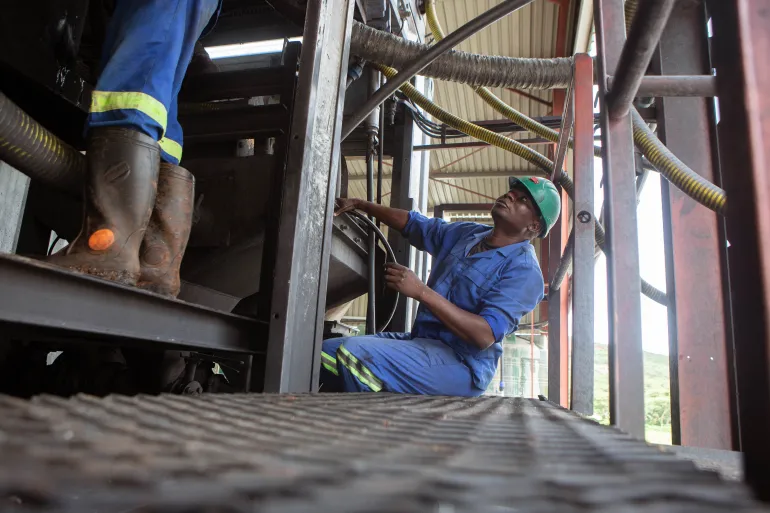
Mechanics work on a machine installed at Arcadia Lithium in Goromonzi, Zimbabwe [Tafadzwa Ufumeli/Getty Images]

He pointed to investments at Arcadia Mine and Bikita Minerals as examples of companies expanding Zimbabwe’s lithium sector.

Ncube said domestic processing could create skilled jobs, strengthen local suppliers and allow Zimbabwe to retain a greater share of the income generated from its mineral resources.

“The success of Zimbabwe’s lithium industry shows that the right policy can attract investment that builds industries, creates jobs and leaves a bigger share of mineral wealth in Zimbabwe,” he said.

Mining concerns

For smaller producers, the debate is not whether Zimbabwe should process its minerals locally, but whether they will have the infrastructure, finance, and market access needed to participate.

Shelton Lucas, business development director at Naivo Mining, said the company operates chrome, antimony and tungsten projects in Mashava, Ngezi and Kadoma but faces challenges accessing affordable processing options.

Lucas said smaller producers were struggling to access processing capacity, particularly in the chrome sector.

“For our raw chrome, we are now forced to sell to local Chinese smelters where they underpay us. For antimony, I have the resources to build the value-addition plant, but for chrome I cannot because the plant is very expensive,” he said.

He said he supported domestic processing but warned that smaller miners could be excluded if new requirements were introduced without support mechanisms.

Lucas proposed a toll-smelting system, where public institutions or industry bodies invest in shared processing facilities that miners can access at transparent rates while retaining ownership of their minerals.

“The challenge is not only building processing plants, but also ensuring smaller producers can access capacity on fair terms,” he said.

Without such measures, he warned that a small number of companies could end up controlling processing capacity and market access.

“If these companies also hold export rights, they could dictate prices to small-scale miners, creating what could become a predatory market that undermines the very people the mining sector is meant to empower,” he said.

Economic constraints

Economists say Zimbabwe’s processing ambitions will depend on whether the country can overcome longstanding challenges affecting mining and manufacturing.

United Kingdom-based Zimbabwean economist Chenayi Mutambasere told Al Jazeera that the policy faced obstacles including power shortages, expensive financing, weak transport infrastructure, foreign exchange constraints and limited access to processing technology.

“The ban should be more than a political slogan; it should be an industrial practical strategy,” she said.

A worker oversees operations at Prospect Lithium Zimbabwe's (PLZ) three-line, single-phase lithium sulphate plant in Goromonzi, Mashonaland East. The facility is part of the company's investment in local mineral beneficiation and Zimbabwe's broader drive to move up the lithium value chain. [Enos Denhere/Al Jazeera]
A worker oversees operations at Prospect Lithium Zimbabwe’s (PLZ) three-line, single-phase lithium sulphate plant in Goromonzi, Mashonaland East [Enos Denhere/Al Jazeera]

Mutambasere said the government needed to support the policy with reliable electricity, investor incentives, skills development and clear implementation timelines.

She warned that restrictions introduced before the necessary support systems were in place could create unintended consequences.

“An abrupt ban where companies have invested in the sector may push the mining sector further underground, which could increase mineral leakage,” she said.

Government vision

Permanent Secretary in the Ministry of Information, Publicity and Broadcasting Services Nick Mangwana told Al Jazeera that the policy was intended to ensure Zimbabwe gains more from its finite mineral resources.

“The government is implementing this beneficiation policy in our minerals for the growth of our economy and to create a lasting legacy that will be witnessed by future generations,” Mangwana said.

He said the policy applied not only to lithium but also to other strategic minerals, including platinum group metals such as palladium, rhodium, ruthenium, iridium and osmium.

Zimbabwe’s push reflects a wider debate among resource-rich countries: whether restricting raw exports can build domestic industries without concentrating opportunities among a few large companies.

For smaller miners, the success of the strategy will depend not only on how much mineral processing takes place inside the country, but whether beneficiation creates broader participation or leaves only the biggest players able to compete.

Lucas said the goal should be to ensure that local processing expands opportunities across the mining sector rather than creating new barriers for smaller producers.

“Beneficiation should not become a barrier to participation. It should be an enabler of inclusive growth, industrial development and sustainable economic transformation,” Lucas said.

Source link