Venezuela Is Slowly Coming Back to Life, But Not for Everyone
A new burger joint in La Castellana, an affluent neighborhood in eastern Caracas. Photo: Santiago Bernal.
Any Venezuelan can tell you how unpredictable our country is. This uncertainty, almost idiosyncratic to Venezuela’s national identity, can be felt before you even arrive. You never really know what awaits you when visiting from abroad, no matter how many times you have made the trip before.
This trip, my first since Maduro was captured by US forces in January and less than two months after the deadly earthquakes that devastated parts of the country in June, was certainly unusual from the beginning.
I arrived in Valencia, a city with a small airport poorly equipped to handle the hundreds of passengers diverted from Maiquetía International Airport, the country’s largest. To reach my hometown of Mérida, I had to take a flight departing from another city, Maracay, because Valencia’s airport was too crowded with international flights to accommodate additional domestic routes. The flight departed not from a conventional commercial terminal, but from a small facility inside Venezuela’s largest Air Force base, surrounded by some of the Russian anti-aircraft equipment and fighter jets that had spectacularly failed to prevent Maduro’s extraction. The check-in process had to be done in a mall in the city, a few kilometers away from the base, to which we were transported in a small shuttle bus. The process was surprisingly efficient.
The road between El Vigía’s airport, which serves Mérida, and the city was in better condition than I expected, although the scars of decades of underinvestment remained clearly visible. In some places, sections of road that had collapsed in landslides more than two years ago were still buried under rubble.
I arrived in Caracas after a drive in a taxi equipped with a Starlink antenna, a gadget that until not too long ago could land you in prison.
As we approached Mérida, I spotted a car-carrying truck filled with brand-new Toyota models.
I could not remember the last time I had seen one of those while living in Venezuela. Maybe 15 years ago? In any case, what would be an unremarkable sight in most countries had become extremely rare in Mérida, a state whose economy depends heavily on its university and small-scale tourism, two sectors devastated by Venezuela’s decade-long economic crisis.
After arriving in Mérida, I realized that the car carrier was serving one of several car dealerships that seemed to have resurfaced across the city, all filled with new vehicles. They were also visible on the streets: hundreds of new Chinese models, alongside smaller numbers of Japanese, Korean, and American cars, were driving around Mérida for the first time I could recall in years.
This may sound banal or superficial, but Venezuela’s aging car fleet had long served as a stark reminder of the country’s economic demise. Between 2014 and 2018, car sales collapsed, reaching a historic low of just 2,000 vehicles sold nationwide in 2018. Seeing a model manufactured after the early 2010s outside Caracas had become highly unusual.
The situation has changed since 2025, when more than 38,000 cars were reportedly sold across the country. That remains a fraction of the more than 300,000 vehicles sold in pre-crisis 2007, at the height of Hugo Chávez’s oil boom, but it is enough to make a noticeable difference.
The return of (limited) consumerism
Mérida’s urban landscape has also been transformed by the hundreds of new stores that have opened across a city where economic stagnation and widespread power outages forced countless businesses to close over the past decade. The same phenomenon was evident in Caracas, where I arrived after yet another tour through Maracay’s Air Force base, and after a drive in a taxi equipped with a Starlink antenna, a gadget that until not too long ago could land you in prison and can now be purchased online through different national authorized distributors.
Beyond new cars, large sections of the city, including old Chacao in Caracas’s affluent east, appear to be undergoing an incipient but rapid process of gentrification, reminiscent in some ways of iconic European neighborhoods such as Gràcia in Barcelona, Ruzafa in Valencia (the Spanish one), or Shoreditch in London.
Chacao’s Bolívar Square is marked by a striking contrast. Its 18th-century church still bears large cracks caused by the earthquakes, while the surrounding streets are now filled with lively atmospheric restaurants and cafés that would not look out of place in Lisbon or Barcelona, and fitted with contactless payment systems charging prices that match those of many large European cities.
These businesses serve a small but very real segment of the Venezuelan population that can afford them. That group is not necessarily limited to enchufados.
This raises an obvious question: how can these businesses be profitable in a country where typical salaries remain around $220–280 a month, less than a tenth of the already meager average European salary, and where living what might be considered a relatively normal life has been estimated to cost around at least $800–1,000 a month per person?
The answer is that these businesses serve a small but very real segment of the Venezuelan population that can afford them. That group is not necessarily limited to enchufados, people who have enriched themselves through their connections to government corruption. Exact figures are difficult to establish, but managers in private companies can reportedly earn around $1,200 a month, while senior professionals in some sectors, including medicine, can make several thousand dollars a month in private practice, depending on their specialization.
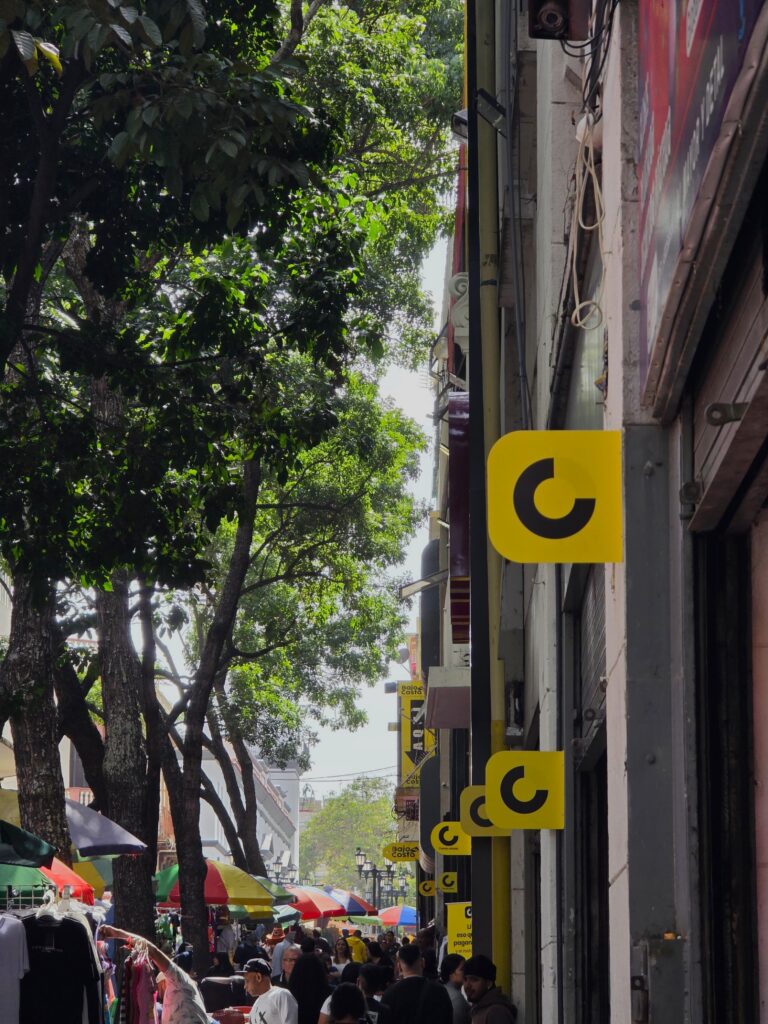
The widespread adoption of Cashea, a fintech company offering consumers interest-free microcredit for everyday purchases, has also increased the purchasing power of a broader segment of the population. Cashea’s success is visible not only in Wall Street, but also in its extraordinary penetration of everyday commerce. Its recognizable yellow logo now signals that the service is accepted in businesses ranging from large clothing stores in shopping malls to small kiosks, and funerary homes.

You can even use Cashea to pay for a ride with Yummy, Venezuela’s equivalent of Uber.
These businesses still operate within a heavily dysfunctional financial system, distorted by an artificially low exchange rate and an economy constrained by high inflation and low productivity. Yet they serve a segment of the population that is slowly turning into a small, resurgent middle class. That group is helping drive growth in specific sectors, most notably real estate, which has reportedly expanded by around 30 percent in 2026.
This modest revitalization has coincided with an important reduction in street violence. Today, around 60 percent of Venezuelans report feeling safe walking at night, according to Gallup, something difficult to imagine only a few years ago. This is one factor helping explain the revival of nightlife in places such as Chacao, Caracas’ historical center and, to a lesser extent, parts of Mérida.
A similar transformation was evident in Margarita Island, a place I had not visited in almost two decades.
Most of these changes began before the US intervention in Venezuela. But they appear to have accelerated and spread in the months following Maduro’s capture.
Known as the “Pearl of the Caribbean,” Margarita’s tropical beaches, tax-free stores and fascinating history attracted large numbers of European and Latin American as well as Venezuelan tourists during the 1990s and early 2000s. Some of my own fondest childhood memories are, in fact, on the island.
That changed dramatically after 2014, as Venezuela’s political, economic, and public-service crises deepened, leaving the island in a state of abandonment.
Today, Margarita is experiencing a modest but noticeable revival in domestic and international tourism compared with the previous decade. This has been partly fueled by significant investment from domestic and international hotel chains, which now offer a wide range of accommodation, from relatively affordable all-inclusive packages to high-end luxury experiences.
After several years in which the island received mostly Russian and Polish tourists, Margarita is once again welcoming growing numbers of international visitors, particularly from Colombia, and Brazil. Many tourism operators are already looking forward to the possible return of American visitors in the short to medium term.
Less than 15 minutes from the mall in Pampatar, I also visited a community that has gone more than six months without running water.
People I spoke to said Margarita feels more alive and prosperous than it did between 2016 and 2019, the worst years of Venezuela’s crisis, even if the situation remains vastly different from the island’s golden age thirty years ago.
Cities such as Pampatar and Porlamar are experiencing a revival similar to what I saw in Mérida and Caracas, with new restaurants and stores filled with customers. In Pampatar, I visited what was probably one of the largest and most modern shopping malls I have ever seen, comparable to those in Miami or Madrid, filled with stores selling American and European brands whose prices I often found prohibitive even by European standards.
Most of these changes began before the US intervention in Venezuela. But they appear to have accelerated and spread in the months following Maduro’s capture, as the idea that something resembling a normal life might again be possible seems to be taking hold in some.
There is, however, a large elephant in the room. Improvements remain largely cosmetic and circumscribed to a small part of the population.
Far from fixed
On the other side of the Avila, the mountain that separates Caracas’ gentrified neighborhoods from the Caribbean sea, over 12,000 people who lost their homes in the earthquakes wait for solutions in dozens of temporary camps erected among the ruins of their apartments.
But the limitations of this apparent resurgence are perhaps most obvious in the dismal state of public services. Hours-long power outages were common in Mérida and Caracas throughout my stay. Less than 15 minutes from the mall in Pampatar, I also visited a community that has gone more than six months without running water. Its residents make a living largely by collecting and selling salt from the island’s salt flats, with virtually no gear, or protection from the region’s unrelenting weather.
Businesses, hotels, and even many households have adapted to what are, in practice, nonexistent public services. Solar panels, batteries, and water tanks allow those who can afford them to maintain a large degree of independence from the State-provided services.
For most Venezuelans, however, these solutions remain unaffordable.

The same is true for healthcare and education. Both systems remain crippled by chronic underinvestment and neglect. The Venezuelan public health system remains severely understaffed and unable to provide adequate services to most of the population, while out-of-pocket health costs represent a large proportion of total health expenditure and less than 10% of the population can afford private insurance. In terms of education, despite a recent increase in school enrollment, the number of students has fallen by almost 2.8 million compared with figures reported in January 2024, as large numbers of high-school students continue to leave their studies to work.
Venezuela is far from fixed, and it will never truly be as long as chavismo remains in power. But it is certainly not the same country I left in 2019, nor the same country it was before January 3.
Many of the people I spoke to still want to leave, especially now that expectations of a quick transition to democracy have been tampered by the warm relationship of the Trump administration with Delcy Rodriguez. Others have decided that a somewhat normal life in Venezuela is once again possible and that, despite its uncertainties, it may be preferable to the immense challenge of migration in an increasingly hostile world.
Yes, these improvements are fragile, uncertain, and profoundly unequal. They exclude most of the country. But they are also an opportunity: Not only for some to live a relatively normal, easier life. But also a chance to build on whatever progress has been made and keep pushing towards the deep institutional and political reforms that only a democratically elected government can implement.