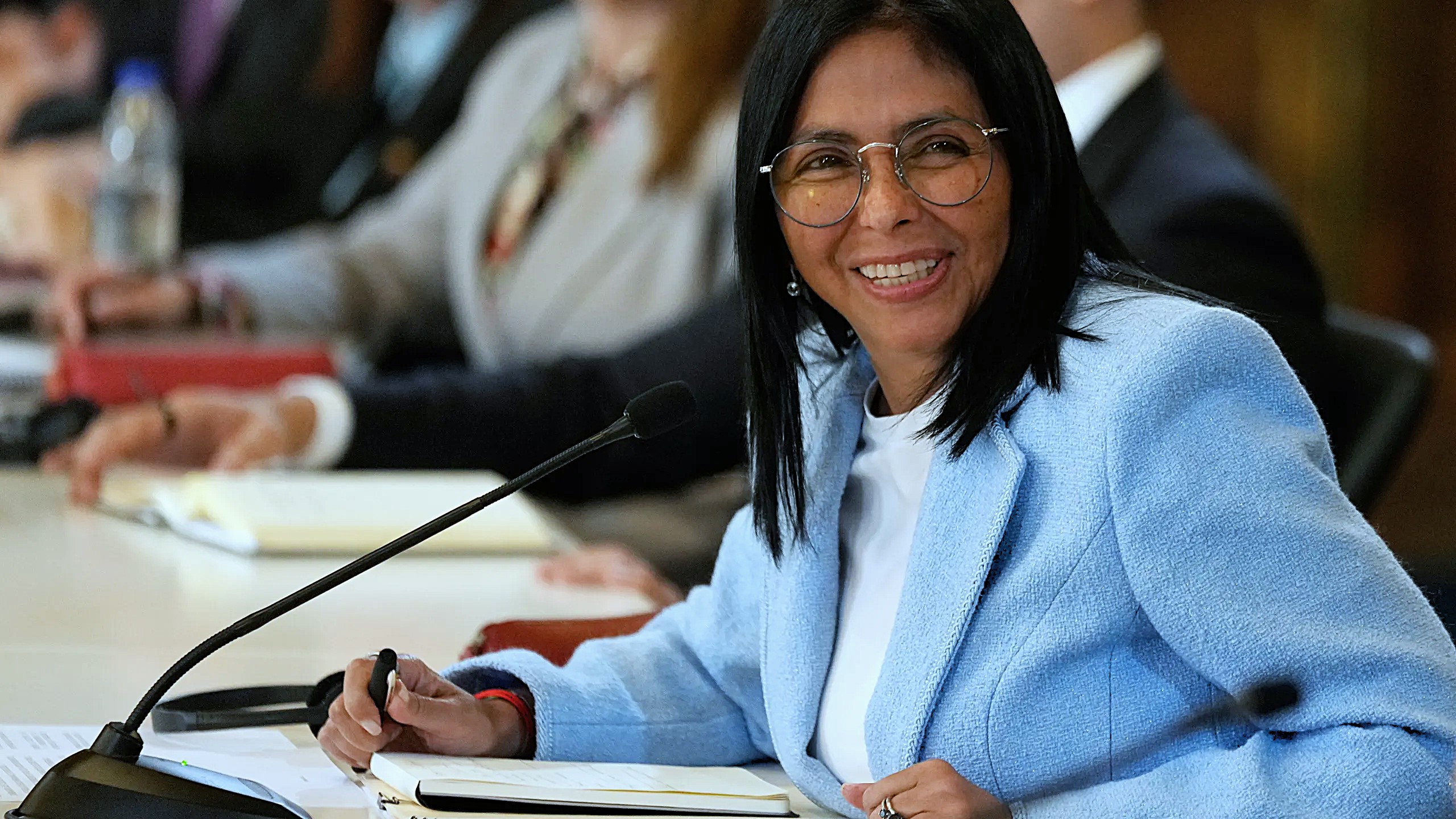
Delcy’s Approval is Already Slipping
Venezuela has spent three months measuring the exact moment when a collective expectation begins to turn into disappointment. The monthly surveys conducted by AtlasIntel and Bloomberg for LatAm Pulse Venezuela, fielded in February, March, and April 2026, document a political process with a name, a direction, and a speed. What they show is unequivocal: Delcy Rodríguez is not consolidating a transitional government. She is managing one that is eroding by disguising that transition rather than carrying it out.
This is not a collapse in her popularity, but a clear downward trend is already visible.
The numbers are precise. In February, 37% of Venezuelans approved of Rodríguez’s performance. By April, that figure had fallen to 31.4%. Disapproval rose from 44.3% to 47.1%. In absolute terms, the gap between those who approve and those who disapprove widened from 7 to nearly 16 points in 90 days.
The most revealing data point is not approval but performance evaluation. Those rating her government as “excellent or good” dropped from 23.4% to 16.2%. That share did not migrate into outright rejection. It moved into the “average” category, which grew from 34.7% to 45.3% and is now dominant. That shift suggests disappointment more than anger, and the former is far harder to reverse than open rejection.
The segment that once supported Rodríguez is the one moving the most. A first conclusion is that the management of expectations created on January 3 is not working. Almost 120 days into her time in power, people are not really buying the narrative.
To understand why these segments are shifting, the economic data must be read in parallel. In February, 78% of Venezuelans believed the country would improve over the next six months. That was the optimism of the historical moment, the expectation unleashed on January 3. Three months later, that optimism has dropped 23 points. Today, 55% still expect improvement.
According to these figures, public perceptions of the opposition remain intact.
Meanwhile, reality has not moved: 77% still rate the country’s economic situation as bad. The labor market is perceived as equally deteriorated. The Consumer Confidence Index fell from +14.7 in February to -1.9 in April. The expectations index dropped from +58.3 to +34.6.
The gap between what was expected and what is being experienced is the engine behind everything else. And that gap does not weigh equally on everyone. That vulnerable Venezuelan who, even in crisis, continued to rely on Chavismo out of necessity, obligation, or support (the lower-income, less-educated, a beneficiary of the Patria system who gave Rodríguez the benefit of the doubt) also expected that the post–January 3 shift would be felt in their pocket, their job, their daily life. Three months later, they do not feel it.
Chavismo and the opposition
The leadership approval ranking measured by AtlasIntel completes the picture. María Corina Machado holds a positive image among 56% of participants without losing a point in three months, with a +30 net rating. Edmundo González stands at 49% with +24 points. According to these figures, public perceptions of the opposition remain intact.
The contrast with the Chavista bloc is stark. No government figure has a positive net rating. Diosdado Cabello stands at -52 points, Jorge Rodríguez at -51, and Nicolás Maduro at -46. Rodríguez is the “least negative” within the bloc at -30, but still deeply in negative territory. The Chavista leadership, without exception, occupies extremely high rejection levels, a clear reflection of how the public views anything associated with Maduro.
Ruling is easy when you control the entire State. Legitimizing power requires improving people’s lives. That is the debt the public is now charging to Rodríguez.
Venezuela is moving from the expectations born on January 3 toward reality. And the reality is that Rodríguez’s government is not being perceived as the solution—it is increasingly being identified as the continuation of the problem left behind by Maduro. AtlasIntel identifies corruption as the country’s number one issue for 53% of respondents. The weakening of democracy ranks third at 32.8%. The public does not confuse management with change.
Rodríguez has not lost her critics, a majority that was never with her. What she is losing is politically more costly: her believers. Those who, without being part of the opposition, expected something to change. Those who gave her the benefit of the doubt at the peak of collective expectation Venezuela had not seen in years. That movement, which is quiet and without headlines, is what AtlasIntel’s data captures month after month with a clarity that official discourse cannot conceal.
AtlasIntel sampling
The data for this analysis comes from a random digital recruitment survey (Atlas RDR) conducted among 4,629 Venezuelans between April 24 and 28, 2026. Like all digital polling in Venezuela, the method carries a known structural bias: it overrepresents populations with active internet access, implying a relative underrepresentation of rural areas, older adults, and lower-income sectors without stable connectivity. Absolute figures should be interpreted with caution.
However, the instrument’s real value lies not in a snapshot but in its month-to-month tracking. If the bias is constant (as it is in this case, given that the digital profile captured remains structurally the same each month) then movements between measurements reflect real changes in opinion. A miscalibrated thermometer still detects a fever. And what this three-month series detects is unequivocal: erosion is real, sustained, and advancing among the segments Rodríguez could least afford to lose.
Managing power is relatively simple when the instruments of the State are in hand. Legitimizing it requires improving people’s lives. That is the debt these three months of surveys are charging to Rodríguez’s government.
If this continues, her own base could withdraw its support in the worst possible way: through the disappointment of those making a final bet on trust after years of having lost it. That kind of disappointment does not reverse, and may represent a more dangerous political rupture than outright rejection.
Chavismo wants to remain in control. But time is charging the opportunity for change that people saw on January 3. If that change does not arrive, it will be demanded. Without elections, it will be very difficult for them to claim to represent the country’s leadership before a population that no longer believes in them. Elections are necessary and urgent. Can chavismo avoid them?