“Dang!,” an amiably chaotic new adult animated comedy premiering Tuesday on Netflix, tells the story of the Dangs, three Chinese American siblings living in New York City. Eunice (Poppy Liu, “Hacks”) and older brother Andrew (Andrew Law) share a walk-up apartment in Chinatown; at 26, she’s still determinedly the baby, with little practical knowledge and dependent on him for the tiniest things. He’s the anxious middle child. (Therapist to Andrew: “I’m getting the sense that you’re an anxious people pleaser.” Andrew: “I’m cool with that if you are. Oh my God, are you?”) Somehow Andrew, who is gay, has a lot of casual sex, and only casual sex, despite being incredibly (and comically, obviously) awkward.
Both Andrew and Eunice, who makes money from a live stream in which “horny men and a few women with eating disorders pay me to step on bread,” are relationship averse. When it’s suggested she might like someone she’s been seeing, Eunice panics, “Am I catching feelings? Can it be stopped? Is there a vaccine? Damn whoever the president is.” There is little romance in this comedy.
Where Andrew and Eunice are aspirational slackers who spend off hours watching reality TV and taking whatever drug comes to hand, their older sister, Ruthie (Stephanie Hsu, “Everything Everywhere All at Once”), is a high-powered lawyer, more than comfortable defending evil corporations from the common people; she recoils at a community garden or free library, which she regards as socialism. (“I don’t even like fire departments.”) Though she’s seemingly the successful one, her life has taken an unexpected turn; she’s left her husband, Warren, a weedy Briton overeager to please her, and is pregnant by a colleague, a creep she idealizes. Her fall from perfection delights her brother and sister, who chant, “One of us!” She moves to New York and into the series.
Co-created by Law, who wrote for “Hacks,” “The Good Place” and “Late Night With Seth Meyers” and has acted a little, and Matt Murray (a smorgasbord of 21st century smart comedies are on his resume), the show was originally conceived as live-action. If anything like the present product, it would have to have been a very particular kind of comedy — something like “30 Rock,” whose beats were borrowed from cartoons in the first place. In any case, animation is the place it ought to be. The grotesqueness of Eunice’s boss, Jane, a product-damaged monster who is all face and very little body, if not unachievable in live-action — Katherine Helmond in “Brazil” comes to mind — isn’t really sustainable. You could not have a dead old man’s head come loose from his body and roll across a conference table with quite the same air of insouciance, or melt a rat walking across an overheated microwave oven, if actual people and rats were involved. On the other hand, the fact that Warren is so annoying reminds us that unreal people can elicit genuine repulsion. I ground my teeth at his every appearance; for Ruthie’s sake, I wanted him gone, and she isn’t real, either. It’s the magic of animation.
The show is generally amusing, sometimes very funny and easy to watch as an evolving story of family. (A visit to the Dang parents in Episode 8 is especially productive.) One’s mileage will vary depending on generation and experience. (“I was born in 1999,” says Eunice, who has never heard of Facebook. “Anything before ‘Skibidi Toilet’ is just cave paintings to me.” Of course, I had to look up “Skibidi Toilet,” and I don’t feel bad about admitting that.) There are sex jokes, fart jokes and pop culture jokes; there are jokes I don’t even want to describe. But there is a satisfying specificity to the humor, especially as involves Asian American culture, gay life, New York City and New York City gay Asian American life, which is not overexplained. The city itself is rendered with some light-handed detail — its delis, drug stores, coffee shops (why did I especially like the paper sleeves on the to-go cups?), Central Park on “Freaquinox,” “the first day that everyone decides it’s spring” when citizens turn into sex-crazed zombies. (Eunice: “Last year, I woke up next to an Uber Eats delivery robot.”)
As a situation comedy, its characters will spend their days and nights getting in and out of scrapes, enduring self-inflicted humiliations, experiencing minor triumphs; they are all a little stupid, and a little smart. And as a cartoon, its job is not just to tell you a story, but to give you something fresh to look at, something to set itself apart while offering easy access to its world and people. The character design, which borrows from anime, is elegant and a little odd — hands and feet are drawn tiny, which has the paradoxical effect of drawing your attention, making them more expressive.
Beyond the three stars and Noël Wells (as Greta, Jane’s cowed assistant), neither the producers nor the publicists nor the onscreen credits nor the usual websites have identified who played whom. But I copied down these names down from the screen: Al Roberts, Sungwon Cho, Jared Goldstein, John Michael Higgins, Adam Pally, Jaboukie Young-White and Mary Holland.
NEW YORK — Whenever Venus and Serena Williams decide to permanently close the door on their storied careers — the duo are competing in the U.S. Open’s women’s doubles this week after receiving a wild-card invitation — the extraordinary tale of two sisters from Compton, just 15 months apart, who both reached No. 1 and won bushels of major titles will continue to reverberate. It might be the most implausible sports story of the last 50 years.
Although Serena’s career accomplishments exceed her older sister’s by considerable margins, including a 23-7 advantage in singles majors, what if Venus had been the baby of the Williams bunch? Would those numbers have evened out?
It’s a fair question.
Research has shown that younger siblings often benefit from being last in the birth order, sometimes called a “younger-sibling effect.” Turns out, the proverbial runt of the litter may have an edge. And while the Williams sisters remain the gold-standard example in tennis, the sport has no dearth of cases, from Alexander Zverev and Andy Murray to Naomi Osaka and Tracy Austin, to name a few.
The birth-order advantage
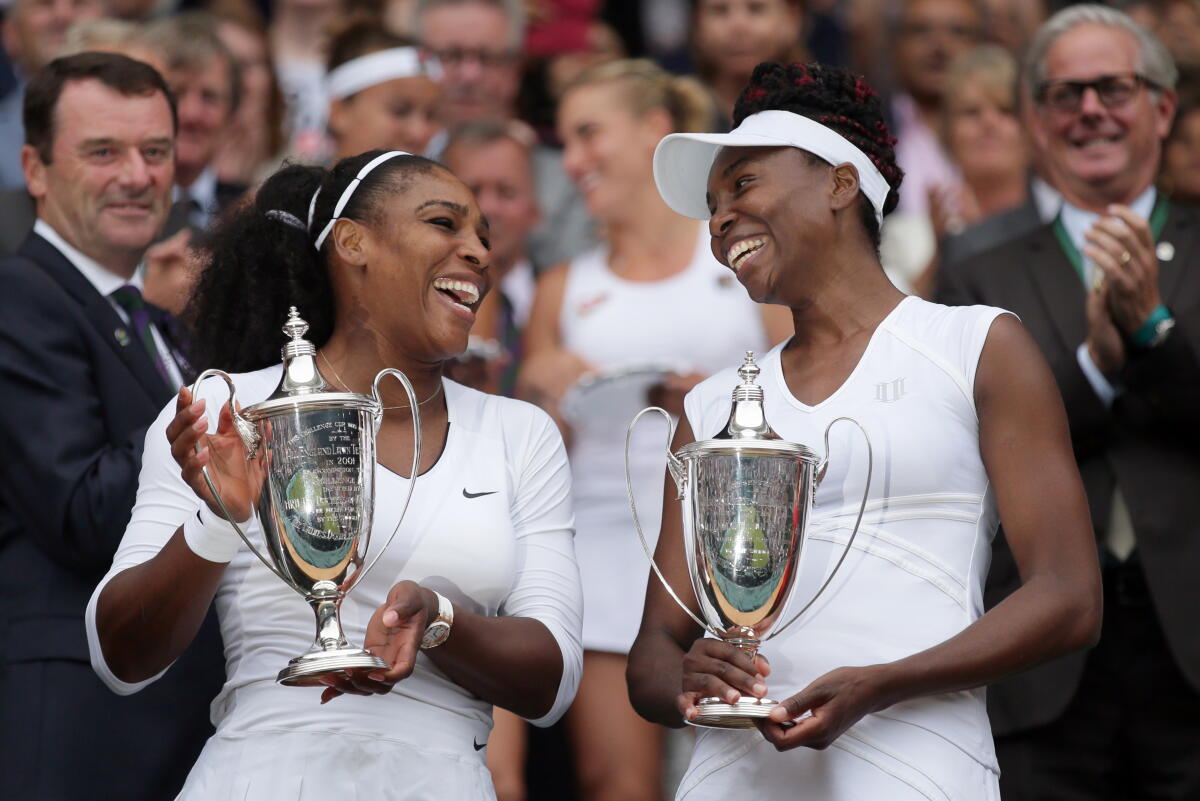
Serena and Venus Williams hold their trophies after winning the women’s doubles final at Wimbledon on July 9, 2016.
(Tim Ireland / Associated Press)
To researchers, Serena’s rise is not an isolated miracle of genetics, but a classic expression of family dynamics. Dr. Joseph Baker, a sports scientist at the University of Toronto, has found that elite athletes are statistically far more likely to be later-born children. “The birth-order effect means there’s some kind of social or genetic element in the family environment that’s driving it,” Baker says.
Dr. Frank Sulloway, a psychology research associate at the University of California, Berkeley, has found that the younger-sibling effect is a modest but reliable and statistically significant trend. While not deterministic — elite firstborns like John McEnroe and Novak Djokovic remain towering counter-examples, and both had younger siblings that played professionally — the later-born tilt repeats across the athletic landscape.
The backyard crucible
Some investigators trace the younger sibling effect to “situated learning.” That is, developing mastery through hands-on engagement, social modeling, and “vicarious experience,” according to Baker.
“Seeing someone from the same family unit achieve greatness gives the younger sibling the confidence to achieve the same,” he says.
For Serena, who is the youngest of five sisters in the blended Williams family, that meant learning to return Venus’s blistering serve on Compton’s public courts. It meant watching her more heralded older sibling navigate a mostly white women’s tour as a teenager. Because Venus was more experienced and stronger, Serena was forced to accelerate her development just to compete. And since their father, Richard Williams, largely kept them out of junior tournaments, that interdependent learning likely proved especially potent.
“I was able to learn, so I didn’t make the same mistakes she made,” Serena said in 2009. Now 44, Serena returned to compete at Wimbledon in singles and has teamed up for several doubles events this season, including in Cincinnati last month with 46-year-old Venus, after saying she was “evolving away from tennis” following her last appearance at the 2022 U.S. Open.
Sisters Jessica Korda and Nelly Korda walk on the ninth green at the Aramco Championship on April 3 in Las Vegas.
(Harry How / Getty Images)
This crucible is not unique to tennis.
Michael Jordan famously credited his older brother, Larry, with igniting his competitive fire. Golfer Nelly Korda followed older sister Jessica onto the LPGA Tour before surpassing her with major titles and an Olympic gold medal, while Peyton and Eli Manning grew up amid the backyard competition of a football-obsessed family that produced two Super Bowl-winning quarterbacks.
The “rough draft” of parenting
Beyond hardwood or turf battles, younger siblings can benefit from a profound shift in parental behavior, a phenomenon Louisiana Tech University sport and exercise psychology professor Dr. Jordan Blazo calls the “rough draft hypothesis.”
Firstborn children are often a parent’s athletic test drive. Parents often face a steep, expensive learning curve when navigating youth sports with older children, overscheduling them and committing developmental mistakes. By the time a younger sibling arrives, parents know the ropes and the pathways to pursue, according to Blazo, who studies sibling relationships and social comparison in sports. They are more attuned to financial and other feasibilities, which gives them a clearer road map to success.
Southern California native Austin, the youngest of three accomplished tennis children and the youngest U.S. Open champion in history at 16 years and 9 months, says her physicist father maintained healthy boundaries. When Tracy once invited him to watch her play German great Steffi Graf, he declined because of a computer club meeting. “Having a parent that wasn’t overly engrossed in my winning and losing was the healthiest thing,” Austin says.
Meanwhile, her mother, having navigated four older siblings’ athletic careers, was free to travel with 14-year-old Tracy because the nest was empty.
Russia’s Mirra Andreeva, 19, agrees. The reigning French Open winner followed her sister, Erika, three years older, onto the pro tour. “I had more benefits because I’m younger,” said fifth-ranked Mirra of her sister, who has been ranked as high as No. 65. “[My] parents obviously knew what to do. Tennis-wise… maybe that saved me some time.”
Zverev, who followed brother Mischa, 9 years his senior, says traveling to pro events as a kid helped normalized the ATP Tour early. “Maybe I wasn’t as nervous… because I’ve seen them and known them for years,” says Germany’s Zverev, who captured his first major title at this year’s French Open and is the top seed in New York.
Swing for the fences: Risk-taking
This competitive ecosystem also shapes how younger siblings play. Sulloway’s research on birth order and risk-taking reveals that later-borns are more psychologically wired to take strategic risks to carve out their own niche and stand out in the family.
Sulloway’s 2010 study of Major League Baseball brothers, conducted in collaboration with psychologist Richard Zweigenhaft, found that later-born siblings were vastly more likely to attempt to steal bases (and were more successful at it) than their first-born brothers. They were also far more likely to strike out because they were literally swinging for the fences, a high-risk, high-reward strategy. In tennis, this could translate to a willingness to play more aggressively, such as going for more on second serves rather than playing it safe, according to Sulloway.
Warmth over hostility
Yet, this sibling incubator seems to work best with one critical condition: the familial relationship is based on warmth and companionship. Blazo’s research shows that when sibling dynamics are colored by hostility and toxic comparisons, younger siblings experience “differentiation.” They can suffer from lower perceived competence, burn out, and ultimately quit or flee to other sports to escape the older sibling’s shadow, which isn’t necessarily a negative course correction. Sometimes it works out best for both.
In other words, the most successful sporting siblings preserve their emotional bonds. Richard and Oracene Williams famously enforced a sisters-first rule, allowing Venus and Serena to battle on court but walk off as best friends. Mirra Andreeva says her parents taught them that sisters are “the closest people we’re gonna have in life,” and to protect that bond they rarely practice together to keep emotions from getting “messy.”
Sisters Venus and Serena Williams hold the U.S. Open doubles winners’ trophy on Sept. 12, 1999.
(Al Bello / Getty Images)
When Venus and Serena were leapfrogging each other early in their careers, often clashing in Grand Slam finals across continents and surfaces, Serena insisted their competition existed in a supportive environment. Certainly it did in doubles, where they teamed up to win three Olympic gold medals and 14 major titles, including two at the U.S. Open in 1999 and 2009.
At the 2001 U.S. Open, where Venus beat Serena in the first all-Williams Grand Slam final, Serena said: “If anything I prefer to play Venus because that means that we have reached our maximum potential and that we’ll both go home winners. So for me, I always want to see Venus do well. I never want to see Venus lose.”
The long shadow
The McEnroe brothers, John and Patrick, separated by seven years, also saw their supportive relationship boost Patrick’s career. When Patrick, the youngest of three boys, was struggling in college and his mother pressured him to take the law boards, John stepped in, telling her to let Patrick chase his pro tennis dreams. Patrick eventually cracked the top 30 in singles and reached No. 3 in doubles, though he never reached the heights of John, who won seven Grand Slam titles and reached No. 1 in both singles and doubles.
“I think it holds water,” Stanford University alum Patrick said of his last-born experience, citing other examples such as Andy Roddick, whose older brother John was an accomplished collegiate player, and Hall-of-Famer Arantxa Sánchez Vicario, the youngest of four whose two older brothers, Emilio and Javier, were top ATP players. “It just so happened that my brother was exponentially more talented than I was as an athlete, but it’s definitely what at least got me into tennis.”
John McEnroe, left, and his younger brother Patrick compete during in a doubles match in Richmond, Va., on Sunday, Feb. 6, 1984.
(Joanna Pinneo / Associated Press)
The comparisons to John, however, played both ways. Patrick said they motivated him as a junior, but felt like a burden when he was trying to establish himself on tour.
With many physical, emotional and psychological variables in play, researchers admit it’s hard to pinpoint where DNA ends and drive begins when it comes to sibling dynamics. Ultimately, genetics and talent establish the ceiling, but the evidence suggests a supportive sibling ecosystem helps alchemize raw potential into greatness, and the sibling that benefits most is the one that comes later.
For Serena, the competitive yet protective shield provided by Venus was critical to her own success. Venus went first. She absorbed the bulk of pressure, provided the model and set the standard her younger sister spent a lifetime chasing, and eventually surpassing.
“Just everything that she does inspires me,” Serena said.