Finding a new TV show can be a chore in itself but luckily people have recently suggested a series which is the “funniest ever” that’ll make you “spit up laughing”
Christine Younan Deputy Editor Social Newsdesk
05:07, 05 Apr 2026
The series is available to watch on Netflix(Image: Peacock)
Recently, people went wild for a gripping series which is similar to Breaking Bad and Dexter. Now if you want something comical and we’re talking laugh out loud funny, then viewers are singing the praises of one show which is available on Netflix. It comes as one TV fan revealed they were on the search for something that “hooks you early” and stays good all the way through.
Posting on Reddit, the person visited the r/tvsuggestions forum for inspiration as many recommended Resident Alien.
They asked: “It feels like everything is overhyped lately and I keep getting disappointed after something people swear is amazing.
“Don’t get me wrong, I don’t mind popular shows, I just want something that actually lives up to it and doesn’t fall off after a few episodes.
“Ideally something that hooks you early and stays consistently good all the way through. Open to any genre at this point, I just want a show that delivers.”
In the comments section, people recommended Resident Alien which is “one of the funniest shows ever made”.
Someone commented: “For real! I absolutely adore it. Such a good storyline. Hard to watch it and eat or drink though. The sudden hilarious moments make me spit laugh.”
What is Resident Alien about?
The American science fiction comedy-drama TV series, which was created by Chris Sheridan, is about an extraterrestrial sent to wipe out humanity who kills a vacationing physician and takes on his identity.
After a crash landing on Earth in a small town in Colorado, the extraterrestrial, named Harry, is asked to do an autopsy on the town’s doctor, who died in unknown circumstances, and eventually takes over for the doctor at the town’s clinic.
With the moral dilemma of his secret mission, he also deals with the mayor’s young son who can see his true alien appearance. He also develops compassion for humanity and ends up defending them from other extraterrestrial threats.
The series ran for four seasons from January 2021 to August 2025 on Syfy, but now it’s available to watch on Netflix.
Rated a 15, the comedy has an 8 out of 10 rating on IMDB. Reviewers say ‘Resident Alien’ is lauded for its clever humour and engaging storylines.
Dakota Mortensen’s storyline will be edited out of the upcoming season of “Vanderpump Villa.”
Mortensen, who regularly appears in “The Secret Lives of Mormon Wives,” was set to be included in the third season of “Vanderpump Villa” — slated to premiere April 16 — as part of a getaway with members of DadTok, the group that consists of past and current partners linked to the MomTok influencers of “Mormon Wives.” Variety was first to report the decision.
Hulu declined to comment.
It’s the latest reality TV series caught in the relationship dust-up involving Mortensen and his ex, Taylor Frankie Paul.
Last month, a domestic violence investigation between the on-again, off-again pair prompted Season 5 of Hulu’s “Mormon Wives” to pause filming. Subsequently, the release of a video of a separate dispute in 2023 led to the shelving of Season 22 of ABC’s “The Bachelorette,” which featured Paul as its heroine. It has not yet been announced whether or not it will air at a later date.
Much of Paul’s story on “Mormon Wives” has revolved around her rocky relationship with Mortensen. Paul was previously arrested and charged in 2023, eventually pleading guilty to one count of aggravated assault; other charges were dropped. Part of that incident was documented on the series premiere of the show in 2024.
How does “Vanderpump Villa” figure into all of this? The third season of “Mormon Wives” featured the fallout from an explosive crossover with Hulu’s other reality series, which follows former Bravo star Lisa Vanderpump and her staff at various luxury European estates. “Mormon Wives” stars Demi Engemann and Jessi Ngatikaura were guests on that show’s second season and got embroiled in drama with staff member Marciano Brunette, who alleges he had intimate connections with both women. The recent fourth season of “Mormon Wives” revisits the crossover, with some of the women’s spouses partaking in their own “Villa” getaway that fuels more drama, including between Mortensen and Paul.
Mortensen isn’t totally out of the reality TV circuit, though. He is set to appear in “Unwell Winter Games,” a YouTube reality competition series produced by Alex Cooper, that premieres April 6.
The One Show has been hit with a schedule shake-up
20:21, 03 Apr 2026Updated 20:21, 03 Apr 2026
BBC The One Show won’t air on Monday (April 6) night (Image: BBC)
Fans will have to wait longer for the next instalment of The One Show.
The popular BBC chat show won’t be airing on Bank Holiday Monday (April 6), though viewers don’t need to worry as it will return to its usual slot on Tuesday (April 7) evening.
During Friday’s (April 6) episode, hosts JB Gill and Angellica Bell were back on our screens, welcoming a string of guests to the iconic sofa.
The presenting pair were joined by Strictly Come Dancing professionals Kai Widdrington and Jowita Przystał, who dished out the latest gossip on what fans can expect from the Strictly Pro Tour.
Also settling into the sofa were Patsy Kensit and Jayne Middlemiss, who opened up about their deeply emotional journey on BBC Two’s Pilgrimage, reports Wales Online.
As the programme drew to a close, Angellica confirmed the show would be returning to screens on Tuesday.
Bidding farewell to viewers, JB said: “Well that’s all we’ve got time for tonight thank you so much to all our guests.”
Angellica then chipped in, adding: “We will be back on Tuesday and we’ve got a whole host of fabulous guests joining us throughout the week.”
The pair gave no explanation for Monday’s absent episode, though we assume that the team is enjoying a well-earned Easter break.
This comes as I’m A Celebrity host Ant McPartlin was quick to issue an apology after seemingly letting slip a “spoiler” ahead of the South Africa spin-off. In the lead-up to the programme, the star appeared on Thursday’s (April 3) episode of The One Show alongside co-host Dec, giving viewers a glimpse of what awaits in this series.
Yet within moments of their conversation starting, Ant felt compelled to apologise as he questioned: “am I saying too much?”
Angellica was keen to discover more about the camp dynamics, asking: “I heard there is some drama.” Ant appeared to let slip a teaser as he responded: “This series gives you everything. There is drama, there’s arguments.. Am I saying too much? Fight… Am I saying too much? I’m sorry, ITV. There is everything, it’s on another level. It’s a must watch.”
The all-stars edition of the beloved ITV reality series is due to return on Monday (April 6) evening, as former campmates head into the South African bush to battle it out for the coveted title of Legend of the Jungle.
The latest series was filmed late last year and is packed with drama, stomach-churning trials, and naturally, no shortage of creepy crawlies.
The One Show airs weekdays from 7pm on BBC One and iPlayer
Reggie Watts has paid a touching tribute to his girlfriend Katherine McCollough, following her sad deathCredit: GettyThe comedian heartbreakingly shared how he ‘understood’ the reason for her passingCredit: Instagram/reggiewattsReggie ended the message by telling Katherine he will always love herCredit: Instagram/reggiewatts
Sharing the news to Instagram, Reggie wrote: “Katherine, I will miss you so much. I know you were in pain, and while I tried everything I could to reflect the light you brought into this world, the sorrow became too much to overcome.
“You changed my life. You opened up my vulnerability and taught me how to receive love from someone so close.
“We built a life together, went on adventures, and we took chances together.
“You had a natural radiance that people could feel from so far away – a light you carried despite the difficult path you walked from childhood.”
Continuing to his 407K followers, Reggie heartbreakingly shared how he “understood” his girlfriend’s “need for peace”.
He wrote: “I’ve been processing so much. I know you can hear me, and I honour the intentionality of your journey. You planned your time in Lima beautifully – the coast, the art, the meals shared with a friend.
“While it is so difficult for those of us left behind, I understand your need for peace.”
“There is so much of you still around me in the house we shared. You were a vital part of my transformation.
“I’m so grateful for everything we shared, and I will hold the light you gave me forever.”
Signing off the post, Reggie asked Katherine to say hello to his late mother, penning: “You never got to meet her, but I know she would have been so happy to see how kind you were to me.
“You took care of me in a way I know she always wanted for me.
“I love you, Katherine. I always will. You are a part of me, as you always have been.”
Reggie added two beautiful pictures of Katherine to his tribute.
Following her death, Katherine’s friends have been raising money via a GoFundMe, to cover the costs of shipping her body from Maine to her home state of South Carolina.
At the time of publishing, the fund has raised $30.6K of its $40K target.
Reggie is best known for being the bandleader on James Corden’s Late Late showCredit: PA:Press AssociationHe was in a relationship with Katherine for two yearsCredit: AFP
After a major national debacle on live TV when she was only 20 years old, Ashlee Simpson Ross finally found a way to win back a small-screen audience’s love: She put a galaxy mask over her head and let the vocals rip.
Forget that 2004 incident where she got caught singing over a backing track in an appearance on “Saturday Night Live.” Sure, she did a weird little dance, then fled the set. Sure, her dad made excuses. But that’s in the past.
“I feel like I became Galaxy Girl and I had the best team ever,” Simpson told People. “So I mean, it felt great to do it. It felt great to perform, not being able to see where I’m going. You can hardly see where you’re going. I think just becoming that character of Galaxy Girl and people not knowing who I was, it was just a different way of performing that. I enjoyed that. It was definitely a moment of discovery.”
Back in fall 2004, Simpson, who’s now 41, was about to do her second song as the musical guest on “SNL.” Following in her famous sister’s footsteps as Jessica Simpson’s newlyweds reality show with then-husband Nick Lachey was hitting its stride, she had just released what would become the year’s top-selling album by a female singer.
Lorne Michaels would confirm later that it had been a first for the sketch show.
“What can I say? Live TV,” host Jude Law told the audience during the show’s goodbye sequence that night. Simpson, standing at his side, jumped in with a rapid-fire explanation of what had just happened, throwing her band under the bus and not making much sense at all.
“I feel so bad. My band started playing the wrong song and I didn’t know what to do, so I thought I’d do a hoedown. I’m sorry!” she said.
This was a year after her sister had asked, with cameras rolling, whether a can of Chicken of the Sea contained tuna or chicken, and whether Buffalo wings were made out of buffalo. So what stuck in people’s minds were those lyrics playing out of the ether. Ashlee Simpson, it was clear, intended to lip sync, which sort of implied to casual observers that she couldn’t sing. She became, to many, a laughingstock.
Her dad said afterward that acid reflux had made her vocal cords swell, necessitating the last-minute switch from live to Memorex. He called it a learning experience and said she would prove herself in future shows.
“Unfortunately, that happened to us on Saturday, so just like every other artist in America she has backing tracks … so you don’t have to hear her croaking through a song on national television,” Joe Simpson told Ryan Seacrest in a radio interview.
“She never used them before,” he said of the vocal tracks, but “you have to do what you have to do.”
A few months later, she was booed on national TV when she did the halftime show at the 2005 Orange Bowl. Folks joked that it was worse than what happened on “SNL.”
So, yes, her career continued, but it hasn’t been 100% smooth. After a couple more albums, she took a role in a Broadway musical and eventually she returned to acting. She said over and over that she was going to get back into music, but life kept getting in the way.
Then in 2025, after celebrating the 20-year anniversary of her breakout album release with a short gig at a WeHo nightclub the year prior, she announced a residency at the Venetian in Las Vegas. The gig proved popular enough that it was extended into 2026.
And over the course of “The Masked Singer” season, Simpson finally proved to those casual observers that she has a voice and knows how to use it. She even bested her husband, who competed this season as Stingray and was cast out in Episode 10.
“Performing is my happy place, and to be doing that again just feels so nice,” she told People. “I’m inspired to keep playing shows and creating new music. And moments like ‘Masked Singer’ and Vegas, and I’m looking forward to Pride and Stagecoach — those moments just make me realize, ‘Oh, this is what I love to do.’
On the first night of Passover, Ye — the superstar rapper, the artist formerly known as Kanye West, the man who once threatened in a tweet to go “death con 3 On JEWISH PEOPLE” — performed for what looked like a full house at Inglewood’s SoFi Stadium.
The first of a pair of Ye concerts this week at the gigantic NFL palace, Wednesday’s show came two months after the 48-year-old musician apologized for his past antisemitic comments, attributing his behavior to injuries he sustained in a 2002 car crash.
More to the point, perhaps, the gig came on the heels of last week’s release of “Bully,” Ye’s first solo LP since 2022’s “Donda 2,” which the trade journal Hits predicts will enter the album chart at No. 2, right behind the latest from BTS.
In other words, Ye’s trying to get a comeback going — and, to judge by the very warm reception he got at SoFi, he might prove successful.
Wednesday’s concert — Ye’s first full live performance in Los Angeles since a 2021 gig at the L.A. Memorial Coliseum — lasted about two hours and featured guest appearances by Don Toliver and Ye’s 12-year-old daughter, North.
The rapper performed atop an enormous dome set up on the stadium’s floor; for much of the night, a spinning globe was projected onto the dome so that Ye looked to be — well, on top of the world is how he might’ve put it.
Early in the set, Ye asked his technical crew to “make the earth move slower,” which somebody made happen.
Accompanied by what sounded like prerecorded backing tracks, Ye opened with a handful of songs from “Bully,” which seeks a middle ground between the soulful, sample-heavy sound of his early work and the gloomier, synthed-up vibe of more recent records like “Donda” and his and Ty Dolla Sign’s “Vultures 1” and “Vultures 2.”
After an extended version of the new album’s “All the Love,” he reached back for an assortment of oldies, including all-timers like “Father, Stretch My Hands, Pt. 1,” “Mercy,” “Black Skinhead” and “Can’t Tell Me Nothing,” which he stopped and restarted after telling the crew to mute the music during the song’s line about getting his money right so that he could hear the crowd join in.
He also did his and Jay-Z’s collaborative 2011 hit — the one whose title contains the N-word — which made you think about how he and his old frenemy are both mounting comebacks at the same time, Jay-Z as a kind of retiree’s victory lap and Ye in hopes of moving past a mess of his own making.
Other classics Ye performed included “Bound 2” and “Heartless,” to name two of his most emotionally potent songs, though thick smoke in the stadium made it hard to feel a sense of connection with him as he moved back and forth atop the dome.
Ye brought out Don Toliver to perform “Moon” and Toliver’s “E85,” then cycled again through the “Bully” tracks he’d done earlier. North West came out to perform “Talking” and “Piercing on My Hand,” after which Ye did his and Ty Dolla Sign’s “Everybody,” which prominently samples the Backstreet Boys’ “Everybody (Backstreet’s Back).”
Then he finished with a sprint through some of his most beloved hits: “All Falls Down” into “Jesus Walks” into “Through the Wire” into “Good Life,” which he restarted several times because he said the lights were “corny.”
“Is this like an ‘SNL’ skit or something?” he asked when nobody made the changes he was looking for.
Ye ended the show with “All of the Lights,” which got a huge pryo display, and “Runaway,” his epic 2010 warning to anyone foolish enough to consider falling in love with him.
“Run away fast as you can,” he sang, and the crowd roared right along.
BBC Ambulance viewers were left feeling emotional during the latest instalment of the popular series
22:35, 01 Apr 2026Updated 22:36, 01 Apr 2026
BBC Ambulance viewers were left in tears during the latest episode(Image: BBC)
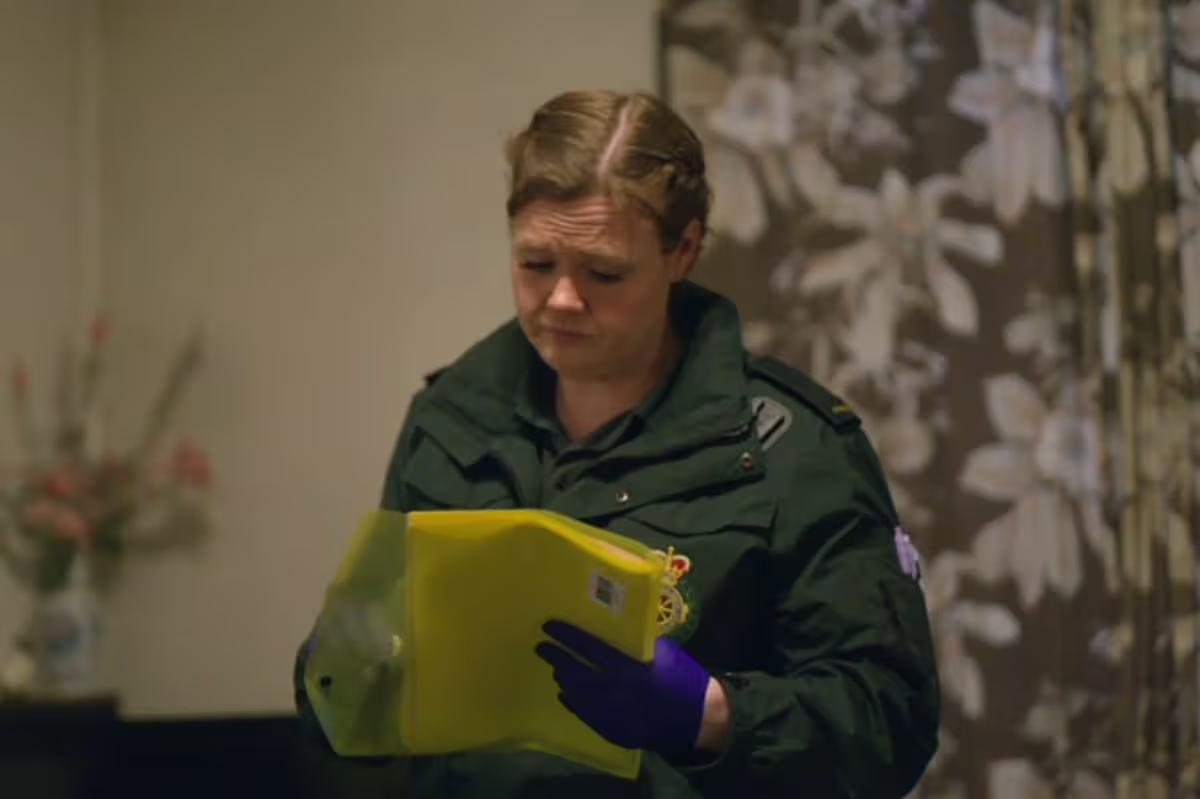
Ambulance viewers were left in tears as they watched the “heart-wrenching” moment the parademics helped an elderly man on end of life care.
During Wednesday’s (April 1) instalment of the BBC hit series, which follows ambulance crews in Yorkshire, viewers saw an emergency team receive a call to attend to a 91-year-old man Terry, who was struggling to breathe.
Halifax crew 1671 Siobhan and Ellie rushed to the scene and found Terry lying in a hospital bed in his living room.
It was clear that Terry was uncomfortable as he struggled to breathe and was getting choked up when coughing. To help with the pain, he was given medication.
In a heartbreaking moment, Terry admitted that he didn’t want to go to hospital so Siobhan made a few calls to confirm he was able to do so.
Visibly moved, Siobhan said: “The most valuable job that I go to is an end of life job. They require a level of care and calm and cup of tea making. A hospital is not the place for everybody.
“Sometimes when we go to a patient who is dying, you have to be that patient’s advocate, following somebody’s wishes and keeping them comfortable and happy. No matter how difficult that is.”
Terry was able to stay in the comfort of his own home as Siobhan admitted that “there is nothing more we could do”.
While sitting in the ambulance, She turned to Ellie and said: “I’ve met Terry before and Terry that we went into was so different but I don’t think there is nothing more we could do.”
Ellie replied: “I think we have done the right thing there. He didn’t want to go to hospital and when someone is on palliative care is it the right thing to do – take them out of their nice warm home. Bless him.”
At the end of the show, it was revealed that Terry had spent three days in hospital before returning home, where he died in line with his wishes.
Viewers were left feeling emotional over the heartbreaking scene as they rushed to social media to share their reaction.
One fan wrote: “#ambulance Aw Terry. Heart wrenching.” Another said: “Terry is breaking my heart #Ambulance.” Someone else commented: “The hardest thing is watching people you love gradually fade away. #Ambulance.”
A fourth fan admitted: “It’s a tough watch tonight #Ambulance. One emotional viewer said: “Sobbing watching this #Ambulance.”
Meanwhile a fifth person added: “Tonight’s episode is just…. tough to see the elderly people nearing the end of their lives and all the paramedics being so caring & dignified in treating them.”
Ambulance airs on BBC One and BBC iPlayer on Wednesdays at 9pm
IT’S being billed as a huge tribute concert to Gary ‘Mani’ Mounfield, who died in November.
But I’m told the “Manichester” event in honour of the Stone Roses bassist, organised by his brother Greg, has caused a rift in the family.
Sign up for the Showbiz newsletter
Thank you!
A gig honouring Stone Roses bassist Mani is causing a rift among his family membersCredit: GettyThe Stone Roses in July 1990 L-R Reni, Mani (top) Ian Brown (bottom) John SquireCredit: Getty
The concert will see musicians including Zak Starkey, Baz Fratelli from The Fratellis, John Mcclure from Reverend And The Makers and Simone Butler from Primal Scream come together at Manchester’s Diecast in May.
Cast are also lined up to perform, along with Mick Rossi from Slaughter & The Dogs and Stone Roses guitarist Aziz Ibrahim.
But while the concert was believed to have the full support of Mani’s family, which includes his twin sons Gene and George, insiders say not everyone is in agreement.
A source said: “Mani’s legacy and celebrating that is so important to so many people.
“But not everyone related to him is happy about this concert.
“Even his young son Gene has voiced his concerns on social media.
“It is all very messy and is spilling over into the public domain.
“This is not what Mani would have wanted. His twin boys were everything to him.”
Mani died at home in Manchester in November aged 63Credit: GettyMani was best known for his work with Stone Roses and Primal ScreamCredit: Getty
Greg confirmed earlier this month that he was organising the tribute concert, and said there were hopes of snaring Noel and Liam Gallagher to perform, as well as Johnny Marr.
He said: “I think it will be brilliant.
“With the names already in the hat, and the names we’re yet to announce, it’s a worthy thing, a tribute to our kid, a Mancunian legend, and I know he’d love it.
“He would be absolutely buzzing about it.”
Mani, who was best known for his work with Stone Roses and Primal Scream, died at home in Manchester aged 63.
Noel and Liam made an on-stage dedication to him during their Oasis ’25 Live reunion tour, while rock icons including Stone Roses singer Ian Brown turned out to pay their respects at his funeral.
As a fan of Mani, I hope this can be resolved quickly and without further upset.
LITTLE BRIT OF FAMILY TIME
BRITNEY SPEARS is being supported by her sons following her arrest for driving under the influence – and it’s about time too.
For years, the Circus singer was deserted by her boys – who she has with ex-husband Kevin Federline.
Britney Spears has been spending time with her two sons, Sean Preston and JaydenCredit: Instagram
But it seems they are back in her life and bringing a smile to her face.
She shared a video on Instagram on a boat with Sean and Jayden, during a getaway, including a shot of them smiling together.
Britney wrote: “Thank you guys for all your support… Spending time with family and friends is such a blessing!”
AITCH FIZZES MUSIC
HE was flying high after his stint in I’m A Celebrity last year.
But now Aitch is facing another trial, and it could be just as gruesome.
Aitch is embroiled in a legal row over his Syps drinks brand with two former directors of the companyCredit: Splash
I’m told the Strike Me A Pose rapper is embroiled in a legal row over his Syps drinks brand with two former directors of the company.
Aitch, real name Harrison Armstrong, created Syps back in 2023 with businessmen David Olusegun and Alexander El-Nemer – with the trio proudly showing off their fizzy, flavoured water at events across the UK.
But I’m told that partnership is now well and truly over, with David and Alexander resigning as directors.
A source said: “Harrison has fallen out with David and Alexander and it seems there is no going back.
“They’re in a full-blown legal dispute and it’s all in the hands of their lawyers.
“The three created the brand together so it could get messy.
“Harrison is still working on the brand and is running things with his manager.
“How quickly this is going to get resolved is the question. One thing is for sure though, Harrison wants it dealt with so he can move on.”
TAMER ROLE FOR HARDMAN ACTOR
TAMER HASSAN is swapping punch-ups for pull-ons after landing a major new deal with sportswear giant Reebok.
The hardman actor has filmed an advert for a bold campaign inspired by Robin Hood, of all people.
Tamer Hassan has landed a major new deal with sportswear giant ReebokCredit: Splash
It sees Tamer playing a cheeky “friendly villain” who nicks sports kits before handing them out to kids.
He is joined by UK rapper K-Trap, and starry cameos from Gary Oldman, Laila Morse and Lisa Maffia.
An insider said: “Tamer is genuinely thrilled to be part of something revitalised and forward-thinking.
“Reebok is part of the culture, and seeing it evolve with fresh energy in 2026 makes this really exciting.”
The retro-style campaign is also a nod to 2005 British crime flick The Business, which starred Tamer alongside Danny Dyer.
Filmed at a secret North London location, the advert is set to drop later this month and marks the start of a huge year for the actor.
He’s gearing up for the premiere of Rise Of The Footsoldier: Retribution at Cannes in May, ahead of its UK cinema release this summer.
From the big screen to the high street, it sounds like Tamer has a lot going for him right now.
TEARY NIGHT FOR ELLIE’S WOLF PACK
WOLF ALICE had an emotional night headlining the final evening of the Teenage Cancer Trust’s concert series – with frontwoman Ellie Rowsell breaking down in tears.
The group debuted two new songs, Hit The Sky and Gospel Oak, and towards the end of the latter, her voice broke and she became teary.
She asked the band to restart the track from the beginning of the final verse and was then hugged by guitarist Joff Oddie and bassist Theo Ellis.
Later, Theo admitted that performing in London’s Royal Albert Hall for the charity concert was making him emotional, too.
He said: “These are my best friends. It’s unbearable how much I want to cry all the time in this gaff.”
They deservedly picked up the British Group gong at the Brit Awards last month following the success of their fourth studio album, The Clearing – one of the best British albums of 2025.
If you’re yet to see them, make sure you make it to one of the festivals they’re playing across the UK this summer.
BENSON SWOON
BENSON BOONE got his fans hot under the collar while cooking up this tour announcement.
He whipped off his top, cracked eggs with his biceps and showed off his rippling muscles as he added ingredients to a bowl while baking a cake.
Benson Boone stripped off for his new tour announcementCredit: instagram/bensonbooneIn the video Benson cracked eggs with his bicepsCredit: instagram/bensonbooneBenson made a cake in the videoCredit: instagram/bensonboone
It was eventually topped with the poster for his new Wanted Man tour.
I have to applaud him for the sexy and hilarious snippet posted on Instagram, but it’s a sea change from 12 months ago when he told Rolling Stone magazine that he didn’t want to rely on his body to sell shows.
He told the mag: “I definitely remember there was a time where I would take my shirt off because I didn’t know what else to do.
“I don’t want to rely on my physical form to be the primary driver of my shows.”
It’s a good job he’s had a fair few hits.
Benson previously told Rolling Stone magazine that he didn’t want to rely on his body to sell showsCredit: instagram/bensonbooneBenson’s new tour is called Wanted ManCredit: instagram/bensonboone
YOU BOOTY, KATYA
STRICTLY’S Katya Jones looked the part – and had the footwear to match – when she strutted in to watch the opening night of musical Kinky Boots.
And she was in for a real treat.
Katya Jones at the opening night of musical Kinky BootsCredit: GettyJohannes Radebe stars in the musicalCredit: Getty
With glitter, tinsel, red leather and high heels, this latest production of the hit show is a dazzling spectacle, the likes of which the West End has rarely seen.
Fellow Strictly star Johannes Radebe is mind-blowing as drag queen Lola, above, proving his singing voice and stage charisma are almost as brilliant as his dancing.
But playing the perfect straight man is X Factor winner Matt Cardle as Charlie Price, who inherits his father’s ailing shoe factory in Northampton and comes up with a plan to save it by making footwear for Lola and her fellow artistes.
Fun, feel-good and unforgettable, everyone should try these Kinky Boots for size.
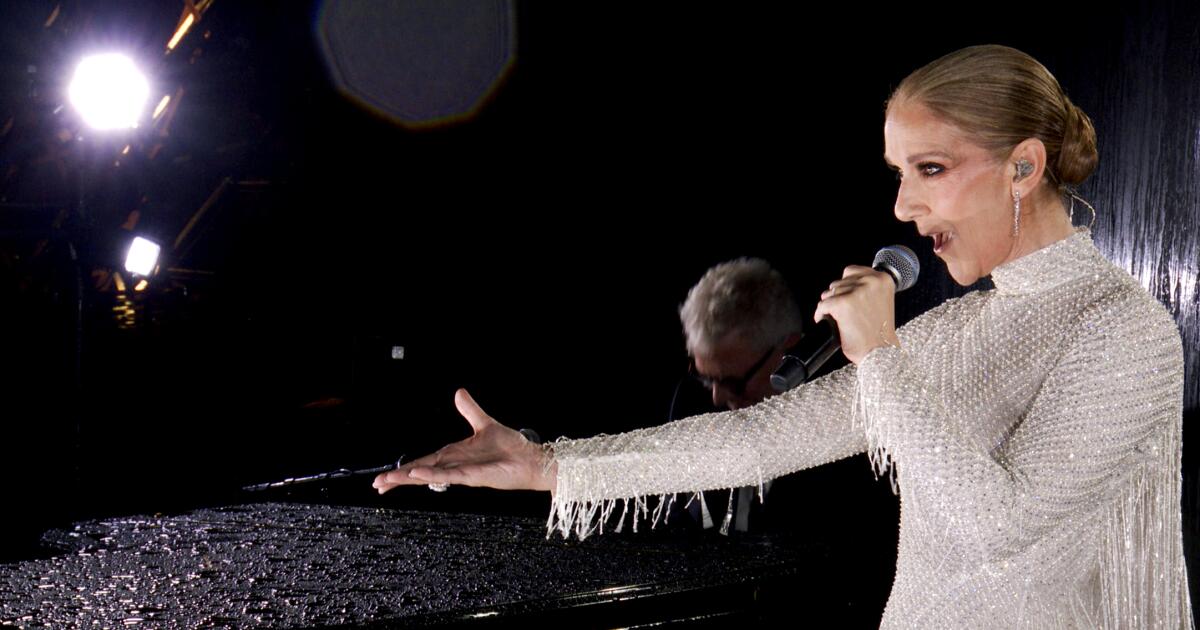
Céline Dion is officially coming back to the stage.
The singer announced on Instagram that she will return to the stage this fall, performing 10 shows at the Paris La Défense Arena. In 2022, Dion canceled her North America tour due to muscle spasms. She was later diagnosed with stiff-person syndrome, an autoimmune neurological disorder, which prevented her from performing.
The concert announcement comes after speculation last week by fans in Paris who spotted posters around the city referencing Dion’s songs, including “Power of Love” and “Pour Que tu M’aimes Encore.”
Dion, who turned 58 on Monday, called this news “the best gift” of her life.
“I’m so happy. I’m so ready to do this. I’m feeling good. I’m strong,” Dion said. “I’m feeling excited, obviously. Of course, a little nervous, but most of all, I am grateful to all of you. I can’t wait to see you again.”
While Dion performed at the opening ceremony of the 2024 Olympics in Paris and at an Elie Saab fashion show in Saudi Arabia, she has not headlined her own concert since her Courage World Tour in 2020. In her video, Dion thanked her fans, who supported her in the “most difficult times.”
“Over these last few years, every day that’s gone by, I felt your prayers and support, your kindness and love,” Dion said. “You’ve helped me in ways that I can’t even describe, and I’m truly so fortunate to have your support. I’ve missed you so much.”
Dion will perform twice a week — on Wednesdays and Saturdays — from Sept. 12 to Oct. 14. In a press statement, Frédéric Longuépée, president of La Défense Arena, called Dion’s residency a major milestone for the venue, which opened in 2017.
Fans can register for presale tickets until April 2, and general ticket sales will go on sale April 10.
Dion discussed her battle with stiff-person syndrome in her 2024 documentary, “I Am: Celine Dion.” In the film, the singer explained how SPS causes a vocal strain that makes it difficult for her to perform. Before her 2022 diagnosis, she had already experienced symptoms for 17 years.
While SPS has no known cure, Dion did not lose motivation to continue performing.
“If I can’t run, I’ll walk. If I can’t walk, I’ll crawl, but I won’t stop,” Dion said.
“Everyone is at least a dormant ballet nerd,” declares 22-year-old Eden Lim, while sitting for an interview in the suburban Dallas studio where she and her sister, Jordan, 24, film and edit their popular YouTube channel “Ballet Reign.”
Judging from the near-universal backlash to Timothée Chalamet’s recent bad-mouthing of ballet, Eden’s summation of the central tenet of their show may be true. With 67,000 subscribers in 166 countries and growing, the Lim sisters are mixing Gen Z humor and exuberance with astounding erudition to bring ballet to a new generation and fire up older, longtime fans.
With episode titles such as “Addictive Ballet Moments to Alter your Brain Chemistry” and promises like “This will increase your lifespan and double your morale,” they are on a mission to ensure that ballet not only survives but thrives.
Share via
Mirthfulness is the Lim sisters’ medium, but their message is serious. During each show, they parse video clips of great performances, often by explaining the history of the piece and giving detailed behind-the-scenes stories. They dissect the most famous pas de deux with trenchant insight and introduce their audience to the greatest dancers, including Natalia Osipova and Roberto Bolle. With signature, irrepressible enthusiasm, the sisters help viewers see precisely what makes the shows and dancers so extraordinary.
Eden, left, and Jordan Lim of YouTube channel “Ballet Reign” trained as professional dancers before deciding to focus on their show full time.
(Larsen & Talbert / For The Times)
A video clip featured in the “Addictive Ballet” episode shows New York City Ballet principal dancer Ashley Bouder launching herself into a jeté so high she seems to leave Earth’s gravity. In midair she manages to turn herself 180 degrees before being caught by her partner, despite her momentum seeming to drift into his arms like a feather blown by a breeze.
While watching the singular feat, Eden exclaims, “Call the news channels! We found a person who can actually levitate!”
Jordan says the goal is to make viewers feel equipped to say, “I understand what’s going on, and I can appreciate it, and I can appreciate that this was done well.”
“Ballet Reign” launched three years ago with modest hopes. The sisters sought a mere toehold in the YouTube universe, aiming for a narrow niche audience of fellow ballet fanatics (“ballet nerds”) ages 16 to 25. To their initial astonishment, they have attracted a far wider viewership spanning all ages, even followers who hitherto had only scant interest in ballet. They have drawn in many young children and older adults, with those 65 and up now their third-largest subscriber group.
The show has rapidly won acclaim from within and outside of the ballet world — perhaps because the depth and breadth of their knowledge makes it hard to shake the suspicion that they secretly are Ivy League professors.
The Lim sisters speak with sophistication about classic ballets and dancers they love — delivering their message through a whimsical show that has attracted fans of all ages.
(Larsen & Talbert / For The Times)
They comment with equal sophistication on ballet steps, choreography, history, musicology and the minute details of costume design. Eclectic references pop out of nowhere — a metaphor from quantum physics, an aside that the flute is the instrument whose sound is closest to a sine wave, that a serinette is an 18th century music box used to teach caged canaries to sing.
Even actual professors laud the show.
Nicolas Krusek routinely shows “Ballet Reign” episodes in his classes for adults on ballet history at Simon Fraser University in Vancouver. Krusek says what makes the show compelling “is the spirit of the videos, just the sense of joyousness and benevolence that they communicate, and a real sense of reverence for the art and the artists.”
John Meehan, a Vassar College professor of ballet and former principal dancer with American Ballet Theatre, calls their episode on Igor Stravinsky’s “The Firebird” ballet “amazing,” adding that it conveys at least as much information in much more palatable form than a “dry” university lecture.
Julie Cronshaw, director of the Highgate Ballet School in London, says even for learned, longtime balletomanes the show opens up a whole new realm of understanding and appreciation. For those weighed down by adult concerns, watching an episode leaves them feeling uplifted.
This is why Jordan believes “Ballet Reign” has attracted a significant older audience — and also because the sisters honor tradition.
“They’re looking at the content and saying, ‘These are pieces that I grew up watching. And these are the dancers that I adored when I was younger,’” Jordan says.
Eden says she hopes “it’s because our content, and the way we deliver it, is able to touch hearts.”
The Lim sisters keep a disciplined schedule, turning out polished, deftly produced episodes 52 weeks a year.
(Larsen & Talbert / For The Times)
The show also benefits from its high production values, with expertly edited clips from performances, clever blurbs of text and quirky cutaways to, say, a pole vaulter as an allusion to how high a dancer jumps.
Episodes generally begin the same way, with the sisters sitting behind a table with an old-fashioned radio-days microphone nicknamed “Mike-elangelo” between them. Eden kicks things off by announcing, “Ladies and gentlemen, this is Ballet Reign.”
A flash of superimposed text identifies them as “*Very certified*, extremely serious ballet experts.”
Jordan and Eden revel in each other’s company, finish each other’s sentences and play off each other with insightful or witty interjections.
“We grew up best friends from the beginning, and that’s never changed,” Jordan says.
They keep a disciplined, grueling schedule, turning out polished, deftly produced episodes 52 weeks a year.
Comments validating their efforts come in frequently. “You really helped me through a dark time,” reads one. Another notes, “I was going through a really difficult life transition and having your videos helped me get through.”
Jordan says, “That’s a sort of impact that I genuinely did not see coming.”
The sisters are openhearted and enjoy revealing ballet’s best-kept secrets, but they have kept a remarkably mysterious online profile. Until now, they have never even disclosed their last names, let alone anything about their background, education or experience.
There is also nearly nothing on the internet, and fans have long wondered about their credentials, including whether they are professional dancers themselves.
On the show the sisters certainly come across as if they were. Surprisingly, the answer is no — with an “almost” caveat.
The oldest of four siblings, Jordan and Eden spent nearly all of their childhood in Ottawa. From the time they were small the sisters beelined toward becoming professional ballet dancers. Jordan says when she was 4 she got up at the crack of dawn every day and put in a VHS tape of a ballet class that her mother, Mary Lim, had bought. With fierce determination, she performed tendus and relevés along with the older students on the tape.
Eden’s ballet fascination quickly followed. Mary says she soon realized she had no choice but to send them to ballet school.
“Obviously, if you look at a 4-year-old doing ballet at 7 a.m. every single day, you’re like, OK, let’s try lessons,” Jordan says.
Eden, left, and Jordan Lim of “Ballet Reign” are the oldest of four siblings and spent nearly all of their childhood in Ottawa before relocating to Texas to pursue their careers.
(Larsen & Talbert / For The Times)
By 2015, the girls needed a better ballet school than was available in Ottawa. Their parents packed up the family and moved to Dallas, where the pair enrolled in the Ballet Academy of Texas. Aside from ballet classes they were entirely homeschooled, but they had plenty of experience dancing in school performances, ballet competitions and with real companies.
Mary says the intent was “to give them an opportunity to move and carve their own path … We wanted them to find their passions.”
The moment the sisters had worked for all their lives arrived in 2020, when the time came to set off around the country — and the world — to audition for ballet companies. But the COVID-19 pandemic hit just as they got started, and almost everything in the ballet world shut down.
Jordan says the hiatus led them to reflect for the first time on whether their lifelong ambition was truly what they wanted. At the same time they groped for a way to put their passion for ballet to temporary use.
For years the sisters had fantasized, half-seriously, about having their own YouTube channel. Eden convinced an initially reluctant Jordan it was time to make the daydream real, and “Ballet Reign” premiered on Dec. 21, 2022.
The sisters say they convinced themselves they were using the show to take “a gap year” while waiting out the pandemic. As the first months passed, and their audience widened and sent glowing feedback, they began to realize they were having a big impact and touching lives. It dawned on them that this wasn’t just an interlude but their calling.
In an agonizing twist, just as the show had gotten underway, Jordan received word she had been accepted by a professional ballet company. She turned down the offer.
“It was one of the hardest decisions I’ve ever had to make,” Jordan says, but in retrospect the right one.
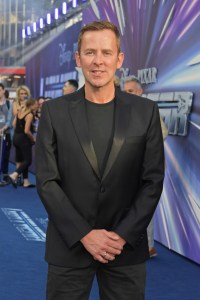
When he announced he was leaving Radio 1, Scott said: “Time actually does fly when you’re having fun, and that’s certainly been the case over the past 24 years at my beloved Radio 1.
“The station I pretended to be on in my bedroom from the age of six.
“The station I told my mum I wanted to work at, but never in a million years thought I would.”
Scott has commentated on Eurovision
What else has Scott Mills presented?
Scott has also appeared on a number of TV Shows.
From 2006-2007 he appeared as a reporter Paul Lang in the medical soap Casualty.
He has also been a contestant on Never Mind The Buzzcocks, Supermarket Sweep, Mastermind and Most Haunted.
Kicking off the upcoming season at the Mark Taper Forum — which recently celebrated its top-grossing musical ever with “Here Lies Love” — is the world premiere of Zack Zadek’s original musical “The Turning,” a folk thriller set in California’s Sequoia groves.
The show, said Center Theatre Group’s artistic director Snehal Desai as the company announces its 2026-27 slate of performances, has a “very L.A. vibe.”
Next up is a batch of shows meant to provide audiences some comedic relief amid a midterm season that’s sure to sow anxiety: Karen Zacarías’ “Destiny of Desire,” Cole Escola’s “Oh, Mary!” and the family-favorite “Dog Man: The Musical.” Then in the spirit of springtime renewal, thought-provoking plays like “John Proctor Is the Villain” and “Fences” will leave audiences in contemplation before festive summer item “Boop! The Musical” swoops in to lift spirits.
When Desai plans the company’s season lineup, he always surveys the year ahead — literally.
“I look at the calendar a lot as to, where do we think we’re gonna be a year from now? Six to eight months from now?” Desai said in a recent interview at his office in downtown L.A.
Some entries in Center Theatre Group’s upcoming season are scheduled intuitively, like the Mischief Comedy team’s “Christmas Carol Goes Wrong,” running in the thick of the holiday season. But with others, Desai said he orchestrated the lineup to tell a programmatic story, like an artist might order tracks on an album.
As an artistic director, Desai said, he always encourages visitors: “Join us all season, versus just coming for the things you like,” and maybe you’ll be pleasantly surprised.
This year as Desai consulted his calendar, he looked even farther ahead than usual, toward Center Theatre Group’s 60th anniversary season (2027-28) and the L.A. Olympics in 2028.
“We were having conversations of, what are the plays that we want to do or we want to bring back,” Desai said, when the theater company’s associate artistic director Lindsay Allbaugh suggested “Fences,” the final play of August Wilson’s acclaimed Century Cycle to be staged at Center Theatre Group.
“I said, ‘Oh, that’s what we want,’” Desai said, “both to end this season and kick off our 60th.”
The artistic director could not yet confirm who would direct the Pulitzer Prize-winning drama about a former Negro League baseball player and his family navigating life in 1950s segregated Pittsburgh.
Desai, who has not shied away from politically charged material during his tenure at the theater company, said Wilson’s play aligned with his intent this season to platform work “asking who we are as a country and as a community and society.”
“I wanted voices that felt bold and fearless, that were both outspoken and unafraid in a world where, right now, it feels like there’s a lot of things that are trying to stifle us from speaking out or coming together,” he said. To him, presenting “Fiddler on the Roof” in Yiddish is revolutionary, as is “John Proctor Is the Villain’s” dissection of a classic through a feminist lens.
Desai added that he planned to balance that rabble-rousing spirit with productions that leaned more “celebratory and communal” and provided “different ways of having catharsis.”
“Oh, Mary!” offers riotous fun, and “Destiny of Desire” is an homage to an oft-dismissed yet widely consumed medium, the telenovela.
“With ‘Destiny,’ you’re able to take that format of something that people often watch in isolation at home, and enjoy it together,” Desai said.
Regional theater faces a slew of challenges: rising production and personnel costs, post-pandemic audience declines and competition from digital media. The situation has felt particularly bleak in L.A., Desai said, as seeming moments of recovery in the past year or so were squashed by the L.A. wildfires, then last summer’s immigration crackdown and associated civil unrest.
“We just constantly live in this time period that feels like we’re on shifting sands,” Desai said. Nonetheless, the company is finding paths through the desert, including with alternative programming through CTG: FWD.
The CTG: FWD initiative this season will bring “Riverdance 30 – The New Generation,” “Clue” and “The Music Man” to the Ahmanson Theatre, and “Dog Man” to the Kirk Douglas Theatre.
Another strategy Desai said the theater company has employed is heavy investment in new works development, particularly new musical development. New works are time-and resource-intensive, Desai said, but they’re also good investments, offering the best chances at longevity and commercial prospects.
With “The Turning,” Center Theatre Group spotlights an emerging voice that Desai said represents “the future of American theater.”
After Desai was introduced to Zadek’s folksy musical “The Turning,” he said, “I just kept listening to it over and over again. I was like, ‘I can’t wait for the cast recording of this to be on Spotify.’”
The artistic director was also thrilled to find an ultra-rare gem in Zadek’s piece: a truly original story.
“A lot of things are adaptations these days: adaptations of films, of TV shows,” Desai said. “So to get a world premiere musical that is based on its own original concept — that, I found, was really compelling.”
Following back-to-back seasons of directing his own productions, Desai is taking a breather this go-around to focus on broader administrative duties. But he still hopes to be a resource for visiting directors learning how to navigate the “special space” that is the Mark Taper Forum — and its neighbors the Ahmanson Theatre and the Kirk Douglas Theatre, which will get its own season announcement in the spring or early summer.
Following her huge success on The Traitors, Claudia Winkleman started her own chat show, The Claudia Winkleman Show, but it’s future is uncertain after it received a cool reception
Future of Claudia Winkleman’s chat show hangs in the balance after cool reaction
Claudia Winkleman‘s new chat show is facing an uncertain future amid low viewing figures and little reaction from social media. The show has only aired three episodes, but a source has said the highly anticipated series has not reached the heights the BBC may have hoped, causing a stir behind the scenes.
The Claudia Winkleman Show began on 13 March, where the star was joined by Jeff Goldblum, Vanessa Williams, Jennifer Saunders and Tom Allen. The show follows Claudia’s huge success as the host of The Traitors, which catapulted her into being one of the most sought-after presenters in the UK. It also comes after she and Tess Daly decided to step down as the hosts of Strictly Come Dancing after over 20 years at the show.
Talking to the Daily Mail, a source explained how The Claudia Winkleman Show failed to rank among the most watched programmes on the BBC and has had little reaction on social media, making the chances of a second series slimmer.
“You’d think it would be guaranteed for a second series at the end of this run,” the source said. “It probably will get one, but the chatter is that it may not be such a certain prospect.”
They added that everyone at the BBC was “excited” about the show but that while usually “everything she touches turns to gold” but this time, “it simply isn’t the case here”. They pointed out that Claudia was “the star” of both The Traitors and Strictly, making the cold reaction to her new show would be “new territory” for her.
The Claudia Winkleman Show is currently midway through its initial run and is due to run for six weeks. It airs in the same slot that The Graham Norton Show, which is created by the same company as Claudia’s chat show, ordinarily occupies.
Ensure our latest headlines always appear at the top of your Google Search by making us a Preferred Source. Click here to activate or add us as your Preferred Source in your Google search settings.
The source told the Daily Mail that one of the reasons Claudia’s show has not matched the heights of Graham’s may be because of the guests she’s had on. While Graham’s red sofa has attracted the likes of Taylor Swift, Tom Cruise, Madonna and Paul McCartney, Claudia’s show has so far featured less well-known faces, such as Niall Horan, Rachel Zegler and Guz Khan.
Next week, Claudia will be joined by James McAvoy, Gugu Mbatha-Raw, Rita Wilson and Russell Howard. Actor James has appeared on The Graham Norton Show multiple times, and Gugu was on the show a year ago. Russell Howard has been on the show as well, but Rita Wilson has not.
The BBC and Claudia Winkleman’s representatives were contacted for comment.
“Kim’s Convenience” may not win points for originality, but originality isn’t really the point of an immigrant family drama meant to be instantly, one might say universally, recognizable.
The play, which opened Tuesday at the Ahmanson Theatre, was a runaway hit at the 2011 Toronto Fringe Festival. That success led to a larger production at Toronto’s Soulpepper Theatre that brought more attention to the show, paving the way for runs off-Broadway, in London’s West End and Washington, D.C.
The story is set in Toronto, and the Kim family (owners of the titular convenience store) is of Korean background. But immigrants from Ireland, Italy, Latin America, India and Eastern Europe and their more assimilated children won’t have any problems relating to the generational conflicts at the heart of this gentle comedy.
Author Ins Choi, who once played the role of the prodigal son, has matured into the part of Appa, the patriarch who left Korea with his wife, Umma (Esther Chung), to start a new life in Canada. He opened a 7-Eleven-style shop, which he once considered calling 7-12, and has been living above the store with his family in what has been an all-hands operation.
Appa made sacrifices to give his son and daughter a better life — and he’s more than happy to tick off a list of what everyone owes him. He’s a mostly benevolent tyrant, but his crotchety side can get ugly and he’s not always in control of his temper. His son Jung (Ryan Jinn) ran away at 16, absconding with money from the store safe, after one of Appa’s flare-ups sent him to the hospital.
Janet (Kelly Seo), Appa’s 30-year-old unmarried daughter, bears the brunt of being the adult child who remained at home. She still works at the store, though her true calling is photography. Her father considers this just a hobby, a weekend recreation that shouldn’t interfere with her taking over the store one day. But she has other ideas for her future.
Change is coming whether Appa likes it or not. A Walmart is heading to the area, and with this news comes an unexpected offer for the shop that would allow him to comfortably retire. But selling the store is tantamount to discarding his story.
Brandon McKnight, left, and Kelly Seo in “Kim’s Convenience.”
(Dahlia Katz)
He explains this to Janet, hoping that she’ll continue his legacy. But she’s put her life on hold for too long. Both her parents never let her forget that she still doesn’t have a husband. But how can she get married when her father subjects any man she dates to the third degree?
Alex (Brandon McKnight), the police officer who answers the 911 call Appa had Janet place to report a Japanese car parked illegally by the store (he still hasn’t forgiven Japan for its invasion of Korea), turns out to be a childhood friend of Jung’s — and someone Janet used to have a crush on. The sparks between them are obvious, and Appa, the soul of indiscretion, can’t help meddling in his overbearing way.
Choi isn’t averse to shtick, if the result is an explosion of audience laughter. One comic gimmick involves Appa’s superhuman grip that can subdue even the mightiest of men. A shoplifter (also played by McKnight, who portrays all the customers and passersby) learns the hard way that Appa is not to be underestimated.
Esther Chung, left, and Ins Choi in “Kim’s Convenience” at the Ahmanson.
(Dahlia Katz)
The scene involves an unsavory routine on how to recognize a shoplifter. Janet challenges Appa’s racist assumptions, but father knows best and no one can convince him otherwise. Janet can’t win with him, but don’t count Appa’s daughter out.
Or his son, for that matter. Jung, who had a stint in rehab, hasn’t had an easy path in life, but he’s stayed in touch with his mother and eventually he and his dad will have their dramatically inevitable reckoning. There’s something determinedly hopeful about “Kim’s Convenience,” which like the store it’s named after, wants its patrons to leave satisfied.
The cast members, under the direction of Weyni Mengesha, all deserve high customer ratings. Choi’s Appa is impossible to stay mad at even when he’s said or done something unforgivable. He doesn’t mean to offend, though other people’s feelings are a luxury he has never been able to afford.
Still, his paternal bluntness is not without its infuriating charm, as when he informs his headstrong daughter, “You have to understand, now is desperation time for you. Sudden death, overtime, penalty kick shoot out. Expiration date is over. Take over store is only choice you having.”
Esther Chung and Ryan Jinn in “Kim’s Convenience” at the Ahmanson.
(Dahlia Katz)
Seo’s Janet is as feisty as she is loyal, making it easy to root for her and her quickly budding romance with McKnight’s worthy Alex. Chung’s Umma doesn’t take up a lot of room in the play, but her maternal presence registers sharply nonetheless. Jinn endows Jung with hidden dimensions of pain and regret.
But the most vivid performance might in fact be the convenience store itself, brought to fluorescent, sanitized, colorful life by scenic designer Joanna Yu and lighting designer Wen-Ling Liao. Nicole Eun-Ju Bell’s video and projection designs subtly transpose the setting when, for instance, Umma meets up with her son at church. The production seems right at home at the Ahmanson, a function of both the broad sitcom-friendly style and the warm Korean American reception that was audible at Tuesday’s opening.
“Kim’s Convenience” has an eager-to-please TV sensibility that can seem formulaic at times. But representation, particularly these days, can be a radical act, and there’s something heartening at the sight of the Kim family enjoying their turn in the mainstream spotlight.
‘Kim’s Convenience’
Where: Ahmanson Theatre, 135 N. Grand Ave., L.A.
When: 7:30 p.m. Tuesdays-Thursdays, 8 p.m. Fridays, 2 and 8 p.m. Saturdays, 1 and 7 p.m. Sundays. Ends April 19
Within the first 72 hours of a 26-day game, “Survivor 50,” featuring 24 veteran players, had already delivered feuding, anguish and heartbreak. Legendary rivals Ozzy Lusth and Benjamin “Coach” Wade appeared to bury the hatchet, only for their conflict to reignite soon after. Kyle Fraser was forced out due to injury, and Jenna Lewis-Dougherty, who competed in both the show’s inaugural season and “All-Stars,” was the first person voted out after more than two decades away from the game.
Yet there were also moments of nostalgia, connection and excitement as returning players arrived on the beach, grateful to be part of the show’s landmark 50th season.
This raw display of humanity has kept the show’s torch burning for over 25 years. “‘Survivor’ is built on a timeless idea because human nature doesn’t change,” says Jeff Probst, the host, executive producer and showrunner of the reality competition series. “It’s essentially behavioral psychology in the wild.”
Back in Fiji’s Mamanuca Islands for “Survivor 50: In the Hands of Fans,” the show has added a novel element. Fans were given a say in key decisions, voting online to shape production and game mechanics, from choosing tribe colors to requiring castaways to earn rice and supplies instead of receiving them at the start.
“What a great twist,” says Wade in an interview over Zoom. “‘In the Hands of Fans’ transforms the game. Instead of it being, ‘They are playing,’ it’s ‘We are playing.’”
Though he was disappointed to be deprived of staples upon his arrival, he smiles and says that if he were watching at home rather than competing, he also would have wanted players to start with nothing.
Singer-songwriter and “Survivor” superfan Zac Brown coooked and performed for contestants on the show.(Robert Voets/CBS)
“Survivor” has also leaned into its famous fan base this season, bringing in self-proclaimed superfans, including Grammy-winning singer-songwriter Zac Brown — who appeared in Episode 4 as a reward for a winning tribe for whom he spearfishes, cooks and performs. The show also nods to Billie Eilish via the Billie Eilish Boomerang Idol featured in the season premiere. The game piece was handpicked by the Oscar- and Grammy-winning pop star — whose 2022 song “TV” references “Survivor” — and accompanied by a letter in which she outlined its instructions.
But Mike White, creator of “The White Lotus,” represents the show’s most intertwined cultural crossover. He drew inspiration for his hit HBO series from “Survivor” and cast several former tribemates in cameos. “Survivor 50” also features “The White Lotus” Easter eggs.
Returning to the franchise for the first time since he finished as runner-up in 2018, in the Season 50 premiere he says, tearfully, “There are times in ‘White Lotus’ where I’m so fried … it’s a 129-day shoot, but I look back on my ‘Survivor’ experience, and I’m like, ‘Dude, I did that and I can do this.’” Yet White’s hard-won resilience couldn’t protect him from being voted out in a blindside in Episode 4, proving that fame offers no immunity.
And that is the point. At its core, “Survivor” is about watching people from all walks of life dropped into a remote, unforgiving landscape where they must outwit, outplay and outlast one another for a $1 million prize — hungry, exhausted and sore, roasting in the blazing sun or shivering through rainstorms, and enduring grueling physical competitions. They must cooperate with the very people they’re competing against. And as alliances form and fracture, each day grows more fraught.
Former “Survivor” contestants Mike White, left, and Quintavius “Q” Burdette in Season 50.
(Robert Voets/CBS)
“It’s very simple but very deep,” Probst says. “The goal is not to get voted out, but the strategy in achieving that goal is infinite, so the game’s easy to understand, but it’s impossible to master. That’s why it’s so much fun to watch. You’re constantly asking yourself, ‘What would I do?’”
It’s one thing to ask from the comfort of home, but another to live it out, and on national television to boot, says Wade. Coach “When you step on that beach, the stakes are so much higher,” he explains. “Nobody really thinks about the million dollars. They’re thinking about surviving, not getting voted off.”
“Most people would be able to do it,” he continues. “But what you’d realize is what happens to your character and your facade when you’re deprived of everything — food, comfort, reaching out to your friends and having a support system that you know and trust. When you strip all of that away, this stops being a game, and your character will be forged, revealed or shattered.”
A four-time player, Season 23 runner-up and 2015 Survivor Hall of Fame inductee, Coach is one of the show’s most legendary figures. Known as the Dragon Slayer, he’s often shown meditating, praying, waxing philosophical, and pontificating on nobility, integrity and honor. His grandiose persona rubbed many the wrong way early on, earning him a villain label.
Reflecting on his legacy, Wade partly blames the edit but acknowledges he often took himself too seriously, was arrogant, and tried too hard to be larger than life, yet he stresses his authenticity. “The way I look, dress and talk — I’m polarizing,” he says. “That’s who I am in my real life, so that’s who I am out there.”
Probst affirms that what you see is what you get. “Coach shows up authentically every day,” he says. “He wears his mythology on his sleeve and has it tattooed on his body. When he pulls back his hair into a ponytail and quotes Magellan, that’s Coach: ‘I’m the guy with quotes about war and victory and fearlessness and courage. That’s actually who I am.’”
This season, Wade calls himself “Coach 4.0,” but Probst remains skeptical. “Every time he plays, Coach refers to himself as the new version of Coach,” Probst says. “But the minute he starts talking, everybody thinks the same thing: ‘Coach, you may have some more maturity and life experiences now that you’re married and have kids, but you’re exactly the same.’”
That’s not a critique of Coach. After observing more than 750 players over 25 years, Probst believes, “We are capable of much more than we think we are, and simultaneously, at our core, we generally are who we are. It doesn’t mean you can’t change or become a better version of yourself, but you’re going to have some core instincts.”
Benjamin “Coach” Wade in “Survivor 50.” (Robert Voets/CBS)
Coach in 2011’s “Survivor: South Pacific,” the show’s 23rd season. (Monty Brinton/CBS)
The show’s unflinching exploration of human nature traces back to visionary British television producer Charlie Parsons. He conceived the social experiment based on a combination of his curiosity about people, the influence of “Lord of the Flies” and “Robinson Crusoe,” and his boarding school experience.
“It was an all-boys school and quite a competitive place, so there was an element of survival in that,” Parsons says over Zoom. “It wasn’t a bad experience, but if you’re 13 and you’ve never lived away from home before, it can be quite a wrench to live for a month at a time away from your parents. On one occasion I called my parents and said, ‘Will you rescue me?’ And they didn’t.”
In 1988, Parsons turned his concept into “The Castaways,” a three-part documentary for a magazine-style television program he was showrunning.
Several years later, he was approached by Disney’s Buena Vista Productions to make an American version of a successful British morning show he created. When that didn’t pan out, he pitched what would eventually become “Survivor,” developing it with Buena Vista in hopes of selling it to ABC.
But, he says, the radical concept didn’t fit neatly into existing TV genres, and the network balked. “It’s difficult to imagine, but back in the ‘90s this idea of reality TV basically didn’t exist,” Parsons says. “Television was reasonably siloed … ABC took a long time deciding because they could see that there was something about it, but in the end they passed.”
In 1997, however, the concept found immediate success in Sweden with “Expedition Robinson,” leading to expansion in more Scandinavian countries.
The leap to America required a new alliance. During Parsons’ development process with Buena Vista, he’d met fellow British TV producer Mark Burnett at a party in Los Angeles where he’d told him about the reality competition format he was building. Burnett then called every six months pressing to produce it until Parsons finally agreed to grant him the American licensing rights.
“Mark had an incredible energy and presence, which meant that he could go and sell the s— out of it,” Parsons says. “He could persuade the networks to take a risk on something risky.”
Even so, as Burnett relayed in a comprehensive 2010 Television Academy interview, he faced a difficult pitching process. But after every major network passed, he re-approached CBS, where then-CEO and President Les Moonves was game to try original programming during summertime when reruns caused dwindling viewership. But when Moonves commissioned a pilot, Burnett said a stand-alone episode was too costly and couldn’t capture the show’s slow-burn endgame.
Instead, he proposed a sponsorship model built on integrating products into the game, pitching the value of a castaway using a branded cellphone to call home, or the desperation for a slice of pizza and a beer. After Burnett secured corporate sponsors, Moonves greenlighted “Survivor.”
Though firmly embedded in the culture today, “Survivor” was revolutionary when it debuted May 31, 2000, quickly becoming a cultural phenomenon. The Season 1 finale averaged 51.7 million viewers, surpassing both the Academy Awards and Grammys that year. Time magazine featured Lewis-Dougherty on its late June 2000 cover, and “The Late Show With David Letterman” featured a “Survivor”-themed Top 10 list presented by the show’s 16 castaways.
From its exotic location to the now-iconic buffs, “Survivor” established a world all its own, complete with a unique lexicon of immunity challenges, tribal council and Probst’s signature catchphrase, “The tribe has spoken.” As the enduring face of the show, Probst is central to its legacy, earning four Emmys for his role as host.
But even Probst’s survival wasn’t guaranteed. About 15 years ago, the relentless travel and schedule left him so depleted that he briefly quit the show. A few months of rest, however, allowed him to reevaluate. “It really was, ‘I don’t know if I have anything left in my tank to bring to the game.’ That might be what partly influenced Mark to make me showrunner even faster,” Probst says. “I needed to be more of a storyteller on this show.”
The cast of “Survivor” Season 1, standing from left: Ramona Gray, Dirk Been, Gretchen Cordy, Richard Hatch, Sonja Christopher, Susan Hawk, Kelly Wiglesworth, Sean Kenniff, B.B. Andersen and Rudy Boesch. Seated from left: Gervase Peterson, Jenna Lewis, Joel Klug, Stacey Stillman, Greg Buis and Colleen Haskell.
(Monty Brinton/CBS)
He’s quick to note the show’s collaborative ethos, however. “The term ‘showrunner’ is pretty misleading at this point. We make this as a team,” Probst says. Under his stewardship, “Survivor” is more cinematic, reimagined through the lens of Joseph Campbell’s “The Hero’s Journey,” and family friendly. Probst also notes the necessity of continually evolving game design, creating unexpected twists and advantages to keep players on edge and never knowing whom to trust.
The pandemic brought changes as well. With production shut down amid a world in turmoil, Probst felt “Survivor” needed more levity. When filming resumed, due to the 14-day quarantine requirement, back-to-back seasons were shot and the format was shortened from 39 days to 26. The faster-paced “New Era” that began with Season 41 also coincided with CBS’s 2020 diversity mandate requiring at least 50% of the cast to be nonwhite, and Probst dropped his longtime catchphrase “Come on in, guys” in favor of more inclusive language.
By Season 45, in keeping with Probst’s narrative-driven vision, the previously hourlong episodes expanded to 90 minutes.
Television habits have also changed since viewers once dissected tribal council proceedings at the office the next morning. Streaming breathed new life into “Survivor,” with younger viewers discovering it during the pandemic, while its cross-generational appeal keeps it a broadcast powerhouse. The Season 50 premiere drew 9.1 million viewers across live broadcast and delayed streaming, and in the weeks leading up to the launch, viewers revisited older seasons, boosting streaming numbers ahead of the anniversary.
According to Mitch Graham, CBS executive vice president of alternative programming, “Survivor” ranks No. 1 in the coveted 18 to 49 demographic, and the Season 50 launch generated the biggest social media engagement in the franchise’s history.
Even as the reality TV landscape has grown crowded, Probst remains unfazed. “It’s a show like no other,” he says. “It’s adventure, survival, strategy, interpersonal relationships, social politics. … This multi-layered storytelling gives it durability because any given week you have no idea what you’re going to watch.”
Meanwhile, as Season 50 continues to unfold, no one knows who will be crowned “Sole Survivor” on May 20 in Los Angeles, the show’s first live finale since 2019. But rest assured, by then they’ll have revealed exactly who they are.
The “Harry Potter” team did not need a divination expert to know its cast would encounter some “unpleasant and aggressive behavior.”
HBO boss Casey Bloys told multiple outlets this week that the network had taken precautions anticipating the vitriol the “Harry Potter and the Philosopher’s Stone” actors would face. Ghanian-English actor Paapa Essiedu recently spoke out about the racist abuse and death threats he has received since the announcement that he had been cast as potions professor Severus Snape.
“With all actors on any kind of big IP shows — and this is obviously one of those where you’ve got, you know, passionate fans, people with a lot of opinions — it can get scary in places,” Bloys told Variety in an interview published Tuesday. “So for any show like that, we anticipated it and tried to have training, you know, best practices in terms of social media and how to handle it. And obviously we’ve got a serious security team.”
Essiedu, who is portraying the enigmatic but ultimately heroic Hogwarts professor first brought to life by Alan Rickman in the original “Harry Potter” films, has opened up about the racist abuse he has received from those who believe a Black man should not be playing the fictional wizard.
“I’ve been told, ‘Quit or I’ll murder you,’” he said in an interview with the Times of London. “The reality is that if I look at Instagram, I will see somebody saying, ‘I’m going to come to your house and kill you.’”
“[N]obody should have to encounter this for doing their job … And I’d be lying if I said it doesn’t affect me emotionally,” Essiedu added.
This is not the first time that fans of J.K. Rowling’s Wizarding World novels expressed outrage over the casting of a Black actor in an adaptation. There was a similar outcry in 2016 when Noma Dumezweni was cast to play Hermione Granger in the original London production of “Harry Potter and the Cursed Child.”
Bloys also told Deadline in an interview published Wednesday that they had “anticipated there would be a lot of interest in all of [the actors], and interest can tip over into more unpleasant and aggressive behavior.”
“We talked to them about what to expect, what to expect on social media and how we handle it, but any kind of security that’s needed is an unfortunate aspect of doing IP shows,” he said. “We just try to be mindful and monitor it.”
Essiedu also told the Times of London that “the [racist] abuse fuels” him.
“[It] makes me more passionate about making this character my own, because I think of how I felt as a kid,” he said. “I would imagine myself at Hogwarts on broomsticks, and the idea that a kid like me can see themselves represented in that world? That’s motivation to not be intimidated by someone saying they’d rather I died instead of doing work I’m going to be really proud of.”
Weekly insights and analysis on the latest developments in military technology, strategy, and foreign policy.
Info is slowly dripping out as to the extent of the Iranian attack on Prince Sultan Air Base in Saudi Arabia that occurred on March 27th. Multiple U.S. military aircraft are reported to have been damaged. This is beyond the toll on U.S. service members, which sits at 10 injured, some of critically. While high-resolution commercial satellite imagery of the Middle East from U.S. companies remains delayed for weeks, foreign satellite images purport to show major damage on the base’s main apron. Now, photos from ground level appears to show one of the USAF’s prizedE-3 Airborne Warning and Control System (AWACS) aircraft totally destroyed.
The images were first posted on the Air Force amn/nco/snco Facebook page and has since spread across social media. The photos show E-3 serial #81-0005’s rear fuselage totally burned out and destroyed. There is debris all around the aircraft. It’s worth noting that a direct strike, while certainly possible here, is often not required to destroy an aircraft. The shrapnel from a nearby impact can and especially if a fire is ignited. The attack reportedly included long-range one-way attack drones and ballistic missiles.
It’s important to note that we cannot confirm the authenticity of the images at this time, but they appear, at least after a cursory examination, to look authentic. This assessment could change and we will update this post if it does.
Satellite imagery from prior to when major U.S. commercial providers, specifically Plant Labs, began delaying photos of the Middle East, shows aircraft parked across the main apron and other high-value assets, like the E-3s, parked on isolated taxiways around the airfield. This is clearly an attempt to minimize damage from Iranian long-range weapons by spreading out the aircraft. It’s very possible these aircraft were shuffled around in order to make targeting more challenging.
At least five other tankers were also damaged in a strike on Prince Sultan Air Base earlier in the conflict. The installation, which sits outside of Riyadh, has come under repeated attack. It is a major operating location for American aircraft supporting the war effort.
U.S. Air Force Senior Airman Stephen Baker, an E-3 Sentry crew chief, 380th Expeditionary Aircraft Maintenance Squadron, marshals a U.S. Air Force E-3 Sentry Airborne Warning and Control System (AWACS) aircraft on Al Dhafra Air Base, United Arab Emirates, May 19, 2021. (U.S. Air Force photo by Master Sgt. Wolfram M. Stumpf) Master Sgt. Wolfram Stumpf
The USAF wanted to migrate much of the airborne early warning tracking duties to a new space sensing layer, but that technology is still years away from operational maturity. The E-7 Wedgetail was ordered to provide an interim bridge solution to augment the E-3s and eventually take their place until a space sensing layer can take on at least most of the mission. The USAF then tried to cut the E-7 in its last budget and procure a handful of E-2D Hawkeyes as a less expensive interim solution. This bizarre move, which would have led to massive capability gaps at a time of increasing airborne early warning and control demand, has since been heavily disputed by congress and now the USAF’s E-7 program appears that it could be headed back on track. Still, the loss of one of the E-3s in a dwindling fleet, and now a delay in the already late to the party E-7 program, puts the U.S. in an increasingly concerning predicament.
Iran has been somewhat successful at targeting key radar installations around the region that enable America and its allies’ air defenses. The fact that they would target an E-3 should come as absolutely no surprise. As for how they acquired the targeting data, satellite imagery is still available from China and Russia is likely providing them imagery as well. There are many other ways to obtain time critical info like where aircraft are parked on a base that is from far far lower tech sources, including classic human intelligence.
A Cold War era hardened aircraft shelter (HAS). (USAF)
It also comes at a time when America’s most capable adversaries are dumping large sums of money into protecting their aircraft on the ground. Even in the Pacific, where a major war could break out with a near-peer competitor that is armed to the teeth with long-range weaponry, these improvements have been nearly non-existent. Only now, after Al Udeid Air Base in Qatar, America’s largest in the region, has been repeatedly attacked during the war with Iran, has the Pentagon budged at exploring hardening some of its infrastructure there.
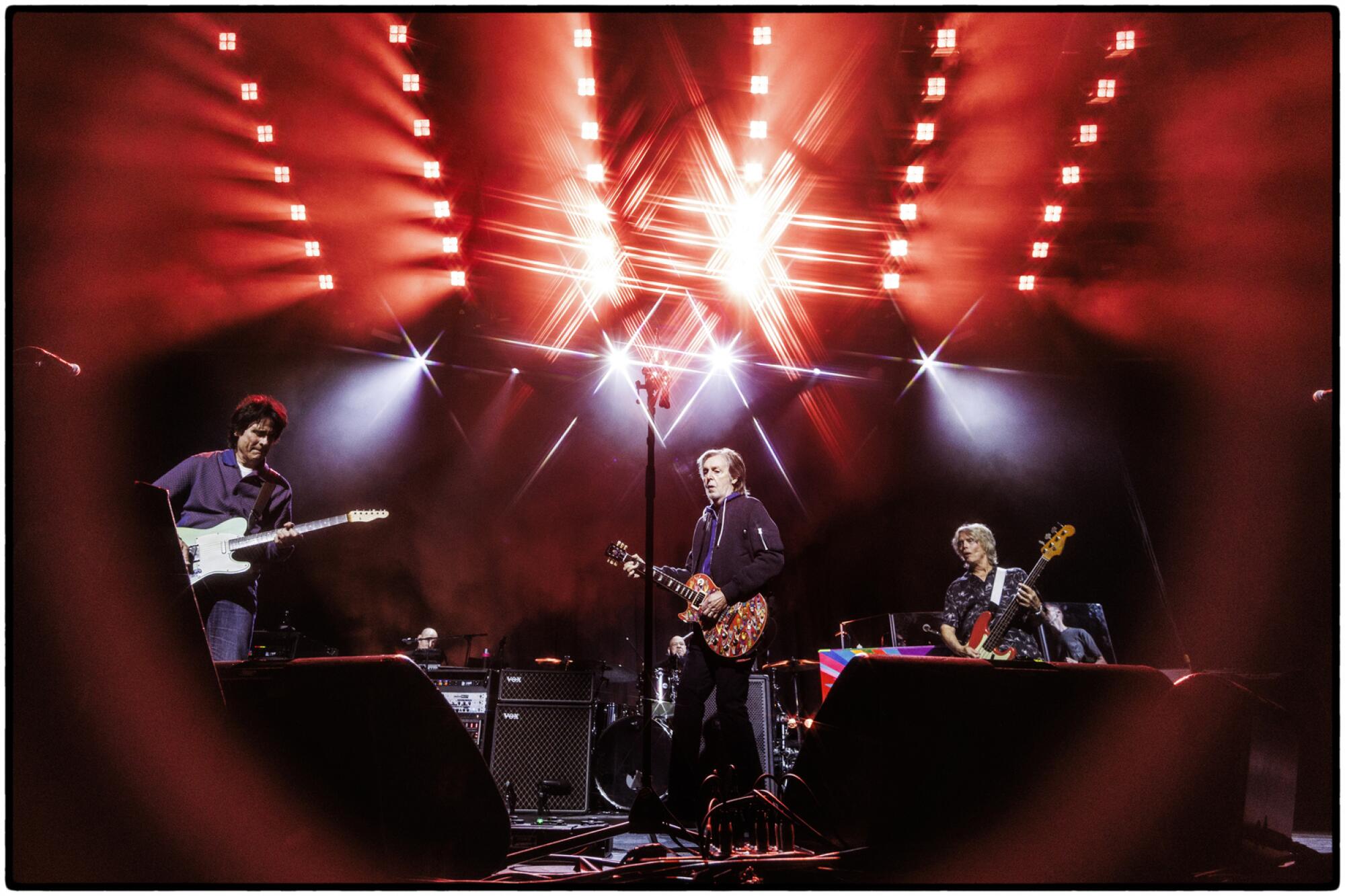
Paul McCartney sauntered onto the stage of the Fonda Theatre, took in the 1,200 faces before him — “I can see the whites of your eyes,” he said — then offered up a brief history lesson about where we’d gathered Friday night.
The Fonda, he told us, opened 100 years ago; back then, he added, it was called the Music Box.
“Cool little place, innit?”
At 83, McCartney is well into his cool-little-place era.
Last year the rock legend played a string of concerts at New York’s tiny Bowery Ballroom while in town for “Saturday Night Live’s” 50th anniversary; a few months after that, he hit the Santa Barbara Bowl as a kind of warm-up for the latest leg of his Got Back world tour.
Paul McCartney and his band during sound check for Friday’s show.
(MJ Kim)
Friday’s underplay — the first of two instant sell-outs at the Fonda — came as McCartney is drumming up interest in a new studio album he’ll release in May. Outside the venue, a double-decker bus was parked with signage advertising the LP, which is called “The Boys of Dungeon Lane” after a road in his Liverpool hometown.
But that hardly seemed like the purpose of the show itself, which lasted about an hour and 40 minutes and didn’t even include a performance of the album’s lead single. The truth is that Sir Paul genuinely appears to get a kick out of these intimate gigs — out of standing right in front of a crowd and doing the magic trick that is a song like “Get Back” or “Jet” or “Got to Get You Into My Life.”
And why wouldn’t he?
If a Paul McCartney concert in an arena or a stadium is a finely honed spectacle of boomer nostalgia and industrial-strength charm, one of his shows in a club or a theater is a chance to play music, which after six and a half decades still clearly turns his wheels.
You wouldn’t say the shows remind McCartney that he’s a regular guy. (Those six and a half decades have made him anything but.) What they might do, though, is remind him why he became so widely adored — valuable self-knowledge for an artist whose great subject has always been the transformative power of love.
Here, as in Santa Barbara, he and his seven-piece band (which featured three horn players) did a pared-down version of the most recent Got Back set, opening with a killer one-two punch — “Help!” into “Coming Up” — that alone said plenty about McCartney’s range and endurance.
“Let Me Roll It” had a funky swagger, while “Getting Better” chugged with cheerful insistence; “I’ve Just Seen a Face” showed off the group’s crisp harmonies and “Lady Madonna” its tight rhythmic interplay. After “Let ’Em In,” McCartney asked his band member Brian Ray to show off the song’s all-important bass line: a single note plucked over and over and over again.
Friday’s show was the first of two at the Fonda.
(MJ Kim)
He did a few other comic bits, including a memory of Tony Bennett singing without a microphone as a way to demonstrate the excellent acoustics of a concert hall — the punch line was that he later saw Bennett do the same thing at the Beverly Hilton — and some gentle ribbing of the folks sitting up in the “posh seats” of the Fonda’s balcony. Among them, McCartney pointed out, was Morgan Neville, director of the recent “Man on the Run” documentary about McCartney’s life in the aftermath of the Beatles’ breakup.
He also noted that his wife, Nancy Shevell, was in the house and dedicated “My Valentine” to her; truth be told, that one was a bit dreary, as was “Now and Then,” the so-called last Beatles song released in 2023 using machine learning to complete a scratchy demo left behind by John Lennon.
“Thank you, John, for writing that lovely song,” McCartney said afterward, which made it a little harder not to like.
In any event, there were more classics to come, not least a buoyant “Ob-La-Di, Ob-La-Da” and a “Let It Be”/“Hey Jude” twofer that inspired such a lusty singalong that McCartney probably could’ve gotten away with lip-syncing if he’d wanted to.
But of course he didn’t want to — that was kind of the whole point.
Luba Muhstuk has been seen heading to her new job after her brutal axe from Strictly Come Dancing and looked full of confidence as she was spotted in London over the weekend
Luba blew a kiss to the camera (Image: JAMES CURLEY AND MAGICMOMENTSUK)
Luba Muhstuk has been seen heading to her new job after her brutal axe from Strictly Come Dancing. The TV star, 36, has served as a professional on the BBC Saturday night favourite since 2018 but along with Karen Hauer, Michelle Tsiakkas and Nadiya Bychkova, it was recently announced that she will not be part of the competition series going forward.
Just hours after the news broke,. Luba herself broke her silence on the matter. Taking to Instagram, insisting the time had come for her “step away” from the show, she wrote: “With a heart full of gratitude, the time has come for me to step away from Strictly Come Dancing. I am deeply grateful for the past 10 years on this beautiful show! Thank for you for the amazing opportunities and unforgettable memories. It truly has meant the world to me.”
Sharing that she was now looking forward to the future, Luba continued : “Now it’s time for me to follow my dreams beyond the show, and I’m excited for what the future holds. I can’t wait to see you all on the Pro Tour and I’m really looking forward to it one last time.”
Ensure our latest headlines always appear at the top of your Google Search by making us a Preferred Source. Click here to activate or add us as your Preferred Source in your Google search settings.
Over the weekend,, photos emerged of Luba heading to role taking dance classes in central London. Despite the sudden nature of her departure from the series, Luba looked to be in great spirits as she walked to work. This was the first time she had been spotted out in public since news of her axing emerged.
The TV star was suitably dressed for her role at the dance class, opting for comfortable rehearsal wear and let her dark locks flow down her back. She clutched her phone in her hand and threw a series of excitable poses.
Praising Luba – while announcing her exit – the BBC said: “We are incredibly grateful for her dedication to the programme and for always going above and beyond—whether through the care and commitment she showed her celebrity partners or her warmth and kindness behind the scenes. Luba has been, and always will be, a much-loved member of the Strictly family, and we wish her every success in the future.”
Fellow dancers were quick to share supportive messages in the comments section. Among them was Amy Dowden, who simply wrote: “Love you xxx.” Johannes Radebe echoed the sentiment, typing: “Love you darling,” alongside a red love heart emoji. And Nadiya, who met the same fate as Luba in recent days, shared three white love heart emojis.
While she will no longer be part of the dancing on screen team, Nadiya has reportedly been offered a chance to stay on the show in a different role. Speaking to The Sun, a source said: “Nadiya is so recognisable with viewers and bosses felt it would be a real loss to lose her from the Strictly family altogether. After a few conversations, they reportedly offered her a choreography role which she is very open to.
“Obviously, she is sad to no longer be dancing but recognises she will have great scope for more lucrative commercial opportunities now, and can explore exciting new projects.”
The Strictly team has already said goodbye to a number of long-time members of the show in recent weeks. Gorka and Michelle Tsiakkas are also said to have been axed in a bid for bosses to get “fresh faces” in the professional line-up.
And the decision of who will present the show following the exit of Tess Daly and Claudia Winkleman is yet to be made public, too. Recently, Louie Spence told the Mirror: “With Strictly, people say I should go on there and be a judge just because I’m known as a dancer – but it’s a very different dance genre. Ballroom and Latin is very particular. It’s like the difference between hip-hop and classical ballet…”
Suggesting Rylan and Zoe Ball would make good hosts, he concluded: “Rylan would be great fun [as host]. I love Rylan, he’s got a great personality. He’s young enough to keep going if it’s going to keep going for years.
“Zoe Ball, she’s great. Who knows how many more years a show like that will last? Things are moving so quickly now, with the way things are changing. Whoever gets it, I’m sure they’d be fabulous.”
A broadcaster has confirmed during BBC Breakfast that a schedule shake-up is happening soon on the long-running programme
Joe Crutchley Screen Time Reporter
09:02, 28 Mar 2026
A TV legend has confirmed a show break on BBC Breakfast in major shake-up(Image: BBC)
A major schedule shake-up has been announced on BBC Breakfast and fans will not be best pleased about it.
The long-running morning show returned to TV screens on Saturday (March 28) for another instalment. Naga Munchetty and Ben Thompsonwere back at the helm, to discuss some of the biggest stories hitting the headlines from around the globe.
During the broadcast, Ben and Naga passed over like normal, to Newswatch host Samira Ahmed, who delved into viewers’ thoughts on recent BBC News coverage.
BBC Newswatch is a weekly show offering viewers and listeners the opportunity to respond to BBC News.
The segment sees Samira presenting viewer feedback on the BBC’s reporting of major stories, with audiences either praising or critiquing the coverage. The programme airs on Saturday mornings at 7:45am on BBC One during BBC Breakfast, or can be watched online.
However, at the end of the latest segment, Samira announced that Newswatch would be off air for several weeks, but reassured viewers that it would return to screens.
“We are off air next weekend over Easter but we will be back to hear more of your thoughts about how the BBC covers the news, in a fortnight,” Samira told viewers.
This is not the first time Newswatch has taken a break from screens. Last year in September, Samira announced the show would be off air for several weeks.
And viewers at the time were not too happy and voiced their opinions on X, regarding the hiatus, with some expressing dissatisfaction with the content of the programme. One viewer commented: “Well, that was a waste of 10 minutes,” while another said: “Disappointing….and last one too.”
A third remarked: “Not this again,” and yet another echoed the sentiment, stating: “Newswatch spending way too long on one little whinge.”
Journalist and broadcaster Samira has 20 years’ experience in print and broadcast and has hosted Newswatch since 2012. In 2020, Samira was named British Broadcasting Press Guild audio presenter of the year.
She has presented many news and arts programmes over the years for BBC TV and radio, including The World Tonight, PM, Sunday Morning Live on BBC One, Night Waves on Radio 3 and The Proms on BBC Four.
BBC Breakfast airs Monday to Friday at 6am on BBC One.
More than a century after the Gilded Age, we have entered another: The gilded age of Trump.
A little over a year after President Trump was sworn into office for the second time, the country has borne witness to a striking aesthetic makeover of the White House and Washington, D.C. A week ago, when the Trump-packed Commission of Fine Arts approved a 24-karat commemorative coin stamped with Trump’s image, that makeover ascended to staggering new heights.
The coin, which breaks with the country’s longstanding tradition of not featuring a living person on its currency, joins a swiftly growing list of other Trumpian imprints on arts and culture, including architectural choices deemed gaudy and garish by experts and laypeople alike.
Plenty of people are on guard against these changes. This week a coalition of eight cultural heritage and architectural organizations, including the National Trust for Historic Preservation and the American Institute of Architects, filed a lawsuit to require the Trump administration to comply with historic preservation laws and get congressional authorization before making any changes to the Kennedy Center.
“The Kennedy Center is not a personal project of any president. It is a national cultural monument built to honor John F. Kennedy and to serve the American people. Federal law requires transparency, expert review, and public participation before it can be fundamentally altered,” Rebecca Miller, executive director of the DC Preservation League, said in a statement.
The same could be said of the White House, the Smithsonian, the NPS and the United States Mint. But Trump doesn’t care about due process, congressional approval or the courts. Time and again he has shown his willingness to go it alone when making big decisions that affect not only America but the world. This includes his actions in Venezuela and Iran. But if he decides he wants to take the Kennedy Center “down to the steel,” as he once threatened, there isn’t really anything that can stop him.
The gilded age of Trump proves that the look of things really does affect how the country sees itself — and how it acts as a result of its new self-image. Golden gaudiness conjures thoughts of empire and imperial rule, but it is also unserious and incidental, bombastic and self-centered. The Trump aesthetic screams, “Me, me, mine!” A willingness to tear down historic structures without care for their symbolic meaning reveals an inability to learn from the past, a tendency that has proved frighteningly perilous.
Will the leader who rises after Trump tear down all that Trump has built? And even if they do, can the damage really be undone?
I’m Arts editor Jessica Gelt, keeping it small and simple for posterity. Here’s your arts and culture news for the week.
You’re reading Essential Arts
Our critics and reporters guide you through events and happenings of L.A.
By continuing, you agree to our Terms of Service, which include arbitration and a class action waiver. You agree that we and our third-party vendors may collect and use your information, including through cookies, pixels and similar technologies, for the purposes set forth in our Privacy Policy such as personalizing your experience and ads.
FRIDAY
Laura Aguilar The late trailblazing photographer’s exploration of her queer Chicana identity against the natural backdrops of Southern California and the Southwest is on display in the exhibition “Body and Landscape.” More of the artist’s work will be on display starting Sept. 20 in “Laura Aguilar: Day of the Dead.” Through Sept. 7. The Huntington, 1151 Oxford Road, San Marino. huntington.org
Cassandra Kulukundis holds the first-ever Oscar for casting for her work on “One Battle After Another” during the Academy Awards, March 15, 2026.
(Robert Gauthier/Los Angeles Times)
The Art of Casting With Cassandra Kulukundis recently winning the first Oscar in the category for her work on Paul Thomas Anderson’s “One Battle After Another,” what better time to learn more about the subject? The academy’s video presentation goes inside the casting process with casting directors discussing their craft and includes previously unseen auditions and screen tests. Through July 6. Academy Museum, 6067 Wilshire Blvd. academymuseum.org
Brahms & Beethoven Uzbek pianist Behzod Abduraimov performs Beethoven’s “Piano Concerto No. 3” as Paavo Järvi conducts the L.A. Phil in Brahms’ “Second Symphony” and Schumann’s “Overture, Scherzo and Finale.” 8 p.m. Friday and Saturday; 2 p.m. Sunday. Walt Disney Concert Hall, 111 S. Grand Ave., downtown L.A. laphil.com
A performance of “Escape.”
(Traj George Simian)
Escape Diavolo reprises this production featuring its trademark blend of dance, movement and storytelling as 22 artists challenge their abilities against a variety of architectural structures. 8 p.m. Fridays and Saturdays; 6 p.m. Sundays, through June 14. L’Espace Diavolo, 616 Moulton Ave. diavolo.org
Arshile Gorky: Horizon West In the summer of 1941, the Armenian immigrant artist, his soon-to-be wife Agnes “Mougouch” Magruder and the artist and furniture designer Isamu Noguchi drove from New York City to L.A. Gorky was emerging as one of the most important figures in the nascent Abstract Expressionism movement, and his cross-country adventures had an enormous impact on his art, which is explored in depth in this exhibit. A selection of landscapes include Gorky’s rich, surrealistic paintings and drawings from before, during and after the life-changing trip. (Jessica Gelt) Through April 25. Hauser & Wirth West Hollywood, 8980 Santa Monica Blvd. hauserwirth.com
A New Song: Langston Hughes in the West The exhibition reveals Hughes’ time spent in California, Nevada and Mexico during the Great Depression, World War II and into the 1950s, when he produced significant work, including lectures, film scripts, plays and his first book of short stories. Through Sept. 13. California African American Museum, 600 State Drive, Exposition Park. caamuseum.org
The White Album Arthur Jafa’s 2018 30-minute experimental film, a social critique of whiteness, uses found and produced footage to demonstrate how the creative work of Black Americans has been co-opted by white culture throughout history. Through Aug 30. UCLA Hammer Museum, 10899 Wilshire Blvd., Westwood. hammer.ucla.edu
SATURDAY
Akira Kurosawa’s “Seven Samurai,”starring Takashi Shimura, from left, Toshiro Mifune and Yoshio Inaba.
(Janus Films)
Darkness and Humanity: The Complete Akira Kurosawa The 1954 classic “Seven Samurai,” starring Toshiro Mifune, kicks off this comprehensive retrospective of the great Japanese filmmaker’s work. 6 p.m. Saturday; series continues through May 30. Academy Museum, 6067 Wilshire Blvd. academymuseum.org
from rock to rock… aka how magnolia was taken for granite Choreographer Jeremy Nedd’s exploration of the hidden poetry, virtuosic freedom and ownership features five performers examining “the Milly Rock,” a viral dance move. 8 p.m. UCLA Macgowan Hall, Freud Playhouse, 245 Charles E. Young Drive East. cap.ucla.edu
A Queer Arcana: Art, Magic, and Spirit On The exhibition collects an intergenerational group of Queer artists whose work examines hidden and mystical knowledge to find sources of connection and transformation. Through Oct. 18. Palm Springs Art Museum, 101 Museum Drivepsmuseum.org
Ralph Steadman More than 140 original artworks and ephemera, including sketchbooks, handwritten notes and personal photographs are included in “And Another Thing,” a traveling exhibition tracing six decades of the artist and illustrator’s career. Through May 9 Torrance Art Museum, 3320 Civic Center Drivetorranceartmuseum.com
Tonality The vocal ensemble performs “Refuge/Requiem,” a program that includes Caroline Shaw’s 17th-century-influenced contemporary work “To the Hands,” and “1605 Requiem,” composed for the funeral rites of Empress María by Tomás Luis de Victoria. Presented with the Wallis. 7:30 p.m. All Saints’ Beverly Hills, 504 N. Camden Drivethewallis.org
SUNDAY To Sleep With Anger Written and directed by the protean Charles Burnett, this film does more than vividly illuminate South-Central’s rarely portrayed Black middle class. A deft domestic horror story, it’s a contemporary tale with a folkloric twist that has old friend Harry (Danny Glover) visiting a married couple and gradually revealing himself to be a trickster with trouble on his mind. With a terrific ensemble headed by Mary Alice and Paul Butler as the couple in question. (Kenneth Turan) 7 p.m. The 35mm screening includes a Q&A with the filmmaker and Ashley Clark, author of “The World of Black Film: A Journey Through Cinematic Blackness in 100 Films.” Beginning at 6 p.m. Clark will sign copies of the book. Billy Wilder Theater, UCLA Hammer Museum, 10899 Wilshire Blvd., Westwood. cinema.ucla.edu
TUESDAY Philip Glass’ Cocteau Trilogy Pianists and siblings Katia and Marielle Labèque perform the composer’s triptych inspired by the films of Jean Cocteau. Part of the LA Phil’s “Body and Sound” festival. 8 p.m. Walt Disney Concert Hall, 111 S. Grand Ave., downtown L.A. laphil.com
Mary Halvorson The contemporary jazz musician, guitarist and composer and new quartet project Canis Major — featuring Dave Adewumi on trumpet, Henry Fraser on bass and Tomas Fujiwara on drums — perform an evening of music designed for deep listening and total immersion. 7 p.m. Getty Center, Harold M. Williams Auditorium, 1200 Getty Center Drive, L.A. getty.edu
Arts anywhere
New releases of arts-related media.
Album cover for “Evening Light: Raga Cycle I.”
(Cantaloupe Music)
Evening Light: Raga Cycle I The first release of an eight-album series in which American composer and pianist Michael Harrison collaborates with a global assortment of artists combining Eastern and Western musical traditions. Each chapter represents three hours of day or night following the Indian raga time cycle. For “Evening Light,” Quebec-based Brazilian vocalist Ina Filip co-composed the music with Harrison. Also appearing on the album are American composer Elliot Cole on synthesizer, French composer Benoit Rolland on electro-acoustics and Bangladeshi tabla virtuoso Mir Naqibul Islam. Cantaloupe Music: download ($10).
Book jacket for “Stephen Sondheim: Art Isn’t Easy” by Daniel Okrent.
(Yale University Press)
Stephen Sondheim: Art Isn’t Easy Part of Yale University Press’ Jewish Lives series, Daniel Okrent’s new biography of the award-winning composer-lyricist who took Broadway musicals to new heights “is a brisk, engaging read that avoids hagiography,” writes Julia M. Klein in a review for The Times. “Okrent highlights the emotional frailties that coexisted with the brilliance and generosity. He seeks to liberate Sondheim’s reputation from the encrustation of myth and to demystify his relationships, while offering a succinct analysis of his achievements. That’s a tall order for a compact book, especially given its subject’s long, complicated life. Okrent’s failings are, unsurprisingly, primarily those of omission.” Yale University Press: 320 pages, $35
Martha Graham Dance Company: We Are Our Times A two-part documentary goes behind the scenes with the troupe as it prepares for its 100th anniversary celebration. Producer-directors Peter Schnall and Cyndee Readdean followed the dancers from rehearsal to premiere on a global tour, capturing their artistic routines and everyday lives. Episode 1, “American Spirit,” 9 p.m. Friday; Episode 2, ““Athletes of God,” 9 p.m. April 3 on PBS. Streaming at pbs.org and on the PBS app.
Culture news and the SoCal scene
Pritzker Prize-winning architect Frank Gehry is photographed in May 2019 with a model of the Grand Avenue Project at his L.A. offices.
(Jay L. Clendenin / Los Angeles Times)
Can downtown L.A. still benefit from the vision of late-great architect Frank Gehry, who put so much time and energy into lifting the area up? Times classical music critic Mark Swed says yes in an optimistic column noting that, “So many plans Frank Gehry imagined for L.A. still remain. Gehry bequeathed blueprints and models, sketches and concepts, for his large and devoted team of younger architects and next-generation visionaries equipped to fabricate our way out of angst.” The time to build, Swed writes, is now.
Freelance writer Jane Horowitz got the skinny on the fifth edition of High Desert Art Fair, which arrives in Pioneertown this weekend, transforming “the rooms of the historic Pioneertown Motel into exhibition spaces for 20 galleries and publishers, while expanding into a broader mix of programming — something akin to a mini Coachella Valley Music & Arts Festival. This year’s edition includes an opening night party with a DJ set by street artist Shepard Fairey, panel discussions, guided meditation and even a sound bath.”
Monty Python” alum Eric Idle poses for a portrait at the Hollywood Pantages.
(Jason Armond / Los Angeles Times)
Malia Mendez sat down with British comedy legend Eric Idle to talk about his spoof musical “Spamalot,” which arrives at the Pantages more than a decade after its last stop at the stage. Over a margarita with a side of chef olives, Idle opened up to Mendez about “his earliest forays into comedy, his legendary run and subsequent break with his former ‘Monty Python’ castmates, and why ‘Spamalot’ arrives in L.A. at the perfect time.”
Times theater critic Charles McNulty headed to the Matrix Theatre to watch Rogue Machine’s production of Jackie Sibblies Drury’s Pulitzer Prize-winning 2018 drama “Fairview.” He writes that the play is “a shape-shifting work that eludes an audience’s assumptions at every turn,” and concludes that the new production “may struggle with the slipperiness of Drury’s writing.” The dramatic construction, however, is solid enough to withstand some of the overly broad strokes of the staging.”
Richard Neutra imagined his first Los Angeles project, the Jardinette Apartments, as a prototype for future garden apartment buildings.
(Myung J. Chun / Los Angeles Times)
Sam Lubell wrote a fascinating story about the painstaking rehabilitation of Modernist architect Richard Neutra’s first L.A. commission: the Jardinette Apartments in Hollywood. The building was hailed a structural and technical breakthrough when it opened in 1928, but it soon dropped from public view and sank into disrepair. The new owner spent more than $5 million on the historic preservation project and the complex may soon go on the market.
Enjoying this newsletter? Consider subscribing to the Los Angeles Times
The Hammer Museum Gala on Oct. 8, 2022, in Los Angeles.
(Michelle Groskopf / For The Times)
The Hammer Museum has announced the honorees for its annual gala. They are artist Betye Saar and television creator Darren Star. The highly anticipated event, set to take place in the Hammer’s garden courtyard on May 2, aims to honor impactful artists while raising funds to support the museum’s exhibitions and public programs.
The 80th Ojai Music Festival, set to take place June 11-14, recently announced this season’s programming and artistic collaborators. Much of this year’s event will be devoted to unpacking and performing works that have been central to the 2026 festival’s music director‘s artistic life. “Esa-Pekka Salonen is one of the most vibrant and adventurous creative forces in our musical world,” said Executive Director Ara Guzelimian in a statement. “It has been an absolute joy to dream up programs together that focus on numerous personal dimensions — his work as composer and conductor, his rich associations with and remarkable history in Los Angeles, the formative influence of his teachers and the giant musical figures of 20th century music, his deep friendships with many peer composers, and his championing of a new generation of composers.”
Washington National Opera Artistic Director Francesca Zambello, who was instrumental in the company’s decision to leave the Kennedy Center after Trump’s takeover, was inducted into the Opera Hall of Fame at the OPERA America Salutes Awards Dinner on March 20, at the Plaza Hotel in New York City.
WASHINGTON — A lead attorney for the Department of Homeland Security suggested that federal agents should have “just started hitting the rioters and arresting everyone that couldn’t get away” during an anti-ICE protest in Los Angeles last June, internal emails show.
The note was in an email chain obtained by the nonprofit watchdog group American Oversight through the Freedom of Information Act and shared exclusively with The Times.
In it, attorneys for Homeland Security appear to be discussing the June 9 lawsuit filed by California Gov. Gavin Newsom over President Trump’s deployment of thousands of California National Guard troops to Los Angeles.
Under the subject line “California DOD Lawsuit,” officials coordinated legal filings defending the Trump administration and included a draft declaration by the Los Angeles field office director of Immigration and Customs Enforcement supporting the deployment of military forces.
The final email in the thread was from Joseph Mazzara, then-acting DHS general counsel, and he appears to be referring to an incident in which protesters tried to breach a protective line at a federal building.
On June 11, he wrote: “Every time I read about the battering ram incident I’m just floored at how wild that is.”
Referring to law enforcement as “they,” he continued: “They should have, when they brought the line in, just started hitting the rioters and arresting everyone that couldn’t get away from them. No one likes being hit by a stick, and people tend to run when that starts happening in earnest.”
The Department of Homeland Security didn’t respond to requests for comment.
Mazzara was later appointed deputy commissioner of U.S. Customs and Border Protection.
Politico reported that Mazzara is among 10 staffers who followed former Homeland Security Secretary Kristi Noem to the State Department after she was fired this month from DHS and given a new role as special envoy for the Shield of the Americas.
The battering ram incident Mazzara referred to is detailed in court documents for the lawsuit.
A June 19 order from a panel judges from the 9th Circuit Court of Appeals states that Trump administration attorneys presented evidence of protesters interfering with federal officers. The protesters threw objects at ICE vehicles, “pinned down” several Federal Protective Service officers and threw “concrete chunks, bottles of liquid, and other objects,” the order said.
Protesters also “used ‘large rolling commercial dumpsters as a battering ram’ in an attempt to breach the parking garage of a federal building,” the order states.
Mazzara’s comment in the email thread with other Homeland Security attorneys was given to American Oversight with a watermark showing the agency had intended to withhold it. American Oversight also received a version of the documents with that statement redacted.
Chioma Chukwu, executive director of American Oversight, said it’s no wonder the administration wanted to keep Mazzara’s comments hidden.
“They reveal a level of hostility toward protesters that is deeply at odds with the government’s obligation to protect civil liberties — and there’s no FOIA exemption that justifies hiding them,” she said.
Kerry Doyle, the former top ICE attorney during the Biden administration, said Mazzara’s comments show a shocking carelessness about the potential for harm against both the general public and the officers he was employed to protect.
The email, she said, “seems to encourage, or, at the very least, support constitutional violations by the operators that are supposed to be getting legal counsel from him to avoid violating the law.” Plus, commenting on operational strategy is outside the scope of his responsibilities, she said.
“He’s doing a disservice to the people that are on the front line, that rely on him and his colleagues to give them the parameters of what they can and can’t do,” Doyle added. “If you give them bad legal advice, you are setting them up for liability.”
Noem’s removal came amid backlash against an escalation of violence during Trump’s crackdown on immigration, including the shooting deaths of U.S. citizen protesters by immigration agents.
Doyle said part of the secretary’s job is to set the tone for the agency so the rank and file know what is expected of them. Mazzara’s comments, she said, show how that tone has permeated all facets of the agency.
After the U.S. Supreme Court cast doubt on the Trump administration’s legal theory for using troops in domestic law enforcement operations, the president in December began removing the National Guard from Los Angeles and other Democratic-led cities.
The protests last summer caused significant property damage in a small section of downtown Los Angeles. But grand juries refused to indict many demonstrators accused by federal prosecutors of attacking agents, and a Times review of alleged assaults found that most incidents resulted in no injuries.