shortage

Missile Shortage Has Now Hit Ukrainian F-16 Force

Ukrainian F-16 pilots are facing such a severe shortage of air-to-air missiles that some daytime sorties have seen them rely solely on the fighters’ internal guns to engage Russian aerial threats, according to a journalist who recently spoke with a senior Ukrainian Air Force commander. Meanwhile, the lack of air-to-air missiles means that the available weapons stocks are now being rationed.

The disclosure provides a remarkable glimpse into the day-to-day reality of Ukraine’s F-16 operations. While the aircraft may be available, the pilots may be ready, and Russian drones and cruise missiles may be approaching, there may simply not be enough missiles on hand to arm the jets.

According to Newsmax journalist Shelby Wilder, the Ukrainian Air Force can find itself monitoring missile shipments as they cross the country’s border, with personnel counting not just the hours but the minutes until those weapons reach the aircraft. The concern is whether the missiles will arrive in time for the next major Russian aerial attack.

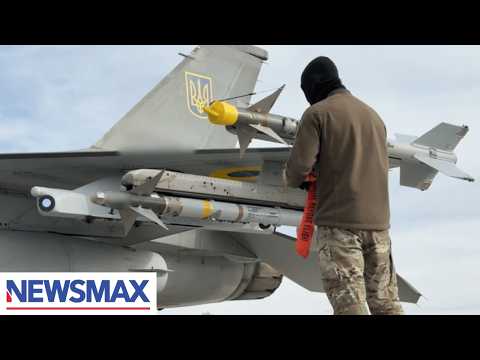
EXCLUSIVE: Ukraine F-16 Pilots Rationing Missiles as Russian Attacks Intensify | NEWSMAX2 thumbnail

EXCLUSIVE: Ukraine F-16 Pilots Rationing Missiles as Russian Attacks Intensify | NEWSMAX2


The Ukrainian commander, who identified himself by the callsign “Phantom” and as commander of the country’s 107th Wing, confirmed the underlying problem when asked directly whether Ukraine was severely short of missiles for its F-16s.

“Yes, that’s true. Any aircraft without weapons is … useless,” Phantom said.

That blunt assessment is particularly striking given what Ukraine is asking its F-16s to do, and the relentless nature of Russian bombardments against Ukrainian cities and infrastructure.

The fighters have become an important part of Ukraine’s layered air defense network, hunting Russian drones and cruise missiles while also providing a potential counter to Russian combat aircraft, and conducting air-to-ground sorties. Ukraine has operated the F-16 since the summer of 2024.

“We are focusing on defending our skies against Russian unmanned drones to protect our infrastructure inside the country,” Phantom said. “Our target priority is cruise missiles.”

Destroying as many incoming threats as possible before they reach Ukrainian cities and infrastructure requires missiles, with the F-16 primarily armed with the AIM-120 Advanced Medium-Range Air-to-Air Missile (AMRAAM) and the shorter-range AIM-9 Sidewinder.

Another live AIM-9L/M launch. This Ukrainian F-16 carries six Sidewinders. Ukrainian Air Force screencap

According to the new disclosure, those missiles have become a commodity whose availability can determine how a sortie is flown.

The F-16 carries an M61A1 Vulcan 20mm rotary cannon, but using the gun against an aerial target is fundamentally different from engaging it with a missile, and comes with its own risks, as we have explored before. This tactic is especially hazardous when going after small targets and especially slow ones, and it becomes even more dangerous at night.

Ukraine has already demonstrated that its F-16s can use their guns in combat. In May 2025, the Ukrainian Air Force said an F-16 pilot had destroyed three aerial targets and was engaging a fourth with the aircraft cannon before an emergency forced him to eject.

An armorer loads an F-16 with 20mm ammunition for its M61A1 cannon. Ukrainian Air Force screencap

One air-to-air weapon not mentioned by Phoenix is the laser-guided 70mm Advanced Precision Kill Weapon System II (APKWS II) rocket, now apparently also part of the arsenal. These rockets would offer the Ukrainian Air Force an extremely valuable, lower-cost option for engaging drones and subsonic cruise missiles. 

Regardless, Phantom specifically called for additional air-to-air missiles, as well as interceptors for ground-based Patriot batteries.

“We require more means of protection, such as Patriot missiles and air-to-air missiles, AIM-9s or AIM-120s to our fleet,” he said.

Phantom’s message is that simply delivering more aircraft is not enough. Ukraine needs a sustainable weapons pipeline to keep those aircraft combat-effective.

This is increasingly becoming a wider problem across Ukraine’s air defense network. Patriot interceptors have been heavily consumed, with relatively few replacement missiles now trickling in, leaving Ukraine with limited ability to defend against ballistic missiles in particular. The strain is now spilling into the lower tiers, including the air-to-air missiles carried by F-16s. Ukraine’s continued consumption of interceptors is a major driver, but it is competing with the enormous demand generated by ongoing wars in the Middle East and a broader surge in demand for advanced air defense weapons around the world. With production struggling to keep pace, scarce interceptors are effectively being rationed across an increasingly crowded global battlefield.

“At least we need to try to increase the production, or at least to allow Ukraine to localize the production in Ukraine or other European countries,” he said.

That proposal reflects the fundamental vulnerability of a relatively small fleet operating in a high-intensity air war. Every missile fired at a Russian cruise missile or drone is one less available for the next engagement. A finite inventory therefore has to cover both routine air-defense missions and the possibility of much larger Russian attacks. At the same time, both the AIM-9 and especially the AIM-120 are used for Ukrainian ground-based air defenses too. The AMRAAM, in particular, is the effector for the NASAMS, which protects Kyiv, and other key objectives against cruise missiles and drones.

Air-to-air with two F-16s. The nearest jet carries a wingtip AMRAAM. Ukrainian Air Force screencap

The problem becomes even more acute because Ukraine cannot know precisely when the next major Russian strike will arrive.

That is why, according to Wilder’s account, the arrival of missile shipments is being followed with extraordinary urgency.

At the same time, Phantom welcomed the major technological leap that the F-16 represents over the Soviet-designed MiG-29s and Su-27s that formed the backbone of Ukraine’s fighter force.

“The F-16s in comparison with the legacy aircraft like MiG-29 or Su-27? This is kind of like a new technology,” Phantom said.

But sophisticated aircraft are only as useful as the weapons available to them.

Ukrainian F-16s have reportedly destroyed huge numbers of Russian drones and cruise missiles, and in July a Ukrainian F-16 was publicly identified by the U.S. Joint Chiefs chairman as having shot down a Russian fighter.

Phantom also asked Ukraine’s Western partners to think beyond individual weapons transfers and toward production capacity.

He also urged the United States and European countries to do more to prevent Russia from acquiring components used in its own missile production through third countries.

“We need to make as much as we can to stop providing the parts, most technological parts to Russians, bypassing the direct sales, of course, through the third party,” he said.

An armed F-16 between sorties. Ukrainian Air Force screencap

Phantom argued that Russia continues to obtain sophisticated components through intermediaries and even ostensibly civilian products.

“It would not be a surprise that Russians [are] using the washing machine that they’re buying from the third party to use those smart details for building missiles,” he said.

His recommendation is tighter sanctions and enforcement designed to cut off Russia’s access to those components.

“Important is to sanction to stop Russia from being able to have access to those parts,” he said.

That, combined with missile shortages, could become an even bigger problem when Russia conducts another major aerial campaign against Ukraine, particularly as Moscow traditionally intensifies attacks against the country’s energy infrastructure during the winter months.

Contact the author: thomas@thewarzone.com



Source link

Panama cuts movements through canal due to El Niño-linked water shortage

Low rainfall caused by El Niño was blamed for a decision by the Panama government to slash the number of ships permitted to transit the Panama Canal each day by more than a tenth, with the policy to be phased in from early September. File photo by Carlos Lemos/EPA

Aug. 21 (UPI) — The Panama government blamed low rainfall caused by El Niño for a decision to cut the number of vessels permitted to transit the 51-mile-long Panama Canal by more than 11%, despite being in the middle of the wet season.

Shipping lines were notified by the Panama Canal Authority on Thursday that as of Sept. 15, it was slashing the number of daily ship movements through the canal from 36 to 32 to ensure there was no disruption to traffic and to conserve water for human consumption.

The authority said the step was necessary “to support the long-term sustainability of transit operations,” even though it had already implemented other water-saving measures and the rainy season had finally arrived.

With the sea-warning El Niño weather cycle expected to be one of the most intense on record, Britain’s Met Office said Central America, along with tropical South America and countries in the western Pacific, was at significant risk of low rainfall in this year’s wet season.

With vessels already lining up to transit the canal, in some cases for weeks, fears were growing of a knock on impact from the delays and extra costs on goods prices, including fuel and medicine.

One container ship reportedly paid $4 million to jump to the front of the line.

San Francisco-based freight-forwarding firm Flexport, which had 30 containers on the ship, told CNN that the delays at the Pacific end were the longest in three months, when there was significant backlog due to a surge in demand from maritime traffic displaced by the closure of the Strait of Hormuz.

“The ripple effects are significant through supply chains and all the way to consumer prices at stores,” said Benjamin Gedan, senior fellow and director of the Latin American program at the Stimson Center in Washington.

The canal relies on fresh water from Lake Gatun to feed 12 sets of locks that use water compartments to move vessels up or down as they navigate the topography of the Panama Isthmus.

Extreme drought during El Niños in 2023 and 2024, forced Panama to impose deep cuts in the number of ships transiting daily — 24 compared with 36 in normal times — after water levels in Lake Gatun retreated to historic lows.

Martin Luther King Jr. delivers his famed “I Have a Dream” speech from the steps of the Lincoln Memorial in Washington on August 28, 1963. The speech galvanized the nation’s civil rights movements and led to the passage of the 1964 Civil Rights Act, the 1965 Voting Rights Act and the 1968 Fair Housing Act. File photo by UPI | License Photo

Source link

Trump denies munitions shortage reports, calls leaks ‘treasonous’

President Donald Trump is shown Monday in the Oval Office at the White House in Washington, D.C. On Thursday, Trump denied U.S. muntions shortage due to the attacks on Iran. Photo by Allison Robbert/UPI | License Photo

Aug. 6 (UPI) — President Donald Trump on Thursday dismissed reports of munitions shortages due to U.S. attacks on Iran, saying those who leaked the information are being “hunted down.”

“The U.S. has massive amounts of ‘munitions,’ especially of certain types,” Trump wrote in a social media post. “Additionally, large amounts are being manufactured and shipped to the U.S. as needed. Defense companies are building the largest number of plants and factories in our country’s history.”

“The ‘leakers’ of these treasonous statements are being hunted down,” he continued. “Long-term jail sentences will be sought!”

Multiple news outlets, including CBS News, reported this week that the United States has used almost all its stockpile of long-range precision missiles in the attacks on Iran. This includes most of its Army Tactical Missile Systems and Precision Strike Missiles.

Officials have also said the most pressing shortage is that of Patriot and Terminal High Altitude Area Defense interceptors, which the country has used faster than manufacturers can replace them.

The Pentagon on Monday announced deals with defense contractors Lockheed Martin and Northrop Grumman to escalate production of parts for missile interceptors, The Hill reported.

“America’s military is the most powerful in the world and has everything it needs to execute at the time and place of the president’s choosing,” Pentagon spokesman Sean Parnell said in a statement to CBS News. “We have executed multiple successful operations across combatant commands while ensuring the U.S. military possesses a deep arsenal of capabilities to protect our people and our interests.”

White House Press Secretary Karoline Leavitt on Wednesday denied a Washington Post report that Trump “demanded answers” on extreme munitions shortages from Defense Secretary Pete Hegseth last week. Trump reportedly said he’d been misled on the shortages.

Leavitt called the report “a B.S. story” and “FAKE NEWS” and said that it “literally never happened.”

The White House has vowed to find and prosecute those leaking information to the press before. In July, the Trump administration issued subpoenas to New York Times journalists, demanding they testify in front of a federal grand jury “in regard to an alleged violation of federal criminal law.” The Times had reported, using anonymous sources, about security concerns involving President Donald Trump’s new Air Force One, which was donated by Qatar. The probe was later dismissed.

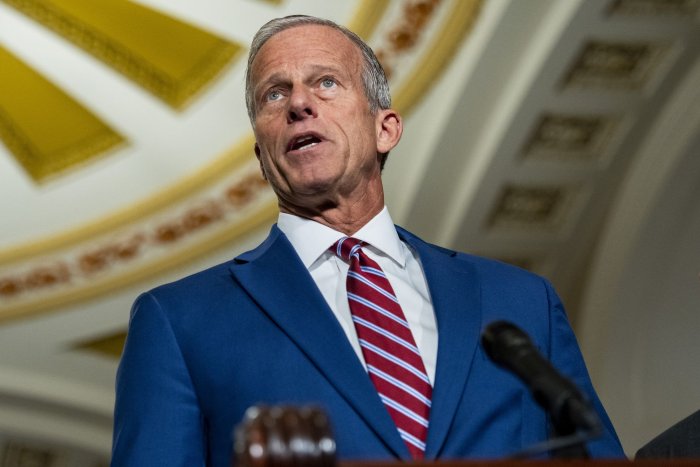
Senate Majority Leader John Thune, R-S.D., speaks during a press conference after weekly Senate caucus luncheons at the U.S. Capitol on Tuesday. With the August recess approaching, Senate Republicans are looking to confirm Acting Attorney General Todd Blanche as Attorney General and pass a budget bill to prevent a shutdown before the midterms. Photo by Bonnie Cash/UPI | License Photo

Source link

Airline suspends flight route until end of summer due to shortage of planes AND pilots

AN airline has temporarily axed one of its routes until the end of August.

Skybus has announced there will be no services between Newquay and St Mary’s Airport on the Scilly Isles with existing customers being rerouted.

Skybus has suspended one of its routes until August 31 Credit: Alamy
Collage of travel items including a plane, sunscreen, passport, suitcase, and plane tickets, advertising The Sun's travel Instagram account.

Passengers received the news yesterday of the cancellations with Skybus.

The airline explained the route has been suspended due to “a combination of a shortage of both aircraft and qualified pilots”.

Skybus continued to say: “We have explored every available option to maintain the Newquay service, but with a limited fleet and crew availability, we would be unable to operate the route reliably throughout the remainder of the summer.

“Our priority is to provide certainty for our passengers.

COAST EFFECTIVE

Best UK family theme & waterparks with cheap stays from just £3pp a night


DIVE IN

Mega waterpark hotels with EVERYTHING you ever wanted & all inclusive from £189pp

“We want to assure passengers booked to travel between Newquay and St Mary’s, you will be transferred onto a Skybus flight departing from Land’s End Airport on the same date.”

They said that by “concentrating” available aircraft and crews on services from Land’s End they can “provide greater reliability and reduce the risk of further disruption during the peak travel period.”

Customers will be contacted soon with dates for alternative flights.

They will also be offered free parking at Land’s End Airport, a refund of any fare difference between their original and revised flights, and a voucher to spend at the airport café.

Skybus operates year-round to the Isles of Scilly, but only from Land’s End Airport Credit: Alamy
Flights from Newquay and Exeter usually operate seasonally between late March to October Credit: Alamy

Skybus operates year-round to the Isles of Scilly, but only from Land’s End Airport – and flights take about 20 minutes.

Flights from Newquay and Exeter usually operate seasonally between late March to October.

The Exeter route will continue as normal.


Source link

S. Korea election watchdog panel recommends criminal probe into ex-chief over ballot shortage

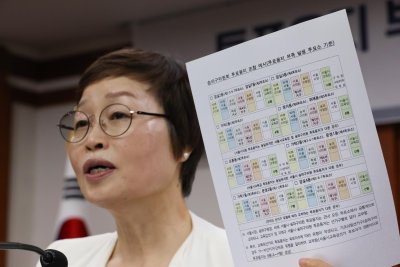
Cho Hyun-wook, chairperson of a fact-finding committee of the National Election Commission, speaks during a briefing at NEC headquarters in Gwacheon on Friday. Photo by Yonahp

The National Election Commission’s (NEC) fact-finding committee investigating ballot shortages during the recent local elections called for a criminal probe into the commission’s former chief Friday, citing systemic failures in the election management system.

Cho Hyun-wook, chairperson of the committee, made the announcement during a briefing at the NEC headquarters in Gwacheon, south of Seoul, as the panel wrapped up a weeklong investigation conducted to determine the cause of the ballot shortages.

The committee recommended that former NEC Chairman Roh Tae-ak, who stepped down from his post over the debacle, and other key officials be referred for criminal investigation.

Cho also stressed that the NEC requires a sweeping overhaul tantamount to dismantling the organization.

“Given the systemic failures in the election management system exposed by the ballot shortage incident, the NEC requires sweeping reforms akin to dismantlement,” she said.

According to the committee, 140 of the country’s 14,288 polling stations requested and received additional ballot papers after anticipating shortages on election day. Of those, 91 used the additional ballots they received, while voting was at least temporarily disrupted at 26 polling stations due to ballot shortages.

The committee, launched on June 10, consisted of six members recommended by civic organizations, media, legal and academic communities.

Copyright (c) Yonhap News Agency prohibits its content from being redistributed or reprinted without consent, and forbids the content from being learned and used by artificial intelligence systems.

Source link

Rival S. Korea parties agree to launch parliamentary probe on election ballot shortage

This composite photo, taken Tuesday, shows Rep. Cheon Jun-ho (L), deputy floor leader of the ruling Democratic Party, and Rep. Kim Seung-soo, deputy floor leader of the main opposition People Power Party, prior to their talks at the National Assembly in Seoul. Photo by Yonhap

The rival parties agreed Tuesday to conduct a 45-day parliamentary investigation into the National Election Commission (NEC) over ballot shortages reported during the recent local elections, party officials said.

In a meeting of their deputy floor leaders at the National Assembly, the ruling Democratic Party (DP) and the main opposition People Power Party (PPP) agreed to put the plan to a vote at a parliamentary plenary session on Thursday.

“We agreed to launch the parliamentary probe to swiftly uncover the truth behind the alleged infringement of voting rights of the citizens caused by the ballot shortages and to lay the groundwork for sweeping reforms of the NEC,” Rep. Cheon Jun-ho of the DP told reporters after the meeting.

According to officials from both parties, the special parliamentary committee will be chaired by the PPP and comprise 18 members — nine from the ruling party, seven from the PPP and two from non-negotiating parties.

Rep. Kim Seung-soo of the main opposition PPP said the rival parties agreed to set the investigation period at 45 days in an effort to conduct the probe as swiftly as possible, while leaving open the possibility of an extension if further investigation becomes necessary.

Ballot shortages were reported at more than a dozen polling stations in Seoul during the June 3 local elections, temporarily disrupting voting and prompting protests.

Last week, the DP and the PPP separately submitted requests for a parliamentary probe, though they differed over the scope of the investigation and the number of seats to be allotted to each party on the committee.

Copyright (c) Yonhap News Agency prohibits its content from being redistributed or reprinted without consent, and forbids the content from being learned and used by artificial intelligence systems.

Source link

Nat’l Assembly begins procedure for potential probe on election ballot shortage

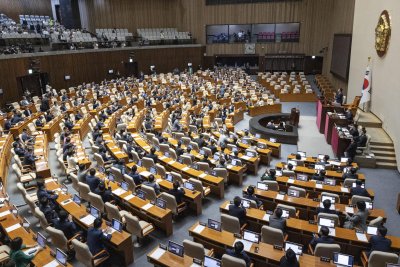
A plenary session of the National Assembly is held in Seoul on Thursday. Photo by Yonhap

The National Assembly on Thursday launched formal procedures for a potential parliamentary investigation into ballot shortages reported during last week’s local elections, with requests for the probe submitted by both the ruling and opposition parties being reported to a plenary session.

The head of the Proceedings Division of the National Assembly Secretariat said that the requests for a parliamentary probe were submitted separately by the ruling Democratic Party (DP) and the main opposition People Power Party (PPP), with all lawmakers from each party sponsoring their respective requests.

The move marks the first step toward establishing a special parliamentary committee to examine allegations of mismanagement by the National Election Commission during the voting process.

The establishment of the committee is expected to undergo negotiations, as proposals from the DP and the PPP differed over the scope of the probe and the number of seats to be allotted to each party on the committee.

The PPP has argued that a separate special counsel probe should be launched alongside the parliamentary investigation, while the DP has maintained that such a move should be considered after the parliamentary probe.

In a meeting chaired by National Assembly Speaker Cho Jeong-sik, the rival parties shared a consensus on holding a plenary session as early as next week to adopt a plan for the parliamentary probe, according to officials.

Separately, the PPP’s new floor leader Jeong Jeom-sig met with Hong Ik-pyo, presidential secretary for political affairs, and stressed the need for a special counsel probe into the incident.

Hong said the presidential office would be open to the idea of a special counsel investigation if the rival parties reach an agreement, according to PPP spokesperson Choi Soo-jin.

Ballot shortages were reported at more than a dozen polling stations in Seoul during last Wednesday’s local elections, temporarily disrupting voting and prompting protests by people alleging election fraud.

Copyright (c) Yonhap News Agency prohibits its content from being redistributed or reprinted without consent, and forbids the content from being learned and used by artificial intelligence systems.

Source link

South Korea election chief to resign over ballot shortage

Heo Cheol-hoon, secretary general of the National Election Commission, issues a public apology after a shortage of ballot papers prompted the temporary suspension of voting in the local elections at some polling stations in southern Seoul, South Korea, 03 June 2026. South Koreans voted on 03 June to elect mayors, governors, local council members and regional education chiefs in nationwide local elections. Photo by YONHAP / EPA

June 5 (Asia Today) — South Korea’s election chief said Friday he will resign to take responsibility for ballot shortages that disrupted voting during the June 3 local elections.

Roh Tae-ak, chairman of the National Election Commission, made the announcement during a public apology at the commission’s headquarters in Gwacheon, Gyeonggi Province. NEC Secretary-General Huh Chul-hoon also offered to resign.

“The high public interest in local autonomy and the active expression of the people’s will through voting were damaged by the ballot shortage,” Roh said. “As chairman of the National Election Commission, I feel devastated and bear unlimited responsibility for the situation, which has damaged public trust in election management and led to distrust in the election process.”

The commission said ballot shortages occurred at 50 polling stations nationwide, including 14 in Seoul’s Songpa district. Voting was temporarily halted at 22 polling stations, the commission said. Outside reports also said the shortages caused delays and protests in parts of Seoul.

The commission said the shortages were linked to a decision to print ballots for at least 50% of eligible voters in some areas, reflecting internal discussions about reducing unused ballots as early voting rates have risen in recent elections.

Yoon Jae-soo, head of the commission’s election policy office, said the minimum number of ballots was set at 50% of eligible voters but could be adjusted depending on local conditions.

“In Songpa district, when the early voting rate of 23.3% was included, ballots equal to 73.3% of eligible voters were secured,” Yoon said. “But shortages occurred because there were differences among individual polling stations.”

The commission said it will create a fact-finding committee made up of outside experts to examine the cause of the shortages, identify problems in the response and prepare measures to prevent a recurrence.

Roh said the commission will cooperate fully with any process to determine responsibility, including a possible National Assembly investigation.

“We will sincerely take part in all procedures to confirm the commission’s responsibility for this incident and will not avoid responsibility depending on the results,” Roh said.

On Wednesday, voters at some polling stations in Seoul’s Gangnam, Gwangjin and Songpa districts had to wait because of ballot shortages. The disruption has drawn criticism from political parties, civic groups and universities over the commission’s election management.

Oh Min-seok, chairman of the Seoul Election Commission, also issued a public apology Friday.

“This was the commission’s fault, with no excuse,” Oh said. “We deeply feel responsibility for damaging public trust through poor election management that ran counter to common sense.”

— Reported by Asia Today; translated by UPI

© Asia Today. Unauthorized reproduction or redistribution prohibited.

Original Korean report: https://www.asiatoday.co.kr/kn/view.php?key=20260605010001883

Source link