April 6 (UPI) — A cruise ship in Fiji ran aground at Monuriki Island, a small, uninhabited island off the coast of Fiji where the movie Cast Away was filmed.
The ship is the 180-foot Fiji Princess, part of Blue Lagoon Cruises. It ran aground on a reef while visiting the island. All 30 passengers and 17 of its 31 crew were taken off the boat on the same day, and there were no injuries reported.
“Initial checks confirmed that the vessel has suffered serious damage to its rear left side, including the area where the steering equipment is located. Part of the vessel underneath has also been damaged,” a spokesperson for the Maritime Safety Authority of Fiji said.
“The vessel also experienced engine failure and was reported to be taking in water following the grounding. Due to rough seas and strong waves, officers were unable to safely inspect the vessel underwater at the time,” the MSAF said.
The main priority is protecting the environment, a spokesperson said.
The ship was carrying about 5,300 gallons of diesel fuel. The spokesperson said authorities had taken oil spill equipment to the area “as a precaution” but that the sea was too rough to use it.
“At the time of inspection, there were no signs that the fuel tanks had been damaged,” the spokesperson said.
Salvage teams, with the help of an Australian salvage specialist, were working to remove the fuel and oil from the ship.
”Msaf’s main concern at this time is the safety of all personnel, the protection of Fiji’s marine environment, and ensuring that response efforts continue safely,” a spokesperson said. “Msaf will continue to work closely with the vessel operator and all response teams, and will provide further updates as necessary.”
Monuriki Island is where the 2000 movie “Cast Away,” starring Tom Hanks, was filmed. It is part of the Mamanuca Island chain, on which “Survivor” has been filmed since 2016.
It was not immediately clear how the vessel, which Marine Traffic tracking data shows is sailing south along the coast of Oman, secured safe passage.
Published On 3 Apr 20263 Apr 2026
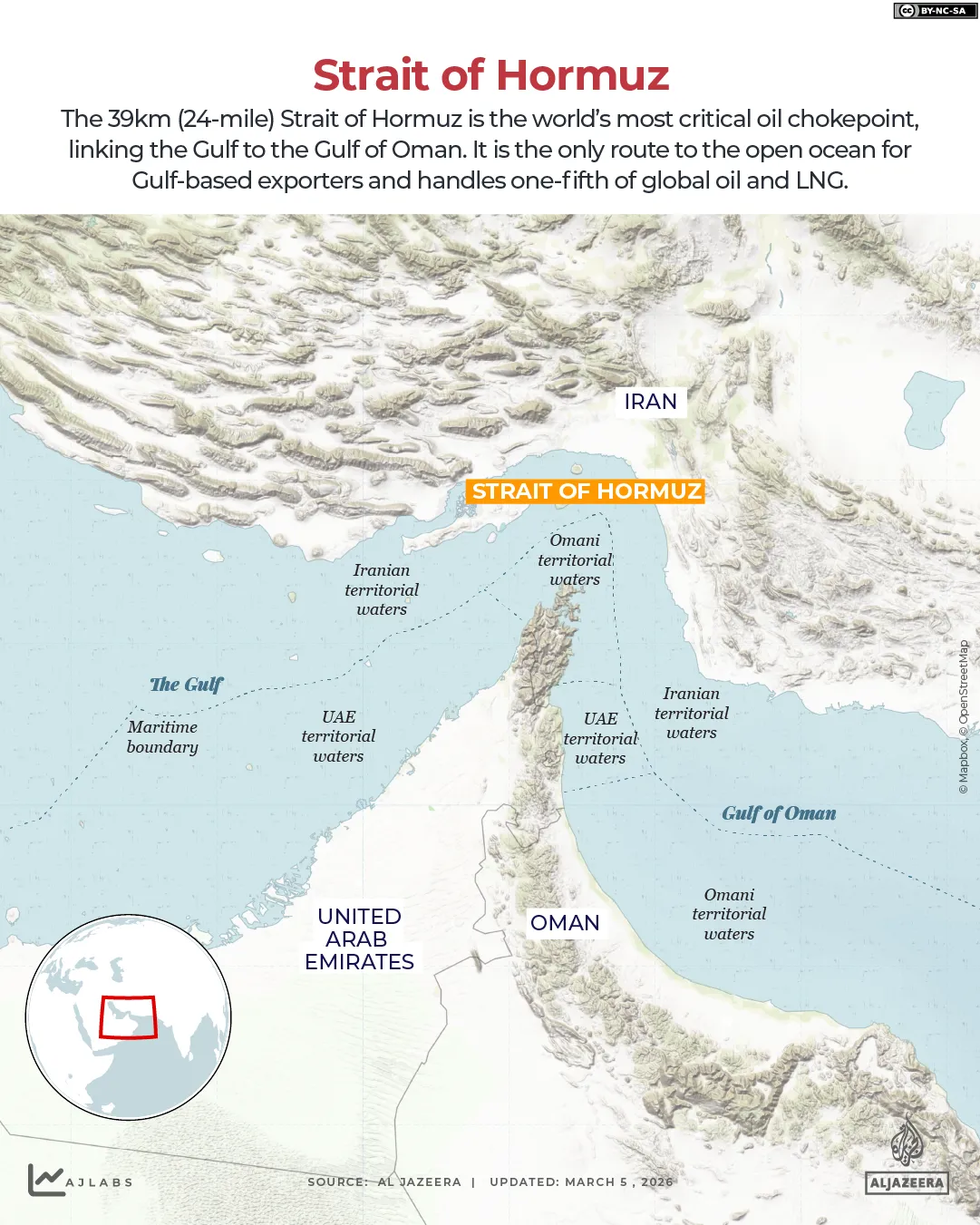
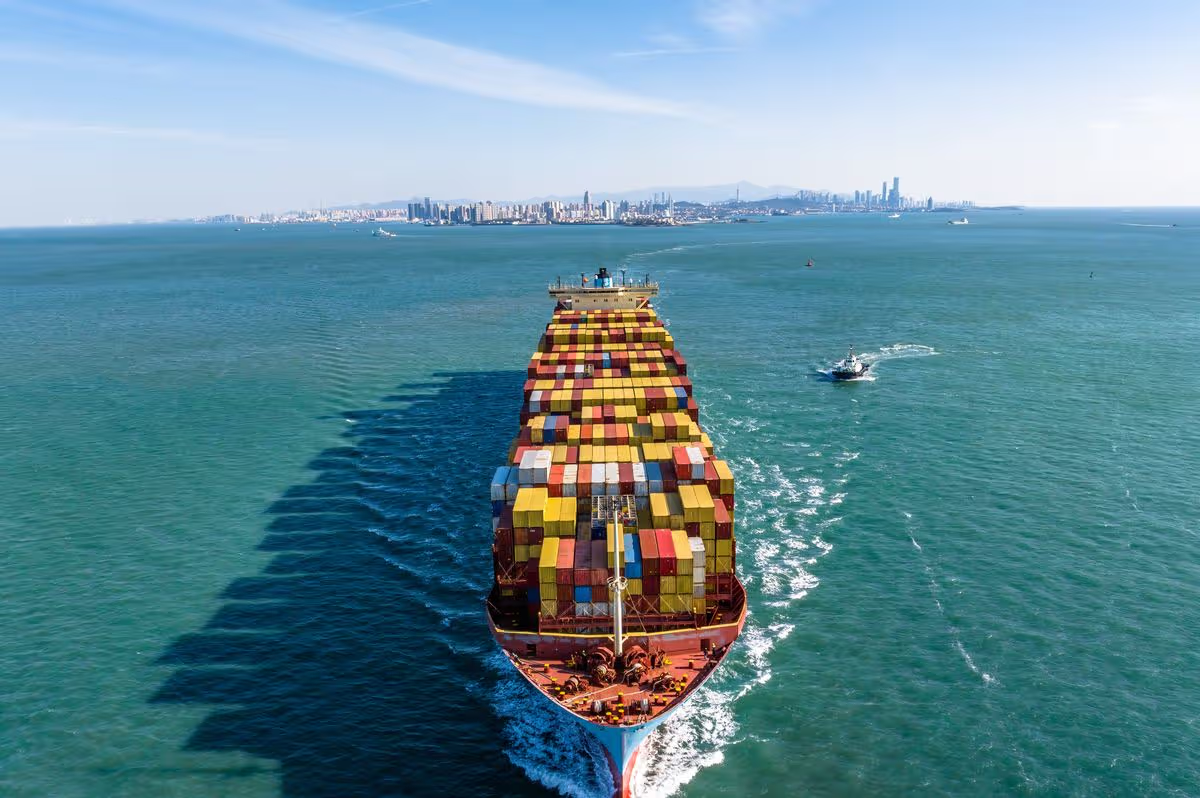
A container ship belonging to French shipping giant CMA CGM has crossed through the Strait of Hormuz, the first such passage by a Western vessel since Iran effectively closed the waterway, the Marine Traffic vessel website shows.
The Malta-flagged Kribi, owned by CMA CGM, crossed the Strait on April 2 and is the first French-owned vessel to make it through the channel since the US-Israeli war on Iran began on February 28.
Recommended Stories
list of 4 itemsend of list
It was not immediately clear how the vessel, which the data shows is sailing south along the coast of Oman, secured safe passage.
There was no immediate comment from CMA CGM.
However, LSEG shipping data showed the vessel on Thursday changed its destination to “Owner France”, signalling to Iranian authorities the nationality of its owner, before crossing the strait’s Iranian territorial waters.
[Al Jazeera]
The ship had originally been bound for Pointe-Noire in the Republic of the Congo.
Only about 150 vessels, including tankers and container ships, have transited the strait since March 1, according to data firm Lloyd’s List Intelligence. Most were linked to Iran and countries including China, India and Pakistan.
Beijing expressed “gratitude” on Tuesday after three of its ships passed through the strait, including two container ships on Monday belonging to state-owned shipping giant Cosco.
Energy crisis
Until the war led to the effective blocking of the Strait, it was the route for about a fifth of global oil and liquefied natural gas supplies. As a result, fuel prices have skyrocketed worldwide.
On Wednesday, US President Donald Trump insisted that petrol prices would fall quickly once the war concluded, but offered no solution for reopening the Strait of Hormuz. Instead, he invited sceptical US allies to do it themselves. He insisted that the war would be worth it.
French President Emmanuel Macron said on Thursday it would be unrealistic to launch a military operation to open the strait, and that only diplomatic efforts would work.
Macron has worked with European and other allies to build a coalition to guarantee free passage through the strait once hostilities have stopped.
Meanwhile, writing in the US journal Foreign Affairs, Iran’s former top diplomat said that Tehran should make a deal with the United States to end the war by offering to curb its nuclear programme and reopen the Strait of Hormuz in exchange for sanctions relief.
Tehran could “declare victory and make a deal that both ends this conflict and prevents the next one,” wrote Mohammad Javad Zarif, foreign minister from 2013 to 2021.
WASHINGTON — President Trump is threatening to deploy ground troops to seize critical oil infrastructure on Iran’s Kharg Island, a military gambit that experts say would risk American lives and could still fail to end the war.
If Trump wants to hobble Iran’s oil industry for leverage in negotiations, a better option might be setting up a blockade at sea against ships that have filled up at Kharg Island’s oil terminals, the experts said.
The island — located on the other side of the Persian Gulf from U.S. bases in Kuwait and Saudi Arabia — is the beating heart of Iran’s oil industry, through which 90% of its exports pass. It is important because Iran’s coastline is mostly too shallow for tanker ships to dock.
“Putting people on the ground might be the most psychologically compelling way of striking a blow at Iran,” said Michael Eisenstadt, a former U.S. military analyst who now directs the Military and Security Studies Program at the Washington Institute for Near East Policy.
“On the other hand, you’re putting your own troops at jeopardy,” said Eisenstadt, a retired Army reserve officer who served in Iraq. “It’s not far from the mainland. So they can potentially rain a lot of destruction on the island, if they’re willing to inflict damage on their own infrastructure.”
Seizing Kharg Island could escalate the conflict, said Danny Citrinowicz, an Iran expert at Israel’s Institute for National Security Studies.
He said Iran and its proxies — including Yemen’s Houthi rebels — could intensify their retaliation, including by laying mines in the Strait of Hormuz or striking targets with drones across the Arabian Peninsula, from the Persian Gulf to the Red Sea.
Commodities researchers and investment banks warn major retaliation could have lasting implications for energy prices and the global economy.
“It will be hard to take. It will be hard to hold,” Citrinowicz said of Kharg Island. “And it might damage the economy, but not in a way that will force the Iranians to capitulate.”
Trump says ‘maybe we take Kharg Island’
Trump is under growing pressure to end the monthlong conflict with Iran, which has attacked U.S. bases and allies in the region.
Iran also has largely closed the Strait of Hormuz, a narrow chokepoint through which 20% of the world’s oil normally flows, causing fuel prices to soar and other economic tumult.
Trump said in a social media post Monday that “great progress is being made” in talks with Iran to end military operations. But he said that if a deal is not reached “shortly” and the strait is not immediately reopened, the U.S. would obliterate power plants, oil wells, Kharg Island and possibly even desalination plants.
Trump has raised the idea of American forces seizing Kharg Island.
“Maybe we take Kharg Island, maybe we don’t. We have a lot of options,” Trump told the Financial Times. “It would also mean we had to be there (on Kharg Island) for a while.”
Asked about Iranian defenses there, he said: “I don’t think they have any defense. We could take it very easily.”
Secretary of State Marco Rubio said Friday that ground troops would not be needed to achieve the Trump administration’s goals. He did not repeat that assertion Monday after being asked about plans for U.S. ground troops, saying “the president has several options at his disposal” but diplomacy is Trump’s preference.
“Now, they are making threats about controlling the Hormuz Strait in perpetuity, creating a tolling system and the like,” Rubio told ABC’s “Good Morning America.” “That’s not going to be allowed to happen. And the president has a number of options available to him, if he so chooses, to prevent that from happening.”
U.S. has hit targets on the island crucial to Iran
The U.S. has already struck various targets on the island, including air defenses, a radar site, the airport and a hovercraft base, according to satellite analysis by the Institute for the Study of War and American Enterprise Institute’s Critical Threats Project.
Petras Katinas, an energy researcher at the Royal United Services Institute, said disrupting Kharg Island would not completely halt oil exports as Iran has other small ports. But it would reduce the oil revenue flowing to Iran’s government, “forcing flows through a much smaller, costlier and less efficient export system,” he said.
However, Tehran has too much at stake to surrender over a single asset, no matter how economically significant, said Citrinowicz, the Iran expert at Israel’s Institute for National Security Studies.
While occupying Kharg might offer Washington some leverage in any negotiations, he said the notion that control of the island could be traded for Iran’s stockpile of enriched uranium was far-fetched.
“It’s in no way a decisive blow,” Citrinowicz said.
U.S. troops face risk from Iran’s mainland if they tried to seize Kharg Island
A U.S. Navy ship carrying about 2,500 Marines recently arrived in the Middle East, while at least 1,000 troops from the 82nd Airborne Division are expected soon. Another 2,500 Marines are being deployed from California. The Trump administration has not said what all those troops will be doing, but the 82nd Airborne is trained to parachute into hostile or contested territory to secure key territory and airfields.
One of the reasons American troops would be vulnerable on Kharg Island is its close proximity — about 33 kilometers (21 miles) — to the Iranian mainland, from which missiles, drones and artillery could be fired. Despite continued U.S. and Israeli strikes, the Islamic Republic is still attacking targets across the region, including a Saudi air base hundreds of miles away where more than two dozen American troops were injured last week.
Even with American ships and planes providing support, there would still be a relatively short window of time to shoot down every drone or missile launched from the mainland at the island, Eisenstadt said.
“The coast tends to be mountainous, so the drones can come in through mountain passes where it’s hard for our radar to pick up,” he said. “And we don’t have the warning time.”
Eisenstadt says a sea blockade against ships carrying Iranian oil would be a safer strategy and achieve the same goal of controlling most of Iran’s oil industry.
“Throw up a quarantine that seeks to seize Iranian oil shipments that are exiting the Gulf,” agreed Clayton Seigle, an energy security expert at the Center for Strategic and International Studies. It could be done at a distance “outside the range of the lion’s share of Iran’s weapon systems.”
Seigle argued against destroying Kharg Island’s oil infrastructure, which Trump also suggested.
“We were supposed to be coming to the rescue of the people that had been rising up and protesting for a better future,” Seigle said. “So to cripple Iran’s revenue-generating potential for many years to come would definitely not work in that direction.”
Finley and Metz write for the Associated Press. Metz reported from Ramallah, West Bank.
ROYAL Caribbean’s massive new cruise ship is launching next year – and new images have revealed what you can expect onboard.
Hero of the Seas is the fourth Icon Class Ship, and set to cost a huge $2billion (£1.5billion) to build, it will break a number of records.
Sign up for the Travel newsletter
Thank you!
Royal Caribbean has revealed it’s new cruise ship Hero of the SeasCredit: UnknownIt will have nine pools onboardCredit: SuppliedYou can book the three storey treehouse roomCredit: Supplied
The ship will have nine swimming pools – the most ever at sea – including a Caribbean themed one and the biggest swim up bar at sea.
Coconut Cove will be the newest pool, while The Hideaway will be home to the two adult-only pools.
Category Six is be the biggest waterpark at sea, with two new family raft slides as well as the first funnel raft slide at sea.
The kid-friendly waterpark Splashaway Bay will have new features too.
Skywalk-zip line attraction Crown’s Edge will return, as well as the Flowrider surf simulator, golf courses and rock climbing walls.
When it comes to eating and drinking, there are 28 to choose from including the new jazz-themed Orleans Parish Supper Club.
Otherwise there will also be the food hall stalls at the AquaDome market, as well as Italian, steakhouses, seafood and Mexican options as well.
Don’t forget the Royal Promenade neighborhood’s restaurants, bars as well, along with the 30,500 plant Central Park.
Otherwise when it comes to live shows there is the Royal Theatre and the biggest ice arena at sea, Absolute Zero.
One of the most exciting new additions to the ship is the Ultimate Family Treehouse room option.
The three-deck treehouse includes a rooftop terrace over the side of the ship as well as a private hot tub.
Two of the floors will be for teens, with two main bedrooms, ensuites, and abalnies.
The suite even has direct access to Surfside, a family-friendly neighbourhood with cooking classes.
The sailings will include seven night sailings from Miami from August 2027, including stays at the private Perfect Day at CocoCay island.
Room prices are yet to be revealedCredit: SuppliedSwim up bars will also be onboardCredit: Supplied
Royal Caribbean boss Michael Bayley said: ““Icon Class truly set a new standard for family vacations, and Hero of the Seas takes that vision even further.
“With more water, more thrills and more choices for all ages, we’re continuing to build on what our guests love about Royal Caribbean and delivering the experiences families are looking for when vacationing together.”
Holidays are not yet on sale but you can sign up for the waitlist to be contacted as soon as they are on April 2.
As the fourth ship of the Icon Class series, it will be a similar size to their others too.
She said: “Imagine taking Paris’ Eiffel Tower or The Shard skyscraper in London and tipping them on their side. Icon is even longer than they are high.
“While The Shard soars 1,016ft into the sky, Icon of the Seas eclipses that at 1,198ft long – the poor Eiffel Tower pales in comparison at just 984ft.
“The ship is cleverly divided into eight distinct neighbourhoods, with more than 40 places to eat and drink on board.
Our favourite travel essentials
*If you click on a link in this box, we will earn affiliate revenue.
Sleep headphones These soft sleep headphones make listening to music much more comfortable, particularly when you are trying to sleep. Built in are two mini speakers that connect to Bluetooth, saving you that horrible discomfort that comes with traditional headphones.
Underseat cabin bag This perfect underseat cabin bag will become your best friend on flights. Plain black, collapsible and barrel-shaped, this bag is designed to slide perfectly into those pesky luggage-sizers at the airport gates. Save yourself the extra baggage fee and come prepared.
Waterproof mobile phone pouch Keep your phone bone-dry and your hands free with this handy waterproof pouch. If you’re splashing in the sea or jumping on a paddle board, your tech will stay safe from splashes. The touch-sensitive screen means you can still snap selfies, too.
Eye mask Trying to sleep on a brightly-lit plane is next to impossible, but napping becomes much easier with one of these. Eye masks can be useful when travelling with kids who need to sleep, as they block out all the light and distractions.
“Of course the ship’s Adventure Ocean kids’ clubs will keep the little ones happy while you enjoy the sun, and families will also have a ball together visiting the arcades, laser tag, minigolf and the largest ice rink at sea.”
Weekly insights and analysis on the latest developments in military technology, strategy, and foreign policy.
The U.S. Navy has unveiled a “marketplace” model for acquiring future fleets of uncrewed surface vessels (USV), which could be owned and/or operated by the service or contractors. The Navy is applying this approach first to the procurement of medium-sized designs, or MUSVs, which could be configured for a variety of missions with the help of containerized payloads. The new strategy, which supplants the Modular Surface Attack Craft (MASC) plan laid out just last year, and aims to cut down on lengthy prototyping requirements, is the latest in a series of Navy efforts to try to speed up the fielding of new USV capabilities at scale.
“The character of warfare is changing rapidly. The Department of the Navy is adapting its acquisition system to deliver capability to our warfighters faster,” Secretary of the Navy John Phelan wrote in a post on X this morning, marking the official roll-out of the new USV acquisition plan. “We are harnessing the talent and ingenuity of the American tech sector by launching a market competition for the Medium Unmanned Surface Vessel (MUSV) Family of Systems. This new approach will leverage private investment and accelerate the delivery of real capabilities to the Fleet. We will reward the companies who are able to deliver capability at the speed of relevance.”
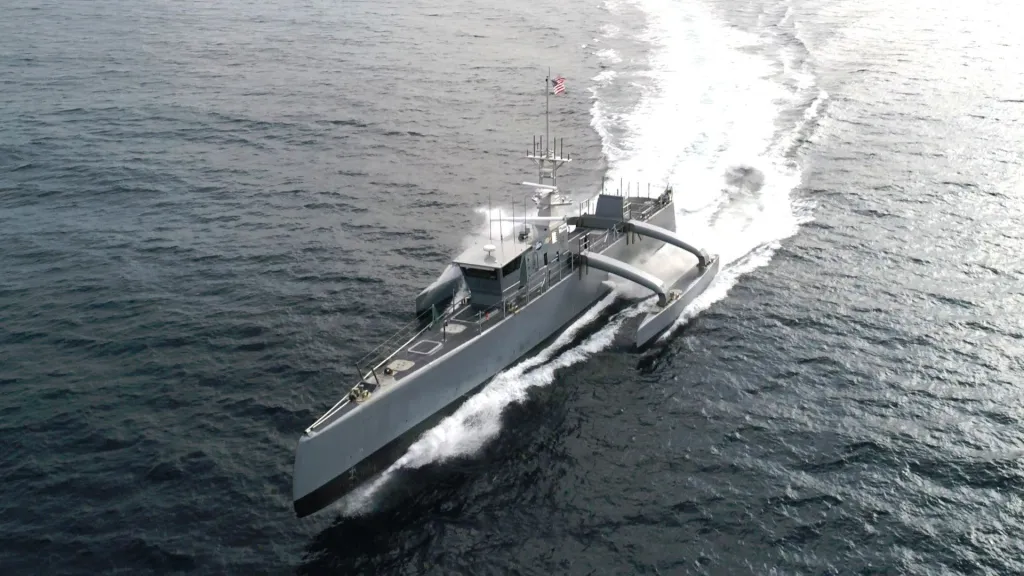
The Sea Hunter seen here is an MUSV-type design that the US Navy has been experimenting with for years now already. USN
“Our goal is to create a regular, recurring marketplace, not just for the MUSV, but for other classes of vessels, as well, over time, designed to match the growing demand for unmanned systems across a range of missions,” Rebecca Gassler, the Navy’s first-ever Portfolio Acquisition Executive for Robotic and Autonomous Systems (PAE RAS), also told TWZ and other outlets during a press call today. “This model that we’ve posted rewards demonstrated performance at sea, not just development, and is not another prototyping award. And it creates a direct path from what’s demonstrated on the water to putting those vessels into the fleet.”
The use of “marketplace” here should not be confused with how the U.S. Army is also now using that term to describe an actual online storefront-style system for ordering small uncrewed aerial systems. “I don’t know how many customers other than PAE RAS there are right now that actually have the funding to go buy or lease an MUSV,” Gassler said in response to a question about whether any kind of comparison between the two might be appropriate.
The Navy also posted a contracting notice regarding what it is now calling the Medium Unmanned Surface Vessel (MUSV) Family of Systems (FoS) program, specifically, online today. Potential offers only have another three weeks or so to submit proposals that involve designs that can be ‘on the water’ by the end of September, underscoring the service’s interest in already highly mature capabilities.
In terms of the actual uncrewed vessels the Navy is seeking through this effort, threshold requirements include a range of at least “2500 nm [nautical miles] at 25 knots while carrying a 25 MT [metric ton] load on the payload deck in NATO STANAG 4194 Sea State 4.” Per this NATO standard, Sea State 4 is characterized by wind speeds of 17 to 21 knots and wave heights between four and eight feet.
The MUSVs also need to be able to carry forty-foot equivalent units (FEU) containerized payloads and to refuel at sea at a rate of “2,000 gallons per minute of fuel through deck connections,” according to the contracting notice. We’ll come back to what might be in those payloads later on.
The Navy also wants designs that are “capable of fully autonomous operations both day and night in varying weather conditions complying with COLREGs [Convention on the International Regulations for Preventing Collisions at Sea], can prescribe keep out and keep in zones, and perform pre-defined behaviors,” per the notice. They also have to be “capable of restricting all Radio Frequency (RF) emissions when commanded while continuing to autonomously operate, perception system for autonomy has a passive mode with no RF emissions.”
The full list of threshold requirements from the MUSV FoS contracting notice released today. USN
In addition, the Navy has outlined a number of desired attributes, including “interfaces between C2, Perception, Machinery Control System, and Autonomy Control System software and hardware systems [that] conform to an open architecture standard with Interface Control Documents (ICD)” and an overall “autonomous system solution [that] enables integration with third party applications, modular upgrades, and component-level interoperability.” The service is also interested in the ability of the MUSV to monitor “health and status and autonomously reports conditions to the offboard C2 station, providing situational awareness of the condition of the vessel to the operator.”
“Vessel can execute 5 days of pre-planned maneuvers without communication connection” and “vessel provides emergency stop functionality to the offboard operator,” defined as “the rapid shutdown of propulsion engines putting the USV into a drift,” are also on the desired attributes list. There are production and operational aspects the Navy is also interested in, such as the ability of a selected contractor to supply between five and 10 operational MUSVs by the end of Fiscal Year 2027 and designs that can be “nested five abeam when moored.”
The complete list of desired attributes for the MUSV FoS from today’s contracting notice. USN
“We believe a number of them [potential offers] will test on production representative, but not full production[-ready designs,] or they’ll test in [sic] surrogate boats, so that we can see the autonomy that they’re bringing, even if it’s not the full production vessel,” Gassler noted today. So, acceptance of a finalized design will include a requirement “to do the full endurance test again, and any additional mission profiles that we have gotten from the Fleet, we will test at the time. And then we will do a full regression test on the autonomy now that it has been connected into the production boat controls.”
Overall, many of the stated threshold requirements for the MUSV FoS are similar, if not identical, to what the Navy had previously outlined for the initial baseline MASC design. The MASC plan was a three-tier approach that also included larger and smaller types, all of which would be configurable for different missions using containerized systems.
At the same time, the new strategy laid out today “is a replacement for MASC, absolutely,” PAE RAS Gassler stressed. MASC “was tailored towards a very specific mission and a very specific ask from the Fleet, [and a] very specific quantity. And we have a much wider variety of requirements for these vessels and missions that they need to accomplish as part of the Golden fleet. And so this is a replacement for that.”
“So, I won’t talk about specifically what mission we’re going after now that kind of gets out of the unclassified realm, but know that we are looking at specific mission profiles,” Gassler added. “For example, some require more complexity in their autonomy features than others, and so when we put these vessels through their tests, those tests will be a superset of those requirements such that we understand they will meet each of those missions.”
“Honestly, inside you could have a sensor, you could have repair equipment for ships,” she also said, speaking more generally about containerized payloads. “You could have any number of payloads inside those, and you basically are able to just swap them on.”
It should be noted here that the Navy did say its initial focus for MASC was on Intelligence, Surveillance, Reconnaissance, and Targeting (IRS&T), Counter-ISR&T, and Information Operations missions. At the same time, the three-tier approach and focus on containerized systems had certainly pointed to additional missions, including surface-to-surface strike and electronic warfare, down the line. The Navy already has a containerized launcher capable of firing SM-6 multi-purpose missiles and Tomahawk land-attack cruise missiles that it has been working to field on crewed ships, as well as in a ground-based configuration. The Navy has test-fired that launcher from an optionally crewed ship in the past.
See the game-changing, cross-domain, cross-service concepts the Strategic Capabilities Office and @USNavy are rapidly developing: an SM-6 launched from a modular launcher off of USV Ranger. Such innovation drives the future of joint capabilities. #DoDInnovatespic.twitter.com/yCG57lFcNW
“As we look across how the Golden Fleet capability, or the Golden Fleet concept, has matured, and we look across where we could use these vessels as part of CNO’s [Chief of Naval Operations Adm. Daryl Caudle] tailored offsets and tailored forces, we bring ourselves to realize there’s a number of missions that we could immediately use these vessels for,” Gassler said. “That is, that is part of the strategy now, is that we will now have a scalable way to procure vessels that meet specific mission profiles.”
Adm. Caudle publicly announced that the Navy would be moving toward a more flexible deployment model using tailored force packages at the Surface Navy Association’s (SNA) annual conference in January. At that same event, he also laid out a new “Hedge Strategy” to try to better maximize Navy resources through a major overhaul of how existing forces are utilized and how new capabilities are acquired and fielded. You can read more about all of this here.
Last week, Caudle also rolled out another new initiative, the Containerized Capability Campaign Plan, which puts new emphasis on containerized weapons and other capabilities, specifically, as a means to help the Navy achieve these broader goals.
Chief of Naval Operations Adm. Daryl Caudle. USN
Perhaps the biggest change the Navy is hoping to see with its USV marketplace strategy is in the processes through which it acquires and fields USVs. This reflects a broader push by the service to shake up how it buys vessels, crewed and uncrewed, to try to avoid the kinds of serious setbacks that have plagued Navy shipbuilding programs in recent years.
From what Gassler said today, the MASC program had been progressing along largely traditional lines, with plans to issue contracts to multiple vendors for a prototyping phase ahead of choosing one or more designs for production. She made clear that the new strategy aims to skip the prototyping phase to the fullest extent possible.
“Industry has leaned forward and has built boats or has built the technology already,” leading to the assessment that “we no longer needed to go through the prototyping phase,” she said. “So this will allow us to test the capability on water and go straight into production. And that will save us approximately on the order of a year, and we will get capability to the fleets faster.”
The Sea Hunter MUSV seen during early testing. DARPA
“What we want to do is capitalize on that investment. So the marketplace will look for several things,” she added. Beyond the “technical design that meets the specifications,” the Navy is also “looking for a variety of business models. So in this case, the [MUSV FoS] solicitation asks for what does a government-owned, government-operated model look like, types of data, rights, things like that, as well as a contractor-owned, contractor-operated model.”
Then there’s “manufacturing readiness. When we go through a normal development program, you don’t consider that until much further into the life cycle of development. Here we’re considering it up front,” she continued. “So we’ll be looking at your staffing, the supply chain, and whether you’ve got any fragility in the supply chain. We’ll be looking at facilities and capacity. So if you say you can produce X number of boats per year, can we really see that in the laydown of your facility, or that of those who you’ve partnered with.”
Gassler says that vendors that successfully complete the on-water test requirements will receive a fixed-price payment as a “reward” to help foster competition. The Navy will then have the option of entering into a production or leasing agreement for the design in question.
With all this being said, as mentioned, this is not the first time the Navy has attempted to accelerate the acquisition and fielding of USV capabilities, especially when it comes to larger types. The service already has a number of smaller USVs with speed boat and jet ski-type designs in service today.
When it was rolled out last year, MASC was presented as finally offering a path forward after more than a decade of prototyping and experimentation efforts that have yet to lead to meaningful operational capabilities. As a prime example of how things have progressed previously, in January, the Navy triumphantly declared its intention to employ two MUSV-type vessels it has in inventory now – Sea Hunter and Seahawk – operationally. Sea Hunter has been sailing since 2016. The Navy acquired Seahawk in 2021.
Sea Hawk and Sea Hunter Participate in Unmanned Systems Exercise
With MASC, the Navy had also hoped to leverage those prior investments, including work that had been led by the Defense Advanced Research Projects Agency (DARPA) and the Defense Innovation Unit (DIU). DARPA’s ongoing No Manning Required Ship (NOMARS) program, which the Navy is also involved in, continues to be particularly relevant in terms of the new operational and production concepts it is seeking to prove out. The NOMARS test ship, the USX-1 Defiant, was designed to be a lower-cost and readily producible design capable of operating without humans ever being on board, as you can read more about here.
USX-1 Defiant At-Sea Overview – No Manning Required Ship (NOMARS)
“All of this comes as USVs have now long been seen as a key way for the Navy to bolster its surface fleets. Distributed fleets of USVs configured for strike and ISR missions, and capable of operating independently or in groups, as well as together with crewed warships, open a door to significant new operational possibilities. Members of the MASC family could also help reduce risks to crewed assets. Modular designs that can be readily configured and reconfigured for different missions using containerized payloads also present targeting challenges for opponents.“
The Navy is clearly hoping that it has found the right formula with its new marketplace strategy to finally get larger and more capable USVs into service.
Space isn’t a forgiving place to be stuck. There’s no air, no pulling over for directions and no margin for error. When something goes wrong, you’re left with whatever you have on hand for however long you can make it last.
That fear drives the new sci-fi epic “Project Hail Mary,” opening in theaters Friday, with Ryan Gosling as Ryland Grace, a middle school science teacher who wakes up alone on a spacecraft light-years from Earth with no memory of how he got there. Gradually he realizes he’s been sent on a mission to figure out why the sun is dimming and how to stop it. What begins in isolation turns into something closer to a buddy movie, as Grace ends up working with an alien he names Rocky, another traveler trying to solve the same problem.
The film, directed by Phil Lord and Christopher Miller, comes from sci-fi author Andy Weir, whose earlier, similarly survival-themed breakthrough novel “The Martian” was adapted by director Ridley Scott in 2015. That movie put Matt Damon alone on Mars and made the act of thinking through one life-or-death problem after another the engine of the story. The result was a critical and commercial hit that earned seven Oscar nominations, including best picture.
Put someone out in space long enough and the story can go in many directions. Sometimes it’s about survival. Sometimes it turns inward. Sometimes it gets more horrific or even darkly comic. Here are eight of our favorite movies about people lost or stranded in space. Watch them somewhere with plenty of oxygen.
“OH, the kids would just love that,” I gasp as I watch the Aqua Slidecoaster rocket up and around the top deck of the new Norwegian Luna.
Following its progress around the pinnacle of this sparkling new cruise ship, I spot ten-deck slide The Drop, the multi-level tangle of Moon Climb’s obstacle nets, high-tech Glow Court with its interactive LED floor for virtual sporting challenges and the wacky technicolour holes of the Tee Time mini golf course.
Sign up for the Travel newsletter
Thank you!
Norwegian Cruise Lines have launched the ultimate family-friendly cruiseCredit: Norwegian Cruise LinesThe ‘slide-coaster’ is thrillingCredit: Lisa Minot
Four more must-dos for any thrill-seeking kiddo.
Alongside indoor and outdoor arcades with carnival games, pools and splash parks and, of course, kids’ clubs, this ship is a paradise for little ones.
And while the kids will be delighted, there’s so much more for all ages onboard.
Luna has a shimmering, celestial theme to its decor — think modern luxury with an almost art deco feel, opulent fabrics and glistening metals that are understated and ooze sophisticated calm.
For a little more luxury, at the rear of the ship the Vibe Beach Club with its cushioned loungers, comfy cabanas and hot tubs is an adults-only zone.
It may come at an extra cost but you are guaranteed your own lounger and there are no splashing kids to avoid.
And what mum wouldn’t want to enjoy a pamper in the vast Mandara spa with its indoor pools sitting beneath a sparkling two-deck high wall of waterfalls.
With multiple saunas, steam, ice and salt rooms, it’s the epitome of zen.
Treatment prices are on the steep side, though.
While the main pool has even more loungers than its Prima class sister ships, one of the features I loved about this ship’s design is the generously wide spaces on deck eight where some restaurants and bars spill outside with al-fresco tables and there’s still plenty of space for loungers, infinity pools and in-pool layouts.
Dubbed the Ocean Boulevard, this 46,000sq ft walkway wraps around the entire ship and also features a vertigo-inducing glass bridge and Luna sculpture that comes with a button you can press for a personal video.
Look up at the camera and within seconds it will take a video of you, panning out so you can take centre stage.
A download of the resulting video costs £3.75 — great for adding to your social media!
Talking of restaurants, the choice is dizzying with 17 dining options and 18 bars and lounges.
The Ocean Boulevard, a 46,000sqft walkway, wraps around the entire shipCredit: Norwegian Cruise LinesEnjoy the state-of-the-art the splash parkCredit: Norwegian Cruise Lines
Norwegian were among the first to challenge the idea that cruise ship dining had to be formal and at set times.
The latest ship shows just how far they have taken their freestyle concept.
There are five venues included in your fare.
I loved the Indulge food hall where you can grab a tablet to make your choice from nine different stations featuring tapas and noodles to curries and barbecue.
Tap away and dishes are then delivered to your table.
Also stunning was Hudson’s – one of the two very chic main dining rooms with floor-to-ceiling sloping windows, offering fabulous views of the ocean.
For quick bites, there’s the Surfside Bar and Grill, The Local serving classic pub fare 24/7 and on-deck ice cream stands with soft whip treats.
But the ship comes into its own with the choice of speciality restaurants.
I sampled the freshest, tastiest sushi at Nama and a sublime filet mignon at Mediterranean-inspired Palomar.
Also new on Luna is authentic Thai cuisine at Sukothai as well as a vast teppanyaki restaurant, Nuki.
These do come at an extra cost, from £38pp for the sushi to £45pp for Palomar and Nuki.
When it comes to a tipple, there’s so much choice, but my favourites were the outdoor Soleil Bar for sunset sips and the Metropolitan for evening cocktails.
Performers steal the show onboardCredit: supplied
And when the sun goes down, there’s plenty of entertainment to keep the grown-ups happy with new shows Elton: A Celebration of Elton John and Revolution: A Celebration of Prince.
But the smaller venues are also sure to be popular with a new Eagles tribute in Syd Norman’s Pour House, an intimate rock-club venue inspired by the Los Angeles Sunset Strip rock scene.
And for a risque pop-circus song and dance experience, the new adults-only LunaTique show comes with an extra charge of £34, but does come with four (very sweet) themed cocktails.
At the end of the night, I was very happy to head back to my spacious balcony cabin, which has a huge bed plus a sofa bed and roomy bathroom with a rainfall shower.
Homeporting in Miami, the ship will offer three and four-day Bahamas voyages as well as seven-night Caribbean itineraries including calls at the Dominican Republic, Cozumel and St Thomas as well as the cruise line’s private island Great Stirrup Cay in the Bahamas.
GO: NORWEGIAN LUNA
SAILING THERE: Seven nights on Norwegian Luna, departing Miami on November 14 is from £785pp including a Free At Sea upgrade to include a premium drinks package, wifi and included meals in three speciality restaurants plus a $50 excursion credit.
The cruise calls at Roatan, Honduras; Harvest Caye, Belize and Cozumel, Mexico as well as Great Stirrup Cay, Bahamas.
Weekly insights and analysis on the latest developments in military technology, strategy, and foreign policy.
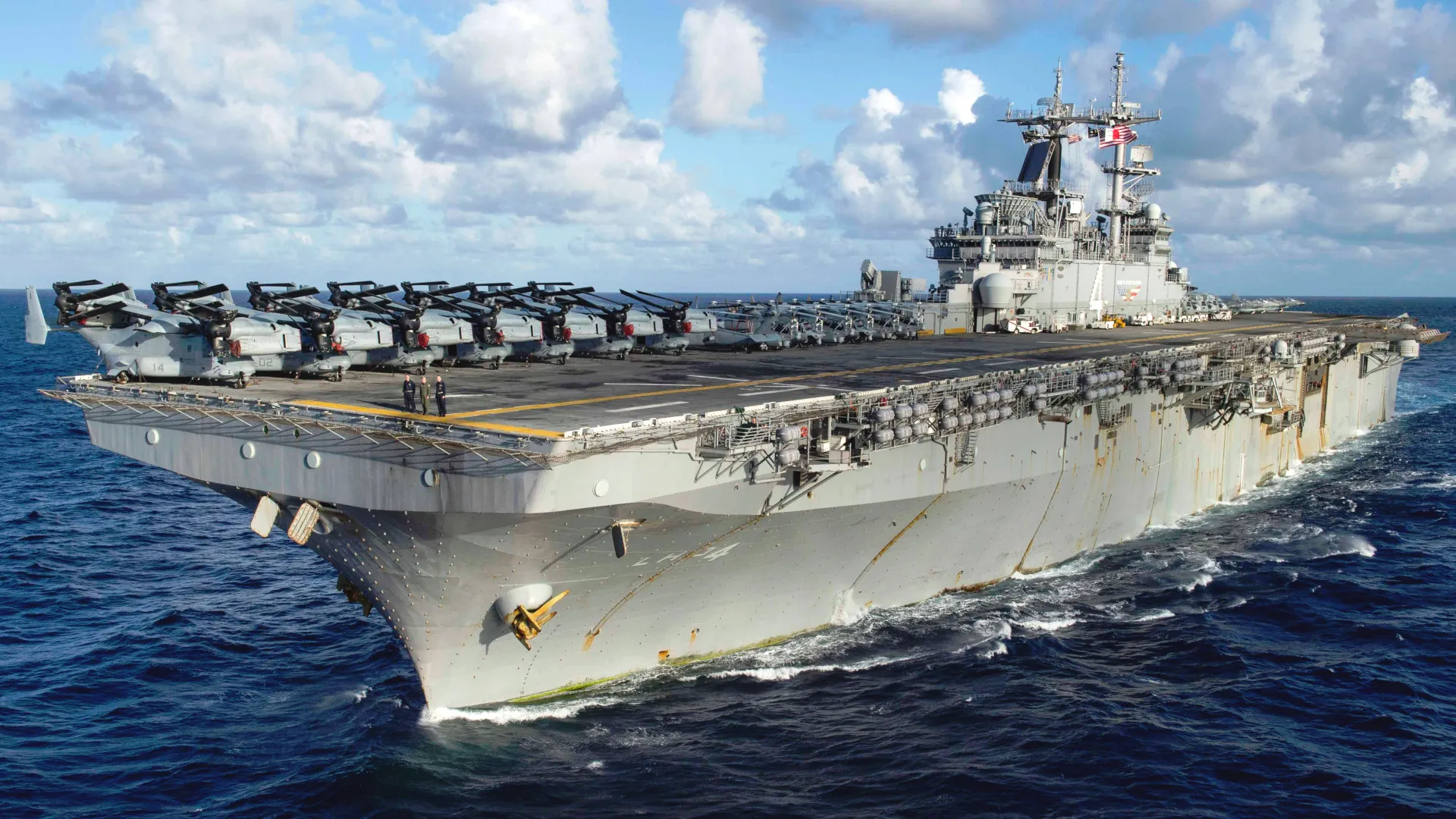
The Pentagon is reportedly sending the Wasp class amphibious assault ship USS Boxer and the rest of its Amphibious Ready Group (ARG), loaded with elements of the 11th Marine Expeditionary Unit (MEU). This comes as the Trump administration is reported to be increasingly considering seizing or blockading Iran’s highly strategic Kharg Island in the Persian Gulf as part of a new phase of Operation Epic Fury.
It has now been widely reported that what is described as an “accelerated” deployment of the Boxer Amphibious Ready Group and the 11th MEU from the West Coast will be in support of Operation Epic Fury.
#BREAKING#EXCLUSIVE The US military has accelerated the deployment of thousands of Marines and sailors to help reinforce US troops in the Middle East amid the war against Iran.
Four officials tell Newsmax the Boxer Amphibious Ready Group and the embarked 11th Marine…
The Boxer Amphibious Ready Group also includes two other amphibious warfare ships, theSan Antonio class USS Portland and the Whidbey Island class USS Comstock. The 11th MEU has roughly 2,500 personnel, in total, and includes air and ground components.
This follows reports last week that the America class amphibious assault ship USS Tripoli and its ARG, carrying elements of the 31st MEU, had also begun moving from the Pacific toward the Middle to support ongoing operations against Iran.
Axios reported today that the Trump administration could be leaning toward establishing a blockade around Iran’s Kharg Island, through which it exports much of its oil, or occupying it, citing unnamed officials. The central goal of doing this would be to step up pressure on the regime in Tehran to, in turn, force it to reopen the Strait of Hormuz. Traffic through that waterway has come to a virtual halt, which is causing massive reverberations across global energy markets.
“[Trump] wants Hormuz open. If he has to take Kharg Island to make it happen, that’s going to happen. If he decides to have a coastal invasion, that’s going to happen,” one official said, according to Axios. “But that decision hasn’t been made.”
The U.S. military carried out extensive strikes on Kharg Island this past weekend. A deployment of U.S. ground troops there would be a major escalation that could have significant ramifications, including domestically.
Last night, U.S. forces executed a large-scale precision strike on Kharg Island, Iran. The strike destroyed naval mine storage facilities, missile storage bunkers, and multiple other military sites. U.S. forces successfully struck more than 90 Iranian military targets on Kharg… pic.twitter.com/2X1glD4Flt
“We’ve always had boots on the ground in conflicts under every president, including Trump. I know this is a fixation in the media, and I get the politics, but the president is going to do what’s right,” a second official, who also said no decision has yet been made, said, per Axios.
A senior official told Axios: “We’ve always had boots on the ground in conflicts under every president, including Trump. I know this is a fixation in the media, and I get the politics. But the president is going to do what’s right.” https://t.co/6dbDy9zCHr
Just yesterday, TWZ spoke with Joseph Votel, the former commander of U.S. Central Command, with a particular focus on the tumultuous Strait of Hormuz, through which around 20 percent of the world’s oil passes. You can read that interview here.
In the meantime, publicly available flight-tracking data indicates that the U.S. Navy is using MQ-4C Triton intelligence, surveillance, and reconnaissance drones to monitor Kharg Island as part of their patrols of the northern Persian Gulf.
A US Navy MQ-4C Triton UAV just completed a reconnaissance mission of the northern Persian Gulf and Kharg Island.
Trump has warned that he might consider targeting oil facilities on the island if Iran or other countries “do anything to interfere” with the safe passage of ships through the strait.
Destroying or damaging oil infrastructure on Kharg could have unintended side effects, however. On the one hand, it would further push up global oil prices. The complex nature of infrastructure might take years to repair, which would compound this. In the long term, there is also the question of whether oil infrastructure here should be preserved for the benefit of a potential new Iranian government.
Any successor to the current regime would lose out on vital oil income, potentially driving further internal strife.
There is also the possibility that seizing the island and cutting off the current Iranian government from its most vital source of revenue could be used as a catalyst to bring about its fall.
Then there is the huge question about the kind of military effort that would be required to seize Kharg. This would require a large-scale, sustained operation and would be brought with risk. The island is only 20 miles from the Iranian mainland, putting whatever U.S. force is there at extreme risk of bombardment of multiple types. Getting amphibious assault ships through the Strait and into the Gulf would be an issue, as well, and those ships would be heavily targeted during transit and especially once inside the Gulf. With this in mind, a longer-range aviation assault would be most likely.
A naval blockade of the island might be easier to achieve in the short term, but it would run the risk of Iranian attacks, likely involving uncrewed surface vessels (USVs), drones, and other asymmetric options, as well as anti-ship cruise missiles, the use of which has been limited up to this point, as you can read about here.
As already noted, additional U.S. forces are headed to the region in the form of the Tripoli ARG and the 31st Marine Expeditionary Unit (MEU). While the deployment of the big-deck amphibious assault ship USS Tripolihad already been reported, we now know it is being supported by the amphibious transport docks USS San Diego (LPD-22) and USS New Orleans (LPD-18), thanks to publicly available ship-tracking data.
USS Tripoli (LHA 7) America-class amphibious assault ship westbound in the Singapore Strait – March 17, 2026 SRC: INST- sgshipspotting pic.twitter.com/iC4qBZUZML
What exactly the next phase of Operation Epic Fury will look like could be clearer as the Navy amphibious warfare ships and the thousands of Marines they are carrying get closer to the Middle East.
UPDATES
UPDATE: 6:16 PM EST –
There are some mixed messages coming out of Washington about the future of Epic Fury.
President Donald Trump said he is considering “winding down” the war on Iran. His comments, delivered on his Truth Social account, come even though two Marine Expeditionary Units (MEUs) are steaming toward the Middle East and the Pentagon has reportedly drawn up plans to put American troops into Iran with the president’s approval.
Trump added that the U.S. could end the war effort even with the Iranians still closing the Strait of Hormuz.
“We are getting very close to meeting our objectives as we consider winding down our great Military efforts in the Middle East with respect to the Terrorist Regime of Iran,” Trump proclaimed.
He stated that the U.S. has: “(1) Completely degrading Iranian Missile Capability, Launchers, and everything else pertaining to them. (2) Destroying Iran’s Defense Industrial Base. (3) Eliminating their Navy and Air Force, including Anti Aircraft Weaponry. (4) Never allowing Iran to get even close to Nuclear Capability, and always being in a position where the U.S.A. can quickly and powerfully react to such a situation, should it take place. (5) Protecting, at the highest level, our Middle Eastern Allies, including Israel, Saudi Arabia, Qatar, the United Arab Emirates, Bahrain, Kuwait, and others.”
The Strait, Trump added, “will have to be guarded and policed, as necessary, by other Nations who use it — The United States does not! If asked, we will help these Countries in their Hormuz efforts, but it shouldn’t be necessary once Iran’s threat is eradicated. Importantly, it will be an easy Military Operation for them.”
Since Day One of Operation Epic Fury, President Trump clearly outlined the U.S. Military’s objectives to end the threat of the Iranian terrorist regime.
The President and the Pentagon predicted it would take approximately 4-6 weeks to achieve this mission.
Our coverage has ended for the day. Stay tuned for more.
UPDATE: 5:15 PM EST –
Retired Marine Gen. James Mattis, who served as Defense Secretary and CENTCOM commander, weighed in on the war, saying he doesn’t believe regime change is likely.
Former General Jim Mattis says that it’s “very unlikely” that this Iranian regime falls right now.
“They’ve told the Iranian parents, don’t let your sons and daughters demonstrate because we will shoot them. We will go after them. So no, they’re not going to go away anywhere… pic.twitter.com/gq3RzIpPlZ
— Firing Line with Margaret Hoover (@FiringLineShow) March 20, 2026
Iranian state media warns Iran will target the UAE’s industrial port city of Ras Al-Khaimah if Iranian islands are again attacked from that nation, Arab News reported.
UPDATE: 4:20 PM EST –
Trump ruled out any ceasefire with Iran.
.@POTUS: “We can have dialogue, but I don’t want to do a ceasefire. You don’t do a ceasefire when you’re literally obliterating the other side… we’re not looking to do that.” pic.twitter.com/g2Yjik41GS
He suggested that re-opening the Strait is “a simple military maneuver.”
.@POTUS on opening the Strait of Hormuz: “It’s a simple military maneuver, it’s relatively safe, but you need a lot of help in the sense that you need ships, you need volume. NATO could help us but they so far haven’t had the courage to do so… it would be nice if the countries,… pic.twitter.com/KDOWOI3rgx
The president also declined to say if he will order troops into Iran.
REPORTER: Are you deploying additional troops to the region for deterrence or to optimize your operational capabilities?@POTUS: “I would say this, that if I told you the answer to that question, my military people wouldn’t be very happy — but we have a lot of troops, we have… pic.twitter.com/2jX7t4tgqq
CBS News is reporting that Pentagon officials have made detailed preparations for deploying U.S. ground forces into Iran. The network cited multiple sources briefed on the plans..
“Senior military commanders have submitted specific requests aimed at preparing for such an option as President Trump weighs moves in the U.S.-Israel-led conflict with Iran, the sources said,” according to CBS. The news outlet’s sources do not specify how those troops would be used. Meanwhile, the Trump administration hasn’t committed to any such plan to put boots on the ground, which would greatly escalate the war.
CENTCOM provided us an update of the number of troops wounded so far in Epic Fury. To date there have been 232 wounded, up from about 200 on Monday. Of those troops, 207 returned to duty. The number of seriously wounded has held steady at 10. The Associated Press was the first to report these details.
The command also shared video of what it says was an attack on The Esfahan Khomeynishahr Drone Production Plant that produced Shahed one-way attack drones.
The Esfahan Khomeynishahr Drone Production Plant produced Shahed one-way attack drones that have been used by the Iranian regime to attack targets across the region. The photo dated March 3, 2026, shows the plant before U.S. strikes. The photo taken on March 12, 2026 shows the… pic.twitter.com/nXxYpv2eyw
New video shows another Iranian cluster munition exploding over Israel. There were no reports of injuries from the attack, which was the ninth so far this evening, according to Times of Israel military correspondent Emanuel “Mannie” Fabian in a post on X.
One of the missiles launched by Iran at central Israel a short while ago carried a cluster bomb warhead, footage shows.
There are no reports of injuries in the attack, the ninth from Iran since midnight. pic.twitter.com/pH2IMCmSOq
— Emanuel (Mannie) Fabian (@manniefabian) March 20, 2026
NATO provided us a statement about pulling its forces out of Iraq as Iranian-backed militias have carried out several attacks there:
“‘I would like to thank the Republic of Iraq and all the Allies who assisted in the safe relocation of NATO personnel from Iraq,’ said Gen. Alexus Grynkewich, Supreme Allied Commander Europe. “‘ would also like to thank the dedicated men and women of NATO Mission Iraq, who continued their mission throughout this period. They are true professionals.’
The last NATO Mission Iraq personnel departed the country on March 20.
NATO Mission Iraq will continue from Joint Force Command Naples. NMI is a non-combat advisory and capability-building mission to assist Iraq in building more sustainable, transparent, inclusive and effective security institutions and forces, so that they themselves are able to stabilise their country, fight terrorism, and prevent the return of ISIS/Daesh.”
Amidst the conflict in the Middle East, the NATO Mission in Iraq has relocated its personnel from the Middle East to Europe, per a release from NATO’s SHAPE page. pic.twitter.com/lSNZ4tH8Kh
Iraq declared a ”force majeure” on all oilfields developed by foreign oil companies, as attacks in the region have disrupted navigation through the Strait of Hormuz,” Al Arabiya reported on X. This is ”preventing most of the country’s crude exports from moving,” oil ministry sources told the outlet.
A force majeure is a contractual clause freeing parties from liability due to extraordinary, unavoidable events, like the war.
Iraq declares force majeure on all oilfields developed by foreign oil companies, as attacks in the region have disrupted navigation through the Strait of Hormuz, preventing most of the country’s crude exports from moving, oil ministry sources say. pic.twitter.com/8mFHXiaRBP
The U.K. Defense Ministry offered its latest update on the war.
The Iranian space program, one of the most advanced in the Middle East, has suffered extensive damage from US and Israeli airstrikes,Bloomberg News reported. The attacks are “potentially driving Tehran to deepen cooperation with China and Russia,” the outlet posited.
The Iranian space program, one of the most advanced in the Middle East, has suffered extensive damage from US and Israeli airstrikes, potentially driving Tehran to deepen cooperation with China and Russia https://t.co/aApWOdfCao
Earlier in our story, we noted that the USS Boxer (ARG) was deploying to the Middle East. Images emerged on line of the Boxer, the Portland and the Comstock departing San Diego.
The USS Boxer Amphibious Ready Group and the 2,500 Marines from the 11th MEU are heading to the Middle East as the US builds up its amphibious assault capabilities in the region.
The USS Boxer, USS Portland, and USS Comstock departed San Diego over the past 48 hours. pic.twitter.com/SKWTleAbG7
Ukrainian President Volodymyr Zelensky is once again touting a deal to provide drones to the U.S., an arrangement Trump has so far dismissed.
“I am very interested in signing this agreement with our close partner – the United States of America,” Zelensky stated on X. “So when President Trump is ready, I will definitely be ready. Our negotiating team will discuss this issue at the meeting in the United States.”
As early as a year ago, we proposed a Drone Deal to the United States of America, because it is our key partner.
The agreement is not only about interceptor drones. First and foremost, it includes naval drones and long-range drones that have been proven in the war. It also…
— Volodymyr Zelenskyy / Володимир Зеленський (@ZelenskyyUa) March 20, 2026
Jerusalem’s Old City, home to some of the most sacred sites in Christianity, Islam and Judaism, was reportedly hit by missile shrapnel that fell near the Al-Aqsa Mosque compound. The official Turkish Anadolu news outlet reported that missile fragments also fell in the Jewish Quarter near Jerusalem’s Old City, amid heightened tension and a security alert in the area.
Shrapnel landed in several locations across Jerusalem, with no immediate details available on the extent of the damage, Anadolu added, citing Israeli media.
Another video shows the moment a fragment from an Iranian ballistic missile struck Jerusalem’s Old City this afternoon. pic.twitter.com/qNvTXmRDr6
— Emanuel (Mannie) Fabian (@manniefabian) March 20, 2026
Shipping giant Hapag-Lloyd provided us with a statement on the current state of their maritime commerce.
“We are monitoring the situation very closely, but the situation in the Middle East remains very fluid. Based on our current risk assessment, we have suspended all transits through the Strait of Hormuz and the Suez Canal as well as bookings from and to the Upper Gulf region. As a result, schedules and port calls may change at short notice, and some services will be adjusted. We have contingency plans in place, and the safety of our people on ground and ocean remains our top priority. Our teams are working closely together to find the best possible solutions for our customers’ shipments.”
A Greek-owned medium-sized cargo vessel, also known as a panamax, became the first bulk carrier to transit the Strait of Hormuz with its Automatic Identification System on since March 2, according to Lloyd’s List.
A Greece-owned panamax has become the first bulk carrier to transit the Strait of Hormuz with its Automatic Identification System turned on since March 2. pic.twitter.com/gfNjJsz517
Moscow proposed a quid pro quo to the U.S. under which the Kremlin would stop sharing intelligence information with Iran, such as the precise coordinates of U.S. military assets in the Middle East, if Washington ceased supplying Ukraine with intel about Russia, according to a report from Politico. The outlet cited two people familiar with the negotiations.
Moscow proposed a quid pro quo to the US under which the Kremlin would stop sharing intelligence information with Iran – such as the precise coordinates of US military assets in the Middle East – if the US ceased supplying Ukraine with intel about Russia.https://t.co/rpN0x8XqOZ
The Israel Defense Forces (IDF) and Iranian media have both reported the death of Iran’s Islamic Revolutionary Guard Corps (IRGC) spokesperson, Ali Mohammad Naeini. The Israeli military said in a post on X that he was killed in an overnight airstrike.
Just before his death, Naeini issued a statement insisting Iran was still able to produce missiles despite the attacks from Israel and the United States.
Naeini made the comment in response to a claim by Israeli Prime Minister Benjamin Netanyahu that Iran could no longer build missiles. Referencing how Iranian schools consider a 20 as a perfect score, Naeini said: “Our missile industry score is 20 and there is no concern in this regard because we are producing missiles even during war conditions, which is amazing, and there is no particular problem in stockpiling.”
Naeini joins a growing list of high-profile Iranian regume figures who have been killed so far in the conflict, others including the former supreme leader Ali Khamenei, the security chief Ali Larijani, head of the paramilitary Basij force, Gholamreza Soleimani, and the intelligence minister, Esmail Khatib.
Tehran has accused the United Kingdom of “participation in aggression,” reflecting the fact that the country has permitted the U.S. Air Force to use its airbases as a launchpad for bombing missions over Iran.
Iranian Foreign Minister Abbas Araghchi warned his British counterpart, Yvette Cooper, and insisted on his country’s right to self-defence. “These actions will definitely be considered as participation in aggression and will be recorded in the history of relations between the two countries. At the same time, we reserve our inherent right to defend the country’s sovereignty and independence,” Araghchi said on his official Telegram channel.
⚡️🇺🇸🇬🇧🇮🇷 Footage of a US Air Force B-52H bomber returning to the UK following a reported strike mission linked to operations against Iran.
US B-52 and B-1 bombers have been deployed to RAF Fairford and are known to be conducting long-range strike missions. pic.twitter.com/m3sj39PHc3
U.S. Central Command says that it has destroyed an Iranian ballistic missile plant in Karaj, to the west of Tehran. The plant was used to “assemble ballistic missiles that threatened Americans, neighboring countries, and commercial shipping,” CENTCOM said.
Prior to Operation Epic Fury, the Iranian regime used the Karaj Surface-to-Surface Missile Plant to assemble ballistic missiles that threatened Americans, neighboring countries, and commercial shipping. The photo dated March 1, 2026, shows the plant prior to U.S. strikes. The… pic.twitter.com/QEs5toZQpX
Satellite imagery from Bandar Abbas suggests that airstrikes have targeted the naval base and port facilities once again. The imagery below shows fires burning at several different structures, although the level of overall damage is not entirely clear.
BDA Update: Bandar Abbas Southern Fleet HQ Mar 18 high-res imagery confirms another wave of strikes near the primary navy piers
➡️Impacts focused heavily on the infrastructure and support buildings just off the waterfront ➡️Active fires with at least 6 distinct structures… pic.twitter.com/KPFAMNacst
Other recent targets of U.S. airstrikes appear to include Qeshm Island in the Strait of Hormuz. Satellite imagery shows cratering, but it unclear if the attacks collapsed the IRGC’s tunnel complex that is understood to be on the island. The underground complex is reportedly used to store small boats, missiles, and drones.
A U.S. strike hit the IRGC’s tunnel complex on Qeshm Island, causing visible surface damage (craters, hits on nearby facilities), but failed to destroy or penetrate the hardened underground tunnels, meaning key assets likely survived.
Israel conducted airstrikes on Tehran today, as Iranians marked Nowruz, the Persian New Year. In a statement on X, the Israel Defense Forces said: “The IDF has now begun a wave of strikes targeting infrastructure of the Iranian terror regime in the heart of Tehran.”
Meanwhile, there are growing questions about the degree to which Israel and the United States are on the same page as regards the war against Iran.
Israeli Prime Minister Benjamin Netanyahu has said that Israel acted alone in the bombing of Iran’s South Pars gas field, one of the largest in the world. He also confirmed that Trump had asked Israel to stop any further such attacks. “President Trump asked us to hold off on future attacks, and we’re holding out,” Netanyahu explained.
Iran is being “decimated” and no longer had the capacity to enrich uranium or make ballistic missiles, but a revolution in the country would require a “ground component,” Netanyahu added.
When asked whether he had dragged Trump into the conflict, Netanyahu responded: “Does anyone really think that someone can tell President Trump what to do?” Netanyahu told reporters, at a press conference. “He didn’t need any convincing,” he added. “I don’t think any two leaders have been as coordinated as President Trump and I. He’s the leader. I’m, you know, his ally.”
Israel, Kuwait, and the United Arab Emirates today all announced that their air defenses were responding to Iranian missile attacks. Elsewhere in the region, Bahrain’s interior ministry announced an air raid alert, while Saudi Arabia’s defence ministry said it had intercepted a drone in the country’s east.
Kuwait’s state oil firm KPC reported that its Mina Al-Ahmadi refinery was hit by multiple drone attacks early on Friday, causing a fire in some units. No initial casualties were reported, according to the state news agency.
Early this morning, multiple Iranian attack drones hit Kuwait’s Mina Al-Ahmadi oil refinery, setting several areas of the refinery complex ablaze and causing a partial shutdown. pic.twitter.com/9HwqC0fHZi
Iranian attacks on energy infrastructure have taken a toll on Qatar, too. Ras Laffan Industrial City in Qatar has been forced to reduce the country’s liquefied natural gas (LNG) export capacity by 17 percent, according to QatarEnergy, the state-run energy giant. The “extensive damage” could reportedly reduce its annual revenues by $20 billion and take “up to five years” to repair.
Footage shows a fire and the moment of impact of an Iranian ballistic missile in Ras Laffan Industrial City, home to the world’s largest liquefied natural gas (LNG) production. pic.twitter.com/zIyGJ5p9ue
Iran has also launched strikes against energy infrastructure in Israel.
According to Israel’s energy ministry, an Iranian missile attack — reportedly using cluster warheads — hit oil refineries in the northern port city of Haifa but did not cause “significant damage.” Energy Minister Eli Cohen added that power was disrupted, but electricity was soon restored to most of those who were affected.
The video below purports to show debris from an intercepted Iranian ballistic missile landing on a car in central Israel.
According to the Fars news agency, the Iranian military has reportedly threatened American and Israeli military personnel and officials. In a post on Telegram, the agency quoted a senior spokesperson for Iran’s armed forces as saying: “We are keeping an eye on your cowardly officials and commanders, your wicked pilots and soldiers… From now on, based on the information we have from you, the world’s tourist attractions, resorts, and entertainment centers will not be safe for you either,” the spokesperson reportedly said.
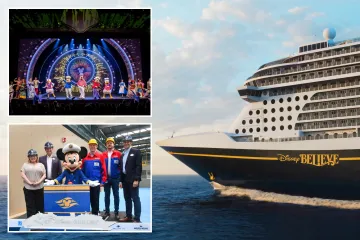
DISNEY is launching another cruise ship next year – with some first time princess appearances.
In 2027, Disney Cruise Line will be launching its ninth ship called the Disney Believe.
Sign up for the Travel newsletter
Thank you!
Disney Cruise Line is launching a new ship next year called Disney BelieveCredit: Disney Cruise Line
The ship will be the fourth ship in the Wish class, joining Disney Wish, Disney Treasure and Disney Destiny.
It will be themed on “dreamers and doers who dare to pursue their own happily ever after”.
On board, stories that will be featured will be from Disney, Pixar, Marvel, and Star Wars.
Each Wish class ship features its own theme, for example Disney Wish is enchantment-themed, Disney Treasure is adventure-themed and the Disney Destiny is heroes and villains-themed.
Disney Believe will be ‘promise and possibilities-themed’.
Disney Cruise Line stated: “Onboard the Disney Believe, powerful tales of characters who believe in themselves and their dreams will come to life in exciting new ways.
“From the mystical worlds of Encanto and Frozen, to the wishing wells of Snow White, to the depths of the sea with Moana and The Little Mermaid, there are endless stories waiting to be discovered and new chapters ready to unfold onboard.”
These characters already feature onboard some of the Wish class ships, with an Arendelle dining experience onboard the Disney Wish.
However, Snow White currently does not feature prominently on any of the current Wish class ships.
The Disney Believe is expected to launch in late 2027.
Disney also announced last month that the Disney Wish ship will be coming to the UK next year.
The ship will sail from Southampton on three to seven-night European sailings.
Entering through the Grand Hall, passengers will meet famous Disney princes and princesses.
Inside each stateroom, passengers will find spacious wardrobes, sprawling beds and a theme specific to a Disney character.
Disney Believe will be promise and possibilities-themedCredit: Disney Cruise
When it comes to food on board the ship, guests won’t be short for choice, with market-style buffet options and immersive dining adventures, such as Arendelle: A Frozen Dining Adventure.
As for other entertainment, passengers can head to West-End style shows including Disney Seas the Adventure, where passengers follow Goofy on a journey sailing the ship.
For a thrilling adventure, head on the Disney AquaMouse ride, which features lighting, special effects and scenes of Mickey and Minnie on different adventures.
And the ultimate night for the whole family is Pirates’ Night, where Captain Jack Sparrow takes a fateful leap from the ship’s funnel.
Parents wanting some time to themselves can check their kids into either the full-service nursery or kids and teens clubs before exploring the ship’s adult-only spaces such as the Senses Spa & Salon.
The cheapest sailing is a three-night Belgium cruise from Southampton, sailing to Zeebrugge (Bruges) in Belgium costing from £1,633 for two people.
In other cruise news, here’s the ultimate family cruise – it has a water roller coaster, a private island and an onboard beach club.
It was so big it couldn’t use the English Channel, Suez Canal or Panama Canal.
The biggest ship in the world was taller than iconic buildings(Image: Cheunghyo/Getty)
The biggest ship in the world was longer than both the Eiffel Tower and the Empire State Building. It was known as the Seawise Giant and became one of the longest self-propelled ships in history.
The boat, later called Happy Giant, Knock Nevis and Mont, was built in Japan between 1974 and 1979. It had the greatest deadweight tonnage of a ship ever recorded.
Fully laden, it was 657,019 tonnes and was the heaviest in the world. Seawise Giant had a draft of 24.6 meters (81ft) and a length of 458.45 meters (1,504.1 ft).
Due to its size, it was incapable of navigating the English Channel, the Suez Canal or the Panama Canal.
The ship has a long history, and was created by Sumitomo Heavy Industries, Ltd in Yokosuka, Kanagawa, Japan, as an Ultra Large Crude Carrier.
It remained unnamed for a long time and was identified as its hull number, 1016. The ship suffered severe vibration problems during sea trials, and an unknown Greek owner refused to take delivery of it.
Eventually, the Japanese shipyard sold the ship thanks to a deal with Hong Kong Orient Overseas Container Line. Yet, they wanted to lengthen the ship by several meters and add 146,152 tonnes of cargo capacity.
Two years later, the ship relaunched as the Seawise Giant. In 1988, it was damaged during the Iran-Iraq war after fires erupted aboard the ship, and oil spread into the water.
The ship was still intact but was so damaged it was not deemed economical to repair.
However, a Norwegian investment firm bought the damaged ship. Over the next few years, it was repaired and renamed Happy Giant.
Up until 2004, the ship was owned by various Norwegian investment firms. It was then purchased by First Olsen Tankers and renamed Knock Nevis.
The ship was converted into a primarily moored storage tanker in the Persian Gulf.
However, it was then taken on by new owners Amber Development and named Mont. It had one final voyage to India where the ship was scrapped.
The ship was beached in December 2009 and due to its size, it took until the end of 2010 for it to be scrapped. The Seawise Giant’s anchor was saved and is on public display in Hong Kong.
It goes down in history as the longest ship ever constructed at 458.45 meters and is taller than many of the world’s tallest buildings. The Eiffel Tower stands at 330 meters and the Empire State Building at 443 meters.