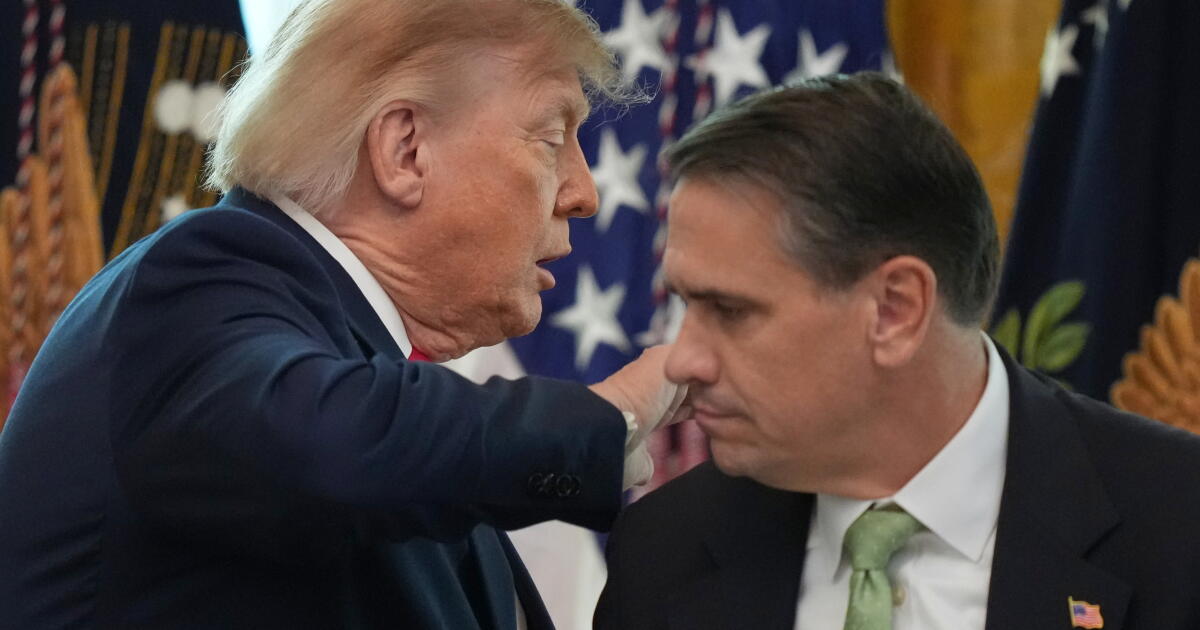
WASHINGTON — U.S. Atty. Gen. Todd Blanche on Sunday defended the Trump administration’s lawsuit to block certification of Alaska’s Senate results if Republican incumbent Dan Sullivan loses the race, arguing that the legal challenge was a necessary step to avoid confusing voters in the closely watched midterm race.
Some election experts have said the move is another attempt by the Trump administration to meddle in the Nov. 3 midterm elections in the event Republicans don’t fare well. Democrats as well as some Republicans have criticized it.
Blanche, however, said on CNN’s “State of the Union” that President Trump — who said Friday in reference to the lawsuit that he was “the one that said do it” — is not trying to overturn state election results “in any way, shape or form.”
“We wish that we didn’t have to do this. We hope for a resolution that works,” Blanche said.
Republicans fear that a second candidate on the ballot who is named Dan Sullivan — a retired teacher and school administrator from the tiny fishing community of Petersburg — could siphon away votes from the GOP senator and tip the outcome in favor of Democrat Mary Peltola, a former congresswoman. Because Alaska has ranked-choice voting, there are more than two candidates on the general election ballot.
A day after the lawsuit was filed Thursday, Peltola called it “just flagrant, flagrant corruption, in my opinion,” and a diversion tactic by Republicans. Alaska’s other Republican senator, Lisa Murkowski, also criticized the lawsuit in a social media post.
Trump told reporters Sunday that he believed the ballot was illegal because it was unfair and that Sen. Sullivan should be identified to voters as the sitting senator. Courts, however, have ruled otherwise, upholding both Sullivans’ spots on the ballot.
“At least let him use the name Sen. Dan Sullivan as opposed to incumbent, because a lot of people don’t know what incumbent means,” Trump said.
Alaskan voters will see “Dan S. Sullivan” identified as a “registered Republican” and “incumbent” on their ballots, while “Daniel J. Sullivan Jr.” is listed without party affiliation.
Blanche represented Trump as a personal attorney — including the case in which Trump was convicted of felony fraud — before the Republican president appointed him to lead the Department of Justice, which filed the lawsuit in Alaska. Blanche defended Trump in his election inference case before voters elected Trump to a second White House term, effectively ending the criminal prosecution.
Blanche told CNN host Dana Bash that it was “crazy” for her to ask him if Trump was trying to lay the groundwork for the same sort of election challenges that occurred before a mob of his supporters stormed the U.S. Capitol on Jan. 6, 2021 — the source of the election interference case, in which Trump was indicted on felony charges, and for which he was impeached.
“We are not doing anything improper. We’re not doing anything we’re not allowed to do. And we have to let the process play out,” Blanche said. “But I do think it’s important for the American people to understand that we are not — [and] President Trump is not — trying to take over a state election in any way shape or form.”
The lawsuit, Blanche said Sunday on CBS’ “Face the Nation,” is meant to “put guardrails in place” to preserve possible evidence of voter confusion at the polls.
“It’s not saying, ‘Don’t certify.’ It’s saying, ‘If a court ultimately determines that it was decided because of confusion and not the will of the voters, then we do not think the states should certify.’ And that’s consistent with federal law and consistent with even Alaskan law, if that happens,” he said.
Kunzelman writes for the Associated Press. AP writer Josh Boak contributed to this report.
European football leaders meet on Wednesday with the aim of shaping strategy to oust Gianni Infantino as FIFA president.
Published On 7 Oct 20267 Oct 2026
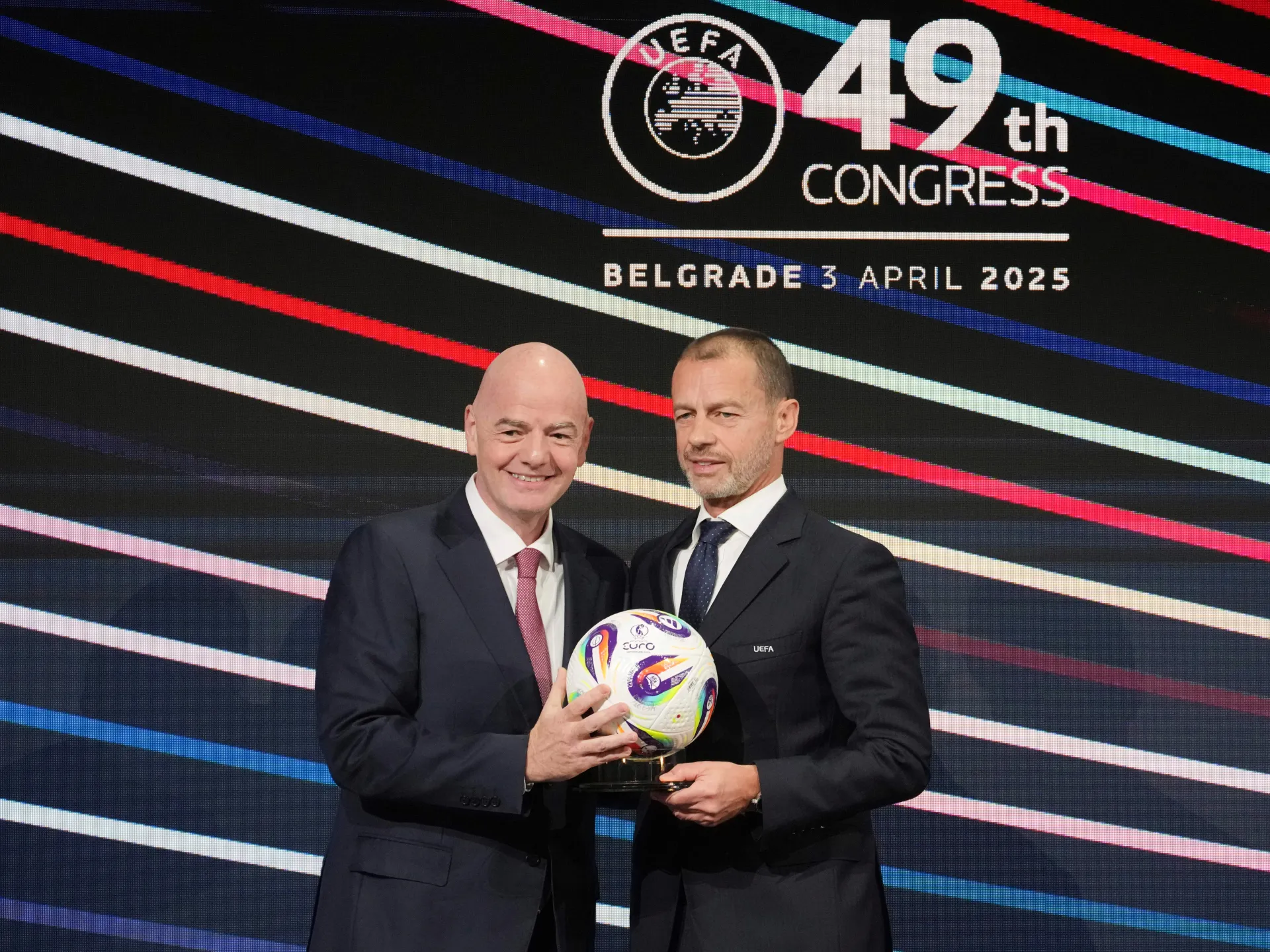
European football leaders were gathering Wednesday with time pressing to find a candidate and shape their strategy for trying to oust Gianni Infantino as president of FIFA.
UEFA has called its 55 member federations to a previously scheduled summit on Thursday in Berlin that arrives in the midst of European efforts to get a new leader for football’s world body.
Recommended Stories
list of 4 itemsend of list
Infantino’s divisive World Cup private investment plan – that failed within days of being revealed in July – pushed UEFA to act on longstanding mistrust of its former employee’s increasingly executive presidency at FIFA.
UEFA’s longer-term plans include preparing a criminal complaint against Infantino in Switzerland for possible financial mismanagement in the World Cup sell-off deal. It has asked courts in the United States to authorise discovery of evidence.
“Somewhere along the way things went too far with FIFA, and we’re looking to put things back where they belong,” UEFA general-secretary Theodore Theodoridis said last month.
Europe’s 55 count for more than a quarter of FIFA’s 211 member federations that can vote in the election on March 18 in Rabat, Morocco. Research by The Associated Press news agency suggests Infantino already has about 90 votes pledged – albeit before any potential opponent is known.
Still, UEFA is not a united bloc. Infantino has support promised from Azerbaijan, the home country of a close aide, and Latvia. On Wednesday he met with football and government officials in the Czech capital Prague.
First, UEFA and its allies worldwide need to agree on at least one candidate to challenge Infantino by the November 18 deadline to enter the race.
UEFA President Aleksander Ceferin was joined in August by his fellow FIFA vice presidents from Asia and North America in denouncing Infantino for deception and breach of trust over the World Cup sell-off plan.
Still, neither Ceferin nor his counterparts at the AFC and CONCACAF, Sheikh Salman bin Ebrahim Al Khalifa of Bahrain and Victor Montagliani of Canada, currently look set to be on the FIFA ballot.
Ceferin has long dismissed any talk of himself running to lead FIFA, though he said last month at UEFA meetings in Greece there were “many, many” potential candidates.
Montagliani is expected to focus on his own re-election at CONCACAF in February.
Sheikh Salman has been Infantino’s FIFA election opponent before. He had been favourite in a five-man campaign that Infantino eventually won in February 2016.
Speculation has often pointed to Paris Saint-Germain president Nasser Al-Khelaifi, a close ally of Ceferin. The Qatari member of UEFA’s executive committee ruled himself out last week at a meeting of the influential European Football Clubs group he leads.
Infantino is part of UEFA’s focus in Berlin for the biennial business meeting of top executives from its member federations, which can debate policy, strategy and international football competitions.
The meeting is expected to discuss proposals for a more transparent FIFA and a presidential candidate willing to commit to those reforms.
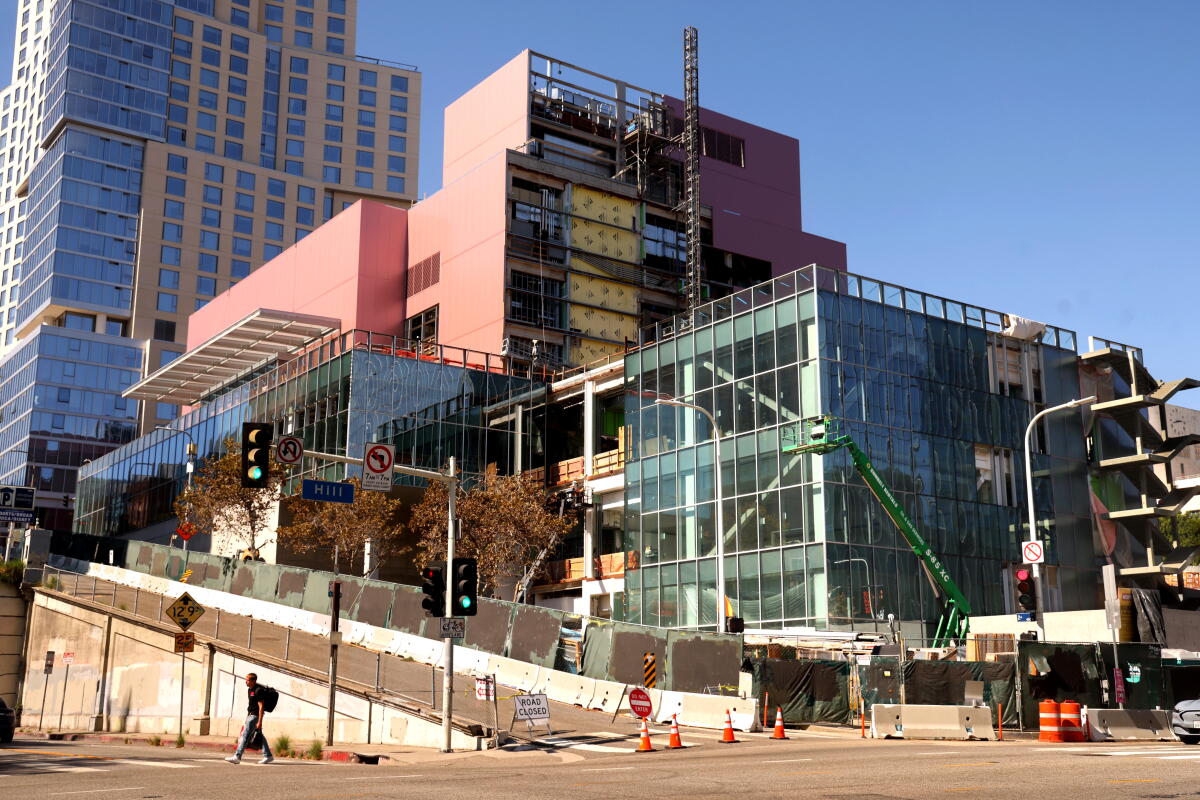
A pet project of architect Frank Gehry, a smaller concert hall to complement his legendary Walt Disney Concert Hall, is taking shape in downtown Los Angeles for an opening next September.
Elements Gehry devised to set it apart are already visible, as construction on the $337-million addition to the Colburn School of Performing Arts reveals details the architect conceived years ago.
The centerpiece of the expansion will be a 1,000-seat concert hall named for Pasadena philanthropists Terri and Jerry Kohl with an in-the-round design meant to create intimacy between the performers and the audience. The hall will include an orchestra pit and a stage similar in size to the one at Disney Hall so it can accommodate grand orchestra, opera and dance performances.
The Colburn Center, still under construction, in downtown Los Angeles last week.
(Genaro Molina / Los Angeles Times)
Gehry set out to create an immersive hall that would inspire artists and envelop the audience, said Meaghan Lloyd, his chief of staff and right-hand at his firm, Gehry Partners.
“Frank’s passion was bringing the audience closer to the performers and getting the relationship between the two just right, so that the audience can feel the performers, the performers can feel the audience reacting,” Lloyd said.
Kohl Hall will be part of the school where Colburn’s symphony orchestra, bands, youth string programs and children’s choirs will perform. It will also be available for rent for outside productions such as jazz and classical music concerts. It is expected to be in use more than 200 times a year.
Architect Frank Gehry with a model of his design for an addition for Colburn School.
(Christina House / Los Angeles Times)
The hall will open with a concert on Sept. 25, the Colburn School announced Tuesday. The weekend celebration will include inaugural performances at the Dance Center, a new dance instruction and performance venue being built as part of the 100,000-square-foot Gehry-designed addition.
The new Dance Center will double facilities for the school’s Trudl Zipper Dance Institute. The dance facilities will include a 100-seat theater for dance and four professional-size studios for dance instruction and rehearsal.
Beginning next year, the hall will be the home of the Los Angeles Chamber Orchestra, a group of professional musicians about half the size of the Los Angeles Philharmonic. LACO concerts will feature premieres of new fanfares by celebrated film composers, including a work by John Williams to be performed at LACO’s inaugural concert in the hall.
Meaghan Lloyd, chief of staff and partner at Gehry Partners, left, and Sel Kardan, president and chief executive of the Colburn School, look over construction of the Terri and Jerry Kohl Hall.
(Genaro Molina / Los Angeles Times)
Part of the hall’s commercial appeal is expected to be its size, in a sweet spot between the 2,265-seat Disney and the popular 415-seat Herbert Zipper Concert Hall already on the Colburn campus. The nearby Dorothy Chandler Pavilion seats about 3,200 guests. The Peacock Theater at L.A. Live seats 7,100.
Kohl Hall’s in-between size “is the missing piece of the venue puzzle” for Los Angeles, Colburn President Sel Kardan said.
A key feature already in place, hanging from the ceiling, is an array of steel clouds packed with concrete, designed to improve acoustics and evoke a sense of airiness. The clouds were made in the Netherlands by a firm with a history of building steel ship hulls that now specializes in building complex steel constructions like the clouds using digital data.
Visitors stand underneath concrete sound clouds designed to improve acoustics.
(Genaro Molina / Los Angeles Times)
The exterior metal cladding of the addition features a luminescent pink paint coating called Pink Kandi.
Japanese acoustical engineer Yasuhisa Toyota will serve as the hall’s acoustician, as he has for all of Gehry’s concert halls, beginning with Disney Hall.
The long-awaited Colburn School addition will be the third Gehry-designed building on Bunker Hill, which already has Disney Concert Hall and the Grand LA, a $1-billion apartment, hotel and retail complex he designed for New York mega-developer Related Cos.
The Colburn School dates to 1950 and moved to its current location downtown in 1998, where it has more than 2,000 students, most of whom range from middle school to college age.
The newbies have a lot of work to do: The Lakers lost 50.8% of their points, 55.7% of their rebounds and 47% of their assists from last year. As coach JJ Redick acknowledged during his preseason press conference alongside Rob Pelinka, “There’s a lot of minutes … up for grabs.”
All things Lakers, all the time.
Get all the Lakers news you need in Thuc Nhi Nguyen’s weekly newsletter.
By continuing, you agree to our Terms of Service, which include arbitration and a class action waiver. You agree that we and our third-party vendors may collect and use your information, including through cookies, pixels and similar technologies, for the purposes set forth in our Privacy Policy such as personalizing your experience and ads.
We know three of the starters. We start with the biggest question mark in that rotation:
Position battle we’re watching most this preseason
Austin Reaves has tormented the NBA with his crafty finishes in the lane and step-back threes. In many of his new Lakers’ teammates, he has found equally frustrating counterparts, defenders that twist him into knots like he does to them.
It’s the best — and most important — problem for the Lakers to have. The Lakers’ deep group of perimeter defenders have the most to prove and could be the biggest X-factor in the season’s success.
The wing group felt so unsettled late into the offseason that the Lakers were among the final teams willing to wait out the Jonathan Kuminga sweepstakes. The 6-foot-7 forward did not make his decision until Aug. 26, spurning the Lakers for the Minnesota Timberwolves.
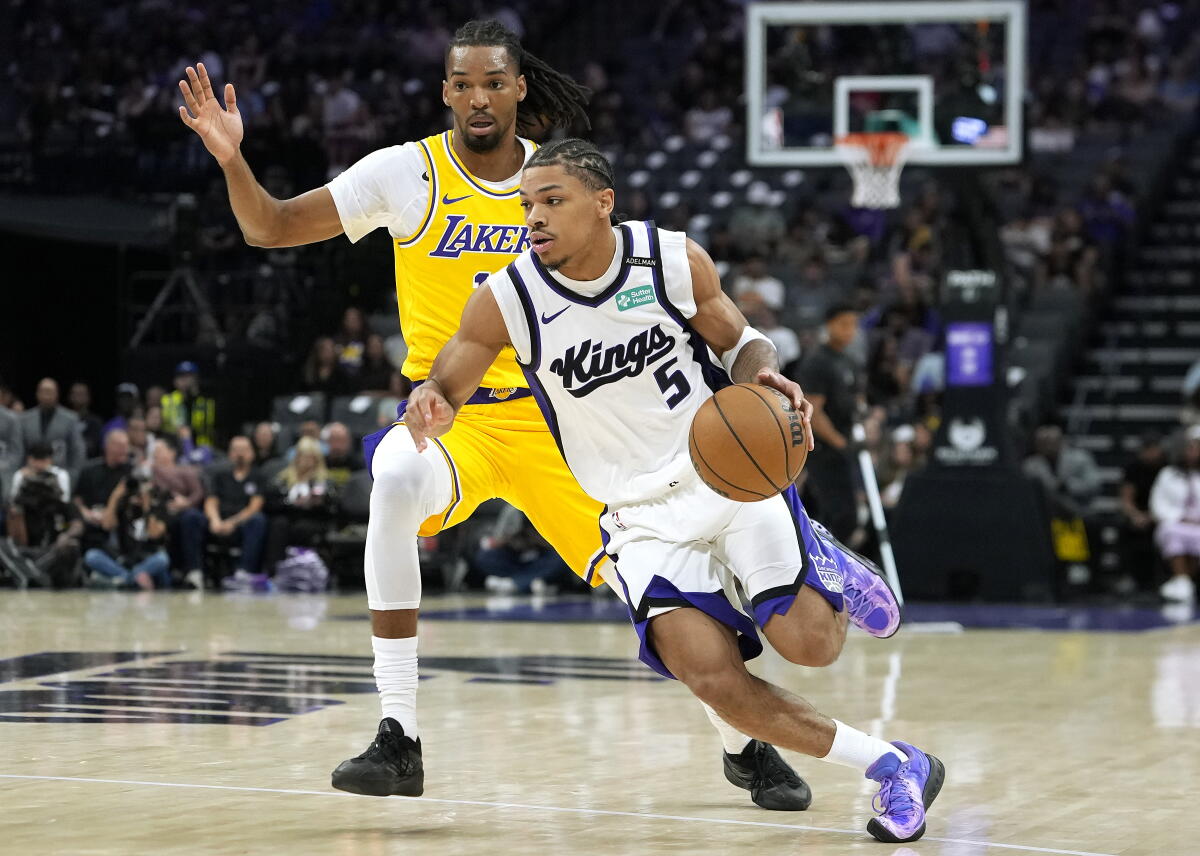
The Kings’ Darius Acuff Jr. dribbles under pressure from Laker Ziaire Williams during a preseason game in Sacramento on Monday.
(Thearon W. Henderson / Getty Images)
The only other offseason bandaids the Lakers could acquire were Williams and Thybulle. After signing minimum contracts, they were both in the starting lineup for the Lakers’ preseason opener Monday.
Williams, the 6-foot-9 forward from Sierra Canyon High, is relishing the chance to play for his hometown team. The former top-10 pick is on his third NBA team in six seasons, never finding solid footing with Memphis or Brooklyn. He is coming off a career-high 10.3 points per game for the tanking Nets. The expectations will be drastically different with the Lakers and the Lancaster native is ready to meet them.
“There’s not really anything I’m not comfortable with,” said Williams, who reported he currently weighs 215 pounds, up 30 from his previously listed weight with Brooklyn. “If it’s a smaller guy bringing the ball up, I pick up 94 [feet]. If it’s a bigger wing who likes to play off a live dribble and jab step, being more physical off the ball.”
Thybulle is listed at 6-foot-5, but renowned for a nearly 7-foot wingspan. Not only does he torment opponents with his length, his defensive anticipation is “top-tier,” Reaves gushed.
The Washington alumnus was a two-time second-team all-defensive honoree with the Philadelphia 76ers. The hope has always been that his three-point shot could match that defensive talent.
Thybulle is a 34.9% three-point shooter, averaging only 2.6 attempts per game during his career, although his attempts increased in Portland. Thybulle and Williams (32.2% on threes in his career, four attempts per game) are consistently shooting threes after every practice. Williams made all three of three-point attempts in Monday’s preseason game while Thybulle made two of four.
Lakers forward Sandro Mamukelashvili drives to the basket in front of Kings guard Daeqwon Plowden during a preseason game in Sacramento on Monday.
(Sara Nevis / Ap Photo/sara Nevis)
“For me personally, at this point, [it’s about] having the confidence in my shot to know that when it comes, I’m ready for it, as opposed to just hoping for the best,” Thybulle said. “I think it goes a long way as well.”
Mamukelashvili offers three-point shooting that stretches the floor. Redick described the 6-foot-9 forward as “an offensive connector” who can revive seemingly dead plays with a simple pass or a cut. After shooting 38.9% from three last season (115-of-296) with Toronto, he’s a potential starter at power forward, but the defensive matchups could be different when he and Walker Kessler share the floor compared to one of the other perimeter-oriented wings pairing with Kessler.
Young wing players including Adou Thiero and Cameron Carr have also impressed coaches and teammates with their athleticism and eagerness to learn. Reaves affectionately hailed Thiero, who was Reaves’ primary matchup during offseason pickup games, as a “freak of nature” and “one of the best athletes in the league.” That talent was obvious during his injury-plagued rookie season when Thiero scored his first NBA basket on a high-flying dunk last November.
Redick said Thiero’s development in the summer has been “unbelieveable.” The most critical part has been his health, said Thiero, who battled nagging injuries to both knees last season.
Between the veterans trying to prove themselves and the young players hoping to make an impact, the Lakers could go six or seven deep at the wing, Redick said. Depth is a critical ingredient of this era of the NBA. The Lakers are confident in theirs.
“We got some dogs on this team,” Williams said. “Everyone plays one through four. All the wings are great. There’s no slack; you see four or five wings out there playing hard, everybody else has to pick it up a notch.”
Position we should watch this preseason
Lakers center Kevon Looney drives to the basket under pressure from Kings Dylan Cardwell and Nique Clifford during a preseason game in Sacramento on Monday.
(Thearon W. Henderson / Getty Images)
There is no reason to panic about Kessler’s preseason absence. He jammed his left pinky finger on the backboard in practice last week and Redick said Kessler is “day-to-day.”
But the sight of the star center on the sideline is still an unnerving way to start preseason games, especially after the Lakers invested so much to get Kessler. The 7-foot-2 center, who cost the Lakers four first-round draft picks and a four-year, $130-million contract, is supposed to be a lynchpin of their defense. Without him, the Lakers’ entire plan could fall apart.
The only true center the Lakers have behind Kessler — who only played in five games last year because of a shoulder injury — is Kevon Looney. The former UCLA star started in Kessler’s place Monday, playing 18 minutes with nine rebounds, three assists and two points. Mamukelashvili, a power forward, can also rotate to center.
The Lakers have so much riding on the center position this year. Their backup options don’t feel strong enough to bear the weight of a possible Kessler injury. But Redick said the team’s wing players could shoulder some of that burden.
“Loon, Mamu, those guys, they’re not going to be Kessler,” Redick said. “Mamu is versatile enough that he can do different things, whether that’s a hedge or a switch or a drop, and we’ll figure out what works best for this team with that when we’re in man. Then with Loon, I think he’s smart enough and savvy enough that he can get the job done. But again, none of that matters if we’re not guarding the basketball.”
Looney, 30, is the unexpected veteran on a team of 20-somethings. Redick used the three-time champion’s experience with the Warriors for inspiration on the first day of practice, saying Looney faced plenty of adversity during those years. The Warriors fell behind in multiple series and still clawed back to win, Redick said. The Lakers expect Looney to stablize the team during the inevitable rocky periods of the season.
“What a great vet,” Kessler said. “He’s done it before. He knows what it takes to win a championship on and off the court.”
On tap
Tuesday at Warriors, 7 p.m. PDT
The Lakers open the preseason with a road back-to-back. Expect that while the Lakers have no pressing injury concerns, most of the key players will be on an early load management schedule.
Thursday vs. Kings, 7:30 p.m. PDT
The Lakers’ third game in four days – a workload that should be banned in the preseason – will be the debut of Lakers public address announcer Derrin Horton. The former KTLA broadcaster will take over for franchise legend Lawrence Tanter, who died last week at 76. Tanter retired from his game day role in June after 43 iconic years as the “Voice of the Lakers.”
Favorite thing I ate this week
From Broken Spanish Comedor, the ceviche (left) and the camote, a coal-roasted Japanese sweet potato served with pork rinds.
(Thuc Nhi Nguyen / Los Angeles Times)
I’d been reading great things about Broken Spanish Comedor, and after finally trying the new Culver City restaurant, I’m surprised to report that my favorite dish from a modern Mexican restaurant was a Japanese sweet potato. The camote was an ideal combination of textures thanks to the creamy coal roasted sweet potato and crunchy pork rinds and sweet, smokey and spicey flavors. We also ordered the ceviche, which came with a deserved heat warning, and the chicharron. The server insisted we get the hand-pressed tortillas and who’s saying no?
All things Lakers, all the time.
Get all the Lakers news you need in Thuc Nhi Nguyen’s weekly newsletter.
By continuing, you agree to our Terms of Service, which include arbitration and a class action waiver. You agree that we and our third-party vendors may collect and use your information, including through cookies, pixels and similar technologies, for the purposes set forth in our Privacy Policy such as personalizing your experience and ads.