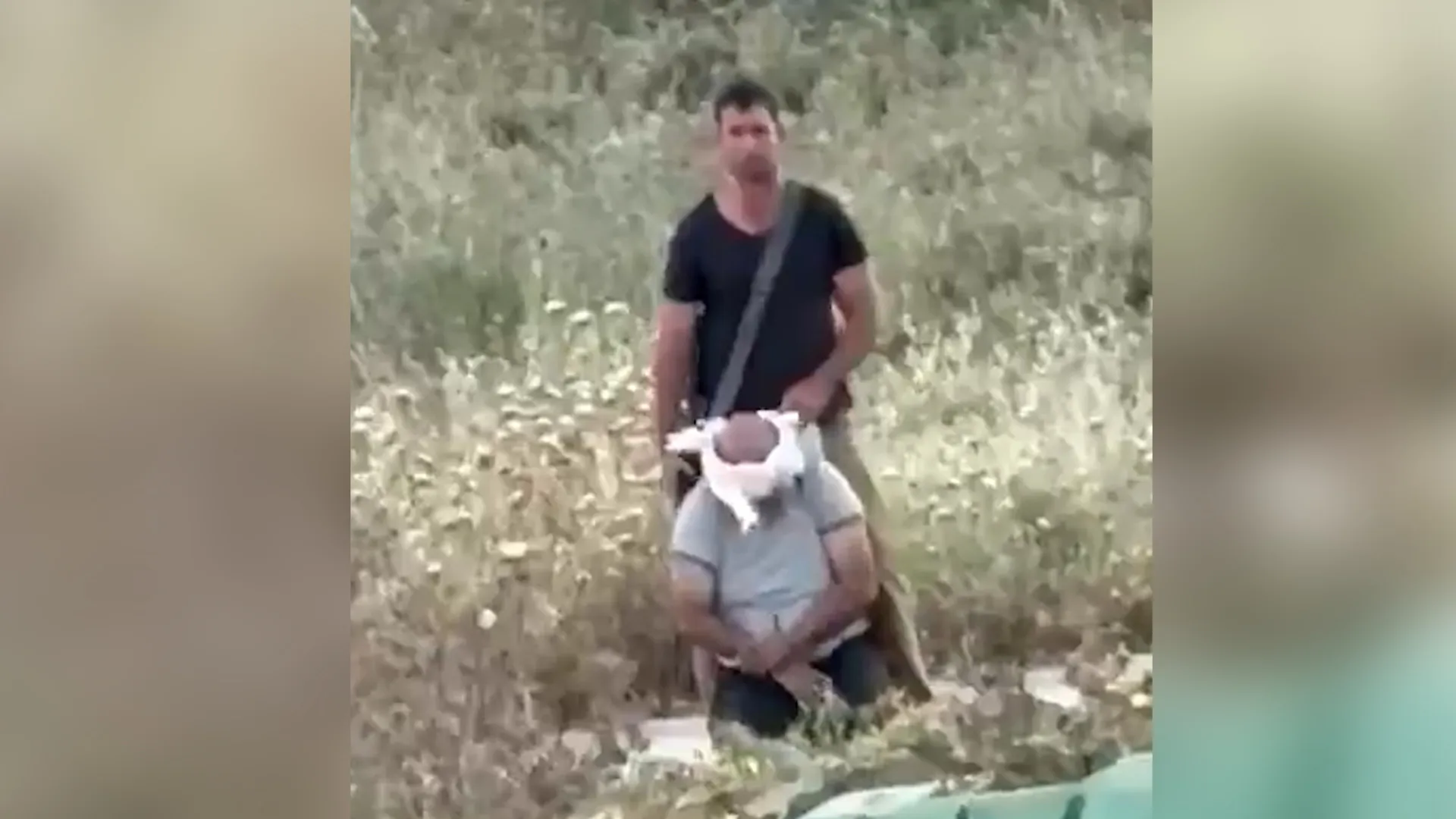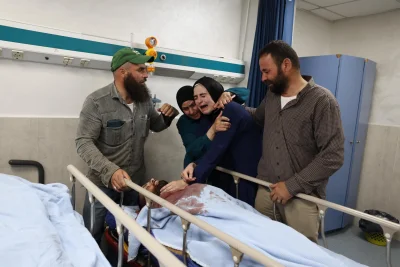
settler

Arab News | 4,000+ Palestinians displaced in West Bank this year by demolitions and settler violence

NEW YORK CITY: About 4,100 Palestinians have been displaced across the West Bank so far this year as a result of demolitions and settler violence, UN deputy spokesperson Farhan Haq said on Thursday.

He warned of a sharp rise in demolitions in the Masafer Yatta area of the southern West Bank in recent days. The Office for the Coordination of Humanitarian Affairs said Israeli authorities demolished 20 homes and other structures, including a water cistern and solar panels, in two Palestinian herding communities there on Tuesday.

This activity, and demolitions in a nearby third community on Wednesday, displaced nearly 60 people, half of them children, and affected a further 30 seasonal residents. Many of the destroyed properties were built with donor support, Haq said.

Masafer Yatta is home to about 1,200 Palestinians in 13 communities, all of whom have been under pressure to leave after Israeli authorities designated the area a “firing zone.”

Haq said humanitarian officials have reported increased violence by Israeli settlers targeting those communities following the establishment in recent years of settlement outposts nearby.

Representatives of the UN and its humanitarian partners visited Masafer Yatta on Tuesday to speak with displaced residents who are receiving emergency shelter, food, hygiene items, baby products and psychosocial support, Haq said.

Across the West Bank, he added, about 1,500 Palestinians have been displaced so far this year as a result of demolitions, and more than 2,600 have been displaced by settler violence and related access restrictions.


Source link

Palestinian farmers battle settler sabotage to save Hebron crops, livestock | Israel-Palestine conflict News

Amid the grapevines that once provided a steady income for her family, 56-year-old Palestinian farmer Theeba al-Sabaa spends much of her day guarding her home and farmland in the occupied West Bank from settlers.

From dusk till dawn, she works on her land in the town of Beit Ummar, north of Hebron, known by locals as “Jabal Sabaa”.

Theeba is engaged in a daily battle against the encroaching settler outposts that have emerged among the rolling hills that surround her, and which block access to sections of her land.

“By God, the land has taught me patience, and to cling to my right, for as long as I have a right, I must take it and never let it go,” she told Al Jazeera.

“I will never leave it because I worked hard on it, I toil and sweat on it, so I will not leave my toil and sweat, or the toil of my children and my husband, to go to someone else.”

Weaponising livestock

Since mid-2024, when settlers established new outposts on the nearby hills, every one of Theeba’s moves has been monitored.

Settlers frequently approach the perimeter of her home and deliberately release livestock into the cultivated fields.

“They enter with their sheep into our land after we plow and fix it, grazing in it, trampling the crops, and stomping on them with their sheep, leaving nothing,” Theeba said.

“As soon as they feel any movement or anyone entering the land, you find them attacking us immediately.”

This intimidation extends to the adjacent fields, where 59-year-old Anwar Sabarneh lives with his extended family of seven brothers.

Due to the repeated settler violations, two of his brothers have been forced to abandon their land.

Sabarneh, who supports a family of 14, owns several dunams of vineyards located just 300 metres (980 feet) from his home. With aggressive settlers around, reaching them has become a dangerous ordeal.

Palestinian farmer Anwar Sabarneh, whose sheep have been confined for months, is barred by the Israeli military from accessing his nearby vineyards in Beit Ummar.[Screengrab/Aljazeera]
Palestinian farmer Anwar Sabarneh, whose sheep have been confined for months, is barred by the Israeli military from accessing his nearby vineyards in Beit Ummar [Screen grab/Aljazeera]

Military complicity

Sabarneh said that the Israeli army even demands permits from Palestinians to work on their own land.

“The army came with the settlers to ask me for a permit so I can work in my home, in front of my house’s door, and on my land where I am the rightful owner,” Sabarneh said.

Farmers are also barred from building anything on their land. Sabarneh’s sheep have also been locked in a barn for over eight months due to the dangers posed by settlers.

“If they see me taking the sheep out, the settlers chase me, kidnap them, and steal them,” he said.

When Sabarneh’s children have tried to retrieve their stolen sheep, Israeli soldiers have arrested and beaten them.

A forced exodus

Repeated pogroms by settlers against Palestinian farmers reflect a broader strategy targeting agriculture across the southern West Bank.

Settlers and the Israeli troops carried out 11,074 attacks in the West Bank during the first half of 2026, according to the Colonization and Wall Resistance Commission. This includes 3,488 carried out by settlers.

Hasan Breijieh, a settlement affairs expert and director at the commission, told Al Jazeera that continuous settlement expansionism, alongside restrictions on Palestinian movement, are the primary reasons that so many Palestinians have been forced to flee their farms.

“Military gates erected at the entrances of Palestinian communities have tightened control over…  access to their orchards and vineyards,” he said.

Bypass roads, built by Israel, have also hindered “connectivity between Palestinian communities”, Breijieh said.

Under such restrictions, Palestinian farmers have faced a fourth consecutive season without being able to harvest olives, grapes, or guava. Their lands have been “neither plowed nor pruned”, and have been forcibly abandoned.

In the face of such oppression, Palestinian women like Theeba al-Sabaa have continued to play a pivotal role in protecting their land, particularly when men have been killed or detained by Israeli forces.

“They continue to maintain their leadership role in preserving the family’s agricultural legacy today,” Breijieh said. “This land was historically the primary source of livelihood for families, and a Palestinian cannot leave it voluntarily, no matter the sacrifices.”

He recalled his own grandfather, who went to his fields to bid farewell before dying. “Goodbye, vineyard,” he said to his land.

Source link

Palestinian teens killed during settler attack on West Bank village, officials say

At least 81 Palestinians have been killed by Israeli forces or settlers in the West Bank since the start of the year, according to the UN’s figures. At least 23 of those deaths have occurred in the context of settler attacks.

Three Israelis, both security forces and civilians, have been killed by Palestinians in the West Bank over the same period, the UN says.

The Israeli military has faced mounting criticism for actively participating in settler attacks on Palestinians, standing by, or failing to prosecute those responsible.

On Thursday, Israel’s police force said a 19-year-old settler had been arrested on suspicion of participating in an attack on the Palestinian village of Qusra on Saturday. It marks the first such arrest in weeks of attacks on Qusra.

Dozens of masked settlers descended on the village, surrounding a house while Palestinians were trapped inside, and throwing stones.

Israeli soldiers who were deployed to the scene reportedly detained the trapped Palestinians but not the settlers, allowing them to leave. The Israeli military said troops removed “rioters” and protected residents.

Israel has built about 160 settlements housing 700,000 Jews since it occupied the West Bank and East Jerusalem – land Palestinians want, along with Gaza, for a future state – during the 1967 Middle East war. An estimated 3.3 million Palestinians live alongside them.

The settlements are illegal under international law.

In a separate development on Wednesday, Israeli forces demolished the Palestinian village of Khirbet al-Tabban, in the Masafer Yatta area.

Israeli human rights group B’Tselem said the village’s 70 residents, including 28 children, were given no warning prior to the demolition and were not allowed to remove their property.

It described the demolition as the most significant in Masafer Yatta since May 2025.

In the 1980s, the Israeli military declared about 3,000 hectares in the South Hebron Hills, which includes Masafer Yatta, as a restricted firing zone for training purposes.

The military says the Palestinian homes there have been built illegally.

In 2022, Israel’s Supreme Court ruled to allow the demolition of homes in the firing zone and the expulsion of their residents, who had argued that such a move violated international law and that their families had been living there since before the State of Israel was established.

B’Tselem says Khirbet al-Tabban is the 66th Palestinian community to be expelled by Israeli authorities since the start of the Gaza war in October 2023, which it alleges is part of a campaign of “ethnic cleansing” being carried out in the West Bank.

Source link

Why Israeli settler attacks on Palestinians in West Bank are pogroms | Explainer

Attacks on Palestinian communities by Israeli settlers in the occupied West Bank, which are often supported by Israeli forces, have gathered pace over the past month since settlers from the Havat Gilad settlement attacked Palestinian homes on the eastern edge of Tal, southwest of Nablus.

On Sunday and Monday, the Israeli military raided multiple towns, villages and refugee camps across the occupied territory, and reports of arrests, home searches and settler attacks have continued to mount.

A 15-day siege on three families comprising 15 people, including two children, in the village of Qusra, which is ongoing, drew a rare public condemnation this month from the United States ambassador to Israel, Mike Huckabee, a staunch supporter of Israel and its West Bank settlements.

Israel is also pushing ahead with plans for the so-called E1 settlement expansion close to Jerusalem, which human rights organisations warn would essentially sever the West Bank in two, further hampering the freedom of movement of Palestinians on either side of it and endangering the possibility of a Palestinian state.

The West Bank attacks increasingly fit the definition of a pogrom, experts said. United Nations Special Rapporteur on the Occupied Palestinian Territories Francesca Albanese described these Israeli attacks against Palestinians as “pogroms against defenceless civilians”.

So why are experts calling settler attacks pogroms, and do they fit the formal definition of one?

A Palestinian man inspects the damage at a mosque that Palestinians say was damaged by Israeli settlers in Qusra near Nablus in the Israeli-occupied West Bank on July 26, 2026
A Palestinian man inspects the damage at a mosque that Palestinians say was damaged by Israeli settlers in Qusra near Nablus in the Israeli-occupied West Bank on July 26, 2026 [Mohamad Torokman/Reuters]

What’s happening in the West Bank?

Settlers, frequently supported by the Israeli military, have been attacking Palestinian homes, businesses, and agricultural fields across the occupied West Bank. Such attacks have been commonplace for decades as settlements have expanded across the territory, but they gathered pace after October 7, 2023 when Israel launched it genocidal war on Gaza, and have become particularly violent and frequent over the past month.

Israeli settlements across the West Bank are illegal under international law.

According to the Palestinian Colonization and Wall Resistance Commission, however, Israeli settlers now number roughly 780,000 across the occupied West Bank and East Jerusalem, living among 192 settlements and 400 outposts, rising to 71 percent of Area C, which is under full Israeli civil and military control, and 91 percent of the Jordan Valley.

Settlers often set up outposts without formal approval around Palestinian villages from which they launch a campaign of harassment, including killing livestock, cutting supply lines and damaging property, in order to drive local residents out. Once they establish a more formal settlement, they often receive retrospective approval from the Israeli government for the settlement.

In some places more recently, illegal settlers have laid siege to individual family homes – such as in the Ras al-Ein area of Qusra – cutting off water and other supplies and damaging orchards or harming livestock.

This has set a new pattern: settlers establish a tent adjacent to individual homes; Palestinians’ homes are besieged, with essentials cut off; and Israeli soldiers arrive not to remove the settlers, but rather to remove the family – through arrest or ostensibly for their “protection”.

In Qusra, the three besieged families were forced together into one of the family houses. Meanwhile, Israeli forces have occupied one of the other homes for use as a military post and thrown furniture and belongings from its windows, according to the Palestinian news agency Wafa.

The UN humanitarian affairs office recorded more than 1,330 settler-related attacks on Palestinians in the occupied West Bank between January and late July this year, averaging six a day and marking the fastest pace since the agency began systematic tracking two decades ago.

Separately, a UN-appointed commission of inquiry has found that the Israeli authorities have repeatedly failed to prevent foreseeable settler attacks and, in some cases, have directly enabled them through army protection and the provision of weapons and funding.

The UN Office for the Coordination of Humanitarian Affairs (OCHA) has found that settler attacks, demolitions and evictions forcibly displaced more Palestinians in the first four months of this year than in the whole of 2025.

OCHA reported that 107 communities, comprising 5,900 Palestinians, had been completely or partially displaced as a result of settler violence since January 2023. It also found that the Israeli military have expelled another 32,000 Palestinians from their homes in the occupied West Bank since January 2025, essentially emptying the Jenin, Tulkarem and Nur Shams camps.

INTERACTIVE - Settler attacks by year across the occupied West Bank_July2026
(Al Jazeera)

What is the definition of a pogrom?

Major US and UK dictionaries vary to some degree on the definition of a “pogrom”.

The British Collins Dictionary identifies a pogrom as “organised, official violence against a group of people for racial or religious reasons”, with a notable inclusion of official, or state-backed violence.

Oxford Advanced Learner’s Dictionary calls it “the organised killing of large numbers of people, because of their race or religion”, without mention of state-sanctioned violence.

Merriam-Webster says it is “an organised massacre of helpless people” – “specifically: such as a massacre of Jews”.

Cambridge Dictionary says it is “an act of organised cruel behaviour or killing that is done to a large group of people because of their race or religion”.

The word is understood to have been introduced via Yiddish and was at first used to describe the wave of violent, organised mob attacks on Jewish communities in the Russian Empire following the assassination of Tsar Alexander II in 1881.

It is important to note that unlike legal terms including “crimes against humanity” or “genocide,” “pogrom” has no established legal definition under international law.

Can attacks in the West Bank be referred to as pogroms?

Besides Francesca Albanese, the UN Special Rapporteur on the occupied Palestinian territories, who has described Israeli attacks against Palestinians in the occupied West Bank as “pogroms against defenceless civilians”, Israeli officials themselves have described such attacks as “pogroms”.

On February 26, 2023, hundreds of Israeli settlers attacked Huwara and surrounding Palestinian communities after two Israeli settlers were killed. A Palestinian was killed, hundreds were injured, and homes, businesses and cars were burned.

The Israeli military’s then-commander in the occupied West Bank, Yehuda Fuchs, called the settlers’ attack a “pogrom”, and it was also recorded as such by the US State Department.

Israeli-Palestinian human rights group B’Tselem has also previously described Israeli actions in the occupied West Bank as “pogroms”, especially after the February 2023 attacks. Later, it followed up with a report titled, “The pogroms are working – the transfer is already happening”, which argued that settler attacks were contributing to the displacement of Palestinian communities.

“Settler violence is not a new phenomenon. But over the past three years, it has become more violent, more systematic and, most importantly, part of a state mechanism intended to ethnically cleanse large parts of the West Bank,” said Yair Dvir, the spokesperson for B’Tselem.

“The government funds and arms the settlers, while the Israeli military stands by and, in many cases, actively participates in the attacks,” he told Al Jazeera. “So far, these militias have expelled 64 Palestinian communities and taken control of around one million dunams of land.”

Dvir also told Al Jazeera that the Israeli settlers are “now carrying out organised attacks on established Palestinian villages and towns in order to drive out their residents”.

“These are armed militias operating as an unofficial arm of the state, with a shared goal: to ethnically cleanse as much of the West Bank as possible,” he added.

The Lemkin Institute for Genocide Prevention, which is named after Polish-Jewish lawyer Raphael Lemkin, who is credited with coining the term genocide after the Holocaust, referred to settler attacks on Al-Mughayyir, a Palestinian village in Ramallah, as “pogroms”, reporting that hundreds of armed settlers attacked residents and burned buildings and cars while soldiers stood by earlier this year. In 2025, the Israeli military uprooted thousands of Palestinian olive trees at Al-Mughayyir.

Raheel Dhattiwala, an Indian scholar who focuses on collective violence, told Al Jazeera: “West Bank attacks fit the characteristics of a pogrom – systematic targeting of one civilian group by another with state approval. A few senior Israeli army officers have called it ‘pogroms’ in the past too, for example after attacks in Huwara.

“One might want to debate the use of the term, ‘pogrom’, but it is accurate to call settler violence systematic attacks of occupiers, with government approval, on groups of occupied people.”

Source link

US ambassador to Israel calls settler violence ‘terror’ | Newsfeed

US Ambassador to Israel Mike Huckabee says Israeli settler violence in the occupied West Bank meets the definition of ‘terror’. His comments are a rare rebuke and follow a days-long siege of a Palestinian-American family’s home by Israeli settlers in the village of Qusra.

Source link

What could stop Israeli settler attacks on Palestinians? | Israel-Palestine conflict News

Violence in the occupied West Bank has intensified under Israel’s far-right Netanyahu government.

Israeli settler attacks in the occupied West Bank are trapping Palestinian families in their homes.

The violence is taking place as Israel’s far-right government faces elections in October.

Why are attacks by settlers intensifying? And what are the consequences?

Presenter: Imran Khan

Guests:

Ofer Cassif – member of the Knesset representing the Hadash-Ta’al political alliance

Mouin Rabbani – co-editor of the Jadaliyya online magazine and non-resident fellow at the Center for Conflict and Humanitarian Studies in Qatar

Ori Goldberg – Israeli political commentator

Source link

Analysis: Israel’s government can’t disown West Bank settler violence | Israel-Palestine conflict News

Israeli settlers have marauded across the occupied West Bank for months, attacking Palestinian towns and villages with impunity.

Events in Qusra, a village south of Nablus, where Israeli settlers have laid siege to three Palestinian households since Sunday, have even led to a rare condemnation of settler behaviour by the Israeli government, with spokesperson David Mercer calling the settlers’ actions “deplorable” and “unacceptable”, and promising that Israeli authorities would investigate and arrest those responsible.

Recommended Stories

list of 4 itemsend of list

Analysts, campaigners, and Israeli parliamentarians who spoke to Al Jazeera have reacted to that with disbelief and incredulity, pointing to the inability of the Israeli military to stop the siege, in which the settlers have cut off water and electricity to Qusra. Israeli soldiers were initially even seen mingling and even praying with settlers in Qusra.

Complicity

“Government attempts to distance themselves from the violence are ridiculous,” Aida Touma-Sliman, a member of the Israeli parliament representing the left-wing Hadash party, told Al Jazeera. “They can say what they want, but they’re complicit.”

“If you look at the West Bank, you can no longer differentiate between the army and the settlers,” she said, adding that many of the settlers had been allowed to carry out their military service protecting the same illegal settlements they had come from. “The government is supplying them, protecting and arming them. It isn’t opposed to them. Supporting them is policy,” she added.

“There is nothing new in what’s happening in Qusra,” Yair Dvir of the Israeli rights organisation B’Tselem said. “We’ve been seeing this for decades. When there’s international criticism of the violence, the government condemns it, the settlers withdraw, and then return as soon as attention shifts.”

Israeli soldiers stand in front of the entrance of a besieged Palestinian house by Israeli settlers in the village of Qusra, south of Nablus, in the occupied West Bank, on August 14, 2026.
Israeli soldiers stand in front of the entrance of a besieged Palestinian house by Israeli settlers in the village of Qusra, south of Nablus, in the occupied West Bank [AFP]

“Let’s be clear, settler violence is state violence,” Dvir added. “They both have the same aim: to displace Palestinians and to take their land.”

The speed and brutality of the Israeli government’s encroachment upon Palestinian land, in defiance of both international law and the ruling of the International Court of Justice (ICJ) that it should stop its illegal settlement of Palestinian territory, has increased in recent months. United Nations Office for Humanitarian Affairs monitoring shows settler violence to be increasing with every week that Israel’s October election – and the potential end of Prime Minister Benjamin Netanyahu’s far-right government – draws nearer.

“We’re definitely seeking an escalation of violence across the occupied West Bank, East Jerusalem, and in other areas, such as Gaza, in the build-up to the election,” saidNeve Gordon, a professor of International Law at Queen Mary University, London, and the author of “Israel’s Occupation”.

“The vote is like a rallying cry for that entire [settler] constituency that they have to do as much as they can, while they can,” he said of fears among settlers and the radical Israeli right that they might lose what many regard as their allies in Netanyahu’s coalition.

Settlement unchained

The Israeli government has done little to distance itself from the actions of the settlers. Instead, prominent members of Netanyhu’s Likud party have attended prominent settlement conferences, including those explicitly focused on ethnically cleansing Gaza. Netanyahu himself responded to recent violence in the Palestinian village of Tal – which prompted the United Nations to warn that the entire West Bank was at “breaking point” – by promising to recognise even more illegal settlements.

At the heart of government policy on settlements have been the polarising figures of National Security Minister Itamar Ben-Gvir and Finance Minister Bezalel Smotrich.

Smotrich has proven to be one of the most consequential Israeli politicians in history in promoting the cause of illegal settlements.

As well as normalising political references to the annexation of the Palestinian territory, Smotrich made being granted partial administrative control over the occupied West Bank a key condition of his joining Netanyahu’s coalition. He has since overseen the expansion of illegal settlements at an unprecedented rate.

Smotrich has also boasted of making the two-state solution a practical impossibility with the announcement of the E1 settlement project, joining occupied East Jerusalem and the Maale Adumim settlement, in August of last year.

However, focusing on just two of the coalition’s more controversial figures was to miss the point, Gordon argued.

“It’s too easy to say it’s all the fault of these few people and if they were gone it would all be OK,” Gordon said. “It goes far wider.”

“The ethnic cleansing we’re seeing of the West Bank, as well as that being undertaken by the army in the territory’s refugee camps, such as Jenin, needs the complicity of the police, the attorney general, the military and, ultimately, the public,” the professor noted. “Without the umbrella they provide, none of this would be possible.”

Source link

UN, Palestinian ministry condemn Israeli settler siege of West Bank homes | Israel-Palestine conflict News

The United Nations human rights agency and the Palestinian Ministry of Foreign Affairs and Expatriates have condemned a days-long Israeli settler siege of Palestinian homes in the occupied West Bank village of Qusra.

The two statements were issued on Thursday, as dozens of Israeli settlers continue to besiege three Palestinian families in the Ras al-Ain area in western Qusra for a fifth night.

Recommended Stories

list of 4 itemsend of list

“These criminal actions by the settlers, supported or acquiesced to by Israel, the Occupying Power, are making life unbearable for these Palestinian families and are clearly aimed at forcing them to leave their homes and their land,” the UN Office of the High Commissioner for Human Rights said.

The three families – comprising 15 people, including two children – have been confined to their homes with their water and power cut off since Sunday, the agency said.

“Time is running out for these three families before they are forcibly displaced,” it warned.

Meanwhile, the Palestinian Foreign Ministry issued a statement condemning the settlers for carrying out “systematic assaults that can only be described as terroristic”.

It also accused Israel of using the settlers as an “unchecked tool to implement its criminal policies” of forced displacement and annexation of the occupied West Bank.

Earlier on Thursday, US ambassador to Israel Mike Huckabee also referred to the settlers’ actions as acts of “terror”.

‘This is all a charade’

Al Jazeera’s Nida Ibrahim, reporting from the scene of the siege on Thursday, said Israeli soldiers initially tried to move the trapped families out of their homes while settlers remained camped outside.

The families refused, not trusting that the Israeli soldiers would allow them back into their homes, and were eventually grouped together in one home. Residents have watched settlers push families out and then take over their properties in the past, she reported.

Qusra has faced settler attacks for decades, Ibrahim explained, and residents tie the rise in violence to the spread of illegal settlements and the lack of accountability for attackers.

On Thursday, the Israeli military said its troops dismantled “two illegal outposts” in Qusra and a nearby village, and detained one Israeli. It said more soldiers were sent to “carry out defensive missions and patrols”.

However, Ibrahim said most Palestinians believe the Israeli army is staging its response to the settler siege for the cameras, and they expect the settlers will eventually return.

Abdel Azim Wadi, the mayor of Qusra, told Al Jazeera that the Israeli army has been protecting and helping the settlers. “We saw them praying together, barbecuing together and dancing together,” he said. “They are not very interested in helping the besieged families.”

Qusra resident Abdul Kareem Hassan told Al Jazeera that he had been sleeping in his car for seven months in order to protect his home.

“This is all a charade,” he said. “If they [the Israeli army] were serious, the whole operation would not take them one hour. We’re talking about 20 settlers. If they would treat them the same way they treat Palestinians, they could finish in less than an hour.”

Another day without respite

Elsewhere in the occupied West Bank on Thursday, Israeli settlers and soldiers continued their elevated campaign of violence against Palestinians, the Palestinian news agency Wafa reported.

Israeli forces issued demolition notices for homes in Kafr Sur, the Jalazone camp and farmers’ shelters in al-Jiftlik.

In Qalqilya, soldiers detained seven relatives of a Palestinian fighter killed in a 2024 strike. Soldiers also detained three Palestinians amid a settler incursion in Burqa, east of Ramallah.

Settler attacks took place across several towns and villages, including an incident in which three Palestinians, including a child, were pepper-sprayed in their car.

Settlers also re-established a settlement near Jenin and erected a new outpost on land belonging to a town near Tulkarem.

Source link