MAYA Jama’s ex-boyfriend Ruben Dias appears to be moving on from their split as he sets his sight on a new romantic interest.
And the Manchester City footballer, 29, controversially seems to be pursuing a connection with a fellow star from within the Love Island family.
Sign up for the Showbiz newsletter
Thank you!
Ruben Dias appears to be putting his split from Maya Jama behind himCredit: InstagramThe Manchester City player made a bold online move this weekCredit: Getty
This week Ruben followed Joanna Chimondes on Instagram, the season 5 stunner who appeared on screens back in 2019 and returned for All Stars in 2024.
Tellingly, Joanna, 29, has followed the Premier League player back on the social media platform – so watch this space.
The Sun has reached out to representatives of Ruben and Joanna for comment.
Joanna is earned a spot in the Love Island historybooks when she stole the affection of scouser Michael Griffiths during Casa Amor – when he was coupled up with Amber Gill.
Ruben has followed Love Island season 5 star Joanna onlineCredit: InstagramAnd she’s reciprocated the move, following him back on InstagramCredit: Instagram
The fireman returned to the main villa with Jo, much to Amber’s disgust who branded her villa rival ‘a dead ting’ upon learning of the betrayal.
Joanna and Michael’s romance didn’t go the distance though, as she was booted from the villa separately with Michael controversially deciding to stay.
The pair first begandatingin December 2024 after meeting at theMTVEuropeMusic Awards in Manchester the month prior.
Their relationship is understood to have ended before Maya jetted off to Scotland to film Celebrity Traitors and ahead of all new Love Island.
Joanna Chimonides returned to Love Island in 2024 for the All Stars spin-offCredit: RexHost Maya and Joanna are both part of the Love Island familyCredit: Shutterstock Editorial
The Space Shuttle Endeavour is approaching its final mission. But this time, it won’t be blasting into a different atmosphere.
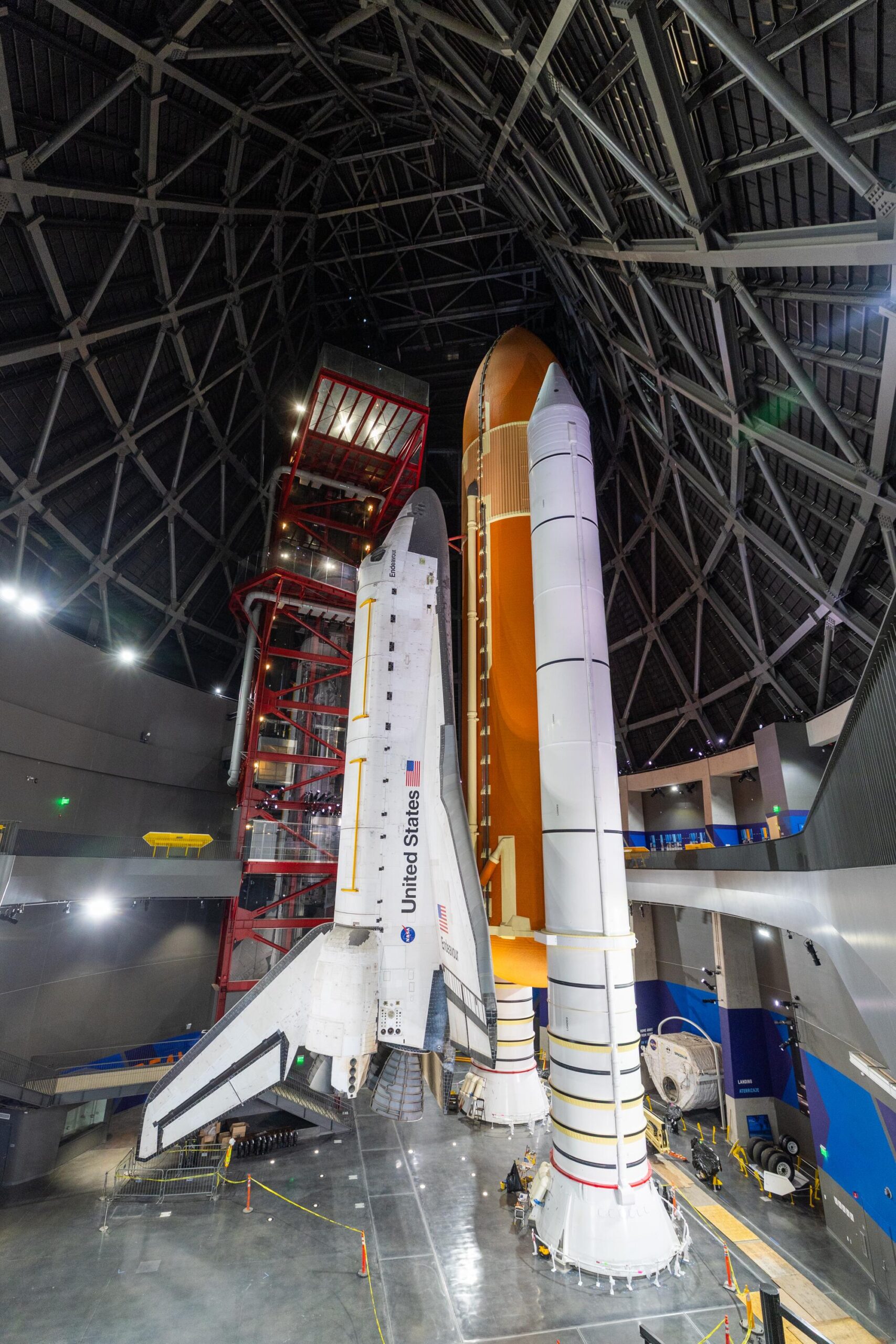
The California Science Center on Wednesday announced its Samuel Oschin Air and Space Center will open to the public on Nov. 13. The $450-million, 200,000-square-foot addition will permanently house the Korean Air Aviation Gallery and the Kent Kresa Space Gallery. But its centerpiece will be the Samuel Oschin Shuttle Gallery, where the Space Shuttle Endeavour will be on permanent display in its vertical “ready-to-launch” position.
When it debuts, the gallery will be the only place in the world with a complete shuttle stack, including orbiter, solid rocket boosters and an external tank.
“I’ve been here a long time. We’ve done a lot of great stuff, but this just keeps getting better. Everybody on our team was so proud of it,” said Jeffrey Rudolph, the Science Center’s president and chief executive. “We are incredibly excited, and we actually think people are gonna come from all over the world to see this thing.”
The Samuel Oschin Air and Space Center will open to the public on Nov. 13. The $450-million, 200,000-square-foot space includes the Samuel Oschin Shuttle Gallery, where the Space Shuttle Endeavour will be on permanent display in launch position.
(Allen J. Schaben / Los Angeles Times)
The Air and Space Center opening will mark the completion of the master plan adapted by the Science Center in 1993. One of three surviving space shuttles, the Endeavour made 25 successful missions into space between 1992 and 2011. In 2012, the shuttle arrived at LAX atop a modified Boeing 747 before being taken on a procession through the streets of Los Angeles to reach Exposition Park. Construction on the Samuel Oschin Air and Space Center, a sleek, 20-story building designed by ZGF Architects, finished in April.
“This shuttle really represents everything that my husband loved,” said Lynda Oschin, the widow of Samuel Oschin. “He was very involved in relativity, exploration, inspiration, children, math, science.”
Dennis R. Jenkins, project director at the California Science Center, estimated that at the height of construction, the team averaged about 400 construction workers a day. For Jenkins, who spent 30 years of his career as a NASA contractor working on space shuttles, seeing the Endeavour in its vertical position is “particularly special.”
“I walk in there 50 times a day, and 50 times a day it takes my breath away,” Jenkins said. “Especially when we have the theatrical lights on instead of the work lights, it is just so stunning to me. I’ve been around space shuttles for exactly 50 years now, and it still takes my breath away.”
Retired astronaut Barbara Morgan, who flew aboard Endeavour in 2007, said the shuttle will inspire space enthusiasts.
“This takes me back! I am right there again, strapped in, excited to launch,” Morgan said in a statement. “But this is even better, because here now is Endeavour for our future generations. She will launch big dreams.”
Jeff Rudolph, president and CEO of the California Science Center, gets a close-up view of the aft section and main engines of the Space Shuttle Endeavour, displayed in a vertical, launch-ready configuration at the new Samuel Oschin Air and Space Center at the California Science Center.
(Allen J. Schaben / Los Angeles Times)
The gallery will open with a video of the shuttle’s history, produced by J.J. Abrams’ company, Bad Robot. The video ends with a simulated launch of the shuttle — complete with fog machines — before the walls retract, letting visitors take in the Endeavour in all its massive glory.
The Endeavour is visible from several angles. Visitors walking around the bend of the center’s second-floor gallery can peek inside the payload bay, which was used to transport cargo like satellites into space. Step downstairs, and viewers can walk underneath the shuttle’s massive engines. To catch a bird’s-eye perspective of the Endeavour, guests can take a glass elevator to the 20th story to look at the shuttle through a glass floor.
“You go up slowly, [the elevator] stops at different levels. You see inside where the payload is, and at every stop you see something else, and when you get to the top and you look down,” Oschin said, the view is just unbelievable. It’s breathtaking. I don’t know what other word I could use.”
Despite the grandeur of the Endeavour, the Science Center didn’t want to glorify it either. Rudolph explained that the tiles on the shuttle’s wings, which were part of its thermal protection system, show the damage on each launch. The shuttle reflects the physical toll space took on the vessel.
“This thing went 25 missions into space, and you can see,” Rudolph said. “When we first got [the Endeavour] at LAX and had it in the United hangar a couple of weeks before we moved it through the street, the United guy said, ‘Do you want us to paint it?’ and we said ‘No! We wouldn’t think of it.’”
Jeff Rudolph, president and CEO of the California Science Center, walks through a doorway toward the Space Shuttle Endeavour during a tour and preview of the new Samuel Oschin Air and Space Center at the California Science Center.
(Allen J. Schaben / Los Angeles Times)
The center’s goal is to present the shuttle as close to mission-ready as possible. Rudolph explained that the exhibit’s hardware, including its bolts and nuts, are unique and extremely specialized. Since the space shuttle program concluded in 2011, many of Endeavour’s missing pieces are no longer produced. Jenkins spent years sourcing pieces of equipment.
However, the largest artifact of the exhibit was the most challenging to source. ET-94 — the exhibit’s ginormous, bright orange external fuel tank— was particularly difficult to get a hold of because it shouldn’t still exist.
“External tanks were only used once. … We jettisoned them on the way to orbit, and it burned up in the atmosphere before it hit Earth,” Jenkins said.
Jenkins explained that the ET-94 was built for a future Columbia Space Shuttle mission, but after the Columbia was destroyed, the fuel tank was used for research. To complete the Endeavour’s full shuttle stack, Jenkins persuaded NASA to donate the $65 million to the Science Center.
The Endeavour will not be alone in the gallery. Plans are in the works for a variety of unique, ancillary creations including a 15-second slide that mimics the path of reentry as a space shuttle descends back into Earth’s atmosphere. Visitors will start inside a dark slide that gives way to an orange glow followed by a double sonic boom. The slide finishes with an S turn, which the Endeavour executed to burn energy.
For Rudolph, the effort represents a giant leap toward the Science Center’s goal of making space exciting for “the next generation of scientists, engineers and explorers.”
“I just can’t wait to stand there and watch people come in, and kids especially. There are going to be a lot of tears looking at this, that I can tell you, happy tears,” Oschin said. “It’s something for children. Children are our future and our hopes for the future. This is going to be very inspiring for them and extremely exciting for them to see.”
Rocket Lab (RKLB) announced on Monday that it successfully launched its Electron rocket and deployed its Pioneer spacecraft for the U.S. Space Force’s VICTUS HAZE mission.
Despite the milestone, the stock closed over ~6% lower at ~$100.29 and traded slightly lower in after-hours trading.
A Southern California music festival featuring only women musicians and created by Olivia Rodrigo? That’s not such a bad idea.
Rodrigo, fresh off the release of her junior album, on Monday unveiled her Daisy Chain Fields music festival and the roster of all-women artists set to take over Irvine’s Great Park on Aug. 29. The lineup will include Rodrigo, Chappell Roan, Katseye, Mitski, Doechii and special guests Karen O, Sarah McLachlan and Stevie Nicks.
The 23-year-old Grammy winner and vocal advocate for women’s rights said in her post that her dream festival has finally become a reality and that earnings from the spectacular will go to charities benefiting women and girls.
“The lineup is truly insane and full of my heroes and friends,” Rodrigo said in her announcement. “I firmly believe that joy, community, and music can be the drivers of meaningful change and I’m hopeful this festival will be just that.”
Artists Bikini Kill, Die Spitz, Eli, Garbage, Not for Radio, Quiet Light, Rachel Chinouriri, Santigold and the Breeders are also set to perform. Fans hoping to snag tickets can sign up for pre-sale access on the festival’s website.
Rodrigo’s Daisy Chain Fields comes to Irvine a month before the former Disney Channel star kicks off her massive Unraveled tour, promoting her latest release “You Seem Pretty Sad for a Girl So in Love.” She will take over Inglewood’s Intuit Dome for four nights in 2027: Jan. 12, 13, 16 and 17.
In his album review, Times pop music critic Mikael Wood writes that Rodrigo’s latest release sees the singer-songwriter approach romance and heartbreak with “new wisdom, drawing sophisticated conclusions about why people in love do the things they do (and don’t do the things they don’t).”
SOUTHAMPTON, N.Y. — The USGA set up a different golf course at Shinnecock Hills to keep it playable in strong wind. And when the wind subsided late Thursday afternoon, Wyndham Clark looked like he was playing in a different U.S. Open.
Clark seized on a more gentle course — slightly calmer and still soft with receptive greens — by pulling away late to reach six-under-par through 16 holes.
He left in darkness with a four-shot lead over seven players, one of them Oklahoma junior Ryder Cowan, another the surprisingly resurgent Dustin Johnson.
Rory McIlroy thought he had made a fine effort with a 69 in gusts that topped 30 mph in the middle of the day, when the scoring average was well above 74. The afternoon started tough until the wind kept subsiding, and players began taking aim at flags. The afternoon wave was playing at least a stroke easier than the early starters who faced relentless wind.
“Everything was kind of clicking,” said Clark, who came into the U.S. Open playing as well as anyone. “We were definitely fortunate with the wind laying down. Overall a good round.”
Shinnecock was still a brute of a test, but the red numbers on the white scoreboard were an unfamiliar site for this course. When play was suspended by darkness, 17 players were under par.
Xander Schauffele hits his tee shot on the ninth hole during the second round of the U.S. Open at Shinnecock Hills Golf Club on Friday.
(George Walker IV / Associated Press)
The lowest opening round in the previous five U.S. Opens at Shinnecock is 66, last done by three players in 2004.
Cowan birdied his last hole for a 68 to join former Sooner Max McGreevy and former Oklahoma State player Sam Stevens, the only one of that trio who faced the harsh wind of the morning wave.
Johnson, in his final year of being exempt from the U.S. Open he won at Oakmont in 2016, ran off four straight birdies and was tied with Clark after 13 holes. But Johnson failed to get up-and-down for birdie on the easy par-five fifth, where Clark made eagle. And then Johnson three-putted from short range for double bogey on the sixth to fall four shots behind.
Scottie Scheffler, who needs the U.S. Open to complete the career Grand Slam, battled all day and relied heavily on his short game to salvage a 72. It was his 10th consecutive U.S. Open round without breaking par, but at the time it left him only four shots out of the lead.
Clark, who won the U.S. Open in Los Angeles three years ago, changed the look of the leaderboard. He was to return Friday morning to complete the round, then head out for the second round in wind expected to be not as strong.
One key to his round might have happened some five hours before he even showed up.
Thirty minutes after the round began, play was stopped because of fog so dense it was difficult to see the fairway and the green on the par-three 11th. The two-hour delay pushed back tee times.
The forecast was for the strongest wind of the week during the brightest part of Thursday.
“I would say when I got my tee times on Tuesday, I was like, ‘Oh, could be a tough draw,’” Clark said. “That two-hour fog delay was very helpful, and it was really nice it laid down. So it definitely helped those last six, seven holes we played.”
His golf wasn’t too shabby, either. Clark started on No. 10 and opened with two quick birdies. He went out in 32 to get his name atop the leaderboard. And after missing an eight-foot birdie putt on No. 1 and failing to save par from a bunker on the long par-three second, he took off.
He hit wedge to five feet on No. 3 for birdie, made a 20-foot birdie putt on the next and then from 207 yards with some wind at his back, he hit his second on the par-five fifth to within three feet for eagle.
When Johnson faltered, Clark had plenty of breathing room — and a quick turnaround.
The wind was so strong and the conditions so severe that it took Scheffler’s group nearly three hours to complete nine holes. There was a question the round could have finished even without the fog delay.
Only 27 out of the 77 players from the afternoon wave — Jason Day withdrew because of a back injury — finished the first round.
Dustin Johnson reacts after missing a putt on the sixth hole during the second round of the U.S. Open at Shinnecock Hills Golf Club on Friday.
(Gerald Herbert / Associated Press)
Johnson was joined by three other U.S. Open champions — Matt Fitzpatrick (2022), Gary Woodland (2019) and Jon Rahm (2021) — at two under, with all still having holes to play.
Rahm, who had a chance in the final hour at the PGA Championship, was bogey-free and reached two under by making a 60-foot birdie putt on the par-three 17th hole.
Stevens overcame a double bogey to start his round — a hole that took him over two hours to play because of the fog — and strung together six birdies for his 68.
“The greens haven’t been too firm, the fairways haven’t been too firm, so I’ve really felt like it’s pretty scorable,” said Stevens, who had only his second sub-70 round in his fourth U.S. Open. “Obviously, it’s difficult, but overall it’s an awesome place. I think the setup is great right now.”
For half of the opening round, the USGA appeared to have the ideal test. Coming off two Opens at Shinnecock when the course got out of control, it slowed greens to 10 1/2 on the Stimpmeter — rare for any major, much less the U.S. Open — and keep plenty of water on the putting surfaces.
It was all because of the wind, which did not disappoint. The sustained wind approached 25 mph, and gusts were even stronger. And if that wasn’t enough, it shifted directions in the middle of the day.
“It was tough around here without wind, and then it was blowing pretty hard — really hard,” Keegan Bradley said after a 70. “The USGA did a great job setting the course up because if the greens were any faster or firmer, we might not be playing right now.”
But they played, it became more ideal with each passing hour late in the afternoon.