SACRAMENTO — Gov. Gavin Newsom signed a pair of bills this week designed to help a San Diego stadium and development project led by Los Angeles Rams owner Stan Kroenke sidestep environmental review hurdles.
Newsom signed Senate Bill 344 and Senate Bill 958, which were put forward by state Sen. Akilah Weber Pierson (D-La Mesa) to help the stadium project, known as Midway Rising. The project would replace the decades-old Pechanga Arena and include a new 16,000-seat facility, 4,254 homes, including up to 2,000 affordable units, and commercial and outdoor space. The site is south of Mission Bay.
Newsom cast the bills as part of a package to help speed up the construction of much-needed housing.
“Every Californian deserves a fair shot at a stable home — families shouldn’t have to wait years for housing to be approved and built in their communities,” he said in a written statement.
Senate Bill 344 deems Midway Rising in full compliance with the state’s landmark California Environmental Quality Act, known was CEQA.
The act, adopted in 1970, has been credited for protecting California’s natural resources and minimizing pollution. It also has been criticized for sometimes being weaponized by opponents of a project, including housing developments.
After the state Legislature’s vote last month, Weber Pierson said the project would provide “much-needed affordable housing, permanent jobs, community spaces, and health resources in a part of our city that is ready for investment.”
Former San Diego Assemblymember Lori Saldaña, a longtime critic of the proposal, called Senate Bill 344 “reckless and rushed” because it was introduced late in the session without public input. Saldaña said the site isn’t suitable for development because of sea-level rise that she said is causing street flooding in the area.
Senate Bill 958 states that a project’s increased building height, and any related noise, shadows, or impact on wildlife shall not be considered significant environmental impacts, if the project meets a host of conditions.
It would apply to any development in the state but was introduced to benefit Midway Rising, according to Weber Pierson.
Assemblymember Carl DeMaio (R-San Diego) was among those who voted against both bills.
The developers “don’t want to play by the rules, so they came here to Sacramento asking for a special exemption,” DeMaio said during a discussion on Senate Bill 958 last month.
“We’re talking about the coast. I think a big condo tower on the coast impeding the view is a significant environmental impact, and I think deep down in your heart of hearts, you know that,” DeMaio said.
Former Senate leader Darrell Steinberg (D-Sacramento) led his colleagues in passing a bill in 2013 that helped the Sacramento Kings arena by limiting environmental lawsuits. The new arena for the Golden State Warriors basketball team in San Francisco also benefited from CEQA reforms passed by state lawmakers in 2011.
The San Diego City Council still needs to approve the project.
“A Different World,” a multicamera comic collegiate soap opera spun off from “The Cosby Show,” has been updated and reborn as a single camera sequel a mere 39 years after the original series welcomed its freshman class and 33 after it packed them off into adulthood. It’s a different “A Different World,” times being what they are, but in many respects the same, set over a school year at the same fictional Hillman College, “the preeminent HBCU in the country.”
As before, we begin with the arrival of new students, sorting themselves out, meeting roommates, finding friends. Many members of the original cast have returned, including Jada Pinkett-Smith, Cree Summer, Charnele Brown, Jenifer Lewis, Dawnn Lewis, Glynn Turman and Joe Morton, as parents or teachers or counselors, three decades older though not necessarily wiser. In a way I can’t exactly articulate — and which has nothing to do with the earlier series, which I know hardly at all — the new “A Different World” made me happy, especially in the early episodes, before the characters are entangled in plot and everything is new, infused with sweetness and energy. (A climactic talent show is just as corny and unpersuasive as every other climactic talent show in television history.)
At the center of a large and sometimes confusing Gen Z cast is Deborah Wayne (Maleah Joi Moon), the daughter of Dwayne Wayne (Kadeem Hardison), who is now the provost, and Whitley Gilbert-Wayne (Jasmine Guy), who in the intervening years founded and sold a beauty empire, which is to say that Deborah, accent on the “bo,” is a rich girl — not at all mean and not especially spoiled, though she doesn’t know how to operate a washing machine. (It also means she is not afraid to raise a ruckus.) She thinks of herself as an artist, but her admission to NYU’s Tisch School of the Arts was rescinded after “a horrible misstep.” And at Hillman, she is required to keep a B average and not get into any trouble, both of which will prove difficult.
Shaquille Johnson (Cornell Young IV), a football star who arrives a week late to practice in a Lamborghini accompanied by his domineering father — it’s Ron Johnson (Darryl M. Bell) from the original cast — who thinks it’s a shame that his son is at tiny Hillman when he could be making a pot of money elsewhere. (Shaquille promised his late mother he’d go there.) “Not everything is about money,” he says. Shaquille also has a gone-wrong romantic past with Deborah, but they are glad to see one another again.
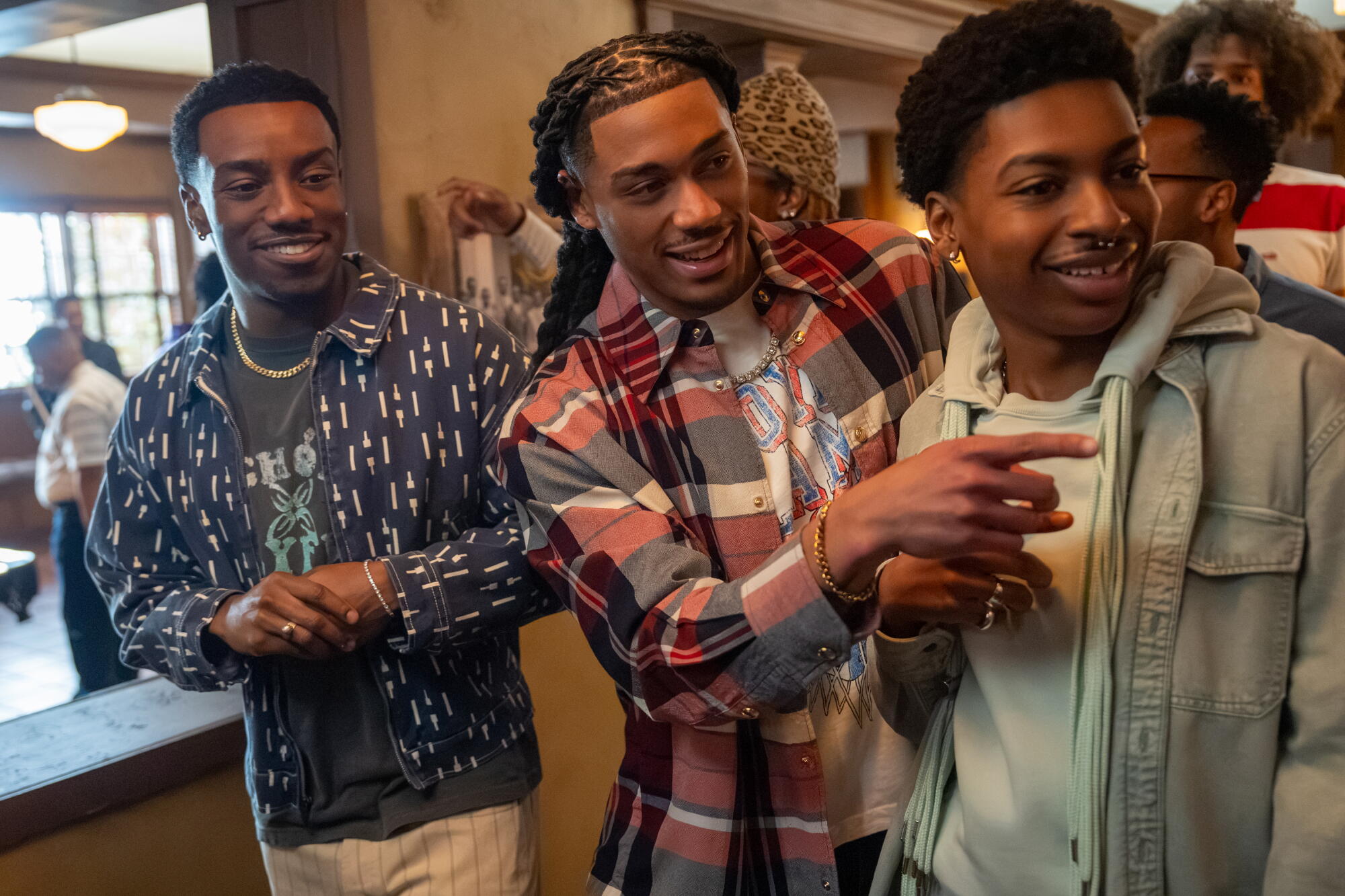
While the show features members of the original cast, the younger generation sorts itself into trios, including Kojo (Chibuikem Uche), left, Shaquille (Cornell Young IV) and Amir (Jordan Aaron Hall).
(Quantrell Colbert/Netflix)
Deborah wants to show her parents, who have been separated for six months but are rarely apart, that she can “enter my full studious season.” This will lead to her engaging a tutor, Ellington (Vincent Jamal Hooper), introduced for some light romantic tension vis a vis Shaquille. Athletic RA Candace (Renee Harrison), who likes Shaquille, provides a counterweight.
The younger generation sorts itself into two entwined trios. For a roommate Deborah draws Rashida (Alijah Kai), who’s from Compton and supposedly a champion gymnast, a characteristic that seems to exist simply to support a joke about Deborah’s “most improved” trophies for Choate women’s pickleball, since it’s never mentioned again. (Some storylines do just melt away.) She’s majoring in criminal justice “to get my cousins out of prison” and thinks Deborah is an unserious student. They’re joined by Hazel (Kennedi Reece), a nice Christian girl looking for a nice Christian guy.
On the boys’ team, alongside Shaquille, are Amir (Jordan Aaron Hall), a gay Harlemite whose deferred admission was because of a year in what they seemingly still call juvie and whose dream is to design clothing; and Ghanian Nigerian “by way of the U.K.” Kojo (Chibuikem Uche), an aspiring influencer bootlegging T-shirts of Shaquille; he, too, has marriage on his mind. They will learn as much in the dorms as they do in the classroom, but the classroom scenes are more on point than they often are in school-set shows.
Shaquille has a rival on the team, Andre (Joshua Suiter), whose wrist he fractures in a locker room fight — but this never really turns into anything. There aren’t any villains here, just young people making young people mistakes and older people making older people mistakes. No one is evil, but people do stupid things, which accords with my own memories of college.
Created by Felicia Pride, who has writing credits on “Queen Sugar,”“Bel-Air” and “Grey’s Anatomy,” it also includes plenty of scenes in which the young folks just have fun, dancing and singing. Big scenes are very well staged, which might have something to do with having choreographer Debbie Allen, director of the premiere episode (and 83 episodes of the original series), as an executive producer. (She also reprises her role as academic counselor Dr. Langhorne, whose motto is “Relax, relate, release,” as if anyone could.)
Over the course of 10 episodes, we’ll encounter many issues relevant to student life and beyond — dyslexia, ADHD (this was my introduction to the parking lot and pomodoro techniques), how lockdown “wreaked havoc” on a generation’s ability to read social cues, STDs, adultification bias, federal cuts to education (Hillman is in the red, and students are losing their grants). bell hooks is quoted on socializing men toward love instead of sex, and, indeed, the series is refreshingly modest on that account.
Welcoming the incoming freshmen, Deborah’s father says, “This is a watershed moment where this country that we built is trying to erase our Black history. Our gains, our culture. They wanna demoralize us. They wanna deport us, they wanna jail us, they wanna shoot us down in the street. But you, you all are their greatest threat. You future leaders who are about justice and community and each other. I know you will stand up. I know you will fight, build and change the world.” It’s a bit speechy — well, it’s in an actual speech — but it’s nice to have that laid out so cleanly in a Netflix sitcom in these difficult days.
And in the wake of a bomb threat, Deborah will declare to the world, “We are not going anywhere. We are studying, we are partying, and we are living our best young, gifted, Black, talented lives right here in our space.” Which sums it up nicely.
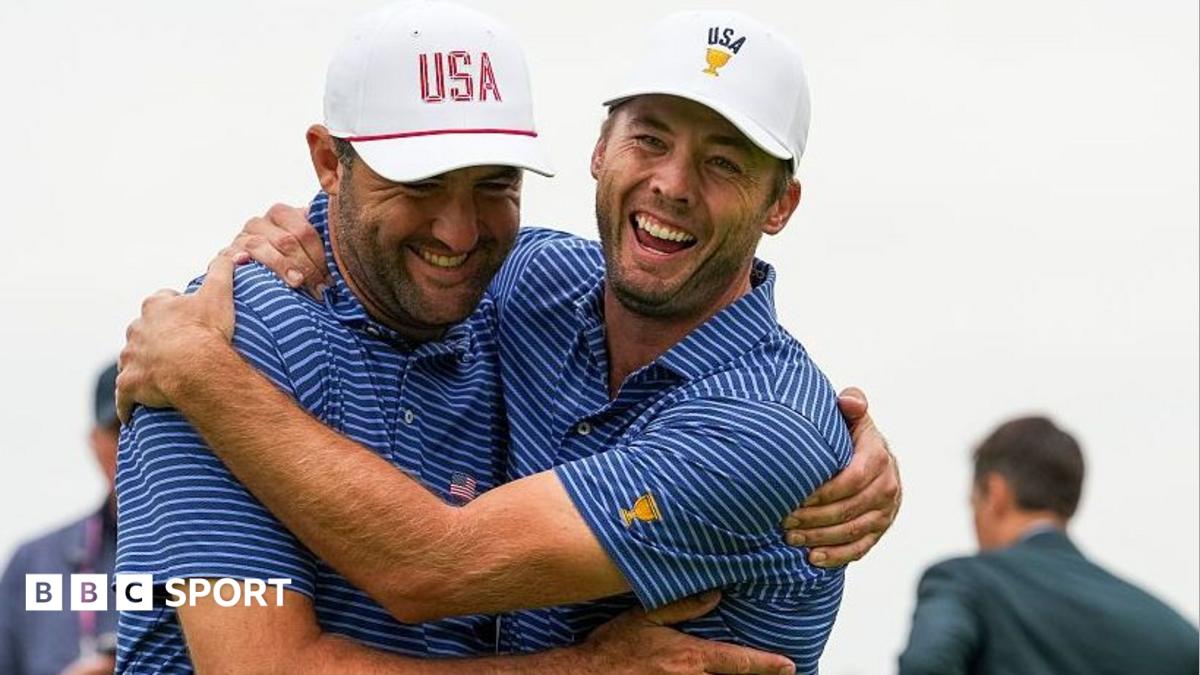
The United States began their bid to win an 11th consecutive Presidents Cup by opening up a 3-2 lead over the International team at the end of Thursday’s fourballs matches at Medinah Country Club in Illinois.
Justin Thomas and rookie Jackson Koivun put the first point on the board for Brandt Snedeker’s American team with a resounding 4&3 win over Canada’s Corey Conners and Colombia’s Nico Echavarria.
World number one Scottie Scheffler, who was partnered with his long-time friend Sam Burns, took the 17th hole and held on to close out their victory over Min Woo Lee and Sungjae Im, who were left to rue several missed putts down the stretch.
And two-time major champions Wyndham Clark and Collin Morikawa ensured the US would take an advantage into Friday’s five foursome matches.
Clark and Morikawa led from the opening hole against Australia’s Adam Scott and reigning Open champion Ryan Fox before completing their 3&2 success with two holes to spare.
“A session win is a session win; we’re going to take it any way we can get it,” said Snedeker.
However, Geoff Ogilvy’s International side will head into the alternate shot format on Friday with optimism of remaining in contention to claim only their second ever triumph in the biennial contest, some 28 years after their first in 1998.
Japanese duo Hideki Matsuyama and debutant Ryo Hisatsune recorded a 3&1 success over Cameron Young and Xander Schauffele, while Kim Si-woo and Tom Kim always looked comfortable in their 3&2 win over Chris Gotterup and Patrick Cantlay.
The five foursome matches scheduled to take place on Friday will be followed by two sessions on Saturday, split between four four-ball matches in the morning and four foursomes in the afternoon.
All 12 players on each team will then compete in the singles matches on Sunday, with 15½ points required for overall victory.