sentencing

Federal judge pauses sentencing to weigh argument in Wisconsin judge’s immigration case conviction

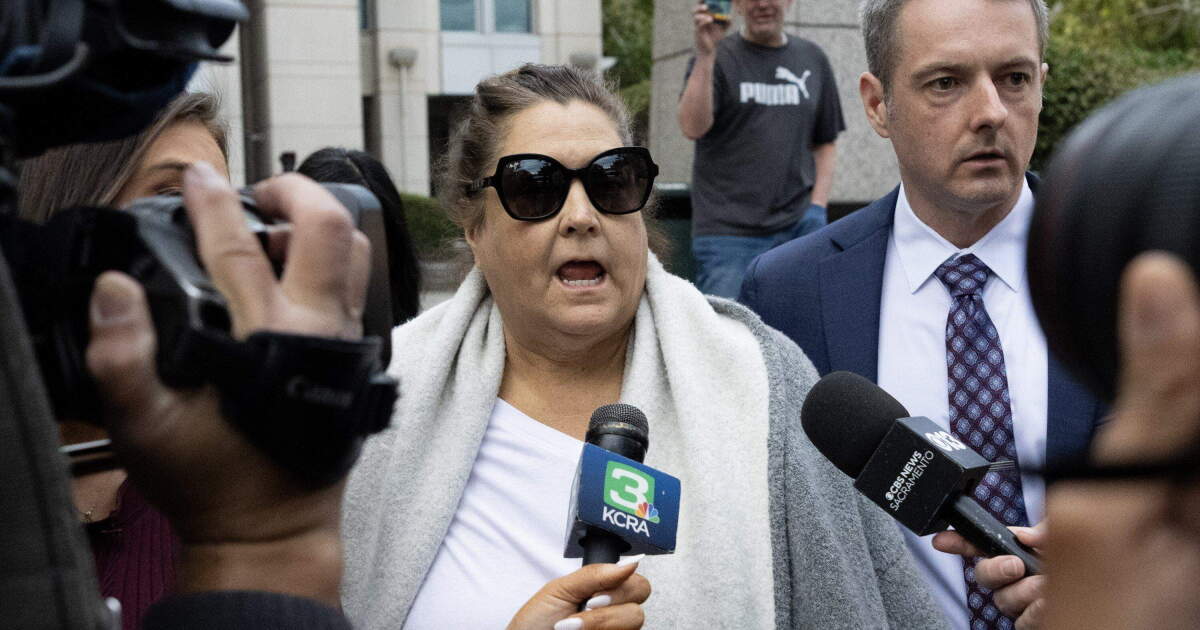
A federal judge on Wednesday considered whether to throw out a jury’s guilty verdict against former Wisconsin Judge Hannah Dugan, who was convicted of felony obstruction for helping an immigrant evade federal officers.

The case was an early test of how the courts would respond to President Trump’s sweeping immigration crackdown.

Dugan had been scheduled to be sentenced on Wednesday, but U.S. District Judge Lynn Adelman postponed the proceedings indefinitely to instead hear arguments about whether to overturn her conviction.

Adelman did not rule from the bench and did not indicate when he might issue a decision. Dugan and attorneys for both sides left the courtroom without commenting to reporters.

Former judge’s attorney points to a Virginia case

Dugan’s attorney Steven Biskupic argued that her conviction was invalid and should be overturned. He said that was necessary because a federal appeals court in April overturned a key Virginia immigration case that the judge and prosecutors had cited in the Dugan case.

Biskupic argued that based on the 4th U.S. Circuit Court of Appeals overturning that ruling, Dugan was improperly convicted, procedurally, under a certain federal law.

“Our primary argument is this was an invalid theory of conviction,” Biskupic said.

In the Virginia case, an immigrant who was in the country illegally was detained by U.S. Immigration and Customs Enforcement agents and later escaped. He was recaptured and indicted on a charge of obstructing a pending immigration proceeding.

The federal appeals court found that the ICE action did not constitute a “pending proceeding,” as is required under the federal obstruction law.

Dugan’s attorneys argue that she should not have been charged because there was no “pending proceeding” against the immigrant in her courtroom being sought by ICE agents, only a warrant filed for his arrest. The filing of a warrant does not constitute a “proceeding” under the law, Biskupic argued.

Prosecutors countered that the facts in the Virginia case are different and don’t apply to Dugan’s. They also argued that other cases support Dugan’s conviction.

“The court should stick with its ruling,” said Richard Frohling, acting U.S. attorney for the eastern district of Wisconsin.

In response to a question from the judge, he contended that the appeals court was wrong to overturn the Virginia case. The judge also quizzed Frohling on what constitutes a proceeding under the law and how long it lasts.

“It could be a couple minutes, it could be a couple years,” Frohling said. “It all depends on the context.”

Dugan’s sentencing was postponed so the court can hear new arguments

Dugan, 67, faces up to five years in prison after a jury convicted her on Dec. 19. But it is unlikely that Dugan would be sentenced to prison. Federal sentencing guidelines generally call for probation for defendants like her who have no criminal history and are convicted of a nonviolent crime.

She resigned from her position as a Milwaukee County circuit judge two weeks after her conviction amid threats of impeachment from Republican state lawmakers. She had been a judge for nine years.

Dugan was present for Wednesday’s arguments but did not speak.

The Trump administration brought the case against Dugan as the president pressed ahead with his sweeping immigration crackdown. Trump’s administration and his allies branded Dugan as an activist judge, while Dugan’s attorneys said she was being unfairly targeted and argued, unsuccessfully, that she was immune from being charged because she was a judge.

Dugan’s case marked the first time that a state judge in Wisconsin went to trial on charges of obstructing immigration agents. She was acquitted of concealing an individual to prevent arrest, a misdemeanor.

Dugan helped an immigrant wanted by ICE agents

On April 18, 2025, immigration officers went to the Milwaukee County courthouse after learning Eduardo Flores-Ruiz had reentered the country illegally and was scheduled to appear before Dugan for a hearing in a state battery case.

Dugan confronted agents outside her courtroom and directed them to the chief judge’s office because she told them their administrative warrant wasn’t sufficient grounds to arrest Flores-Ruiz.

After the agents left, she led Flores-Ruiz and his attorney out a private jury door. Agents spotted Flores-Ruiz in the corridor, followed him outside and arrested him after a foot chase. A week later, FBI agents arrested Dugan in the courthouse, leading her outside in handcuffs.

Flores-Ruiz was deported in November.

Bauer writes for the Associated Press.

Source link

NBA probe of Steve Ballmer, Clippers nears end with Sanberg sentencing

The sentencing of Aspiration co-founder Joseph Sanberg to 14 years in federal prison on Monday brings the NBA a step closer to concluding its nine-month investigation into the Clippers allegedly circumventing the salary cap.

Sanberg pleaded guilty in October to federal charges of conspiring to bilk investors out of $248 million for portraying the now-defunct Aspiration as a “socially-conscious and sustainable banking services and investment products” firm.

The NBA has declined to comment on the status of the probe centered on $60 million invested in Aspiration by Clippers owner Steve Ballmer and the $28-million contract Clippers star Kawhi Leonard signed with Aspiration for endorsement and marketing work that he never delivered.

Players are allowed to have separate endorsement and other business deals, but at issue is whether the Clippers participated in arranging the side deal beyond simply introducing Aspiration executives to Leonard. Doing so would be a violation of Article 13 of the NBA collective bargaining agreement, punishable by a $4.5-million fine, the loss of a first-round draft pick and the voiding of Leonard’s contract.

The NBA draft takes place June 23-24 and the Clippers have three picks, including the fifth overall selection. The league is not expected to release its findings until after the NBA Finals, which begin Wednesday between the New York Knicks and San Antonio Spurs.

Clippers officials haven’t commented on the investigation. But Leonard, who has one year left on a three-year, $149.5-million contract that will pay him $50.3 million next season, told The Athletic after the Clippers’ season-ending game April 15 that “I think we’re going to be in the clear. I’m not stressing.”

Otherwise, among the few public comments about the investigation were letters submitted to federal court judge Stephen V. Wilson ahead of Sanberg’s sentencing by Ballmer and the law firm conducting the probe on behalf of the NBA.

The letter from Dave Anders of Wachtell Lipton stated that Sanberg provided documentation and information helpful to the NBA investigation during two in-person interviews.

“In all our dealings with Mr. Sanberg, both directly and through his counsel, he provided information that was consistent with our review of contemporaneous documents and other evidence,” Anders wrote. “Mr. Sanberg’s cooperation substantially assisted our investigation, including our ability to develop a more complete understanding of key events.”

Ballmer countered by asking Wilson for a stiff sentence in a five-page Victim Impact Statement posted on social media by his lawyer, David N. Kelley.

“Sanberg continues to exploit his fraud of Mr. Ballmer for his benefit, providing information to the NBA in return for a sentencing letter that the league submitted on his behalf,” Kelley wrote. “The reliability of Sanberg’s information is suspect given that he has pleaded guilty to federal fraud charges, and the government has made its own determination that he is not credible.”

Before handing down the sentence, Wilson made it clear that Sanberg’s credibility was questionable.

“He portrays himself as a do-gooder who was in business to help the world, but he did personally gain from his fraud,” Wilson said, later adding, “I would put the grade of his fraud at the zenith.”

Ballmer, a former longtime CEO of Microsoft who has owned the Clippers since 2014, accused Sanberg of targeting him for his well-known interest in environmental sustainability and exaggerating their relationship to convince others to invest in the fraudulent company. He said he met Sanberg only once.

Ballmer invested $50 million in Aspiration in September 2021. A month later, the Clippers announced a $300-million sponsorship deal with the company. Ballmer nearly granted Aspiration naming rights to the team’s new $2-billion venue as well, but instead chose financial services firm Intuit. Ballmer made an additional $10-million investment in Aspiration on March 9, 2023.

Ballmer was added in November as a defendant in a civil lawsuit against Sanberg and several others associated with Aspiration. Ballmer and the other defendants are accused by 11 investors in Aspiration of fraud and aiding and abetting fraud, with the plaintiffs seeking at least $50 million in damages.

Kelley contended that Ballmer was added as a defendant because of his “visibility and resources,” and portrayed the Clippers owner as a victim, saying “Mr. Ballmer’s losses are not measured solely, or even primarily, on a balance sheet. They are measured in the reputational damage that will take years to remediate, and in the chilling effect on future endeavors intended to do good.”

The lone public comment about the investigation from NBA Commissioner Adam Silver came during All-Star Weekend in February at the Intuit Dome when he described the issue as “enormously complex.”

“You have a company in bankruptcy, you have thousands of documents, multiple witnesses that needed to be interviewed,” Silver said.

The investigation was triggered by reports from podcaster Pablo Torre that Leonard’s sponsorship deal with Aspiration was to circumvent the salary cap. Torre and the staff of “Pablo Torre Finds Out” won a Pulitzer Prize for Audio Reporting for their efforts.

Source link