senate majority

Democrats hope for major gains as Americans head to polls

Control of Congress hangs in the balance as Americans head to the polls Tuesday to vote in a historic set of midterm elections that will determine how power is divided for the rest of President Trump’s time in office.

A robust turnout appeared possible, after months of polls suggesting voters’ frustration with cost-of-living issues may drive them to the polls. More than 59 million Americans had already cast ballots in early voting, according to the University of Florida Election Lab.

The campaign has largely been marked by Democrats’ unexpected traction in red states, resulting in Senate races that have been far more competitive than anticipated. Whether that translates into losses for Republicans could become a nail-biter Tuesday night.

Polling shows Democrats poised to make significant gains in the U.S. House and well-positioned for swing Senate races, but analysts say the Senate majority could go either way. Several gubernatorial seats are also open, and some contests have become unexpectedly close, including in Georgia, Kansas, Texas and Florida.

Eyes will be on a handful of bellwether House races as the polls begin closing, with a Kentucky district expected to be the first to offer clues as to how good a night it may be for Democrats.

For weeks, the midterms have appeared poised to deliver a referendum on Trump’s second term and the state of the economy. Americans’ approval of the president has sunk to historic lows as they have cited concerns about affordability, corruption and immigration as driving factors for their votes.

On Monday and over the weekend, candidates made their final pushes to persuade voters.

Democrats, hoping to clench voter support for a “blue wave,” hammered home their arguments about affordability, corruption and the perceived toll of Trump’s governance, aiming to sway non-Democratic voters.

“This election is a battle between the powers that be and the powers that ought to be,” Democratic Senate nominee James Talarico of Texas said at a Sunday night rally. “We are standing with the powers that ought to be — the teachers and the nurses, the farmers and the ranchers, the grandmother who is facing eviction.”

Republicans, anticipating losses in the House, focused on delivering dire warnings to voters about Democratic candidates, whom they have portrayed throughout the campaign as extreme, dangerous and in some cases a threat to the American way of life.

“This race is about defending our state and our country, but it’s also about safeguarding our way of life,” Texas Atty. Gen. Ken Paxton, the state’s Republican nominee for Senate, said Sunday. “Texas has never been this close to slipping away. We’ve never been this close to losing everything that we hold dear — our jobs, our livelihoods, our way of life.”

As voters cast ballots Tuesday, the Justice Department’s election monitors fanned out at polling sites across the country. Thousands of volunteers nationwide were also mobilized to be poll monitors, a backlash to the idea of potential federal election interference.

Trump sent out a flurry of last-minute social media endorsements for Republican congressional candidates and called in to the “Fox and Friends” show to make a final case. Democratic candidates dropped last-minute ads urging voters to head to the polls.

This article will be updated.
Source link

These are the possible midterm outcomes for House and Senate

Americans are heading to the polls Tuesday in a historic set of midterm elections that will determine which party controls the chambers of Congress for the remainder of President Trump’s time in office.

Democrats appear poised to make significant gains, with polling showing the party up between 7 and 11 points on the generic ballot. Republicans are braced for losses but hoping to hang on to Senate control.

The night’s big question is whether a true wave will materialize for Democrats and how sizable it might be — how many U.S. House seats the party can flip, whether it can secure a Senate majority and whether Democrats take control of a majority of governorships.

The first polls close at 3 p.m. PST in parts of Kentucky and Indiana, and more Eastern states follow at 4 p.m. Here’s a rundown of the possible outcomes and what to watch as Tuesday unfolds.

Who could control Congress?

  • Blue House, red Senate: Democrats could win a House majority — either substantial or modest — while Republicans retain the Senate.

    Split control of Congress would give House Democrats the ability to launch investigations into the Trump administration and block Republican legislative priorities. Senate Republicans would be able to scuttle legislation coming out of the House and continue approving Cabinet and judicial appointments, including to any openings on the Supreme Court. Legislative gridlock — and possible government shutdowns — would be likely.

  • Total Democratic control: A larger “blue wave” could occur, sweeping up House seats for Democrats and tipping key Senate races in their favor to hand Democrats a majority in both chambers. The Senate majority would likely be very narrow and could come down to a single race.

    Democrats would be able to block Senate confirmation of Cabinet and judicial appointments. They would be able to pass legislation, but Trump would hold veto power and the Democrats would be unlikely to secure veto-proof majorities on partisan priorities.

  • Wild cards: Most analysts agree there is very little chance that Republicans will keep House control.

    The potential for civic unrest looms over the election. If results in one or more races are contested by a losing party — as Trump and his allies have suggested is possible — the potential exists for prolonged uncertainty or a constitutional crisis.

When will we know the outcome?

The House majority could become clear before the night is over. The Senate majority could require a longer wait, particularly if it comes down to Alaska, which along with Hawaii is the last state to close polls, at 9 p.m. PST.

If the Democrats take the House, their full margin of victory likely won’t be clear Tuesday night. Some key swing races are in states that have slower ballot counts, including California and Pennsylvania.

If a blue wave does not materialize and the race for the House majority narrows, how each party makes out could take longer to ascertain.

Which races will provide early clues?

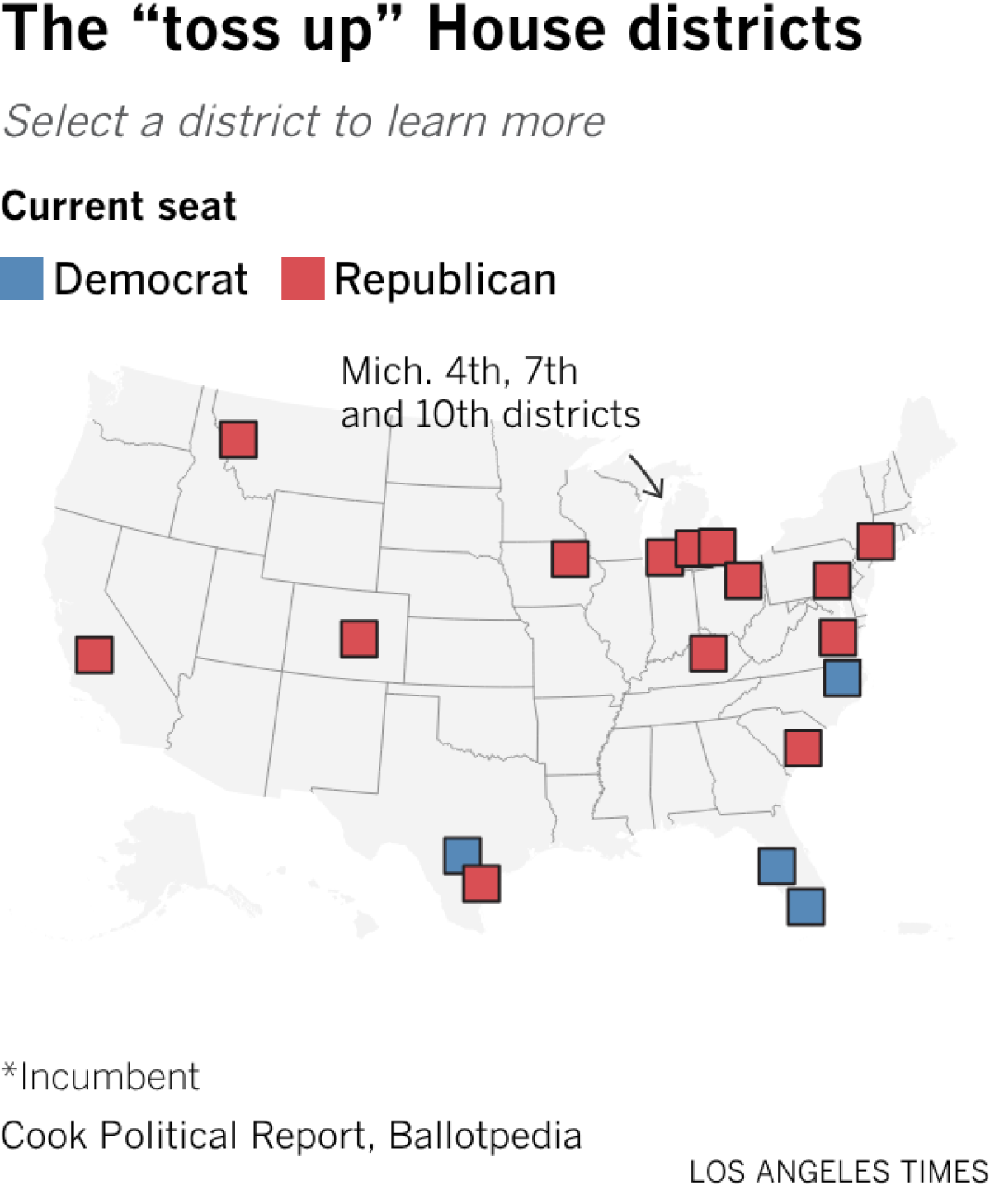
More than four dozen House races are competitive, including 18 that are considered tossups by election forecaster Cook Political Report. The additional 35 races are considered competitive but leaning towards one party. Whether additional, less competitive seats flip unexpectedly will be one indication of how much of a “wave” election this is.

Seven Senate seats are tossups: Alaska, Iowa, Kansas, Maine, Michigan, Ohio and Texas. Three more are potentially competitive: South Carolina, which leans Republican, and Minnesota and New Hampshire, which lean Democratic under Cook’s ratings.

North Carolina and Georgia, originally viewed as competitive seats, are now both seen by forecasters as fairly safe bets for Democrats.

The swing states could largely tip for Republicans or for Democrats, or the majority could come down to just a single race.

Experts say they’re watching a handful of races that could provide early indicators for how the night may go, though predictions are always dicey and outliers are possible. Among the races to keep an eye on:

  • Kentucky’s 6th: This Lexington-area U.S. House district has become an unexpected tossup, and with the nation’s earliest poll-closing time, it could be a bellwether. “If Democrats win that district, then it’s a Democratic tsunami,” said Christopher Warshaw, a Georgetown University public policy professor. “Even if it’s close, that would be pretty telling.”
  • Iowa’s 2nd: Forecasters have shifted this race to a tossup amid a difficult environment for state Republicans. If Republicans lose this seat — which belonged to Rep. Ashley Hinson, the party’s Senate nominee — it could signal a blue wave on the bigger side.
  • New York’s 17th: One of just three districts with a Republican incumbent that went blue in the 2024 presidential election, the outcome of this close race could “tell us a lot,” said Todd Belt, a George Washington University political science professor.
  • Texas’ 15th: This district offers a bellwether for Latino voters who moved right in 2024 but, signs indicate, may be shifting back to the left. The 34th and 35th districts in Texas could also be indicative.
  • Michigan Senate: If the Democrats lose Michigan, their path to Senate control becomes difficult. A win in Michigan is a best-case scenario for Republicans seeking to retain Senate control. Without Michigan, Democrats would have to flip five out of six swing seats in Alaska, Texas, Ohio, Iowa, Kansas and South Carolina.
  • Maine Senate: If Democrat Troy Jackson wins in Maine, that will likely be a good sign for his party’s chances at the Senate majority and their races in Michigan, Ohio and Iowa. Without it, Democrats could still take the majority, but Republicans’ path will become easier.
  • Other states: If Democrats pull off wins in purple or red districts in Florida, Virginia and Pennsylvania, those could also signal a blue-leaning night.

Source link