An Earthquake-Prone Country Without a Seismic Monitoring System
Over two weeks have passed after the June 24 Venezuelan earthquakes. The main concerns at the moment are coping with the human and material costs of the disaster, while laying down the work ahead for what looks to be a slow path to recovery. Meanwhile, a recent news report that is curiously connected to the seismic event itself caught attention.
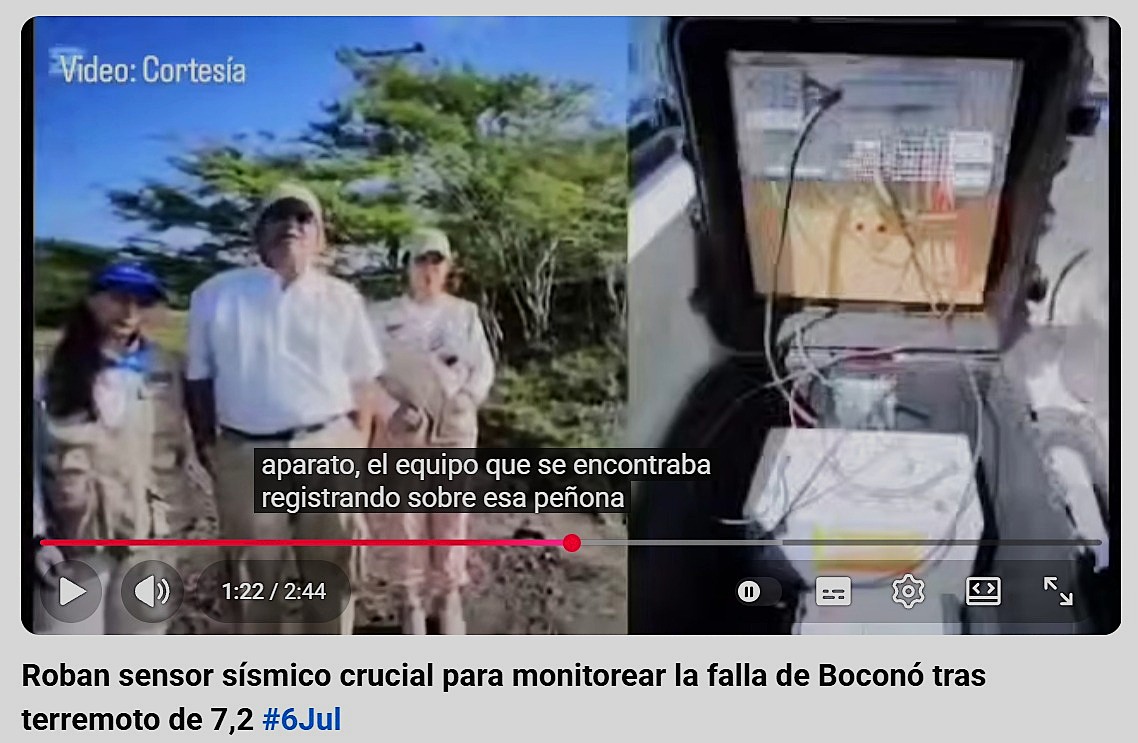
A video recorded by renowned Venezuelan geologist Franck Audemard, along with staff from Funvisis (the Venezuelan Foundation for Seismological Research), denounced that a high-precision GPS monitoring device, used to track movements along the Boconó Fault, was missing from its location at “La Chicharronera”, by the Morón-Barquisimeto highway (part of the Cimarrón-Andresote Highway), inside a piece of land owned by the former Major League Baseball player Melvin Mora.
“In the year 2013, we installed equipment in the rock that we have behind us”, says Audemard in the video. “This equipment is a global positioning device, which was sown in a giant rock to follow the movement of the Boconó Fault, which was responsible for the first of the two earthquakes of June 24th, 2026… The equipment that was registering on that rock has disappeared, it’s no longer in the location where it was.”
“Therefore, we are making this public call to the person who put it into safety to be kind enough to return at least the sensor from such equipment… The data being registered there is vital to what’s currently happening in the central, center-west part of the country.”
Funvisis issued its first report about the quakes several hours after its Colombian and US counterparts did.
Audemard publicly asked whoever has this equipment or sensor to deliver it to any public office or entity nearby. He and the Funvisis staff were visiting the area of one of the two quakes’ epicenters in Veroes municipality, Yaracuy state. In the small town of Palmarejo, a 300-meter crack opened up. There was serious material damage but no loss of life. Unfortunately, there were at least 15 people dead at the neighboring Juan José Mora municipality (Morón) in Carabobo state.
Audemard didn’t explain, though, the mystery of when Funvisis realized that one of its most important monitoring stations ceased to transmit data, assuming it’s true that it stopped because someone stole the equipment. It’s like they are using this story to justify the lack of response from the Venezuelan seismological agency Funvisis, which issued its first report about the June 24th quakes several hours after its Colombian (SGC) and North-American (USGS) counterparts did.
In recent days, Audemard spoke to several media outlets about what caused the earthquakes. Worth recommending is this long interview with Colombian private TV channel Caracol, in which he explains how the Boconó Fault accumulated enough energy to provoke a 7-7.5 earthquake based on a study he helped with in 2017. He has written articles on the Boconó Fault as well.
At first glance, this news report could be considered as not that relevant in the large scale of things with all what’s happening around us. But it cannot be dismissed either, as it reflects some of the criticisms regarding the management of seismic monitoring in Venezuela by Funvisis, the entity in charge since 1972, and its state of declining operability at the time of the recent quakes.
1% of former capacity
An article published on the Spanish website of Deutsche Welle (DW) on June 26 offers a picture of how the country found itself at such a moment by interviewing two local experts on the matter. One of them was Raúl Estévez, the founder of the Geophysics Laboratory at the University of Los Andes (ULA) and the Seismological Network of the Venezuelan Andes.
Estevez told DW that “the occurrence of these earthquakes wasn’t totally unexpected”, adding that specialists noticed for some time “a seismic breach” in Western Venezuela. “We expected the next big quake to happen there and with a magnitude of seven or more… We knew that.”
“We used to have between 250 and 300 seismological stations all across the country. In Mérida alone, we had around 25. Funvisis only has 3 to 5 functioning stations.”
As for Funvisis and the situation of the national seismic monitoring system, Estévez said that “politics went above everything else and neglected all the institutions that did seismology”.
A week after the DW piece was published, Estévez and three of his ULA colleagues held a forum in Mérida state titled “The Earth Shakes: analysis and challenges after the June 24th earthquake.”
Estevez said that the operativity of Funvisis is minimal: “We used to have between 250 and 300 seismological stations all across the country. In Mérida alone, we had around 25. Funvisis only has 3 to 5 functioning stations. The infrastructure is gone because we didn’t get resources.”
Chavista official Francisco Garcés became one of the most visible public faces of the official disaster response.
He also pointed to the lack of enough specialized personnel during the forum event in Merida and in his interview with DW. “The next generation of seismologists had to leave the country, not because they wanted to but because simply there were not enough resources to survive”.
Related to this, Estévez told DW that because of our lack of capacity we are more dependent on foreign institutions like the United States Geological Service (USGS). “…as a good part of the monitoring is from stations outside of Venezuela, any seismic activity information can only be inferred.”
“Mistakes are paid dearly”
Another callback is that many Venezuelans were able to know about the quakes right before they happened through their phones thanks to Google’s Android Earthquake Alert System.
Going back to DW’s article, the other local expert consulted didn’t directly address any issues regarding Funvisis. Which is somewhat curious as that person was its former head Francisco Garcés, who held the position between 2009 and 2010.
Instead, he mostly focused on how singular the June 24th quakes were: “It isn’t normal to suffer two consecutive earthquakes of this magnitude. This is extraordinary in any part of the world”. Yet, he acknowledged the lessons to be learned from this disaster: “Mistakes are paid dearly.”
The June 24 doublet was not an ordinary seismic event, but there must be serious reflection on the State’s failures when it comes to monitoring and reporting.
Garcés has become one of the most visible public faces of the official response to the disaster by giving multiple media interviews explaining in detail the causes and impact of the earthquakes.
Now, he was given a double new role by Delcy Rodríguez: first up, as the Chairman of the new Presidential Commission for the Evaluation of Housing Habitability and General Infrastructure, which will be in charge of reviewing houses and other kinds of structures like roads and bridges. The other role is of Transportation Minister, a position he already occupied between 2010 and 2011.
Garcés has already met with the national civil engineering guild (Colegio de Ingenieros de Venezuela) to unify the technical criteria to be used for the ongoing round of inspections. He has also explained the traffic light-style methodology to identify the state of any given infrastructure.
It’s true that what happened on June 24th was not an ordinary seismic event. But as the nation begins to pull itself back on its feet, there has to be serious reflection on the failures in properly monitoring and reporting these kinds of natural disasters. I agree with what Mr. Audemard just told State TV channel VTV about having a “seismic culture”, but that has to come along with proper preparation by the authorities who should be in charge of helping us when it’s needed.