Katie Zacharia, the new White House press secretary under United States President Donald Trump, has drawn increasing criticism over claims about her professional background.
On Wednesday, a public accountability nonprofit filed a complaint with the State Bar of California over Zacharia’s repeated claims that she was a lawyer.
Recommended Stories
list of 3 itemsend of list
If made falsely, such a claim is a crime in the state. According to Zacharia’s LinkedIn profile, she received a degree from the Pepperdine Caruso School of Law in 2011, but critics have questioned whether she received a licence to practise law, as she has suggested.
“Ms. Zacharia has represented herself as a lawyer repeatedly to buttress her reputation and credibility as a television legal commentator and now as the White House spokesperson,” Michelle Kuppersmith, the head of the Washington, DC-based Campaign for Accountability, said in a statement. “Yet it seems it was all a lie.”
Her organisation filed the complaint with California’s bar office, a regulatory agency that oversees the licensing of lawyers.
“In California, calling yourself a lawyer without a license isn’t puffery; it’s a crime,” Kuppersmith said.
“The State Bar should investigate whether Ms. Zacharia has misled the public about her credentials and hold her accountable if she has.”
Zacharia, a commentator who has appeared frequently on Fox News and Newsmax, began her term as White House press secretary on Tuesday.
In a news briefing that day, she seemed to falter and speak haltingly, sometimes having to repeat herself.
Her appearance was brief, lasting under 15 minutes. She spent much of her time at the podium thanking Trump for the opportunity and reading from a prepared statement.
“I have wanted to work for him for a very long time,” Zacharia said.
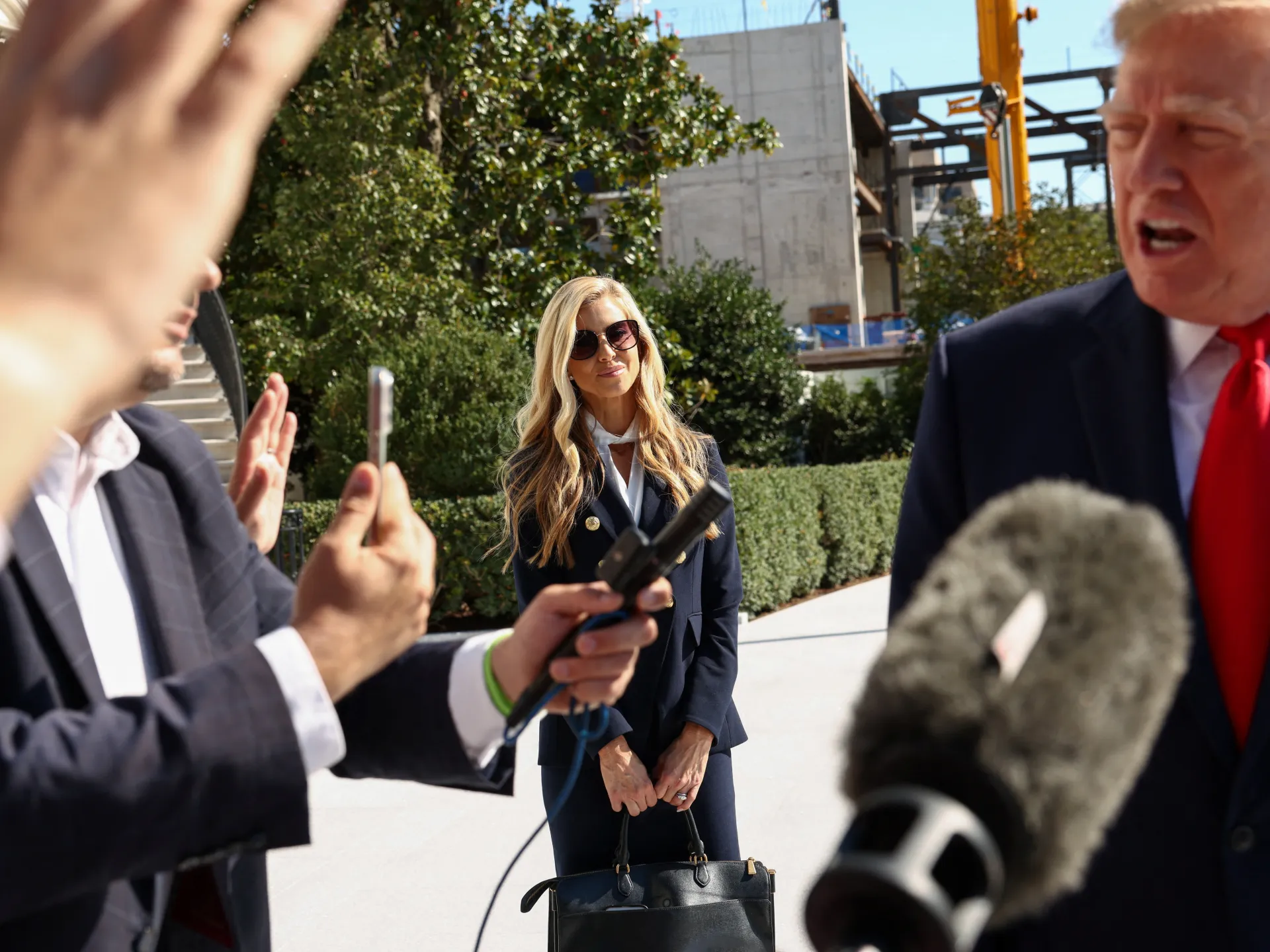
Later, she joined Trump outside the White House to speak further with reporters. When asked where she had passed the bar exam, Zacharia replied, “When I moved to China.”
The response was an apparent reference to a three-year stint in which she claims she worked at a law firm in Beijing.
A biography on the website for the pro-Trump women’s organisation Trumpettes USA Inc says she “served as outside counsel” for the World Bank and International Finance Corporation while in Beijing.
Her LinkedIn profile, meanwhile, indicates Zacharia served as an associate at the Zhong Lun Law Firm in Beijing from 2011 to 2013. More recently, from 2024 to 2025, it lists her as general counsel for Fix California, a voter rights group started by a Trump administration official.
On her Instagram profile, Zacharia describes herself as a “Wife, Mom, & Lawyer”.
But Zacharia’s assertion that she passed the bar in China has fuelled media scrutiny. China’s equivalent of the bar exam, the notoriously difficult National Unified Legal Professional Qualification Examination, can only be taken by Chinese citizens.
China has, on rare occasion, allowed foreigners to practise law in the country if they have several years of experience in their home countries first.
But that does not appear to be the case for Zacharia. According to media reports, Zacharia has not been found to be licensed as a lawyer in any state in the US.
In a statement to The Associated Press, Zacharia responded to the scrutiny by saying, “I practice international transaction law, with all the appropriate credentials.”
Since Trump’s return to office for a second term, Zacharia has spent several months as a communications adviser at the Department of Homeland Security.
Since June, she has also worked as the senior communications adviser at the Trump Media and Technology Group, which owns the Truth Social platform.
New Delhi, India – Indian democracy has been shaken by new revelations showing divisions within the body that is in charge of conducting its elections over controversial policies that critics say have disenfranchised tens of millions of people.
India’s Election Commission, a supposedly autonomous constitutional body, is tasked with administering elections in the world’s largest democracy, and in recent decades, had won admirers across the globe for its success in conducting a voting process unmatched in scale and complexity.
But an investigation by The Indian Express newspaper reported that the current chief of the commission frequently overruled concerns raised by his two other equally ranked commissioners about the integrity of ongoing changes in the voter database.
These revelations come after a months-long struggle by India’s opposition parties to bring what they have described as the “sabotaging” conduct of the election commission to the fore, which they say is dictated by Prime Minister Narendra Modi’s party for its electoral benefit.
For decades, India has grappled with deep inequality; divisions along caste, religious and ethnic lines; and the growing role of money in its elections. Yet through it all, the actual conduct of its elections was largely viewed as “free” domestically and by global monitors.
But leading opposition leaders have, in recent months and years, for the first time, questioned whether elections can be trusted and whether votes are counted accurately, as well as whether rights decide who gets to be a voter or if those in authority take the decision arbitrarily. Those concerns, say analysts, are likely to only be amplified by the latest revelations.
“Today, that faith [in the election process] has shaken. It is very shocking for the nation,” SY Quraishi, who headed India’s election commission between 2010 and 2012, told Al Jazeera. “The Election Commission used to be a very reputed institution. Now, it is totally dysfunctional – and that’s an understatement.”
So, what does this mean for India and its democracy?
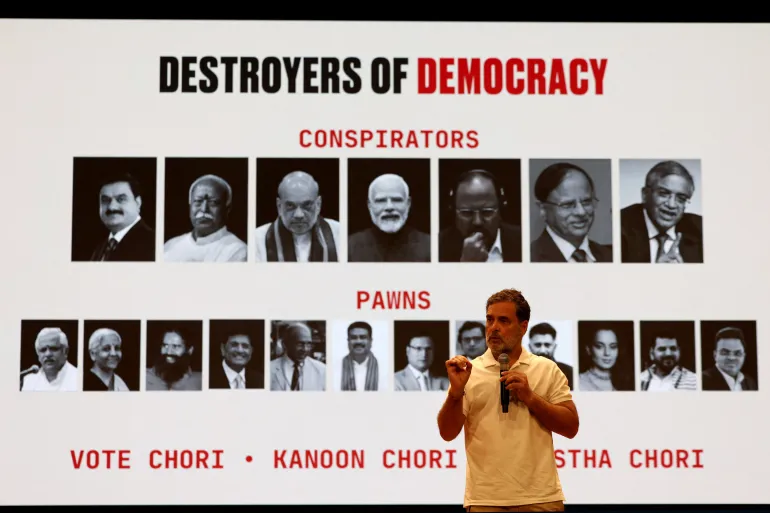
Indian opposition leader Rahul Gandhi speaks during a news conference to demand resignation of India’s Chief Election Commissioner Gyanesh Kumar, in New Delhi, India, September 24, 2026 [Bhawika Chhabra/Reuters]
What are the latest revelations about India’s Election Commission?
Earlier this week, the Indian Express newspaper published a series of stories, based on internal documents and interviews, laying bare divisions within the poll panel – consisting of three commissioners, Gyanesh Kumar, Sukhbir Singh Sandhu, and Vivek Joshi. Kumar is the commission’s chief.
Indian law requires the commission to decide by a majority. Reports revealed that Sandhu and Joshi resisted and questioned the legality of measures Kumar took unilaterally.
Since June last year, the commission has been revising and updating the voters list state-wise. It has struck off more than 13 million names during the exercise since then, which the critics say targeted economically weaker sections, minorities, and other vulnerable groups of Indian society disproportionately.
Opposition parties took the matter to the country’s top court, which largely signed off on the process to decide on who gets to vote in India. For India’s more than 1.4 billion population, a voting right does not end merely on ballots – rather, several government welfare schemes are tied to voting rights.
Now, reports reveal that some of the strongest resistance to the three-member commission’s decisions was coming from within. In fact, Sandhu and Joshi formally objected on record at least 14 times over the last 10 months to measures issued by circumventing them. Sandhu called it “unauthorised and illegal”.
Those objections related to the new voter registration mandate; deletion and restoration of voters in the rolls; appeals by people against deletions; and the security of the list. In short, everything the commission undertook.
The opposition has alleged that the additions and deletions of the voters are undertaken as an exercise to disenfranchise a section of voters to benefit Modi’s Bharatiya Janata Party (BJP).
The commission maintained that access to the voters’ list is highly secured and decentralised, meaning that even in the remotest parts of the country, a local officer made the judgement and decision.
But the latest revelations show that the commission relied on ECINet, a digital platform that logs nearly a billion voters, which was increasingly centralised, giving more control to New Delhi over editing calls.
In one instance, the newspaper reported that officials in the coastal state of Goa flagged nearly a hundred voters who were mistakenly taken out. Editing access was limited to New Delhi.
So, Goa’s chief electoral officer wrote eight emails to officials in New Delhi in a week before the deadline passed, but got no response and voters were knocked off the list.
An Indian Youth Congress activist, wearing a mask depicting Chief Election Commissioner Gyanesh Kumar and handcuffed, takes part in a protest in New Delhi, India, September 25, 2026 [Rajat Gupta/EPA]
Why is revision of voters’ list controversial?
The Special Intensive Revision (SIR), as the process of revising the list is called, has become controversial mainly because it places an unusually heavy burden on existing voters to prove their eligibility.
Such a drive requires people to produce old records, like birth, land, and education certificates – and puts poorer, migrant, and marginalised Indians at a disadvantage, essentially drawing lines on who gets to vote in India. A minor mismatch, such as a spelling, in decades-old records could result in being struck from the voters list in India.
Opposition parties and civil society groups have argued that mass deletions could significantly alter the electorate before elections.
In some places, the exercise has been reported to disenfranchise minorities, including Muslims. In the eastern state of West Bengal, Al Jazeera earlier reported that the exercise removed 9 million residents from the electoral rolls just days before the state elections that were held in April and May.
Nearly 34 percent of the deleted voters were Muslims in the state, where they only make up 27 percent of the population. Then, Prime Minister Modi’s Hindu majoritarian BJP came to power for the first time in the politically critical state.
The BJP and supporters of the SIR process have argued that it is fundamentally aimed at removing illegal migrants, the deceased or fraudulent voters from the rolls – and have tried to portray many Muslims eliminated from the lists in border states as “illegal Bangladeshi migrants,” despite hard evidence that Indian nationals have been victims of the process.
But as the exercise has been expanded to other parts of the country, those claims have increasingly returned to embarrass even proponents of the exercise: In New Delhi, notices were served to India’s Foreign Minister S Jaishankar and his wife, alongside other high-profile politicians, judges and senior bureaucrats. Several former Indian ambassadors to countries across the world have received notices to prove that they are Indian – even though they have served as India’s sovereign representatives abroad for years.
All of this has turned what was political opposition to the SIR process into much more broad-based, nationwide scepticism about the lack of transparency in the Election Commission’s software, the process of matching voters against decades-old electoral rolls, and the criteria being used to flag voters as having “logical discrepancies”.
“The [revision of voters’ list] fundamentally inverts India’s model of electoral democracy,” said Milan Vaishnav, a senior fellow and director of the South Asia programme at the Washington, DC-based nonpartisan think tank The Carnegie Endowment for International Peace.
“Since the adoption of the Constitution, India has assumed the burden of ensuring that the last man or woman is registered to vote,” he said. Vaishnav added that unlike other democracies, notably the United States, which has repeatedly thrown up barriers to the franchise, “India historically adopted an unusually activist approach to voter registration.”
“Specifically, the way in which [the revision] has been carried out threatens to turn that principle on its head,” he told Al Jazeera. “It is now the voter who must prove his or her entitlement to remain on the electoral rolls.”
Quraishi, the former election commissioner of India, told Al Jazeera that he has been against the policies taken up under the revision.
“I hope [these revelations] are a wake-up call and serious action will be undertaken, including at the Supreme Court, the central government, and the Parliament,” Quraishi told Al Jazeera.
“Because the reputation of the Election Commission has gone into the dumps. And it is very difficult to restore it now,” he said. “We need efforts to rebuild faith in the system.”
Abhijeet Dipke, head of the Cockroach Janta Party (CJP) speaks as the party’s conveners Ashutosh Ranka and Saurav Das look on during a news conference to demand the resignation of India’s Chief Election Commissioner Gyanesh Kumar, in New Delhi, India, September 24, 2026 [Bhawika Chhabra/Reuters]
What is the opposition demanding?
Leader of the opposition Rahul Gandhi has accused the Election Commission of “treason” against the nation, and promised that its leaders will be tried for it, if his Congress Party returns to power.
India’s popular Gen-Z pressure group, the Cockroach Janta Party, whose protest movement led to the ouster of India’s education minister in July, has threatened to hit the streets again if Kumar, the commission’s sitting chief, does not resign by Saturday.
The Cockroach group has also called for an overhaul in the selection process of the next election commissioner.
For its part, the election commission has said in a statement that the investigation report drew on “differing views and deliberations” between the three commissioners rather than official statements of protest. Sambit Patra, a spokesman for Modi’s party, told reporters that any deliberation or divisions in the commission were rather “a sign of a healthy democracy”.
But none of that appears to be cutting ice in a nation where far too many people have now faced the threat of losing their vote through an opaque process.
“Our elections are fundamentally broken,” said Gandhi at a news conference in New Delhi on Thursday. “The sacred belief in elections,” he added, was evaporating.
Aiming at Modi, Gandhi argued that the popularity of a leader could be understood, but not “how anti-incumbency disappears”.
“It doesn’t exist in North Korea. There is no democracy where anti-incumbency doesn’t work. We are looking for answers to where it went here,” Gandhi said, in effect questioning Modi’s re-election first in 2019 and then again in 2024, with a much-reduced mandate – even though there is no firm evidence of widespread voter manipulation helping Modi win those elections. “And we have found answers.”
Women voters stand in queues to cast their ballots at a polling station during the first phase of voting for assembly elections on November 6, 2025, at the Raghopur constituency in the Vaishali district of the Indian state of Bihar [Sachin Kumar/AFP]
What does it mean for Indian polity?
Asim Ali, a political analyst in New Delhi, said that the Indian republic is standing at a “dangerous moment, where we could see a breakdown of the republic.”
“We have reached a situation where every opposition party feels that the democratic guardrails have been destroyed,” Ali told Al Jazeera, adding that the allegations are about the worry that “independent institutions like the Election Commission and Supreme Court have become co-opted.”
The political cleavage has created an extreme polarisation of politics in India. “Politics has assumed a kind of existential stakes, where we have unrestrained politics of friend vs enemy,” he added.
Rasheed Kidwai, a political analyst and senior journalist who has covered the Indian government for several decades, told Al Jazeera that “impartiality is paramount” for the Election Commission.
“The fact is that Caesar’s wife should be above suspicion,” he said. “In India, we have seen difficult times, including a state emergency, but never was the role of the Election Commission compromised at this level.”
Kidwai noted that Modi’s party has ridiculed opposition parties’ concerns about free-and-fair elections, calling them sore losers. “The outcomes of a match are inconsequential, but at least the umpire should play fair,” he told Al Jazeera.
The major criticisms of Indian democracy in recent years have principally related to what happens in between elections, said Vaishnav of the Carnegie Endowment think tank.
While critics “pointed to the erosion of basic freedoms, an uneven rule of law, and the concentration of power in the hands of the executive,” Vaishnav said, “most observers have argued that when the electoral spotlight is on, India’s democracy remains remarkably robust and competitive.”
The conduct of the Election Commission is “now calling this distinction into question”, he added.