Sanders

Bernie Sanders hasn’t changed. Is that his strength or a weakness?

After breakfast on a recent Saturday, Robert Fraass crossed the river from Omaha to this southwest corner of Iowa to catch Bernie Sanders at the opening of his newest campaign office.

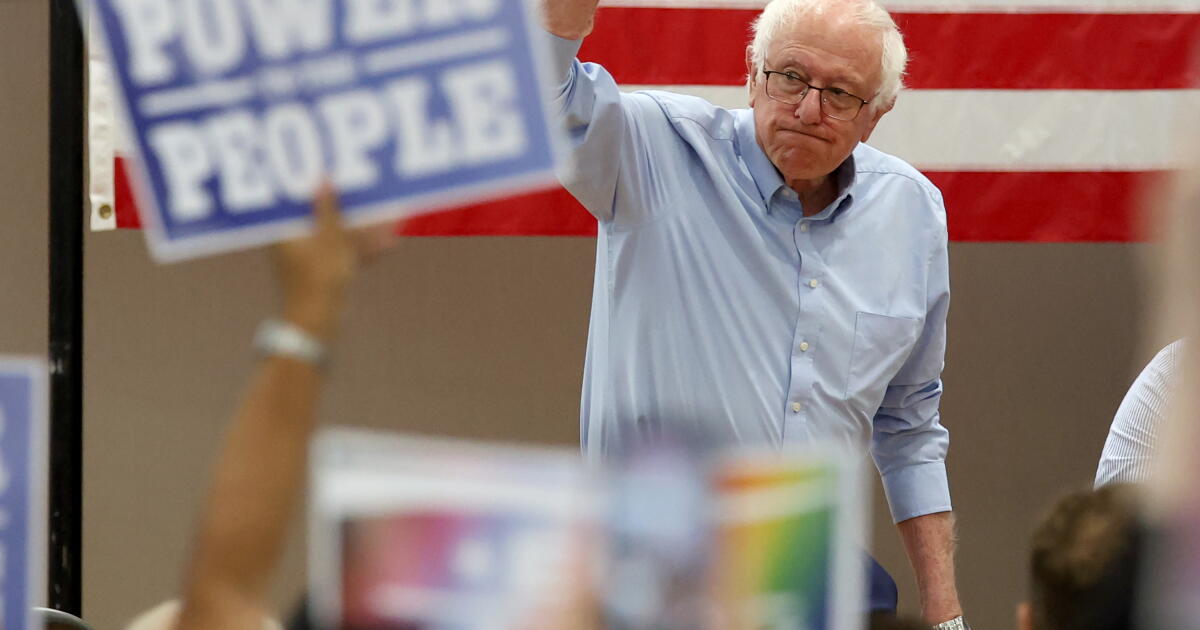
He sat in the fourth row, cheering and clapping with about 200 others as Vermont’s senator delivered his familiar tirade against the oligarchs and plutocrats and greedy corporations that he said are choking the life from America’s middle and working classes.

Fraass voted for Sanders in the 2016 Democratic primary when the candidate ran as the left-leaning, fist-shaking alternative to establishment favorite Hillary Clinton. He’s still a fan. But this time, with more than two dozen presidential candidates to choose from, Fraass is shopping around.

He worries that Sanders, 77, is too old and too far left to win a general election. “Realpolitik,” said Fraass, 53, a project manager who works in the credit card industry. “I want someone who can beat Trump, and I wonder if Sanders can do it or if someone else would be better suited.”

Robert Fraass backed Bernie Sanders in 2016 but right now he's shopping among Democratic candidates.

Robert Fraass backed Bernie Sanders in 2016 but right now he’s shopping among Democratic candidates.

(Mark Z. Barabak)

By several measures — polling, fund raising, die-hard support — Sanders remains one of the leading contenders for the Democratic nomination. He has more cash on hand — nearly $27.5 million — than any other Democrat and commands strong on-the-ground organizations in the two most politically crucial primary states: Iowa, which he barely lost four years ago, and New Hampshire, which he won handily.

But he’s fallen behind former Vice President Joe Biden in most state and national polls, lagged several rivals in the latest fundraising quarter and is no longer the political and cultural phenom he was four years ago.

Rather, Sanders has become something considerably less buzz-worthy, just another candidate scrabbling to break from the pack of presidential hopefuls, many staking positions similar — if not identical — to his own. Most have the added benefit of seeming newer and fresher.

“He’s been consistent. I think he’s as honest as the day is long,” said Tom Stewart, 72, a semiretired educator who swung by to hear Sanders at a Sunday morning coffee-and-doughnuts stop at the United Auto Workers hall in Ottumwa. Stewart might even vote for him again. But first, he said, “I want to see other candidates.”

To some degree, Sanders has been a victim of his own success.

“Last time when I was campaigning here in Iowa, I had ideas that many people in the political establishment and the media establishment thought were really radical. Far out,” he said, with a bit of ’60s hippie intonation as a crowd of 100 or so sweltered inside his storefront campaign office in downtown Ottumwa. “Well, a lot has changed over the last four years.”

Much of what Sanders proposed then — a government-financed universal healthcare system, a $15 federal minimum wage, higher taxes on the rich, tuition-free college, nationwide decriminalization of marijuana — has, in fact, become standard orthodoxy for many of the Democrats running.

For all that has changed, however, a great deal remains the same; a person waking from a 2016 coma might not even realize time has passed.

Sanders burns with the same white-hot flame, spits out the same dramatic statistics on income inequality, gives unshirted hell to the pharmaceutical and fossil-fuel and military- and prison-industrial complexes, just as he did last time.

With a fluttery wave of his hands, like a conductor before an orchestra, he excoriates the corruption in Washington, the rotten influence of political cash, the overweening power of special interests, all heightened, he says, “by the worst president in the history of this country.”

He appears mindful, if unabashed, that he incessantly repeats himself.

“I don’t want to beat a dead horse here,” Sanders told a gathering of several dozen seniors in Council Bluffs, as he launched into his standard attack on the evils of the American healthcare system. The flogging then continued through another 20 minutes of questions and answers.

Not that his audience seemed to mind. They spent an hour recounting horror stories about insurance coverage heedlessly denied, families destroyed and lives shattered by various health crises.

To supporters, his repetition is reassuring, a sign of Sanders’ passion and dedication.

John Blasingame, who took part in a panel discussion on the candidate’s “Medicare for all” proposal, has looked over others in the Democratic field and was impressed by Sens. Kamala Harris of California and Elizabeth Warren of Massachusetts. (The two are cosponsors of Sanders’ universal healthcare legislation.) Blasingame would like to see more women elected to political office.

“But I support Bernie because he has come out continuously, year after year after year, in support of people like me,” said the 80-year-old retired construction worker. “He’s introduced bills again and again in both the House and Senate which go toward helping the mass of people, not the rich privileged few, and he’s done this forever.”

John Blasingame likes Kamala Harris and Elizabeth Warren but supports Sanders because of his longstanding consistency.

John Blasingame likes Kamala Harris and Elizabeth Warren but supports Sanders because of his longstanding consistency.

(Mark Z. Barabak)

Others remain to be convinced.

Sandra Cerveny, 69, a retired college administrator, likes Sanders and very much supports Medicare for all. But she also has good things to say about Harris and former Vice President Joe Biden, who has criticized Sanders’ healthcare plan and suggested expanding the Affordable Care Act instead. “Frankly, I’m for whoever can beat Donald Trump,” Cerveny said, suggesting any of several Democrats would do just fine.

Faiz Shakir, who manages Sanders’ campaign, concedes that the candidate may have lost his novelty.

“For sure, the fact is other candidates are fresher,” Shakir said. But he noted that there will be plenty of opportunities over the next several months for them to rise and, he believes, fall again. “There are going to be a lot of boomlets,” he said.

But in the end, Shakir continued, those moments “will evaporate” and the Democratic contest will come down to who can deliver fundamental change and which candidate is best poised to defeat President Trump. Sanders, with his appeal to working-class voters in key states like Wisconsin, Michigan and Pennsylvania and unwavering call for political revolution, is the candidate best suited to achieve both, Shakir asserted.

There have been some small adjustments.

Sanders, who struggled last time for support among African Americans, has spoken more about his early involvement in the civil rights movement, seeking to broaden his appeal to black voters. He’s increased his outreach to older Americans — his recent Iowa swing was almost entirely devoted to senior issues — another group that largely spurned his insurgent 2016 effort.

After filling stadiums to deliver his angry oratorio — he packed Santa Monica High School’s amphitheater at a Friday night rally — Sanders has begun staging smaller, more intimate events intended to offer the up-close experience that voters in Iowa and New Hampshire, especially, have come to expect. In two days zigzagging the breadth of Iowa, from the Missouri to Mississippi rivers, he never spoke to a crowd larger than 250 or so and sometimes spent more time answering questions than giving his standard stump speech.

He has even begun posing for selfies — by now a staple of the presidential campaign trail — a task Sanders conducts with the joyless precision of a worker manning an assembly line. Smile. Click. Next.

What Sanders can’t change is the fact he’s no longer quite so compelling. For some Democrats that’s a reason — for now, anyway — to look elsewhere.

Back in Council Bluffs, Fraass left Sanders’ campaign office happy with the scorching rhetoric he’d heard. “I really liked his energy,” Fraass said, toting a blue-and-white “Bernie 2020” poster as he stepped into the 96-degree heat.

But Fraass wasn’t through shopping. Sixty miles east, in Shenandoah, Iowa, he planned to catch an afternoon appearance by this year’s political phenom, South Bend, Ind., Mayor Pete Buttigieg.

Source link

As California primary nears, even Sanders supporters are uniting behind Clinton and against a common enemy: Trump

Most of Sen. Bernie Sanders’ supporters in California say they expect that come November, Hillary Clinton will be elected president — and, by and large, they’re OK with that.

While both Democratic camps prepare for a final battle in the state’s June 7 primary, the latest USC Dornsife/Los Angeles Times statewide poll found that just over half of Sanders’ supporters said they expected Clinton to be the next president. About a third of Sanders’ backers said they expected the Vermont senator to emerge the winner, and 12% said they thought Donald Trump would prevail.

Close to 8 in 10 Sanders supporters said in the survey that they would vote for Clinton in a race against Trump, although many said they would do so reluctantly.

Those findings show the reality underlying the still-heated rhetoric of the Democratic primaries: By contrast with the civil war that divides Republicans, Democrats in the country’s largest state have begun to coalesce behind their front-runner.

In the primary race, Clinton holds a modest lead over Sanders, 45% to 37%, among all Democrats and independent voters eligible to vote. Her lead is slightly larger, 47% to 36%, among those most likely to vote. Either way, that’s a significant problem for Sanders.

The poll was conducted before Sanders’ sweep of three Western states — Alaska, Hawaii and Washington — on Saturday, but those victories don’t change the electoral math much. Sanders would need not just a win in California, but something close to a landslide to overcome Clinton’s large lead in delegates before the party’s nominating convention in July.

Something else hasn’t changed: If there’s one blemish in the picture for Clinton, it’s the persistently high percentage of voters who have an unfavorable image of her, 45% in the new poll.

Clinton’s image in heavily Democratic California is more positive than it is in more Republican parts of the country; 52% of the state’s surveyed voters see her favorably. She fares far better than Trump, her most likely opponent in November, who is viewed negatively by almost three-fourths of California voters.

A Democratic voter at a Washington state caucus on Saturday. In the California primary race, Hillary Clinton holds a modest lead over Bernie Sanders, 45% to 37%, among all Democrats and independent voters eligible to vote.

A Democratic voter at a Washington state caucus on Saturday. In the California primary race, Hillary Clinton holds a modest lead over Bernie Sanders, 45% to 37%, among all Democrats and independent voters eligible to vote.

(Elaine Thompson / Associated Press)

But her image with the public lags significantly behind other leading Democrats. That includes President Obama, whose popularity has risen, both statewide and nationally, in recent weeks. He is now seen favorably by 65% of the state’s voters, the highest level since early in his tenure. Gov. Jerry Brown is viewed favorably by 57%. Both men are viewed negatively by about one-third of voters.

The large share of voters who have a negative view of her does not put Clinton in danger of losing California in a general election: She would defeat any of the Republican candidates handily in the state, which has formed the cornerstone of Democratic victories nationally ever since her husband’s win in 1992. Against Trump, in particular, Clinton would win overwhelmingly, the poll indicated, carrying the state 59% to 28%.

But the negative impressions of so many Californians point toward the deeper problem she faces in the country and also to the likely tone of the fall campaign. A Clinton-Trump race, more than any other in recent decades, would feature two candidates who would start the campaign with large parts of the electorate deeply disenchanted with them. Given that, each side is likely to try to focus voters’ attention on the other’s flaws.

“Clinton’s challenge is not one of persuasion, it’s one of motivation,” said Dan Schnur, director of USC’s Jesse M. Unruh Institute of Politics. “She’s not going to get Sanders supporters to fall in love with her,” he added, but “the other way to motivate your base is to frighten them about the alternative. Against Donald Trump, that should be very doable.”

That’s certainly the case for Gretta Whalen, a 32-year-old freelance writer and communications consultant from Los Angeles, who leans toward Sanders. Clinton, she said, “has been around for so long, and we know so much about her, and not all of it is positive.” Sanders, by contrast, seems attractive, and his ideas feel new, even if “some of them are very pie in the sky and would be very difficult to get the rest of the country on board with.”

But, she added, as she paused from feeding her newborn son, the contest is different “now that we’re looking at a likely race against Donald Trump.” She and her friends, most of whom back Sanders, “are all so shocked that we’re in this place where Donald Trump is a serious contender for president,” she said. Compared with past elections, this campaign “feels a little more surreal.”

“I was much more excited about Bernie” earlier in the campaign season, she added. “We love him as a candidate. We also recognize that he’s not the most realistic winner.”

Just under 1 in 4 voters in the state have a negative image of both of the likely contestants. That group would hold its nose and side with Clinton over Trump, 38% to 23%, with a significant share of them saying they would not vote at all, the poll found.

Sercan Ersoy, a 33-year-old substitute teacher in Oakland, has much more negative feelings about Clinton than does Whalen. A former member of the Green Party who changed his registration in order to vote for Sanders in the primary, Ersoy feels Clinton is “too much of a war hawk” in addition to having too many ties to Wall Street. “I don’t want to vote for her,” he said.

But “if you ask me in late October,” he added, “and there’s a real possibility of a President Trump, I might say, ‘OK. I’ll vote for Hillary.’”

This USC/L.A. Times poll was conducted March 16-23 by telephone, both cellphone and landline, among 1,503 registered voters in California, including 832 Democrats and non-party voters eligible to take part in the June primary. The poll has a margin of error of plus or minus 2.8 percentage points for the full sample and 3.7 percentage points for the Democratic primary sample. It was conducted by Greenberg Quinlan Rosner Research, a Democratic polling firm, and the Republican company American Viewpoint.

The poll found the race between Clinton and Sanders dividing along lines that have become familiar during nearly two months of primaries: Sanders overwhelmingly wins voters younger than 30; Clinton does better with older voters. She leads among women by 11 percentage points, among men by 5 points.

Clinton leads narrowly among white voters but has a much larger edge among blacks and Latinos. In a surprise, given her family’s long-standing popularity with Asian voters, Clinton appears to be trailing Sanders with that group, although his edge, 43% to 35%, is within the poll’s margin of error for such a subgroup.

Clinton’s lead among minority voters is “much more muted” than her edge in previous contests in Texas and across the South, said pollster Anna Greenberg. That’s largely a result of a generational divide, with Sanders leading among younger Latinos, much as he does among young white voters. The other minority groups are too small to allow a detailed breakdown by age.

The other significant division in the primary is by party. California’s Democratic primary is open to registered Democrats as well as voters who decline to state a party. Clinton leads Sanders by 14 percentage points among registered Democrats; Sanders leads by 9 percentage points among the nonpartisan voters — again a pattern seen repeatedly in other states.

Among Sanders voters, 80% polled said they would vote for Clinton in November, although the share saying they would do so “reluctantly,” 45%, outnumbers those who would do so “enthusiastically,” 35%.

About 1 in 8 Democratic primary voters surveyed said they would refuse to vote for Clinton if she is the nominee. That’s half the level of rejection that Trump faces among Republican primary voters.

Among the Democratic primary voters most resistant to backing her in the fall are white men 65 and older, according to the poll. By contrast, only 4% of people who identified themselves as students said they would refuse to vote for Clinton — another indication that Sanders’ core supporters are unlikely to reject her candidacy.

By 72% to 21%, Democratic primary voters said in the survey that they are excited about the prospect of voting for the first female president.

Sanders has centered his campaign around the belief that the U.S. economy is unfairly rigged by Wall Street and big corporations. Not surprisingly, a large majority of his voters share that view.

The poll asked people if they thought that in today’s economy “everyone has a fair chance to get ahead in the long run if they work hard” or if “it’s mainly just a few people at the top who have a chance to get ahead.” By more than 2 to 1, Sanders’ voters said that only those at the top could get ahead.

Clinton’s supporters were more evenly divided, with 52% saying that everyone had a fair chance and 42% saying that only those at the top could get ahead. That reflected, in part, the feelings of Latinos, who are more likely than other Americans to say that hard work still pays off in the long run.

Those who backed Clinton were also more likely than Sanders’ backers to say that “when it comes to good jobs for American workers, our best years are ahead of us.” More than 6 in 10 of Clinton’s voters agreed with that statement, compared with just under half of Sanders’.

Neither group of Democratic voters was as pessimistic as Trump’s supporters, however. A majority of them said that when it comes to good jobs, “America’s best years are behind us.”

david.lauter@latimes.com

For more on Campaign 2016, follow @davidlauter

Sign up for the Essential Politics newsletter

ALSO:

Trump leads Republican primary field

California’s June primary just became crucial in the race for the White House

Full coverage of the USC Dornsife/Los Angeles Times poll

Full poll results and detailed crosstabs

Updates on California politics

Live coverage from the campaign trail


Source link

Public ownership in AI: Trump and Sanders find common ground

It was perhaps a surprising private overture from OpenAI Chief Executive Sam Altman to Sen. Bernie Sanders.

The meeting between the two had come just after the Vermont senator announced a plan for the public to take a 50% ownership stake in artificial intelligence companies such as OpenAI, using their stock to create a public wealth fund that would spread the fortune generated by AI behemoths.

Altman told Sanders that he, too, wants the public to have equity in AI companies. Though the CEO said he couldn’t support Sanders’ threshold of 50%, he nonetheless wanted to work with him to advocate for the general idea, according to people with knowledge of the conversation.

The nearly hourlong meeting in Sanders’ Senate office this week, held at Altman’s request, highlighted the inherent tension between AI powerhouses and policymakers as Americans are increasingly asked to accept the costs of the AI boom even as many remain unconvinced of its direct benefits. Yet it’s also creating odd political bedfellows fueled by populism as politicians from Sanders to President Trump embrace giving the public a stake in AI’s growth.

Speaking to reporters Friday on Air Force One, Trump described a potential partnership “where the American people can benefit from the success of AI” and said executives from leading AI companies will visit the White House, perhaps in the coming week, to discuss the idea.

“There’s something very interesting about it, where it almost becomes a partnership with the American public,” Trump said.

When reporters noted to the Republican president that Sanders, a democratic socialist and political independent, had proposed public ownership in AI companies, he pointed to similarities in their coalitions. The economic views of Trump voters and those who have supported Sanders for president, Trump said, “aren’t that far apart.”

Trump has embraced government investment in private companies in his second term, scrambling his party’s politics. His administration last year secured a 10% stake in the struggling Silicon Valley company Intel, and it considered a government takeover of Spirit Airlines earlier this year, although the airline couldn’t reach a deal and ultimately closed.

Public backlash

The positioning of leading figures such as Trump and Sanders comes as concerns about AI are emerging far beyond Washington.

In Michigan, Democrats recently clashed over Gov. Gretchen Whitmer’s appearance with Altman at the site of a major data center. Candidates such as New York Democratic House candidate Alex Bores have also made AI regulation a campaign issue by tapping into voters’ unease about the technology.

“This is a real change to society,” Altman told reporters this week. “I think it’s possible both that people can use AI a lot and like using it and also have anxiety about what it’s going to do for the future.”

Data center projects across the country have drawn opposition from residents concerned about electricity demand, water consumption and environmental impacts. Some states once eager to attract the facilities, including Ohio and Virginia, have moved to reconsider tax incentives.

“We need to pass legislation right now that says there’s not going to be any further data center development until they agree to pay for their own electricity, build their own grids and pay for their own water supply,” Sen. Josh Hawley of Missouri, a leading Republican skeptic of Big Tech, told the Associated Press.

Before arriving in Washington, Altman stopped in Michigan on Monday to appear alongside Whitmer, a Democrat, at the site of a 1.65 million-square-foot data center project. Whitmer’s team said the project will create more than 2,500 union construction jobs.

But it also drew criticism from local activists and some fellow Democrats, including Rep. Rashida Tlaib of Michigan, who called the project “disgusting.” She said she was “so disappointed” in Whitmer.

“It’s a very controversial topic right now and it’s coming from the ground up,” Sen. Elissa Slotkin, another Michigan Democrat, said about the grassroots resistance. “People feel very strongly about it.”

Whitmer defended her appearance, telling reporters afterward that “one thing’s very clear: Everyone has a cellphone in our pocket.”

“We are all, more and more, consuming technology and data, and these data centers are going to get built. So, my thought is if we can hold them to a high standard and do it in Michigan, that’s the best way to do it,” she said.

The tensions extend beyond data centers. On college campuses, commencement speakers have been interrupted by boos when discussing artificial intelligence. About 70% of college students see AI as a threat to their job prospects, according to a 2025 poll by the Institute of Politics at the Harvard Kennedy School.

Altman acknowledged those concerns. He said that while “the impact on jobs has been less than many people in our field expected,” he understands “that college students have a lot of anxiety about the future.”

Washington seeks an AI bargain

The idea that AI’s expansion is inevitable is increasingly shared by leaders across the political spectrum, even as they disagree sharply about how to manage it.

That reality was at the center of Altman’s conversations in Washington. In addition to Sanders, Altman met with Trump administration officials such as Michael Kratsios, the White House’s chief science and technology advisor, and congressional leaders from both parties.

Sanders’ team emphasized that the two did not reach an agreement on the main points that the senator made to Altman, including the 50% figure to ensure that the public has decision-making power. The senator also expressed opposition to the growing spending on elections by the AI industry.

“Unfortunately, Sam Altman did not commit to any of those,” Sanders spokesperson Jeremy Slevin said.

Altman, emerging from the conversation, described it as “great,” though noting that the two “obviously don’t agree on everything.”

How AI should be governed

Congress this week released a bipartisan framework that would establish the first broad federal approach to AI regulation while temporarily preempting many state laws.

Anthropic, one of OpenAI’s top competitors, has proposed mechanisms for coordinating pauses on advanced AI development if systems become too powerful.

The Trump administration has also begun constructing its own oversight structure, signing an executive order to establish a process for reviewing national security risks posed by advanced AI systems before their public release.

Sanders said he found the administration’s move notable after years of warnings that regulation could slow American innovation.

“Even these guys are beginning to catch on that there are legitimate concerns that have to be dealt with,” Sanders said.

Cappelletti and Kim write for the Associated Press.

Source link