Salzburg

Matthias Pintscher to become new music director of LACO

With the Los Angeles Philharmonic and Gustavo Dudamel heading off on a brief tour to London and Edinburgh, the Los Angeles Chamber Orchestra steps in Tuesday night at the Hollywood Bowl with an all-Mozart program. Mozart has long been a specialty of LACO.

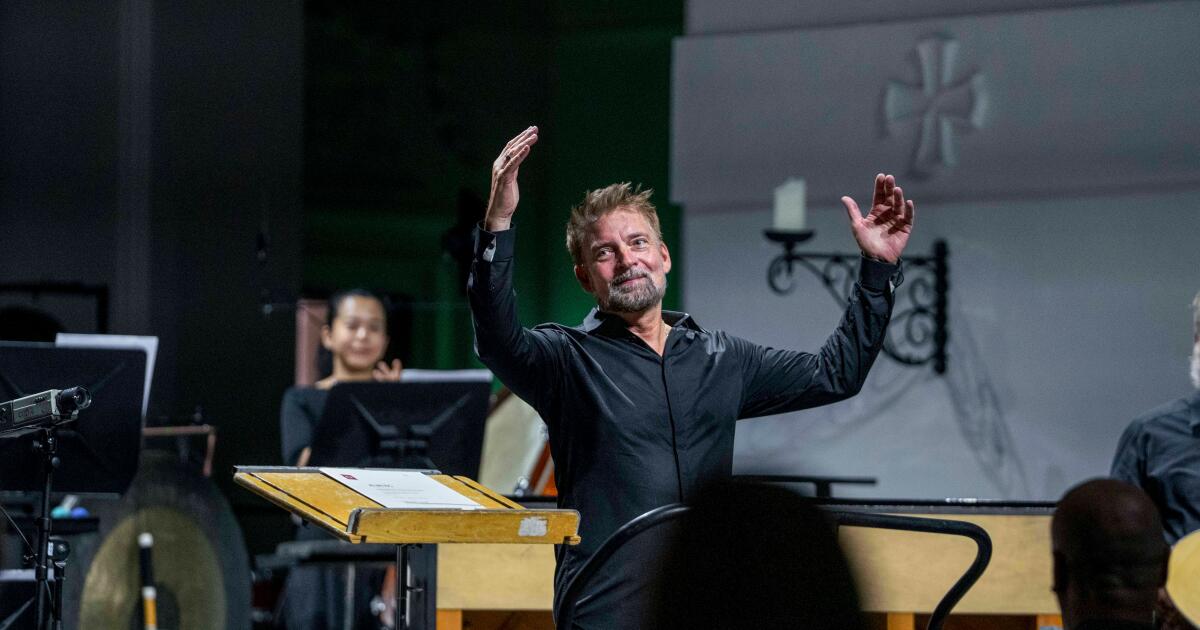
And it so happens that the orchestra is using the Mozartean occasion to announce that its next music director will be German composer and conductor Matthias Pintscher, who has been busy conducting in Mozart’s birthplace, Salzburg, where I caught up with him.

Pintscher, who will succeed current music director Jaime Martín beginning in 2027-28 season, augurs a new era for LACO. The orchestra will have a part-time residence when the Colburn Center opens next fall. The innovative 1,000-seat hall for concert, opera and dance looks to be Frank Gehry’s last music-meant masterpiece certain to usher in a new era for the Grand Avenue cultural district.

It also means a sort of homecoming for LACO, which gave its first concert in 1969 in the then-new Mark Taper Forum, the last of the Music Center’s initial three venues. The orchestra had been founded as an outlet to Hollywood studio musicians, and its first music director was the lively Mozartean, Neville Marriner. LACO’s first nine seasons included a Monday night series when the theater, originally meant to be a chamber music hall, was otherwise dark.

A little odd, perhaps, but the Taper remains until now the most intriguing venue of the peripatetic ensemble that has roamed through the years from Santa Monica to Pasadena, and that helped give the ensemble a distinctive image.

That is still the case. Once the Colburn Center opens, LACO will continue its series at the Wallis as well as at various chamber music programs around town.

Pintscher made his LACO debut in 2016 and already there was talk about him succeeding Jeffry Kahane, at two decades, who was the longest-running and most admired music director. Pintscher then served as its artist-in-residence, during which he oversaw a stab at the avant-garde. Not all LACO patrons were pleased.

It was out of the modernism, if not exactly avant-garde (but close), that Pintscher emerged first as a composer of colorfully complex orchestral and vocal scores that reflect a dizzying technical command and often a deep philosophical concept, sometimes taken from ancient Judaic tradition. His first big break as a conductor was as music director of France’s premiere new music Ensemble Intercontemporain that was founded by Pierre Boulez. But Pintscher also expanded in other directions. At the same time, he guest conducted orchestras in Europe and America with programs, while heavily weighed on the 20th century, that went back to Mozart and Haydn. He developed a surprising reputation as an interpreter of Rachmaninoff and other romantics disliked by modernists.

In 2008, he moved to New York, where he has remained, teaching composition at the Juilliard School and guest conducting widely (including the Los Angeles Philharmonic). Two years ago, he became the unlikely music director of the Kansas City Symphony. It was, he said over coffee at Salzburg hotel terrace, love at first rehearsal. His programming is a kind of wish-list of the new and recent with newly-buffed chestnuts, and it’s worked. His contract has been extended to 2034.

Pintscher, who is 55, says he is not ready to make any grand statements about LACO other than being eager to explore West Coast music and that he loves combining old with everything else. There is always room for Mozart and Haydn, to say nothing for his recent infatuation with Aaron Copland. He also described a mission for collaborative and theatrical projects, noting eager discussions with the Los Angeles Master Chorale (expect a Haydn “Creation” sooner rather than later) and director Peter Sellars.

When asked whether he saw himself as a composer who conducts or a conductor who composes, he simply laughed. But Pintscher did say he had no intention, at least for the present, of conducting his own works, feeling that to be a kind of self-promotion. But his mind can be changed. After two years Kansas City talked him into doing a piece, even if a small one.

Meanwhile, a new opera by Pintscher, “Das Kalte Herz” (The Cold Heart), which had its premiere in Berlin earlier this year, happened to be directed by the Long Beach Opera artistic director and chief creative officer, James Darrah Black. Watch this space.

Pintscher was enticed to the Salzburg Festival as part of this summer’s homage to the ageless Hungarian composer György Kurtág, who turned 100 this year. Pintscher conducted two programs with Vienna’s new music ensemble Klangforum Wien. In one, noting Kurtág’s affinity to Samuel Beckett, Pintscher led a transfixing performance of Morton Feldman’s “For Samuel Beckett” holding an audience prisoner for 50 minutes within a chord that won’t go away.

A mystical aura filled the heat-wave-sweaty Kollegienkirche, a voluminous central Salzburg church. Written on his deathbed in 1988, Feldman‘s piece reflects a final harmonic vision combining mismatched patterning of Turkish rugs and Hebraic chant. It remains super soft throughout and nothing seems to happen. But under the surface, little bits of notes fall precisely in and out of place in a rhythmic structure almost too hard to count.

The world’s complexity and emptiness simultaneously filled the church. Afterward, I walked past the home where Mozart was born. It was late at night. The tourists had turned in. My hotel was nearby, just across the river. But I made a lost, wrong turn.

Pintscher had put a peaceful, Feldman-esque, Twilight Zone spell on Mozart.
Source link

Dudamel’s ‘Resurrection’ in Salzburg serves as symbol of optimism

“Optimism doesn’t mean pretending everything is fine,” the Belarusian flutist and political activist Maria Kalesnikava said in this year’s Salzburg Festival keynote address. “It means deciding to step up and act, even in the face of uncertainty.”

Picture-perfect, Mozart-drunk Salzburg can’t pretend everything is fine. Temperatures are rising and normally rainy Salzburg now worries about water shortage and the environmental ravage of over-tourism. The artistically and culturally exceptional six-week Salzburg Festival, which began mid-July with a two-week Ouverture Spirituelle this year titled “miserere” (mercy), is facing its own political and administrative turmoil and uncertainty.

Salzburg’s worries are our worries; its triumphs can be ours as well. Los Angeles and the Salzburg Festival have been cultural and political soulmates for close to a century, beginning when playwright, director and filmmaker Max Reinhardt, who co-founded the Salzburg Festival in 1920, found mercy in L.A. as refuge from the Nazis.

Reinhardt’s star-studded 1934 music-theater production of “Midsummer Night’s Dream” at the Hollywood Bowl offered a template for spectacle in the young amphitheater, and the Los Angeles Philharmonic’s participation crucially reinforced a young orchestra’s early venturesome ambition following an avant-garde Bowl season the previous summer that nearly bankrupted the Bowl. Over the next decade this Salzburger’s influence on Hollywood dramaturgy would become legend.

L.A. has reciprocated by sending our visionaries to Salzburg, where director Peter Sellars and conductor Esa-Pekka Salonen, for instance, have been given the license and means to inspire a reinvention of musical and theatrical thinking. L.A. arts patrons Betty Freeman and Richard Colburn provided important support for Salzburg during their lifetimes that included commissioning new work.

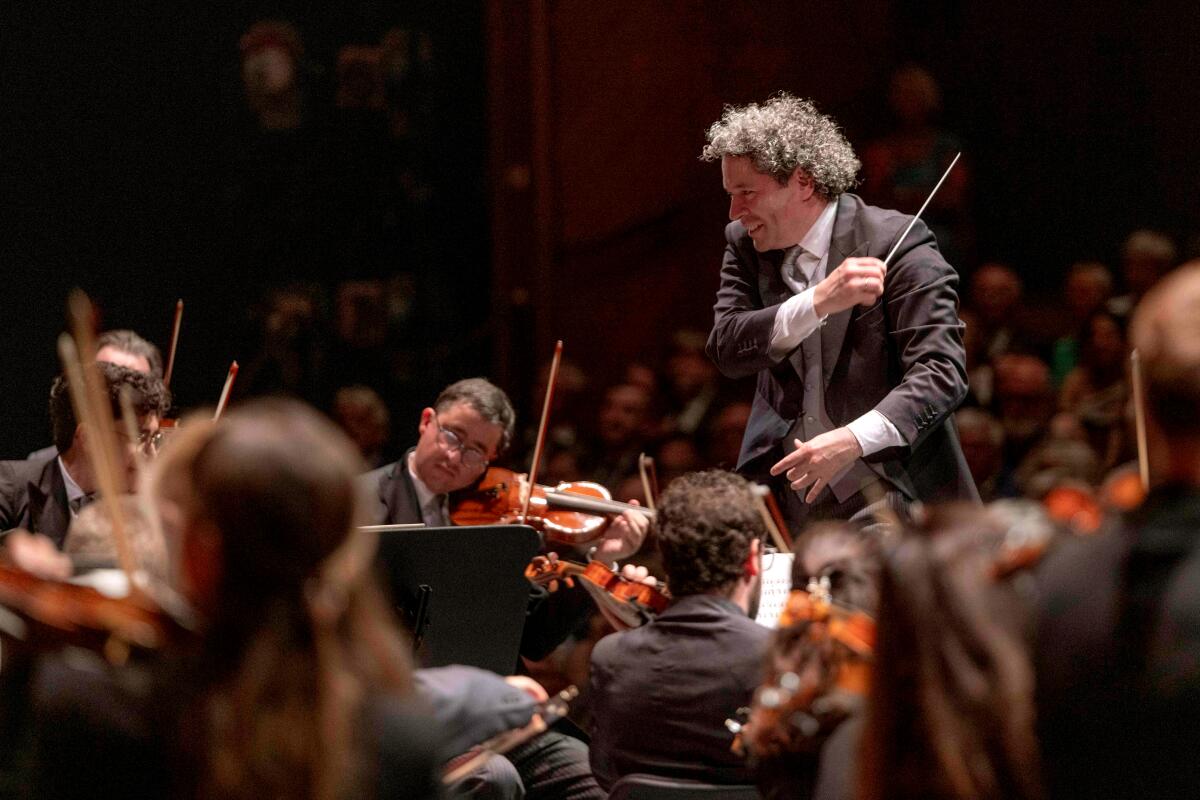
Gustavo Dudamel conducts Strauss' 'Alpine Symphony' with the Vienna Philharmonic in Salzburg Aug. 25, 2024.

Gustavo Dudamel conducts Strauss’ ‘Alpine Symphony’ with the Vienna Philharmonic at the Grosses Festspielhaus in Salzburg Aug. 25, 2024.

(Marco Borrelli / Salzburg Festival)

Gustavo Dudamel, L.A. Phil’s optimist these 17 seasons, has long been a Salzburg regular as well, and he arrived last week just in time to take up Kalesnikava’s challenge. Her proclamation of optimism comes on the heels of her having been released in December from a brutal Belarusian prison for supporting an opposition candidate running against the country’s authoritarian leader.

In Dudamel’s case, his life has been turned around by the recent earthquakes that devastated Venezuela just two weeks after his last concerts in Walt Disney Concert Hall as L.A. Phil music and artistic director. His activities this summer now revolve around partnering with the United Nations Development Program to gather global support for Venezuela’s recovery, which is estimated at $6.7 billion.

Although little noted, Dudamel’s buoyant World Cup halftime appearance with 20 members of the Simón Bolívar Symphony Orchestra and 20 from the New York Philharmonic was as a FIFA fundraiser supporting children affected by global crises, in this case earthquake relief in Venezuela. Dudamel has further turned his last Hollywood Bowl program as L.A. Phil music director into a benefit on Aug. 23.

Prophetically, Dudamel had months ago been invited to close this summer’s Ouverture Spirituelle by leading the Vienna Philharmonic in Mahler’s Second Symphony, known as the “Resurrection.” One way to think about Mahler’s extravagant 90-minute exercise in his search for life’s meaning is as an exercise in attaining optimism in the face of tragedy.

“Rise again, yes, you shall rise again,” Mahler extols in a final ecstatic climax, and it is with the “Resurrection,” which includes chorus and a pair of vocal soloists, that Dudamel began his “Gracias Gustavo” L.A. Phil season last fall. Raising roof, the message was clear: optimism is the native language of Walt Disney Concert Hall.

In Salzburg, where Dudamel’s two Vienna Philharmonic performances were dedicated to the people of Venezuela, those lines took on obvious new meaning. Earlier in the day, Dudamel gave a public talk with a lively German journalist, Marco Frei, in which he described himself as a “resurrectionist” in more ways than one.

The symphony has been a been a musical and spiritual guide for him since his boyhood. He became so excited about a new sense of freedom he feels in the second movement that he leaned back in his chair and kicked his white sneakers in the air.

After the talk, I walked with Dudamel back to his hotel as he displayed a different, more solemn passion describing the toll the earthquakes have taken on El Sistema, the Venezuelan youth program that has been behind his educational activism in L.A.

“At least 140 members of the El Sistema staff and educators were killed or are unaccounted for,” Dudamel said, and that’s not counting what may have happened to a great many children and their families. But remarkably, Dudamel noted, in places where few structures remain, the nucleos (the small El Sistema community schools) are surprisingly still standing. They have become centers for food, aid and shelter.

In Salzburg, Dudamel indulged the Vienna Philharmonic’s incomparable lushness, those plush strings, glowing winds, golden brass, voluminous timpani. The symphony received mixed reviews, with critics complaining of a lack of transparency, argument and depth. Had they been in Disney Hall, they would have had it all.

But here Dudamel became more simply an architect of awe, unfazed by Mahlerian uncertainty as he worked his way to an inevitable cosmic grandeur unfazed by uncertainty. An enthralled audience left opening its collective wallets. Ushers stood at all the exits of Great Festival Hall with baskets for donations for Venezuela. I did not see a single member of the audience leave without throwing in a bill or several.

Dudamel’s “Resurrection” might also be read as a message from L.A. to Salzburg. In the spring the festival board dismissed its artistic director of the past decade, Markus Hinterhäuser, saying there is a difference in vision. Hinterhäuser’s penetrating and uncompromising vision is what has made the modern festival matter. Hinterhäuser has implied political meddling.

It is a huge festival, with more than 200 performances. Last year’s audience exceeded 200,000, with visitors from 88 countries. The arts as a vehicle for coming together can be cliché. In Salzburg, sharing becomes essence, not the kind of narcissism that appears to be adopted by our upcoming LA28 cultural Olympiad, in which Angelenos are invited to submit entrees that show off our goods rather than a cultural exchange.

Over 100 artists have protested Hinterhäuser’s removal, including two Nobel Prize laureates. Hinterhäuser is also an insightful pianist, and he joined baritone Matthias Goerne in a chilling performance of Schubert’s existential song cycle, “Winterreise.” Hinterhäuser got thunderous ovations.

Salzburg’s future is anyone’s guess, but even with Hinterhäuser on the sidelines, this summer is still his festival, meaningful as ever.

A new production of “Carmen” could not be darker, nor more brilliant. It is the latest project of conductor Teodor Currentzis, who has worked extensively with Peter Sellars in Salzburg and elsewhere, and who brings electricity to every moment with his Utopia Orchestra and Choir. Argentine choreographer Gabriela Carrizo makes her debut directing opera and utilizes her alarmingly vibrant Belgian dance company, Peeping Tom. Performing in a vast empty space, two gripping singers — Asmik Grigorian plays an understated Carmen as a survivor in a hostile society, while Jonathan Teltelman’s Don José is unable to cope with that society — turn Bizet’s opera into revelatory existential theater in which survival is toleration.

A scene in director Yuval Sharon's "The Excursions of Mr. Broucek to the Moon and the 15th Century" at the Bregenz Festival.

A scene on the moon in director Yuval Sharon’s magical new production of Janacek’s neglected opera “The Excursions of Mr. Broucek to the Moon and the 15th Century” at the Bregenz Festival.

(Daniel Ammann / Bregenz Festival)

Something similar happens in “Faust, Part 1,” in which the actors spend the entire four hours in a new production by German director Ulrich Rasche walking against the direction of of a revolving disc. To remain in front of the audience, they must remain in motion. They’re dressed in modern business attire, but as they bare their souls, they bare their torsos as they step against forces that prevent progress. The backdrop is brightly illumined screens that hurt your eyes.

This, however, can serve as a reminder of a “Faust” staged by Reinhardt at the Pilgrimage Theater (now John Anson Ford Theater) when it was designed to look like the gates of ancient Jerusalem in 1935. Practically all of Hollywood celebrity showed up for what was the theatrical event of the season.

I asked Lukas Crepaz, who directs the Salzburg Festival’s administrative and business operations, whether it would be possible and whether there still is time for the Salzburg and L.A. to collaboration on an opera production. He said yes, if funding could be found. In fact, the L.A. Phil will mount in February “One Morning Turns Into an Eternity,” a Salonen/Sellars essay in intensity from Salzburg last summer.

Another option: The Bregenz Festival, also in Austria, has just staged a new production by Yuval Sharon of Janacek’s little-known opera, “The Excursions of Mr. Broucek to the Moon and the 15th Century.”

Sharon — who was responsible for the fabulous excursions of his L.A. experimental company, the Industry — supplies his characteristic wit, imagination and insight into a hard-to-please opera about a beer-besotted philistine landlord, who comes to no good in his drunken dreams of going to the moon and back in history, as he does as an angry old man stumbling home from the bar or sitting watching TV (Sharon’s invention).

L.A. optimism may matter more to Austria this summer than it does to L.A. We have two years to step up and act, even in the face of uncertainty.

Source link

Salzburg bans tourists from driving into historic centre over summer | Austria

Salzburg has begun enforcing a summer ban on visitors driving into its historic centre, picking up a policy modelled by other car-choked European cities plagued by overtourism.

Authorities in Austria’s fourth largest municipal area said they hoped the “less traffic, more city” restrictions in July and August would reduce the number of vehicle entries by 1,000 a day.

As part of the campaign against gridlock, park-and-ride facilities are offering a day ticket including travel on local public transport for five people for €7.50 (£6.45).

“We don’t want chaotic traffic situations like we saw last year,” said the mayor, Bernhard Auinger, when he announced the measure in May. “It is aimed at day trippers who travel by car from farther afield. It is important to me that residents of the central Salzburg area and business-related traffic are not affected by this.”

Auinger said tourists themselves, drawn to attractions such as Mozart’s birthplace and the baroque-style 17th-century cathedral, would also benefit from the policy. “It’s certainly much better than spending hours stuck in traffic. And it also makes life a lot easier for the people who live and work in the city of Salzburg.”

The restrictions will make life ‘a lot easier for the people who live and work in the city’, said the mayor. Photograph: Westend61/Getty Images

The mayor said mounting complaints by residents about traffic during the summer months had prompted the city to take action. “We basically allowed tourists to drive into our sitting room,” he told the news website Salzburg24.

Patrolling police officers will impose fines of up to €80 on any drivers with numberplates from outside the Salzburg region entering the old town in the radius around the Staatsbrücke (state bridge) spanning the Salzach River.

skip past newsletter promotion


Exceptions will be granted to commuters, delivery vehicles, taxis and rental cars, as well as disabled visitors and hotel guests with a reservation confirmation in the restricted zone. German motorists from the neighbouring Bavarian areas of Berchtesgaden and Bad Reichenhall are also exempted.

Heidi Strobl, of the local tourism board, said Salzburg’s policy, approved by the city council in May, had taken a page from the zona a traffico limitato (limited traffic zones) in Italian cities such as Rome, Florence and Pisa as well as a ban in Dubrovnik, Croatia, after they had become inundated with tourist vehicles during the summer months.

Salzburg, whose historic centre is a Unesco world heritage site, has just over 158,000 residents but records more than 3m overnight stays each year. Last year’s celebrations of the 60th anniversary of The Sound of Music, the classic movie filmed in the Salzburg region, spurred an extra tourist boom.

Source link

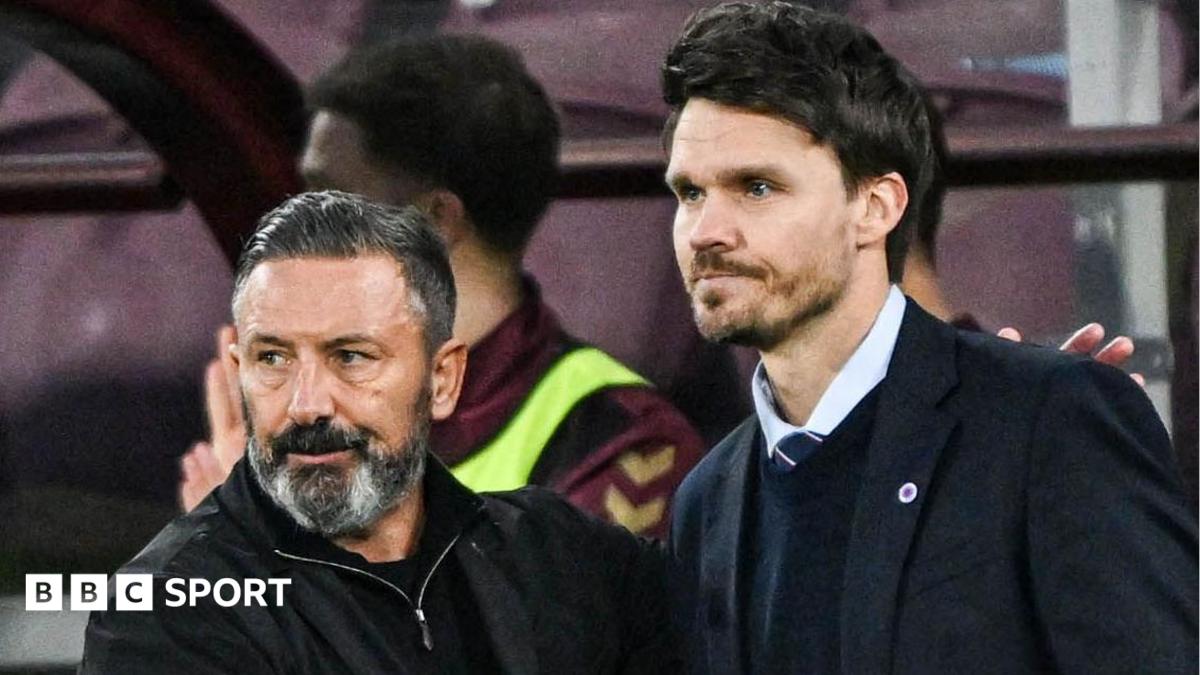
Derek McInnes: Rangers appoint Hearts head coach as manager after Danny Rohl joins Red Bull Salzburg

Rangers have appointed Derek McInnes as manager on a three-year contract after agreeing a compensation deal with Scottish Premiership rivals Hearts.

McInnes is the third boss at Ibrox inside a year and replaces Danny Rohl, whose move to Austrian side RB Salzburg was confirmed earlier on Wednesday.

The 54-year-old joined Hearts from Kilmarnock last summer and led the Tynecastle club to a second-placed finish, missing out on the title to Celtic on a dramatic final day, but edging Rangers out of the Champions League qualifiers.

The former Rangers midfielder turned down an approach from the Ibrox club in December 2017 in order to stay at Aberdeen but has now followed Tynecastle captain Lawrence Shankland in moving from Hearts.

“It is a real honour,” McInnes said. “The demands here are clear and our supporters rightfully have high expectations. It is up to me, my staff and my players to meet those expectations, and have this club performing as it should.

“There is a lot of hard work ahead, but already the preparations have begun and I am looking forward to meeting the current squad in the coming weeks and welcoming some new faces.”

Alan Archibald, Paul Sheerin and Craig Clark will assist McInnes.

While Rohl was head coach, McInnes will have the title of manager and was the frontrunner as soon as it emerged that the German was keen to leave for Salzburg.

Chairman Andrew Cavenagh said the Scot is “someone we have always rated highly” and is “exactly what this club needs at this moment in time”.

He added: “His deep Scottish and Rangers experience are important for us. He knows how to win in this league, and he is coming off an extremely strong season with Hearts.”

Rohl, 37, replaced Russell Martin as head coach in October and steered Rangers into a three-way title fight, but a post-split collapse yielded a third-placed finish behind Celtic and Hearts as the Ibrox club ended the campaign without silverware.

Cavenagh – who publicly backed Rohl at the end of the season – thanked him for his “service and commitment to Rangers”.

“He and his staff put in a significant amount of hard work during his time in charge, which we are greatly appreciative of,” he added.

Source link