sailor

Trump says USS Abraham Lincoln deployment ‘not nearly long enough’

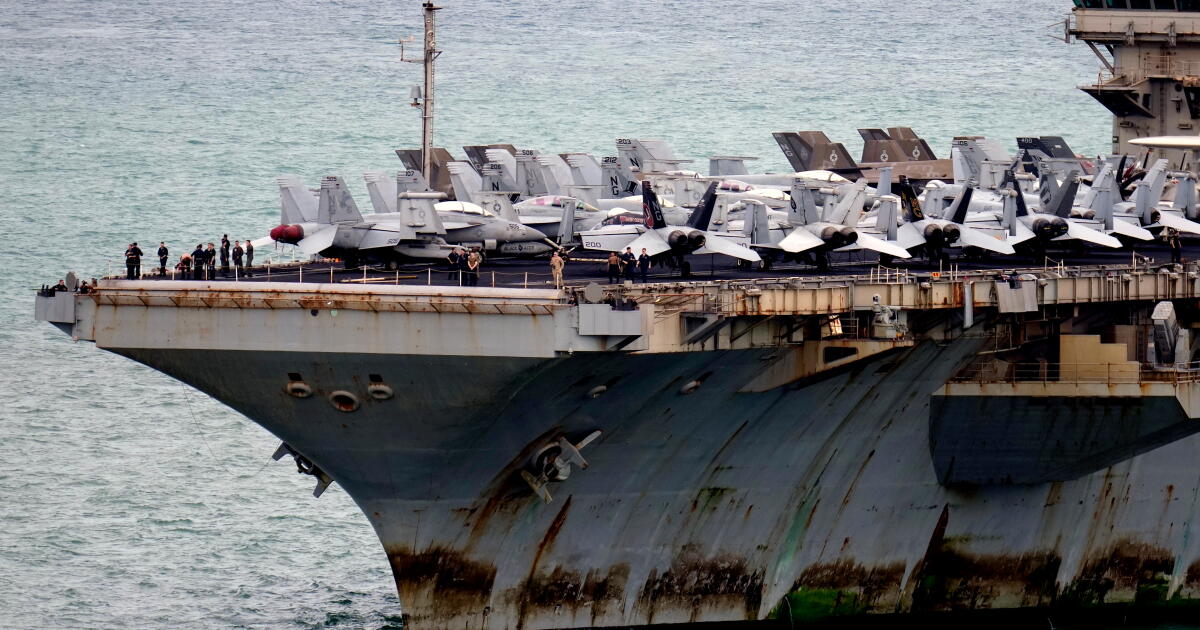
Democratic lawmakers and military families are pressing the Pentagon for answers after reports emerged that thousands of sailors aboard the USS Abraham Lincoln have endured food shortages, plumbing failures and severe fatigue during deployment that has stretched more than 260 days.

The roughly 5,000-person crew, which left San Diego in November and has been stationed in the Middle East to support the U.S. war against Iran, has spent a record amount of uninterrupted time at sea. Now, families of those on board have begun speaking out publicly, describing concerns about mental health and supply issues aboard the aircraft carrier.

Since those reports — which Defense Secretary Pete Hegseth characterized as “completely misrepresented” — the U.S. military announced plans to send the USS George Washington, a Pacific-based aircraft carrier, to relieve the USS Abraham Lincoln.

But when asked Friday for a reaction, Trump downplayed families’ concerns and characterized the length of the deployment as “not nearly long enough.”

The president’s remarks stand in contrast to the concerns raised by lawmakers and military families, including reports by the Military Times and the Stars and Stripes that sailors tried to jump overboard as the deployment kept going.

“The plans in the works to relieve the USS Lincoln are not enough,” Rep. Mike Levin (D-San Diego) wrote in a letter to Hegseth on Thursday. “We need clear and honest information from the Department of Defense about the operational failures that led to the problems aboard the USS Lincoln to ensure this never happens again.”

Morale aboard a nuclear-powered aircraft carrier already is difficult to maintain without a record-breaking stint, said Julie Roland, a retired veteran Navy lieutenant commander who worked briefly on the USS Lincoln.

Between the lack of sun below deck for some nonpilot personnel and rooms packed with triple-bunk beds, the conditions on vessels like the Lincoln can be difficult to bear. Although service members expect such difficulties, the situation on the USS Lincoln raises additional concern among sailors, Roland said.

“I know what months at sea does to a person even when the ship has hot chow and working plumbing,” Roland said. “The warrior ethos shouldn’t have to include bravely facing water contamination. … Even warfighters need basic care.”

Roland added that she was not surprised to hear complaints of poor living conditions from sailors on board, given that their few days of reprieve for port call constantly were being delayed. She said she received videos showing trash being tossed overboard because of broken incinerators, heard stories of a lack of proper medical supplies and kept in touch with one sailor who detailed his mental health deterioration as days dragged on aboard the Lincoln.

“The magnitude of difference between official information from the Department of Defense and firsthand reports from the crew should be troubling, and may have serious implications about what else the Pentagon may be withholding regarding the conflict in Iran,” Roland added.

In his letter to Hegseth, Levin said the Trump administration needs to answer concerns from military families and loves ones about the conditions aboard. He said he heard concerns about moldy showers, broken toilets, lack of hot water, lack of access to fresh produce and supply shortages.

Rep. Sara Jacobs (D-San Diego), who serves on the House Armed Services Committee, also demanded answers from U.S. military leaders on what she called “horrific” reports of the conditions aboard the ship.

Tensions over the situation also prompted military leaders to hold in-person and virtual meetings last week with the families of the sailors and Marines. Both meetings were combative, according to a recording obtained by MS NOW.

During the in-person meeting at the Naval Air Station North Island in San Diego, Navy leaders were unable to tell families when their loves ones would be relieved from duty. Spouses, in turn, asked what was being done to address issues of mental health and exhaustion, MS NOW reported.

Concerns about mental health deteriorating on these types of deployments are well-founded.

A study of nearly 1,000 sailors published in the journal Military Medicine in January 2025 found that service members aboard Navy ships suffer the highest rates of “serious psychological distress” compared to other branches of the U.S. military. Among the reasons are “unique stressors, such as poor habitability, noise and demanding scheduled that leave inadequate time for sleep and rest,” the study found.

Sen. Richard Blumenthal (D-Conn.), a member of the Senate Armed Services Committee, said the USS Abraham Lincoln was not an “isolated case” and demanded an inquiry.

“Recent carrier deployments have repeatedly stretched beyond their original anticipated duration, suggesting that extended deployments may be becoming a feature rather than an exception of the Navy’s force-generation model,” Blumenthal wrote.

Hegseth told reporters on Thursday that “some deployments are longer than others.”

“What they do in those high seas and those austere conditions with less port calls, it’s incredible. And Americans don’t understand what it’s like to do that,” he said, while adding that he wants “folks rotated as quickly as possible.”

In a message to the crew aboard the USS Abraham Lincoln, Hegseth said: “We’re going to do everything we can for you. We are so grateful for the dedication of that crew and others.”

Source link

Philippines says China injured sailor in latest maritime clash

July 20 (UPI) — The Philippine military accused China of beating and injuring a Philippine Navy sailor with a wooden baton in the latest seaborne confrontation between the two nations over a submerged reef in the disputed South China Sea.

The incident occurred Monday morning near the BRP Sierra Madre, a derelict warship the Philippines intentionally grounded on the Second Thomas Shoal, a reef both countries lay claim to and which the Philippines calls Ayungin Shoal and China, Ren’ai Jiao.

The Armed Forces of the Philippines said in a statement that a China Coast Guard rigid-hull inflatable boat with eight people on board unlawfully approached the BRP Sierra Madre and took pictures and video of it.

While two AFP rubber boats drove it away, China Coast Guard personnel on the boat struck a Philippine Navy sailor on his head with a wooden baton. The man suffered a deep gash on his scalp, according to a picture shared online by Philippine Coast Guard spokesperson Jay Tarriela.

Video of the incident posted online by Tarriela shows some China Coast Guard members aboard a larger boat swinging long sticks down upon members of the Philippine Navy in a smaller rubber boat.

“Striking an unarmed sailor on the head with a baton — inside our own exclusive economic zone — is not law enforcement. It is unlawful aggression, plain and simple,” Tarriela said in a statement.

China has rejected the accusation, accusing the Philippines of instigating the incident.

“The Philippine personnel first launched malicious attacks on Chinese law enforcement officers using oars, long poles and other tools,” the China Coast Guard said in a statement published online by China’s Embassy in Manila.

“The Chinese side, acting in full compliance with laws and regulations, employed measures such as verbal warnings, evasive maneuvering and proportionate countermeasures to stabilize the situation on site, while exercising the utmost rationality and restraint.”

At roughly 105 nautical miles west of Palawan, the Second Thomas Shoal is well within the Philippines’ exclusive economic zone. The Philippines beached its Sierra Madre warship on the disputed submerged reef in 1999, which it has manned since in an effort to protect its maritime claims.

However, China lays claim to the Second Thomas Shoal and much of the South China Sea via its Nine-Dash-Line map, which has been rejected by several nations, including the United States. The Hague’s Permanent Court of Arbitration also rejected China’s sweeping maritime claims in a landmark 2016 ruling in a case brought by Manila. Beijing rejects the ruling.

Following the incident, the China Coast Guard said in a statement that it would continue to “carry out rights protection and law enforcement activities” and “firmly safeguard China’s territorial sovereignty and maritime rights and interests.”

The U.S. State Department late Monday issued a statement in support of the Philippines, condemning “China’s dangerous and aggressive actions against Philippine navy personnel.”

State Department spokesperson Thomas Pigott said the United States calls on China to “immediately cease its destabilizing conduct.”

“China’s troubling pattern of provocation against lawful Philippine maritime operations undermines regional peace and stability and directly contradicts China’s repeated commitments to resolve disputes peacefully,” he said.

“We stand with our ally, the Philippines, and commend the professionalism and restraint shown by the Philippine navy personnel in this incident.”

Pigott added that the United States reaffirms the 2016 tribunal ruling as final and legally binding on both China and the Philippines.

Customers inspect various wind chimes during the opening day of the Furin-Ichi wind chimes market at the Kawasaki Daishi Heikenji Temple in Kawasaki, Kanagawa-Prefecture in Japan, on July 17, 2026. Photo by Keizo Mori/UPI | License Photo


Source link

U.S. military suspends search for missing sailor in Arabian Sea

U.S. Navy airmen prepare an MH-60S Seahawk helicopter for flight as part of recovery operations for NASA’s Orion Capsule prior to splashdown after a successful uncrewed Artemis I Moon Mission off the coast of Baja California, Mexico, on Dec. 11, 2022. A Navy aircrewman remains missing after a MH-60S Seahawk he was aboard crash landed in the Arabian Sea on Wednesday. File Pool Photo by Mario Tama/UPI | License Photo

July 5 (UPI) — The U.S. military suspended its search Sunday for a missing Naval aircrewman who went missing Wednesday following an emergency landing in the Arabian Sea.

U.S. Naval Forces Central Command announced the suspension of the search in a statement on social media after more than 102 hours.

“The efforts concluded following an extensive search by the U.S. Navy and U.S. Air Force in the U.S. Central Command area of responsibility,” U.S. Naval Forces Central Command said in a statement. “The Sailor’s name is benign withheld until at least 24 hours after next-of-kin notification is complete in accordance with Navy policy.”

The search spanned more than 14,000 square miles. The military utilized multiple helicopters and other U.S. Air Force aircraft, aircraft carriers and guided-missile to canvas the region.

The missing crewman was aboard a MH-60S Sea Hawk helicopter when it crash landed at about 3:30 a.m. EDT on Wednesday. There were four people in the helicopter. The other three crewmembers were recovered and listed in stable condition.

The helicopter was on a routine patrol when it went down.

U.S. officials said the helicopter’s crash landing was not the result of hostile fire.

Source link