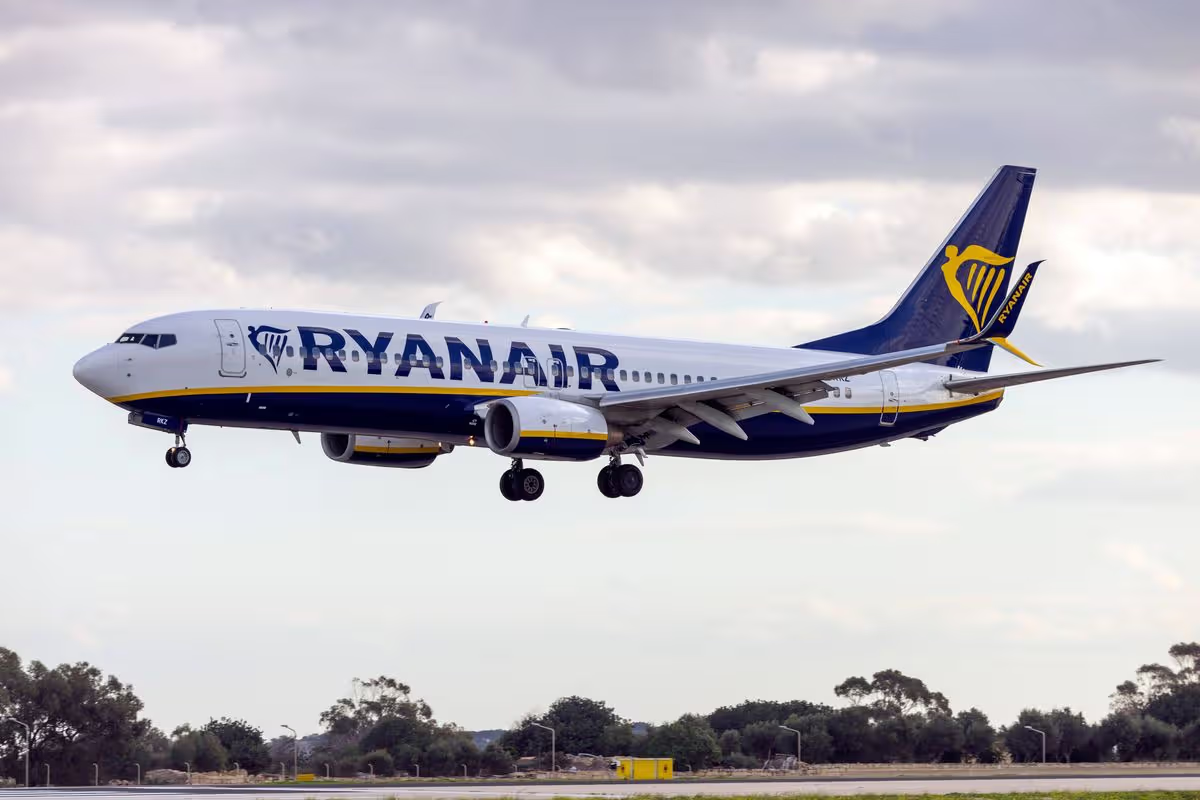
A booking trick can help ensure you are covered as many UK airlines face chance of disruption or cancellation this summer due to Middle East conflict impacting air travel
Jet2, Ryanair and easyJet £100 flight booking warning(Image: Getty Images)
Due to ongoing conflict in the Middle East, Europe is facing a fuel crisis, causing concern about the likelihood of summer holidays going ahead.
The International Energy Agency has warned that supply issues could kick in in the next five to six weeks with the owner of British Airways commenting that flight tickets may increase in line with skyrocketing fuel costs.
The fuel crisis comes as the Strait of Hormuz has been blocked throughout the conflict, meaning energy is not able to be distributed at a normal rate.
The strait is the shipping passage for 20 per cent of the world’s fuel and has seen the costs of petrol rapidly increase since the outbreak of war.
For travel, this has caused disruption to many flights, with prices changing and traveller’s fearing cancellations.
According to EU energy commissioner Dan Jorgensen it’s “very likely that many people’s holidays will be affected, either by flight cancellations or very, very expensive tickets”.
If your flight is cancelled it is covered by UK law if it was set to depart or arrive at a UK airport on a UK or EU airline, or arrive at an EU airport on a UK or EU airline.
Popular UK airlines Jet2, Ryanair and easyJet are all covered by this rule.
If you are covered and your flight is cancelled, the airline you are travelling with must provide you with a refund or book you on an alternative flight.
The Civil Aviation Authority (CAA) says that you can get all of your money back for your tickets or for the parts you haven’t used.
With return flights, if outward travel is cancelled, you are entitled to a full refund.
The CAA added: “If you are a transfer passenger and you have already completed part of your journey, you are also entitled to a flight back to your original departure point when your connecting flight is cancelled and you decide not to continue your journey.”
Experts gave a £100 flight booking warning, advising to pay via credit card as this gives you Section 75 protection under the Consumer Credit Act, legally protecting you for purchases costing between £100 and £30,000.
The situation is currently so unpredictable that travellers should be aware of all the cover they are entitled to, as flights may be cut at any point.
Global aviation expert Geoffrey Thomas told the Daily Mail that flights could be cut at the last minute.
Thomas highlighted that Europe is particularly impacted, especially when it comes to long haul travel.
“Europe is more exposed at the moment than Asia is, which means trips from Australia are obviously a challenge.
“For airlines like Qantas, who operate the Perth to London service, at the moment, they have to fly additional distance to refuel in Singapore.
“Any airline that operates through the Middle East is also exposed if the conflict widens or the Iranians decide to resume random drone attacks.”
Amid the conflict, travel experts reiterated the importance of travel insurance.
“To not travel with insurance these days is pretty crazy,” Dr David Beirman told the Daily Mail.
“Most policies will cover cancellation or major changes to an itinerary from a number of causes.
“If your airline is being difficult about a changed flight, and they’re only prepared to give you a credit or something like that, the travel insurance company will usually come to the party and help financially.”
Everything travellers need to know about online check-in rules and bag drop deadlines for Ryanair, EasyJet and Jet2 in 2026
11:51, 27 Apr 2026Updated 12:12, 27 Apr 2026
Passengers flying with these airlines should be aware of the latest check-in rules(Image: Getty )
With the two May bank holidays fast approaching, numerous travellers will be plotting to make the most of the long weekends by jetting off on getaways. Among the most popular airlines operating at UK airports are Ryanair, Jet2 and EasyJet, and passengers flying with these carriers are being urged to familiarise themselves with the latest check-in regulations.
There are specific policies and rules that holidaymakers need to be aware of, including various timing requirements to avoid missing their flights. Due to longer queues at passport control following the rollout of EES (Entry/Exit System) for passengers travelling to non-Schengen destinations, travellers are advised to factor in additional time when arriving at and departing from overseas airports.
Check-in desks have designated closing times for passengers to drop off their luggage before shutting. For anyone heading abroad with bags to check in, here are the current rules for Ryanair, Jet2 and EasyJet you’ll want to get to grips with to avoid last-minute panic.
Ryanair’s latest check-in rules
Ryanair has overhauled how check-in and boarding passes operate in a bid to streamline airport procedures. The most significant upcoming change is that check-in and bag drop desks will close earlier, coming into effect from November 10, 2026. The current deadline means desks typically open two hours before and close 40 minutes before your scheduled departure.
In November, desks will close 60 minutes before departure across all airports. The airline is introducing this change to allow passengers more time to clear security and passport control, particularly owing to potential delays from the new EU Entry/Exit System (EES), reports the Liverpool Echo.
Should you fail to check in online up to two hours before your scheduled departure time, you may still check in at the airport up to 40 minutes before departure, however you will be charged an airport check-in fee. See Ryanair’s table of fees. “We urge all passengers to check in online before arriving at the airport to avoid these fees,” the airline says.
Towards the end of last year, Ryanair switched to 100% digital boarding passes via the Ryanair App, with exceptions for certain destinations such as Morocco and Turkey, which still require printed passes. If you have checked in but are unable to access your digital pass, staff can provide a free replacement.
You can check in via the Ryanair.com website or through the mobile App. Once logged in, select check-in and input your travel document details. For your safety and security, and for the safety and security of your fellow passengers and crew, the check-in process must be completed by you personally, by a passenger on your booking, or by someone with personal knowledge of you and your luggage.
If you have pre-reserved a seat, online check-in is available up to 60 days before your scheduled departure. Bear in mind that both your outbound and return flights must fall within that 60-day window. If you haven’t reserved a seat and one is being randomly allocated to you, check-in opens 24 hours before your flight and closes two hours before departure.
Airport check-in is also an option, though you’ll be charged a fee per passenger for the additional service – refer to Ryanair’s table of fees for full details. Should you have already checked in but are unable to display your boarding pass on the app upon arriving at the airport, you will be issued a replacement boarding pass free of charge.
Jet2’s latest check-in rules
Online check-in through Manage My Booking is available from 28 days up to six hours before departure via Jet2’s website or app. You’ll need to either print your boarding passes, download them to your device, or check in at the airport no later than three hours before your scheduled departure.
At the airport, Jet2 check-in desks typically open at least two hours and 30 minutes before your scheduled departure, and potentially up to three hours beforehand. Jet2 says: “Please arrive at the airport in good time, as our check-in desks will close 40 minutes before your scheduled departure time. By this point, you must have completed the check-in process.” If you have checked luggage, you must arrive at the check-in desk by the time stated on your itinerary, or at least two hours before your flight departs. You are also required to be at the boarding gate no later than 30 minutes before the scheduled take-off time.
Jet2 is unable to provide online check-in for flights departing from Turkey. It says: “You can still complete the process and get your pre-allocated seats, but you’ll need to visit our airport check-in desks to collect your boarding pass before you go to security.”
In line with European Regulations, passengers are prohibited from carrying certain items into security-restricted areas or aboard an aircraft. To view the complete list of banned items, visit the Jet2 website. At select UK airports, Jet2 provides a Twilight Check-in service, allowing passengers to drop off their luggage at the airport the evening prior to departure, provided their flight is scheduled before noon.
Due to the EU Entry/Exit System (EES) which launched on April 10, 2026, travellers should allow additional time at the airport for the mandatory biometric registration process. Once you have checked in online, amendments to your booking, such as adding extra baggage or changing names, cannot be made without contacting customer services directly.
EasyJet’s latest check-in rules
Passengers can check in online from 30 days up until two hours before departure, downloading or printing boarding passes for all their flights. A passport or identity card may be required, and EasyJet might ask travellers to verify their contact information.
The airline doesn’t accept PDF scans of boarding passes on mobile devices, as airport security personnel cannot scan them. Passengers must use either the official app version or a clearly printed paper copy. Lost boarding passes can be reprinted, and when printing, the entire pass must be legible.
Should any booking amendments be made – such as adding hold luggage or altering flight times – passengers must check in again and obtain a fresh boarding pass. EasyJet says: “If you have any technical problems whilst checking in, please don’t give up and do try again later. If you continue to have difficulty, please ask our ground crew for help when checking in at the airport: this must be done before the bag drop closing time.”
The airline emphasises there are crucial timings for travel. Passengers need to have all documentation prepared and allow sufficient time to navigate the airport to arrive punctually for their flight. Those running late may be refused travel by EasyJet, resulting in a missed flight. All timings are calculated from your flight’s scheduled departure time. Unless EasyJet informs you otherwise, these timings remain valid even if your flight is delayed, as the airline states it always endeavours to recover any lost time. You can view the complete list of crucial timings on the EasyJet website.
A statement on the website reads: “Please note – airport times may change after you’ve booked. For example, if there’s major disruption or new airport procedures such as increased security. We’ll send any updates using the contact details we have for your booking, so please check with the booker that we have the correct details. Please also check our Flight Tracker for the latest updates about your flight.”
Arrival times differ by airport, but general deadlines are calculated from your scheduled departure:
Bag drop opens: Usually two to three hours before departure.
Bag drop closes: Strictly 40 to 60 minutes before departure, depending on the airport.
Gate closes: Promptly 30 minutes before departure.
TUI, Jet2 and easyJet have all confirmed they will not add fuel surcharges to pre-booked or new package holidays and flights this summer
13:13, 26 Apr 2026Updated 13:13, 26 Apr 2026
TUI has confirmed it will not introduce fuel surcharges for passengers(Image: Getty Images)
Airline TUI has this afternoon released a statement for passengers worried about being slapped with surcharges on holidays they’ve already booked. The conflict in the Middle East has disrupted oil deliveries, raising the prospect of serious jet fuel shortages.
This has also caused fuel prices to skyrocket, leaving those who’ve already secured their holidays – and those preparing to – anxious they’ll be asked to stump up extra cash to offset the soaring costs facing airlines.
Jet2 and easyJet confirmed over the weekend that they will not be passing on any price increases to passengers via surcharges. Now, this afternoon, airline and tour operator TUI has announced it will not charge passengers additional fees.
Neil Swanson, Managing Director at TUI UKandI, said: “We understand that customers want both confidence and clarity when booking a holiday. Our teams are here to support people who are thinking about booking, and those who have already booked with TUI can be reassured that their holiday price is fixed, with no fuel surcharges added.”
easyJet has issued a fresh statement confirming the airline and tour operator will not add surcharges to any pre-booked flights and package holidays, or future bookings. The company said travellers can book their package holidays with confidence thanks to its Best Price Guarantee and Ultimate Flexibility policy: “easyJet and easyJet holidays has confirmed that it will not introduce surcharges on its flights or package holidays, giving customers complete peace of mind when booking.
“No surcharges will apply to any pre‐booked easyJet holiday packages or to any new bookings for summer 2026.easyJet currently sees no disruption to its jet fuel supply and all flights and package holidays continue to operate normally.” Garry Wilson, CEO of easyJet holidays, said: “We know that holidaymakers may have questions about what recent global events might mean for their travel plans this summer so we are giving our customers absolute peace of mind that no surcharges will be added to their flights or package holidays.”
“Our operations remain unaffected, so customers can be confident that not only will their holiday go ahead as planned, but there will be no surprise extra payments, and they can enjoy their brilliant holidays at unbeatable prices.”
Jet2 has confirmed it won’t be slapping surcharges on any pre-booked flights or holidays to cover increased costs, including those related to jet fuel. In an effort to calm growing anxieties, the Department for Transport yesterday issued direct guidance to passengers with bookings through carriers such as Jet2, Ryanair, Wizz, easyJet and British Airways. Jet2 has axed surcharge provisions across all its flights and holidays, despite the carrier never having previously imposed them. The policy applies to all flights and holidays booked through any channel, be it online, via the mobile app, contact centre or independent travel agent. It does not cover tourist taxes, which are payable at the resort during the stay and are settled directly with the accommodation provider.
Steve Heapy, CEO of Jet2 said: “Holidaymakers should have every right to book their hard-earned break in the sun, without worrying about being hit with additional costs, and they can have that complete assurance when they book a flight or holiday with Jet2. As a result of today’s announcement, customers booking with Jet2 know that they are locking in their price without additional cost surprises later and we strongly believe that is the right thing to do by them. Ahead of a busy summer this is yet more evidence of why, on top of our incredible holidays and award-winning customer service, nothing beats a Jet2holiday.”
The DfT said on Friday: “There is no current need for passengers to change their travel plans. UK airlines buy jet fuel in advance, and airports maintain stocks to support their resilience. The government is working closely with the aviation industry to monitor risks and minimise disruption to passengers.
“If your flight is cancelled, you have clear legal rights, including the right to a full refund or re-routing. Read this factsheet for the full picture on the current situation and what it means for you.”
Meanwhile, IAG – the parent company of British Airways, Aer Lingus and Spain’s Iberia – has referred to “pricing adjustments to reflect these higher fuel costs”. A spokesperson commented: “We are not seeing jet fuel supply interruptions, but fuel prices have risen sharply and, despite our hedging strategy, which gives some shorter-term mitigation, we are not immune to the impact.”
Ryanair, easyJet, and TUI ban electrical item – what passengers need to know – The Mirror
Need to know
Airlines have strict rules on power banks and batteries, with some banning them entirely while others only allow them in cabin hand luggage
Airline passengers have been told some items must only be put in cabin luggage and not used while taking off(Image: Getty Images)
Power Bank Flight Rules: What You Need to Know
Airlines have issued strict warnings to passengers about packing power banks and electrical items in hold baggage due to serious safety concerns.
Some carriers including Vietnam Airlines, Vietjet Air and Emirates have completely banned power banks, while budget airlines like Ryanair, EasyJet and TUI still permit them but only with tight restrictions.
According to UK Civil Aviation Authority (CAA) safety experts, lithium batteries pose a danger on planes primarily due to their potential to enter “thermal runaway,” a phenomenon where a battery experiences a rapid, uncontrollable rise in temperature, resulting in fire, explosion, and the release of toxic fumes.
Ryanair allows up to 15 personal electronic devices but requires spare batteries to be individually protected in original packaging or with taped terminals. Power banks must be stored under seats, not in overhead lockers, and cannot exceed 100Wh.
EasyJet strictly bans all lithium batteries from hold luggage and requires power banks under 100Wh to be carried in cabin baggage only. Those between 100-160Wh need airline authorisation.
TUI forbids loose lithium batteries in checked luggage and caps power bank capacity at 100Wh, with terminals safeguarded against short circuits.
The new rules reflect growing concerns about battery fires mid-flight, with some airlines now prohibiting the use of power banks during flights entirely.
Boss speaks out with pledge after big concerns about travellers being hit with ‘extra’ charges to cover soaring fuel
easyJet has issued a statement on if passengers will be hit with extra charges due to Iran crisis(Image: Getty Images)
easyJet has issued a major announcement for all holidaymakers with flights booked this summer. Concerns are mounting that the Iran situation, which has seen the crucial Strait of Hormuz closed and severely disrupted global oil supplies, could significantly affect jet fuel availability.
EU energy commissioner Dan Jorgensen has warned ‘it’s very likely that many people’s holidays will be affected, either by flight cancellations or very, very expensive tickets’ because of the crisis. Fears are growing that travellers could face additional charges from airlines attempting to manage spiralling fuel costs.
On Friday, Jet2 confirmed it would not impose surcharges on passengers – and now easyJet has released a fresh statement pledging the airline and tour operator will not add surcharges to any pre-booked flights and package holidays, or future bookings.
The company said travellers can book their package holidays with confidence thanks to its Best Price Guarantee and Ultimate Flexibility policy: “easyJet and easyJet holidays has confirmed that it will not introduce surcharges on its flights or package holidays, giving customers complete peace of mind when booking.
“No surcharges will apply to any pre‐booked easyJet holidays packages or to any new bookings for summer 2026.easyJet currently sees no disruption to its jet fuel supply and all flights and package holidays continue to operate normally.” Garry Wilson, CEO of easyJet holidays, said: “We know that holidaymakers may have questions about what recent global events might mean for their travel plans this summer so we are giving our customers absolute peace of mind that no surcharges will be added to their flights or package holidays.”
“Our operations remain unaffected, so customers can be confident that not only will their holiday go ahead as planned, but there will be no surprise extra payments, and they can enjoy their brilliant holidays at unbeatable prices.”
Jet2 has confirmed it will not impose surcharges on any pre-booked flights or holidays to offset rising costs, such as those linked to jet fuel. In a move to ease mounting concerns, the Department for Transport yesterday issued direct guidance to passengers booked with carriers including Jet2, Ryanair, Wizz, easyJet and British Airways.
Jet2 has scrapped the surcharge provision across all flights and holidays, despite the fact the airline has never previously applied them.
The policy covers all flights and holidays booked through any channel, whether online, via the mobile app, contact centre or independent travel agent. It excludes tourist taxes, which are payable at the resort during the holiday and are paid directly to the accommodation provider. Steve Heapy, CEO of Jet2 said: “Holidaymakers should have every right to book their hard-earned break in the sun, without worrying about being hit with additional costs, and they can have that complete assurance when they book a flight or holiday with Jet2. As a result of today’s announcement, customers booking with Jet2 know that they are locking in their price without additional cost surprises later and we strongly believe that is the right thing to do by them. Ahead of a busy summer this is yet more evidence of why, on top of our incredible holidays and award-winning customer service, nothing beats a Jet2holiday.”
The DfT stated on Friday: “There is no current need for passengers to change their travel plans. UK airlines buy jet fuel in advance, and airports maintain stocks to support their resilience. The government is working closely with the aviation industry to monitor risks and minimise disruption to passengers.
“If your flight is cancelled, you have clear legal rights, including the right to a full refund or re-routing. Read this factsheet for the full picture on the current situation and what it means for you.”
However, IAG – the parent company of British Airways, Aer Lingus and Spain’s Iberia – has spoken of “pricing adjustments to reflect these higher fuel costs”. A spokesperson said: “We are not seeing jet fuel supply interruptions, but fuel prices have risen sharply and, despite our hedging strategy, which gives some shorter-term mitigation, we are not immune to the impact.”
Government spoke out to passengers booked with carriers like Ryanair, easyJet, Jet2 and Wizz Airs amid fears of fuel supply disruption and potential flight cancellations
Amidst fears of holiday meltdown the UK Government this afternoon issued statement and check sheet(Image: Getty Images)
The Government this afternoon issued a statement to passengers across the UK amid growing concerns over jet fuel shortages and the prospect of flight cancellations. The Department for Transport stepped in to respond following warnings from the European Union.
EU energy commissioner Dan Jorgensen said this week: “Unfortunately, it’s very likely that many people’s holidays will be affected, either by flight cancellations or very, very expensive tickets.”
He added: “Even if we do everything we can do, if the jet fuel is not there, then it’s not there. [Currently] it is primarily a crisis of prices and not yet a crisis of supply, but unfortunately we cannot be sure to prevent a crisis of supply, especially on jet fuel in the future, if the crisis continues.”
Earlier today, President Trump suggested the Iran situation could drag on for weeks, stating he ‘wouldn’t rush’ a deal. The DfT then issued direct guidance to passengers booked with carriers including Jet2, Ryanair, Wizz, easyJet and British Airways.
It said: “There is no current need for passengers to change their travel plans. UK airlines buy jet fuel in advance, and airports maintain stocks to support their resilience. The government is working closely with the aviation industry to monitor risks and minimise disruption to passengers.”
“If your flight is cancelled, you have clear legal rights, including the right to a full refund or re-routing. Read this factsheet for the full picture on the current situation and what it means for you.”
Is there a shortage of jet fuel in the UK?
DtT said: “UK airlines are clear that they are not currently seeing a shortage of jet fuel. It is typically bought in advance, with airports and their suppliers keeping stocks of bunkered fuel to support their resilience.”
Do you need to change your travel plans?
Officials explained: “There is no current need to change upcoming travel plans. Government regularly meets with industry to monitor risks, understand pressures and ensure clear communication with passengers, should circumstances change.
“We recognise that families may be concerned, and that aviation and tourism businesses are operating in challenging global conditions. We are working hand‑in‑hand with industry to help flights keep operating.
“We advise passengers to continue checking with their airlines before they travel, and to check the FCDO travel advice for the latest updates. You should also ensure you have appropriate travel insurance.”
How is the government protecting passengers?
Under UK law, if your flight is cancelled, you are entitled to either a full refund or to be booked onto an alternative flight if you:
depart from an airport in the UK on any airline
arrive at an airport in the UK on an EU or UK airline
arrive at an airport in the EU on a UK airline
For more information about your rights, you can:
What is government doing?
The UK Government said: “Since the closure of the Strait of Hormuz, we have been closely monitoring UK jet fuel stocks and working with airlines, airports and fuel suppliers to ensure passengers keep moving and businesses are supported.
“We continue to plan for a range of contingencies, while focusing on securing a long lasting and workable solution to get shipping flowing freely again through the Strait of Hormuz.”
How are airlines being supported?
In terms of carriers the DfT said: “At some UK airports, airlines are given scheduled times known as ‘slots’ in which to take off or land.
“Under normal rules, airlines must use at least 80% of their allocated slots during a season to keep them for the following year. If they fall below this threshold, those slots can be reassigned to another airline. This is known as the ‘use it or lose it’ rule.
“Airport Coordination Limited, the independent body that manages slot allocation at UK airports, has updated its guidance so that airlines will not lose their slots if fuel shortages prevent them from flying. Airlines can now apply for an exemption from the ‘use it or lose it’ rule in these circumstances.
“This means airlines can focus on minimising disruption for passengers, rather than feeling pressure to operate flights purely to protect their slots.”
Budget airline Ryanair has suggested a controversial new fee targeting one type of passengers on early morning flights – and the idea has divided opinion among travellers
15:17, 24 Apr 2026Updated 15:18, 24 Apr 2026
Ryanair has threatened to add a new fee for a certain type of passengers (stock image)(Image: trevorbenbrook via Getty Images)
Budget airlines such as Ryanair are often an excellent choice if you need to travel across the UK and Europe without emptying your bank account for the ticket fee. However, they frequently impose a range of ‘hidden’ charges should you wish to add special extras to your standard ticket.
From airport check-in charges for travellers who don’t check in online, to amending the name on your booking, or missing your flight, it all carries an additional cost that can add up quickly. And Ryanair is no stranger to threatening to bring in further fees, as they regularly turn to social media to float ‘ideas’ for new passenger charges – though these seldom become reality.
Potential new charges that have been shared on their social media channels include a denim fee for travellers who choose to wear jeans while on the aircraft, to a ‘toilet use’ charge. The possibilities, it appears, are genuinely limitless – and frequently prompt mixed reactions from passengers who are swift to devise ‘hacks’ to dodge the various fees.
Now, the carrier has unveiled what could be one of its most controversial proposals yet – charging talkative passengers on early morning flights. The company turned to Facebook to float the concept in a tongue-in-cheek message.
“We’ll be charging yappers on our 6am flights very soon,” they posted. Despite how absurd it may appear, some travellers seemed entirely supportive, as they were keen for a peaceful and quiet flight when having to board early. One user wrote: “A charge we can all stand by.”
Another chimed in: “Here’s a deal, if we get on board and say we don’t want a scratch card, then we are left in peace for the rest of the flight by your in-air street traders who do most of the yapping.”
Ryanair is well known for selling scratch cards on its flights, with a portion of the proceeds going to charity.
However, others were quick to turn on the airline, questioning whether this fee would also apply to the cabin crew themselves. One user hit back, asking: “Does that include the ones yapping on the PA system about scratch cards and duty free?”
“That would be your crew selling us perfumes first thing in the morning,” another user added.
Ryanair fees to be aware of
While Ryanair frequently pokes fun at its own extra charges, there are some very real fees that passengers ought to familiarise themselves with – as being caught off guard could land you with a steep bill at the departure gate.
Failing to check in online means you can expect to be charged £55/€55 to ‘cover the extra cost’ of checking in at the Ryanair desk. If your flight is departing from Spain, however, this drops to £30/€30. Instead, travellers are urged to check in for their flights via the Ryanair app or website prior to arriving at the airport. Those who have pre-booked a seat can check in up to 60 days before a scheduled departure, while others may check in 24 hours before a flight. Generally, check-in closes two hours before departure.
You’ll also need to ensure your luggage meets the size requirements for cabin bags, as this is where numerous passengers come unstuck, finding themselves hit with a £60 fee per bag. Previously, bags had to be 40x25x20cm, but as of last year, passengers can bring a bag of up to 40x30x20cm. This small item can be a laptop bag, handbag, rucksack, or any item that fits within the dimensions to fit under the seat in front of you.
For an additional charge, which differs depending on route and availability, passengers can bring a second cabin bag of up to 10kg in weight. This bag can be up to 55x40x20cm in size and passengers will need to be able to load this into the overhead locker themselves without any assistance from the cabin crew.
Passengers, especially from Britain, have been facing waits of up to three hours at border control, missing flights after new system was introduced
07:58, 24 Apr 2026Updated 08:02, 24 Apr 2026
The European Union’s new Entry/Exit System has caused chaos for UK holidaymakers(Image: Getty Images)
Spanish airports are taking steps to tackle border control chaos affecting British travellers, according to reports from the popular holiday destination. The European Union’s new Entry/Exit System became fully operational on April 10, 2026, and within hours, airports throughout the Schengen zone were plunged into turmoil. Passengers endured waits of up to three hours at border control, missed flights, and were left spending thousands arranging their own journeys home.
Several countries have already responded, with Greece temporarily suspending the new EES entry/exit border control system after non-EU passengers, particularly those from the United Kingdom, encountered lengthy queues. Now the Majorca Daily Bulletin reports that airport authority AENA has apparently directed staff to take whatever measures possible to streamline the process and cut waiting times.
According to VisaHQ, while officials at Madrid-Barajas, Barcelona-El Prat, Málaga, Alicante and Palma airports have confirmed the technology is functioning properly, they have admitted that passenger numbers during peak periods rapidly overwhelmed checkpoint capacity throughout Easter week. Based on guidance issued to frontline personnel on Tuesday evening, airports may temporarily redirect families and travellers with reduced mobility to conventional stamping queues when biometric queue waiting times surpass 25 minutes. They may also stagger flight arrivals through coordination with Aena’s slot management team, a measure already trialled in Málaga. These steps are reportedly “adjustments, not a suspension”, with biometric capture remaining compulsory for first-time registrants.
The new EES system, which was initially introduced back in October, has faced substantial criticism from the travel industry and airlines, and several countries are said to be weighing up whether to follow Greece’s lead with the summer season mere weeks away and the travel sector having to contend with the Middle East crisis alongside threats of fuel shortages and rising airfares, which are doing little to bolster consumer confidence.
AENA airports
A Coruña (LCG)
Adolfo Suárez Madrid-Barajas (MAD)
Albacete (ABC)
Algeciras (AEI)
Alicante-Elche Miguel Hernández (ALC)
Almería (LEI)
Asturias (OVD)
Badajoz (BJZ)
Bilbao (BIO)
Burgos (RGS)
Ceuta (JCU)
César Manrique-Lanzarote (ACE)
Córdoba (ODB)
El Hierro (VDE)
Federico García Lorca Granada-Jaén (GRX)
Fuerteventura (FUE)
Girona-Costa Brava (GRO)
Gran Canaria (LPA)
Huesca-Pirineos (HSK)
Ibiza (IBZ)
Jerez (XRY)
Josep Tarradellas Barcelona-El Prat (BCN)
La Gomera (GMZ)
La Palma (SPC)
Budget carrier Ryanair this week announced that passengers requiring its airport check-in or bag-drop services will need to complete the process 20 minutes earlier. The airline confirmed it will close these services an hour before a flight’s scheduled departure – compared with 40 minutes at present – to allow passengers additional time to navigate security and passport checks. This will cut down on the “very small number of passengers” who miss their flight while caught in queues, the airline added. Ryanair’s website states that passengers who fail to check in on time “may be denied boarding without refund”.
The new policy will take effect from November 10 and follows the introduction of the EES.
The British travel association ABTA has said that alongside implementing the contingency measures, destinations and border authorities must do more to prepare for peak travel periods. This should include deploying additional border guards during the busiest times. Mark Tanzer, Chief Executive of ABTA – The Travel Association said: “The ambition of a project like EES means it was never going to go completely smoothly, and we were prepared for that.
“However, what is frustrating is that border authorities have it within their power to ease queues and deal with issues as they arise – but that doesn’t seem to be happening across the board. As we head towards peak travel periods, we’re urging border authorities to plan for busy periods and use the contingency measure available. It’s critical the Commission keeps a close eye on this.”
Ryanair chief marketing officer Dara Brady said the “small 20-minute change” will “allow these 20% of our customers who check in a bag more time to clear through airport security and passport queues, and get to their departure gate on time”. He added that this will be particularly important “during busy travel periods when some of these airport queues can be longer”. Numerous UK travellers are experiencing hold-ups at airports across continental Europe due to the introduction of new border regulations.
The EU’s Entry/Exit System (EES) requires visitors from non-member countries such as the UK to have their fingerprints recorded and photograph captured to enter the Schengen Area, which comprises 29 European countries, predominantly within the EU.
Earlier this month, over 100 easyJet passengers caught up in lengthy waits at passport control at Milan Linate airport missed their flight to Manchester. Ryanair has announced it is rolling out additional self-service bag drop kiosks throughout its network.
By October, more than 95% of the airports it operates from will be equipped with these facilities.
Tourists travelling to some of the most popular holiday destinations in Spain have been handed an update on prices
Robert Rowlands Deputy editor, money and lifestyle, content hub and Maria Ortega
04:00, 24 Apr 2026
Travellers look at flight information screens at Palma de Mallorca Airport in Palma, Spain – file image from 2025(Image: Getty)
Travel officials in Spain have warned that airline ticket prices are set to rocket this summer. The warning comes as the Iran conflict places severe strain on the supply of jet fuel to airlines across the globe.
The mounting pressures have already prompted some airlines to scale back their planned flight schedules, with knock-on effects already being felt on ticket prices. And bosses say there are further headaches ahead for holidaymakers at some of the most popular Brit tourist spots as the peak travel season approaches – with around 18 million Brits heading to Spain every year.
The latest alert was issued by travel agents in Spain. The Balearic Islands Travel Agencies Association (AVIBA) has warned those heading to popular destinations such as the 3 key tourist spots of Mallorca, Menorca and Ibiza to brace themselves for steeper ticket prices – even as it confirmed flights to the region are not expected to be reduced.
According to reports in the Spanish media, AVIBA president Pedro Fiol cautioned that ticket prices will inevitably rise sharply due to the financial pressures stemming from the conflict. He warned that the war is likely to produce a summer “with a context of greater tension and rising costs that will be gradually passed on to ticket prices”, Spanish website Ultima Hora reports.
Despite this, he maintained that the profitability of routes to the Balearic Islands makes it unlikely that flights to the area will be axed. He did, however, flag that this could become a possibility outside of peak season.
AVIBA note that airlines are currently maintaining “a certain restraint” in airfares. But the president warned that the scarcity and increased cost of fuel driven by the Iran conflict will undoubtedly result in higher airfare prices. The Airline Association (ALA) has issued a similar forecast.
Lufthansa yesterday confirmed the axing of some 20,000 flights through October as part of its operational shake-up. The carrier explained that these reductions relate to unprofitable bases, though none of these are located in Spain. The strategy is to refocus resources on the most lucrative routes.
Mr Fiol said: “We don’t foresee a summer with planes grounded due to a lack of fuel, but we do anticipate a more complex and price-driven environment.” Meanwhile, Spanish website INB3N reports that Mr Fiol also cautioned there was a danger that additional flights could be compelled to make stops so aircraft can refuel mid-journey.
This week, TUI revealed the Iran war set it back around 40 million euros (£34.8 million) last month after it was obliged to bring home thousands of holidaymakers and staff. Europe’s biggest travel operator slashed its profit forecast and suspended revenue guidance as a consequence, causing its shares to fall.
The firm is amongst travel companies to have been substantially disrupted by the conflict in the Middle East, which erupted at the end of February. It is also amongst airline operators to face strain from a spike in jet fuel prices after the conflict drove up the cost of oil.
And holidaymakers should have “no worries” about flights being cancelled this summer, despite airlines confronting a “triple whammy” as a consequence of the conflict in the Gulf, a former industry boss has maintained.
Tim Jeans, a former commercial director at Ryanair who was later managing director of Monarch Air, said that while there “may be some trimming of schedules” by airlines, he did not expect carriers to scrap routes entirely.
His remarks follow stark warnings from the trade body representing European airports, which cautioned that a “systemic” jet fuel shortage could emerge ahead of the peak summer season if the Strait of Hormuz fails to reopen in the coming weeks.
Airports Council International, which represents more than 600 airports, recently wrote to European commissioners for energy, transport and tourism, warning that if the vital strait does not reopen in a “significant and stable way within the next three weeks” then “systemic jet fuel shortage is set to become a reality for the EU”.
Director-general Olivier Jankovec said: “The fact that we are entering the peak summer season… is only adding to those concerns.” However, Mr Jeans insisted: “I don’t see a situation where flights will get cancelled because of the non-availability of fuel.”
He acknowledged that there was a “triple whammy for airlines at the moment”, pointing to “the issues in the Middle East which has caused a massive spike in the cost of fuel”.
Speaking on BBC Radio Scotland’s Breakfast programme, Mr Jeans added: “That in turn is pushing up ticket prices, and the uncertainty around whether it is going to be possible to travel, plus the increase in prices is reducing demand.
“And so you have a situation where airlines are looking at their bookings for the next three months ahead and saying ‘should we fly that flight, is it going to be profitable?'”
Ryanair has criticised a new aviation tax that has been imposed on a European country and urged it to be abandoned as the airline outlined its impact on travel and tourists
Ryanair has slammed a new aviation tax imposed by a European hotspot(Image: Getty Images)
Ryanair has slammed the new aviation tax imposed on a major holiday hotspot and urged it to be ditched in a bid to boost visitor numbers.
The beautiful country of Austria offers a scenic escape, thanks to its dramatic backdrops of snow-capped mountains, mirrored lakes, alpine forests, rolling hills, national parks, and fairy-tale-like villages. Vienna, Salzburg and Hallstatt are among the most popular destinations for Brits.
According to the outspoken people at budget airline Ryanair, a €12 (£10.39) aviation tax imposed by the countries could severely impact airlines and, in turn, travel to the country.
Ryanair claimed the tax will see airlines such as Wizz Air, Level and easyJet “abandon Austria”, although it’s worth noting these other airlines have not issued statements to this effect. Two of Austria’s biggest airlines, AUA and Ryanair, have cut their capacity and closed routes, opting for “lower-cost neighbouring countries” such as Albania, Italy and Slovakia, according to Ryanair. The airline has long been a vocal opponent of many different forms of aviation taxes, despite a post-tax profit of £1.31 billion last year, according to AJ Bell.
Earlier this week, Ryanair called on the Government of Austria to ditch its €12 aviation tax by May 1, over concerns that it could lead to a “decline in airlines, routes and traffic serving Austrian airports”. The airline noted that the €12 tax has made “Austria uncompetitive”, as countries such as Albania, Italy and Slovakia have opted to revoke aviation taxes, lower ATC fees, and introduce growth incentive schemes to help reduce airport costs for airlines.
Ryanair has demanded that the €12 aviation tax is axed by the Austrian government, or else claims that it won’t invest in the country. The airline says it has a $1 billion (£740 million) growth plan, which could include basing 10 new B737 aircraft based in Vienna. If these proposed plans went ahead, Ryanair says the country’s traffic would grow by 70%, to 12 million passengers within the next five years.
As much as Ryanair’s bosses may not like the levy, the aviation industry has long benefitted from generous tax breaks. Even now, no fuel duty is paid on jet fuel, and no VAT is applied. This is in sharp contrast to other modes of transport. When it comes to driving in the UK, petrol is hit with a levy of 52.95 pence per litre, as well as 20% VAT.
“Aviation’s exemption from fuel duty and VAT appears more like an indirect subsidy that allows airfares to be kept artificially low. The absence of tax has helped to fuel passenger growth and the sector’s CO2 emissions have increased 125% since 1990. Over the same period, the UK’s overall emissions decreased by 43%,” writes the Aviation Environment Federation.
In a statement released on April 21, the CEO of Ryanair, Michael O’Leary, said: “Today we call again on Chancellor Stocker and Transport Minister Hanke to abandon their failed high tax policies. Austria has become totally uncompetitive, and is losing aircraft, routes and traffic to lower cost alternatives like Slovakia, Albania and Regional Italy. Even Sweden, the home of Greta Thunberg and flight shaming, has now abolished its aviation tax.
“Meanwhile, Austria has the highest aviation taxes, the highest ATC fees, and Vienna Airport has abandoned its growth incentive schemes, making Austria and Vienna hopelessly uncompetitive at a time when neighbours such as Slovakia have abolished aviation taxes, slashed ATC fees, and have lowered airport charges through growth incentive schemes, which Vienna Airport used to offer, but no longer does.
“The solution to Austria’s aviation crisis is clear. We need leadership and we need action. Abolish Austria’s harmful €12 aviation tax, cut Austria’s expensive ATC fees immediately by 50% to make them competitive with neighbouring Slovakia, and demand that Vienna Airport reinstate the growth incentive schemes, which were such a success when Vienna introduced them 8 years ago.
“Ryanair can and will deliver rapid traffic and tourism growth for Vienna, but only when Austria offers a competitive cost base to that currently offered in Slovakia, Albania and Regional Italy. Until such time as it does, it is inevitable that Austria will continue to lose aircraft, routes, traffic and jobs to lower cost countries, while “Sleepy Stocker” and “Hopeless Hanke” fiddle around with “reform” of the aviation tax, when what it needs, is abolition.
“It’s time for action from the Stocker Govt, and we call on them to abolish this stupid aviation tax on 1 May next, and give Austria an opportunity to recover the traffic, tourism and jobs it has lost as a result of its high tax policy over recent years.”
Do you have a travel story to share? Email webtravel@reachplc.com
Several UK airlines may have to cancel flights or hike prices ahead of summer with travel experts warning passengers to ensure insurance is in check with ‘refund’ update
05:20, 23 Apr 2026Updated 05:20, 23 Apr 2026
EasyJet, Jet2 and Ryanair flight warning(Image: Pavel1964 via Getty Images)
As summer holidays are approaching and UK airlines are facing some disruptions due to the Middle East conflict, passengers have been urged to be aware of their refund rights.
Travel experts are warning holidaymakers to be aware of how to protect your plans before summer commences.
Fuel prices have nearly doubled since the war began, with the International Energy Agency describing the situation as potentially the largest energy crisis the world has faced.
A document has been submitted to ministers and the Civil Aviation Authority warning that if disruption “worsens” airlines in the UK will be forced to increase fares and cut flights.
Airlines UK, which represents a number of carriers, including EasyJet, Jet2, British Airways and Ryanair, say in the document that “the doubling of jet fuel costs (with fuel accounting for around one-third of airline costs) represents a major additional price shock”.
The letter is an attempt to get the government to step in to secure fuel supplies and give airlines more flexibility to cope with soaring costs.
One of the asks is to allow the temporary import and use of Jet A – a grade of jet fuel produced in the US, according to ITV.
The emergency document illustrates the financial fears of airlines, adding to the concern that flights may be cut or prices escalated.
A travel expert has warned that British travellers should ensure “travel insurance is in order” and “check booking terms” ahead of summer.
Airlines will still be required to offer full refunds, should flights be cancelled, or provide an alternative route.
The spokesperson for Ski Vertigo said: “This is a situation every traveller with a summer booking should be watching closely. Prices are already moving and the risk of cancellations is real, particularly on shorter intra-European routes where the economics are tightest.
“Our advice is to make sure your travel insurance is in order, check your booking terms, and keep a close eye on any communications from your airline.” They added: “If your flight is cancelled, airlines are still required to offer you a full refund or an alternative route, and their duty of care — covering meals, accommodation where needed, and rebooking — remains in place regardless of the reason for the disruption.
“However, because this crisis stems from a geopolitical conflict outside the airline’s control, it is likely to be treated as an extraordinary circumstance, which means financial compensation beyond a refund is unlikely in most cases.”
AIRLINES around the world have been forced to cancel flights due to the ongoing Iran war.
Thousands of holidaymakers have been affected by the conflict, which has seen the cost of jet fuel spiral due to the closure of the Strait of Hormuz.
Sign up for the Travel newsletter
Thank you!
We spoke to all of the major UK airlines about the latest fuel crisisCredit: Alamy
Not only has this seen prices go up by the blocking of the world’s busiest trade route, but it has also sparked fears of shortages.
Foreign airlines including United, Cathay, Lufthansa and Scandinavian Airlines are just some that have said they are cancelling flights.
But nervous Brits will be wondering if their own holidays will be affected.
Airlines UK, which represents a number of carriers, including BA, Virgin, easyJet, Jet2 and Ryanair, are calling on the government for support to protect flights and holidays.
This would include temporary use of fuel type Jet A (not currently allowed in the UK) as well as relaxing the strict airport slot rules that would see airlines lose them if they don’t operate flights.
Easing night flight bans and “relieving the burden of Air Passenger Duty” have also been put forward.
In the mean time, we’ve gone to all the top UK airlines and tour operators to get their latest update.
Jet2
Jet2 – the UK’s biggest tour operator – said that flights and holidays remain unaffected at the moment.
A Jet2 spokesperson told us: “We remain in continual dialogue with our fuel suppliers, as is standard practice.
“Based on the conversations we have been having, we see no reason not to look forward to operating our scheduled programme of flights and holidays as normal.
“We understand that our customers work and save very hard for their holidays, and we are looking forward to making sure that they enjoy their award-winning Jet2holidays.”
TUI
TUI holidays have not been affected or cancelled by the fuel crisis.
A TUI spokesperson told Sun Travel: “We’re closely monitoring the developing situation in the Middle East and its potential impact on global aviation fuel supplies.
“At present, we’re not anticipating disruption to our flight schedules or holiday programmes from fuel shortages.”
TUI has not issued any warningsCredit: AlamyJet2 hasn’t cancelled any flights due to the fuel crisiCredit: PA
easyJet
EasyJet flights are not currently affected by the fuel crisis.
A spokesperson told Sun Travel that there was ” no disruption to flights” and “no plans to make any changes to our flying schedule”.
Javier Gándara told local media: “If there are problems in other countries, that ends up affecting flights to Spain. No one will be immune to potential supply problems.”
Ryanair
The budget Irish airline has not cancelled flights caused by the fuel crisis.
He said earlier this month: “We don’t expect any disruption until early May, but if the war continues, we do run the risk of supply disruptions in Europe in May and June, and we hope the war will finish sooner than that and the risk to supply will be eliminated.”
This is because the airline currently hedges (pays a set price) for 80 per cent of fuel, not but the remaining 20 per cent.
EasyJet has warned to expect higher flight costsCredit: AlamyRyanair has echoed this, and said cancellations are likely if the war continuesCredit: Alamy
British Airways
British Airways has not cancelled any flights due to the jet fuel crisis.
The only current flight changes are due to the ongoing war affecting destination in the Middle East.
This includes a reduction in daily flights to Dubai (from three to one) as well as reductions across Doha and Riyadh. Flights to Jeddah are being permanently suspended from April 24.
A British Airways spokesperson told us: “Due to the ongoing situation in the Middle East, we have made further changes to our flying schedule to provide greater clarity for our customers.
“We’re keeping the situation under constant review and are directly in touch with affected customers to offer them a range of options.”
“We will continue to assess and introduce further flying where possible.”
Virgin Atlantic
When the war first broke out in Iran, Virgin Atlantic was also affected by the closure of airports in the Middle East, which saw some cancellations.
As well as announcing a new rule, Ryanair is in the process of installing more self-service bag-drop kiosks, with 95% of the airports it operates from to have them by October
The airline has issued a baggage update (Image: Getty Images)
Ryanair is changing its luggage rules, it announced today.
From November 10, all check-in and bag drop services at all airports it operates from will close 60 minutes prior to scheduled departure, up from 40 minutes currently.
The budget airline claims this is to provide “more time for passengers to get through airport security and passport queues” which will “reduce the very small number of passengers who currently miss their flight departure as they are getting stuck in these airport queues.”
The change means the 20% of Ryanair passengers who check their bag will have slightly more time to get through airport security and passport queues and arrive at their departure gate before boarding starts.
Ryanair is in the process of installing more self-service bag-drop kiosks, with 95% of the airports it operates from to have them by October.
Ryanair CMO, Dara Brady, said: “From Tuesday 10 November next, Ryanair customers will see airport check-in and bag drops close 60 minutes before scheduled departure, instead of today’s 40 minutes. This will allow these 20% of our customers (who check in a bag) more time to clear through airport security and passport queues, and get to their departure gate on time, especially during busy travel periods when some of these airport queues can be longer.
“We are also installing self-service kiosks at over 95% of Ryanair airports before October. This means a quicker bag-drop service, less queuing at airport desks, and an even more punctual service for the 20% of our customers who still wish to check in a bag, while the 80% (who don’t check in a bag) will be unaffected by this small 20-minute change, as they will continue to check in online before they arrive at the departure airport and they go straight through airport security to their departure gate.”
Over the past week, Ryanair passengers have been affected by the new entry/exit system (EES), which has led to long queues at some European airports. Passengers scheduled to fly from Milan Bergamo to Manchester were left behind due to difficulties at passport control.
The system was rolled out across all Schengen Area border checkpoints on April 10. Over the last few weeks it has meant that passengers have taken longer to get through airport security and some have even missed flights as a result.
EES requires non-EU nationals, including British citizens, to register biometric data. This includes facial scans and fingerprints, which are subsequently verified each time they cross a European Schengen Area border. EES is operated by the respective border control authority in each nation rather than by airports or airlines.
Ryanair has since addressed the incident at Milan Bergamo airport. Its spokesperson said: “Should these passengers have presented at the boarding gate desk before it closed, they would have boarded this flight.”
The city is a popular cruise ship destination, is famous for its huge Christmas lights displays – and is within easy reach of ‘the world’s best beach’
Robert Rowlands Deputy editor, money and lifestyle, content hub and Maria Ortega
04:05, 22 Apr 2026
A beach on the Cíes islands(Image: Carol Yepes via Getty Images)
British holidaymakers are bracing themselves for a new tourist tax at a Spanish beauty spot. Vigo, located in the north-west of Spain, has 45 beaches according to one report – and is within easy reach of one of the best beaches in the world.
The city is equally renowned for its spectacular Christmas light displays, considered among the best on the planet. Respected travel expert Simon Calder is a firm admirer of the destination, describing it as ‘cultured’ and ‘highly affordable’. The Aviothic website calls it ‘Spain’s best kept secret’.
But now local officials are putting the finishing touches to plans for a new tourist tax, according to reports in the Spanish media. The move follows in the footsteps of Santiago and La Coruña, both of which introduced similar levies in late 2025, drawing criticism from various quarters.
Reports indicate that Vigo City Council is pressing ahead with proposals to introduce its own tourist tax, with the aim of ‘redistributing’ profits generated by the tourism industry. The levy is also intended to help reduce the environmental strain caused by mass tourism on the local area.
Vigo is perhaps best known for its dazzling Christmas lights, with more than 11 million LED lights illuminated across the city last year. The city, home to around 295,000 residents, is also celebrated for a nearby breathtaking beach within reach of Vigo – although visitors staying near the beach will not pay the tax.
The Guardian once hailed its Rodas Beach, situated on the Cíes Islands, as the “best beach in the world”. The bustling port city is equally popular as a cruise ship destination.
In fact, this week Vigo takes centre stage in international tourism as the season’s first triple cruise ship call gets under way, with the city set to welcome more than 7,500 visitors within just a few hours. The port is simultaneously hosting three large ships, the Britannia, the Ventura and the Le Bellot.
However, it now seems tourists will shortly face a levy for the privilege of visiting the destination. No form of accommodation will escape the charge, according to El Debate. The amount will vary depending on the hotel’s star rating.
The publication reports the tax could reach as much as €2 per person daily for 4-star superior and 5-star establishments. A €1.60 daily charge is proposed for tourist accommodation and 2-star superior, 3-star and 4-star hotels.
It’s understood that under the proposals, holiday apartments and rural tourism properties – alongside hostels and campsites – will incur a €0.80 per person daily fee, while guesthouses and 1- and 2-star hotels will pay €1.20. Cruise passengers won’t escape either. Abel Caballero, mayor of Vigo, confirmed those disembarking at Vigo’s docks will be charged €1.20.
He said: “From when it comes into force until July 1, 2027, the tax will apply to the first two nights of a stay. Therefore, someone visiting Vigo for 4 nights will pay the tourist tax for only the first 2 nights. From July 1, 2027, the tax will apply to a maximum of five nights per stay.”
He said the tourist tax would be rolled out “gradually” from October, shortly before the Christmas lights are illuminated. Exemptions for health reasons are being considered. Children and certain disabled individuals are also expected to be exempt.
The tax must still secure approval from the Governing Board ahead of one final vote – however, the mayor’s comments suggest it could well be on the cards. In Barcelona, the combination of a regional tax and a municipal charge has hiked up the cost to between 5 and 12 euros a night. In La Coruna, the local hotel association has launched a legal battle to block the levy.
Travel journalist Simon Calder has previously highlighted Vigo’s appeal to British visitors. Writing in the Independent, he said: “Vigo claims to be the largest fishing port in the world, and plentiful fresh seafood is a strong attraction. The city is also an excellent starting point for wider exploration of the rias (inlets) that carve the shoulder of Spain so dramatically.”
How can I get to Vigo from the UK?
Ryanair offers a direct service from the UK to Vigo–Peinador airport, operating out of London Stansted. Journey times are approximately 2 hours 10 minutes.
Many visitors heading to Vigo opt to fly into nearby Santiago de Compostela instead, which is just 50–60 minutes away by car. Both Ryanair (Stansted) and Vueling (Gatwick and Heathrow) operate direct flights to Santiago several times weekly, offering a greater choice of services and often cheaper fares.
Bear in mind, however, that Santiago airport is closed from April 23 to May 27, 2026 for runway resurfacing works. At the heart of Vigo’s social scene lies the Casco Vello (Old Town), a beautifully restored maze of narrow granite streets and bustling plazas.
Visitors may also wish to explore Castro de Vigo, an archaeological site that reveals how the region’s original inhabitants lived in stone huts more than 2,000 years ago. The Guardian says the city has 45 beaches, and notes that an attraction for UK tourists in visiting Vigo is that it brings “the Caribbean-like beaches of the Cíes islands within easy reach.”
“The islands are an easy day trip from Vigo, adding a relaxing beach element to your Spanish city break,” the paper said in a positive review of the city.
Ryanair has threatened to cancel flights to a popular EU country if border control delays do not improve, as the EU’s new Entry Exit System (EES) causes waits of up to 40 minutes at its airport
The Ryanair subsidiary has threatened to reduce flights to Malta(Image: Nicholas Ahonen via Getty Images)
Ryanair has threatened to cancel flights to a beloved European hotspot unless lengthy queue delays are brought under control.
David O’Brien, CEO of Ryanair’s Malta subsidiary Malta Air, has put the government on notice that the airline could divert capacity away from Malta to rival Mediterranean destinations if border check hold-ups at the airport fail to improve.
“If we find ourselves with significant congestion and delay, we’d have to redirect capacity away from Malta to other destinations and that’s not something we’d like to do,” he told the Times of Malta.
The EU’s new entry/exit system (EES) has triggered significant delays at a string of busy airports, with passengers in Malta facing waits of up to 40 minutes.
Have you been caught up in EES delays? Email webtravel@reachplc.com
The problem affects all non-EU travellers, with passengers from the UK – Malta’s biggest market – bearing the brunt of the disruption.
“Europe is utterly unprepared in a general sense. We hope Malta is prepared. We haven’t reached summer peak yet,” Mr O’Brien warned.
David Curmi, executive chairman of national carrier KM Malta, also voiced his concerns to the Times of Malta over mounting delays.
“We are unable to wait for passengers to board our aircraft. Passenger compensation regulations state that we have to compensate all passengers, including those who arrive late because of this system,” he said.
Both aviation chiefs have called for the system to be suspended to prevent delays and passengers missing their flights during the peak summer period.
It was announced yesterday that Greece has suspended EU fingerprint and facial scans for British holidaymakers. The country has chosen to abandon the new biometric security measures amid fears about queue chaos spreading across the continent. Queues have been hitting the country, with four-hour waits reported in many destinations, including Greece.
Eleni Skarveli, director of the Greek National Tourism Organisation in the UK, emphasised that the decision would “ensure a smoother and more efficient arrival experience in Greece” and would “significantly reduce waiting times” while easing congestion at airports.
A total of 122 passengers were reportedly prevented from boarding the flight from Milan Linate to Manchester on Sunday due to delays at passport desks triggered by the roll-out of the EU’s Entry Exit System (EES). The 11am departure was delayed for 59 minutes before taking off with the bulk of seats vacant.
Under the EES, travellers are required to register their biometric information, which involves having their fingerprints scanned and photograph captured.
They must also respond to questions about their visit, such as whether they have accommodation arranged, sufficient funds for their trip and a return ticket.
All children must register, though under-12s are exempt from fingerprinting. EES is free for travellers.
Prior to its launch earlier this year, the Home Office warned travellers to anticipate “longer wait times at border control”, while Advantage Travel Partnership advised visitors to southern Europe to “allocate four hours for navigating the new system”.
The system is designed to strengthen border security by reducing illegal migration and identifying visitors who overstay. Once registered, travellers won’t need to repeat the process for three years. Any future border crossing during that timeframe will require verification of an individual’s fingerprints and photograph, which is anticipated to be faster than the initial registration.
A POPULAR holiday destination could soon lose all of its Ryanair flights – due to huge queues at the airport.
Malta is just one of the destinations in Europe that recently implemented the EU’s new Entry/Exit System (EES) at its airport, which requires new biometric checks.
Sign up for the Travel newsletter
Thank you!
Ryanair is threatening to axe flights to Malta due to border control queuesCredit: Getty
However, recent reports found that passengers were left stranded on the tarmac for 20 minutes because the queues were so long at security inside the airport building.
David O’Brien, one of Ryanair’s executive officers and the CEO of Malta Air, said: “If we find ourselves with significant congestion and delay, we’d have to redirect capacity away from Malta to other destinations and that’s not something we’d like to do.”
He has since written to Malta’s Home Affairs Minister Byron Camilleri to ensure border controls are fully staffed for this summer, according to The Times of Malta.
O’Brien added that “Europe is utterly unprepared in a general sense” and that while the airline has not yet experienced significant delays at Malta Airport, it is concerned about the upcoming summertime period.
Last year, Ryanair carried more than half of total passengers to Malta and of those travelling to the country – with the UK being the biggest market.
To try and reduce the delays, Malta Airport has introduced new measures such as a specific Schengen corridor, as well as increasing the amount of immigration desks.
The airport has also transferred more airport staff to be working on the new system.
Alan Borg, CEO of Malta International Airport told The Times of Malta: “We are working hand in hand with the Malta Police Force to make sure we can do everything possible to support them in this important initiative.
“It is what it is. We need to find ways to improve the processing time over the summer period.”
EES is a new system used across 29 European countries to register non-EU nationals, which includes Brits, for short stays of up to 90 days in any 180-day period.
And Malta isn’t the only airport suffering delays due to the newly implemented EES.
Last month, Travel Reporter Alice Penwill experienced three-hour queues at Lanzarote Airport.
She said: “The queues stretched along the corridor and zigzagged all the way through the arrivals hall that took passengers to EES registration.”
“I’d already signed up to EES, having visited Lithuania a few months ago – but that was no use at all.
The airport is experiencing queues of around 40 minutes for people arriving and leaving MaltaCredit: Alamy
“There was no separate queue for – or any staff for that matter – advising those who have registered to head straight to the passport e-gates.
“While this was frustrating, what was even more so was that only half of the EES machines were actually working.
“When I finally made it to my bus transfer, even the Jet2Holidays rep said she’d ‘never seen delays this bad’.”
Delays have also been reported at Brussels, Lisbon and Prague airports.
Greece has even decided to halt the system completely.
On April 18, a statement from the Greek Embassy announced that Brits are “exempt” from biometrics at all Greek border crossing points.
Eleni Skarveli, the director of the Greek National Tourism Organisation in the UK, said: “The exemption of British passport holders from biometric registration at Greek border crossing points, effective from 10 April 2026, is expected to significantly reduce waiting times and ease congestion at airports.
“UK travellers will no longer need to undergo additional EES biometric procedures, ensuring a smoother and more efficient arrival experience in Greece.“
Sun Travel has contacted Malta Airport and Ryanair for comment.
It comes after the introduction of Europe’s new Entry/Exit SystemCredit: AlamyThe new system applies to all non-EU nationals including BritsCredit: Alamy
Ryanair has issued a warning to its customers(Image: Getty)
Ryanair has issued a warning to passengers hoping to fly in the days ahead. The budget airline has sent emails to travellers flying from the UK to large parts of Europe.
It cautions of ‘longer queues, particularly at busy airports’. The reason is the new Entry and Exit System (EES), which has been rolled out by the European Union (EU). It requires all travellers from the UK and other non-EU nations to be photographed and fingerprinted at EU airports and border crossings.
The objective is for the new system to replace manual passport stamping and more efficiently track the 90-day visa-free limit, but there have been accounts of it causing delays stretching to several hours at busy airports. It has even been temporarily suspended at times to clear the backlog.
In a message to customers titled ‘Important: Changes to Passport Control’, Ryanair says: “From 10 April 2026, the EU’s Entry/Exit System (EES) is in place at all Schengen Area external borders. As a result, passport control may take longer for some passengers.
“You are affected if you hold a non‐EU / non‐EEA / non‐Swiss passport (e.g. UK, USA, Canada, Australia), and are flying into or out of the Schengen Area.
“Commonly affected routes include flights between the Schengen Area and countries such as: UK, Ireland, Cyprus, Albania, Montenegro, Serbia, Türkiye, Egypt, Israel and others.
“At passport control you may need to:
Scan your passport
Provide fingerprints
Have a facial image taken
These checks may cause longer queues, particularly at busy airports. Queues may form before security.
If affected, please:
Arrive at the airport early to allow for queues
Have your travel documents ready
Follow signs marked EES / Passport Control
Those who are not affected:
EU, EEA and Swiss passport holders
Flights within the Schengen Area (e.g. Spain–Italy, France–Germany)
“If you are denied entry, this will be due to EU policy, not Ryanair’s rules.”
Greece has reportedly opted to pause the EES rollout following considerable delays. A statement on the Greek Embassy website and posts across official social media channels said: “In the framework of the implementation of the Entry/Exit System, as of 10 April 2026, British passport holders are exempt from biometric registration at Greek border crossing points.”
Airport representatives and the European Commission convened a meeting on Tuesday to address issues surrounding the system. Approximately 122 passengers were left stranded and unable to board their flight from Milan Linate to Manchester on Sunday, following severe hold-ups at passport control linked to the introduction of the EES.
The Foreign, Commonwealth and Development Office has confirmed that your details will need to be re-registered every three years. A statement also warned that travellers may face longer waiting times when entering or departing a country. It states: “The European Union’s (EU) Entry/Exit System (EES) started on 12 October 2025 This is a new digital border system that has changed requirements for British citizens travelling to the Schengen area.
The countries in the Schengen area are: Austria, Belgium, Bulgaria, Croatia, Czechia, Denmark, Estonia, Finland, France, Germany, Greece, Hungary, Iceland, Italy, Latvia, Liechtenstein, Lithuania, Luxembourg, Malta, Netherlands, Norway, Poland, Portugal, Romania, Slovakia, Slovenia, Spain, Sweden, and Switzerland.
The Republic of Ireland and Cyprus are not within the Schengen area, and therefore EES is not applicable when travelling to either of these countries. If you are travelling to a country in the Schengen area for a short stay using a UK passport, you may be required to register your biometric details, such as fingerprints and a photo, when you arrive. You do not need to take any action before you arrive at the border, and there is no cost for EES registration.
EES registration is replacing the current system of manually stamping passports when visitors arrive in the EU. EES may take each passenger extra time to complete so be prepared to wait longer than usual at the border.
“On your first visit to the Schengen area, you may be asked to create a digital record at the port or airport on arrival. You may be asked to submit your fingerprints and have your photo taken at dedicated booths. You don’t need to provide any information before travelling to a Schengen area country. The checks may take slightly longer than previously, so be prepared to wait during busy times.”
“If you enter the Schengen area through the Port of Dover, Eurotunnel Le Shuttle at Folkestone or Eurostar, St Pancras International, any EES checks will be completed at the border, before you leave the UK. You may also be asked to provide either your fingerprint or photo when you exit the Schengen area.”
“If you frequently travel to the Schengen area for work and/or leisure purposes, you must ensure that your total stay in the Schengen area is no more than 90 days in every 180 days. You must be aware of the penalty and enforcement approach for exceeding the immigration limit in any individual Member State you plan to travel to, or through.”
Ryanair was established in 1985 and has gone onto become one of the most popular airlines in the world, thanks to its budget-friendly flights. Now, the airline has shared the one mistake passengers always make
Jess Flaherty Senior News Reporter
03:31, 19 Apr 2026
Ryanair has revealed the number one mistake passengers continue to make (stock image)(Image: Getty Images)
Ryanair has detailed the one mistake the average passenger continues to make and it’s caused quite a stir. The budget-friendly airline is famed for its reasonably priced flights, boldly declaring on its website that it offers “Europe’s lowest fares”.
Founded in 1985 by Irish aviation executive Christopher Ryan and Irish billionaire businessman and philanthropist Tony Ryan, the company was named after its founders. Today, it boasts a fleet of more than 600 planes.
Like many companies, Ryanair maintains a consistent presence on social media. In a recent video posted on TikTok, the airline humorously poked fun at a common travel blunder many people are guilty of making – packing suitcases which are too large.
All Ryanair fares “include one small personal bag (40cm x 30cm x 20cm) that must fit under the seat”, which may be a handbag or a laptop bag.
Ryanair’s baggage policy states: “Additional options include Priority boarding with a second 10kg cabin bag, checked bags of 10kg, 20kg (up to 3), or 23kg (1 allowed).
“Infants have no cabin allowance but may bring a 5kg baby bag and two baby equipment items free.”
But it seems some passengers fail to check the size of their bags. In the TikTok clip, an animated image of a man holding a comically oversized bag could be seen moving across the screen towards the check-in desk.
Text written over the top of the footage branded the man an “average Ryanair passenger”. In a voiceover, he is told: “Your bag is too big, sir.”
Content cannot be displayed without consent
The voiceover then detailed a string of excuses and responses Ryanair staff often hear, including “it fit at home”, “this is unfair”, “how could you do this?” and “I’m never flying Ryanair again”.
The lighthearted video has, so far, gained 245,900 views and hundreds of comments. One TikTok user said: “It is like their first time every time! Never ceases to amaze me. It is not as if you don’t get enough reminders either as to what you have booked and paid for…”
Another jokingly asked: “What bag should I bring then?????????” A third shared: “My uncle does that.” To which, Ryanair replied: “He will be charged.”
But someone else quipped: “Does paying extra at the gate magically make the bag smaller/lighter?”
One person said: “At the gate they say that you can carry 2 bags a person though.” Another quipped: “I’ll just travel by unicorn instead.”
The low-cost Irish airline is headquartered in Swords, County Dublin, Ireland. Based on the annual number of international passengers carried, the fleet size and the number of flights, Ryanair is the largest airline in the world. It’s the second-largest airline worldwide based on market capitalisation after Delta Air Lines.
It boasts a fleet of 613 planes, including 26 leased aircraft.
Approximately 95% of aircrafts used by Ryanair are single-aisle Boeing 737s. The 737-8-200 was designed by Boeing specifically for Ryanair in order to help the company carry more people at a lower cost per passenger.