Matthew VanDyke and six Ukrainians were accused of smuggling weapons and drones to armed ethnic groups fighting India.
Published On 28 Sep 202628 Sep 2026
Matthew VanDyke, a United States citizen held in India for more than six months and accused of supporting ethnic separatist groups, has been temporarily released on bail and returned to the US.
The 47-year-old arrived on Saturday morning and reunited with his family, according to a family spokesperson.
India’s main opposition Congress party said that, despite being “accused of plotting terrorist acts”, VanDyke was allowed to return home from New Delhi.
“Obviously US pressure determined this outcome, but what did India get in return?” Jairam Ramesh, a legislator and spokesperson for the party, posted on X.
VanDyke’s family told Al Jazeera before his release that his health was failing and he had lost weight after going on a month-long hunger strike in Tihar Jail to try to improve conditions in prison. He had to use a wheelchair to attend hearings, according to his mother, Sharon. VanDyke denied the accusations against him, and his family said he was in the region documenting the situation faced by minority ethnic groups.
Matthew VanDyke, who spent months in Libyan prisons before joining rebel forces who opposed dictator Moammar Gadhafi, speaks with reporters after his flight arrived at Baltimore-Washington International Airport, Saturday, November 5, 2011. [Patrick Semansky/Reuters]
Earlier this month, Indian prosecutors declined to bring terrorism charges against VanDyke and the others. Instead, prosecutors formally accused them of visa violations for entering restricted areas along the Myanmar border.
The Maryland native is a former filmmaker and rebel fighter during the Arab Spring and spent about six months in a Libyan prison during the Muammar Gaddafi regime. He was held alongside James Foley, a journalist who was later killed by ISIL in Syria. In recent years, VanDyke was based in Ukraine, where his consultancy helped train Ukrainian military forces.
In a statement to Al Jazeera before VanDyke’s release, James Foley’s mother, Diane, who now heads a foundation named after him, said she was “deeply saddened by his arrest in India and by his apparent poor health.” She added that her foundation called for “his release on humanitarian grounds.”
It’s never been a more terrifying time to be an undocumented immigrant in America. Despite countless protests and pushback, ICE agents continue to patrol the streets. In July, Colombian immigrant Johan Sebastián Durán Guerrero was shot and killed by an ICE officer in Biddeford, Maine, during a routine traffic stop.
But what about the white-passing undocumented immigrants that seem to slip through the system? The ones who blend in so seamlessly (despite the thick accents of some)? We forget they are also legally not supposed to be here. Specifically, those from Eastern Europe, Russia and the former Soviet Union. And what about those young, desperate women who suggestively posed for the camera as the Soviet Union collapsed all around them, hoping to be chosen by an American man?
Book Review
Ungrateful Immigrant Daughter: A Memoir From the Child of a Mail-Order Bride
By Katya Suvorova Alcove Press: 352 pages, $30
If you buy books linked on our site, The Times may earn a commission from Bookshop.org, whose fees support independent bookstores.
Katya Suvorova’s searing debut memoir, “Ungrateful Immigrant Daughter: A Memoir from the Child of a Mail-Order Bride,” out Sept. 29, is a heart-wrenching tale of immigration that pulls back the velvety red curtain to reveal one story behind the over-sexualized stereotypical post-Soviet mail-order bride narrative so ingrained in post-Cold War U.S. culture.
My own family legally immigrated to the U.S. from Soviet Belarus in the early 1990s. I grew up with the Western media narrative that Eastern European women were submissive sex symbols, desperate for financial security. Some boys in school even assumed I was “easy” because I was Eastern European.
Mostly told from a child’s point-of-view, Suvorova’s “Ungrateful” traces their journey in the ’90s from Russia to the U.S. and life thereafter, as white-passing undocumented immigrants who illegally crossed the border from Mexico — with the help of a man who replied to her mother’s mail-order-bride ad in a catalog. A catalog Suvorova would find years (and many rich American stepfathers) later while cleaning out the garage, and realize her mother had lied to her. She was not, in fact, a model, posing for a Coca-Cola ad, but a young woman with a small child desperate to leave Russia behind for the West. When Suvorova confronts her mother after finding the catalog, her mother replies: “Everyone was doing it.”
Mail-order brides shaped early colonial America. Men were often the first to settle small Western frontier towns and would in turn grow lonely for companionship. Newspaper ads for brides were normalized and proliferated in 19th century America. According to historian Elliott West, “Some mining camps in Idaho in 1870 had nine men for every woman.” The truth is that love didn’t enter the picture when it came to marriage until about the 19th century with the Victorians; before then, marriage was more like a business contract, with dowries and cows alike.
Letter brides remained ubiquitous in 20th century America and were not stigmatized until the 1970s and 1980s when it became more apparent that mail-order immigrant brides from developing Southeast Asian and Eastern European countries were being abused and exploited. It wasn’t until 2005 that the U.S. passed the International Marriage Broker Regulation Act (IMBRA), which requires background checks and other precautions meant to protect foreign brides from domestic abuse, violence and exploitation. You don’t have to dig deep to see this narrative proliferated in our culture. Jeffrey Epstein mostly recruited Eastern European women into his international sex-trafficking ring.
Author Katya Suvorova
(Alcove Press)
Suvorova and her mother were not spared such indignities. Abuse, both psychological and physical, permeates the pages of “Ungrateful.” From one of her earliest childhood memories of watching her mother being abused while stuck in a closet to later tales of her mother’s forced alcohol abuse and estrangement from her own mother (Suvorova’s beloved Babushka), expertly executed by her stepfather Adam — the abuse ran rampant. Suvorova herself is a victim, neglected by her mother and forced to act as a child bride to please one of the husbands. Eventually, Suvorova realizes that it wasn’t just her mother that was sold in a catalog to an American suitor, but her young daughter (Suvorova) as well. It’s no surprise that Suvorova is estranged from her mother, a topic she covers often on her social media.
Of course, there is also the “gold digger” stigma. Suvorova writes about girls in school accusing her mother of being a gold digger, intentionally choosing rich boyfriends that would eventually become rich husbands while they lived in poverty and couch surfed. Suvorova’s mother would use creative tactics to find these men: hang out in five-star hotels or fancy athletic clubs. She would have them buy her computers, clothes and expensive jewelry she could sell later. She always ordered the priciest thing on the menu and bought gift cards when the men gave her money for groceries in case the relationship did not work out. She passed down these survival tactics to Suvorova like gospel. But, ultimately, it wasn’t money that her mother was after, it was green cards for them both, the permanence and safety of American citizenship: the American Dream.
In 2012, I dressed up as a mail-order bride for Halloween. I was 22, about the age Suvorova’s mother was when they immigrated to the U.S. I wore a tight sleeveless red American Apparel dress. Shiny fake patent leather pumps. A white veil from Claire’s at the mall. I covered myself in bits of cardboard, packing tape and foam peanuts and overdid my makeup with several coats of mascara and thick black eyeliner. I thought this costume was funny, clever, appropriating and reclaiming the narrative that haunted me all my life. I thought because of where I was born, I was allowed to do this. A notoriously blunt girl who I sensed didn’t like me approached while I was waiting for the bathroom. “What are you, a slut?” she said, scanning me like a barcode.
Suvorova’s memoir effectively shows the risks immigrants were willing to take to escape the collapse of the Soviet Union and the corruption (ruled by the KGB) that followed. Without explicitly diving in, her writing sheds light on today’s Russian corruption and Putin’s endless war with Ukraine, which is ultimately a war against the West. In fact, Suvorova and many antiwar Russian immigrants today are terrified to return to their motherland due to fear of imprisonment and retaliation, as one Los Angeles woman in 2024 learned the hard way upon landing in Russia, receiving a 12-year prison sentence for donating $51 to a Ukrainian charity.
In the building I grew up in and my parents managed, a young Russian “model” and her mother lived with a much older Persian man. Without much inquiry, I simply assumed she was a mail-order bride running from a traumatic past in the motherland, ordered from a catalog to make him dinner and vacuum his carpet. Closer to my age than not, she became my friend. Gifted me jewelry. Babysat me while my parents drank tea with her mother. I later found out she cheated on the Persian man, laid out her wedding dress on the soiled carpet while he was at work, and moved herself and her mother to Las Vegas, where she started a successful business and bought a house.
Suvorova’s story is not just about the childhood trauma inflicted by her mail-order-bride mother, but it’s a redemption story about reuniting with her beloved maternal Babushka and biological father. It’s a story of self-discovery. Not unlike the bestselling memoir “Educated” by Tara Westover, who overcomes an abusive childhood in a rural survivalist Mormon family. Like Westover, Suvorova finds shelter in books, school and an education.
Like all contemporary creative nonfiction writers and memoirists who are not celebrities, Suvorova must have been told somewhere down the line that in order to sell her memoir she must gain a following on social media, and she’s done just that. With about 95,000 followers on Instagram, Suvorova uses the platform to reveal earnest roundups, tips, tragic tales of estrangement and survival, and summaries of deleted chapters of “Ungrateful” as blocks of text over grainy film photos of her as a child. Suvorova’s very active social media presence sheds light on the current state of memoir and nonfiction publishing: You must have a platform to be read.
In a bizarre meta twist of events, Suvorova must sell herself and her story on social media, like her mother sold herself (and in turn her daughter) to those American husbands. In a stroke of marketing genius, some early copies of “Ungrateful” come with book-branded condoms.
And despite revealing in the memoir that she eventually did become an American citizen, Suvorova has since moved to Europe. When I asked Suvorova over Instagram direct message why she and her husband left the U.S. for Europe, she replied: “We left because I didn’t feel safe publishing my book about growing up as an undocumented kid under the current Trump administration. I have to take medicine that, if I were detained and could not take it, would lead to organ failure. We knew ICE was detaining U.S. citizens as well and decided not to risk it. In order to still publish the book and not be detained, we left the U.S.”
How many of us have been cruel immigrant daughters (or sons)? Ungrateful. Spoiled. Unaware or unwilling to acknowledge how much our parents have sacrificed to get us here. In the case of Suvorova’s memoir — although, she does acknowledge her white privilege — she certainly has a lot to be ungrateful for.
Ruzova is a Soviet-born writer based in Los Angeles. Her essay “The Sauna” was a notable in Best American Essays 2025.
Ukrainian President Zelenskyy says Moscow launched nearly 4,000 drones, aerial bombs and missiles against his country in past week.
Published On 28 Sep 202628 Sep 2026
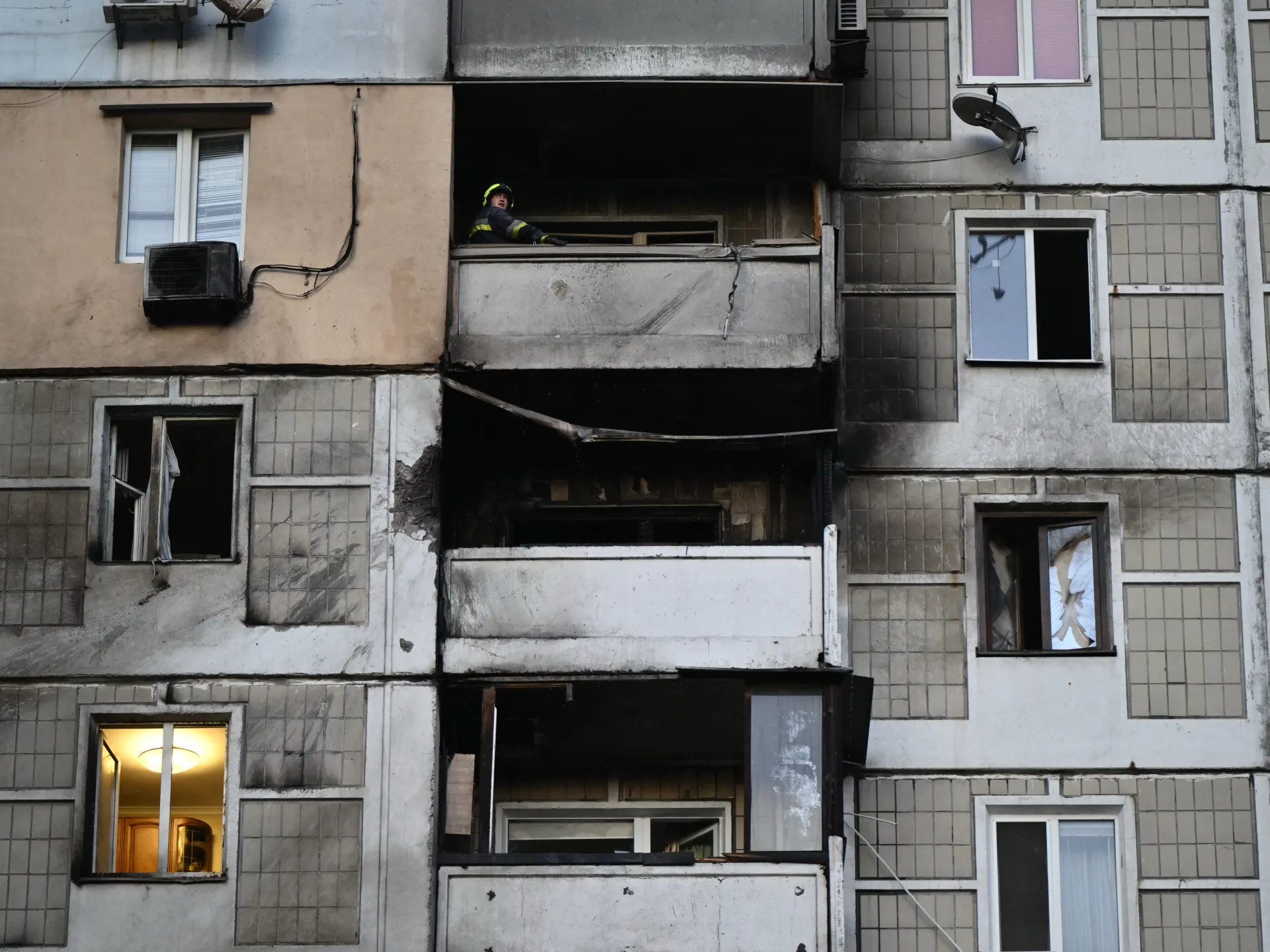
A Russian military strike on northeastern Kharkiv, Ukraine’s second-largest city, has injured at least 22 people, including children, less than a day after eight people were killed in attacks nationwide.
Kharkiv Mayor Ihor Terekov said on his Telegram account that a guided Russian aerial bomb hit an apartment block early on Monday, destroying two floors of the multistorey building.
Recommended Stories
list of 3 itemsend of list
He said six children were among the injured.
Russian attacks were also reported across Ukraine on Sunday.
Ukrainian Minister of Internal Affairs Ivan Vyhivskyi said three people, including a 16-year-old girl, were killed in air strikes that damaged a children’s centre in the northern city of Sumy.
Authorities in the Odesa region, meanwhile, said a “massive strike” on the south of the Black Sea region killed one person and damaged residential buildings, a shop, a hotel, a medical building, and a grain warehouse.
And in the capital, Kyiv, Mayor Vitali Klitschko said a woman and two 16-year-olds were injured and hospitalised.
“The enemy continues to relentlessly attack the Kyiv region with strike drones,” the city’s administration said.
“Sixteen sites have been damaged”, including 12 houses, a warehouse and a production facility, it added.
Ukrainian President Volodymyr Zelenskyy said on Sunday that three people were killed in strikes in the southern Zaporizhia region and that a Russian drone strike had killed one man in Kyiv.
Zelenskyy said in a post on his X account that Russia had launched more than 2,200 attack drones, 1,630 aerial bombs and 38 missiles of various types against Ukraine in the past week.
“If Russia were truly preparing for any real steps towards de-escalation, as it claims, particularly to American negotiators, this wave of Shahed terror would not be happening,” Zelenskyy said in later comments, referring to the Iran-developed drones Moscow has used against Ukraine.
In Moscow, Russia’s Ministry of Defence said it had bombed a Kyivstar data centre in Kyiv and another belonging to the Omega Telecom company. It said that the firms were providing services to the Ukrainian army.
Russian Minister of Foreign Affairs Sergey Lavrov told the United Nations General Assembly in New York on Saturday that Moscow intended to continue its military campaign “to the end”.
Ukrainian drones struck an oil depot in Russia’s Krasnodar region on Monday, according to local reports.
Ukrainian Telegram channel Exilenova+ published footage of a large fire and identified the facility as the Pavlovskaya oil depot.
No injuries have been reported so far.
Ukraine has intensified its targeting of Russian oil infrastructure in recent weeks.
United States-led talks to end the war, which began with Russia’s full-scale invasion of Ukraine in February 2022, have failed to produce a breakthrough, and the UN has highlighted the growing civilian toll.
South Korea’s presidential office criticises Ukraine for denying POW nondisclosure agreement.
Published On 27 Sep 202627 Sep 2026
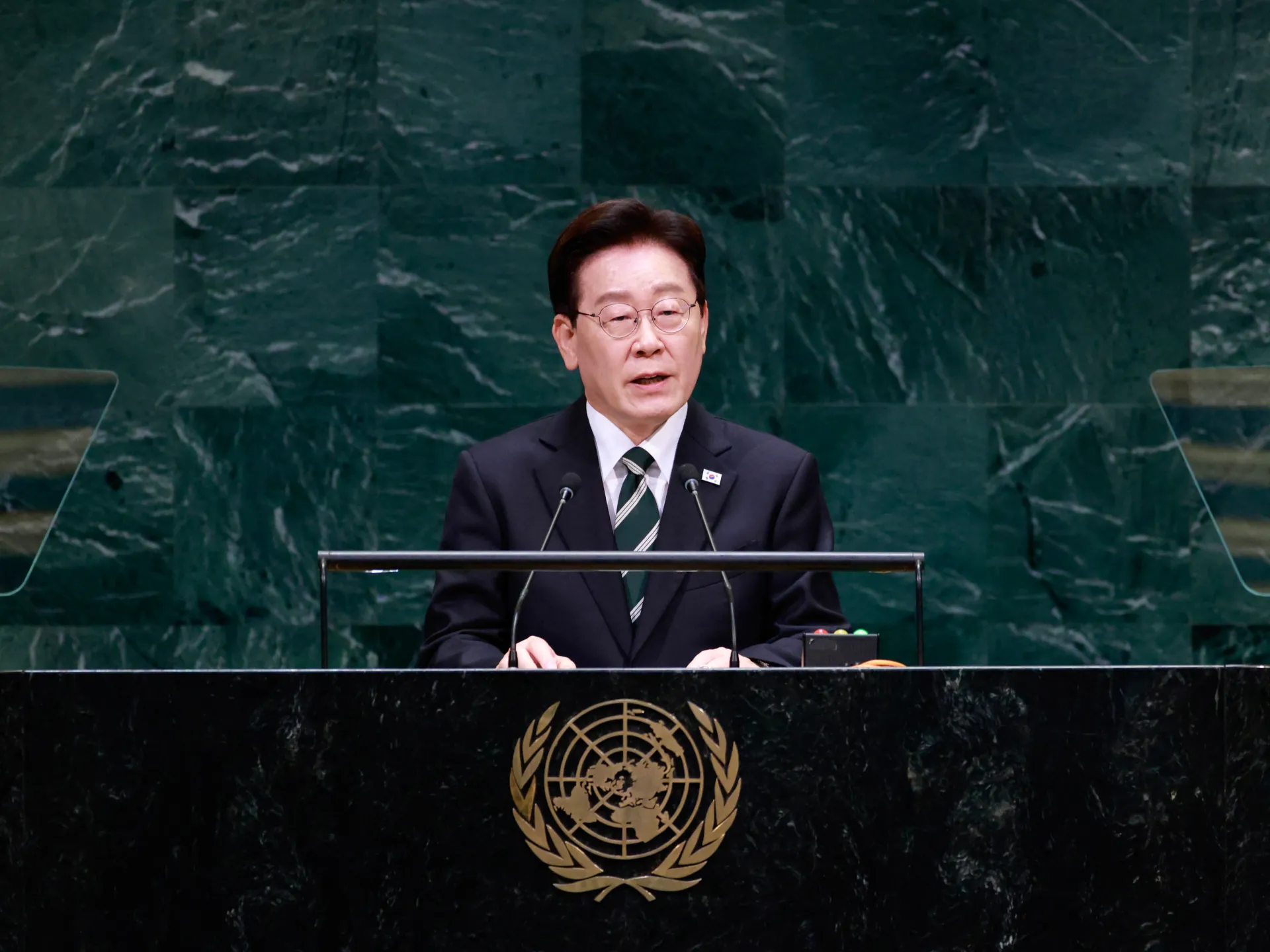
The South Korean president’s office has expressed “strong regret” over Ukraine’s disregard for a nondisclosure agreement with Seoul in the transfer of two North Korean prisoners of war (POWs) to Seoul, South Korean media reported.
Last week, Ukraine’s President Volodymyr Zelenskyy said in an address to the United Nations General Assembly (UNGA) that his country transferred two North Korean POWs to South Korea.
Recommended Stories
list of 3 itemsend of list
President Lee Jae Myung’s office “expresses strong regret over Ukraine’s unilateral disclosure [of the transfer] and its subsequent false announcement that there had not been a non-disclosure agreement”, the Yonhap news agency quoted Seong Ghi-hong, South Korea’s senior presidential secretary for public relations, as saying in a statement on Sunday.
The office said the nondisclosure agreement aimed to safeguard the soldiers from dangers they could face if their transfer were to be disclosed, in accordance with international law and humanitarian principles.
According to Yonhap, a South Korean media outlet, the Ukrainian presidential office said it had disclosed the transfer of the POWs without extensive details on the process, claiming that it would have been strange to keep the entire transfer a secret. Ukrainian media outlets reported a Ukrainian presidential source as denying the existence of a confidentiality agreement with Seoul, Yonhap said.
The South Korean presidential office said the Ukrainian presidential office’s “false” denial of the confidentiality agreement “seriously hampers” bilateral trust and causes serious disruptions to bilateral friendship.
Seong Ghi-hong said the government was considering additional measures over the issue, if necessary, Yonhap added.
North Korean POWS
Ukrainian forces captured the two North Korean soldiers in Russia’s Kursk region in January 2025.
Mounting evidence, including from intelligence reports and testimonies of defectors, has indicated that North Korean soldiers resorted to self-detonation or other forms of suicide rather than be captured.
In his UN address, Zelenskyy said, “These guys are not easy to capture alive.” He added, “One of them, when he realised he was going to be taken prisoner, tried to kill himself. And he was shocked that fate did not let him die.”
South Korean media reported that the two captured soldiers had expressed their desire to defect to South Korea.
The issue of North Korean prisoners of war was a key topic during the NATO summit in Ankara, Turkiye, where Lee met Zelenskyy in July.
Senior presidential spokesperson Kang Yu-jung stated afterwards that both leaders agreed to resolve the status of North Korean POWs in accordance with international law. This built on a prior agreement reached during the South Korea-Ukraine foreign ministers’ meeting in March, where both nations pledged to cooperate on the POW issue.
According to South Korean intelligence, North Korea is estimated to have deployed approximately 14,000-15,000 soldiers to support Russia’s efforts in its war with Ukraine since 2024, primarily in the Kursk border region. South Korean, Ukrainian and Western officials said they suffered heavy casualties, with more than 6,000 North Korean soldiers killed in the fighting.
The transfer comes as South Korea has backed efforts to revive dialogue with North Korea, while United States President Donald Trump has renewed his willingness to engage with Pyongyang.
The dire messaging, growing louder by the day, is being delivered amid concerns about intensifying hybrid attacks that Russia is using to spread fear throughout the continent, fray the NATO alliance, and make it think twice about continuing support for Ukraine. Intel has increasingly pointed to the possibility that this could culminate in a much more severe operation, one that would be aimed to challenge NATO at its core.
Our long-range responses had a very significant impact in the Moscow region last night. One of Russia’s key oil industry facilities and the aggressor’s logistics facility were hit. These are billions of dollars that sustain the war machine. The systems used included FP-1, RZ-100,… pic.twitter.com/ka5mlDSgb7
— Volodymyr Zelenskyy / Володимир Зеленський (@ZelenskyyUa) September 20, 2026
“There has definitely been an uptick” in Russian so-called hybrid warfare actions of late, a senior NATO military official told TWZ on Monday morning. “Despite its accusatory statements towards NATO, which remains a purely defensive alliance, Russia remains the aggressor. We see that clearly in Ukraine, where Russia is losing more than just the war it started. It therefore may incorrectly perceive the only way out is through increasing its hybrid campaign. That’s a losing proposition, because we are ready to respond, which we have shown.”
The official’s comments come after the shoot down last week of a suspected Russian drone that entered Lithuanian airspace from Belarus and in the wake of recent defensive actions by several European nations.
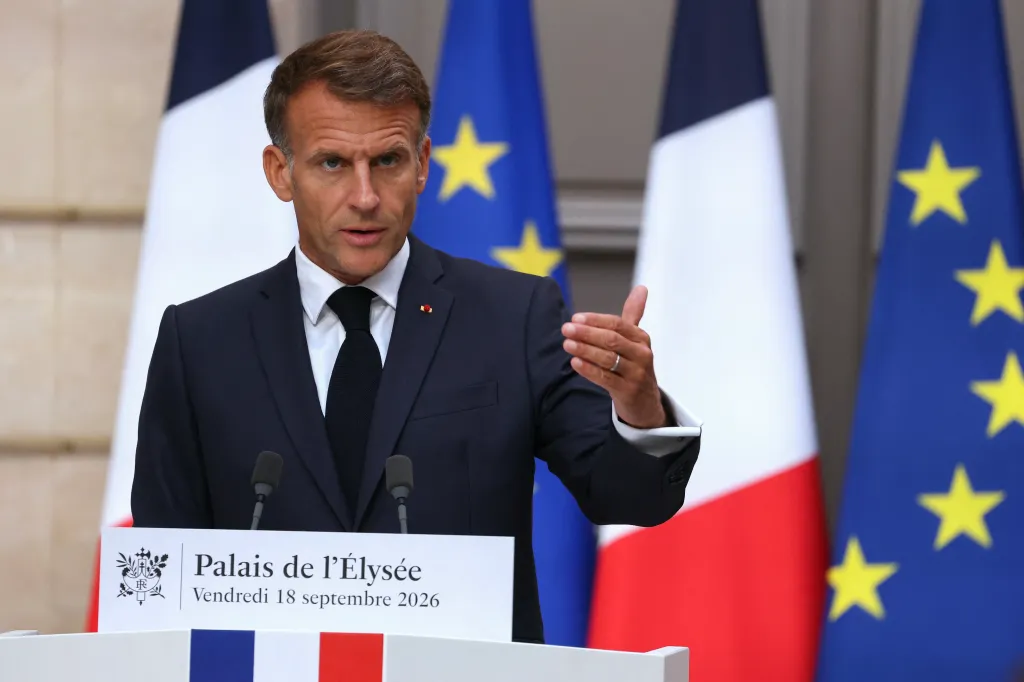
On Friday, French President Emmanuel Macron told reporters that his country had recently been targeted by Russian hybrid attacks. He ordered “the government to prepare a plan to protect our critical infrastructure” and the “most sensitive” defense industry and technology sites against drone and cyberattacks.”
Macron said the “intention behind it is to intimidate us and to derail the effort to support the Ukrainians. The consequence will be the opposite.”
France’s President Emmanuel Macron ordered the preparation of a “plan to protect our critical infrastructure” in the face of “Russian hybrid attacks.” (Photo by Thomas SAMSON / POOL / AFP) THOMAS SAMSON
In addition to Macron’s warnings, the French newspaper Le Monde reported that the French military was carrying out clandestine operations against Russia. However, the unnamed source cited offered no details and TWZ cannot independently verify that claim.
A day before Macron’s statements, Polish Prime Minister Donald Tusk warned in a speech to the Polish parliament that Russia is planning hybrid strikes with drones or rockets on European countries supporting Ukraine, including Poland.
The Polish leader offered an assessment about Moscow’s motives similar to Macron’s.
Russia will pretend the attacks are “accidental” in order to “paralyze or at least weaken the motivation of NATO countries” to rush to the defense of the member state coming under attack, The Associated Press noted.
“There is a real risk that drones or other types of projectiles will enter the territory of one or several countries on the eastern flank and even cause destruction,” Tusk cautioned. In July, a Russian AS-23 cruise missile crashed in Poland.
This video grab taken from footage of TVN Poland on July 30, 2026 shows the Polish army securing a large crater from a Russian missile that crashed in Poland. (Photo by various sources / AFP) –
In the face of these growing threats, officials in Lithuania are updating evacuation plans in case of a Russian attack.
“Poland is to be one of the evacuation destinations from the capital,” Žygimantas Solovjovas, head of the Civil Defense Department at Vilnius City Hall, told Polish Radio.
Evacuation should begin before a direct threat arises, Solovjovas stressed. “Vilnius residents should not assume that they will flee the city along an evacuation route while under fire,” Solovjovas explained, adding that in such a situation, one must seek shelter.
“One of the reasons for preparing this plan was to get residents accustomed to the idea that this should be a controlled process,” he noted. “If we allow chaos to ensue, the entire operation will be much more difficult.”
In Germany, where Defense Minister Boris Pistorius said Russia could attack by 2029, hospitals are preparing for a future influx of war-related casualties.
“In a report that gamed out potential scenarios should Russia invade NATO territory, the Bundeswehr calculated that as many as 1,000 wounded soldiers could arrive in Germany each day,” Bloomberg News reported last week. “As the country’s five military hospitals would quickly reach capacity — and the law requires that civilian hospitals help during wartime — the system would likely come under unprecedented strain, and could be forced to triage soldier and civilian care.”
As we noted last week, the alliance writ large is taking action against the growing Russian threats as well.
NATO’s air commander, U.S. Air Force Lt. Gen. Jason T. Hinds, told reporters, including from TWZ, last week that he was tasked with implementing two NATO air and missile defense plans. Hinds is also the Air Force’s top officer in Europe, serving as the commander of U.S. Air Forces in Europe/U.S. Air Forces Africa (USAFE).
Adding to the concerns about Moscow’s actions, Russia’s client state Belarus just wrapped up mechanized and tank battalion training adjacent to the Suwalki Gap. That’s the border between Poland and Lithuania that separates the Russian enclave of Kaliningrad from Belarus. It has long been considered a potential flashpoint for a war in Europe and the training exercise exacerbated concerns that NATO allies are not prepared for a Russian attack there.
The Suwalki Gap between Kaliningrad and Belarus is also the only land border between Poland and the Baltic states. (Google Earth)
Russia is also making some potentially concerning preparations.
The Defense Ministry is reportedly seeking “an additional 16,000 to 20,000 hospital beds for wounded soldiers in the Northwestern Federal District,” according to the Russian Volya Telegram channel. That district is located near the Baltics.
“Military hospitals have been struggling to cope with the influx of wounded since 2023, so the Ministry of Defense is increasingly using civilian hospitals (including maternity hospitals and specialized medical facilities) for its needs,” Volya stated. “Some of these hospitals are being completely repurposed for military use, but more often, civilian hospitals allocate a few departments to treat the wounded, while continuing to provide care for civilian patients in other departments.”
The expansion “will primarily affect regions within the Northwestern Federal District: Karelia, St. Petersburg, Leningrad and Novgorod regions, as well as Smolensk,” which are near the Baltics “and the Moscow regions.”
🤔 Militarnyi: In the fall of 2026, the Russian Federation plans to add 16,000-20,000 military beds in civilian hospitals in the Northwestern Federal District, located near the Baltic states. pic.twitter.com/0sLMvoCxfC
In addition, the Border Service Directorate for St. Petersburg and the Leningrad Region announced that from September 16 to September 26, 2026, there would be a restriction on access to the border of the Slantsevsky and Kingiseppsky districts near the Estonian border.
“These measures aim to prevent violations regarding border regulations, migration laws, and the protection of aquatic biological resources,” the directorate claimed, according to Russian regional officials.
The new rules prohibit people from being on the shorelines or in small vessels along a portion of the Narva River and from hunting or carrying firearms in the border area. In addition, they forbid the “presence and movement of individuals and vehicles during hours of darkness outside of populated areas within the five-kilometer strip of territory along the state border in the Kingiseppsky and Slantsevsky districts.”
Obviously, the stated reasoning behind this was taken with great skepticism from neighboring Baltic NATO countries who are already on edge.
Russia’s FSB imposes a nighttime curfew along the Estonian border near Narva, banning people and vehicles outside towns and villages within 5 km of the border in the Slantsy and Kingisepp districts from Sept 16–26 pic.twitter.com/8Ez8AvMXFy
Though Russia remains bogged down in its war on Ukraine and is suffering heavy losses of personnel and equipment, some European intelligence officials suggest Vladimir Putin could still carry out a small-scale invasion of NATO territory.
“It’s possible,” Michal Koudelka, the head of the Czech Republic’s BIS security service, told The Guardian about a potential Russian thrust into NATO. “It could involve a limited incursion, false-flag provocations, a massive influence campaign,” he told the publication, adding that this scenario could play out in a matter of “months, not years.”
While Russia has been carrying out a range of hybrid actions against Europe for years, including cyberattacks, drone incursions and sabotage, last month’s foiled attack on Germany’s Leipzig-Halle airport is seen in European intelligence circles as an inflection point.
As we previously reported, a drone discovered inside the secured area of Leipzig/Halle Airport during the night of August 4-5, was carrying approximately 1.3 pounds of explosives. It was found close to a Ukrainian-operated Antonov An-124 heavy cargo aircraft used to transport weapons to Ukraine. German authorities blamed Russia for that incident.
“To have an armed UAV drone sent into a busy airport in the middle of Europe … If you have attacks that could result in losses of life or losses of very critical infrastructure that have a huge implication for society, I think that is a gamechanger,” Thomas Nilsson, the head of Sweden’s military intelligence and security service, told The Guardian.
A Ukrainian Antonov AN-124 cargo plane is parked at Leipzig/Halle Airport after specialists from the Federal Police defused a drone equipped with an explosive device that German authorities blamed on Russia. (Photo by Hendrik Schmidt/picture alliance via Getty Images) picture alliance
It is unknown at this point whether Putin will decide to expand his hybrid actions against Europe to a more traditional conflict. However, as the attacks increase, officials across the continent are committing greater resources and planning to be prepared should that happen.
At the same time, the heat is only being turned up on Moscow as Ukraine accelerates its long range attacks. Now it has a whole new weapon, one that has been long in the works, to reach into Russian territory with while bypassing most air defenses.
Zelensky has officially unveiled the FP-7 Pelican ballistic missile and said it was used in the attack on Moscow. This is a monumental advance for Ukraine that has lacked modern ballistic missile capabilities since the war started. Still, Ukrainian media has raised doubts about whether the FP-7 — with an estimated operational range of 200-350 kilometers (124-217 miles) — can reach the Russian capital, which is about 450-500 kilometers (280-311 miles) from the Ukrainian border.
However, one expert suggested “that the ballistic weapon may have played an integral role within a coordinated, multi-axis combined strike,” according to the Kyiv Post.
Regardless, even if it can’t hit Moscow, it can hit plenty of other targets and it represents a major escalation in Ukraine’s weapons capabilities.
There is no avoiding the reality that the security situation in Europe is deteriorating, where exactly that leads is unclear apparently to everyone at the moment.
UPDATE: 7:04 PM Eastern –
Airspace restrictions have been imposed over Vilnius Airport due to a suspected “hybrid attack” from Belarus after the detection of what is suspected to be balloons in Lithuanian airspace, airport officials announced.
“Aircraft arrivals are temporarily suspended; however, departures are permitted from 12:55 a.m. subject to all safety requirements,” the airport explained. “These restrictions were introduced due to a hybrid attack by Belarus against Lithuania, civil aviation, and the public, involving the detection of navigational markers—characteristic of balloons—in areas posing risks to aviation.”