Russia-Ukraine war

Can Russia serve as an economic lifeline for Iran amid the Hormuz blockade? | US-Israel war on Iran News

As Iran stares down the economic consequences of a prolonged blockade of the Strait of Hormuz, attention is shifting north.

With Gulf shipping lanes disrupted and oil exports constrained, Tehran may seek to depend less on the Gulf and more on a patchwork of railways, Caspian ports and sanctions-era trade networks linking it to Russia.

Recommended Stories

list of 4 itemsend of list

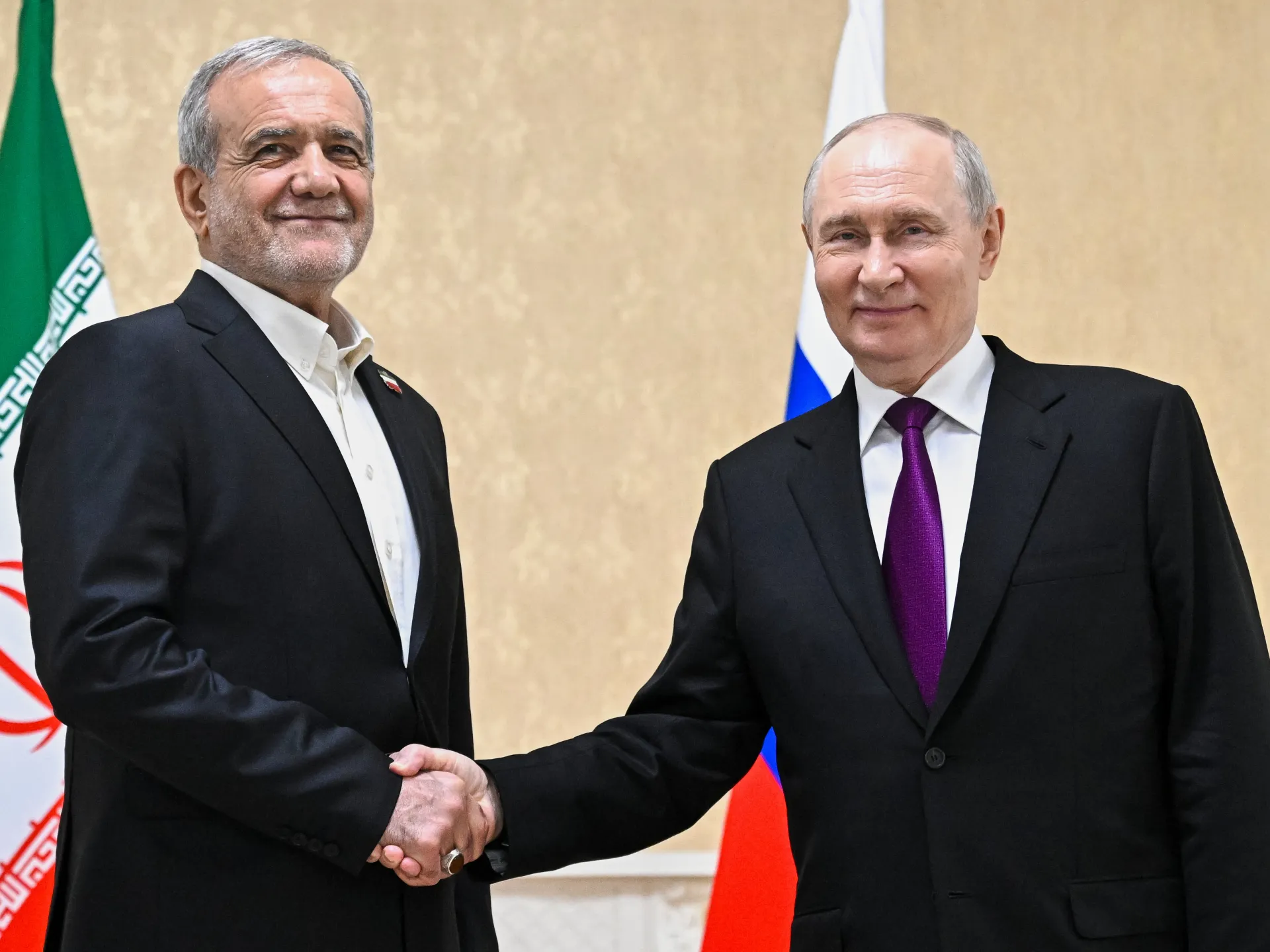
The importance of that relationship was underscored this week when Iranian Foreign Minister Abbas Araghchi travelled to St Petersburg for talks with Russia’s President Vladimir Putin, praising Moscow’s “firm and unshaken” support as the two sides discussed the war, sanctions and the future of the Strait of Hormuz.

But could Moscow really offer a lifeline for Iran’s beleaguered, war-torn economy, and would it even want to? We spoke to experts to find out.

Increasing but modest bilateral trade

Economic relations between Iran and Russia deepened after the US withdrew from a 2015 nuclear deal with Iran and other nations in 2018 and reimposed sweeping sanctions on Tehran.

Russia’s full-scale invasion of Ukraine in 2022 served to accelerate that trend as both countries found themselves increasingly cut off from the Western financial system. They turned to sanctions-evasion networks, alternative payment systems and non-Western trade corridors to keep goods, energy and money flowing.

Current trade is dominated by agricultural products – especially wheat, barley and corn – alongside machinery, metals, timber, fertilisers and industrial inputs. Tehran has also supplied Russia with low-cost Shahed drones, which Russia updated and has been using in its war on Ukraine.

“Trade turnover reached $4.8bn last year [2024], but we believe that the potential for our mutual trade is much greater,” Russian Energy Minister Sergey Tsivilyov told an intergovernmental commission on trade and economic cooperation between Moscow and Tehran in 2025.

Bilateral trade is reported to have increased by 16 percent during that period, driven largely by Russian exports of grain, metals, machinery and industrial goods.

But experts say that despite this increase, the overall trade relationship remains relatively modest compared with Iran’s trade with China or the Gulf countries.

Trade between the two is “not substantial, because both countries are producing almost similar products and the industries are similar”, Mahdi Ghodsi, an economist at the Vienna Institute for International Economic Studies, told Al Jazeera.

Russian President Vladimir Putin shakes hands with Iranian Foreign Minister Abbas Araqchi during a meeting at the Boris Yeltsin Presidential Library in Saint Petersburg, Russia April 27, 2026. Dmitri Lovetsky/Pool via REUTERS
Russian President Vladimir Putin shakes hands with Iranian Foreign Minister Abbas Araghchi during a meeting at the Boris Yeltsin Presidential Library in Saint Petersburg, Russia, April 27, 2026 [Dmitri Lovetsky/Pool via Reuters]

Alternatives to Hormuz

The backbone of Russia-Iran trade is the International North-South Transport Corridor (INSTC), a network of shipping lanes, railways, and roads linking Russia to Iran and onward to Asia, bypassing Western-controlled maritime routes.

Goods move from southern Russian ports, across the Caspian Sea to northern Iranian ports, including Bandar Anzali, before continuing by rail or truck.

The route has become increasingly important for Russian grain, machinery and industrial exports to Iran.

This route can serve as a “viable but partial lifeline”, Naeem Aslam, chief market analyst at London-based Think Markets, told Al Jazeera, adding that Russian ports in Astrakhan, on the Volga River delta near the Caspian Sea, and Makhachkala, on the Caspian Sea, are already “primed for a surge in grain, metals, timber and refined products”.

A western branch also runs through Azerbaijan, though a key missing rail link between Rasht and Astara in northern Iran remains unfinished.

In 2023, Moscow agreed to help finance the line, with Russia’s president calling the agreement a “great event” that “will help to significantly diversify global traffic flows”.

Easier in theory than in practice

Analysts say that, although these routes may provide a temporary solution, the Strait of Hormuz offers a scale and efficiency that rail and land corridors cannot easily replicate.

Although maritime trade has been highly volatile in recent weeks, “from a historical perspective it is simply the quickest and the most cost-effective way of transporting anything”, Adam Grimshaw, an economic historian at the University of Helsinki, told Al Jazeera.

“Roughly 90 percent of Iran’s international trade is maritime trade that goes through the Gulf, which can’t be quickly or immediately replaced through land access to Iran or through air transport to circumvent the American blockade”, Nader Hashemi, an associate professor at Georgetown University, told Al Jazeera.

Ghodsi said Russia might be able to offer a “lifeline” in the short term, as it did when it exported grain during Iran’s droughts, but in the long run, it simply “cannot substitute” the vast amounts of maritime trade.

Re-routing trade routes via land “takes time”, pushing up prices for consumers and creating more food waste as perishables rot en route.

Does Moscow want to help Iran?

Most analysts say throwing an economic lifeline to Iran is not in Russia’s interests.

“They’ve got their own economic problems,” John Lough, head of foreign policy at the New Eurasian Strategies Centre, told Al Jazeera, pointing to signs of stagnation inside Russia, pressure on reserves and growing frustration over the prolonged war in Ukraine.

While Moscow could offer symbolic support or limited humanitarian assistance, “now is not a good time” to invest in Iran, he said, referring to the US-Israel war on the country.

Replacing maritime trade with overland routes would be extremely difficult, despite years of discussion about alternative corridors linking the two nations, he said.

It also won’t necessarily help Iran’s economy, which needs all the export revenue it can get, experts say.

“Much of Iran’s economy revolves around the sale of oil, and with that blocked or prevented by the American blockade, Russia really can’t help in that regard”, Hashemi said.

Others are more optimistic, however.

“Propping [up] Iran locks in higher global oil prices that buoy Russia’s war economy, cements INSTC dominance for Asian trade, and keeps a key anti-Western ally alive – no downside for Moscow in a fragmented Gulf,” Aslaam said.

Source link

Russia attacks Odesa, claims Ukraine hit Zaporizhzhia nuclear plant | Russia-Ukraine war News

A Ukrainian attack on the captured Zaporizhzhia nuclear plant kills a worker, according to the site’s Russia-installed authorities.

Ukrainian officials say Russian drones have again attacked the southern port city of Odesa, injuring at least 11 people, including two children, and damaging homes and important infrastructure.

Odesa Governor Oleh Kiper said the attack affected three districts, hitting residential buildings, vehicles and civilian facilities, including a hotel, warehouses and funicular railway. Windows shattered in many buildings and the port area sustained damage.

Recommended Stories

list of 3 itemsend of list

“All specialised and municipal services are working to mitigate the consequences. Law enforcement agencies are documenting the latest war crimes committed by Russia against the peaceful population of [the] Odesa region,” Kiper said.

Russian attacks killed one person in the southeastern Zaporizhzhia region, according to Governor Ivan Fedorov.

“A 59-year-old man died as a result of an enemy attack on the Zaporizhzhia region,” Fedorov wrote on Telegram.

A Ukrainian drone attack killed an employee at the Zaporizhzhia nuclear power plant, which was captured by Russian forces and is shut down.

“A driver was killed today when a Ukrainian Armed Forces drone struck the transport department at the Zaporizhzhia Nuclear Power Plant,” said a statement from plant managers who were installed by Russia.

Regional governor Fedorov said Russian forces launched 629 strikes across 45 settlements in the region in a single day, with at least 50 reports of damage to homes and infrastructure.

Russian officials reported Ukrainian drone attacks in the Belgorod border region, where at least one person was killed and four women injured, alongside damage to buildings and vehicles.

Stalled diplomatic efforts

The attacks come as diplomatic efforts to end the war remain stalled. Donald Trump said on Sunday that he has had “good conversations” with Presidents Vladimir Putin and Volodymyr Zelenskyy.

“We’re working on the Russia situation, Russia and Ukraine, and hopefully we’re going to get it,” Trump said on Fox News.

“I do have conversations with him, and I do have conversations with President Zelenskyy, and good conversations,” he said.

“The hatred between President Putin and President Zelenskyy is ridiculous. It’s crazy. And hate is a bad thing. Hate is a bad thing when you’re trying to settle something, but it’ll happen.”

Zelenskyy said he signed agreements on security and energy cooperation with Azerbaijan during a visit to Baku, adding that Kyiv had discussed the possibility of future talks with Russia there.

Source link

North Korea opens museum commemorating troops killed fighting for Russia | Russia-Ukraine war News

North Korea has opened a memorial museum in Pyongyang for its soldiers killed while fighting alongside Russian forces in the war in Ukraine, in the clearest sign yet of how central the conflict has become to the growing alliance.

The inaugural ceremony at the Memorial Museum of Combat Feats at the Overseas Military Operations was held on Sunday. It also marked the first anniversary of what the two countries describe as the end of an operation to “liberate” Russia’s Kursk border region from a Ukrainian incursion, the state-run Korean Central News Agency (KCNA) reported on Monday.

KCNA said North Korea’s leader Kim Jong Un attended the event along with senior Russian officials, including State Duma Chairman Vyacheslav Volodin and Defence Minister Andrei Belousov.

South Korea’s intelligence agency has estimated that North Korea deployed about 15,000 soldiers to fight for Russia in the Kursk region, and that about 2,000 of them were killed. Moscow and Pyongyang have not disclosed any figures.

During the ceremony, Kim sprinkled earth over the remains of one soldier and laid flowers for others whose bodies had been placed in a mortuary, according to KCNA. Kim and the Russian officials then signed a guestbook at the newly opened museum.

In his speech, Kim said the fallen North Korean troops would remain “a symbol of the Korean people’s heroism” and would support “a victorious march by the Korean and Russian people”.

He accused the United States and its allies of pursuing a “hegemonic plot and military adventurism” on the Russia-Ukraine front, praising Russian and North Korean forces for thwarting those efforts.

Meeting Belousov separately, Kim pledged full support for Russia’s policy of defending its sovereignty and security interests, KCNA said.

Russia’s TASS news agency quoted Belousov as saying that Moscow is ready to sign a military cooperation plan with Pyongyang covering 2027-31.

In a letter read by Volodin, Russian President Vladimir Putin said the new museum would be “a clear symbol of the friendship and solidarity” between the two countries and pledged to further strengthen their “comprehensive strategic partnership”.

Since Russia’s full-scale invasion of Ukraine in 2022, Kim has tilted his foreign policy decisively towards Moscow, supplying troops and conventional weapons in exchange, analysts say, for economic support and possibly sensitive technologies.

Officials in South Korea, the US and allied countries fear Russia could transfer advanced know-how to Pyongyang that would boost its nuclear and missile programmes.

Military experts say North Korean troops initially suffered heavy losses in Kursk due to their lack of combat experience and unfamiliarity with the terrain, making them vulnerable to Ukrainian drone and artillery fire.

But Ukrainian military and intelligence officials have assessed that the North Koreans later gained crucial battlefield experience and became central to Russia’s efforts to overwhelm Ukrainian forces by deploying large numbers of soldiers in the region.

Source link

Russian attacks on Ukraine kill at least five, damage ship in port | Russia-Ukraine war News

Ukraine’s attacks on Russia injure at least six people in the region of Vologda and the annexed Crimea.

Ukrainian officials say Russian attacks in several regions have killed at least five people and damaged a ship in the port of Odesa – as Moscow claimed to have intercepted more than 200 Ukrainian drones.

A Russian drone attack killed two men on Saturday in Ukraine’s northeastern Sumy region, according to Governor Oleh Hryhorov. He said civilians were hit in Bilopil close to the Russian border.

Recommended Stories

list of 4 itemsend of list

In the central Dnipropetrovsk region, Russian attacks on four districts killed one person and injured four others, Governor Oleksandr Ganzha said.

In the southern region of Kherson, Governor Oleksandr Prokudin said Russian shelling wounded seven people.

Further east, Russian forces launched more than 700 attacks on 50 settlements in the Zaporizhia region over the past 24 hours, killing two people and injuring four, according to Governor Ivan Fedorov.

Homes, vehicles and infrastructure were damaged, he added.

In Odesa region, Deputy Prime Minister Oleksii Kuleba said Russian forces again targeted port infrastructure.

“The attack damaged port and logistics infrastructure facilities, warehouses, technical equipment, cargo storage tanks, administrative buildings, as well as freight transport,” Kuleba said on Telegram.

He added that a civilian vessel flying the flag of Palau was damaged while loading in port. No injuries to the crew were reported.

Ukraine’s air force said it shot down or disabled 124 of 144 drones launched by Russia overnight with impacts recorded at 11 locations.

Russia reports Ukrainian drone attacks

Russia’s Ministry of Defence said its air defences destroyed 203 Ukrainian drones between Saturday evening and Sunday morning over Russian regions and the Black Sea.

The ministry said 95 Ukrainian drone control centres were destroyed over the previous 24 hours.

In Russia’s Vologda region, Governor Georgy Filimonov said five people were injured in a Ukrainian drone attack on a nitrogen complex.

In Sevastopol in Crimea, which was annexed by Russia, debris from downed drones struck the cardiology department of a hospital, injuring one person, according to Governor Mikhail Razvozhayev. He said 16 Ukrainian drones were shot down over the city overnight.

Razvozhayev added that drone debris also fell on rail tracks, damaging overhead power lines and causing train delays.

Peace efforts continue

The latest attacks came as diplomatic efforts to end the war, now in its fourth year, remained stalled.

Ukrainian President, Volodymyr Zelenskyy, said he signed agreements on security and energy cooperation with Azerbaijan’s President Ilham Aliyev in Baku on Saturday.

Zelenskyy said Kyiv wanted to draw on its experience defending airspace from Russian attacks. He also said he had discussed the possibility of holding future talks between Ukraine and Russia in Azerbaijan.

“We are ready for the next talks to be in Azerbaijan, if Russia will be ready for diplomacy,” Zelenskyy said.

Source link

Overnight Russian attacks on Ukraine kill five, injure 30 | Russia-Ukraine war News

Russia launched more than 600 drones and 47 missiles as it targeted eight regions in Dnpiro, authorities say.

Overnight Russian attacks in eight regions of Ukraine have killed at least five people and wounded 30 others, Ukrainian officials say.

The central Ukrainian city of Dnipro was hardest hit, with more than 20 people reported wounded, including a nine-year-old and two police officers, according to a Telegram statement from Ukraine’s National Police.

Recommended Stories

list of 4 itemsend of list

Two people died in the city of Nizhyn in the northern region of Chernihiv, while a one-year-old boy was among the wounded in Kharkiv region, police said.

A rescue operation was underway at a residential building in Dnipro, while emergency services worked in regions across Ukraine, including in Chernihiv, Odesa and Kharkiv.

Donetsk Governor Vadym Filashkin wrote on Telegram that one person was wounded in attacks on Sloviansk, and another in Kramatorsk. Six homes, five high-rises and buildings, including a post office and a church, also reported damage.

Ukraine’s Air Force tallied 619 Russian drones and 47 missiles launched during the attacks. Air defences shot down or suppressed 610 of them, it said.

“Russia’s tactics remain unchanged – attack drones, cruise missiles, and a significant number of ballistic missiles. Most targets are civilian infrastructure in cities,” President Volodymyr Zelenskyy posted on X on Saturday, along with a video of emergency workers responding to shelled-out buildings.

The latest attacks came on the heels of the killings of a Ukrainian married couple, both aged 75, during a Russian strike on the port city of Odesa yesterday. Strikes also destroyed residential buildings and hit a foreign ship, Ukrainian authorities said.

The European Union this week approved a new round of sanctions targeting Russia’s energy, banking and trade sectors. Discussions had previously stalled amid opposition from Hungary.

The EU’s foreign policy chief, Kaja Kallas, called on Friday for a new package of sanctions, telling reporters in Cyprus that the EU is “really pushing”.

Zelenskyy urged European leaders to expedite the process in light of the latest attacks.

“The pause caused by the blocking of the 20th package gave the aggressor additional time to adapt – it is important to counter this,” he added.

Source link

Turkiye making efforts to revive Russia-Ukraine talks, says Erdogan | Russia-Ukraine war News

Turkish president meets NATO chief as Kyiv asks Ankara to host a leaders’ level meeting with Russia.

Turkiye is making efforts to revive negotiations between Russia and Ukraine and bring together the leaders of the warring sides, Turkish President Recep Tayyip Erdogan has told NATO Secretary-General Mark Rutte.

Ankara has maintained good ties with both sides since Russia’s full-scale invasion of Ukraine in 2022.

Recommended Stories

list of 4 itemsend of list

Erdogan and Rutte met in the Turkish capital Ankara, the Turkish presidency said on Wednesday.

“Erdogan said we were engaged, as Turkiye, for the Ukraine-Russia war to end with peace, and that we are working to revive negotiations and start talks at leaders’ level,” the presidency said in a readout of the meeting.

The Turkish president also told Rutte that maintaining transatlantic ties was “indispensable”, but that Ankara expected European NATO allies to take more responsibility for transatlantic security, the presidency said.

Separately, Erdogan had a phone call with German Chancellor Frank-Walter Steinmeier on Wednesday, informing him of Ankara’s efforts to achieve a lasting peace through talks in Ukraine, the presidency said.

Erdogan told the German leader that the US-Iran war was “starting to weaken Europe” and that the damage from the conflict would increase if world powers failed to intervene with “peace-oriented approaches”.

“Erdogan said Turkiye was working to end the Ukraine-Russia war through negotiations and reach lasting peace, just as it is trying with regards to Iran,” the presidency said in a statement after the phone call.

Ukraine’s request

Earlier on Wednesday, Kyiv said it had asked Turkiye, a NATO member, to host a leaders’ level meeting with Russia.

“We asked the Turks about it, we asked some other capitals,” Ukraine’s Foreign Minister Andrii Sybiha said in comments to reporters on Tuesday that were cleared for release on Wednesday.

He added that Ukraine would be ready to consider any place other than Belarus or Russia for a meeting with Russian President Vladimir Putin, and that Ukraine’s President Volodymyr Zelenskyy has long sought to try to hasten a resolution of the more than four-year war.

Meanwhile, Russian news agencies quoted Kremlin spokesman Dmitry Peskov as saying that Putin would be ready to meet his counterpart only for the purpose of finalising agreements on the conflict.

“The main thing is the goal of this meeting. Why should they meet? Putin has said he is ready for a meeting in Moscow at any moment,” the TASS news agency quoted Peskov as telling Russian state television.

“The main thing is that there should be a reason to meet, and the main thing is that the meeting should be productive. And it can only be for the purpose of finalising agreements.”

Source link

Russian police raid book publisher accused of pushing ‘gay propaganda’ | Russia-Ukraine war News

Raid is part of Moscow’s hardline social conservatism and clampdown on political life.

Russian police have raided the country’s top publishing house on suspicion that it has been disseminating “homosexual propaganda”, local media report.

Police reportedly seized thousands of books on Tuesday and took Yevgeny Kapiev, the chief executive of Eksmo, in for questioning. The raid appears to be part of Moscow’s pivot to hardline social conservatism with repressive laws running alongside a clampdown on political life and aggressive foreign policy.

Recommended Stories

list of 4 itemsend of list

Police targeted Kapiev as part of a “criminal case on extremism” over the publication of books “dealing with LGBT themes”, Eksmo communications director Yekaterina Kozhanova told the AFP news agency.

The firm’s finance director, head of distribution and deputy commercial director were also interrogated, Kozhanova said.

Eksmo is suspected of unofficially marketing books, including novels, that promote “gay propaganda” to Russian youth, the broadcaster Ren-TV reported.

An investigation into Eksmo was opened last year when authorities said “LGBT propaganda” had been “detected” in books published by its Popcorn Books subsidiary and they arrested several members of its staff.

Ultraconservative turn

Books showing approval of same-sex relations have been banned in Russia for more than 10 years.

The law has been tightened recently, requiring publishers to remove publications and destroy entire editions if they depict same-sex relationships.

The persecution of LGBTQ individuals, organisations and communities has intensified in the past decade or so as the Kremlin heralds “traditional values”. That drive has included a crackdown on films, books, art and culture, among other areas of social life.

Cultural producers have faced significant pressure even when they focus on giants of Russian culture. Biographies of Mikhail Bulgakov, author of The Master and Margarita, and the poet, actor and singer Vladimir Vysotsky have to be marked with warning labels because they are seen as promoting drug-taking.

The ultraconservative social turn has accelerated since Russia launched its full-scale invasion of Ukraine in February 2022.

In 2023, Russia’s Supreme Court ruled that LGBTQ activists should be designated as “extremists” and banned activities of the “international LGBTQ movement”.

Courts have issued fines and jail sentences to people displaying LGBTQ “symbols”, such as clothes, jewellery or posters featuring the rainbow flag.

Out of 49 European countries, the Rainbow Europe organisation ranked Russia third from bottom in terms of tolerance of LGBTQ people.

Source link

EU credibility is on the line over Israel, says Spanish foreign minister | Russia-Ukraine war

NewsFeed

Spain’s foreign minister has warned the EU risks losing credibility if it fails to apply the same principles to Israel’s “perpetual war” in the Middle East as it does to Russia’s invasion of Ukraine. He urged a unified stance, citing human rights clauses in the EU–Israel agreement and criticising ongoing violence in Gaza, the West Bank and Lebanon.

Source link

Bulgaria’s former President Radev wins election: All you need to know | Elections News

Bulgaria’s eighth parliamentary election in five years has concluded with former president Rumen Radev’s Progressive Bulgaria party emerging as the clear winner. Radev will be the next prime minister.

While pollsters predicted a win for Radev ahead of the election, they did not necessarily expect it to be such a large one.

Recommended Stories

list of 3 itemsend of list

With 98.3 percent of ballots tallied on Monday, official figures show Radev’s party taking 44.7 percent of the vote, and likely to secure roughly 130 of the 240 seats in parliament. The centre-left party has come in far ahead of rivals, raising hopes among voters for a more stable government after years of fragile coalitions and repeated votes.

However, questions remain over what Radev’s foreign policy will entail and what his election means for Bulgaria’s position within the European Union and NATO.

Here is what you need to know:

Who is Rumen Radev?

The 62-year-old served as Bulgaria’s president for nearly a decade before stepping down in January this year to launch his bid to become prime minister.

The former air force commander has positioned himself as an outsider, saying he wants to rid the country of its “oligarchic governance model”, amid widespread frustration with corruption and political turmoil that has gripped the country of 6.6 million people.

In 2025, Radev supported anti-corruption protests that brought down the conservative-backed government of former Prime Minister Rosen Zhelyazkov. He urged voters to turn out in large numbers to counter vote-buying.

At a pre-election rally on Wednesday last week, he pledged to “remove the corrupt, oligarchic model of governance from political power”.

epa12899730 Rumen Radev, leader of the Progressive Bulgaria (PB) coalition, casts his ballot during the parliamentary elections in Sofia, Bulgaria, 19 April 2026. Approximately 6.6 million voters are heading to the polls to elect 240 members of the National Assembly in an attempt to establish a stable coalition government following a period of prolonged political deadlock in the Balkan nation. EPA/BORISLAV TROSHEV
Rumen Radev, leader of the Progressive Bulgaria (PB) coalition, casts his ballot during the parliamentary elections in Sofia, Bulgaria [Borislav Troshev/EPA]

Radev’s stance on foreign policy has drawn attention in Europe, however.

Although he publicly condemned Russia’s 2022 invasion of Ukraine, he has also opposed providing military support to Ukraine and called, instead, for renewed, “practical relations with Russia based on mutual respect and equal treatment”.

Radev objected to a 10-year defence pact concluded between Bulgaria and Ukraine in March.

He has also called for the resumption of Russian imports to Europe, despite EU sanctions on Russian oil and a decision at the end of last year to cease all energy imports from Russia by 2027.

All this has led to critics labelling him “pro-Russian”. Radev, however, says he is merely taking a pragmatic approach.

“We are the only member state of the European Union that is both Slavic and Eastern Orthodox,” he said in an interview with Bulgarian journalist Martin Karbovski.

“We can be ‌a very important ⁠link in this whole mechanism … to restore relations with Russia,” he added.

Following the election, Russia congratulated Radev, welcoming his victory.

“Of course, we are impressed by the statements made by Mr Radev, who won the election, and by some other European leaders regarding their willingness to resolve problems through pragmatic dialogue,” said Kremlin spokesman Dmitry Peskov on Monday.

On Europe, some label Radev a eurosceptic, as he has criticised aspects of EU policy, including reliance on renewable energy and Bulgaria’s adoption of the euro.

At his campaign rally on Wednesday last week, he said: “The coalition-makers introduced the euro in Bulgaria without asking you. And now, when you pay your bills, always remember which politicians promised you that you would be in the ‘club of the rich’.”

Following his victory, he told reporters: “A strong Bulgaria and a strong Europe need critical thinking and pragmatism. Europe has fallen victim to its own ambition to be a moral leader in a world with new rules.”

Nevertheless, Radev has signalled his willingness to cooperate with pro-European parties on issues like judicial reform and has stated that Bulgaria will “continue on its European path”.

Following his win, European Commission President Ursula von der Leyen said: “Bulgaria is a proud member of the European family and plays an important role in tackling our common challenges.”

How significant is this result?

Since 2021, Bulgaria has been through multiple governments, many brought down by protests or parliamentary disagreements.

The election result places Radev’s party, with 44 percent of the vote, well ahead of the centre-right GERB party of former Prime Minister Boyko Borissov, which secured 13.4 percent of the vote, and the reformist PP-DB coalition, with 12.7 percent.

The margin between the parties is wider than pollsters predicted. On Friday last week, according to Bulgaria’s Alpha Research, Radev’s Progressive Bulgaria was projected to win, but with only 34.2 percent of the vote, followed by Borissov’s GERB-UDF with 19.5 percent. This led observers to predict that a coalition government would be necessary.

Despite securing a clear majority, however, Radev has yet to rule out creating a coalition with a smaller party to form a government.

“We are ready to consider different options so that Bulgaria can have a regular and stable government,” he told reporters on Sunday.

This latest election was called after former PM Zhelyazkov announced in December that his cabinet would resign, amid a looming no-confidence vote.

The election campaign centred heavily on cost-of-living pressures, corruption, and other economic concerns, with many voters expressing frustration at the lack of credible political alternatives.

What will Radev’s role as prime minister be?

Although Radev is best known for holding the title of president, that is a largely ceremonial role in Bulgaria’s political system.

The president serves as head of state, representing national unity and playing a role in foreign policy; executive power lies primarily with the prime minister and his cabinet.

The prime minister appoints his cabinet ministers, sets the government agenda, and is the key representative of Bulgaria in international affairs, including within organisations like the European Union and NATO.

The prime minister remains in office unless he chooses to resign or is removed in a no-confidence motion.

Source link

Russia claims Ukraine-linked bomb plot foiled, German woman arrested | Russia-Ukraine war News

Russia’s FSB accused the woman, found with a bomb in her backpack, of taking part in a plot hatched by Ukraine.

Russian authorities say they have thwarted a Ukraine-linked bomb plot against security services and arrested a German woman found with a makeshift bomb in her backpack.

Russia’s FSB security agency said the unnamed woman was detained on Monday in the southern city of Pyatigorsk.

Recommended Stories

list of 3 itemsend of list

In a statement cited by Russia’s state-run TASS news agency, the FSB said it had “prevented a terrorist attack planned by the Kyiv regime against a law enforcement facility in the Stavropol region, involving a German citizen born in 1969”.

It said the woman had been recruited by a citizen from a Central Asian country, who was working on orders from Ukraine. That man was found and arrested near the targeted site.

According to the FSB, the device contained an explosive charge equivalent to 1.5kg (3 pounds) of TNT and was intended to be detonated remotely. The agency said the blast was ultimately prevented by electronic jamming.

Video of the purported arrest published by Russia’s state RIA Novosti news agency showed armed Russian security agents approach the woman as she was face down in a car park.

Another video showed masked plainclothes agents pulling a man into a station, followed by a controlled explosion of the backpack.

Russia’s previous allegations

Russia has arrested dozens of people throughout the four-year war, mostly its own citizens, on allegations of working for Ukraine to carry out sabotage attacks.

Russia has previously accused Ukraine of working with Islamic fundamentalists to carry out attacks inside Russia, without providing evidence.

Officials initially alleged that the perpetrators of a 2024 massacre at a concert hall on the outskirts of Moscow that killed 150 people were ISIL (ISIS) members in coordination with Ukraine.

ISIL claimed responsibility for that attack, making no reference of any Ukrainian involvement, for which no evidence was presented by Moscow and which Kyiv denies.

Source link

Ukraine claims attack on Russian warships in occupied Crimea | Russia-Ukraine war News

Ukraine’s military intelligence says it struck two large landing ships in Sevastopol Bay in Russian-occupied Crimea.

Ukraine and Russia have attacked each other overnight, with Ukrainian drones striking Russian assets in Black Sea ports and Russia hitting several regions across Ukraine, including the capital Kyiv.

Ukraine’s GUR military intelligence unit claimed attacks on two Russian landing ⁠ships and a radar station in Sevastopol Bay in Russian-occupied Crimea. It says the $150m vessels were successfully hit and radar equipment destroyed.

Recommended Stories

list of 3 itemsend of list

In Russia, Ukrainian drones targeted the port of Tuapse, killing at least one person, injuring another and damaging transport infrastructure, according to regional governor Veniamin Kondratiev.

The strike was the second on the port in three days, hours after a fire from a previous attack was extinguished.

Russia’s Defence Ministry said air defences destroyed 112 Ukrainian drones overnight.

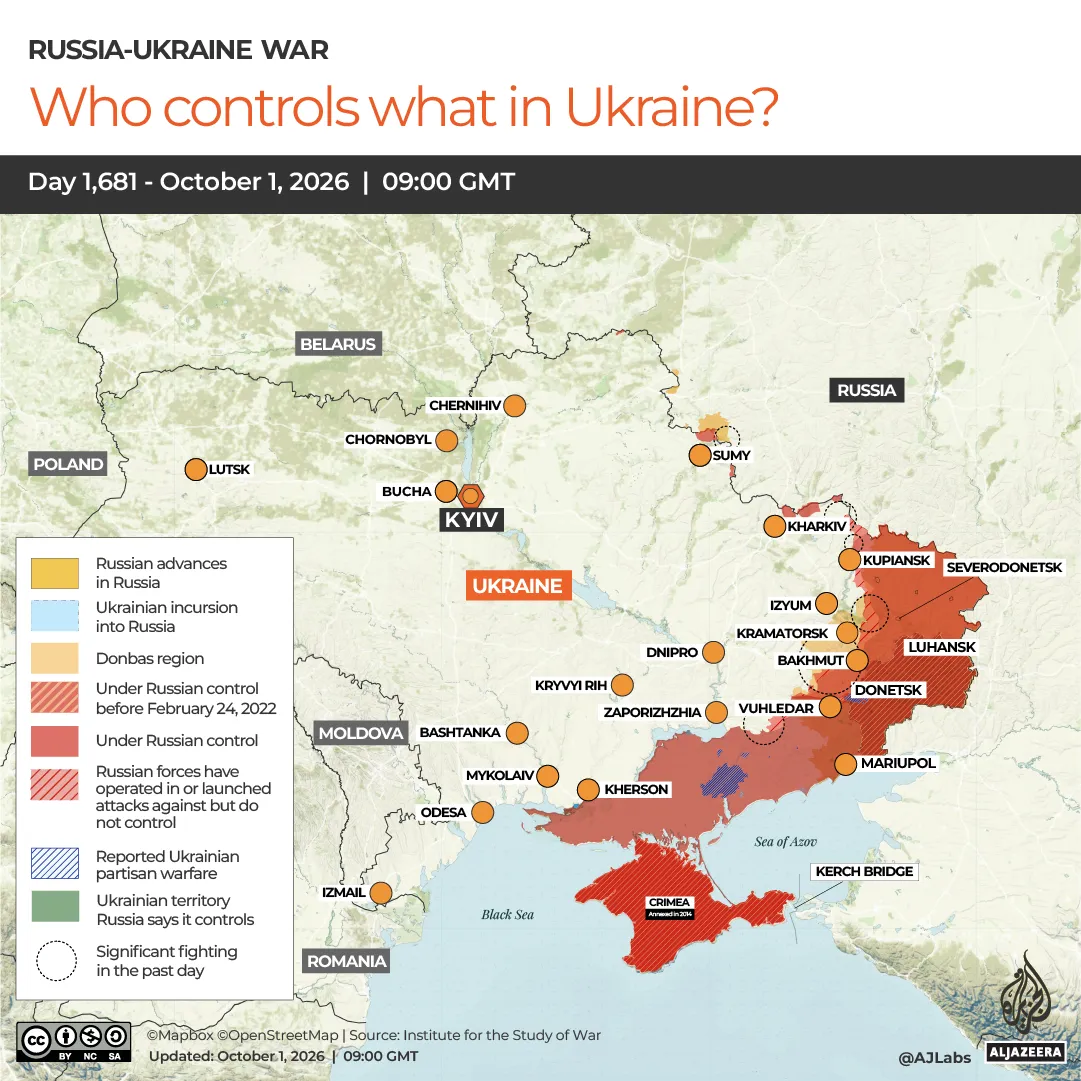
INTERACTIVE-WHO CONTROLS WHAT IN UKRAINE-1776241851
(Al Jazeera)

Ukraine reported a series of Russian attacks on Ukrainian territory overnight, including in Kyiv, Kharkiv, Kherson, Sumy and Zaporizhia regions.

Drones hit a car in the city of Putyvl in Ukraine’s border region of Sumy, injuring three women, as well as two homes in Kyiv’s Brovary district, damaging them and injuring one person, according to Ukrainian officials.

“Tonight, the enemy is again attacking the Kyiv region with drones. Under the sights are peaceful people, homes,” said Kyiv regional military administration head Mykola Kalashnyk.

Russian attacks also damaged railway infrastructure in the northeastern city of Kharkiv, according to the Interfax-Ukraine news agency.

Over the past 24 hours, Russian attacks in the Kherson region killed one person and injured seven, while injuring four others in the Zaporizhia region, Ukrainian officials said.

Moscow’s forces have hit civilian areas almost daily since the all-out invasion of its neighbour more than four years ago, with the regular assaults occasionally punctuated by massive attacks.

More than 15,000 Ukrainian civilians have died in the strikes, according to the United Nations.

There have been several rounds of United States-brokered negotiations in recent months, but they have failed to reach an agreement to stop the fighting, with the process further stalled since the outbreak of the US-Israel war on Iran.

Even before the war on Iran, progress towards a peace deal in Ukraine had been slow, due to differences over territorial issues.

Ukraine has proposed freezing the conflict along current front lines. Russia rejects that, saying it wants the whole of the Donetsk region, despite it being partly controlled by Ukraine – a demand Kyiv says is unacceptable.

Source link

‘Sent to be killed’: How Russia forces migrants to fight in Ukraine | Russia-Ukraine war News

Kharkiv, Ukraine – Hushruzjon Salohidinov, 26, was working as a courier in Saint Petersburg, Russia’s second-largest city and President Vladimir Putin’s hometown.

But last year, the Tajik man and practising Muslim says he was arrested while picking up a parcel which police claimed contained money stolen from elderly women.

Salohidinov says he never interacted with the alleged criminals, but nevertheless spent nine months in the Kresty-2 pre-trial detention centre about 32km (20 miles) from the city, while a judge refused to start his trial because of the “weak evidence” against him.

But instead of releasing him after that, prison wardens threatened to place him in a cell with HIV-infected inmates who, they said, would gang-rape him – unless he “volunteered” to fight in Ukraine.

“They said, ‘Oh, you’ll put on a skirt now, you’ll be raped,’” Salohidinov, who has raven black hair and a messy full beard, told Al Jazeera at a centre for war prisoners in northeastern Ukraine, where he is now being held, having been captured in January this year by Ukrainian forces.

Using a carrot-and-stick tactic, the wardens also promised him a sign-up bonus of 2 million rubles ($26,200), a monthly salary of 200,000 rubles ($2,620) and an amnesty from all convictions.

So, in the autumn of 2025, Salohidinov signed up as he “saw no other way out”.

Officials in Kresty-2, St Petersburg’s prosecutors’ office and Russia’s Ministry of Defence did not respond to any of Al Jazeera’s requests for comment.

Russia migrants
Hushruzjon Salohidinov, 26, a Tajik man forced to fight for Russia, at a prisoner of war facility [Mansur Mirovalev/ Al Jazeera]

‘Catching migrants’

Salohidinov is just one of tens of thousands of labour migrants from Central Asia coerced by Russia to become soldiers as part of the Kremlin’s nationwide campaign, according to human rights groups, media reports and Russian officials.

Hochu Jit, a Ukrainian group that helps Russian soldiers surrender, has published verified lists of thousands of Central Asian soldiers like Salohidinov.

“They are literally sent to be killed, no one considers them soldiers that need to be saved,” the group wrote in a 2025 post on Telegram. These soldiers’ life expectancy on the front line is about four months. “Losses among them are catastrophic,” the group reported.

With its low birthrate and large oil wealth, Russia has for years been a magnet for millions of labour migrants from ex-Soviet Central Asia, especially Tajikistan, Uzbekistan and Kyrgyzstan.

The campaign by the Kremlin to force Central Asians to fight in Ukraine dates back to 2023 – the year after Russia’s invasion of Ukraine – when police began rounding up anyone who didn’t look Slavic and charging them with real or imagined transgressions such as a lack of registration, expired or “fake” permits or blurred stamps on their documents. Sometimes, migrants are simply bused straight to conscription offices.

In 2025, Al Jazeera interviewed another Tajik man who said he had been detained with an expired work permit and was then tortured into “volunteering” while being subjected to countless xenophobic and Islamophobic slurs from his officers.

Migrants say they are abused, tortured and threatened with jail or having their entire families deported.

“The main way of recruiting as many migrants as possible is pressure on them with threats of deportation,” Alisher Ilkhamov, the Uzbekistan-born head of the London-based Central Asia Due Diligence think tank, told Al Jazeera.

Sometimes, migrants are simply duped.

Salohidinov said one serviceman in his squad was an Uzbek who “didn’t speak a word of Russian” and was fooled into “volunteering” while signing papers at a migration centre.

In their reports about “catching” migrants, officials frequently use derogatory terms about them, and also when they describe men who have obtained Russian passports but skipped registration at conscription offices. Since the Soviet era, such registration has been obligatory for all men and, since 2024, a newly naturalised Russian national can lose his citizenship if he fails to do it.

“We’ve caught 80,000 such Russian citizens, who don’t just want to go to the front line, they don’t even want to go to a conscription office,” chief prosecutor Alexander Bastrykin said in May 2025, referring to the migrants’ alleged patriotic sentiments.

He boasted that 20,000 Central Asians with Russian passports were herded to the front line in 2025.

The year before, he said 10,000 Central Asians had been sent to Ukraine.

Such remarks resonate with the Russian public that lives with “a high level of xenophobia in the stage of fear and helplessness,” Sergey Biziyukin, an exiled opposition activist from the western city of Ryazan, told Al Jazeera.

“For them, such phrases from Bastrykin are a form of sedative.”

What makes Central Asians easy targets is that they hail from police states, which depend on Moscow politically and economically, observers say.

“While the migrants are frightened into signing contracts, their motherland doesn’t really pay any attention,” Galiya Ibragimova, an Uzbekistan-born, Moldova-based regional expert, told Al Jazeera.

Despite hefty signup bonuses and relentless propaganda, the number of Russians who want to fight in Ukraine fell by at least one-fifth this year, and Moscow will strive to recruit more Central Asians, she said.

Russia conscripts
Russian conscripts called up for military service attend a ceremony marking their departure for garrisons from a recruitment centre in Saint Petersburg, Russia, on October 15, 2025 [Anton Vaganov/Reuters]

‘We’ll have our fingers broken’

After signing the contract and leaving his debit card with his sign-up bonus with his parents, Salohidinov was sent to the western city of Voronezh for three weeks of training that did little to prepare him for the war.

“We just kept running back and forth with guns,” he said.

Their drill sergeants, he says, told the conscripts that the standard-issue flak jackets, helmets, boots and flashlights were of subpar quality and urged them to pitch in a million rubles ($13,100) each for “better” gear.

The incident corroborates reports on dozens of similar cases in Russian military units.

Salohidinov was ordered to work in a kitchen – and was verbally abused and beaten for the slightest transgression.

Of 28 men in his unit, 21 were Muslims – but their ethnic Russian officers ignored their pleas not to have pork in meals, repeating a decades-old practice of ignoring religion-related dietary restrictions dating back to the Soviet army.

The commanders demonised Ukrainians, telling them “that if we surrender, we’d be tortured, have our fingers broken, maimed, get [construction] foam up our a**, have our teeth yanked out one by one, have our arms broken”, Salohidinov says.

In early January this year, the conscripts were bused to the Russia-occupied Ukrainian region of Luhansk.

Salohidinov says he was tired, frightened and disoriented – Ukrainian drones were “always” above them and a grenade explosion nearby damaged his left eardrum.

Ukraine prisoner swap
A woman waits for news about a missing loved one as some Ukrainian soldiers return during a prisoner of war (POW) swap, amid Russia’s attacks on Ukraine, in an undisclosed location in Ukraine, on April 11, 2026 [Thomas Peter/Reuters]

‘Glad I got captured’

On the fourth day of his service, Salohidinov was ordered to run beyond Ukrainian positions as part of Russia’s new tactic to send two or three servicemen to infiltrate the porous front line.

The mission was suicidal because the terrain was open, dotted with landmines and the bodies of dead Russian soldiers, while Ukrainians were firing machineguns and flew drones above them.

“I ran and ran and saw we were being shot at,” he said. “Me and my commander decided to surrender voluntarily instead of dying for nothing.”

They detached their assault rifles’ magazines, raised their hands and yelled they were surrendering.

What followed was “a calm feeling, beautiful”, he said. “They fed us, let us have a smoke, gave us food and water and even cake.”

Now, Salohidinov hopes to return to Tajikistan and panics at the thought of being made part of a prisoner swap – these have taken place several times each year – and returning to Russia because he would be sent back to the front line.

Tajikistan and other Central Asian nations have never endorsed Russia’s war in Ukraine, but nor have they openly criticised it.

In August 2025, Tajikistan’s Prosecutor General Habibullo Vohidzoda declared that no Tajik national would be charged for fighting in Ukraine.

So, what Salohidinov needs right now is an extradition request.

“I’m even glad that I got captured, because I’m not fighting anyone now, not risking anything,” he said. “I’ll even say thanks to Ukraine for taking me prisoner.”

The Tajik embassy in Kyiv did not respond to Al Jazeera’s request for comment.

Source link

Russian attack on Ukraine’s Kyiv kills 12-year-old child, wounds 10 | Russia-Ukraine war News

BREAKING,

Kyiv’s mayor says the attacks hit Podilskyi and Obolonsky districts, causing large fires and damage to residential buildings.

Russian forces have bombed the Ukrainian capital, Kyiv, killing a 12-year-old child and wounding at least 10 people, including several doctors, according to the city’s mayor.

The child was killed early on Thursday in Kyiv’s Podilskyi district, where rocket fragments hit a 16-storey building and caused a fire at a residential building, Mayor Vitaliy Klitschko wrote in a post on Telegram.

Recommended Stories

list of 4 itemsend of list

He said rescuers have pulled another child and her mother were pulled from the rubble in Podilskyi.

The attack also hit Kyiv’s Obolonsky district, with falling rocket debris causing a large fire at a non-residential building. “Cars are also on fire,” Klitschko wrote.

More soon…

Source link

Russia suffers ‘record’ soldier casualties as Ukraine ups drone production | Russia-Ukraine war News

The casualty rate for Russian soldiers in Ukraine increased to a new monthly high in March, according to Ukraine’s armed forces. They say drone production enabled a record number of strikes.

Ukraine tallied Russian casualties at 35,351 last month, with drones causing 96 per cent of them while artillery and small arms fire accounted for the rest. That casualty rate was a 29 per cent increase on February, said Ukraine’s commander in chief.

“These are clearly confirmed losses: we have video footage of each such strike in our system,” said Ukrainian Defence Minister Mykhailo Fedorov.

The losses are slightly above a previous record set in December, and appear to confirm Ukraine’s claim that Russian casualty rates are rising inexorably this year. Ukrainian Presidential Office Deputy Head Colonel Pavlo Palisa told RBC-Ukraine that Russia had suffered 316 casualties for every square kilometre it captured in the first three months of 2026, compared with 120 casualties per square kilometre last year.

Ukraine’s defence ministry said Russia has been unable to replace all of the losses since December. Russia aimed to recruit 409,000 contract soldiers this year, Ukraine’s armed forces said in January.

That means a daily average recruitment rate of 1,120. But Ukraine’s “I Want to Live” initiative, which provides communication channels for Russian soldiers wishing to surrender, said Russia recruited 940 troops a day in the first quarter.

If sustained, that meant Russian recruitment was on track for a 65,000-man shortfall this year. Ukraine now sees manpower shortages as a Russian strategic weakness it can exploit. President Volodymyr Zelenskyy, set a goal of 50,000 Russian casualties a month in January, which he called the “optimal level” to ensure Russian forces weaken irrecoverably.

“We are confidently moving towards our strategic goal – 50,000+ eliminated occupiers per month,” said the Ukrainian defence ministry.

The territory Russia is capturing for its mounting losses is also in long-term decline, according to estimates by the Institute for the Study of War, a Washington-based think tank. Russian forces captured an average of 5.5sq km a day this year, compared to 10.66sq km a day in the middle of last year and 14.9sq km a day at the end of 2024, said the ISW.

Zelenskyy said the stark reality of manpower weakness lay behind Russian President Vladimir Putin’s ceasefire demand that Ukraine hand over the heavily fortified quarter of the eastern Donetsk region it held last August.

“They believe that if we retreat, they won’t lose hundreds of thousands of people,” Zelenskyy told the Associated Press in an interview this week.

Drones are the key

Ukrainian officials credit drone production and training for their armed forces’ growing lethality. Commander-in-Chief Oleksandr Syrskii said the armed forces struck 151,207 targets in March using drones, a 50 per cent increase on February. That’s the result of 11,000 drone sorties a day.

“This is all a historical maximum,” Syrskii said.

Palisa said that’s because Ukraine’s drone manufacturing had managed to outpace Russia’s to achieve a 1.3:1 overall ratio in First Person View drones on the frontlines.

Other reports suggested Ukraine was raising drone production. Fedorov said Ukrainian interceptor drones shot down a record 33,000 Russian UAVs of various types in March – twice as many as in the previous month.

His deputy, Serhii “Flash” Beskrestnov said he was working with interceptor drone manufacturers to develop the next generation of interceptors capable of flying at 400-550km/h to counter the jet-powered Shahed drones to which Russia was gradually converting.

Fire Point, Ukraine’s biggest manufacturer of long-range drones used in the majority of strikes deep inside Russia, told Reuters that it had designed two ballistic missiles of 300km and 850km range, which were approaching the deployment stage.

The longer-range type is capable of reaching Moscow.

Ukraine gains defensive ‘strategic initiative’

Syrskii thinks that Ukraine’s forces, although still ceding small amounts of territory, have now gained “the strategic initiative” because they “do not allow Russian troops to resume a large-scale offensive.”

He said an increase in mid-range strikes against logistics, warehouses, command posts and oil depots 30-120 km into the Russian rear had been particularly effective in hamstringing Russian assaults – one of the top operational priorities.

Syrskii said on April 5 that fighting was most intense in Dnipropetrovsk, where Ukraine’s forces have recaptured eight settlements and 480sq km of territory.

Ukraine’s leadership has long believed that Russia harbours territorial ambitions to seize the Odesa and Mykolaiv regions to control Ukraine’s entire Black Sea coastline, and to carve out a buffer zone across northern Ukraine.

Palisa told RBK-Ukraine on April 8 that Russia also planned to create a southern buffer zone in Ukraine’s southwestern Vinnytsia region next to Moldova’s Russian-speaking territory of Transnistria.

That was the first time a Ukrainian official has suggested such an ambition. “I am 100 per cent convinced that the Russians want to completely occupy us,” Zelenskyy told the AP.

Source link

Russia and Ukraine agree to 32-hour Orthodox Easter ceasefire | Russia-Ukraine war News

Moscow and Kyiv signal a short Easter truce as diplomacy stalls and war pressures mount.

Russia’s President Vladimir Putin has announced a 32-hour ceasefire for Orthodox Easter, with President Volodymyr Zelenskyy confirming that Ukraine will honour it.

The Kremlin said on Thursday that the pause in fighting will begin at 4pm Moscow time (13:00GMT) on Saturday and run until midnight on Sunday, covering Easter celebrations observed in both countries.

Recommended Stories

list of 3 itemsend of list

“We proceed on the basis that the Ukrainian side will follow the example of the Russian Federation,” the Kremlin said in a statement.

It added that Defence Minister Andrei Belousov had instructed Chief of the General Staff Valery Gerasimov to halt military operations during the period. Russian forces, however, would remain ready to respond to any violations.

Zelenskyy said Ukraine had already proposed a similar pause and would act in kind.

“Ukraine has repeatedly stated that we are ready for reciprocal steps. We proposed a ceasefire during the Easter holiday this year and will act accordingly,” he wrote on Telegram.

“People need an Easter without threats and a real move towards peace, and Russia has a chance not to return to attacks even after Easter.”

Hours after the announcement, the governor of Dnipropetrovsk region said Russian artillery and aerial attacks had killed two people.

“The enemy attacked three districts of the region almost 30 times with drones and artillery,” Oleksandr Ganzha said on Telegram on Friday.

This weekend’s planned ceasefire echoes a similar, short-lived pause declared by Moscow last year, which both sides accused each other of breaching.

The ceasefire comes as wider diplomatic efforts to end the war remain stalled, with attention in Washington shifting towards escalating tensions in the Middle East.

Difficult months ahead

Kremlin spokesman Dmitry Peskov said Moscow had not discussed the Easter proposal in advance with the United States, nor did it signal any immediate revival of three-way peace talks.

Despite the limited pause, humanitarian channels between the two sides remain active. Speaking from Moscow, Al Jazeera’s Yulia Shapovalova said Russia and Ukraine recently carried out another exchange of soldiers’ remains.

“Moscow handed over the remains of 1,000 Ukrainian soldiers to Kiev in exchange for 41 bodies of the Russians,” she said.

“More than 500 bodies of Russian servicemen have been returned this year during these regular exchanges and over 19,000 bodies of Ukrainian soldiers have been returned to Kiev,” she added.

These exchanges, often mediated by Turkiye, remain one of the few functioning lines of communication between the warring sides, alongside periodic prisoner swaps.

Zelenskyy has repeatedly pushed for temporary ceasefires, including a halt to attacks on energy infrastructure, but said Moscow had largely rejected proposals. He added that Ukraine now faces growing pressure, both on the battlefield and from international partners.

“This spring–summer period will be quite difficult politically and diplomatically. There may be pressure on Ukraine,” Zelenskyy said. “There will also be pressure on the battlefield.”

He warned that the coming months could prove decisive, as Kyiv confronts both sustained Russian attacks and shifting geopolitical priorities among its allies.

“I believe it will be very difficult for us until September.”

Source link

Ukraine strikes Russian Black Sea energy hub Novorossiysk | Russia-Ukraine war News

Ukraine has increased attacks on Russian energy infrastructure in bid to disrupt financing of its war.

The Ukrainian military reported that it has struck a Russian ⁠warship and ‌a drilling rig in the Black Sea.

Kyiv’s drone forces ⁠commander Robert Brovdi said on Monday that the attack targeted ⁠the Admiral Makarov missile carrier in ⁠the port of Novorossiysk, which is Russia’s largest oil exporting outlet on the Black Sea. Ukraine has increased its attacks on Russian energy infrastructure in a bid to disrupt export revenues that feed into Moscow’s war chest.

Recommended Stories

list of 3 itemsend of list

Russian authorities said at least eight people, including two children, were injured in Novorossiysk, without specifying whether the port was struck.

Videos posted on Telegram and verified by Al Jazeera’s verification unit showed a fire at one of the oil port’s docks in the city.

Novorossiysk’s Mayor Andrei Kravchenko said debris from drones had fallen on two locations in the city, including a residential area.

Russia’s military said in the early morning that air defence units had downed 148 Ukrainian drones over a three-hour period. It added that officials said emergency crews were restoring power to nearly half a million households in ⁠outages linked to air attacks.

Attack on Russian ship
Ukraine has concentrated drone attacks around the port of Novorossiysk throughout the war, but has raised its efforts to halt Russian energy exports recently (File: Reuters)

The area of the port of Novorossiysk is also a location for the Caspian Pipeline Consortium’s (CPC) terminal, which exports oil from Kazakhstan and whose shareholders include US majors such as Chevron and ExxonMobil.

Ukraine has significantly intensified attacks on Russia’s energy facilities, including the largest oil exporting hubs ‌both on the Baltic and Black Seas, as it seeks to reduce Moscow’s revenues from the sales of oil, the lifeblood of its economy.

The Kremlin has attempted to boost its exports after US President Donald Trump gave it a temporary waiver from sanctions to ease supply constraints, as the US-Israeli war on Iran upends oil markets following the effective closure of the Strait of Hormuz.

Kyiv officials complain that Russia will use the additional revenue on new weapons to hit Ukraine harder.

Later on Monday, Russia reported that Ukrainian drones had attacked the CPC terminal. The export facility, which handles 1.5 percent of global oil supply, reported damage to mooring, loading, and storage infrastructure, the Reuters news agency reported.

“The Kyiv regime deliberately attacked facilities of the international oil transportation company Caspian Pipeline Consortium in order to inflict maximum economic damage on ⁠its largest shareholders – energy companies from the United States and Kazakhstan,” ⁠the defence ministry said in a statement.

The Black Sea strikes come a day after Ukrainian drones struck Russia’s Baltic Sea port of Primorsk – one of Russia’s main oil exporting outlets – and the NORSI oil refinery in the central Nizhny Novgorod region.

Alexander Drozdenko, governor of Russia’s northwestern Leningrad region, said a fuel reservoir in the Primorsk port area leaked when it was hit by shrapnel.

Ukrainian drones also repeatedly struck ⁠Russia’s Baltic Sea port of Ust-Luga last month, damaging several buildings in the sprawling ⁠complex of oil-processing facilities and export terminals.

epa12734232 Ukrainian people survey the site of the overnight Russian attack on the residential area in Odesa, Ukraine, 13 February 2026, amid the ongoing Russian invasion. At least one person was killed, and six others were injured during the Russian attack in Odesa, according to the State Emergency Service. EPA/IGOR MASLOV 110091
Odesa has been targeted numerous times by Russian strikes (EPA)

In Ukraine, a Russian overnight drone attack on the southern port city of Odesa on Monday killed two women and a toddler, authorities said.

Ukrainian President Volodymyr Zelenskyy said in a post on X that 16 people were wounded, including a pregnant woman and two children.

Russia’s overnight strikes also hit energy infrastructure in the Chernihiv, Sumy, Kharkiv and Dnipro regions, Zelenskyy said.

More than 300,000 households were without electricity in the northern Chernihiv region after distribution facilities were damaged in attacks, according to the regional power utility.

The Ukrainian leader said that over the past week, Russia launched at Ukraine more than 2,800 attack drones, nearly 1,350 powerful glide bombs and more than 40 missiles of various types.

Source link

At least four people killed in Russian attacks on Ukraine | Russia-Ukraine war News

Russian air attacks on northeast Ukraine over the past 24 hours have killed at least four people and injured 11 others, according to Oleh Syniehubov, Kharkiv’s regional governor.

Syniehubov said on Saturday that the attacks targeted the city of Kharkiv and 11 other towns and villages.

Recommended Stories

list of 3 itemsend of list

Also in northeastern Ukraine, at least 11 people, including a child, were injured after a Russian drone struck a building in the region of Sumy in an overnight attack.

“Attack drones struck a 16-storey building and a private residential area [in the region of Sumy]. Residents of the burning high-rise were promptly evacuated … The fire has been extinguished,” the State Emergency Service of Ukraine’s press office said in a statement.

“Law enforcement officers are documenting the aftermath of the shelling, recording the damage and gathering evidence of war crimes,” reported Russia’s Interfax news agency.

The Ukrainian Air Force said that the defence forces had “shot down or neutralised” 260 of 286 Russian drones fired towards the “north, south, east and centre of the country” in overnight attacks.

It added that 11 drones “were recorded striking 10 locations” with debris from the downed drones found at “six locations”.

Meanwhile in Russia, at least one person was killed and four others injured in drone and missile attacks in its southern Rostov region, according to its governor.

The overnight attack took place in the port city of Taganrog, Rostov Governor Yury Slyusar said on Telegram.

Slyusar said that the injured people – three of whom were Russians and one foreign national – were in “critical condition”.

A missile also struck a “commercial facility”, said Slyusar, causing a fire to break out on the premises. People were evacuated and the fire was brought under control, he said.

Separately, falling drone debris hit a foreign-flagged cargo vessel in the Sea of Azov, causing a fire, while air defences destroyed drones over Taganrog Bay and other districts, said Slyusar, who did not specify the origin of the attacks.

The Sea of Azov, an economic lifeline connecting Russia and Ukraine, acts as a key shipping route for industrial cargo.

Stalled diplomacy

Diplomatic efforts to end Russia’s full-scale war on Ukraine that started in February 2022 continue to stall.

The United States, Russia and Ukraine have held three rounds of high-level, trilateral talks in the United Arab Emirates’ Abu Dhabi and Switzerland’s Geneva this year in a bid to negotiate an end to the war.

A fourth round of talks due to take place last month was postponed due to the US-Israel war on Iran, with no progress on the vital question of territory in eastern Ukraine.

Ukrainian President Volodymyr Zelenskyy had proposed an Easter truce, which Russia’s foreign ministry had rejected, dismissing it as a “PR stunt”.

As its price for peace, Russia is insisting that Ukraine cede the fifth of the eastern area of Donbas that it has been unable to conquer during four years of war, with Zelenskyy refusing to countenance the prospect, which in any case goes against the country’s constitution.

Kyiv believes it can keep defending its remaining “fortress belt” of industrial towns and cities in the Donbas for years, citing the glacial pace of Russia’s front-line advances since 2023 as its soldiers run into a defensive wall of Ukrainian drones.

Source link

Zelenskyy arrives in Jordan to bolster security ties | Russia-Ukraine war News

The Ukrainian leader’s visit comes after Kyiv agreed to cooperate on defence with Qatar, Saudi Arabia and the United Arab Emirates. 

Ukrainian President Volodymyr Zelenskyy has arrived in Jordan as he continues his tour to bolster defence ties in the Gulf amid the ongoing United States and Israeli war on Iran.

Zelenskyy announced his arrival in a post on X on Sunday and stated that an “important meeting” was going to take place.

Recommended Stories

list of 3 itemsend of list

“Today in Jordan. Security is the top priority, and it is important that all partners make the necessary efforts toward it,” Zelenskyy said.

The Ukrainian president has been seeking support from the Gulf states as the Russia-Ukraine war continues, with no end in sight. More than four years since Russia launched a full-scale invasion, Kyiv is struggling to cover its budget deficit and fund domestic weapons production.


Still, Ukraine has intensified retaliatory attacks on Russian infrastructure, including refineries, oil depots and ports, arguing that they were justified targets to sever revenues funding Russia’s offensive.

On Sunday, a drone strike that Ukraine claimed triggered a fire at Russia’s Baltic port of Ust-Luga, which was hit for the second time in several days.

According to the Russian regional governor, Alexander Drozdenko, damage was sustained at the port, the fire is now under control, and there were no casualties from the attack.

He added that 36 drones were destroyed overnight in the region.

But Zelenskyy’s visit comes after Ukraine has agreed to cooperate on defence with Qatar, Saudi Arabia and the United Arab Emirates.

Kyiv’s anti-drone experts have also been deployed to all three countries as Iran targets infrastructure there using drones that Russia has also used during its war with Ukraine.

A senior Ukrainian official told the AFP news agency, on condition of anonymity, that a Ukrainian team is also in Jordan, without elaborating.

In repelling the drones, Ukraine uses a mix of cheap drone interceptors, electronic jamming tools, and anti-aircraft guns.

Source link

How extensive is Russia’s military aid to Iran? | US-Israel war on Iran News

“A bit” is what United States President Donald Trump thinks about the scale of Russia’s military aid to Iran.

Moscow “might be helping them a bit”, he told Fox News on March 13.

A day later, Iran’s Foreign Minister Abbas Araghchi stated laconically that Moscow’s military cooperation with Tehran was “good”.

His words seemed to confirm earlier media reports that Russia is providing Iran with satellite and intelligence data on the locations of US warships and aircraft.

It may not sound like much, given the superiority of Western military satellites and Russia’s battlefield losses and communication problems after Elon Musk’s SpaceX company switched off smuggled Starlink satellite Internet terminals.

But data on US military assets Iran is receiving most likely comes from Liana, Moscow’s only fully functional system of spy satellites, according to an expert on Russia’s space programme and military.

“The [Liana] system has been created to spy on US carrier strike groups and other navy forces and for identifying them as targets,” Pavel Luzin, a senior fellow at the Jamestown Foundation, a US think tank, told Al Jazeera.

Eyes in the sky

Russia also played a key role in the development of Iran’s space programme and its key satellite, the Khayyam.

Launched in 2022 from Russia’s Baikonur cosmodrome, the 650kg (1,430 pound) satellite orbits the Earth at 500 kilometres (310 miles) and has a resolution of one metre (3.3 feet).

Moscow “can, in theory, receive and process data from Iran’s optical imaging satellite and share data from its own several satellites”, Luzin said.

On Wednesday, Tehran claimed to have struck the Abraham Lincoln carrier with multiple cruise and ballistic missiles, but the Pentagon called the claim “pure fiction”.

On Sunday, Iranian media claimed that a “massive blaze” was caused by a strike on a US destroyer refuelling in the Indian Ocean.

Washington did not comment on that strike.

Russia has, for decades, supplied weaponry to Iran, including advanced air defence systems, trainer and fighter jets, helicopters, armoured vehicles and sniper rifles, worth billions of dollars.

Since Washington and Tel Aviv began their strikes on February 28, Russia has continued aiding Iran with “intelligence, data, experts and components” for weaponry, Lieutenant General Ihor Romanenko, former deputy chief of Ukraine’s general staff of armed forces, told Al Jazeera.

While Moscow and Tehran loudly proclaim their strategic partnership, they do not have a mutual defence clause, and Moscow has not intervened in the conflict directly.

But the arms supplies have been mutual. Since Russia’s 2022 invasion of Ukraine, Tehran has provided Moscow with ammunition and artillery shells, firearms and short-range ballistic missiles, helmets and flak jackets.

Cyprus
Flashes appear in the sky over RAF Akrotiri, as seen from Pissouri, Limassol District, Cyprus, in this screengrab taken from a handout video obtained on March 2, 2026 [KitasWeather/Handout via Reuters]

Drones with ‘comets’

And then there are the Shahed kamikaze drones – slow, noisy, yet cheap to manufacture – which have been launched on Ukrainian cities in swarms of dozens and then hundreds. Ukraine became so adept at bringing these down – now mass-producing cheap interceptor systems specifically to target Shaheds – that it is now providing its own know-how to Gulf states where US military assets have come under fire from Iran in recent weeks.

In the course of its war with Ukraine, Moscow has manufactured and modernised Shaheds, making them faster and deadlier, and equipping them with cameras, navigators and, occasionally, artificial intelligence modules.

And now, some of the upgrades have made their way back to Iran.

A Shahed drone with a pivotal Russian component launched by Iran-backed Hezbollah from southern Lebanon was able to hit a British airbase on Cyprus on March 1, the UK’s Times newspaper reported on March 7.

It reportedly contained Kometa-B (Comet B), a Russian-made satellite navigation module that also acts as an anti-jamming shield, making drones more resistant to interference.

Russia has also perfected the tactic of sending waves of real and decoy drones to exhaust and overwhelm Western-supplied air defence systems in Ukraine.

These days, the scheme helps Iran hit targets in the Gulf, Western officials say.

“I think no one will be surprised to believe that Putin’s hidden hand is behind some of the Iranian tactics and potentially some of their capabilities as well,” British Defence Secretary John Healey said on March 12 after Iranian drones struck a base used by Western forces in Erbil, northern Iraq.

However, if Iran is suffering a shortage of drones – as some analysts believe it is – that would render the use of Russian tactics, as well as Russia-supplied satellite data useless, experts say.

“Russia does supply data, it’s obvious, the data helps Iran, but not much,” Nikita Smagin, a Russian expert who has written extensively on ties between Moscow and Tehran, told Al Jazeera.

After four days of intensive strikes using up to 250 drones a day in early March, Iran has been launching only up to 50 drones a day, according to Nikolay Mitrokhin, a researcher with Germany’s Bremen University.

“Iran ran out of steam really fast,” he told Al Jazeera.

Interactive_Shahed_Lucas_Drone_March26_2026
[Al Jazeera]

‘A goodwill gesture’

Moreover, Moscow is not necessarily particularly interested in an Iranian military victory, as the war is benefitting Russian President Vladimir Putin’s own conflict in Ukraine.

Skyrocketing oil prices make “Putin financially capable of further hostilities,” Lieutenant General Romanenko said.

As Iran strangles shipping through the Strait of Hormuz, the price of Brent crude – the international benchmark – has soared past $100 a barrel in the past three weeks. US President Donald Trump was forced to temporarily suspend sanctions on shipped Russian oil to ease the economic backlash. The result has been tankers laden with Russian oil bound for China making U-turns in the open ocean to divert to India, as countries scramble to grab Russian oil cargoes out at sea. The price of Urals crude has bounced.

Putin “hasn’t achieved his goals in Ukraine and will therefore use anything, including the war [in Iran] and lies to achieve his vision, press with his ultimatums,” Romanenko said.

The Kremlin “doesn’t pursue a breakthrough in this war, doesn’t help Iran break the United States and Israel,” Ruslan Suleymanov, an associate fellow at the New Eurasian Strategies Center, a US-British think tank, told Al Jazeera.

The current intelligence and military aid is “more of a goodwill gesture, an attempt to create an illusion of help, to show Tehran that despite the lack of formal commitments, Russia doesn’t leave its friend in need”, he said.

And Tehran fully understands how insufficient Moscow’s aid is – and therefore relies on its own stratagem of expanding hostilities to the entire region through strikes on neighbouring states and of crippling the global economy with soaring oil prices.

“Iranians understand that the forces are not equal and it’s impossible to defeat the United States and Israel on the battlefield, and no Russian aid is going to help,” he said.

It seems that Trump’s assessment that Moscow “might be helping them a bit” may not be too far wide of the mark.

Source link