Rushing

Dodgers’ Shohei Ohtani wins duel vs. Twins’ Joe Ryan despite cross-up with Dalton Rushing

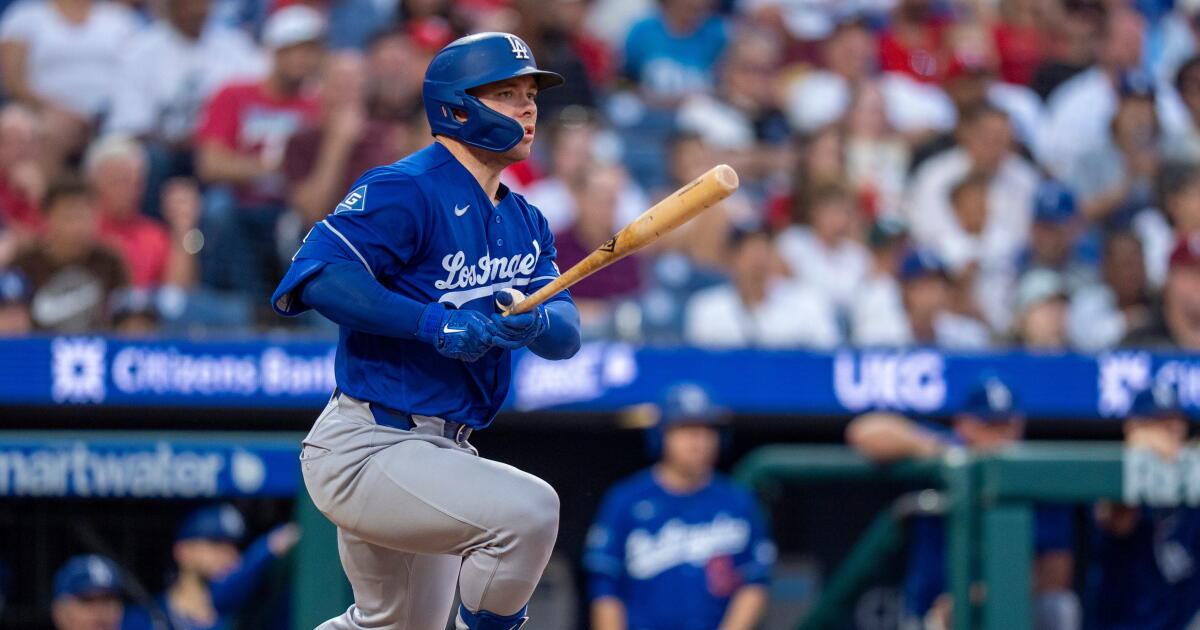
The series finale between the Dodgers and Minnesota Twins featured a marquee pitching matchup between Shohei Ohtani and Joe Ryan. But the Dodgers’ 4-3 win on Wednesday wasn’t quite the pitcher’s duel it was advertised to be, in front of the Twins’ first sellout crowd of the season at Target Field.

The Dodgers offense had eight hits against Ryan, tied for the second-most he’s allowed in a start this season, and four runs in six innings. And Ohtani gave up three runs (two earned) and five hits.

Ryan won the first battle — the one against Ohtani the hitter to lead off the first inning.

Ohtani roped a first-pitch fastball to right field, clocking an exit velocity of 110.7-mph, into the glove of Twins outfielder Kody Clemens. That was part of a three-up, three-down first inning for Ryan. Ohtani countered with a hitless first inning of his own on the mound, but with a walk.

In the top of the second, Mookie Betts’ solo homer gave the Dodgers (52-29) an early lead. The 300th home run of Betts’ career was part of a three-hit day for the shortstop, a triple shy of the cycle.

The Twins’ offense responded.

Their first run was the result of a passed ball. Ohtani gave up singles to three of the first four batters he faced in the second inning, to load the bases. Then, Ohtani threw a first-pitch fastball inside to Ryan Kreidler. It got past catcher Dalton Rushing, who seemed to expect a different pitch, and the ball rolled out of play to tie the score.

Rushing, in his first game back in the lineup after being removed Monday to rule out a concussion, huddled with Ohtani and pitching coach Mark Prior on the mound to debrief.

Ohtani then gave up a two-run single to Kreidler before striking out Trevor Larnach to end the inning.

It was a good thing Ohtani, who went 2-for-5 on Wednesday, had lobbied to hit and pitch. Dodgers No. 9 hitter Alex Freeland led off the third with a double. Then Ohtani sent a ground ball up the middle to give himself some run support.

That started a three-run rally for the Dodgers. Max Muncy later drove in Ohtani, and Alex Call contributed a sacrifice fly to give the Dodgers a lead again.

Twins left-hander Anthony Banda, who received his World Series ring Monday from a gaggle of his former teammates, took over for Ryan in the seventh.

Ohtani was the first hitter he faced. And Banda struck him out on a fastball that barely clipped the outside corner — and was initially called a ball, before a successful ABS challenge by Twins catcher Victor Caratini.

Banda then hit Andy Pages with a pitch and gave up a single to Freeman. But he escaped unscathed, stranding them at the corners.

The Twins threatened in the seventh and eighth, but Dodgers right-hander Kyle Hurt overcame a pair of walks, and left-hander Alex Vesia navigated a pair of singles to hold the score. Closer Tanner Scott secured the save.

Source link

Dodgers game to start 30 minutes late; give updates on Kyle Tucker and Dalton Rushing

Dodgers manager Dave Roberts is planning for right fielder Kyle Tucker to be out for the rest of the series against the Minnesota Twins, after he left Monday’s game with low back spasms.

Roberts hopes to write Tucker into the lineup Friday, when the Dodgers open a three-game series in San Diego, after three days off, plus most of the game Monday.

“Hopefully he [can take] advantage of this, obviously to get right, but also kind of a mental reset,” Roberts said. “Hopefully the four days will suffice.”

Tucker, who said he felt a little better Tuesday but still sore, especially when rotating, is “pretty confident” that he’ll be able to avoid the injured list. And if he can take swings on Wednesday, he’ll probably be on track for that Friday return.

“But if he doesn’t, then we’ll have probably a tougher decision on Friday,” Roberts said.

Tucker, who has a .707 on-base-plus-slugging-percentage this season, has had a slow offensive start to his Dodgers’ tenure. He wasn’t ready to make any declarations about the potential benefits of time off to reset.

“Maybe,” he said. “We’ll see after I get back. We’ll see how that goes.”

The news on catcher Dalton Rushing, who exited Monday’s game to rule out a concussion, was more straightforward.

Rushing hadn’t yet gone through the second round of concussion testing needed to clear him to play when Roberts addressed the media Tuesday afternoon. But Rushing had told Roberts he was ready to play.

“That doesn’t carry too much weight until I hear from the medical staff,” Roberts said. “But it is good to know that he said he’s good to go. My hope is that he’ll be available off the bench in some capacity.”

As a downpour hammered the tarped field early Tuesday evening, it was unclear when exactly the Dodgers would be playing. But despite plenty of rain in the forecast Tuesday evening, the teams and Major League Baseball identified a window for the game.

The Twins announced an estimated 5:05 p.m. PDT first pitch, representing a 25-minute rain delay.

Source link

Dodgers’ Kyle Tucker (back spasms), Dalton Rushing exit game

Dodgers right fielder Kyle Tucker exited the game against the Minnesota Twins on Monday in the top of the second inning because of lower back spams, the team announced.

He drew a walk in the second inning, advanced to second on Tommy Edman’s single and was replaced by pinch-runner Alex Call soon after.

Tucker jogged off the field into the dugout, his hand on his right side as he talked to hitting coach Aaron Bates.

Tucker, in his first season with the Dodgers after signing a four-year deal worth $240 million this winter, entered Monday with a .705 on-base-plus-slugging percentage, on pace for his worst offensive year by that measure since his 2018 rookie season with the Houston Astros.

Tucker recently went nine games with a .303 batting average. But then he went hitless in the Dodgers’ two losses to the Baltimore Orioles last weekend.

“If we can get him back to being who he is, then we’ll bet on the results,” manager Dave Roberts said before the game, noting Tucker’s reputation for controlling the strike zone. “It’s not something that we might see tonight. But I think going here forward, that’s something that I think we’re going to see.”

Rushing exits too

Catcher Dalton Rushing was replaced behind the plate by Chuckie Robinson in the bottom of the third inning so the team could check Rushing for a possible concussion.

The Dodgers did not point to a cause for the concern, but Rushing did take a foul tip off his mask on Will Klein’s first pitch of the game.

The Dodgers already were down one catcher. Starter Will Smith has been sidelined for more than two weeks because of a neck injury. He did not travel with the team to Minnesota.

Source link

Dalton Rushing helps cap Dodgers’ wild walk-off win over Orioles

Dalton Rushing was frustrated. He just chased a slider in the dirt — again. And this time, the game was on the line. The Dodgers were down to their last out. He was down to his last strike.

So he took a moment, took a breath, and looked to the Dodgers dugout.

The first person he spotted was Mookie Betts, who had just cut the Orioles’ lead to a run with a solo homer. Betts was locked in with Rushing, brimming with confidence, cheering him on.

“For a guy like that, a guy that’s lived in that moment, he’s succeeded in that moment, he’s failed in that moment, he knows what it feels like, it’s pretty special,” Rushing recounted.

Rushing’s eyes traveled along the railing, noting his teammates all on the top step, all relying on him.

He dug into the box, expecting the slider that Baltimore’s Ryan Helsley threw next — it was high, for a ball. Then Rushing got a fastball he could drive. And he did not miss.

The next moments in the Dodgers’ 6-5 walk-off win Friday were chaos.

Rushing lined a tying single into right field, giving Alex Call time to score from second. Call slid across the plate as the throw from Orioles right fielder Tyler O’Neill took for a long hop to catcher Samuel Basallo.

Basallo misjudged it, taking an unhurried shuffle up the line, before the ball glanced off his glove and rolled toward the Dodgers dugout.

Third base coach Dino Ebel waved home Ryan Ward, who scored standing up.

Manager Dave Roberts, who looked down at his card when the throw was in the air, was already thinking through extra innings when the crowd erupted again. He heard field coordinator Bob Geren shouting something like, “The run counts.”

The Dodgers (49-27) ran onto the field and swarmed Rushing, who had just reached second. They jumped and yelled as the Dodgers Stadium lights flashed around them.

“It was good to get Freddie [Freeman] a night off for being the guy in the middle for a change, you know?” Rushing said with a grin. “No, it’s a great feeling, and I think it honestly just feels great that we won that baseball game.”

For several innings, it looked like they wouldn’t.

Dalton Rushing celebrates after hitting a run-scoring single in the ninth inning.

Dalton Rushing celebrates after hitting a run-scoring single in the ninth to help lift the Dodgers to a 6-5 walk-off win over the Baltimore Orioles at Dodger Stadium.

(Gina Ferazzi / Los Angeles Times)

The Dodgers had jumped out to an early 3-0 lead, on a two-run single from Max Muncy in the first inning and an RBI double from Andy Pages in the second. Then their scoring dried up.

Rushing was having as frustrating of a night as anyone, with a line out and three strikeouts.

His first strikeout was part of a brutal sequence. The Dodgers loaded the bases with no outs in the third. Then Ward, Rushing and Alex Freeland, all went down swinging.

Rushing struck out on a slider in the dirt. And Orioles starter Trey Gibson got him to bite on the same putaway pitch in the fifth.

Rushing’s reactions steadily grew more animated, on the field and in the dugout.

Mookie Betts celebrates as he runs the bases after hitting a solo home run in the ninth inning Friday against the Orioles.

Mookie Betts celebrates as he runs the bases after hitting a solo home run in the ninth inning Friday against the Orioles.

(Gina Ferazzi / Los Angeles Times)

Alex Freeland signals safe after sliding past Baltimore catcher Samuel Basallo to score on a double by Andy Pages.

Alex Freeland signals safe after sliding past Baltimore catcher Samuel Basallo to score on a double by Andy Pages in the second inning Friday.

(Gina Ferazzi / Los Angeles Times)

“He plays with a fire under his ass,” Freeland said. “He gets after it. He expects nothing but the best for himself day in and day out, and that comes with it.”

Said Roberts: “After he … vents, he does a good job of collecting himself to get back into the next play, the next at-bat, catching.”

On Friday, he was catching Roki Sasaki, who faced just one batter over the minimum through five innings. But during the third time through the order, the Orioles finally figured him out and hit back-to-back home runs.

With two outs and a runner on, Sasaki yanked a splitter to the inside edge of the strike zone to Gunnar Henderson, who lifted it over the wall in right field. Pete Alonso then homered to left-center field on an inside fastball about belt high to tie the score.

“I thought he threw the baseball really well,” Roberts said. “I liked the way he competed. The fastball command was good. He was fantastic tonight.”

The Orioles (35-42) pulled ahead against the Dodgers bullpen. Will Klein surrendered a seventh-inning single to Jackson that sent two baserunners, including one inherited from Dodgers left-hander Jack Dreyer, across the plate.

Kyle Hurt and Blake Treinen threw clean eighth and ninth innings.

Finally, in the bottom of the ninth, Betts ended the Dodgers’ scoring drought. Then Muncy — later replaced by the pinch-running Call — and Ward drew walks.

With two outs, Rushing stepped up to the plate, fell behind in the count 0-2 and reset.

“I look in the dugout, and all those guys care about is that next pitch, and the next pitch after that, and the next pitch after that,” Rushing said. “They just want you to win one pitch at a time.”

So, that’s what he did.

Source link

Navy Rushing To Arm Carrier Strike Groups With Hellfire Missiles

The U.S. Navy has shared details about what looks to be a previously undisclosed effort to rapidly arm ships in two carrier strike groups with radar-guided Longbow Hellfire missiles to protect against drones. This reflects a larger push to expand shipboard defenses against uncrewed aerial threats, which now includes four Arleigh Burke class destroyers sailing with new launchers to fire Coyote interceptors. TWZ was first to report on the appearance of one of these launchers on the USS Carl M. Levin, with Naval News subsequently sharing more information.

The dangers drones pose, including to Navy warships, are not new. Still, the service’s experiences in recent years during operations in and around the Red Sea, as well as against Iran, have firmly driven home the critical need for more shipboard defenses against uncrewed aerial threats.

“Supplemental funding was provided to rapidly field CUAS [Counter-Unmanned Aerial Systems] solutions for the Gerald R Ford Carrier Strike Group (CSG) which included the procurement of Longbow Hellfire launchers, Coyote launchers, and the installation/integration work,” according to a line item in the Navy’s 2027 Fiscal Year budget request, which the service rolled out in full earlier this week. “Funding was also provided to rapidly field CUAS solutions on the Theodore Roosevelt CSG to include Longbow Hellfire Launchers, Coyote launchers, and the installation/integration work.”

A stock picture of the Navy’s supercarrier USS Gerald R. Ford. USN

“FY2024 and FY2025 [Fiscal Years 2024 and 2025] funding utilized to rapidly field CUAS solutions for the Gerald R Ford Carrier Strike Group (CSG) and the Theodore Roosevelt CSG, which included the procurements of Longbow Hellfire launchers, procurements of Coyote launchers, installations, and integration work,” the newly released budget documents also note.

The same line item is present in the Navy’s proposed budget for the 2026 Fiscal Year, but makes no mention of the Hellfire or Coyote integration efforts. An early type of naval launcher for Coyote was first seen on Arleigh Burke class destroyers assigned to the Gerald R. Ford Carrier Strike Group last year, and we will come back to developments on that front later on.

The Navy’s latest budget documents do not say which ships in the Gerald R. Ford and Theodore Roosevelt CSGs may have received the Longbow Hellfire launchers, or whether they are currently installed. TWZ has reached out to Naval Sea Systems Command (NAVSEA), as well as the Long Hellfire’s prime contractor, Lockheed Martin, for more information about this integration work and what it has entailed to date.

The millimeter-wave radar-guided Longbow Hellfire, which also carries the designation AGM-114L, has a demonstrated counter-drone capability, as well as the ability to strike targets on land or at sea. The Navy previously announced modifications to its Freedom class Littoral Combat Ships (LCS) to allow them to engage uncrewed aerial threats with AGM-114Ls fired from launchers specifically designed for those vessels. However, LCSs are not a component of a typical carrier strike group. On the surface, Navy carriers are usually escorted by a mix of Ticonderoga class cruisers and Arleigh Burke class destroyers.

The Freedom class Littoral Combat Ship (LCS) USS Milwaukee fires an AGM-114L Longbow Hellfire. USN

In June 2025, Naval News did report that two Arleigh Burke class destroyers – the USS Jason Dunham and USS The Sullivans – had previously been involved in testing of various new capabilities, including Longbow Hellfire in the counter-drone role. Neither of those ships were assigned to the Gerald R. Ford or Theodore Roosevelt CSGs at that time. No specific details were available then about what the integration of AGM-114L had consisted of, either.

In March, Lockheed Martin did unveil a containerized Hellfire launcher called Grizzly, development of which started last year. At the time, the company said Grizzly could be adapted for shipboard use.

A picture showing a test of Lockheed Martin’s Grizzly containerized Hellfire launcher. Lockheed Martin

As an aside, the Navy has talked about a containerized counter-drone launcher able to hold up to 48 Hellfires as being a future armament option for its forthcoming FF(X) frigates. There has been no indication, though, that this is an operational capability now.

Lockheed Martin has also been developing a ship-based launch capability for its AGM-179 Joint Air-to-Ground Missile (JAGM), which is derived from the laser-guided AGM-114R variant of the Hellfire. For more than a year now, the company has been publicly displaying a model of an Arleigh Burke class destroyer fitted with six four-cell JAGM Quad Launchers (JQL; pronounced jackal). At the same time, there have been no signs so far that the Navy is actively moving to field those launchers on ships of this class.

A close-up look at the JQLs on Lockheed Martin’s Arleigh Burke class destroyer model, as seen at the Navy League’s Sea Air Space 2026 exposition. Jamie Hunter

Hellfire, in general, does have a long history at this point of being integrated onto a wide variety of platforms, including helicopters and ground vehicles. A tripod launcher even exists for laser-guided variants of the missile.

With all this in mind, it is not surprising that Longbow Hellfire in some configuration would be an attractive immediate option for the Navy to help bolster shipboard defenses against ever-growing drone threats.

As the Navy’s latest budget documents note, the service has also been working to add other counter-drone interceptors to its ships, such as the combat-proven Coyote. The USS Carl M. Levin, as well as the USS John Paul Jones, the USS Paul Hamilton, and the USS Decatur, have all now received new eight-cell Coyote launchers. All of those warships are currently assigned to the Harry S. Truman Carrier Strike Group. This builds on the integration of the earlier four-cell launchers on at least two other ships in the class, the USS Bainbridge and the USS Winston S. Churchill.

An annotated image highlighting the new eight-cell Coyote anti-drone interceptor launcher as seen on USS Carl M. Levin. USN
Another annotated image highlighting the earlier Coyote installation as seen on the USS Bainbridge. A stock image of a Coyote Block 2 interceptor is also seen at top right. USN

“This is the first deployment of this launcher which increases the cell count from four to eight and provides increased marinization,” a Navy spokesperson told TWZ when asked for more information after Carl M. Levin emerged with the new Coyote capability. “We are working [on] plans for future carrier strike group deployments to install these and potentially other containerized launchers.”

“This is a non-permanent change; launchers can be removed after the completion of a deployment and transferred to other ships—accelerating the deployment of advanced capabilities throughout the Fleet,” that spokesperson added.

The Navy has previously confirmed plans to integrate Anduril’s Roadrunner-M counter-drone interceptors on additional surface warships. The service has also been working with the Pentagon’s Defense Innovation Unit (DIU) on the development of Roadrunner-M, as well as another interceptor called White Spike from Zone 5 Technologies, under a project called Counter Unmanned Aerial Systems – NEXT, or Counter-NEXT.

Roadrunner successfully deploys from prototype launch enclosure.

In 2024, @DIU_x selected Anduril to develop cUAS for the @DeptofWar’s Counter NEXT program. Today, we’ve been awarded additional funding to move into the next phase of development and ultimately deliver these… pic.twitter.com/PAScfvIRHZ

— Anduril Industries (@anduriltech) September 29, 2025

Zone 5 White Spike Counter UAS drone interceptor flight tests thumbnail

Zone 5 White Spike Counter UAS drone interceptor flight tests


Navy plans for additional shipboard counter-drone capabilities go beyond physical interceptors, as well. Just this week, the service disclosed a live-fire test of a palletized version of the AeroVironment LOCUST laser counter-drone system onboard the Nimitz class aircraft carrier USS George H.W. Bush. You can read more about that test, which occurred in October 2025, here.

Demand within the Navy, as well as the rest of the U.S. military, for an array of layered counter-drone capabilities is likely to remain high for the foreseeable future. As noted, these threats are not new and are continuing to expand in scale and scope, driven now in large part by advances in artificial intelligence and machine learning. Automated targeting and fully networked swarming capabilities are not only proliferating, but the barrier to entry, even for non-state actors, is low.

More launchers for counter-drone interceptors, whether they are loaded with Longbow Hellfires, Coyotes, or something else, are only likely to continue appearing on Navy warships as the service works to further address this threat.

Contact the author: joe@twz.com

Joseph has been a member of The War Zone team since early 2017. Prior to that, he was an Associate Editor at War Is Boring, and his byline has appeared in other publications, including Small Arms Review, Small Arms Defense Journal, Reuters, We Are the Mighty, and Task & Purpose.


Source link